



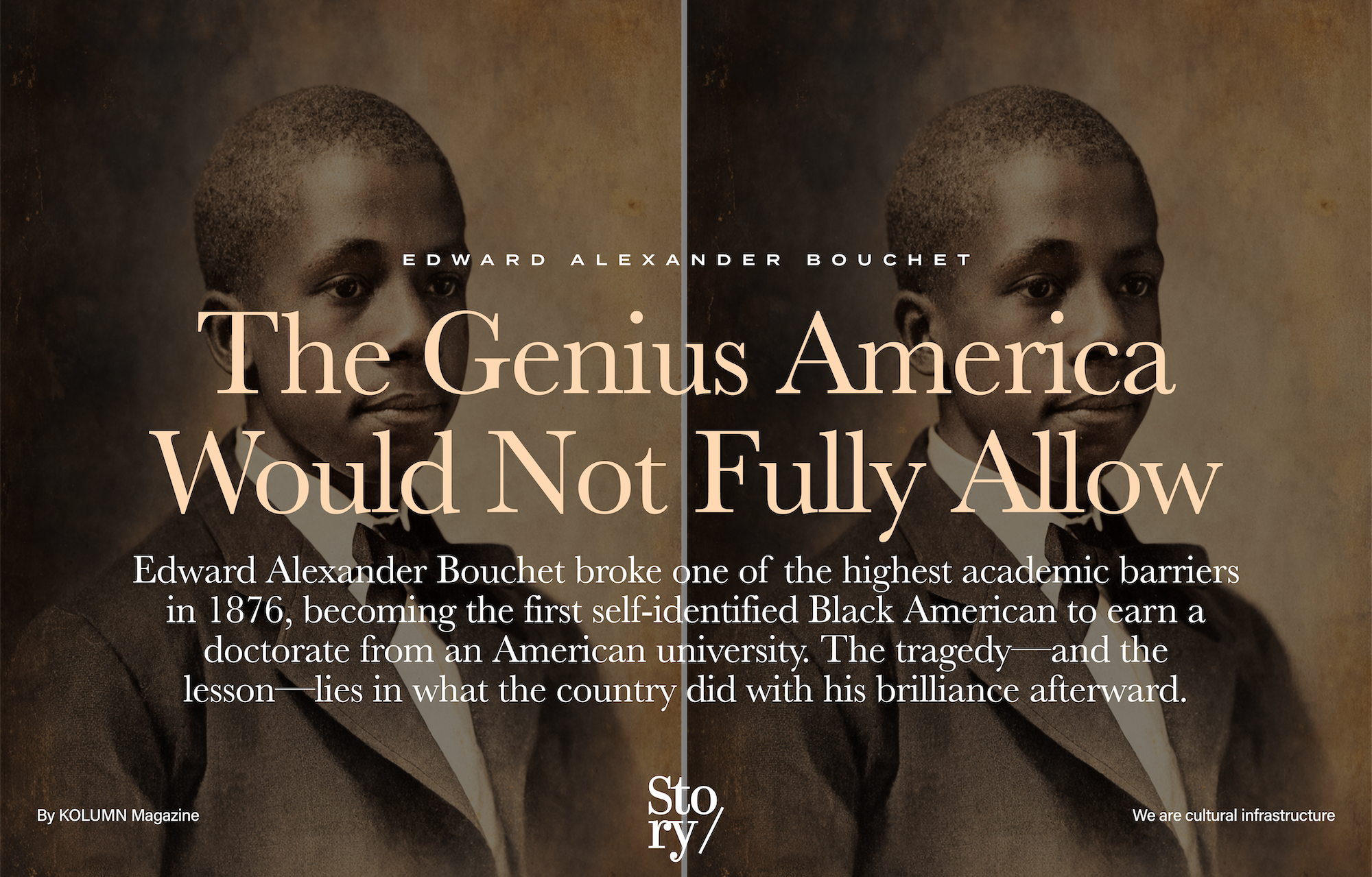
Bouchet’s life was not just a victory over barriers. It was evidence of how many barriers the country was willing to build around genius.
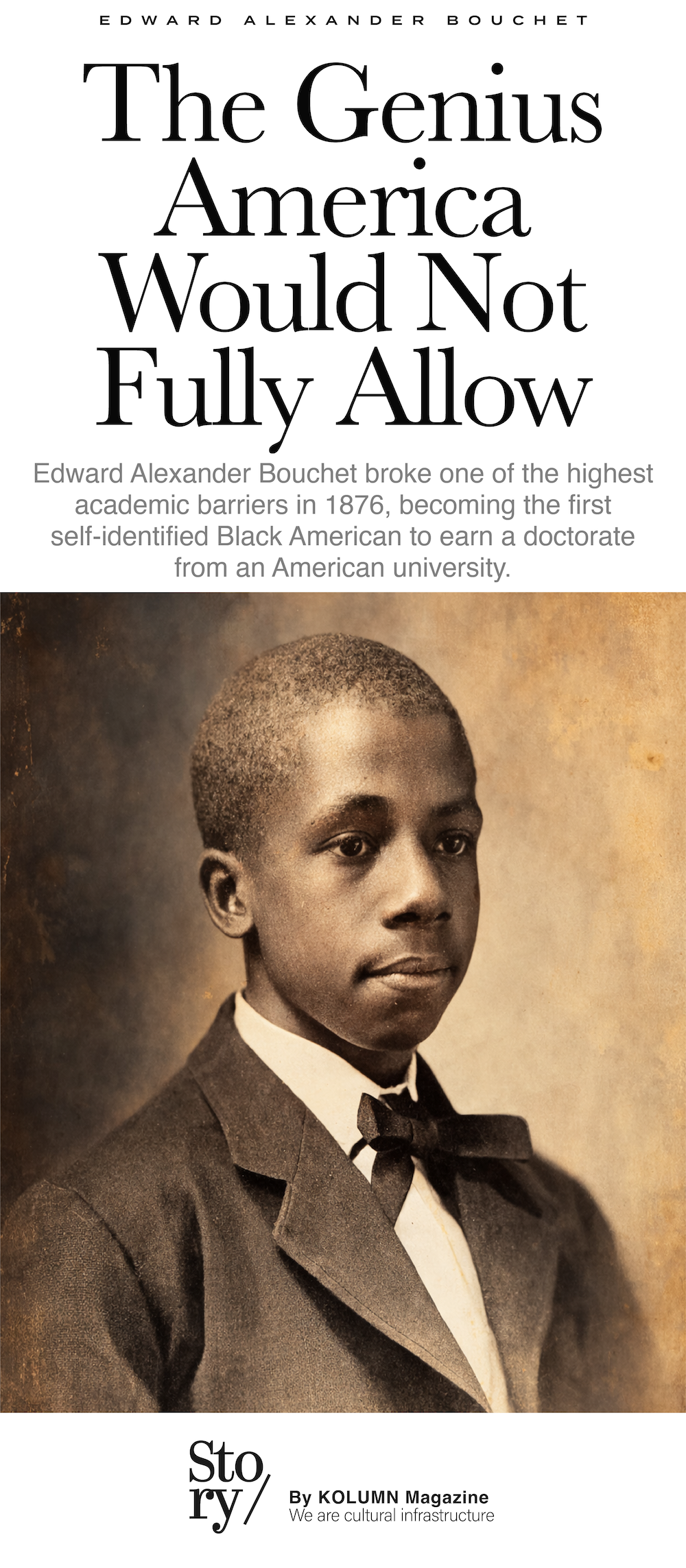
Bouchet’s life was not just a victory over barriers. It was evidence of how many barriers the country was willing to build around genius.
By KOLUMN Magazine
Edward Alexander Bouchet’s résumé, even in shorthand, lands with force: born in New Haven in 1852, educated in segregated schools, valedictorian at Hopkins School, graduate of Yale College in 1874, and, in 1876, the first self-identified African American to earn a doctorate from an American university—specifically a Ph.D. in physics from Yale. At the time, he was also only the sixth person in the western hemisphere to earn a doctorate in physics.
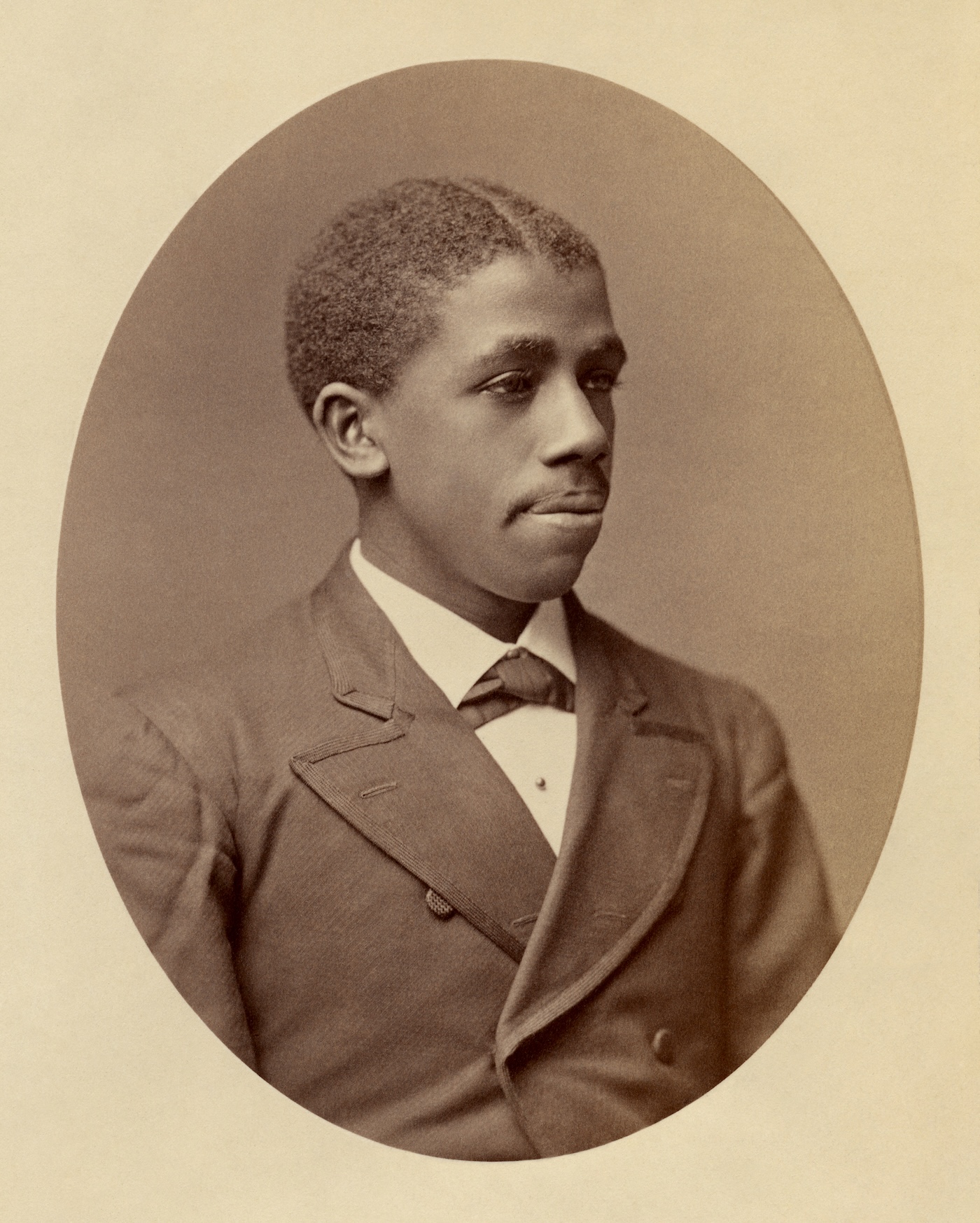
That should have been the beginning of a major scientific career. In a fair country, it likely would have been. Bouchet had the intellect, the discipline, the credentials, and the timing. He emerged at a moment when graduate education in the United States was still young, when physics as a formal academic profession was still forming, and when American universities were deciding—through policy, habit, and prejudice—who counted as a scholar. Yale had already awarded the first Ph.D.s in the United States in 1861, and Bouchet arrived only fifteen years later, near the ground floor of the entire American doctoral enterprise.
But Edward Bouchet’s life is not only the story of a first. It is also the story of containment. The same nation that could point to him as proof of academic possibility had little interest in allowing him to pursue research at the level his training warranted. Shut out of white colleges and universities because of race, Bouchet spent the bulk of his professional life teaching in Black institutions and segregated settings, especially at Philadelphia’s Institute for Colored Youth, where he taught science for twenty-six years. His work mattered deeply. His students mattered deeply. But the fact remains: one of the best-trained physicists of his generation was denied the laboratory culture and institutional backing that might have made him a central figure in the scientific history of the United States.
That tension is what makes Bouchet so significant now. He belongs to the history of Black education, yes, but also to the history of American exclusion. He matters not simply because he “overcame obstacles,” that favorite flattening phrase of institutional tribute, but because his life exposes how deliberately this country restricted Black intellectual possibility even when achievement was undeniable. To write about Bouchet honestly is to resist the temptation to turn him into a symbol too quickly. He was not merely an inspiring exception. He was a diagnostic tool. Through him, you can see the machinery.
A child of New Haven, and of Black ambition
Bouchet was born on September 15, 1852, in New Haven, Connecticut, the youngest of four children. His mother, Susan Cooley Bouchet, worked as a laundress. His father, William Francis Bouchet, had migrated from South Carolina to New Haven and worked as a custodian at Yale; he was also active in the city’s Black religious life, serving as a deacon in the Temple Street Church, one of New Haven’s oldest Black congregations. The family was neither wealthy nor insulated from the racial order of the period. What they did possess was aspiration, discipline, and a belief in education as both inheritance and insurgency.
It is easy, from the distance of more than a century, to make New England sound naturally more enlightened than the rest of the country. Bouchet’s childhood corrects that myth. In his youth, New Haven had only a small number of schools that admitted Black children. He began at the Artisan Street School, a segregated school for Black students, where a teacher named Sarah Wilson is remembered for encouraging his academic gifts. He later attended New Haven High School and then Hopkins School, where he graduated as valedictorian in 1870.
That sequence matters. Bouchet’s educational ascent did not occur because the system was open; it occurred because Black families and a few key educators forced openings within a hostile structure. He came from a local Black community that treated literacy, church, mutual uplift, and formal schooling not as abstractions but as tools of survival. The story is not just that Bouchet was brilliant. It is that he was formed in a world where Black advancement had to be defended at every turn.
By the time he entered Yale College in 1870, Bouchet had already done something rare: he had navigated a path from a segregated primary education to one of the nation’s most elite institutions. He graduated from Yale College in 1874, ranking sixth in a class of 124, and his academic record was strong enough that he was elected to Phi Beta Kappa, though historical corrections later clarified that because Yale’s chapter had been inactive and only formally reorganized later, Bouchet was not the first African American elected to the honor society, despite long repetition of that claim.
That correction is not trivial. It tells us something about the historical record itself: Bouchet has often been celebrated in broad strokes, but the details matter. Yale today typically describes him as the first self-identified African American to earn a doctorate from an American university, language shaped in part by later scholarship revising older assumptions about who was first to graduate from Yale College. Those refinements do not diminish Bouchet. If anything, they place him more precisely where he belongs—in a larger, complicated Black educational history that institutions are still learning how to tell honestly.
At Yale, near the beginning of American science
Bouchet’s achievement is sometimes reduced to ceremonial firstness, but the actual academic accomplishment was extraordinary by any standard. He remained at Yale for graduate study in physics and completed his dissertation, “On Measuring Refractive Indices,” in 1876. The dissertation was in geometrical optics, a technical area that required mathematical rigor and serious scientific training. He finished the degree in just two years. Physics Today notes that he earned the physics Ph.D. at Yale in only that brief span, which underscores both his preparation and his intellectual speed.
The timing makes the degree even more striking. Doctoral education in the United States was still new. Yale’s early Ph.D. history placed Bouchet among the earliest cohort of American scholars to receive such credentials at all. When Yale Graduate School recounts its own institutional history, Bouchet appears as a landmark figure in the development of graduate education in the nation. He was not entering an established pipeline. He was entering a space still being invented.
Which raises a painful question: what might he have become if the usual pathways available to talented white scholars had also been available to him?
That question shadows every serious account of Bouchet’s life. He had earned a doctorate in one of the most demanding scientific fields of the era. He had studied at a university already central to the emergence of American graduate education. He had demonstrated exceptional scholastic ability over and over again. And yet the record after Yale is not one of professorships, laboratories, scientific societies, or sustained research appointments. It is instead a record of racial foreclosure.
This is where Bouchet’s story moves from inspiration into indictment.
“In another America, Edward Bouchet would have been remembered as a builder of American physics, not merely as the man who arrived first.”
The closed door after the doctorate
After completing his Ph.D., Bouchet sought the kind of college or university appointment that a scholar of his training would ordinarily pursue. He did not get one. Historical accounts from Yale, the American Physical Society, and mathematics-history sources agree on the broad outline: despite his credentials, racial discrimination blocked him from academic and research posts in white higher education.
This is the hinge of his life and, in many ways, the hinge of the article. Too often, Bouchet is remembered as a heroic pioneer without sustained attention to what was done to him by the institutions that could admire him in theory but refuse him in practice. He was not denied because he lacked merit. He was denied because nineteenth-century America, including its northern academic centers, was structured to restrict Black access to professional authority.
So Bouchet went to Philadelphia and joined the Institute for Colored Youth, a Quaker-founded institution that had become one of the most important centers of Black education in the country. There he taught physics and chemistry and helped build the school’s science program. Sources note that he also taught astronomy, physical geography, and physiology, and that he pushed for stronger laboratory instruction for students.
There is a tendency in American memory to interpret redirection as destiny. That can become a form of dishonesty. Yes, Bouchet’s work at the Institute for Colored Youth was important. Yes, teaching Black students in the late nineteenth century was nation-building work. Yes, it is possible to argue that his influence there radiated farther than a single research career might have. All of that can be true. But it should not obscure the coercive context. Bouchet did not simply choose the classroom over the laboratory in a field of open options. The classroom became the viable site because white institutions made other sites unavailable.
And yet what he did with that constrained space is part of why he endures.
The long labor of teaching
Bouchet taught at the Institute for Colored Youth for twenty-six years, from 1876 until 1902. That length of service alone suggests something more than temporary employment. He became part of the school’s intellectual architecture. The Institute had high standards and a college-preparatory orientation, and Bouchet’s role there placed him among Black educators committed to rigorous academic formation, not merely minimal instruction.
This is crucial to understanding Bouchet as an educational figure rather than simply a physicist who got sidelined. He was part of a Black pedagogical tradition that insisted African American students deserved full intellectual development, including advanced scientific instruction, at a time when much of white America argued the opposite. His life intersects here with the larger debates that would define Black education in the late nineteenth and early twentieth centuries: industrial education versus classical education, accommodation versus agitation, narrow utility versus expansive intellectual citizenship.
When the Institute for Colored Youth shifted away from its college-preparatory mission under an all-white board more favorable to industrial education, Bouchet resigned in 1902. Multiple university sources connect his departure to that institutional turn, situating it in the era of the Du Bois–Booker T. Washington debates over the purpose of Black education.
This part of the story should not be rushed. Bouchet was not only blocked from mainstream scientific institutions; he later found himself displaced within Black education as well, when one of its premier institutions reoriented itself under white managerial preferences. In other words, he lived inside two versions of the same American argument. The first said a Black physicist did not belong in the research university. The second said Black students did not need the kind of advanced academic preparation a physicist could offer.
Bouchet’s career therefore tells us something unsettling about the nation’s educational imagination. His existence challenged racist assumptions, but rather than revise those assumptions fully, institutions repeatedly changed the frame around him.
After Philadelphia, a quieter geography of service
Following his departure from the Institute, Bouchet spent years moving through various educational roles. He served as director of academics at St. Paul’s Normal and Industrial School in Lawrenceville, Virginia, from 1905 to 1908. He later became principal of Lincoln High School in Gallipolis, Ohio, and then joined the faculty of Bishop College in Marshall, Texas before retiring due to illness and returning to New Haven.
These posts can read, on paper, like a decline from his academic peak at Yale. In one sense, they were. They lacked the prestige, resources, and research possibilities that should have been available to someone of his training. But in another sense they reveal Bouchet’s stubborn commitment to teaching as public duty. He kept showing up where Black students needed serious educators. He kept converting credentialed brilliance into instruction, administration, discipline, and example.
This matters, particularly now, when discussions of educational impact are often distorted by prestige logic. Bouchet did not spend his life in the kind of settings that generate global recognition. He spent it in classrooms, schools, and institutions where Black education was still being built under pressure. The archive does not offer us the glamorous arc of celebrated scientific discovery. It offers something more sober and, in some ways, more revealing: a portrait of intellectual endurance.
By the time he retired in 1916 and returned to New Haven, he had spent four decades in education. He died there on October 28, 1918, after illness, and was buried in the family plot at Evergreen Cemetery. For decades, his grave was unmarked. Yale eventually added a headstone in 1998. That detail feels almost too symbolic, but there it is: even in burial, recognition came late.
Why Bouchet’s story still lands so hard
There are many ways to describe Edward Alexander Bouchet’s significance, and each one catches only part of him.
He was a pioneer in physics. He was a Black educational leader. He was an early Yale graduate whose life now forces the university to reckon more fully with its own racial history. He was proof that Black scientific excellence existed not at the margins but near the very beginning of formal American doctoral education. He was also a casualty of the country’s refusal to make room for that excellence.
His significance, then, is not only representational. It is structural.
Bouchet shows that the “pipeline problem” in American science did not begin with recruitment gaps or twentieth-century policy failures. It began with denial. The issue was never simply that there were not enough Black scholars prepared for advanced work. Bouchet’s life proves that extraordinary preparation could exist and still meet a locked gate. Modern language about access, retention, and representation can sometimes obscure the plain historical fact that institutions actively excluded people who were already qualified.
He also matters because he complicates triumphalist narratives about education. Americans love school stories in which talent naturally rises. Bouchet’s life says otherwise. Talent rose, yes. But institutions did not rise with it. The result was not meritocracy but diversion.
And yet his life is not reducible to victimhood. That would be another kind of distortion. He built a legacy through students, through example, and through the institutions that now bear his name. The American Physical Society’s Edward A. Bouchet Award recognizes distinguished minority physicists and promotes participation by underrepresented groups in physics. Yale and Howard co-founded the Edward A. Bouchet Graduate Honor Society in 2005 to honor scholarly achievement and support excellence in doctoral education and the professoriate. The fact that such programs exist is itself an acknowledgment that Bouchet’s life still speaks to unfinished work.
“Bouchet’s legacy is not merely that he was first. It is that institutions now have to answer for what they did with the first.”
The politics of remembrance
The recent revival of attention to Bouchet is part of a broader pattern in American cultural life: institutions revisiting the Black figures they once marginalized, neglected, or only partially understood. Yale’s own materials now place him in a wider context of “early Black Yale students” and emphasize the updated language of “first self-identified African American” doctoral recipient. Its physics department has highlighted his devotion to science education, and the Graduate School situates him within its institutional origin story.
This is valuable. It is also worth interrogating.
What does it mean for an institution to celebrate a figure whom it once could not protect from the wider racial order? Yale did award Bouchet the degree. That matters. But degrees alone do not constitute justice. The broader academic world into which Yale credentialed him was not built to receive him as an equal. Institutional remembrance can sometimes produce a comforting moral arc: he was overlooked, and now he is honored. The truth is sharper. He was overlooked because the nation’s educational and scientific establishments were organized to look past men like him.
That is why the unmarked grave matters. That is why the delayed praise matters. They are not side notes. They are evidence.
At the same time, remembrance can be reparative when it is paired with structural action. Honor societies, named awards, research clusters, and annual conferences can become empty branding exercises if they stop at symbolism. But they can also serve as infrastructure for the very scholar-community Bouchet was denied. Yale now hosts Bouchet-centered graduate programming. The Bouchet Society has spread to multiple institutions. The APS award continues to identify physicists whose excellence might once have been pushed to the margins. These are not substitutes for history. They are responses to it.
Bouchet in the lineage of Black education
To place Bouchet properly, he should be seen alongside the long Black tradition of educational insurgency in the United States. He belongs in conversation with the teachers, principals, fundraisers, churchwomen, intellectuals, and institution-builders who treated education not as private advancement alone but as collective defense.
That is one reason Bouchet’s career at the Institute for Colored Youth matters so much. He was not simply a brilliant Black individual stranded in history. He was part of a Black educational ecosystem that included Quaker reformers, Black families, fellow educators, and students pressing toward fuller citizenship through scholarship. The Institute itself was one of the most serious Black educational institutions of its era, and Bouchet’s presence there signaled an ambitious claim: Black students deserved instruction from the most highly trained minds available.
This is where Bouchet’s life becomes deeply contemporary. Current debates about who gets advanced coursework, who gets access to research opportunities, whose schools are allowed to cultivate intellectual confidence, and which students are encouraged toward STEM fields all echo the older world Bouchet inhabited. The language has changed. The stakes have not.
His life also challenges the way scientific achievement is often narrated as detached from social conditions. Bouchet did not fail to become a major research figure because he lacked the mind for it. He did not simply take a different path out of personal preference. He was rerouted by a racial regime. If we care about scientific history, not just Black history, that point is essential. The development of American science was not only shaped by discoveries made; it was also shaped by discoveries deferred, careers blocked, and intellects systematically underused.
What America lost
One of the hardest things about writing Bouchet’s life is confronting the counterfactual. What did the country lose by refusing him?
No archive can answer that completely. We do not know what research he might have produced with steady laboratory support, university colleagues, and the ability to move through the profession without racial exclusion. We do know he had already mastered advanced work in optics. We know he completed demanding graduate study at a moment when very few had done so. We know his intellect impressed the people around him. And we know that after 1876 the nation never gave him conditions proportionate to that achievement.
That loss was not his alone. It was national.
This is the part of Bouchet’s story that should unsettle anyone tempted to think of racism merely as a moral failing of the past rather than a practical sabotage of the common good. A country that blocks gifted people from doing their highest work does not only injure them. It impoverishes itself. Bouchet represents not a sentimental tale of perseverance, but a ledger entry in the long accounting of American waste.
And yet, paradoxically, he also represents what Black communities salvaged from that waste. If the nation would not let him become the scientist he might have been, Black educational institutions still found ways to turn his gifts into formation for others. That does not excuse the exclusion. But it does testify to the genius of Black institutional life: its ability to gather damaged possibilities and make from them something durable.
The enduring lesson
Edward Alexander Bouchet’s life asks for a mature kind of admiration. Not the easy admiration reserved for uncomplicated heroes. Not the tidy school-assembly version in which a gifted child studies hard, breaks a barrier, and is rewarded by history. Bouchet’s life was harsher, more revealing, and therefore more useful than that.
He broke the barrier. The reward did not come. What came instead was work—serious, dignified, under-recognized work in classrooms and Black institutions that carried scientific seriousness into communities the nation preferred to underrate. He lived long enough to see neither the full honoring of his name nor the broad opening of the profession he had entered so early. But his life survived in another register: in the memory of Black education, in the later institutions that claimed him, and in the stubborn truth that he had already disproved the lie.
That may be his deepest significance. Bouchet did not merely succeed despite racism. He rendered racism intellectually absurd. A Black child from segregated schools in New Haven became one of the earliest Ph.D.s in physics in the western hemisphere. The society that still refused to treat him accordingly did not expose his limits. It exposed its own.
In that sense, Edward Alexander Bouchet remains a profoundly modern figure. He belongs to every conversation about educational access, scientific equity, and the politics of institutional memory. He belongs to the history of Black excellence, certainly, but also to the history of American contradiction. He is what the nation produced and what the nation refused. He is proof of capacity and proof of obstruction. He is a first, yes. But more than that, he is a measure.
And perhaps that is the most accurate way to end where his dissertation began, with measurement. Bouchet spent part of his graduate life studying refractive indices, how light bends as it passes through different media. His own life offers a related lesson. Genius, moving through a racist society, does not travel straight. It is bent, diverted, slowed, scattered. The wonder is that it shines anyway.
More great stories
Afro Sheen, Wall Street, and the Architecture of Black Possibility
July 6, 2026
No Comments
The Fire Inside the Fourth
July 5, 2026
No Comments