





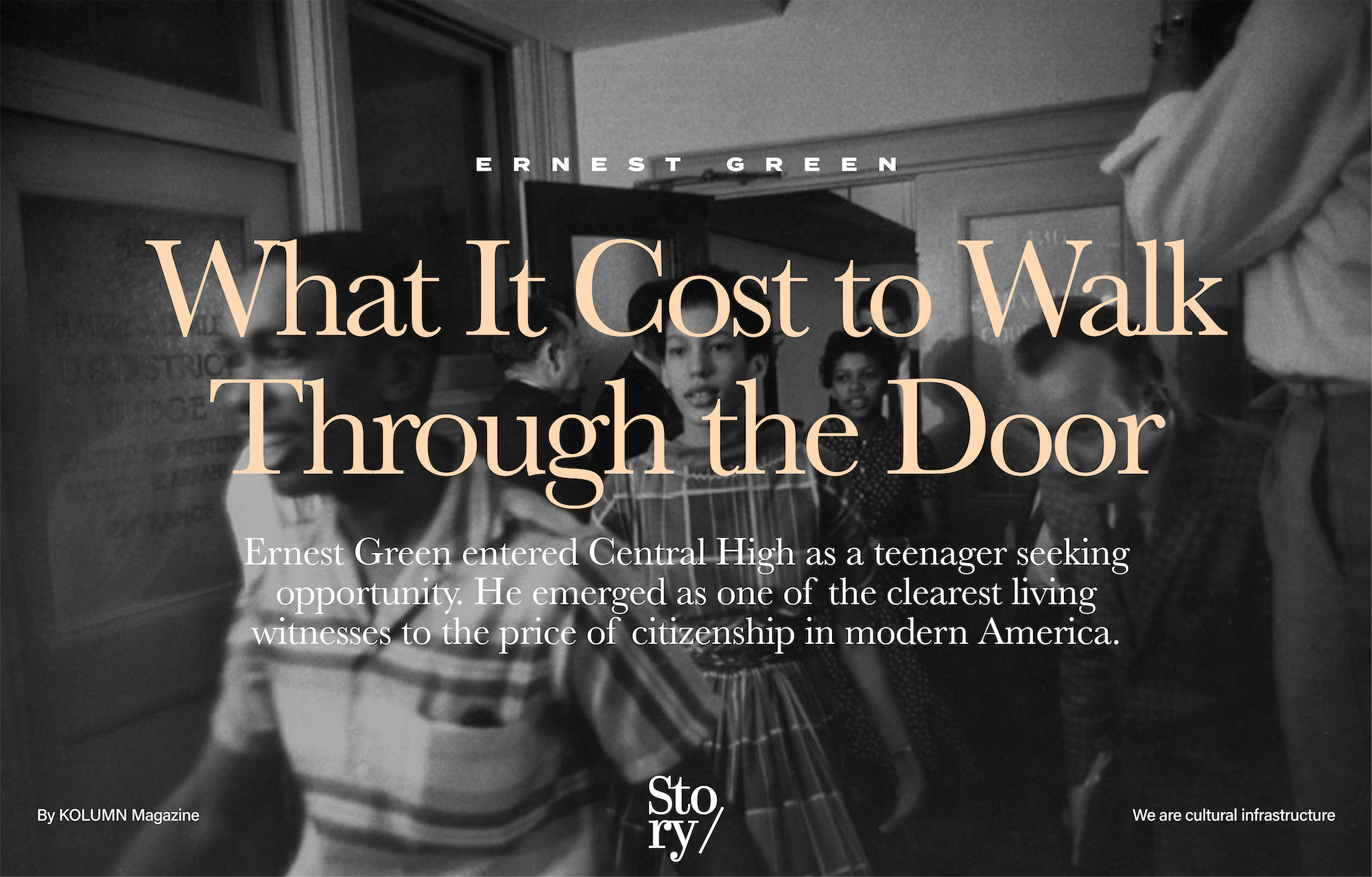
He insisted that what belonged to him as a citizen should not be withheld because he was Black.

He insisted that what belonged to him as a citizen should not be withheld because he was Black.
By KOLUMN Magazine
Ernest Green is often introduced with a phrase that is accurate but incomplete: he was the first Black graduate of Little Rock Central High School. That line is true, historically important, and impossible to separate from the crisis that made Little Rock a global symbol in 1957 and 1958. But it does not fully capture Green’s significance. He was not simply first in a ceremonial sense. He was the senior among the Little Rock Nine, the student closest to commencement, the one whose continued presence at Central would prove in real time whether the federal government, the courts, and the rhetoric of equal education meant anything when confronted by organized white resistance. His graduation was not merely an ending. It was evidence.
To write about Ernest Green only as an icon of teenage bravery is to miss the harder and more revealing story. Green’s life illuminates several overlapping histories at once: the machinery of Jim Crow in the urban South; the legal afterlife of Brown v. Board of Education; the role of Black parents, churches, and local organizers in forcing national change; the emotional burden placed on children asked to enact constitutional principle; and the complicated arc by which a civil rights pioneer moved from Little Rock to Michigan State, from labor and workforce policy to finance, public service, and institutional leadership. His biography is not an anecdote attached to the civil rights movement. It is one of the movement’s clearest case studies in how personal ambition and collective struggle can become inseparable.
Green himself has often resisted grandiosity. At the White House in 1999, when the Little Rock Nine received the Congressional Gold Medal, he said, “We were really ordinary people,” adding that the students were “simply exercising our right to the best education in the world.” The remark is classic Ernest Green: understated, precise, and morally disciplined. It also points to the core of his public meaning. He did not frame the struggle as abstract heroism. He framed it as a claim to public goods that should never have been racially rationed in the first place.
Before Central, there was Little Rock as it was
Ernest Gideon Green was born in Little Rock on September 22, 1941, to Lothaire and Ernest Green Sr. He grew up in a city where segregation was not incidental background but organizing principle. Public institutions, neighborhood geography, school assignments, and everyday etiquette all reinforced a racial order that treated Black aspiration as something to be managed, contained, or deferred. Green later recalled childhood moments that made the system’s absurdity and cruelty plain, including being reprimanded for drinking from a whites-only water fountain. Those memories matter because they show that Little Rock’s crisis did not begin with television cameras or federal troops. It began much earlier, in the routine humiliations that taught Black children how the color line operated before they were old enough to name it.
Like several members of the Little Rock Nine, Green was shaped by a Black family culture that treated education not as ornament but as obligation. In later interviews he spoke with real force about the role of parents and elders, arguing that the public story had too often minimized what families risked. His mother and aunt were schoolteachers; his grandfather had tried to vote despite threats. In a 1997 interview, Green said the untold part of the Little Rock story was “the role of our parents, who put property, life and limb on the line to carve out a vision for the next generation.” That formulation is crucial. It shifts the frame away from spontaneous teenage exceptionalism and back toward Black institution-building, intergenerational strategy, and disciplined community sacrifice.
Green attended segregated Dunbar Junior High and then Horace Mann High School, which the Little Rock School District had designated for Black students under its so-called phased integration plan. The disparity between schools was not theoretical to him. He knew Central High as the city’s premier white school long before he enrolled there. He had used secondhand books stamped with Central’s name. He had marched on Central’s field as a saxophone player from Horace Mann because Black schools used the facility on separate nights. In later recollection, he was candid about why Central mattered: it had better science labs, more language offerings, and newer textbooks. The moral drama of desegregation is real, but so is the material question beneath it. Green wanted access to the resources his city had chosen to concentrate on white students.
The slow violence of “all deliberate speed”
The years between Brown v. Board of Education in 1954 and Green’s entry into Central in 1957 are essential to understanding both his decision and its consequences. The Supreme Court’s ruling declared school segregation unconstitutional, but the follow-up decision known as Brown II instructed districts to desegregate with “all deliberate speed,” language that allowed Southern officials to convert nominal compliance into practical delay. Little Rock’s school authorities publicly acknowledged the Court’s ruling, then adopted the Blossom Plan, a phased integration scheme that moved cautiously, limited contact, and preserved as much of the existing order as possible. The district even opened Horace Mann as a Black-only high school while claiming to be preparing for integration.
This was the contradiction Green inherited: the law had changed, but the architecture of resistance had modernized. Instead of saying no outright, officials built delay into the system. Instead of denying Black students’ humanity in explicit legal language, they managed access, timing, and administrative procedure. The NAACP understood the stakes. In 1954 it petitioned for immediate integration, and in 1956 Black parents filed the federal lawsuit Cooper v. Aaron. Green’s story, then, belongs not just to a moment of adolescent courage but to a much longer campaign in which Black families and lawyers forced the state to live up to its own constitutional obligations.
When Green volunteered to attend Central, he did so in a city already primed for conflict. He was the only senior among the students selected. That status gave his choice special weight. A senior could test not only whether Black students could enter the building, but whether one of them could remain long enough to graduate. In a later interview, Green remembered being summoned to the school board office and learning he had been selected, then returning to his summer job and hearing a white acquaintance ask, “How could you do it?” The question, as Green told it, was revelatory. It showed him that what he had initially understood as a school transfer had already become, in the white imagination, a rupture in the racial order.
“How could you do it? … Why do you want to destroy our relationship?”
That exchange tells us something subtle but important. White moderates often narrate segregation as a system maintained only by extremists. Green’s recollection suggests otherwise. Ordinary white social relationships could themselves depend on Black acceptance of inequality. The problem was not only the mob. It was the everyday assumption that harmony required subordination.
When a schoolhouse became a national battlefield
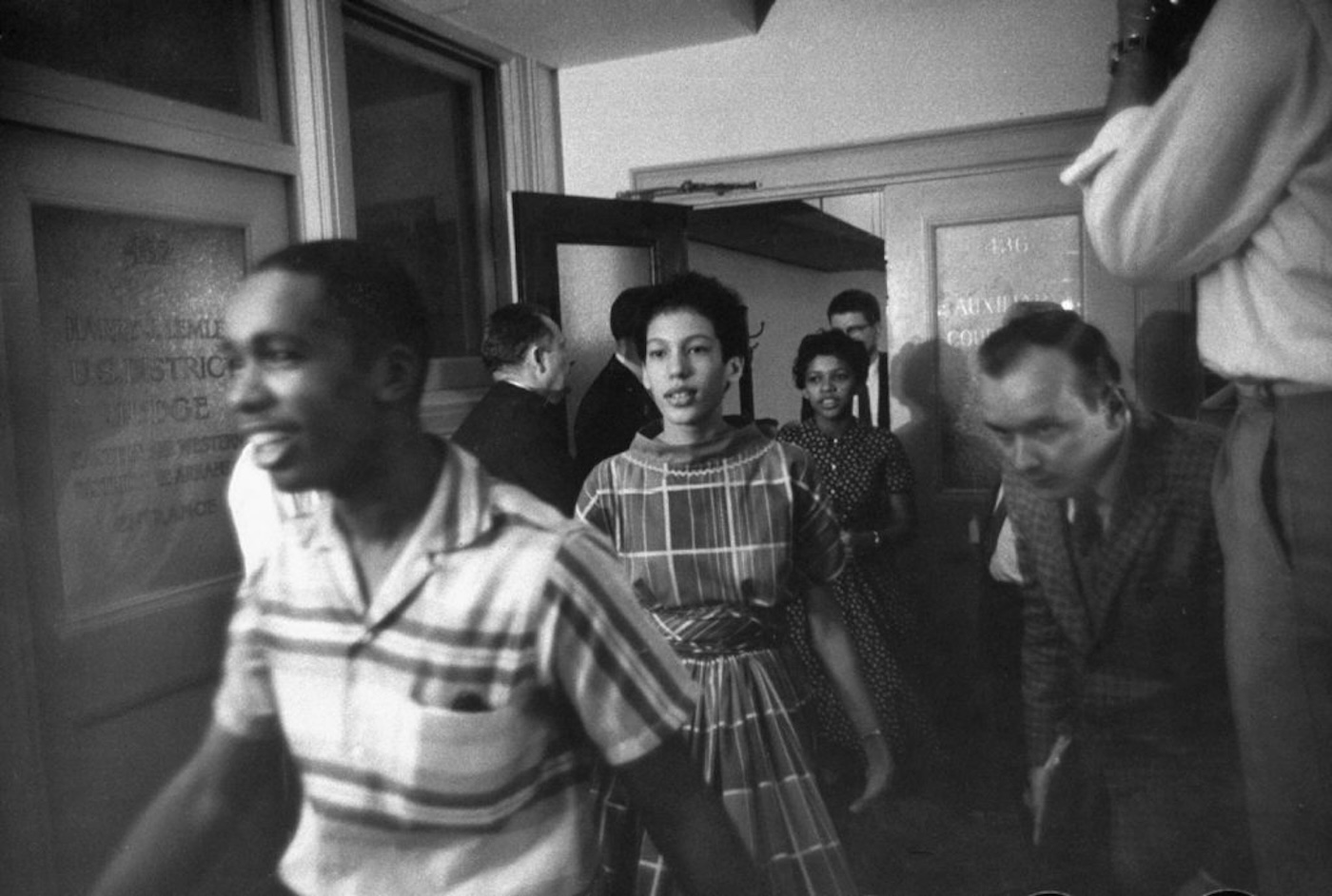
The public phase of the crisis is now part of American civic memory. In September 1957, Governor Orval Faubus used the Arkansas National Guard to prevent the students from entering Central. Elizabeth Eckford’s solitary walk into the hostile crowd became the crisis’s most famous image, but the entire group was under threat. More than two weeks later, the Nine entered briefly on September 23, only to be removed when violence escalated outside. On September 24, President Dwight D. Eisenhower federalized the Arkansas National Guard and sent in the 101st Airborne Division. On September 25, under troop escort, the students entered for their first full day.
Those dates matter because they clarify what Ernest Green’s school year represented. This was not a gentle opening of opportunity but a collision among local defiance, state obstruction, federal authority, and constitutional law. Little Rock became a referendum on whether Brown would be enforced at all. When Eisenhower declared that “mob rule cannot be allowed to override the decisions of the courts,” he was not speaking in abstraction. He was describing the condition under which Green and the others were attempting to get an education. In that sense, Green’s presence inside Central was both educational and juridical. He was a student, but he was also living proof that the rule of law required material protection.
Inside the school, the glamour of national attention vanished quickly. The Nine had guards assigned to accompany them between classes, but those guards could not protect them in classrooms, bathrooms, or locker rooms. Harassment became daily structure. The National Park Service records verbal and physical abuse; Green later described classmates throwing wet towels in the locker room, social isolation, and relentless pressure on any white student who showed sympathy. Minnijean Brown’s suspension and eventual expulsion after retaliating against abuse revealed the grotesque standard imposed on the Black students: they were expected to absorb humiliation without visible anger. Students circulated cards that read, “One Down, Eight to Go.”
Green’s recollections from that year remain striking for their lack of melodrama. He did not minimize the danger, but he often described the experience with analytical distance, as if trying to preserve the truth of the atmosphere without surrendering to theatrical retrospect. In one interview he said that, halfway through the year, the students realized the struggle had become larger than their own personal schooling. What they were doing, he said, was “removing a series of barriers” for Black people in Little Rock. That shift in consciousness matters. Green entered Central for an education. He stayed understanding that education itself was political terrain.
Why he stayed
One of the most revealing features of Ernest Green’s public memory is that he has never treated suffering as the point of the story. He stayed because the goal remained concrete. In a 1997 interview with The Washington Post, he said plainly: “It was about getting the best education available in Little Rock, not so much about integration.” That sentence should not be read as a retreat from civil rights politics. It is the opposite. It insists that the struggle against segregation was inseparable from the struggle over budgets, facilities, books, languages, laboratories, and expectations. The right to attend a school is empty if the school system has already decided some children will receive less.
At the same time, Green was not naïve about the symbolic burden. In a 2007 Washington Post profile, he acknowledged that neither he nor the others anticipated the depth of difficulty, but once they were inside, “all nine of us knew how important it was to stay. Backing down was not an option.” The quote captures the discipline that animated the group. Persistence was not just personal toughness; it was strategic necessity. If the students left, segregationists would read departure as proof that coercion worked. If they remained, even at great cost, they would establish a different precedent: that Black students could claim elite public institutions and endure the backlash long enough to make exclusion more expensive for the state.
There is another layer here, too. Green has repeatedly redirected praise away from himself and toward parental expectation. In that same 1997 interview, he recalled the uncompromising academic standards set at home: if you brought home a C, you had failed. This is more than family anecdote. It counters a persistent tendency in public memory to sentimentalize Black endurance while neglecting Black excellence. Green’s family did not send him to Central merely to survive. They expected him to perform, to learn, and to convert access into achievement. In the civil rights era, dignity was not only the right to enter the institution but the right to excel inside it.
Graduation as constitutional proof
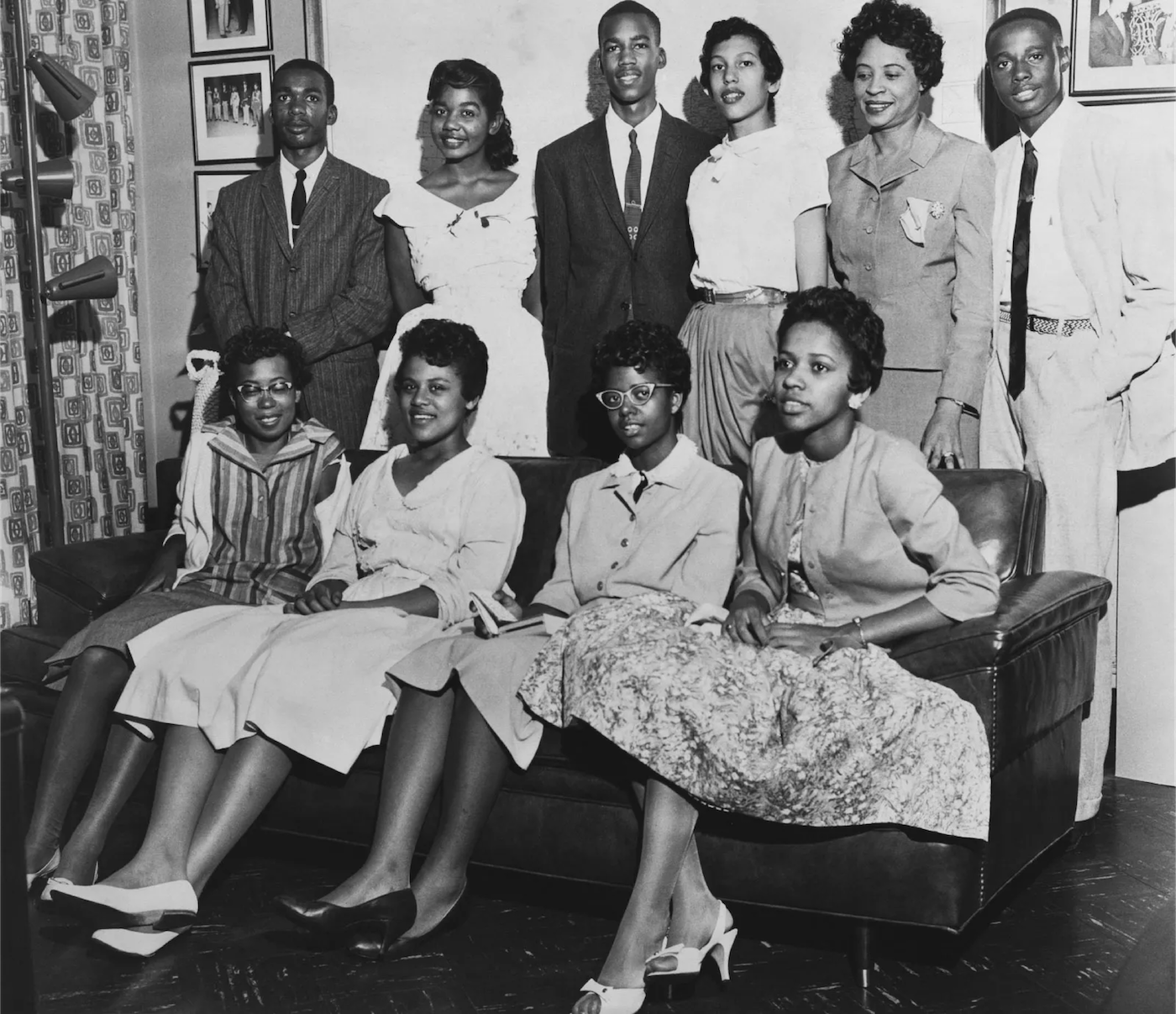
On May 27, 1958, Ernest Green became the first Black graduate of Little Rock Central High School. Dr. Martin Luther King Jr., in Arkansas for another engagement, attended the graduation with Green’s family and, according to multiple accounts, did so with relatively little fanfare. The image is almost too perfect: King, not yet fully embalmed in national memory, sitting quietly while a teenager crossed a threshold that segregation had been designed to keep closed. Green later summarized the year with a line that has followed him ever since: “It’s been an interesting year. I’ve had a course in human relations first hand.”
The remark is famous because it is wry, but it is also conceptually sharp. Green did not say he had learned a lesson in hatred alone. He called it a course in human relations, which suggests an education in power, behavior, institutions, fear, cowardice, solidarity, and the unstable boundaries between them. That year taught him not simply that racism existed, but how it reproduced itself through school policy, peer pressure, adult silence, and public ritual. It also taught him something about federal obligation and Black resolve. In other words, the lesson was national, not local.
Green’s graduation also carried a strategic meaning for the movement. It demonstrated that desegregation could be forced through, sustained, and completed despite massive resistance. That did not mean victory was secure; Little Rock’s high schools would be closed the following year in an effort to halt further integration. But Green’s diploma entered the historical record as something resistant to rollback. Segregationists could close buildings; they could not undo the fact that a Black student had graduated from the state’s most prominent white high school under the authority of federal law.
The years after Little Rock
Too many civil rights narratives stop once the symbolic photograph has been taken. Green’s life did not. After Central, he attended Michigan State University, earning a bachelor’s degree in social science in 1962 and a master’s degree in sociology in 1964. That educational path mattered in more than résumé terms. Michigan State represented the continuation of the project that had brought him to Central in the first place: education as leverage, as social mobility, and as preparation for institutions from which Black Americans had long been excluded or only partially admitted.
At Michigan State, Green remained politically engaged. Later sources note that his scholarship came from an anonymous donor, whom he eventually learned was university president John Hannah. By then, Green had already lived the contradiction of American liberalism well enough to understand it: institutions that opened doors did not necessarily do so from pure conviction, and beneficiaries of access still had to press for deeper structural change. That sensibility would define much of his later career.
His post-college work placed him squarely in the world of labor, workforce development, and public policy. President Jimmy Carter nominated him in 1977 to serve as Assistant Secretary of Labor for Employment and Training. The nomination notice emphasized Green’s work with the Recruitment and Training Program in New York, his efforts to bring minority group members into the building trades, his prior service with Job Corps, HUD, and the Agency for International Development, and his place on the Federal Committee on Apprenticeship. This was not ceremonial appointment. It was a continuation of a theme that runs through Green’s life: access. First access to schools, then access to trades, jobs, and the economic institutions through which citizenship becomes materially real.
That workforce dimension is one reason Ernest Green deserves wider attention than he usually gets. The popular memory of Little Rock places him inside the schoolhouse door and leaves him there. But Green’s later work suggests that he understood educational integration as one front in a larger fight over who gets prepared, hired, trained, financed, and trusted. His alliance with labor and apprenticeship initiatives, including work associated with Bayard Rustin and the Recruitment and Training Program, shows a civil rights politics attuned to class mobility and institutional entry, not only symbolic breakthrough.
From public service to finance
After his years in government, Green moved into consulting and then finance, eventually becoming a managing director in public finance at Lehman Brothers in Washington. Some readers may find that arc surprising, as if the passage from Little Rock to Wall Street sits uneasily inside the standard grammar of civil rights biography. But the move is not as discontinuous as it first appears. Public finance is one of the languages through which cities build schools, airports, infrastructure, and public capacity. Green’s work in that arena placed him at another kind of decision table, one where capital and governance intersect. By 2007, The Washington Post described him as a major public finance figure with high-level contacts and clients including large public entities.
There is a temptation, when writing about Black pioneers, to prefer only the versions of their lives that fit a morally tidy script. Green’s career resists that simplification. He was a civil rights figure, a labor official, a policy practitioner, a finance executive, and a board leader. His public life was not reducible to one ideological pose. That complexity is part of what makes him significant. He belongs to a generation of Black leaders who understood that power operates through multiple institutional channels and who moved, sometimes uncomfortably, across them.
He also continued to serve in appointed and advisory roles. The National Park Service notes that he was appointed by President Bill Clinton to chair the African Development Foundation and by Education Secretary Richard Riley to chair the Historically Black Colleges and Universities Capital Financing Advisory Board. Those appointments are important not because they confer prestige alone, but because they place Green inside the longer Black political tradition of institution-building: schools, development, finance, and pathways for future generations.
Recognition, memory, and the making of a symbol
The honors attached to Ernest Green’s name are substantial. In 1958, the NAACP awarded the Spingarn Medal to Daisy Bates and the Little Rock Nine. In 1999, Green and the other members of the Nine received the Congressional Gold Medal. He later received honorary doctorates, including one from the University of Arkansas in 2011, and has been recognized by organizations ranging from the Boy Scouts to civic and educational institutions. These honors are deserved, but they also reveal something about how the nation processes moral crisis. Often it resists justice in the moment and commemorates courage decades later.
That tension runs through Green’s public image. By the late twentieth century, the country was comfortable celebrating the Little Rock Nine as democratic heroes. But celebration can flatten as much as it honors. It can turn living people into symbolic furniture, permanently frozen at the age of their ordeal. Green’s own statements often work against that flattening. He returns again and again to parental discipline, educational quality, and ordinary aspiration. He reminds audiences that the students were not created by the crisis from nothing. They came from communities with standards, institutions, and political intelligence.
The films and retrospectives surrounding his life, including The Ernest Green Story, have helped preserve public memory. But no dramatization fully captures the thing Green himself seems most intent on preserving: proportion. He knows the year at Central was history. He also knows that history can become distortion when it strips away the labor that preceded the moment and the life that followed it.
What Ernest Green means now
The most serious way to assess Ernest Green’s significance is not to ask whether he was brave. He was. The better question is what his life reveals about the unfinished business of American education and democracy. Sixty-plus years after Little Rock, debates over schooling still revolve around access, geography, unequal resourcing, state resistance, and the distance between legal principle and lived experience. Green recognized this plainly. In a 2007 interview, he warned that people miss out when they do not mingle with those unlike themselves and argued that children must learn they are “more similar than different.” This may sound ecumenical, but in context it is a diagnosis of persistent segregationist habit.
His life also underscores a more uncomfortable truth: federal intervention was necessary because local custom and state power were not going to surrender segregation voluntarily. That lesson remains relevant in every era when civil rights are treated as self-executing. They are not. Ernest Green’s school year shows that rights require enforcement, institutions, and people willing to endure the backlash that enforcement provokes. The Constitution did not walk into Central High on its own. Children did. Soldiers did. Parents did. Lawyers did. Organizers did.
And Green’s later career adds another layer to that lesson. Integration was never supposed to end with symbolic inclusion. It was meant to widen access to the full range of American institutions: universities, trades, government, finance, boardrooms, and policymaking bodies. Green’s life maps that broader ambition. He did not simply survive history; he entered the institutions that shape it.
The quiet radicalism of his example
There is something quietly radical in the way Ernest Green has narrated his own life. He has not romanticized trauma. He has not made performance of pain his public brand. He has instead insisted on standards: educational standards, moral standards, family standards, civic standards. That insistence may be the deepest throughline in his story. In Little Rock, he demanded a school equal to the one white students took for granted. In public service, he worked on employment and training systems meant to widen access to opportunity. In finance and public leadership, he occupied spaces from which Black Americans had historically been excluded. Across all those domains, the underlying claim remained recognizable: the nation must be measured not by its slogans, but by the institutions it is willing to open and sustain.
That is why Green still matters beyond commemoration. He stands at the intersection of civil rights memory and contemporary policy reality. School segregation did not vanish; it changed form. Equal access did not become universal; it became more bureaucratic, more spatialized, and in some ways easier to deny. The same country that now reveres the Little Rock Nine still struggles to deliver fair schooling, durable opportunity, and equal public investment. Green’s life offers neither cynicism nor easy uplift. It offers a sterner message: progress is real, but it is never self-sustaining
In that sense, Ernest Green’s significance is larger than the title “activist,” though the title fits. He was an activist by action, certainly, and by consequence. But he was also a constitutional witness, a student claimant, a labor-policy actor, a public-finance practitioner, and a steward of historical memory. His life shows what happens when a teenager seeking a fair education ends up testing the republic.
And maybe that is the cleanest way to understand him. Ernest Green did not become important because he sought importance. He became important because he insisted that what belonged to him as a citizen should not be withheld because he was Black. The country forced that insistence into drama. History turned it into symbol. Green, for his part, kept calling it what it was: the pursuit of an education, the refusal of a lie, and the belief that public institutions should serve the whole public. That may sound modest. In America, it remains one of the most revolutionary things a person can say.
More great stories
Afro Sheen, Wall Street, and the Architecture of Black Possibility
July 6, 2026
No Comments
The Fire Inside the Fourth
July 5, 2026
No Comments