



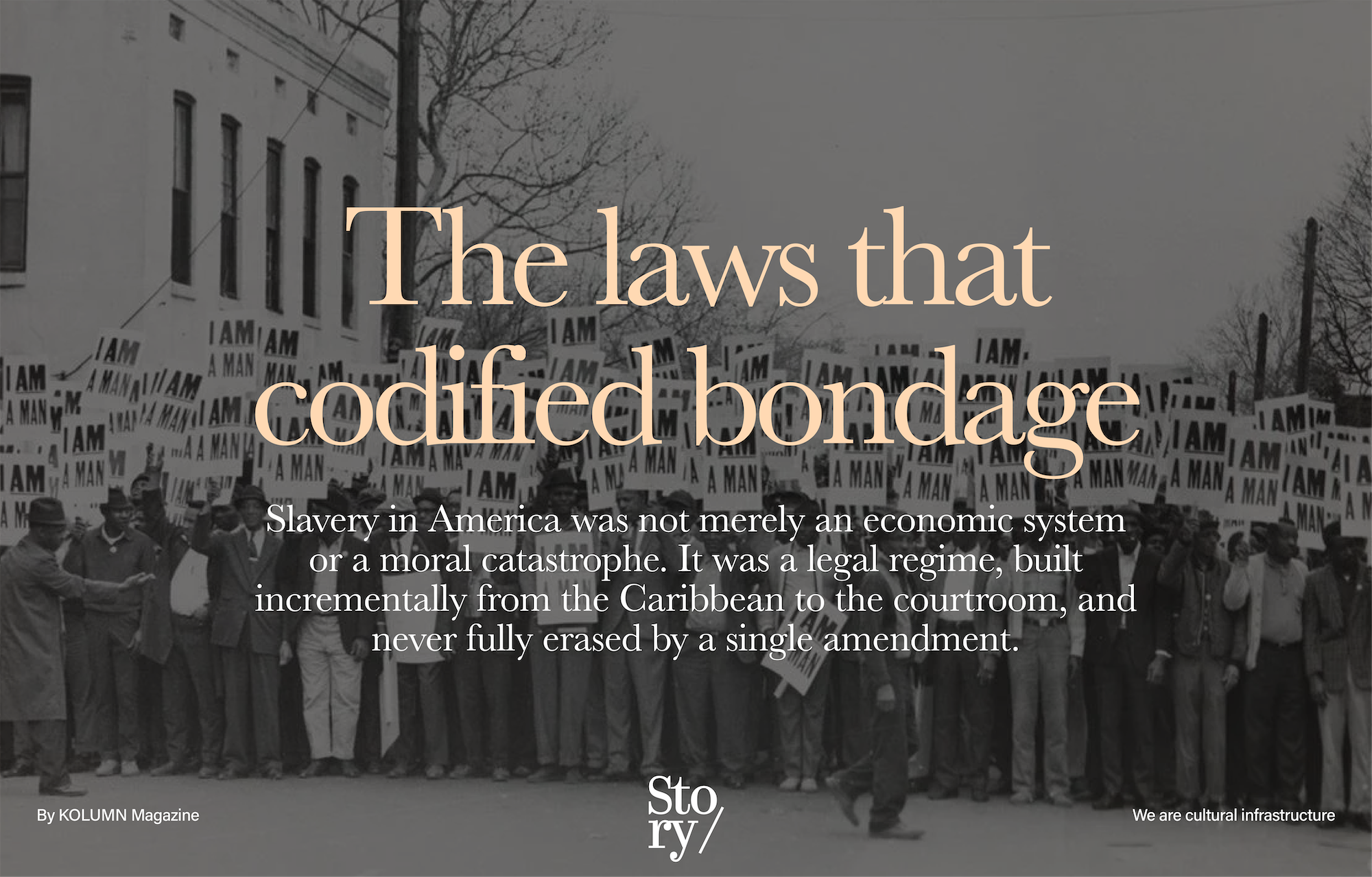
Statutes were the institution’s operating manual.
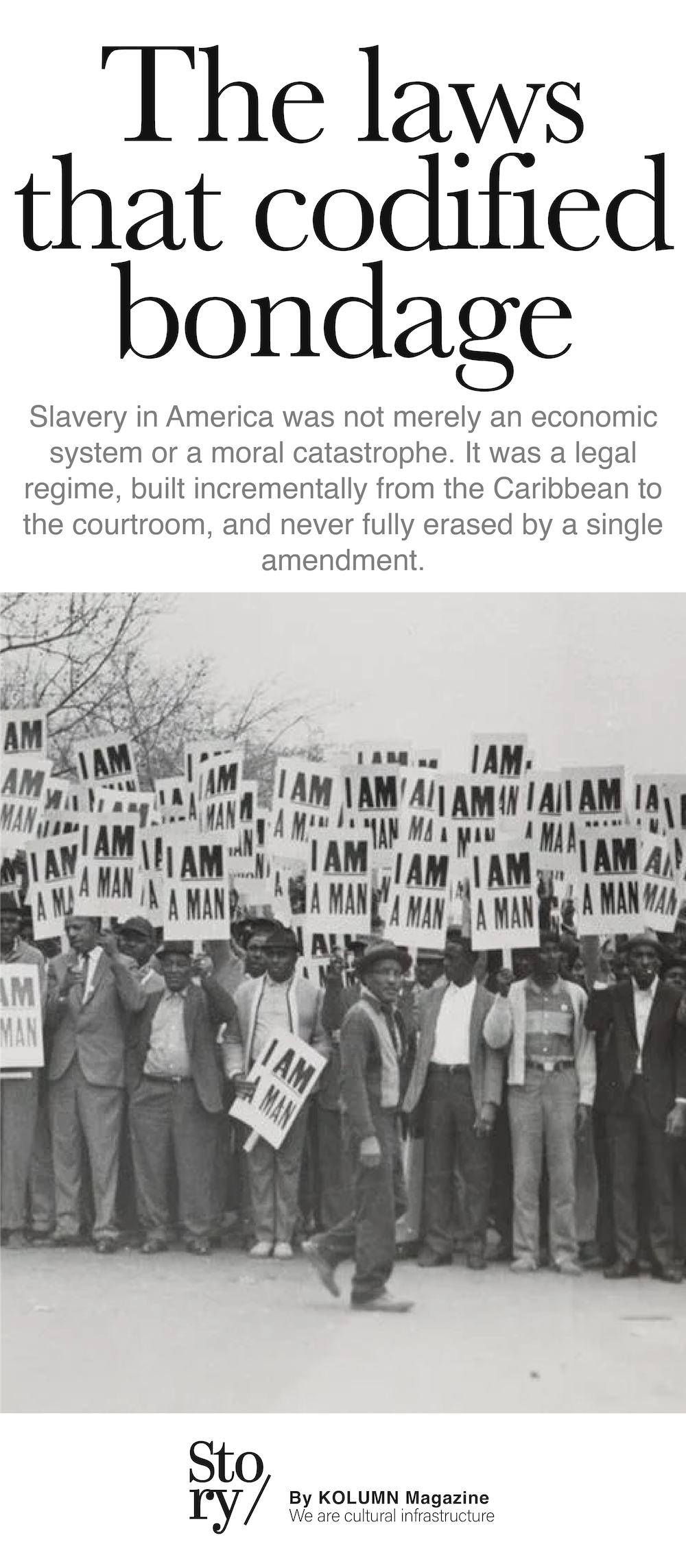
Statutes were the institution’s operating manual.
By KOLUMN Magazine
The history of American slavery is often narrated through its most visible scenes: the slave ship, the auction block, the plantation ledger, the cotton field, the cane brake, the courtroom, the battlefield, and the Emancipation Proclamation. Those scenes matter because they make the violence legible. But they do not, by themselves, explain how slavery lasted so long, adapted so effectively, and survived so many political crises. To understand that endurance, it is necessary to move from spectacle to structure. American slavery was not sustained by force alone. It was systematized through law. Legislatures, colonial assemblies, imperial decrees, municipal ordinances, constitutional clauses, and judicial opinions steadily converted captivity into a durable public order.
That legal history did not begin in 1619, and it did not end in 1865. Long before English colonists in Virginia began sorting Africans into an emerging racial labor system, Iberian empires had already established coercive models in the Caribbean. Long after the Thirteenth Amendment abolished chattel slavery, lawmakers in the South used criminal statutes, labor laws, and local enforcement to reconstruct forms of involuntary servitude through convict leasing, peonage, and Black Codes. The legislative story, then, runs from the late fifteenth century through the twentieth. It is a story of how power was codified, how economic need was translated into legal doctrine, and how white supremacy repeatedly sought protection through the state.
The Jim Crow Museum’s slavery timeline is useful precisely because it frames slavery not as a series of disconnected atrocities but as an accumulating regime. It notes that Africans in the colonies were stripped of rights within decades, that Massachusetts legally recognized slavery in 1641, that Virginia’s 1662 law made maternal status decisive, that the 1705 Virginia code intensified slaveholder authority, and that the federal government later entrenched the system through measures like the Fugitive Slave Act, the Missouri Compromise, and the Compromise of 1850. It also marks the deeper truth that abolition did not erase slavery’s legacy from American law or public life.
What follows is not simply a history of bondage. It is a history of legislation: how slavery was imagined, refined, and defended in law from the Caribbean world of conquest to the post-emancipation penal state.
The Caribbean origins of American slave law
By the late fifteenth century, European colonization in the Caribbean had already begun creating the legal premises that would shape slavery in the Americas. After 1492, Spanish colonizers transformed the Caribbean into an imperial zone of extraction and conquest. Indigenous labor, first coerced through conquest and imperial labor demands, collapsed under violence, epidemic disease, and dislocation. In response, Spanish authorities turned increasingly to African labor. Africans were present in Hispaniola early in the sixteenth century, and by 1502 the importation of enslaved Africans into the Spanish Caribbean had clearly begun. That early transition matters because it reveals that African slavery in the Americas preceded English mainland colonization and emerged within a legal environment that treated labor scarcity as justification for human commodification.
The Caribbean did more than introduce African slavery to the hemisphere. It established the legal habit of colonial rule that would prove decisive later: empire treating captive labor as administratively normal. In the Spanish Caribbean, colonial authorities and merchants learned to regulate the sale, movement, and labor of Africans as a matter of public order. The law did not merely acknowledge slavery after the fact. It helped stabilize it, first through imperial permission, then through routinized governance. That model shaped the Atlantic world the English later entered.
In this early period, the legislative record was not yet “American” in the national sense, but it was foundational to what would become American slavery. The Caribbean provided a working grammar: Christian empire could coexist with commodified Black labor; colonial administrators could reconcile profit with formal coercion; and human beings could be inserted into imperial law as transportable property. That grammar traveled northward. By the time English colonists in Virginia began resolving uncertainty about African status, the wider Atlantic world had already taught European empires how to make enslavement a governed institution.
1619 and the legal ambiguity of first arrivals in Virginia
The 1619 arrival in Virginia remains symbolically important because it marks the entrance of a group of captive Africans into mainland English North America under circumstances that exposed the instability, and the opportunism, of early colonial law. The Hampton History Museum report in the attached document traces the origins of these captives to the Portuguese invasion of Ndongo in West Central Africa. They were first loaded onto the San Juan Bautista, then stolen again when the English privateers White Lion and Treasurer attacked the vessel in the Bay of Campeche. The report notes that in late August 1619 the White Lion sold “20 and odd,” probably twenty-nine to thirty Africans, at Point Comfort to Virginia officials in exchange for provisions, and that the Treasurer arrived shortly afterward and sold an additional two or three before moving on.
The attachment is especially valuable because it shows how slavery operated before it was fully codified. The men who acquired these Africans in Virginia did not wait for a completed slave code. They recognized the captives as valuable labor and treated them as commodities immediately. The report states that food was scarce and that colonial officials found the Africans desirable enough to part with dwindling stores. By March 1620, Virginia’s census listed thirty-two Africans as “Others not Christians in the Service of the English.” That description was imprecise, but it was already administratively meaningful. It placed Africans in a distinct category outside English Christian belonging and within English labor control.
The early Virginia record is often misread because it lacks an immediate statutory declaration that all Africans were slaves for life. But the absence of a single comprehensive law in 1619 should not be confused with the absence of enslavement. As the Hampton report makes clear, the evidence supports slavery from the outset for most of those brought in 1619, even if a few early Africans later secured freedom. That distinction matters because it tells us something crucial about law in colonial settings: practice often precedes doctrine. First there is purchase, classification, and exploitation. Then comes the statute to secure what custom has already normalized.
Virginia and the making of hereditary racial slavery
Virginia provides the clearest case study in the transition from fluid labor hierarchy to fully articulated racial slavery. The colony’s early decades contained ambiguity. Some Africans labored under conditions that resembled indenture more than the later mature slave regime, and a small number gained freedom or property. But by the mid-seventeenth century, the assembly moved aggressively to foreclose ambiguity and convert African descent into a legally durable condition of bondage.
The 1640 John Punch ruling stands as an early signal. As the Jim Crow Museum notes, when three runaway servants were recaptured, the two white servants received extended terms, while Punch, a Black man, was condemned to servitude for life. This was not yet a full slave code, but it showed Virginia authorities using race to differentiate punishment and labor status in decisive ways. It was an early judicial marker in the colony’s movement toward racialized perpetual bondage.
The 1662 Virginia act commonly known as “Negro womens children to serve according to the condition of the mother” was a legislative turning point. Encyclopaedia Virginia explains that the statute reversed the common-law presumption that status followed the father and instead made the status of the child depend on the mother. In practical terms, it meant that children born to enslaved women would be enslaved. This was not a technical adjustment. It transformed reproduction into a mechanism of property accumulation, protected slaveholders from legal complications arising from sexual exploitation, and made slavery hereditary in a form tailored to colonial economic interests.
Virginia followed with the 1667 act declaring that baptism did not exempt enslaved persons from bondage. That law mattered because it cut off a potential route to freedom. In an earlier legal culture that still took Christian identity seriously, conversion might have complicated claims to permanent enslavement. Virginia’s assembly resolved the issue by separating spiritual status from civil condition. Christianity could save a soul, perhaps, but not a body from ownership. The law thus reconciled Anglican colonial society with the perpetual enslavement of baptized Africans and African-descended people.
Later statutes extended this architecture. Laws in 1682 and 1691 hardened racial distinctions further by broadening the classes of people who could be enslaved, intensifying patrol and policing mechanisms, and restricting interracial relationships. The 1691 “act for suppressing outlying slaves” linked racial control to mobility control, criminalizing unsupervised movement and strengthening plantation surveillance. By 1705, Virginia consolidated many of these earlier measures in “An act concerning Servants and Slaves,” a mature slave code that clearly distinguished white servants from enslaved nonwhite people, protected owners’ interests, and declared that an enslaved person’s presence in England did not automatically free them. As the Jim Crow Museum summarizes, the 1705 code also treated non-Christians imported into Virginia as enslaved persons even if they later converted, authorized punishment with little fear of legal consequence for owners, and specified rewards for capturing runaways.
Virginia’s legislative measures formed a template that other colonies adapted in different ways. The crucial features were plain: maternal inheritance of status, severance of Christianity from liberty, policing of movement, narrowing of manumission, and legal deference to the disciplinary power of owners. Virginia did not simply reflect slavery’s rise. It engineered its durability.
Massachusetts, Maryland, and the uneven colonial map
Although the Chesapeake is often centered in discussions of slave law, other colonies made their own important contributions to the legal history of bondage. In New England, slavery developed on a smaller scale, but that did not make it legally insignificant. Massachusetts became, as both the Jim Crow Museum and the Massachusetts Historical Society note, the first English colony in North America to give slavery formal legal recognition through the 1641 Body of Liberties. The text did not announce unrestricted racial slavery in the later southern sense, but it did permit “lawful captives” and certain kinds of servitude, creating a formal legal opening for enslavement in the colony. That mattered not only because it was early, but because it shattered the myth that slavery was always alien to New England law.
Massachusetts later occupied a different place in this legal history by moving toward antislavery. The Massachusetts Historical Society’s timeline traces the colony’s and then state’s long arc from legal sanction to personal liberty measures that resisted the federal fugitive-slave regime. That trajectory underscores a broader point: northern colonies and states were not outside slavery’s history. They were participants in it, and in some cases later became sites of legal contest against it.
Maryland’s legal development paralleled Virginia’s in important respects. The record reflected in Maryland historical material shows that slavery was not fully legalized there until 1664, by which point colonial lawmakers were already hardening racial distinctions and entangling bondage with rules about marriage and inheritance. Maryland’s 1664 legislation is widely recognized as a critical step in formalizing lifelong slavery and penalizing interracial unions, especially relationships involving white women and Black men, thereby tying sexual regulation to racial order and labor control. The colony thus joined Virginia in transforming Black servitude from a contingent condition into a hereditary, racialized status protected by law.
These northern and mid-Atlantic examples matter because they show that colonial slave law was never a single uniform code descending neatly from one center. It was a patchwork of experiments. Some colonies moved earlier; some wrote more comprehensive statutes; some later turned toward gradual emancipation. But across the English mainland colonies, lawmakers confronted similar questions: who could be enslaved, whether baptism mattered, how inheritance would work, whether interracial relationships would be punished, and how masters’ claims would be enforced. Those questions generated a shared legal grammar even where local details differed.
South Carolina, Georgia, and the plantation police state
If Virginia revealed how slave law could become hereditary and racialized, South Carolina revealed how it could become intensely militarized. South Carolina’s demographic reality made this almost inevitable. By the early eighteenth century, the colony had a Black majority, and lawmakers responded by developing some of the harshest and most influential slave-control measures in mainland North America. The South Carolina Encyclopedia notes that by 1708 the colony already had a Black majority and that by 1740 nearly two-thirds of the population was African American. In that environment, legislative attention focused heavily on surveillance, assembly, weapons, travel, and manumission.
The central statute was the 1740 Negro Act, passed in the aftermath of the Stono Rebellion. The South Carolina Encyclopedia describes it as the colony’s most comprehensive slave law and the basis of slave law in South Carolina through the end of slavery. The statute restricted movement, prohibited large unsupervised gatherings, limited access to literacy and economic autonomy, intensified patrol obligations, and made manumission dependent on special legislative approval. It also laid down a mature legal framework for a plantation society structured around fear of rebellion and obsessive control over Black mobility.
South Carolina’s patrol system was equally significant. The South Carolina Encyclopedia explains that patrols were rooted in earlier practice but became more regularized and constant after 1740. The law required broad militia participation and converted ordinary white civic duty into routine policing of Black life. Patrols could search, question, whip, and detain. In modern terms, they were a decentralized security apparatus embedded in everyday governance. Slave law in South Carolina thus fused plantation economics with public policing in unusually explicit form.
Georgia, which initially restricted slavery when founded, eventually reversed course and legalized it in 1751, after settler pressure and economic competition with South Carolina intensified. Once legalized, Georgia borrowed heavily from South Carolina’s regulatory model, including patrol-style enforcement and rules aimed at preventing collective organization among the enslaved. The significance of Georgia lies not in originality but in replication. It demonstrates how slave law migrated regionally, with lawmakers importing measures that had already proven useful in neighboring colonies.
Taken together, the lower South showed how colonial law could turn slavery into a comprehensive security state. These statutes were not merely labor laws. They were systems of preventive repression designed to maintain white control in colonies where enslaved Africans and African-descended people were numerically powerful and politically feared.
New York, New Netherland, and the northern city of slavery
New York’s place in the history of slavery has often been obscured by later associations with finance, immigration, and abolitionist politics, but colonial and early state New York was deeply implicated in slavery. Under Dutch rule, New Netherland used enslaved labor in both urban and agricultural contexts, and slavery remained a significant institution after English conquest. By the early eighteenth century, lawmakers in New York were crafting a body of law that responded to a substantial enslaved population, especially in New York City and the Hudson Valley.
The Jim Crow Museum notes that the 1712 slave revolt in New York City led to increased restrictions on the enslaved. Those measures strengthened the pattern seen elsewhere: rebellion produced more law, not less. Authorities responded by tightening surveillance, punishment, and limits on assembly. The city, often imagined as a northern commercial hub outside plantation logic, became instead an important site where slavery and urban governance converged.
New York is also central because it shows how gradual emancipation itself could be profoundly compromised. The New York courts historical material explains that the legislature’s 1799 gradual abolition law did not free all enslaved people immediately. Instead, children born to enslaved mothers after July 4, 1799 were declared free in principle but required to serve their mother’s owner until age twenty-eight if male and twenty-five if female. That was emancipation, but at a crawl. It preserved owners’ labor claims for decades and reveals how even antislavery legislation was shaped by deference to property interests.
New York’s 1817 legislation moved further by setting July 4, 1827 as the date for final emancipation in the state. Yet the delay itself is instructive. Northern emancipation was often structured less as a repudiation of slavery than as a managed transition that minimized disruption to slaveholders. New York thus belongs in the legislative history of slavery not only because it once sanctioned bondage, but because it demonstrates how law could convert abolition into a staggered, compensatory process favorable to existing power.
Pennsylvania and the rise of gradual emancipation
Pennsylvania occupies a distinctive place in this history because it generated both an early formal antislavery protest and one of the first major legislative retreats from slavery in the new nation. The Jim Crow Museum notes that in 1688 Pennsylvania Quakers adopted the first formal antislavery resolution in American history. That act did not end slavery, but it signaled that slavery would from time to time be contested in legislative and quasi-legislative language, not only in sermons and pamphlets.
The more consequential step came with Pennsylvania’s 1780 Gradual Abolition Act, the first such state law in the United States. While the act moved the state away from slavery, it did so incrementally. It prevented the further importation of enslaved people into Pennsylvania and provided that children born thereafter to enslaved mothers would not be slaves for life, though they were still bound to lengthy terms of service. Like New York’s later statute, it reveals the dual character of gradual emancipation: progressive in direction, conservative in implementation. The state sought to end slavery without abruptly extinguishing existing property claims.
Pennsylvania later enacted personal liberty measures designed to obstruct aspects of the federal fugitive-slave regime. The Massachusetts Historical Society timeline references the broader northern pattern of such laws, which forbade or restricted state officials from participating in the capture and return of fugitives. These measures matter because they show slavery generating not just proslavery law but counter-law: state-level efforts to limit federal enforcement on behalf of slaveholders.
Pennsylvania’s example clarifies a larger truth about the early republic. The legal history of slavery was not only a southern story of entrenchment. It was also a national story of contested dismantling, in which even antislavery laws were shaped by gradualism, compromise, and an unwillingness to confront property claims too directly.
Louisiana and the civil-law management of bondage
Louisiana adds another crucial layer because its legal traditions were shaped first by France, then Spain, and then the United States. Under French rule, the 1724 Louisiana Code Noir adapted earlier French Caribbean principles to North America. The 64 Parishes material explains that the code regulated religion, marriage, punishment, and inheritance among enslaved people and free people of color. It prohibited enslaved people from carrying weapons, prescribed Catholic instruction, and declared that children inherited status through the mother: if the mother was enslaved, the child was enslaved; if she was free, the child was free. That feature aligned Louisiana with the broader Atlantic logic already visible in Virginia, though developed within a civil-law tradition rather than an English common-law one.
The Code Noir is sometimes described as relatively protective because it imposed certain obligations on masters, including care for the sick and observance of Sundays. But the historical interpretation offered by 64 Parishes is clear: whatever nominal restrictions it placed on owners, the code remained a framework for slavery. It regulated captivity; it did not challenge it. The existence of formal protections did not make the institution humane. It made it administratively elaborate.
Under Spanish rule, Louisiana saw a growth in its enslaved population and a somewhat different legal environment, especially regarding manumission and the status of free people of color. Yet the Spanish period functioned, as 64 Parishes explains, as a bridge between the earlier French “society with slaves” and the later American “slave society.” When the United States acquired Louisiana, Anglo-American racial ideology and plantation expansion intensified, and Louisiana’s laws moved toward a harder defense of slavery, tighter restrictions on free Black people, and increasing limits on manumission.
Louisiana is thus central to the legislative history of slavery because it demonstrates that different legal traditions could arrive at similar ends. English common law, French royal ordinance, Spanish colonial regulation, and American state law all found ways to secure coerced Black labor. The pathways differed. The destination often did not.
The Constitution and the federalization of slavery
The American Revolution unsettled slavery rhetorically, but it strengthened it institutionally. The Constitution of 1787 nationalized slavery without naming it. It protected the transatlantic trade until 1808, required the return of fugitives through the Fugitive Slave Clause, and constructed a political order in which slavery shaped representation and sectional bargaining. The silence of the word “slavery” did not soften the effect. It made the compromise easier to defend while preserving the substance.
Congress soon began legislating within this constitutional framework. The first Fugitive Slave Act, passed in 1793, made it a crime to harbor an escaped enslaved person or interfere with their arrest, as the Jim Crow Museum notes. This established a national enforcement regime for slaveholders’ claims, shrinking the legal distance between free and slave jurisdictions. Enslavement was not merely a matter of state policy; it had become a matter of federal concern.
The ban on the international slave trade, effective January 1, 1808, is often treated as a turning point. It was one, but not in a simple moral sense. As the Jim Crow Museum states, the law ended the legal African trade in the United States and the British colonies. It did not abolish slavery or the domestic trade. Instead, it redirected value inward, increasing the economic importance of enslaved people already in the United States and intensifying the forced migration of enslaved families from the Upper South into the Deep South. A federal prohibition on importation thus coexisted with internal expansion.
The Missouri Compromise of 1820 tried to preserve sectional equilibrium by admitting Missouri as a slave state and Maine as a free state while prohibiting slavery north of a line in the remaining Louisiana Territory. The Compromise of 1850 again sought balance, but at enormous moral and legal cost, especially through a harsher new fugitive-slave law. The Jim Crow Museum notes that the Compromise of 1850 committed the United States government to enforcement of that new law. In practical terms, this meant the federal state was increasingly mobilized not to restrain slavery but to protect it.
The Kansas-Nebraska Act of 1854 then shattered the older territorial settlement by replacing the Missouri line with popular sovereignty. Again the Jim Crow Museum’s summary is concise and accurate: the act made the settlers’ vote decisive in determining whether a territory would be free or slave. That formula was presented as democratic, but it effectively reopened the possibility of slavery’s expansion. It converted the future of bondage into a matter of organized political conquest on the ground.
Dred Scott and the legal extremism of slave property
No history of slavery’s legislation is complete without the judiciary, because statutes alone did not define the regime. Courts interpreted and sometimes radicalized it. The most infamous example is Dred Scott v. Sandford in 1857. As the Jim Crow Museum notes, the Supreme Court ruled that Black people were not citizens of the United States and that Congress lacked the power to prohibit slavery in federal territories. This was not just a denial of one man’s claim. It was an attempt to constitutionalize the widest possible understanding of slave property.
The decision mattered because it collapsed several lines of containment at once. It denied Black citizenship, invalidated congressional authority that had underwritten territorial compromise, and elevated the property interests of slaveholders above the liberty claims of the enslaved. In legal terms, Dred Scott represented the extreme endpoint of a long pattern: government repeatedly structuring itself to protect slavery rather than the people enslaved by it.
The ruling also underscored the national nature of slavery’s legal regime. By the 1850s, slavery was not merely a southern institution defended by southern statutes. It was a national constitutional problem in which Congress, the presidency, and the Supreme Court were all deeply implicated. The machinery of bondage had become federal, and so had the crisis.
Abolition and the unfinished work of emancipation
The Thirteenth Amendment, ratified in 1865, ended chattel slavery in formal constitutional terms. The Jim Crow Museum properly marks it as the decisive legal destruction of the institution. Yet the amendment’s exception clause, permitting involuntary servitude as punishment for crime, left open a channel through which coerced labor would continue. Emancipation was therefore revolutionary and incomplete at the same time.
Postwar southern governments quickly exploited this gap. Black Codes sought to regulate labor contracts, movement, vagrancy, apprenticeship, and public conduct in ways that restricted the freedom of formerly enslaved people and pushed them back into dependent labor. The Massachusetts Historical Society timeline and related historical materials make plain that the postwar struggle was not about whether slavery had ended in theory, but whether its social and labor relations would be recreated in another form.
Convict leasing became one of the most brutal answers to that question. Historical commentary from the Library of Congress and related scholarship has shown how Black Codes and criminal enforcement fed a labor system in which disproportionately Black prisoners were leased to private employers. Under this model, states profited, employers gained cheap labor, and the coercive logic of slavery reappeared under criminal-law cover. If antebellum law had treated enslaved people as property, postbellum penal law treated Black criminalization as a renewable labor resource.
This is why the legislative history of American slavery must run into the twentieth century. Peonage prosecutions, chain gangs, prison farms, and racially targeted labor coercion did not replicate antebellum slavery in exact form, but they carried forward its central legal premise: that the state could help secure Black labor under conditions of severe coercion. The terminology shifted. The underlying logic often remained recognizable.
What the statutes reveal
Viewed across four centuries, the legislative history of slavery in America reveals a pattern more systematic than accidental. First came imperial precedents in the Caribbean, where conquest and labor extraction normalized the administrative treatment of African captives as movable property. Then came colonial experiments in places like Virginia, Maryland, Massachusetts, New York, South Carolina, and Louisiana, each refining a local answer to the same central question: how can Black labor be rendered permanent, profitable, and governable. After independence, federal law and constitutional compromise nationalized those answers. Finally, after abolition, criminal and labor law preserved important fragments of slavery’s coercive order.
The specific legislative measures varied, but their aims frequently converged. Virginia made status hereditary through the mother and declared baptism irrelevant. Maryland formalized lifetime bondage and tied racial order to marriage law. Massachusetts legalized slavery early, even if it later moved toward resistance to fugitive enforcement. South Carolina militarized slavery through the Negro Act and patrol laws. New York restricted the enslaved after revolt, then dismantled slavery only gradually. Pennsylvania pioneered gradual abolition without immediately discarding forced service. Louisiana’s Code Noir regulated captivity through a civil-law framework while preserving its substance. Congress, meanwhile, made fugitives recoverable, territory contestable, and slavery nationally significant. The Supreme Court, in Dred Scott, attempted to universalize slaveholder claims even further.
Accounts that reveal Virginia’s first Africans offers an especially important interpretive lesson. Records shows that the law of slavery was often built in layers. Captives from Ndongo were stolen by Portuguese forces, stolen again by English privateers, sold in Virginia for provisions, and then entered into censuses and social categories before a mature slave code ever appeared. Law was not always born as statute. It could begin as recognized practice, tolerated commerce, bureaucratic classification, and judicial differentiation. The code came later, to stabilize what officials had already decided they could live with.
That may be the hardest conclusion in this history. Slavery endured not simply because cruel people wanted power, though many did. It endured because institutions repeatedly translated cruelty into legality. Assemblies drafted it. Governors signed it. Clerks recorded it. Judges interpreted it. Patrols enforced it. Congress protected it. Police and sheriffs later reinvented parts of it. The legislative history of American slavery is therefore not a side story to the history of the institution. It is the institution’s operating manual.
More great stories
Afro Sheen, Wall Street, and the Architecture of Black Possibility
July 6, 2026
No Comments
The Fire Inside the Fourth
July 5, 2026
No Comments