

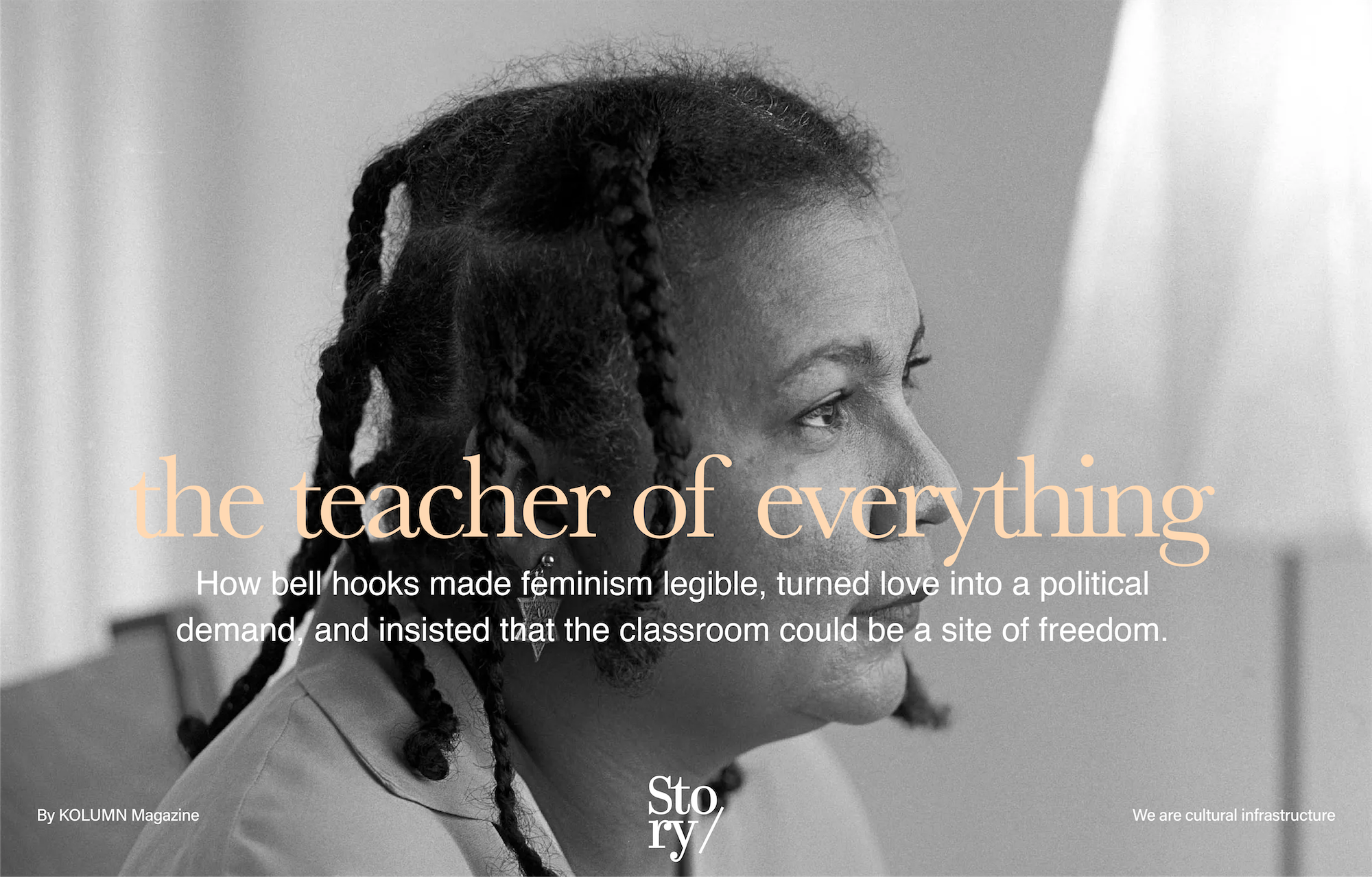
With hooks, we should be compelled to fully understand that liberation requires structural change, that patriarchy has no gender, that capitalism shapes intimacy, that movements reproduce hierarchy, that love demands accountability.
With hooks, we should be compelled to fully understand that liberation requires structural change, that patriarchy has no gender, that capitalism shapes intimacy, that movements reproduce hierarchy, that love demands accountability.
By KOLUMN Magazine
In the public imagination, bell hooks can appear as a set of quotations that travel well: the lowercase name as a symbol of humility; the bracing definition of feminism; the insistence that love is an action rather than a feeling. But the real story—what made Gloria Jean Watkins into bell hooks—was never reducible to a slogan. It was a decades-long argument with the world, conducted across genres and audiences, animated by an unusually grounded premise: that domination is learned in the places people call normal, and that liberation must therefore be practiced in the places people call ordinary.
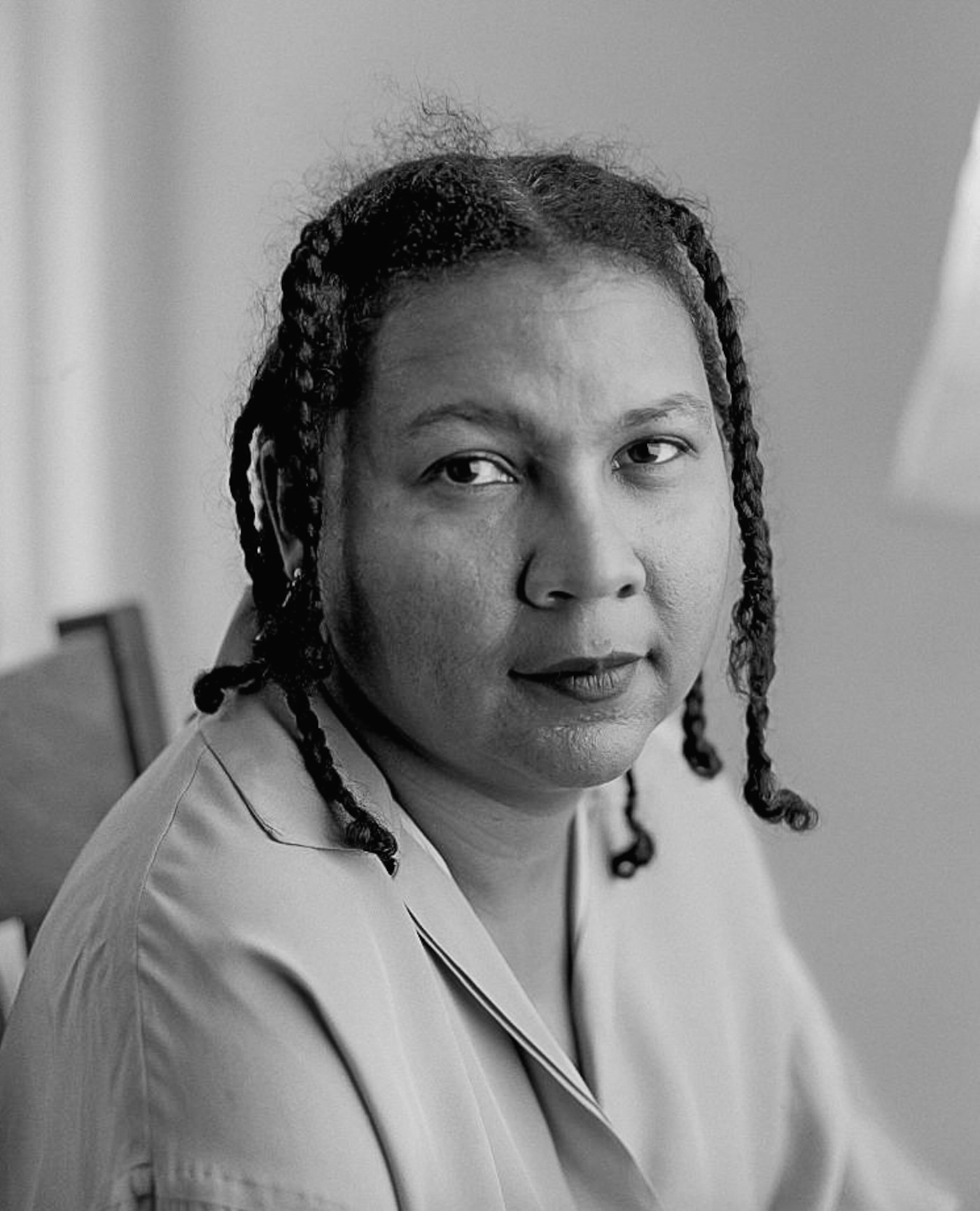
hooks—who died in 2021 at 69 in Berea, Kentucky—was a cultural critic, teacher, and Black feminist theorist whose work moved fluently between the academy and the everyday. She wrote about slavery’s afterlives, racism inside feminist movements, patriarchy inside Black communities, class stratification inside liberation politics, and the intimate injuries that follow when a culture trains people to equate love with control. In the same career, she could publish dense theoretical critique, children’s books, memoir, film criticism, and pedagogical essays, often in a voice that refused the mystique of academic inaccessibility. Admirers credited her with giving them a language to describe their lives; critics sometimes faulted her for moral severity, for overreach, or for moving too quickly from cultural diagnosis to broad prescriptions. Both reactions—devotion and irritation—pointed to the same thing: hooks wrote with the conviction that ideas are not ornaments. They are instruments. And instruments are meant to be used.
The stakes of her writing were shaped early. Watkins was born in 1952 in Hopkinsville, Kentucky, a segregated town where the racial order was not merely background but architecture. The Smithsonian’s National Museum of African American History and Culture notes her working-class upbringing and the formative experience of growing up under segregation, where reading and language became both refuge and weapon. The later details of her biography—Stanford, Wisconsin, UC Santa Cruz; teaching posts; a return to Kentucky—are important, but they don’t explain the steady throughline of the work. What explains it is the way she understood power: not as an abstract force hovering above daily life, but as something reproduced through habits, institutions, images, and family scripts.
Even the choice of a name carried that logic. The pen name “bell hooks” honored her maternal great-grandmother (Bell Blair Hooks) and, famously, appeared in lowercase. The point was not a typographical trick. It was a proposition about attention: the work over the author, the ideas over the personality. That decision became a public curiosity—one the Washington Post revisited after her death, noting how the stylization kept returning as a question attached to her fame. In hooks’s view, the curiosity was instructive: it revealed how culture clings to individual identity even when the argument being made is about systems.
Those systems were never, for her, a single-issue matter. A major reason hooks became foundational for generations of readers is that she was among the thinkers who trained people to see interlocking structures—race, gender, class, capitalism, imperialism—working together rather than in sequence. In public interviews and essays, she used a phrase that has become emblematic of her method: “imperialist white supremacist capitalist patriarchy,” a deliberately cumulative formulation meant to stop readers from isolating one form of domination and imagining the others as incidental.
But if her diagnostic vocabulary could be fierce, her project was not simply to name harm. It was to build practices—intellectual, political, relational—that might interrupt it.
The first shock: writing Black women into feminist history
hooks arrived in print at a moment when the mainstream feminist movement in the United States was still widely narrated through the experiences and priorities of white, middle-class women—and when Black women were often asked to choose between racial solidarity and feminist critique, as though the two could not coexist without betrayal. Her early landmark, Ain’t I a Woman: Black Women and Feminism (published in 1981), did not accept those terms. It argued that the history of slavery, white supremacy, and sexism produced a distinctive set of degradations for Black women, and that neither the civil rights movement nor the feminist movement had adequately addressed that convergence. The book’s title—echoing Sojourner Truth—was not mere homage; it was an indictment of how often Black women had been treated as rhetorical devices rather than full political subjects.
What made the book land, and keep landing, was not only its critique but its insistence on historical grounding. It forced a reckoning with the ways slavery’s gender regime and post-slavery racism shaped cultural ideas about Black womanhood, labor, sexuality, and respectability. Word In Black, in its obituary coverage, emphasized hooks’s stature as an author and activist and the breadth of her impact—an influence that extended beyond academic feminism into public argument. Ebony similarly framed her as internationally recognized, situating her death as a major cultural loss.
If Ain’t I a Woman brought Black women’s experience to the center of feminist analysis, it also exposed a pattern hooks would keep returning to: movements that claim liberation can replicate domination internally. This was not a comforting thesis. It meant feminism had to critique itself. It meant racial justice work had to confront sexism. It meant the romance of solidarity could not substitute for structural honesty.
“Feminism is for everybody,” and the fight against elitism
One of hooks’s most consequential moves was rhetorical: she refused to let feminism remain a boutique politics for the already-initiated. In Feminist Theory: From Margin to Center (1984), later recognized by outlets like TIME as a defining intervention, she critiqued a feminism that treated the concerns of women of color and poor women as secondary, and she argued for feminism as a mass movement—an ethic and politics aimed at ending sexist oppression rather than simply expanding opportunities for a subset of women.
That critique remains relevant partly because it anticipated dilemmas that still define contemporary politics: the tension between representation and redistribution; the seductions of institutional inclusion; the gap between professionalized advocacy and grassroots life. hooks could be impatient with what she saw as feminism’s assimilationist ambitions—women’s advancement into systems that remained exploitative. Her lens was often class-conscious in a way that put her at odds with liberal triumphalism. She wrote about consumer culture, the corporatization of identity, and the ways that “choice” could be used to moralize inequality rather than dismantle it. In this sense, her feminism was not primarily about individual empowerment; it was about collective transformation.
Her later popular primer, Feminism Is for Everybody, made that argument in a deliberately accessible register—one reason it continues to circulate among young readers and organizing spaces. Word In Black, in a more recent reading list, describes the book as a “starter course” that clarifies how patriarchy and internalized sexism warp relationships and movements. This accessibility was not, for hooks, a simplification. It was a political strategy. If feminism could not be understood across class boundaries, it would fail as a movement.
The classroom as a site of struggle—and possibility
If hooks’s early work reshaped feminist theory, her pedagogical writing helped reshape how many educators think about teaching. Teaching to Transgress: Education as the Practice of Freedom (1994) remains a defining text for engaged pedagogy—an approach that treats the classroom as a space where power is negotiated, not a neutral container for information. hooks drew from Paulo Freire and others, but she made the theory personal, describing how schooling under segregation and then integration shaped her sense of what education could do. She argued that the classroom reproduces social hierarchies when it trains students for obedience, and that liberatory education requires an ethic of mutuality, presence, and critical consciousness.
The book’s endurance is partly due to its refusal to romanticize teaching. hooks did not present educators as saints. She insisted that teachers’ positional power is real, that institutions enforce accountability unevenly, and that liberation requires honesty about status and structure, not performative informality. She also insisted on the body and emotion as part of learning—ideas that, in the 1990s, could read as provocative in academic culture that prized detachment.
Her pedagogical work connects directly to her institutional choices. After teaching at multiple universities, hooks returned to Kentucky and became Distinguished Professor in Residence at Berea College. Berea’s own institutional materials emphasize her role in mentoring students and building feminist programming on campus, including the bell hooks Institute and, later, the bell hooks center. (Berea College) The archive of her papers at Berea further reflects how seriously she took the material legacy of ideas—what gets saved, who can access it, and how future scholars will tell the story.
In this, hooks practiced what she preached: that education is not simply personal advancement. It is community infrastructure.
Looking back: film, representation, and the “oppositional gaze”
For many readers beyond feminist studies, hooks first arrived through cultural criticism—especially her writing on film, music, and representation. Her concept of the “oppositional gaze,” associated with her essay “The Oppositional Gaze: Black Female Spectators,” gave language to a form of looking shaped by history: the awareness that Black people, and Black women in particular, were often denied the social permission to look, to interpret, to judge—and that reclaiming the gaze could be an act of resistance. The essay’s argument about spectatorship, power, and the politics of representation has been widely circulated in film and cultural theory contexts.
hooks’s cultural criticism did not treat representation as a side issue. She understood images as a form of governance—training desire, legitimizing hierarchy, scripting who is seen as complex and who is seen as disposable. In collections like Black Looks: Race and Representation and Reel to Real: Race, Sex, and Class at the Movies, she analyzed how popular culture rehearses racial and gendered mythologies, and how viewers might cultivate interpretive resistance. Her critiques of prominent directors and artists—Spike Lee among them—were often controversial, not least because she refused the logic that representation by Black creators is automatically liberatory. That refusal made her unpopular in some corners. It also made her analysis harder to dismiss.
This is one place where hooks’s method can look severe: she could demand political accountability from art in ways that frustrated readers who wanted criticism to be primarily celebratory. Yet it was also here that her insistence on complexity mattered. She argued, again and again, that domination can reproduce itself through prestige, through success, through the pleasure of visibility.
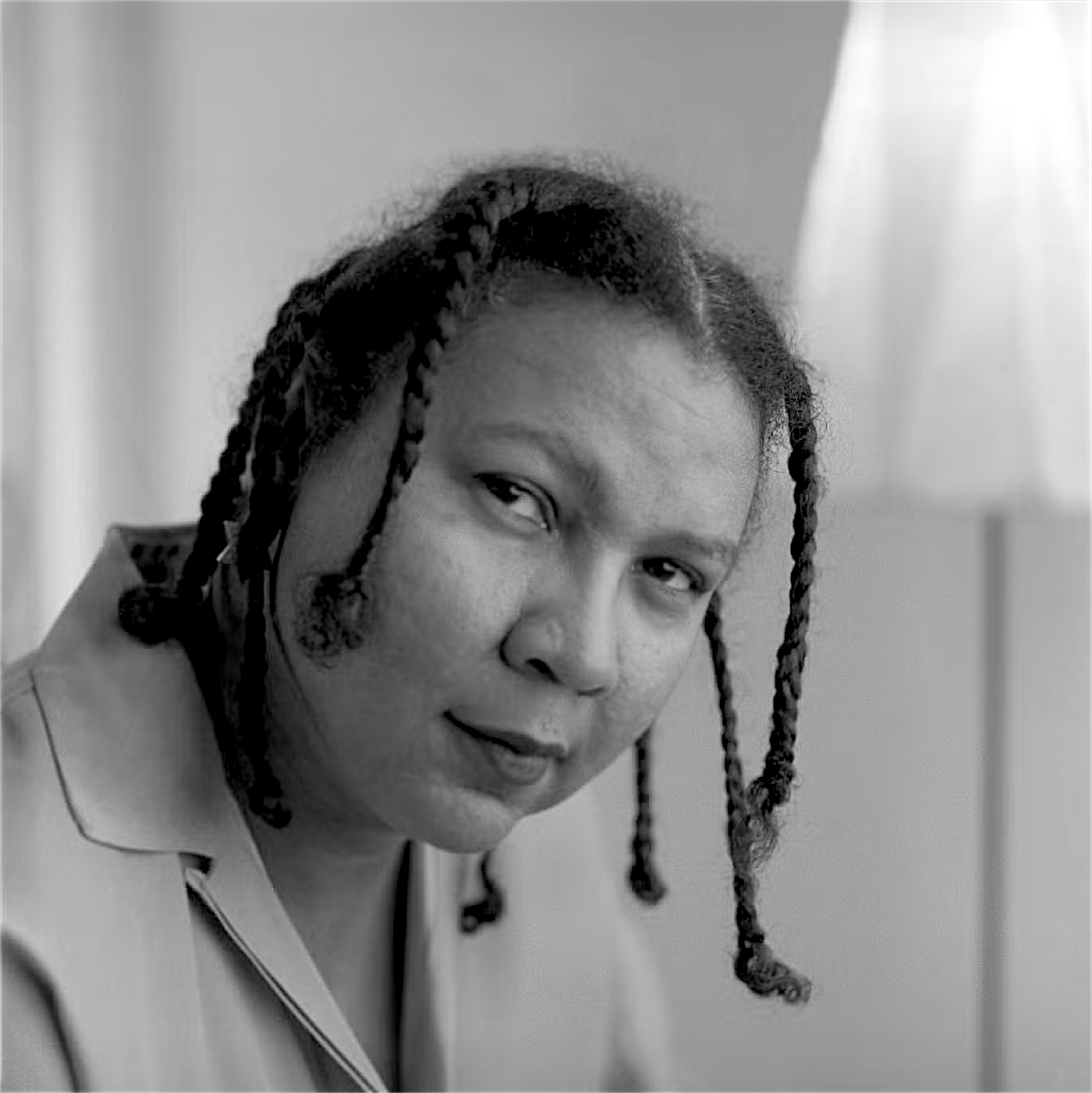
The turn that wasn’t a turn: love as discipline
If hooks’s cultural criticism helped readers see domination, her writing on love helped readers imagine alternatives. All About Love: New Visions (2000) is often described now as a “love book,” sometimes marketed almost as self-help. But hooks did not mean love as mood. She meant love as ethic—care, responsibility, commitment, knowledge, trust—an intentional practice that can be measured by action. The book’s renewed popularity in the 2020s reflects a hunger for language that addresses relational harm without reducing it to individual pathology. Associated Press reporting has documented how a new generation has embraced All About Love, while also noting scholars’ caution against flattening hooks into a mere lifestyle guru. (AP News)
That tension—between hooks as political theorist and hooks as personal-guide figure—is one of the central interpretive battles over her legacy right now. It is tempting, in an era of viral quotes, to treat her love ethic as a soothing balm. But hooks’s love ethic was confrontational. It demanded that people interrogate domination not only in governments and workplaces, but in households, friendships, sexual relationships, and movement spaces. It demanded a critique of patriarchy as a system that teaches men (and women) to equate control with care. It demanded that people tell the truth about how violence can be normalized as “discipline.”
Her argument also carried an implicit critique of political culture: activism without love becomes another theater of domination. The Center for Action and Contemplation, for instance, has summarized hooks’s claim that a love ethic could reshape public life, framing love not as sentiment but as a moral and social practice capable of resisting dehumanization.
Read in full context, hooks’s work on love is not a retreat from radical politics. It is a claim that radical politics fails without a relational foundation sturdy enough to sustain it.
Masculinity, patriarchy, and the risk of intra-community critique
hooks was also willing to write directly to and about men, particularly Black men, in ways that were sometimes received as both challenging and vulnerable. In We Real Cool: Black Men and Masculinity (2004), she addressed how patriarchy harms men—through emotional illiteracy, through violence as performance, through the policing of tenderness—and how racism and class oppression can intensify those dynamics. This was not a politics of excusing harm; it was a politics of naming the conditions under which harm becomes thinkable as identity.
Her willingness to critique patriarchy inside Black communities was, for some readers, an act of honesty; for others, a gift to racist narratives that pathologize Black men. hooks anticipated that critique and refused it as a silencing mechanism. For her, liberation politics had to be able to look inward without collapsing into shame or betrayal. A movement that cannot critique itself becomes a church. She did not want churches. She wanted freedom.
This is also where her work can feel relentless. If you are looking for a politics that offers uncomplicated heroes, hooks is not your writer. If you are looking for a politics that treats Black communities as beyond critique in order to protect them from racist interpretation, hooks rejects the bargain. She treats truth-telling as a form of protection too.
Kentucky, homeplace, and a public intellectual’s geography
A useful corrective to the idea of hooks as purely theoretical is to take seriously her sense of place. In a tribute after her death, The Atlantic emphasized how deeply her work was shaped by Kentucky—by Hopkinsville, by the South, by what she sometimes framed as “homeplace.” This matters because hooks’s writing is often read as urban, cosmopolitan critique. But her sensibility—especially her attention to family, intimacy, and community memory—has roots in Southern Black cultural life and in a working-class worldview. That is part of what gives her prose its friction: she is not performing academic neutrality. She is writing out of lived social structures.
At Berea College, that geography became institutional. The creation of the bell hooks Institute in 2014 and the later opening of the bell hooks center were not mere honorary gestures; they were a continuation of her belief that ideas should have local infrastructure—programs, archives, conversations, and spaces for underrepresented students to gather without performing themselves for the dominant gaze.
The critics: moralism, certainty, and the burdens of celebrity
It would be irresponsible to write about hooks as though her reception was universally admiring. She was frequently contested. Some critics found her critiques of popular artists overly prescriptive, reading them as moral policing. Others argued that her sweeping indictments of “mainstream” feminism or Black leadership sometimes flattened internal variation. Some scholars debated her relationship to postmodern theory, or questioned whether her rhetorical approach sacrificed nuance for accessibility.
There is also the complicated afterlife of her celebrity. The very accessibility that made her powerful also made her extractable: her sentences travel without context; her phrases become captions; her love ethic becomes a brand identity. The danger is not only misreading. It is domestication—turning a radical critique of domination into an aesthetic of empowerment. The more hooks becomes a cultural saint, the easier it becomes to ignore the disruptive parts of what she argued: that liberation requires structural change, that patriarchy has no gender, that capitalism shapes intimacy, that movements reproduce hierarchy, that love demands accountability.
In death, tributes tended to emphasize her breadth and influence. The Washington Post obituary described her as a trailblazing Black feminist and social critic, highlighting the scale of her impact across decades of debate about race and gender. The Guardian obituary similarly emphasized her role as a public intellectual whose work centered the intersecting oppressions of race, gender, and class—and kept love at the heart of community healing. These are accurate summaries. They can also smooth out the roughness that made her essential.
What her body of work actually did
To take hooks seriously is to see her oeuvre less as a shelf of books than as a sustained architecture of questions.
What does it mean to build a feminist politics that does not replicate racism and classism? What does it mean to build racial justice politics that does not replicate sexism and homophobia? What does it mean to live in a culture where domination is disguised as normalcy—where control masquerades as love, where violence masquerades as discipline, where representation masquerades as justice?
Those questions appear across her bibliography because she treated culture as a total environment. She wrote theory, but she also wrote about television, music, romance, classrooms, beauty standards, parenting, and spirituality. She insisted that oppression is not only an event; it is a training. And if oppression is a training, liberation has to be a counter-training—something practiced repeatedly, with intention, in community.
This is why her emphasis on love is not a detour. It is a method. It is the only way, in her view, to sustain a politics that aims to end domination rather than reverse its direction. Her famous line that “feminism is for everybody” is not a marketing slogan. It is a strategic insistence that liberation must be collective—or it will become another form of hierarchy with better language.
The enduring significance: a vocabulary that still organizes the present
It is hard now to imagine contemporary discourse about intersectional oppression without hooks somewhere in the soil. She was not the only thinker building this framework, and the term “intersectionality” itself is most closely associated with Kimberlé Crenshaw. But hooks’s influence is distinctive: she made structural critique readable to people who did not live in academic departments, and she insisted that structural critique must reach into the private sphere.
Her legacy is visible in the continued circulation of her pedagogical work, in the ubiquitous use of her definitions, in the way activists and artists argue about representation, and in the resurgence of All About Love among readers seeking ethical frameworks for intimacy. It is visible in institutional legacies like the bell hooks center and in the archival care surrounding her papers. It is visible, too, in the ongoing debates she helped provoke: whether critique can coexist with pleasure, whether love is political, whether movements can be both radical and humane.
If there is a single thread that can hold the full range of her work, it is this: hooks refused the fantasy that justice is only public policy. She treated justice as a comprehensive project—spanning the state and the household, the classroom and the movie theater, the archive and the body. That refusal can feel exhausting. It can also feel like relief: a permission to tell the truth about where domination actually lives.
The lowercase name, in the end, is less a brand than a clue. It points away from personality and toward practice—toward what we do with what we know. And hooks’s central wager was that knowledge is not complete until it changes how we live.
More great stories
Afro Sheen, Wall Street, and the Architecture of Black Possibility
July 6, 2026
No Comments
The Fire Inside the Fourth
July 5, 2026
No Comments