





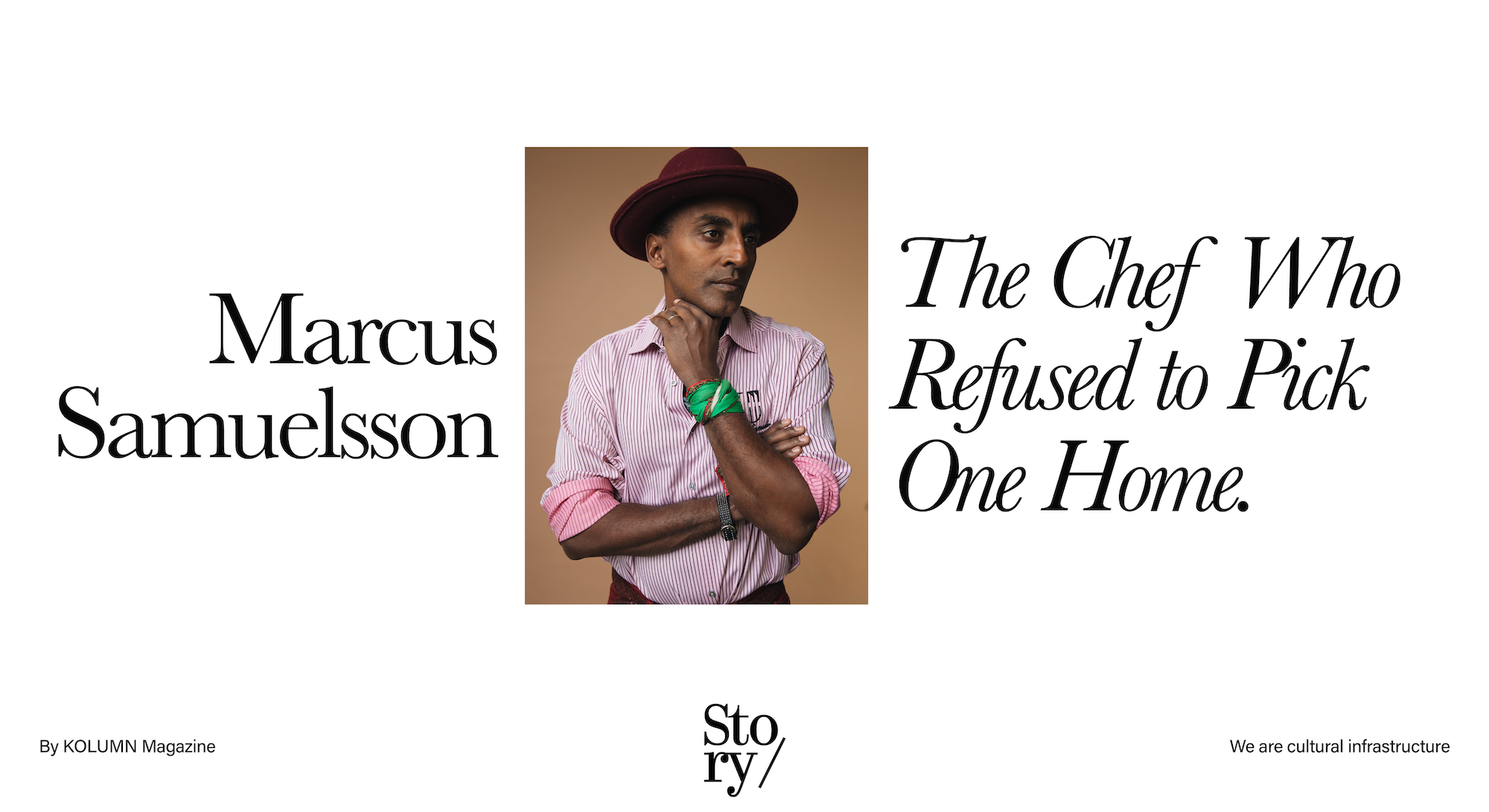
Samuelsson has spent a career turning displacement into hospitality.
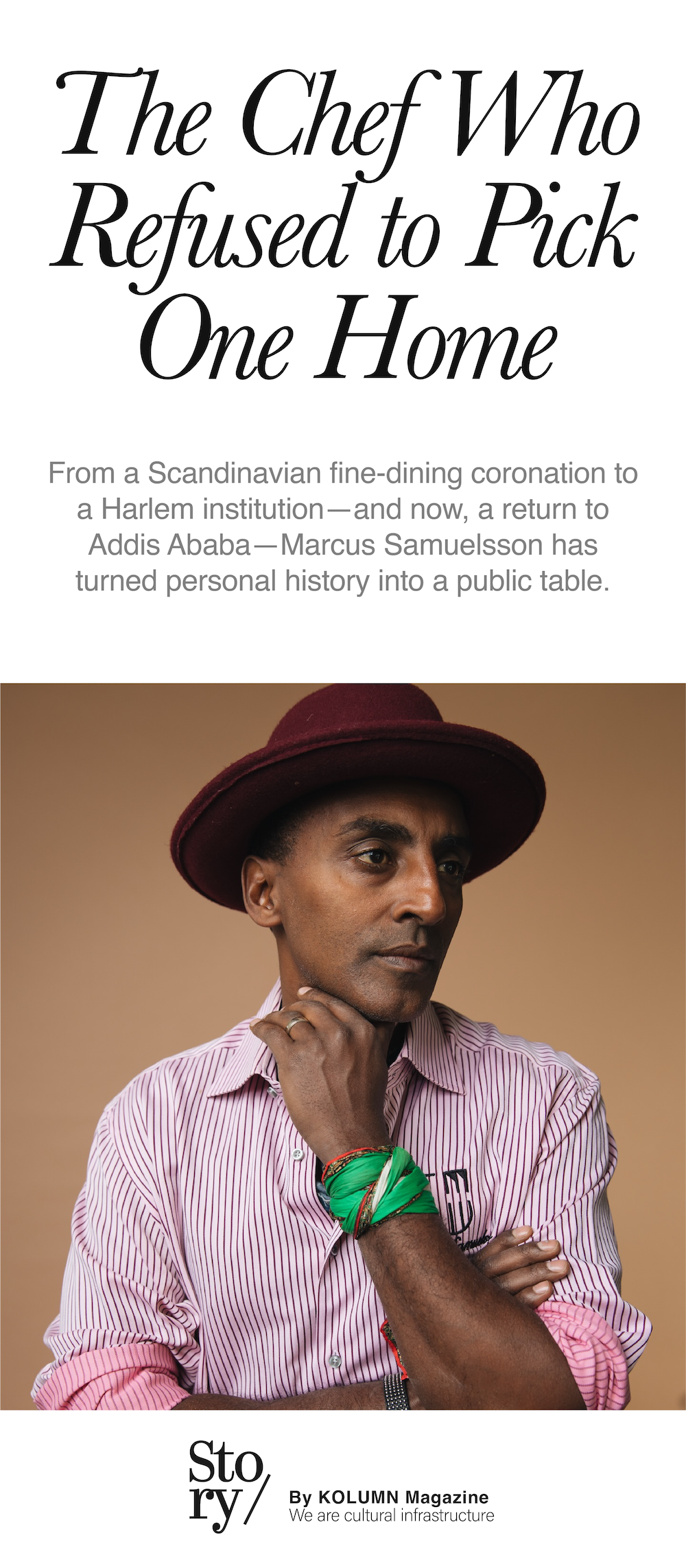
Samuelsson has spent a career turning displacement into hospitality.
By KOLUMN Magazine
The first thing to understand about Marcus Samuelsson is that his biography doesn’t behave like most chef biographies. It refuses the clean arc—childhood obsession, apprenticeship, breakthrough, empire. Instead it arrives in fragments, braided together by migration, adoption, and the complicated mechanics of making a self when your first identity is something you can’t fully remember.
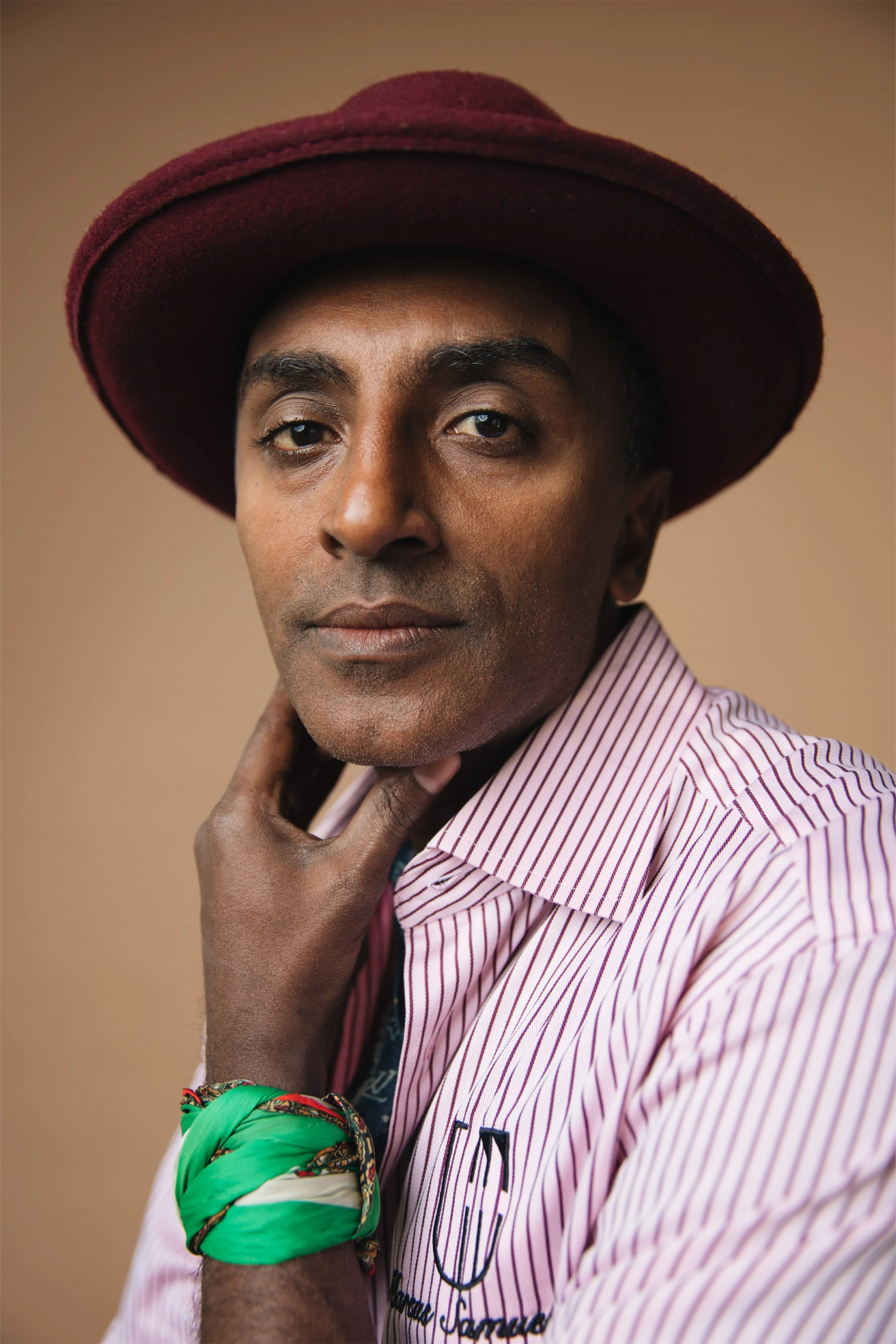
Samuelsson was born in Ethiopia in 1971, during an era of upheaval that would soon reshape the country’s political and social landscape. In accounts that he and major biographical sources have repeated over the years, he was very young when tuberculosis tore through his family, killing his mother and leaving him and his sister in peril. After their recovery, the siblings were adopted by a Swedish couple and raised in Gothenburg, a city whose coastal light and restrained culinary palette could not have been farther from the imagined Ethiopia he carried like a phantom limb.
That origin story is often told with the kind of awe that Americans reserve for improbable success: the orphan who becomes a celebrity chef. But that framing can flatten what is, in practice, a more intricate emotional economy. Samuelsson’s memoir Yes, Chef—written with journalist Veronica Chambers—locates the deeper tension in a question that has haunted many adoptees and many immigrants: what does it mean to belong somewhere when the story of how you got there is both miraculous and brutal? The book’s public reception mattered not only because it became a bestseller, but because it was recognized at the James Beard Awards (one of the food world’s most visible forms of credentialing) and because major critics read it as something more than personal narrative—an argument about race, aspiration, and the gatekeeping architecture of elite kitchens.
Food, in Samuelsson’s telling, becomes the instrument for stitching these worlds together. His Swedish grandmother, Helga, appears across profiles and publishing descriptions not as a sentimental device but as an early teacher of structure: repetition, ritual, patience, the unglamorous labor behind something as simple as roast chicken. If you want to understand his later obsession with building restaurants that double as cultural spaces, you can start there—with the idea that a meal is never only a meal. It is also a room, a set of rules, and a statement about who is welcome.
Sweden: Training inside a tradition that didn’t imagine him
Samuelsson’s adolescence and early adulthood in Sweden unfolded in a country that could be both modern and socially progressive, yet also homogenous enough for race to become an everyday negotiation. In later essays and interviews, he has spoken directly about what it meant to be Black in a Nordic context—visible, sometimes exoticized, sometimes isolated, always noticed.
This matters because restaurant culture—especially the older European model that heavily influenced Scandinavian fine dining—tends to run on inherited codes: accent, pedigree, posture. In that system, Samuelsson wasn’t just learning how to cook; he was learning how to be legible.
He enrolled in culinary school in Gothenburg and then took the kind of apprenticeships that still function like a chef’s passport: Switzerland, Austria, France—training grounds where hierarchy can be ruthless and excellence is enforced through repetition. This European training is sometimes described as his “foundation,” but in a more precise sense it gave him a vocabulary for technique: sauces, temperature control, butchery, and the discipline that makes creative improvisation possible. It also placed him inside a professional culture that, at the time, had not produced many chefs who looked like him—and that gap would become one of the undercurrents of his career.
New York: The Aquavit years and the speed of ascent
Samuelsson arrived in the United States in the mid-1990s and, like many ambitious young chefs, found his way to New York City, a place where talent can be rewarded quickly—especially when it is paired with a willingness to work punishing hours. He landed at Aquavit, a Scandinavian restaurant that was already part of Manhattan’s fine-dining ecosystem. What happened next became one of the central myths attached to his name: he became executive chef at a remarkably young age and, during his tenure, earned a three-star review from The New York Times—a distinction widely repeated as historic because of both his age and the rarity of that rating.
A three-star review functions like an accelerant. It doesn’t just increase reservations; it changes the kinds of doors that open. Invitations arrive. Publishing opportunities appear. Television producers start calling. And within the industry, your name begins to circulate as shorthand: prodigy, wunderkind, future.
But speed has a cost. Samuelsson’s later narrative—especially in Yes, Chef—doesn’t romanticize the climb as pure triumph. It treats it as a process of learning what elite kitchens demand from the human body and from the ego, and how thin the line can be between ambition and self-erasure. The memoir’s critical framing, as echoed in secondary reporting about major reviews, emphasized that Samuelsson was not simply recounting career milestones; he was describing why so few Black chefs, historically, have been allowed to rise in the fine-dining world at the same rate and with the same backing as their white counterparts.
In 1999, he was named Rising Star Chef of the Year by the James Beard Foundation, and in 2003 he won Best Chef: New York City—credentials that, in the American food world, signify not just skill but institutional acceptance. These awards mattered because they arrived during a period when celebrity-chef culture was expanding rapidly, and when “chef” was becoming not only a job title but a public identity.
The pivot: From Scandinavian fine dining to a broader map
If Samuelsson’s story ended at Aquavit, it would still be impressive. But it would be a narrower story: a chef mastering a single tradition and rising within it. His actual career becomes more interesting at the moment he begins moving away from that narrowness—toward food that could contain more than one homeland.
This shift is sometimes framed as “finding his roots,” but roots can be an oversimplification for someone whose life is built from dislocation. What Samuelsson appears to have pursued instead is range: a cuisine that could hold Sweden and Ethiopia and America at once, without collapsing them into a novelty fusion.
His cookbooks chart that intellectual and culinary movement. The James Beard recognition for The Soul of a New Cuisine (often associated with spotlighting African flavors and techniques for American audiences) signaled that he wasn’t only cooking; he was translating and advocating—using the authority he’d earned in fine dining to argue that African cuisines belonged in the center of global culinary conversation, not at its margins.
Later projects would make that argument even more explicitly. The Rise: Black Cooks and the Soul of American Food positions Black cooking as foundational to American cuisine—an insistence that the country’s most beloved food traditions are inseparable from the labor, creativity, and survival strategies of Black people, too often uncredited.
That intellectual throughline—credit, belonging, narrative power—sets the stage for the most consequential decision of his public career: opening Red Rooster Harlem.
Red Rooster Harlem: Building a restaurant that’s also an argument
Red Rooster opened in Harlem in 2010, and the opening itself was read as a cultural event. Harlem has never been just a neighborhood; it is a symbol—of Black art and political power, of the Harlem Renaissance, of struggle and reinvention, of gentrification debates that flare each time a new “destination” arrives uptown. Any chef who chooses Harlem as a flagship is choosing to enter that symbolic terrain.
Samuelsson’s own language about the place—repeated in interviews—often flips the usual restaurant-world hierarchy. The goal, he has suggested, is not simply to make Red Rooster the star. The goal is to make Harlem the star, and to treat the restaurant as a platform that can celebrate local artists, musicians, and community history.
The food at Red Rooster leaned into comfort and familiarity—fried chicken, biscuits, collards, cornbread—while also reflecting the chef’s global vocabulary. The menu’s premise was not that Harlem needed “elevating,” but that American cuisine already contains multitudes, and a restaurant can dramatize that fact.
Yet Red Rooster also became a flashpoint in a larger question: when does investment become extraction? Critics and neighbors alike have long debated whether high-profile hospitality accelerates the forces that push longtime residents out. Even sympathetic accounts acknowledge that gentrification is part of the conversation around any “buzzy” Harlem institution.
What complicates the usual script is that Samuelsson’s approach has consistently emphasized local hiring, local programming, and an attempt—imperfect, contested, real—to operate as a neighborhood institution rather than a colonizing outpost. The restaurant’s own public descriptions foreground community impact: buying from local purveyors, hiring from within the neighborhood, and creating programming that links food to culture.
You can read that as PR. You can also read it as strategy. In the modern restaurant economy, the line between hospitality and civic life is thinner than we like to admit. Restaurants create jobs; they shape street traffic; they influence what a neighborhood is “for.” Red Rooster’s bet was that a restaurant could be both profitable and porous—that it could welcome presidents and bus drivers in the same room without making either feel like a prop. That aspiration is woven directly into how Yes, Chef and subsequent projects describe the Red Rooster ideal: a multiracial dining room as a social practice, not a marketing line.
The Obama state dinner: When culinary fame becomes statecraft
In November 2009, Samuelsson served as guest chef—working with the White House’s executive chef—for President Barack Obama’s first state dinner, honoring Indian Prime Minister Manmohan Singh. The menu was widely reported as predominantly vegetarian, a nod to Singh’s dietary preferences, and it became an example of how state dinners communicate politics through food: diplomacy, respect, and a curated version of American identity.
The symbolism operated on multiple levels. Here was an Ethiopian-born, Swedish-raised Black chef cooking one of the most public meals in American political life—at a moment when the Obama presidency itself was recalibrating the nation’s sense of who could represent it. Media coverage noted not only the menu’s details but the fact of Samuelsson’s selection, a kind of culinary acknowledgment that the country’s “official” table could include immigrant narratives, too.
It also helped cement Samuelsson’s brand as more than fine dining: he was now a chef who could move between the rarefied world of star ratings and the symbolic world of national ceremony.
Television, publishing, and the making of a public chef
Like many chefs whose careers matured alongside food television, Samuelsson became a familiar face on competition shows and as a host. He won Top Chef Masters, and his work across televised formats helped translate his story into something broader than restaurant culture: a narrative about perseverance, identity, and global curiosity.
His PBS series No Passport Required fit particularly neatly into his worldview. The concept—treating immigrant communities and their cuisines as central to American food rather than peripheral—matches the deeper argument running through The Rise and his Harlem work: that “American” is less a fixed tradition than a living record of movement.
Publishing became another pillar of that public identity. The cookbooks are not only collections of recipes; they are vehicles for story. A notable feature of The Red Rooster Cookbook, as described in major magazine coverage, is that it reads like a literary love letter to Harlem, interweaving community voices with food—a deliberate refusal to treat the neighborhood as scenery.
In 2020, The Rise went further, framing Black cooking as both history and present tense—an intervention at a time when the country was again arguing about race, recognition, and whose labor is visible. PBS coverage around the book highlighted its intention as celebration and correction: a way to point the camera toward Black culinary professionals and traditions too often treated as anonymous “heritage.”
The pandemic: Red Rooster as a community kitchen
COVID-19 forced many restaurants into existential crisis; for a time, the industry looked less like an economy than like a mass casualty event. In that context, Red Rooster’s pivot into community support became a revealing chapter in Samuelsson’s Harlem-first ethos.
As The Atlantic reported in 2020, Red Rooster—already a gathering place for a broad cross-section of Harlem—was refashioned into a community kitchen when the neighborhood was overwhelmed by the virus’s early surge. The act was practical—feeding people when hunger spiked—but also symbolic. Restaurants, suddenly, were forced to confront what they owed the communities that sustain them when diners disappear. Samuelsson’s decision suggested one answer: if your restaurant claims neighborhood identity, that identity becomes a responsibility when crisis arrives.
This moment also sharpened the question that has trailed his Harlem project: is Red Rooster a business that benefits from Harlem’s cultural capital, or an institution that circulates value back into the neighborhood? Reasonable people disagree. But the pandemic chapter gave his argument a concrete form: the dining room could become a kitchen for the community, not only a room for paying guests.
Philanthropy and mentorship: Influence beyond the plate
Samuelsson’s philanthropic work is often noted in his official biography and in foundation profiles: partnerships and board affiliations connected to hunger relief and culinary education, including associations with organizations like City Harvest and C-CAP (Careers through Culinary Arts Program).
He has also used competitive television winnings and public projects to support humanitarian efforts; Food Network’s profile, for example, links his James Beard recognition to ongoing UNICEF-related endeavors.
In recent years, mentorship has become a more explicit part of his public mission. A 2025 Food & Wine profile describes a “Rise Residency” initiative designed to give culinary talent paid time and space for experimentation and reflection—an artists’-residency model applied to chefs, premised on the idea that creative labor needs room to breathe if the next generation is to build something new. That same reporting frames Samuelsson as a mentor to emerging chefs, a role that mirrors what he says earlier gatekeepers did for him: seeing potential before he could fully see it himself.
Expansion, scale, and the risks of an empire
The restaurant world loves the language of “empire,” but expansion is as risky as it is glamorous. Concepts that feel alive in one neighborhood can become hollow when franchised. For Samuelsson, whose brand is tied to place—Harlem, in particular—scaling has required a careful balancing act: replicating a sensibility without turning it into a theme-park version of itself.
His official bio and restaurant group materials list a growing portfolio across cities and even countries, including New York projects like Hav & Mar and Metropolis, plus international ventures including Addis Ababa. The expansion reads, on paper, like the logical move of a chef who has long occupied both celebrity and institutional lanes.
But it also raises an editorial question about legacy: can a chef be both a neighborhood institution-builder and a global brand? The best version of this story says yes—that the neighborhood becomes the anchor, and global expansion becomes a way of exporting values. The worst version says no—that brand logic eventually flattens the specificity that made the original place matter.
The evidence so far suggests Samuelsson is at least aware of the tension. He has spoken, in interviews summarized by The Guardian, about not opening new Red Roosters indiscriminately—implying that replication requires a city “dynamic” worth learning, not simply a market worth capturing.
Ethiopia, again: The meaning of coming home with power
If Red Rooster was a bid to belong in Harlem, the opening of Marcus Addis can be read as a different kind of belonging: a return to Ethiopia with resources, influence, and the ability to shape an institution rather than simply search for personal history.
A 2025 Bon Appétit feature describes the emotional and cultural stakes of that return, framing the Addis project as both culinary innovation and legacy-building, including training and hospitality development meant to raise standards and create pathways for local talent. In that telling, the restaurant isn’t only a monument to Samuelsson’s success; it is a bet on what Ethiopian cuisine could become when treated as globally consequential and locally owned.
This is where Samuelsson’s career begins to resemble a long argument rather than a series of achievements. Early fame made him legible to the American food establishment. Harlem made him legible to a broader cultural conversation about race, gentrification, and community. Ethiopia, now, offers a chance to make the argument in the opposite direction: not “let African flavors into the canon,” but “watch the canon change as Africa asserts its own standards.”
The “modern Black chef” question—and why his career keeps circling it
Samuelsson’s story has repeatedly been used to ask a question that’s larger than him: what does it mean to be a Black chef at the highest levels of a profession that has historically handed its most prestigious platforms to white men?
In 2024, The Root explicitly framed him through that lens in a segment about becoming a “modern Black” chef—an indicator of how, even decades into his career, his identity remains part of the public meaning attached to his work. That framing can be limiting; it can reduce a chef to symbolism. But it also reflects a real industry imbalance that Samuelsson has addressed by using books like The Rise to spotlight other Black culinary voices and histories, not only his own.
His career suggests a particular strategy for surviving and then reshaping gatekept spaces. First, master the language of the gate—classic technique, elite reviews, institutional awards. Then, once you have leverage, use it to widen the room: open restaurants that center community, publish books that redistribute credit, mentor talent that might otherwise be dismissed, and keep insisting that “American food” is not a single lineage but a contested, plural story.
Accomplishment, in the clearest terms
Lists of achievements are the easy part: the Beard Awards (Rising Star, Best Chef: New York City, and later recognition for writing and broadcasting), the high-profile state dinner, the media career, the global restaurant portfolio.
But the more durable accomplishment is harder to quantify. It is the way Samuelsson has used the chef’s platform—still a rare one for a Black immigrant with his particular biography—to argue that food is culture, that culture is power, and that the restaurant can be more than a luxury product. It can be a civic space: messy, contested, imperfect, alive.
That ambition is why his story keeps returning to the same themes: belonging, credit, migration, community. The roast chicken in a Swedish grandmother’s kitchen becomes, decades later, a restaurant in Harlem that tries to hold a neighborhood’s contradictions without pretending they don’t exist. And the chef who once needed the establishment’s approval now operates with enough leverage to challenge what the establishment calls “important” food in the first place.
If you want the cleanest sentence for what Marcus Samuelsson has done, it might be this: he has spent a career turning displacement into hospitality—then using hospitality as a way to talk back to history.
More great stories
Afro Sheen, Wall Street, and the Architecture of Black Possibility
July 6, 2026
No Comments
The Fire Inside the Fourth
July 5, 2026
No Comments