


The shock of the Reagan tape was not that racism existed near power. It was that so many people still needed audio proof.
The shock of the Reagan tape was not that racism existed near power. It was that so many people still needed audio proof.
By KOLUMN Magazine
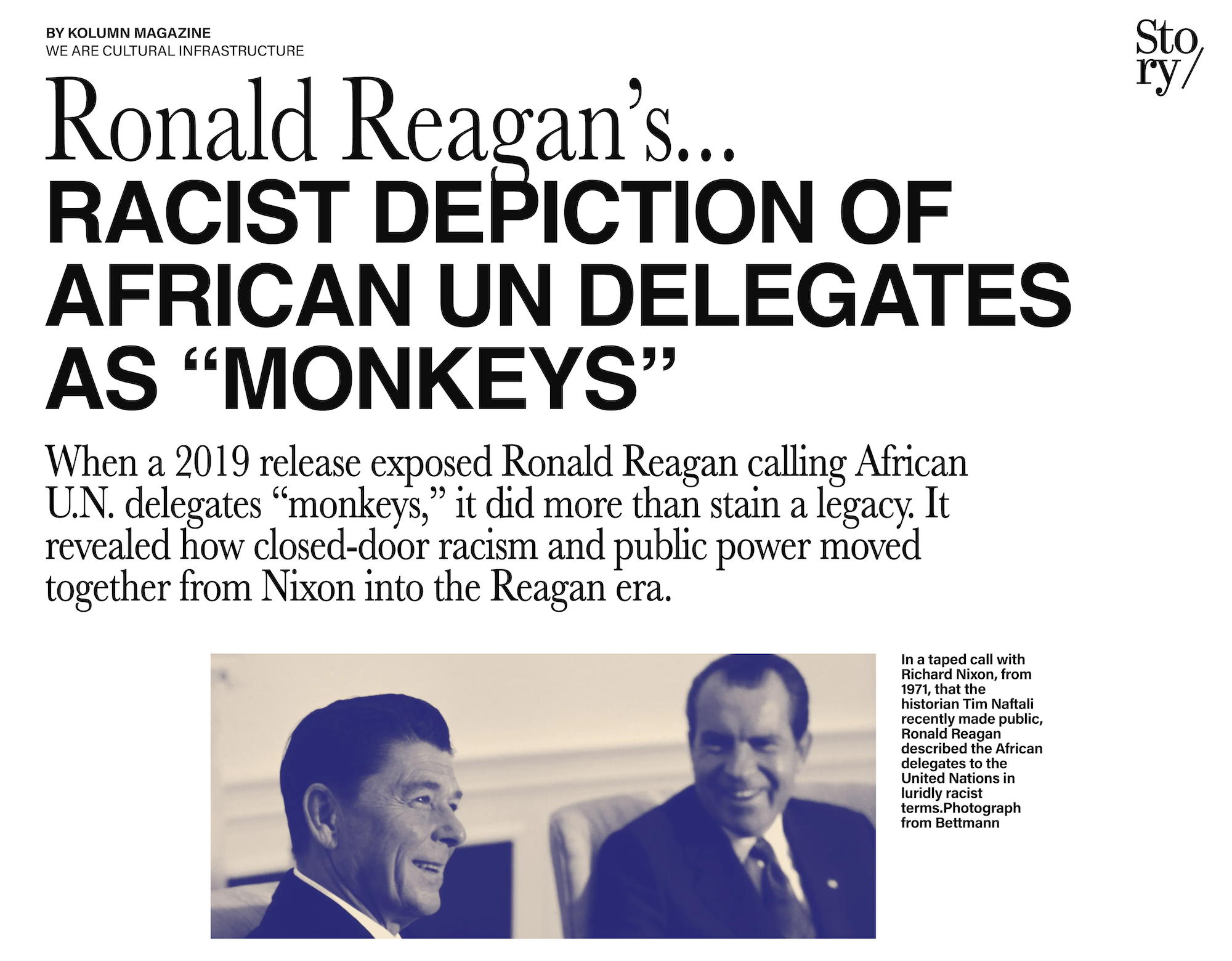
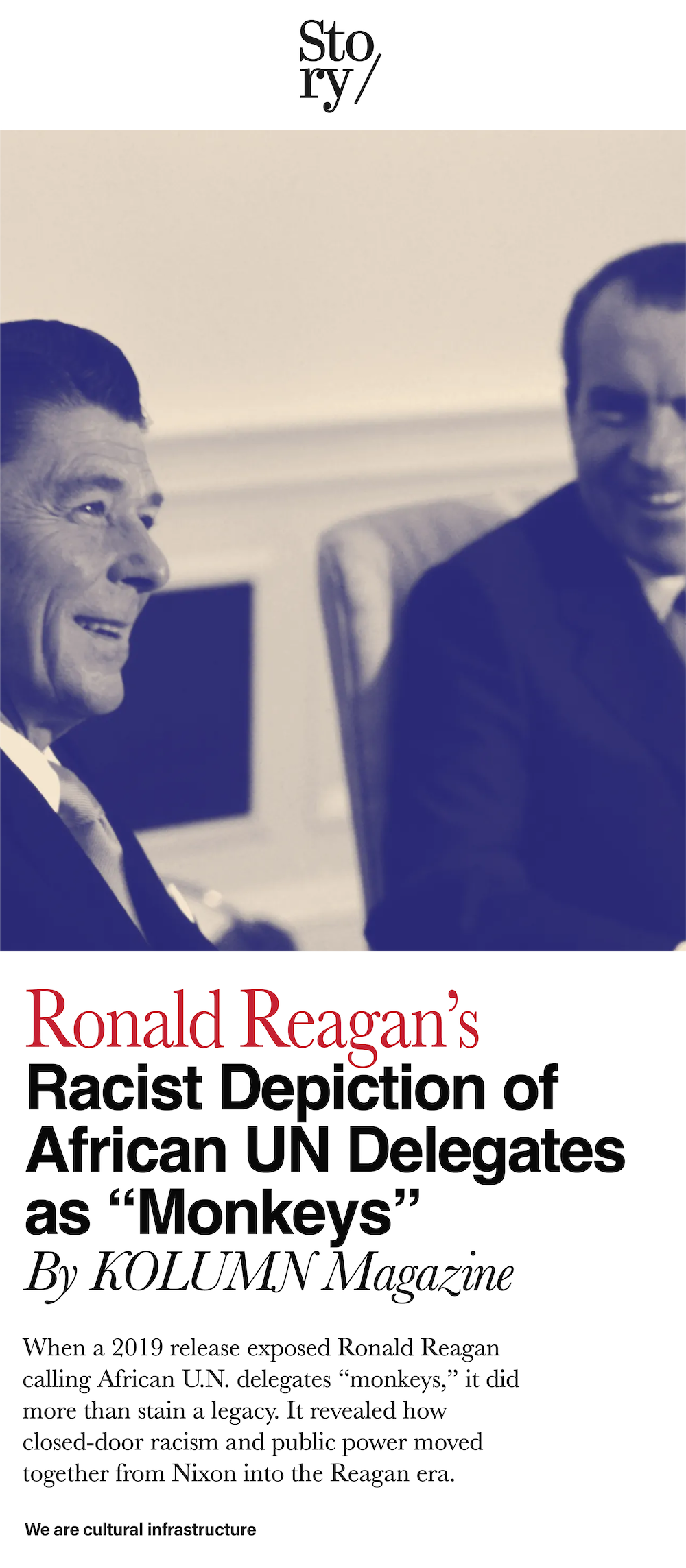
In July 2019, a newly public recording forced the country to hear something that many Americans had spent decades refusing to believe about Ronald Reagan, or perhaps refusing to hear clearly enough. On the tape, Reagan, then governor of California, is speaking by phone with President Richard Nixon after the United Nations voted to seat the People’s Republic of China and remove the representatives of Taiwan. Reagan is furious about the behavior of African delegates at the U.N. Nixon listens. Reagan reaches for one of the oldest degradations in the Western racist archive and calls the delegates “monkeys,” then adds that they were “still uncomfortable wearing shoes.” Nixon laughs. The scene is short, ugly, and clarifying. It is also historically larger than the sound bite that traveled the news cycle.
The recording did not merely reveal that Reagan, in private, could speak with grotesque racial contempt. It revealed the ecosystem in which such speech was legible, affirming, and politically useful among powerful men. Nixon did not recoil. He did not challenge Reagan. He laughed, then echoed the logic of minority nations wielding influence against American preferences as a kind of improper inversion, a case of “the tail wagging the dog.” Historian Timothy Naftali, who helped bring the material to public attention, later emphasized that the significance was not just Reagan’s slur but Nixon’s repetition of the sentiment in later conversations, a reminder that racism at the summit of power often requires collaboration more than confession.
That matters because the enduring public image of Reagan has long depended on a split screen. On one side stands the genial apostle of optimism, the avuncular conservative who restored confidence after the traumas of Vietnam, Watergate, stagflation, and national drift. On the other side—frequently minimized, compartmentalized, or explained away—stands the politician who helped perfect the transition from overt segregationist language to racially coded governance. The 2019 tape did not invent that second Reagan. It stripped away some of the lacquer from the first.
The Global Context Behind the Slur
To understand why the recording landed with such force in 2019, it helps to remember the precise historical trigger. The conversation took place on October 26, 1971, in the wake of U.N. General Assembly Resolution 2758, the vote that recognized the People’s Republic of China as the legitimate representative of China at the United Nations and displaced the representatives of Chiang Kai-shek. The United States had opposed that outcome. Reagan, watching television coverage of African delegates celebrating the vote, phoned Nixon in anger. The slur was not random; it emerged from an imperial irritation that Black and brown nations, many newly independent, could exercise collective power in a global forum and frustrate U.S. preferences.
That context matters because the remark was not simply about race in the abstract. It was about race and sovereignty. It was about who gets to govern the terms of world order. In Reagan’s language, African diplomats were not acting as legitimate political actors. They were cast as primitive interlopers who had trespassed into a realm of decision-making he believed belonged to more civilized powers. The contempt was colonial in structure even if expressed in a common slur. It reduced modern statesmen to caricatures, then treated their participation in diplomacy as evidence of absurdity rather than democracy.
The Politics of Memory and Mythmaking
The afterlife of the recording exposed another familiar American instinct: the scramble to preserve the myth while acknowledging the fact. Patti Davis, Reagan’s daughter, responded in a Washington Post essay that hearing the tape made her cry and that there was no defense or suitable explanation for what her father said. Time and other outlets summarized her position similarly: she rejected rationalization, even while suggesting that the man she knew would have wanted forgiveness. The Ronald Reagan Presidential Foundation also said, through CBS’s reporting, that if Reagan said it, “he shouldn’t have” and would have apologized. Those responses were human, and in Davis’s case clearly anguished, but they also illuminated how American political memory works. Even when the evidence is explicit, the culture looks for a way to convert structure into aberration and ideology into personal failing.
But the tape resists that conversion. Reagan’s insult was not some isolated corruption of an otherwise racially innocent politics. It fits too neatly into a longer pattern. Long before the 2019 release, Reagan’s political career had already been shadowed by arguments over racially coded appeals, from his attacks on welfare fraud through the “welfare queen” trope to his 1980 Neshoba County Fair speech in Mississippi, where he invoked “states’ rights” near the site where James Chaney, Andrew Goodman, and Michael Schwerner had been murdered in 1964. Critics at the time, including President Jimmy Carter and Andrew Young, heard the signal clearly enough. So did some reporters and campaign observers.
The familiar defense of Reagan has often been that he was a conservative, not a racist; that he believed in small government, not white supremacy; that his rhetoric about federalism, crime, taxes, and welfare was ideological rather than racial. But American political history rarely offers those categories as separable in practice. The genius of late-20th-century conservatism was not that it replaced racial politics with neutral principle. It was that it learned to encode racial hierarchy inside the vocabulary of neutrality. By the time Reagan became president in 1981, the public idiom of respectable racism had already evolved. The old epithets had become risky. The new language was about local control, taxpayer fairness, law and order, colorblindness, reverse discrimination, and the undeserving poor.
That evolution is captured with almost vulgar bluntness in the notorious 1981 interview with Republican strategist Lee Atwater. Atwater explained that the language of politics had changed: the old explicit slurs would backfire, so operatives moved toward abstractions like forced busing, states’ rights, and tax cuts—issues that sounded facially race-neutral but could still produce racially stratified effects and communicate the right affinities to white voters. The importance of Atwater’s statement is not that it proves every conservative argument was insincere. It is that it explains how racial messaging survived the death of openly segregationist speech. It names the mechanism.
Reagan did not invent that mechanism, but he became one of its most effective national practitioners. His political gift was to make reaction sound cheerful. He could deliver hard ideological content in the cadence of common sense and neighborly anecdote. He could advance a project of rollback while sounding like he was simply restoring balance. That tonal mastery is part of why the 2019 tape hit so hard. It introduced rawness into a legacy built on polish. Americans had long argued about whether Reagan’s public rhetoric on race was coded. Here was Reagan in private, uncoded, unguarded, speaking exactly as many Black Americans had suspected he thought.
Civil Rights Retrenchment in Practice
The throughline from the 1971 call to the politics of the 1980s is not that Reagan spent his presidency speaking in open slurs. He did not. The throughline is that private dehumanization and public governance belonged to the same moral architecture. In private, African delegates were “monkeys.” In public, the era’s racial order was administered through euphemism, personnel, enforcement choices, and selective definitions of fairness. The most revealing continuity is not stylistic. It is institutional.
Consider civil rights enforcement. During the Reagan years, civil rights groups and even the U.S. Commission on Civil Rights repeatedly warned that the administration was reversing earlier commitments. In 1983, the Commission stated that the administration had embarked on a “major policy reversal” by limiting investigations into discrimination at private schools and colleges and jeopardizing fundamental protections unless the changes were reversed. Around the same time, Washington Post reporting described broad objections to the administration’s civil rights posture, including its opposition to busing, quotas, and established modes of enforcement. This was not the language of a government aggressively extending equal citizenship; it was the language of retrenchment under the sign of procedural fairness.
The personnel choices reinforced the pattern. William Bradford Reynolds, who led the Justice Department’s Civil Rights Division, became one of the administration’s most visible antagonists of affirmative action as it had been understood in the post-civil-rights era. Washington Post coverage from the 1980s described him attacking numerical hiring goals and recasting affirmative-action success in ways that loosened pressure on employers with discriminatory histories. Later historical work in the Post’s “Made by History” series summarized the larger architecture plainly: Reagan removed affirmative-action supporters, re-staffed key civil-rights institutions, and helped move fears of so-called anti-white discrimination into the center of federal discourse.
This is where the 2019 tape becomes more than an archival embarrassment. It helps decode how a politics of racial innocence functioned. Reagan could publicly insist on equality in the abstract while empowering an administration that narrowed the definition of discrimination, weakened enforcement tools, and treated many race-conscious remedies as the real injustice. In that framework, the state no longer appeared as a guarantor against structural exclusion; it appeared as an overreaching intruder on the liberties of those resisting desegregation or redistribution. That is not merely a change in legal theory. It is a reallocation of moral sympathy.
The same tension appeared at the symbolic level. Reagan’s 1980 appearance at the Neshoba County Fair remains contested in some circles, but the contemporary record makes clear that critics did not need hindsight to grasp its meaning. Lou Cannon reported for The Washington Post that Reagan used rural Mississippi to begin a key campaign swing and invoked “states’ rights” before an overwhelmingly white crowd. Carter later accused him of injecting racism into the campaign through code words, while the Post also reported that the phrase immediately evoked decades of segregationist politics. Whether one sees the speech as deliberate dog whistle, reckless indifference, or both, the point is that Reagan’s national ascent was already intertwined with racial semiotics that many Black Americans understood perfectly well in real time.
The Welfare State and the Racial Imagination
And then there was welfare. Reagan’s use of the “welfare queen” trope did lasting political work by racializing social provision without always naming race outright. Washington Post reporting on the life behind the myth emphasized that the phrase was designed to conjure racist stereotypes: a Black single mother living extravagantly off public largesse, turning taxpayer support into moral theater. Other analyses, including in The Atlantic and New America, have traced how Reagan elevated an extreme and distorted anecdote into a durable national symbol. The result was not just stigma for one woman. It was a way of telling white voters that the social state had been captured by undeserving Blackness.
This is why the phrase “closed-door racism” matters, but only if it is used precisely. The danger is to imagine that the ugliness stayed behind the door. In fact, what stayed private was often the crudest language. The hierarchy itself traveled outward. It shaped what kinds of complaints were considered legitimate, what populations were imagined as threatening or parasitic, and what policies could be sold as common sense. The Reagan-Nixon tape is shocking in part because it lets listeners hear the sentiment before it has been laundered. But the laundering was never the same thing as disappearance.
The broader Reagan-era legal story bears this out. In 1988, Reagan vetoed the Civil Rights Restoration Act, arguing that the bill would unjustifiably expand federal power. Congress overrode him. The override itself is significant: it shows that even by the late 1980s, many lawmakers understood the administration’s position as too narrow, too hostile, or too politically dangerous to sustain. Yet the veto also dramatized the ideological instinct that ran through the decade—one in which expansive civil-rights enforcement was portrayed less as a democratic obligation than as bureaucratic overreach.
This tension between public myth and documentary record has haunted Reagan scholarship for years. Naftali’s comments after the tape’s release, including in The New Yorker interview, are useful because they do not ask us to flatten Reagan into a cartoon. Instead, they insist that private statements matter not because they reveal the “real” person hidden beneath a false public self, but because they illuminate the ideas powerful people carried into decision-making and the moral permission, they gave one another. Naftali’s phrase about “the dynamic power of racism when it finds enablers” is especially apt here. The tape is not a lone burst of hate. It is an audio specimen of elite reinforcement.
Nixon’s role is crucial. Too often, public memory reduces the episode to Reagan’s disgrace, as though Nixon were merely the recorder. He was more than that. Reporting at the time of the release noted that after the call, Nixon went on to adopt Reagan’s language in conversation with Secretary of State William Rogers. Naftali emphasized that Nixon repeated the slur’s logic more than once. That matters because it places the episode in a presidential continuum rather than an interlude. Reagan did not bring racism into an otherwise clean room. He entered a White House already fluent in private prejudice and comfortable translating it into strategic understanding of the electorate.
The question, then, is why the tape still mattered in 2019, nearly half a century after the call itself. One answer is archival: the full recording had not previously been public, and the public record changed when people could hear the exchange for themselves. Another answer is political timing. The tape surfaced during a period when the United States was once again arguing—badly, defensively, often dishonestly—about whether racism in politics had to be explicit to count. Reagan’s remark cut through that debate with brutal efficiency. It reminded listeners that the statesmen later embalmed as principled conservatives or institutional adults often held views in private that would disqualify them from polite consensus if voiced plainly in public.
Black Americans, of course, were less likely to be surprised. The Washington Post noted as much in 2019, arguing that the tapes were ugly but not shocking to many Black observers who had long viewed Reagan’s record on race with skepticism. That distinction is essential. For communities accustomed to hearing their experiences dismissed unless white institutions finally validate them, revelations like the Reagan tape do not so much create knowledge as ratify it. They do not tell Black America something entirely new; they make denial more expensive for everyone else.
That is also why the tape belongs inside a larger conversation about the etiquette of American racism. The country often imagines progress as a matter of vocabulary. By that logic, a political class that avoids explicit slurs has evolved beyond the old racial order. But the 1980s showed the limits of that belief. A politics can stop saying the quiet part loudly and still build coalitions through racial fear, designate Black need as illegitimate dependency, and treat civil-rights enforcement as unfair favoritism. Reagan’s genius—and damage—lay partly in helping institutionalize that transition. The private language of contempt remained available behind closed doors. The public language of restoration, colorblindness, and taxpayer grievance did the rest.
There is also an international dimension that deserves more attention than the 2019 headlines often gave it. Reagan’s outburst came in response to African delegates exercising agency in a multilateral institution. The insult therefore sits at the intersection of domestic white supremacy and postcolonial resentment. In the early 1970s, African states were not only symbolic presences at the U.N.; they were increasingly meaningful blocs in debates about decolonization, representation, apartheid, and the legitimacy of global power arrangements. Reagan’s reaction suggests how intolerable that agency could appear to American conservatives who believed leadership should remain in more familiar hands.
Seen from that angle, the tape is not merely about American race relations. It is about a broader hierarchy of civilization embedded in Cold War politics. The delegates Reagan derided had not simply offended his sensibilities. They had defied U.S. power. He answered that defiance by denying their full political humanity. That move—the translation of geopolitical frustration into racial dehumanization—is an old one. It is also one of the clearest signs that racism, at elite levels, is often less about personal animus than about who is imagined as entitled to history.
The reaction to the tape also revealed a recurring problem in American journalism and political culture: the temptation to treat documentation as culmination rather than invitation. Once the recording was published, there was a brief flurry of outrage, some defensive memory work, and a predictable cycle of hot takes about legacy. But the more difficult question was what the tape asked us to re-read. Not just Reagan the man, but Reaganism the governing style. Not just his personal prejudice, but the machinery through which racialized common sense became federal policy, campaign strategy, and historical nostalgia. On that score, the tape was less a final verdict than an opening exhibit.
The Meaning of the Tape in 2019—and Now
KOLUMN has already worked this territory from adjacent angles. Pieces such as What a Campaign Can Be, in its treatment of Reagan’s ideological ascendancy and the political weather of the early 1980s, and The Gospel of Power & Race, in its study of the “Silent Majority” mythology and white conservative moral identity, help frame the world in which the Reagan-Nixon tape belongs. Those articles did not need the 2019 recording to argue that race, power, and conservative coalition-building were tightly braided. The tape simply supplies the archival candor.
That matters for legacy journalism because Reagan remains one of the country’s most protected political ancestors. Even critics often grant his mythic stature before contesting his record. He is remembered as a communicator, a Cold War victor, a tax cutter, a conservative philosopher of limited government. All of that has been narrated repeatedly. What has too often been treated as secondary, or worse, impolite, is how central racial positioning was to the political order that flourished under his name. The tape makes the omission harder to defend. It compresses into a few seconds what whole libraries of sanitized remembrance try to diffuse.
If there is a lesson in the 2019 release, it is not simply that Ronald Reagan harbored racist beliefs in private. The historical record was already rich enough to unsettle innocence. The lesson is that private racism and public policy should never have been treated as separate files. A man who could casually reduce African diplomats to “monkeys” was not somehow disconnected from a politics that weaponized “states’ rights,” stigmatized Black poverty through the welfare queen myth, narrowed civil-rights enforcement, and recast remedies for discrimination as threats to fairness. The vocabulary changed from room to podium. The hierarchy did not.
In that sense, the most revealing feature of the Reagan-Nixon recording is not even the insult. It is the ease. There is no hesitation in Reagan’s voice, no sense that he is crossing into forbidden territory with a man who might object. There is the confidence of shared premises. There is the intimacy of impunity. That is what makes the tape historically valuable. It captures the social life of elite racism: not theatrical hatred, but relaxed hierarchy among men certain they are talking to their own kind.
And that may be the enduring challenge the recording poses to the Reagan legend. Myths survive contradiction by turning evidence into exception. Yet this tape belongs too comfortably with too much else: the coded campaigning, the race-laden anecdotes, the civil-rights retrenchment, the personnel choices, the vetoes, the architecture of grievance politics that flourished in the 1980s. The recording was released in 2019, but what it documented was older and larger: a governing worldview in which racial contempt could be private, strategic, and still thoroughly consequential. That is not an incidental footnote to the Reagan era. It is part of the blueprint.
The tape broke the myth because it made evasion harder. But its deeper value is that it invites a stricter reading of American politics itself. Closed-door racism in the 1980s was not meaningful because it stayed hidden. It was meaningful because it helped shape what could be said in public, what could be done in policy, and what kinds of inequity could be defended as principle. The slur on the tape was obscene. The more durable scandal was the translation mechanism that turned such assumptions into the respectable language of an era.
More great stories
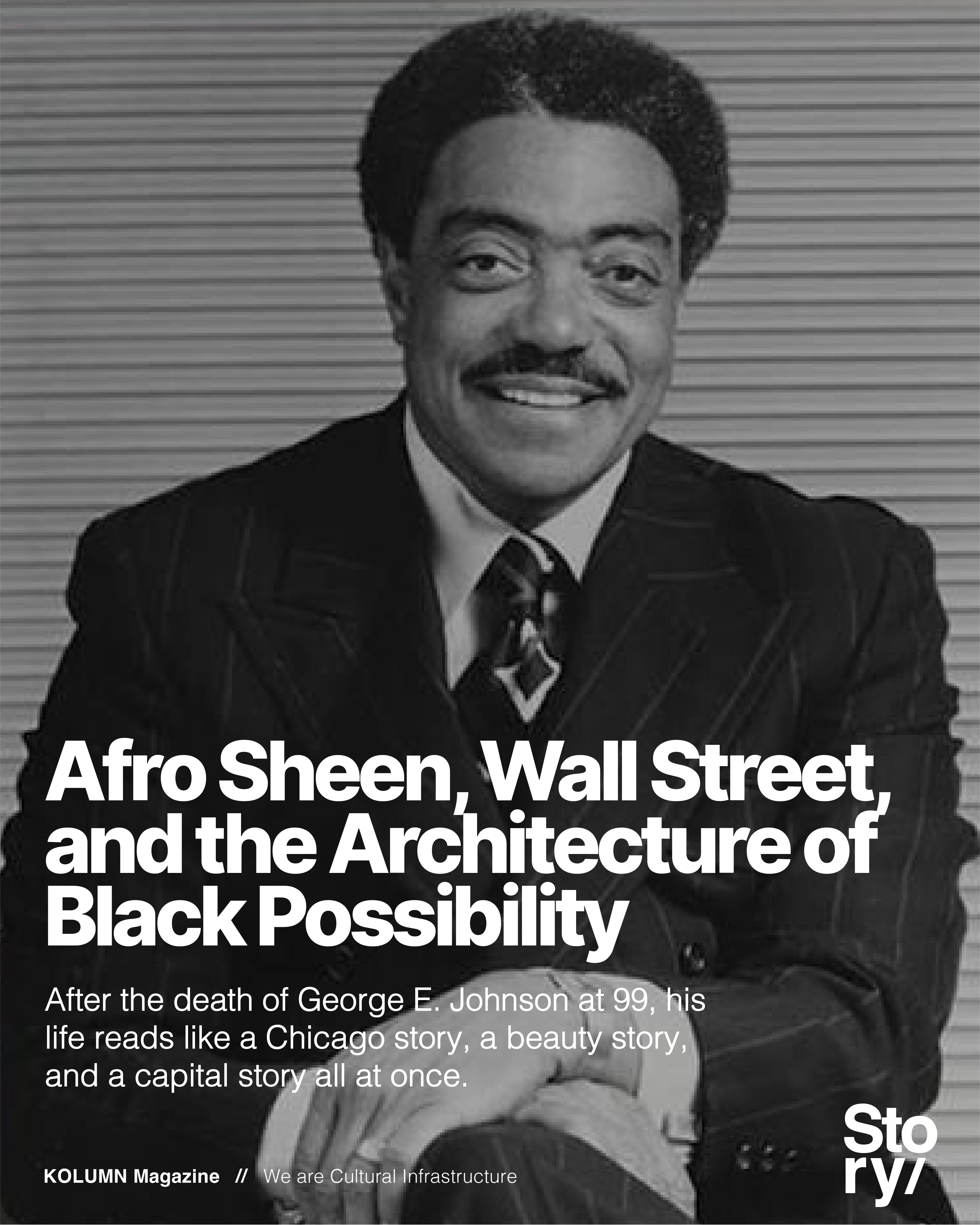
Afro Sheen, Wall Street, and the Architecture of Black Possibility
July 6, 2026
No Comments
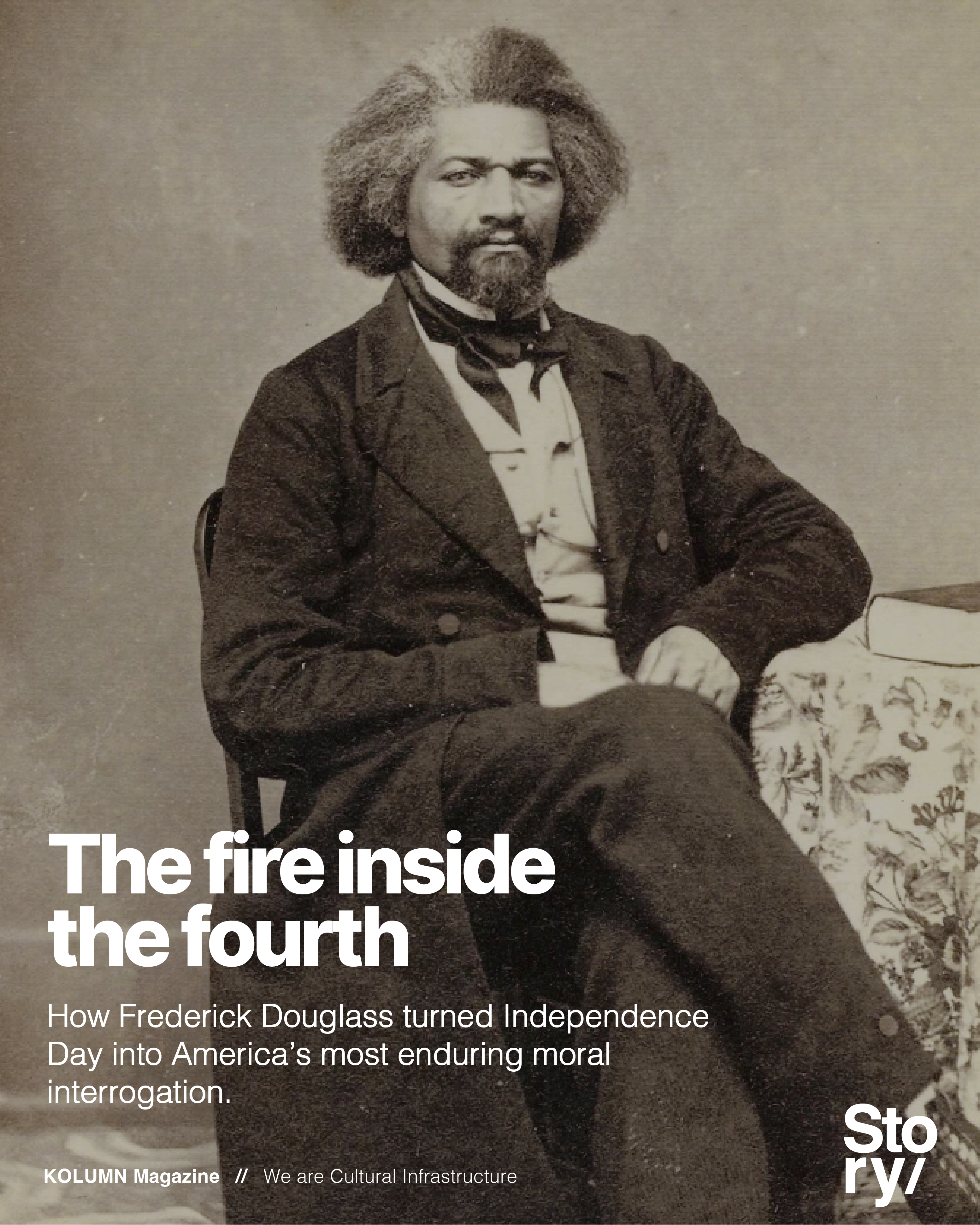
The Fire Inside the Fourth
July 5, 2026
No Comments