




Annie Lee Cooper is remembered for striking Jim Clark. She should be remembered, too, for how many times the state struck first.
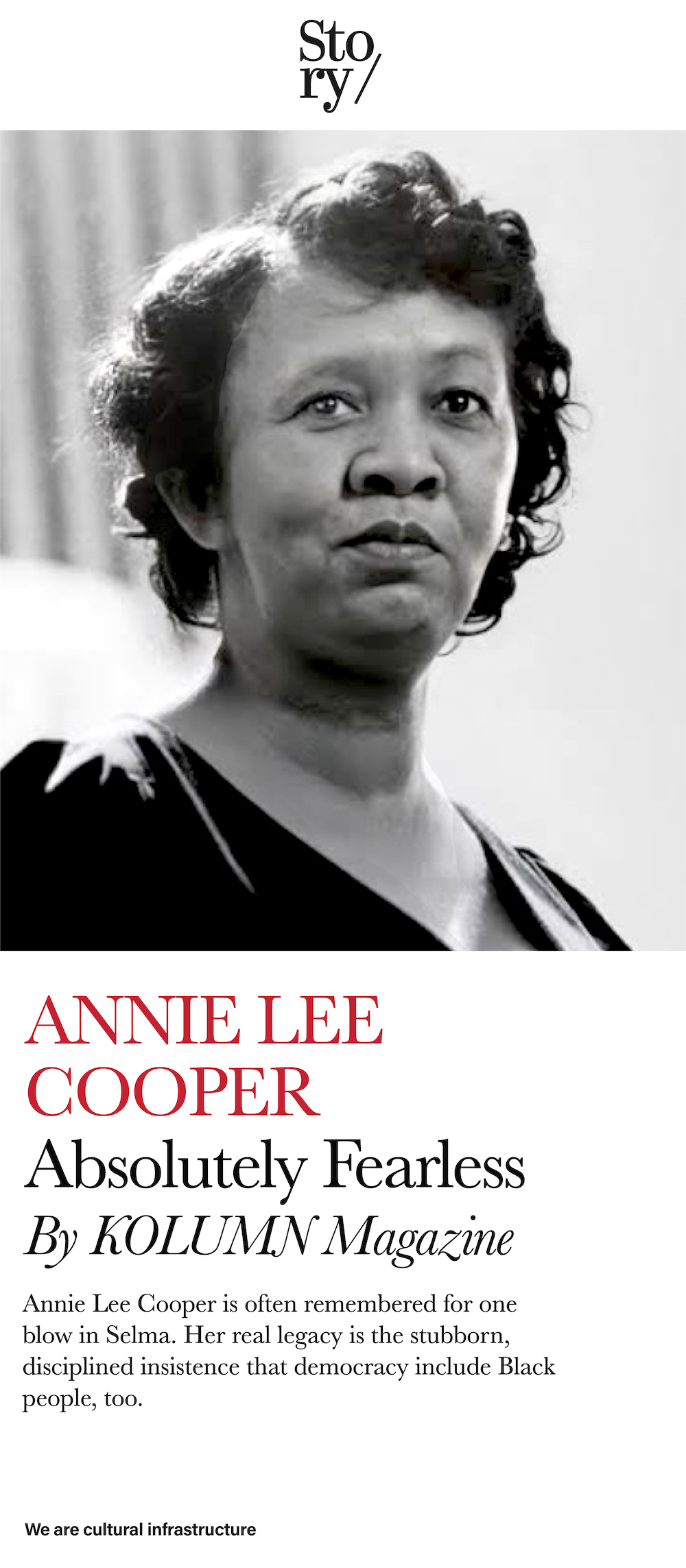
Annie Lee Cooper is remembered for striking Jim Clark. She should be remembered, too, for how many times the state struck first.
By KOLUMN Magazine
American history has a habit of flattening the people who made it. It turns movements into montages, and it turns organizers into symbols. A march becomes a single bridge. A campaign becomes one speech. A woman becomes one punch. Annie Lee Cooper has been subjected to that compression more than most. For many Americans, if they know her at all, she exists as the woman who hit Sheriff Jim Clark in Selma in 1965. That moment matters. It is dramatic, cinematic, and morally clarifying. But it is also incomplete. Annie Lee Cooper’s significance lies not just in the force of one act, but in the long endurance that made that act legible in the first place: decades of work, repeated humiliation, economic retaliation, and an unshaken belief that Black citizenship had to mean something real at the courthouse door.
Cooper was born in Selma on June 2, 1910, and died there on November 24, 2010, after living long enough to see the country commemorate a struggle that once treated people like her as disposable. SNCC’s Digital Gateway describes her as “upfront, pleasant and…absolutely fearless,” borrowing John Lewis’s phrasing, and places her at the center of the local organizing that made Selma a national battleground over voting rights. That wording matters because it restores proportion. Cooper was not a stray footnote in someone else’s story. She was one of the people who made the story possible.
To understand Annie Lee Cooper, you have to begin with the ordinary violence of Jim Crow, not just the spectacular kind. She grew up in a Black Belt city enriched by cotton and ordered by racial hierarchy. Alabama’s 1901 constitution had stripped Black voters from the rolls through poll taxes, literacy tests, and other restrictions designed to preserve white rule. By the time Cooper came of age, disenfranchisement was not merely policy. It was atmosphere. It shaped what Black people could imagine as possible. SNCC notes that Cooper grew up without really considering voting a realistic part of Black life in Alabama; that changed only after she left Selma and saw Black people voting elsewhere.
That detail is crucial. Cooper’s political awakening did not begin with a famous leader descending on town. It began with comparison. After leaving school around the seventh grade, she moved to Kentucky to live with relatives, and later spent time in Ohio as well. In those places, she became a registered voter. The experience was revelatory. The vote was not some abstract constitutional promise; it was a practice she had seen and, outside Alabama, exercised. When she returned to Selma in 1962 to care for her mother, she brought back with her not merely frustration, but evidence. She knew, firsthand, that Black people voting was neither radical nor impossible. It was only being made impossible in Alabama.
That distinction helps explain why Cooper’s story feels so contemporary. The best movements are often powered by people who have seen a wider world and refuse to accept that degradation is natural. She returned to a place that wanted Black residents to treat disenfranchisement as weather, as an unchangeable condition of life. Cooper did not. She had already encountered another democratic standard, and once you have seen that, local humiliation becomes harder to domesticate.
Selma before Selma became myth
The popular memory of Selma is often telescoped into Bloody Sunday and the march to Montgomery. But the National Archives is clear that the Selma marches were the product of organizing by local leaders and organizations, especially the Dallas County Voters League, joined by SNCC and later the Southern Christian Leadership Conference. That means Annie Lee Cooper’s importance sits in the less glamorous, more labor-intensive phase of the struggle: before the cameras fully arrived, before the bridge became a shrine, when the work was door-knocking, line-standing, housing organizers, attending meetings, and risking employment for the right to register.
By the fall of 1963, SNCC had helped turn Selma into what the organization called a testing ground for its “One Man, One Vote” campaign. Cooper joined forces with both SNCC and the Dallas County Voters League, the local formation associated with figures such as Amelia Boynton Robinson and Marie Foster. According to SNCC and the Legal Defense Fund, Cooper also opened her home to movement workers and meetings. This is one of the many ways Black women in the movement have historically been undervalued: domestic space gets treated as background, when in fact homes were infrastructure. Living rooms became strategy rooms. Kitchens became organizing hubs. Hospitality became political labor.
Cooper was trying repeatedly to register in Alabama, and each attempt exposed the mechanics of disenfranchisement. Sometimes she was told she had failed the so-called literacy test. Other times she was simply made to wait and never allowed through. In a Jet recollection quoted by The Washington Post, she remembered going down to register in 1963, being rejected, and in one case standing in line from 7 a.m. to 4 p.m. without ever getting inside. That is the architecture of suppression in its most revealing form: not always a dramatic denial, but a bureaucratic performance of delay, exhaustion, and contempt.
It is worth pausing here because Cooper’s story unsettles the fantasy that voting-rights suppression was mainly a matter of a few bad officials behaving badly. The National Archives notes that Black southerners faced poll taxes, literacy tests, bureaucratic restrictions, intimidation, economic reprisals, and physical violence when they attempted to register or vote. Annie Lee Cooper encountered all of it. Her struggle was not a glitch in the system. It was the system functioning exactly as intended.
Freedom Day and the punishment for wanting citizenship
On October 7, 1963, SNCC organized what became known as Freedom Day in Selma, urging Black residents to crowd the Dallas County courthouse and attempt to register. Around four hundred people showed up and stood for hours in brutal heat. Cooper was among them. The day is often remembered as a civic action, but it was also a workplace test. White employers watched. They took note of who appeared in line. They understood, maybe more clearly than anyone, that Black political participation threatened the entire social order on which cheap labor and racial deference depended.
Cooper was working at Dunn’s Rest Home when her employer, Mr. Dunn, saw her and fellow worker Elnora Collins trying to register. SNCC records that both women were fired within days. The site also reports that Dunn later struck Collins with a cattle prod and that all the other Black women employed there walked off in protest. White employers then blacklisted the women, making it difficult for them to find work. Cooper eventually found employment at the Black-owned Torch Motel. The sequence is revealing: registration attempt, job loss, collective protest, blacklist, economic precarity. This is what the fight for the ballot often cost. Not rhetoric. Rent. Food. Employment. Survival.
The Washington Post, citing Cooper’s 1965 comments to Jet, preserved the bluntness of that retaliation. She said that after going down to register in 1963, “The next day I was fired from my job as a practical nurse at a rest home.” That line deserves to sit in the foreground of any serious account of her life. It rebukes the sentimental version of the civil-rights movement in which courage is abstract and consequences are vague. Cooper understood that white supremacy did not merely hate Black votes; it enforced obedience through payrolls.
And yet she kept showing up. That is the part of the story people tend to rush past because it is repetitive, and repetition is not how public memory likes its heroes. But repetition was the point. The movement in Selma was not built by one transcendent day. It was built by people willing to return after every insult. Annie Lee Cooper’s moral authority came from recurrence. She came back after being dismissed. She came back after being fired. She came back after being made to wait all day. She came back in a place where every return was a refusal to accept one’s assigned station.
“I’ve tried to register several times,” Cooper recalled of Selma’s courthouse regime, describing a process designed less to evaluate than to exhaust.
The courthouse confrontation
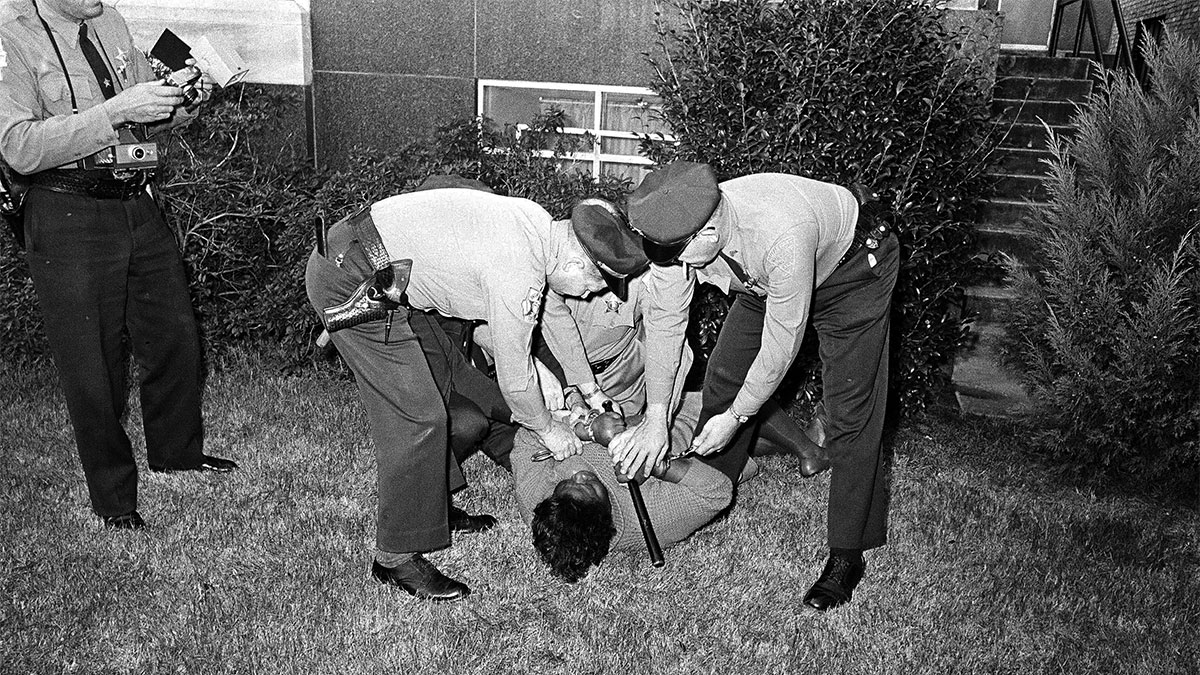
Then came January 25, 1965, the moment for which Cooper is most famous. She stood in line at the Dallas County courthouse once again, attempting to register. According to The Washington Post and SNCC’s account, Sheriff Jim Clark arrived with deputies to break up the line. Clark poked or prodded Cooper with his billy club. Cooper later recalled that he came up behind her, jerked her, and twisted her arm. She broke loose, pushed back, and struck him.
The image has lived for decades because it violated the racial script of the South. Here was a Black woman, in a regime built on the ritualized submission of Black people, physically resisting one of the most notorious local enforcers of white supremacy. But the scene should not be romanticized into spontaneity alone. It came after years of exclusion and after a carefully structured provocation. Clark was not policing neutral space. He was defending a racial order that treated Black applicants as trespassers at the democratic gate. Cooper’s blow was memorable because it made visible the violence already present in the system.
What happened next is just as important. Deputies forced Cooper down, and Clark beat her repeatedly with his club. The Washington Post’s obituary of Clark says deputies held her down while he struck her. Encyclopedia of Alabama similarly describes the confrontation as one in which Clark’s deputies restrained her while he beat her with a billy club. That matters because the most common shorthand, that she “punched Jim Clark,” can accidentally center Clark as the injured party and Cooper as the aggressor. The fuller record shows something else: a state officer initiated the confrontation, then the state used force to punish resistance.
Cooper was arrested, and later accounts say she was detained for hours before being released after charges were dropped. Some sources indicate officials considered severe charges, even attempted murder, before backing off. However the paperwork shifted, the larger fact is clear: the legal system moved immediately to criminalize the Black citizen who resisted abuse, not the officer who inflicted it. That asymmetry sits at the heart of the Selma story. Law in Dallas County did not stand above white supremacy. It operationalized it.
There is a tendency, particularly in popular retellings, to treat this episode as a deviation from the movement’s commitment to nonviolence. But that frame can be too neat. Cooper’s action did sit uncomfortably with public expectations of nonviolent discipline. Yet it also revealed a truth that movement historians have long understood: not every person fighting for the vote entered the struggle as a sainted icon of passive suffering. Many were ordinary people confronting extraordinary abuse. Cooper’s response did not diminish the movement’s legitimacy. If anything, it underscored the inhumanity of expecting Black citizens to absorb endless indignity without ever defending their own bodies.
Why Black women like Cooper were pushed to the margins
One of the enduring problems in civil-rights memory is that Black women are everywhere in the movement and underrepresented in its mythology. The Legal Defense Fund’s retrospective on the women of Selma explicitly argues that women’s work has often been overshadowed by their male contemporaries, even though the movement depended on them. Cooper’s life is a textbook example. She housed organizers, joined local political work, endured job loss, kept returning to the courthouse, and became a public face of the struggle. Yet for years she was more likely to be caricatured in headlines than interpreted as a strategist, citizen, and moral witness.
That distortion was racial and gendered at once. Black women in movement history are often allowed visibility only at the edges of spectacle: as grieving mothers, anonymous marchers, or embodiments of suffering. What Cooper did not fit easily was the category of respectable passivity. She was plainspoken, direct, and unafraid of confrontation. John Lewis’s description of her as “absolutely fearless” is not just affectionate; it is analytical. Fearlessness in a Black woman has often been treated by American culture as inconvenient evidence, because it complicates the easier iconography of noble suffering.
This is one reason Cooper’s rediscovery in the twenty-first century matters. Her reemergence does not simply add another name to the civil-rights roll call. It changes the texture of the story. Selma becomes less a tale of a few nationally known men and more a dense local ecosystem of women, workers, churchgoers, students, and neighbors who forced the country to see what it was doing. In that fuller history, Annie Lee Cooper is not an exception. She is representative of the people whose labor made leadership effective.
From local confrontation to national law
The Selma campaign did not produce the Voting Rights Act through symbolism alone. It forced a crisis by demonstrating that case-by-case litigation and federal caution were insufficient against entrenched local resistance. The Justice Department’s own history says that by 1965 efforts to break state disfranchisement had yielded only modest gains, and that the unprovoked March 7 attack on peaceful marchers in Selma helped persuade President Johnson and Congress to overcome resistance to meaningful voting-rights legislation. In other words, the movement succeeded because local struggle exposed the bankruptcy of incrementalism.
Annie Lee Cooper belongs inside that causal chain. She was not on the margins of the story leading to federal action; she was one of the people who gave the nation evidence. Her beating by Clark came weeks before Bloody Sunday, and together these episodes helped reveal what Dallas County’s voting regime really was: not administrative procedure, but organized racial coercion. The National Archives identifies the Selma marches as a watershed that led to the passage of the Voting Rights Act of 1965. The Justice Department adds that the existing legal framework had proven too weak, because every time one discriminatory device was challenged, another could replace it. Selma supplied the public proof that the problem was structural.
When President Lyndon B. Johnson signed the Voting Rights Act on August 6, 1965, the law outlawed literacy tests and created mechanisms, including federal examiners, to register qualified voters in jurisdictions where discrimination had blocked access. The National Archives notes the act’s immediate effect: by the end of 1965, roughly a quarter million new Black voters had been registered, about one-third by federal examiners. That is not merely legislative history. It is Annie Lee Cooper’s life translated into statute. The law targeted the exact machinery that had been used against her: tests, arbitrary barriers, local evasion, and intimidation.
This is one reason Cooper’s story remains so vital now. She is often treated as a figure from the prehistory of voting rights, as though her struggle ended when the act passed. But her biography insists on a harder lesson. Rights on paper are only as strong as the institutions willing to enforce them and the citizens willing to defend them. Cooper fought not for a commemorative democracy but for a functional one.
The long afterlife of Selma
Cooper successfully registered to vote in Alabama after the courthouse confrontation, according to Teaching for Change and later summaries of her life. That outcome has the shape of vindication, but it would be wrong to read it as closure. Registration was not a happy ending; it was proof of what had been wrongly denied all along. The more telling question is why it took so much. Why did a woman who had already voted in other states have to endure firing, blacklisting, beatings, and jail to do something so basic in her home state? The answer is the same one that shadows the whole movement: Black citizenship in the South had to be fought into administrative reality.
Cooper lived long enough to become a centenarian. In later years, Selma began to treat her not as a nuisance to order but as a historical figure. Accounts note that a street near her home was renamed in her honor. That kind of civic recognition is meaningful, but it also reveals an American pattern. The nation often waits until danger has passed to celebrate the people it once punished for telling the truth. Annie Lee Cooper was honored because history eventually caught up to what she had already known: there was no moral legitimacy in a democracy that made Black people beg for entry.
Her death in 2010, at age 100, closed a life that had spanned the hard arc from Jim Crow disfranchisement to public commemoration. But even then, broad recognition lagged. For many people outside movement history, Cooper became newly visible only after Oprah Winfrey portrayed her in Ava DuVernay’s 2014 film Selma. The Washington Post identified Winfrey as the actor who brought Cooper to a larger audience, and Winfrey later said she accepted the role because of “the magnificence of Annie Lee Cooper” and what her courage meant to the movement. The movie mattered not because Hollywood discovered Cooper, but because it forced a wider public to ask why they had not known her already.
That is perhaps the most useful thing about Selma: it did not complete Cooper’s story, but it interrupted her erasure. The risk, of course, is that film can shrink her again into one powerful scene. The task of journalism and history is to widen the frame back out. Annie Lee Cooper was not important because she delivered a satisfying act of defiance that plays well on screen. She was important because she embodied the everyday toughness required to turn constitutional theory into lived democratic access.
Annie Lee Cooper’s significance now
To write about Annie Lee Cooper in the present tense is to confront a question the country still has not resolved: what do Americans owe the people who made democracy more democratic? Not rhetorically. Materially, politically, historically. Cooper’s life points toward an answer. We owe them accuracy. We owe them proportion. We owe them more than one frozen image.
Accuracy means saying that she was a local activist, not just a supporting player in someone else’s movement. It means acknowledging that Selma’s campaign was built by organizations including the Dallas County Voters League and SNCC before national attention fully settled there. It means recognizing that women like Cooper paid a price in wages, safety, and public reputation. It means telling the truth that the franchise in Alabama was defended by violence and that federal law changed because local people made that violence impossible to ignore.
Proportion means understanding that Cooper’s punch, famous as it is, was not the whole moral event. The whole event was a state that kept blocking Black people from voting; a courthouse that functioned like a racial checkpoint; an employer who retaliated against workers for seeking citizenship; a sheriff who used his club as political argument; and a woman who kept returning anyway. That is the real drama. The blow landed because the burden had already been enormous.
And to owe her more than one image is to understand that Annie Lee Cooper stands for a broader category of American political actor: the local person whose name is nearly lost because her labor was considered too ordinary to monumentalize. She was not ordinary in the sense of being interchangeable. She was ordinary in the sense that movements require thousands of people like her, people who are not trying to become legends, only citizens. That is why her story matters beyond Selma. It is a study in how democracy actually changes. Not from sentiment alone, but from stubborn people forcing institutions to obey their own claims.
Annie Lee Cooper did not ask the country for inspiration. She asked it for a ballot, and when it refused, she helped expose the refusal to the world.
There is also a deeper lesson in Cooper’s life about memory itself. American political culture prefers movement narratives that are inspirational without being too indicting. Cooper resists that sanitization. Her life insists that disenfranchisement was enforced not only by demagogues and mobs, but by clerks, tests, bosses, delays, and “procedure.” It insists that Black women were not auxiliary to freedom struggles but constitutive of them. And it insists that resistance sometimes looks like patient line-standing and sometimes looks like pushing back when the club comes down.
That makes her a difficult and necessary figure. She belongs in the lineage of people who compel the nation to stop romanticizing its democratic promises and start measuring them against lived reality. In Selma, Annie Lee Cooper measured that distance with her own body. She stood in lines meant to humiliate her. She lost work for seeking the vote. She was beaten for refusing mistreatment. She lived long enough to watch the country finally name some portion of what she had done. Yet even now, the responsibility remains with us to tell it fully.
Annie Lee Cooper was never just the woman who struck Jim Clark. She was a witness to the fraud of American democracy under Jim Crow and a worker in the long campaign to make that democracy answerable to Black people. She matters because she turned refusal into persistence, persistence into confrontation, and confrontation into a piece of national reckoning. She matters because the right to vote, in her life, was not ceremonial. It was the dividing line between being managed and being counted.
And maybe that is the cleanest way to say what her legacy is. Annie Lee Cooper did not just help expand American democracy. She embarrassed it into honesty.
More great stories
Afro Sheen, Wall Street, and the Architecture of Black Possibility
July 6, 2026
No Comments
The Fire Inside the Fourth
July 5, 2026
No Comments