


Harold Cruse did not want Black politics to be admired. He wanted it to be effective.
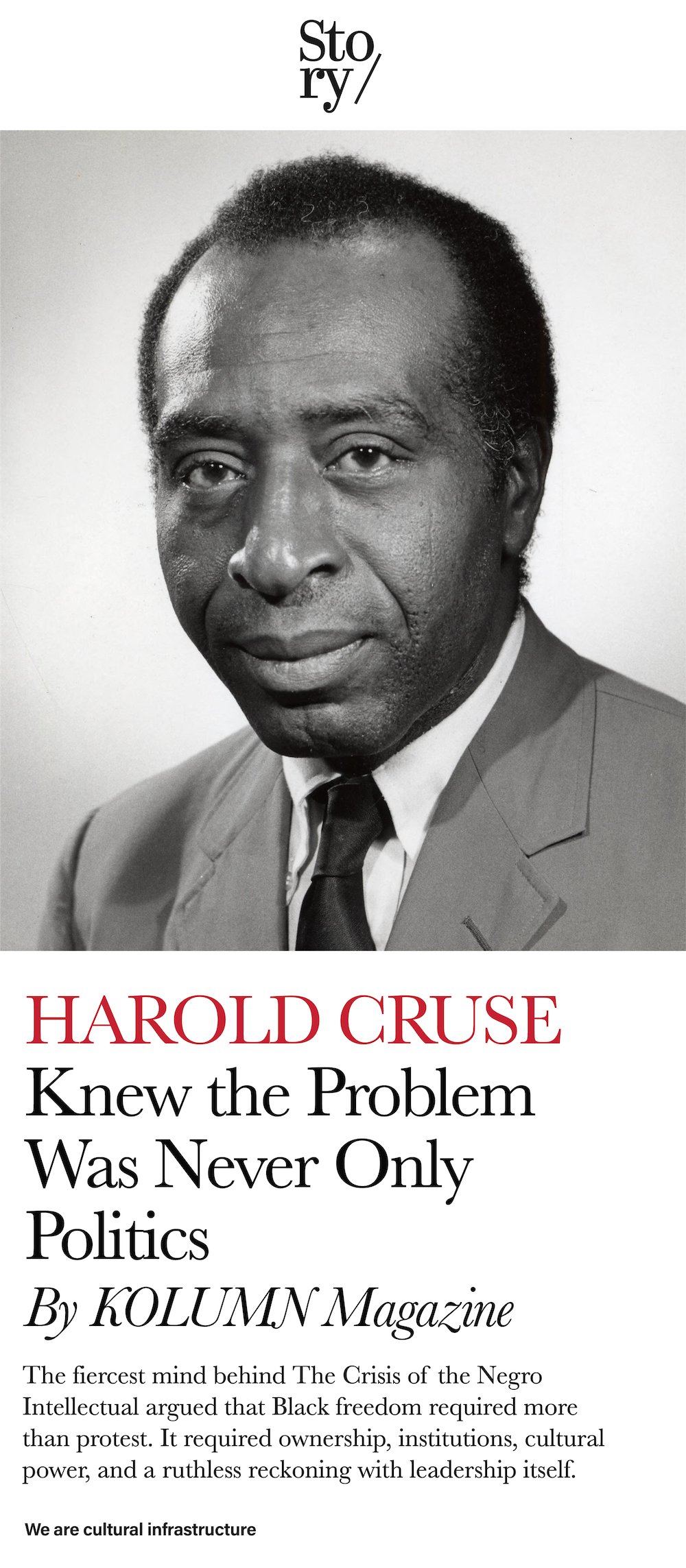
Harold Cruse did not want Black politics to be admired. He wanted it to be effective.
By KOLUMN Magazine
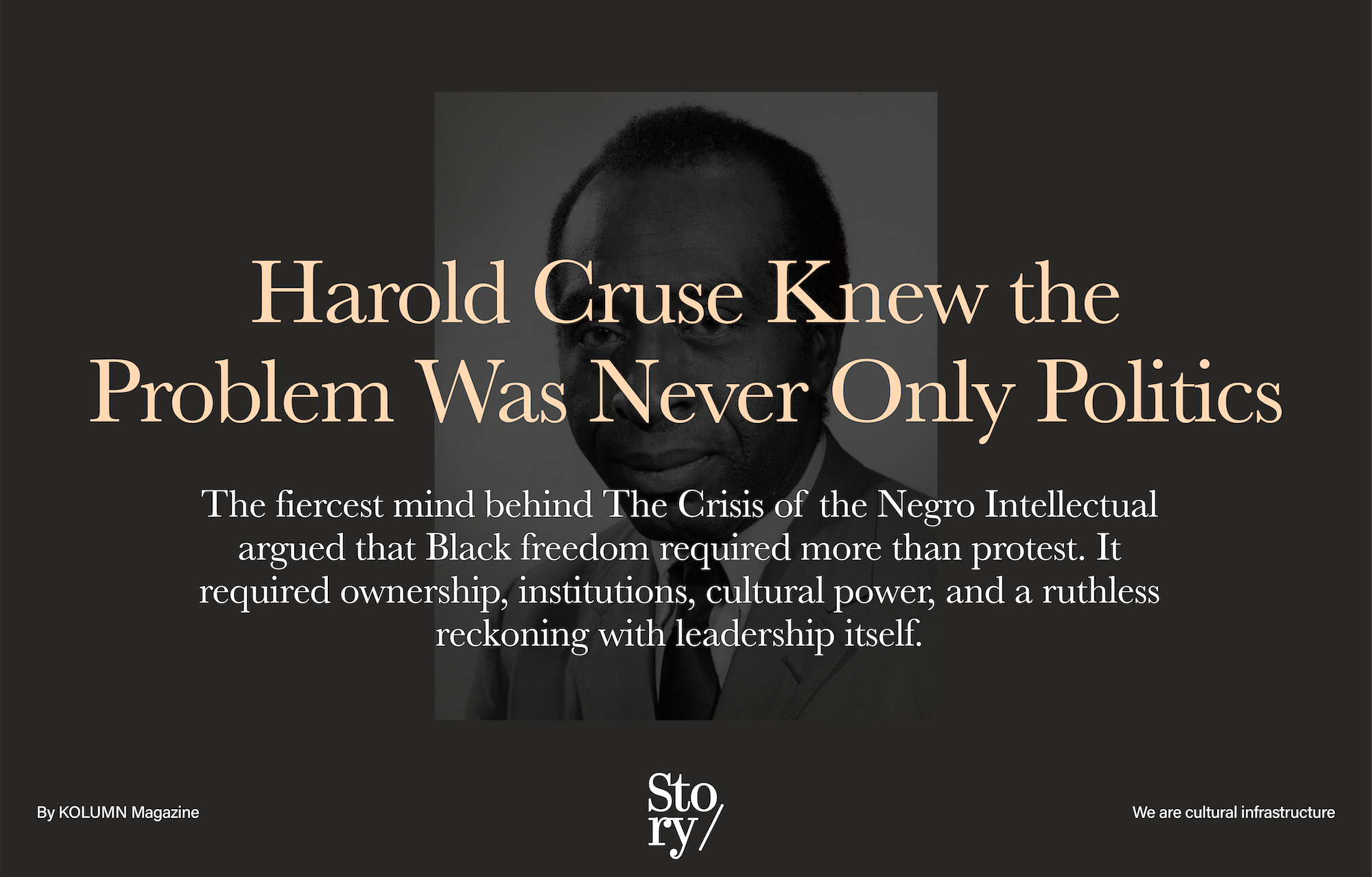
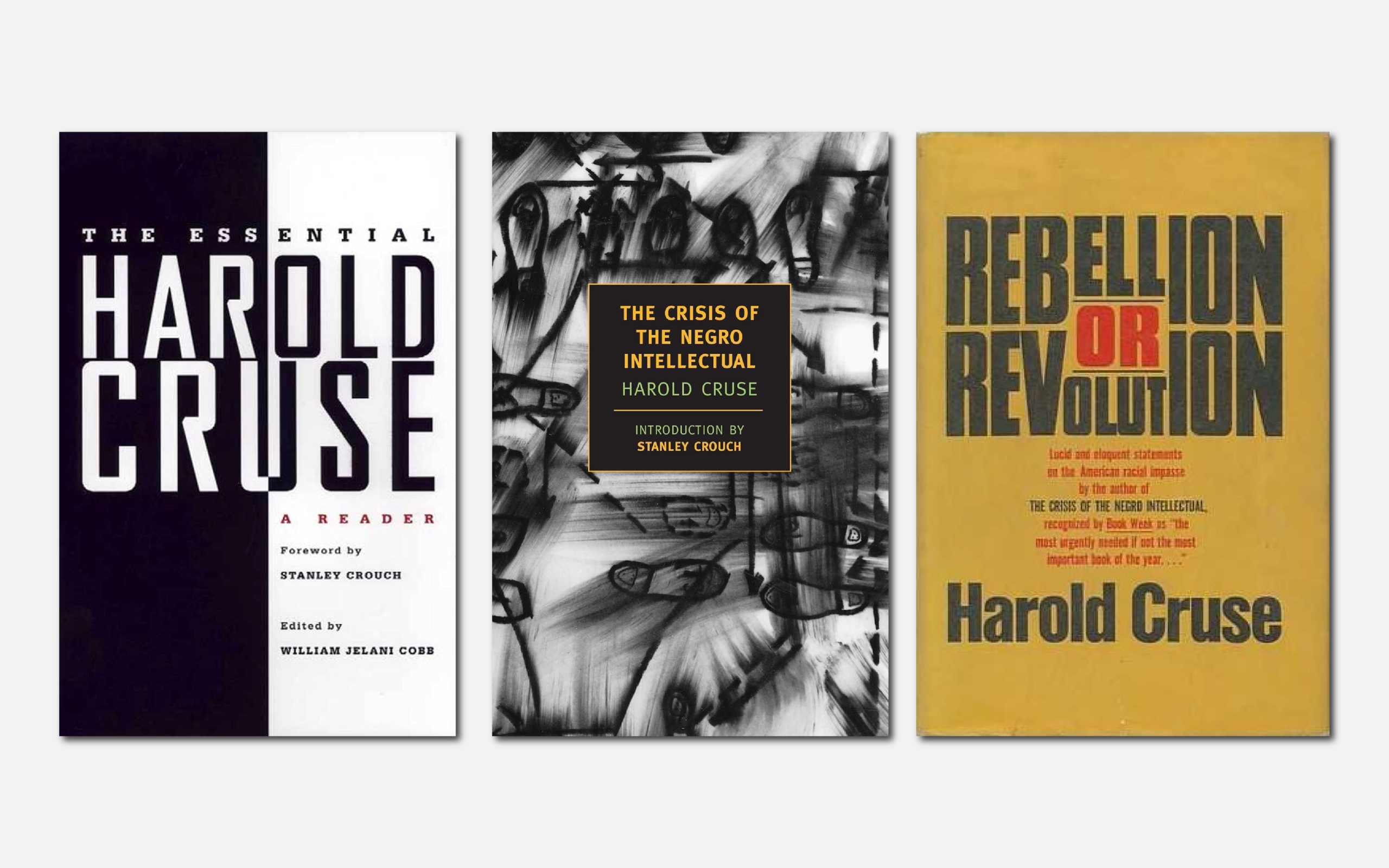
Harold Cruse remains one of the most unsettling figures in twentieth-century Black intellectual life, which is another way of saying he remains one of the most necessary. He did not write to comfort his readers. He wrote to expose what he believed were the structural weaknesses in Black political thought, Black cultural production, interracial liberalism, and the American left. His name is still spoken most often in connection with The Crisis of the Negro Intellectual, the 1967 book that established him as one of the era’s most formidable and quarrelsome critics. But to reduce Cruse to a single book, even a landmark one, is to miss the larger fact of his life: Harold Cruse was trying to remake the terms by which Black political and cultural leadership would be judged in the United States.
That ambition explains why Cruse still feels contemporary. In a period when public conversation often flattens Black politics into electoral shorthand and Black culture into visibility metrics, Cruse’s old insistence lands with fresh force: culture is not decorative. It is institutional. It is economic. It is political. It is bound up with ownership, patronage, education, media, and the capacity of a people to narrate themselves rather than be narrated by others. His great complaint was not simply that Black America had been oppressed by white supremacy. That part was obvious. His complaint was that too many Black intellectuals and leaders had failed to develop a durable strategy for wielding power inside the nation that oppressed them.
For KOLUMN, Cruse belongs in the same editorial lineage as the Black writers, artists, and thinkers whose lives reveal that cultural labor is never merely aesthetic. In recent KOLUMN-ready considerations of figures such as Countee Cullen and Joan California Cooper, the underlying question has been how Black imagination survives, adapts, and contests the institutions around it. Cruse pushed that question into harsher territory. He did not simply ask what Black art means. He asked who owns the theaters, who prints the books, who controls the criticism, who funds the schools, and why so many Black leaders had mistaken access for sovereignty.
A childhood between Virginia and Harlem
Harold Wright Cruse was born in Petersburg, Virginia, in 1916, the son of a railway porter. After his parents separated, he moved to New York City while still young, growing up largely in Harlem and absorbing the world of Black urban modernity that would later animate so much of his criticism. That movement between South and North mattered. It gave Cruse a vantage point that was not provincial and not fully assimilationist either. He came of age in a Black metropolis shaped by migration, performance, commerce, radical politics, and the afterlife of the Harlem Renaissance. He was less interested than many later mythmakers in preserving Harlem as a symbol. He wanted to understand it as an ecosystem of class interests, ambitions, failures, and cultural battles.
His early fascination with performance and public culture would prove decisive. Cruse was drawn not only to books and ideas but to theater, music, and the machinery of cultural life itself. This is one reason The Crisis of the Negro Intellectual reads so differently from conventional political history. It is crowded with playwrights, editors, magazines, publishers, actors, movements, factions, impresarios, and institutions. Cruse understood earlier than many of his peers that there was no clean line separating the political from the cultural in Black life. A people denied political sovereignty would necessarily wage part of its struggle through schools, newspapers, stages, screens, churches, unions, and artistic movements.
War, labor, and the making of a dissident
Like many men of his generation, Cruse was shaped by war. He served during World War II in the U.S. Army’s 28th Quartermaster Regiment and saw combat in North Africa and Italy. Military service widened his world, but it did not resolve his politics. If anything, the war years and their aftermath sharpened his sense that American democracy was rhetorically expansive and structurally selective. Black service abroad did not translate automatically into Black freedom at home. That contradiction, familiar across the twentieth century, became one of the moral conditions under which Cruse’s criticism matured.
After the war, he attended City College of New York but did not graduate. The absence of a formal degree became part of his legend later, especially when he rose to full professorship and tenure at the University of Michigan. But it also shaped his style. Cruse was not a disciplinary thinker in the narrow academic sense. He was a self-fashioned intellectual, impatient with pieties and impatient, too, with the credentialed class that often mistook institutional status for analytical depth. His prose could be sprawling, abrasive, repetitive, and brilliant. He wrote like a man who regarded polite consensus as evidence that the real issue had been avoided.
For a period in the late 1940s, Cruse joined the Communist Party and wrote reviews for the Daily Worker. That episode mattered less because he stayed in the party than because he left it. Cruse came to believe that American communism did not adequately comprehend the specificity of Black experience in the United States and too often subordinated Black struggle to imported ideological formulas or white-led organizational habits. His break with the Communist Party became one of the defining tensions in his later work. He never abandoned structural critique, but he rejected any left politics that failed to grasp race as more than a secondary contradiction.
That break also helps explain why Cruse could never be comfortably absorbed into any camp. He was too nationalist for orthodox Marxists, too skeptical for celebratory nationalists, too institutionally demanding for liberals, and too unsparing toward Black leadership to become a usable saint. The friction was the point. Cruse believed Black intellectual life had become trapped by slogans and borrowed frameworks. He meant to break the spell.
Cuba, Black nationalism, and a widening political horizon
In 1960, Cruse traveled to Cuba with a delegation of Black writers and intellectuals that included figures such as Amiri Baraka, Julian Mayfield, and John Henrik Clarke. The trip has taken on outsized symbolic importance because it sat at the intersection of anti-colonial fervor, Cold War alignment, and the growing restlessness of Black intellectuals dissatisfied with both American liberalism and white-led radicalism. For Cruse, Cuba was not a conversion experience so much as part of a broader political education. It reinforced his sense that Black Americans needed a political language adequate to their own historical position, rather than one inherited wholesale from Europe or borrowed from white American progressives.
By the early 1960s, he was contributing essays and arguments that would eventually feed into The Crisis of the Negro Intellectual and later into Rebellion or Revolution? His thinking moved toward a form of cultural nationalism, but it was not the easy romantic kind. He was not arguing merely for pride, style, or symbolic reclamation. He was arguing for institutional Black control over culture and for a political strategy grounded in American realities rather than abstract revolutionary theater. Later readers have rightly noted that Cruse could be contradictory here, simultaneously dismissing some versions of nationalism while arguing for Black autonomy with unmistakable nationalist force. But even that contradiction is revealing. He was trying to think through the problem of collective power in a society where Black people were both central to the nation and denied full possession of it.
The book that made enemies in every direction
When The Crisis of the Negro Intellectual appeared in 1967, it arrived like an indictment. New York Review Books later described it as a work that “electrified a generation of activists and intellectuals,” and that phrase is not exaggerated. The book was published at a moment when the early triumphs of civil rights liberalism were giving way to urban rebellion, ideological fracture, and the rise of Black Power. Cruse used that moment not to celebrate a new consensus but to announce that there was none. The Black movement, he argued, was at an impasse because it lacked a sufficiently serious corps of intellectuals able to analyze the American situation in all its institutional complexity.
The scope of the book was astonishing. Cruse moved through Harlem history, the legacy of the Renaissance, left politics, theater, publishing, media, labor, Black-Jewish relations, the Communist Party, civil rights leadership, and the failures of cultural democracy. He named names and kept naming them. W.E.B. Du Bois, Richard Wright, James Baldwin, civil rights liberals, Black nationalists, white radicals, Black Marxists, publishers, editors, and artists all came under scrutiny. The effect was cumulative and bruising. Readers encountered not a neat theory but a battlefield report from a critic convinced that nearly everyone had misread the terrain.
Cruse’s central proposition was simple enough to state and hard enough to satisfy: Black liberation required a Black intellectual and cultural class capable of building institutions, commanding resources, and directing public life on terms not dependent on white patronage. He believed Black Americans had too often produced talent without producing the structures necessary to sustain that talent. The result, in his telling, was a recurring pattern of co-optation, dependency, or theatrical rebellion detached from material control.
This is why Cruse’s work still startles. He was not satisfied by the moral drama of protest alone. He wanted to know what happened after the march, after the speech, after the poem, after the applause. Who owns the outlet? Who trains the cadre? Who distributes the work? Who profits? Which class benefits? In today’s language, one might say Cruse was obsessed with infrastructure. But even that sounds too managerial for a thinker whose prose often carried the heat of betrayal. He believed generations of Black genius had been squandered by a failure to convert cultural brilliance into durable institutional power.
Against easy integration, against lazy nationalism
Cruse has often been described as a Black nationalist, and the label is not wrong, but it is incomplete. What distinguished him was not simply a commitment to Black autonomy. It was his dissatisfaction with the available languages of Black politics on all sides. He criticized integrationists for mistaking access to white institutions for a solution to Black inequality. He criticized Marxists for minimizing race or funneling it into class-first abstractions. He criticized nationalists when they substituted mood for strategy or rhetoric for institution-building. What he wanted was a political realism rooted in the actual position of African Americans as a distinct historical people within the United States.
His arguments about Black-Jewish relations, interracial organizing, and ethnic group competition were among the most controversial parts of his work, then and now. Some readers regarded those sections as sharply diagnostic, especially in their attention to how different groups entered the American system with different routes to power. Others saw in them distortions, resentments, and generalizations that weakened his historical judgment. Later critics have also pointed to conspiratorial tendencies and damaging blind spots in some of Cruse’s formulations. Those objections are not incidental to his legacy; they are part of it. Cruse matters not because he was right about everything but because he forced readers into arguments they could not settle with sentiment.
This is the difficult thing about Cruse. He remains useful and dangerous at once. Useful because he understood the political economy of culture with uncommon clarity. Dangerous because he could push that clarity into overstatement, grievance, or flattening caricature. Serious engagement with him requires both recognitions. To canonize him is to evade him. To dismiss him is also to evade him.
Culture was never “extra” to him
The deepest originality in Cruse’s thought lies in how seriously he took culture as a field of power. That may sound obvious now, in a century saturated with talk of media ecosystems and narrative control. It was not obvious in the same way when Cruse was writing. He grasped that Black artistic production could not be separated from the economic and institutional conditions under which it circulated. The question was never merely whether Black people had produced great art. They had. The question was whether they possessed the means to govern the institutions through which that art acquired meaning, value, and staying power.
This emphasis helps explain Cruse’s recurring attention to theater, film, journalism, publishing, and criticism. He saw them not as side concerns but as sites where political defeat or advancement could be organized. In that sense, Cruse anticipated later arguments about cultural industries, Black public spheres, and the institutionalization of minority discourse. He also anticipated later frustrations with a society happy to consume Black style while resisting Black control. His writing, for all its period-specific quarrels, still feels uncannily fitted to an era in which Black expression is globally marketable and Black institutional sovereignty remains uneven at best.
From polemicist to professor
The notoriety of The Crisis of the Negro Intellectual helped bring Cruse to the University of Michigan in 1968. There, despite never having completed college, he became a professor, eventually earning tenure and helping build what would become one of the nation’s significant centers for Afro-American and African Studies. University of Michigan records describe him as instrumental in the founding of the Center for Afro-American and African Studies and identify him as its first director. That institutional role matters as much as the book. Cruse did not remain only a critic of institutions; he became a builder inside one.
There is a certain poetry in that fact. The man who had spent so much energy scolding Black intellectuals for their inability to establish durable cultural authority found himself helping to define a new academic field. Black Studies, as it emerged in the late 1960s and 1970s, was never a single coherent project. It was a struggle among militants, scholars, administrators, students, and community visions. Cruse entered that struggle as someone who believed the field must be rigorous, historically grounded, and institutionally serious. The University of Michigan later situated him within the history of race on campus precisely because his role exceeded ordinary faculty service; he was part of the making of a structure.
His later books, including Plural but Equal and The Essential Harold Cruse, extended these concerns, even if they never eclipsed the shadow cast by Crisis. He remained committed to analyzing race through the lenses of power, pluralism, ethnicity, and social organization rather than through moral aspiration alone. Readers did not always follow him there. Some found the later work provocative but less galvanizing. Yet the continuity is unmistakable: Cruse spent his career trying to name the institutional terms under which Black life was forced to negotiate America.
The critic’s afterlife
Cruse died in 2005 in Ann Arbor, Michigan, of congestive heart failure. Obituaries in the Washington Post, Los Angeles Times, and University of Michigan publications presented him as a fierce, often controversial social critic whose best-known work had left an indelible mark on Black political and cultural debate. But death did not end the argument around him. If anything, the decades since have made his work newly legible to scholars studying Black Studies, African American intellectual history, and the entanglement of race and institutions.
Some later scholars have stressed the durability of his questions even when they challenge the accuracy of his answers. AAIHS essays on Cruse have described Crisis as a work of “ruthless criticism,” while also publishing sharp reassessments that argue the book holds up unevenly as intellectual history. Cambridge scholarship has gone even further, suggesting that the “crisis” Cruse named has, in some respects, given way to a kind of triumph in African American intellectual life through the growth of institutions, archives, and scholarly fields that scarcely existed at the scale he confronted. That is an irony Cruse himself might have appreciated: he helped create the very intellectual world that now judges him.
Yet the triumph is incomplete, and this is where Cruse keeps returning. The formal institutionalization of Black Studies did not solve the broader problems he identified. Black culture can be globally visible while Black institutions remain financially precarious. Black writers can be canonized while Black-owned media struggle for capital. Black criticism can flourish in universities while mass culture rewards spectacle over memory. Cruse’s insistence on joining cultural analysis to questions of control, patronage, ownership, and class still presses on these contradictions.
The blind spots that must be named
A serious appraisal of Harold Cruse cannot sidestep the limits of his work. His prose could harden into sweeping generalization. His treatment of women was often narrow or underdeveloped. His discussions of Jews and Black-Jewish relations, while influential, have also been criticized for resentment, imbalance, and interpretive distortion. Some commentators have noted that his polemical style, which gave Crisis so much energy, also led him at times toward overreach and historical unfairness. These criticisms do not erase his significance, but they do set terms for how he should be read now: as a major thinker whose brilliance and damage are not cleanly separable.
That complexity is exactly why Cruse still belongs in the conversation. The point is not to recover him as a saint of Black Studies. It is to confront the force of a mind that saw what many others preferred not to see: that symbolic inclusion can coexist with structural weakness, and that cultural prestige without institutional control can become a sophisticated form of dispossession. Even his harshest critics often concede that he changed the terrain of debate. He made it harder to talk about Black leadership, Black art, or interracial politics without addressing the material conditions that shape them.
Why Harold Cruse belongs now
What would Cruse make of the present? He would likely recognize certain symptoms immediately. He would see a nation eager to celebrate Black cultural output while endlessly negotiating the terms of Black political legitimacy. He would see the expansion of Black professional and academic classes alongside persistent institutional fragility in media, education, and cultural ownership. He would see mass visibility mistaken for power. He would see performative radicalism flourishing beside weak organizational capacity. Above all, he would ask the same rude question he always asked: who actually controls the means by which Black life is represented, funded, taught, archived, and reproduced? That question remains lethal because it remains unresolved. This is an inference from the structure of his published arguments and their later reception.
Cruse also belongs now because he understood that argument itself is part of cultural seriousness. He did not believe a people could flatter themselves into freedom. He believed they had to think harder, organize better, and build institutions that outlived charisma. In an era allergic to sustained intellectual combat, there is something almost cleansing about his refusal to dilute disagreement. One does not read Harold Cruse to be soothed. One reads him to remember that critique, when it is historically grounded and institutionally alert, can be a form of political labor.
And that is finally where his significance lies. Harold Cruse was not merely the author of a famous book. He was an architect of pressure. He pressed on the civil rights consensus from one side, on Marxist orthodoxy from another, on Black nationalism from another still, and on the academy as both refuge and problem. He forced Black intellectual life to account for its institutions, not just its ideals. He made culture answer to economics, politics answer to structure, and rhetoric answer to control. Even where he was wrong, he was wrong in ways that compelled response. Few critics can claim as much.
For a magazine like KOLUMN, that is reason enough to bring him forward again. Harold Cruse belongs to the genealogy of Black figures who refused to treat culture as mere ornament. He saw it as territory. He understood it as a contest over memory, ownership, education, performance, and power. He could be severe, unfair, dazzling, and impossible. He was also, unmistakably, one of the minds that changed the argument. That argument is still underway.
More great stories
Afro Sheen, Wall Street, and the Architecture of Black Possibility
July 6, 2026
No Comments
The Fire Inside the Fourth
July 5, 2026
No Comments