





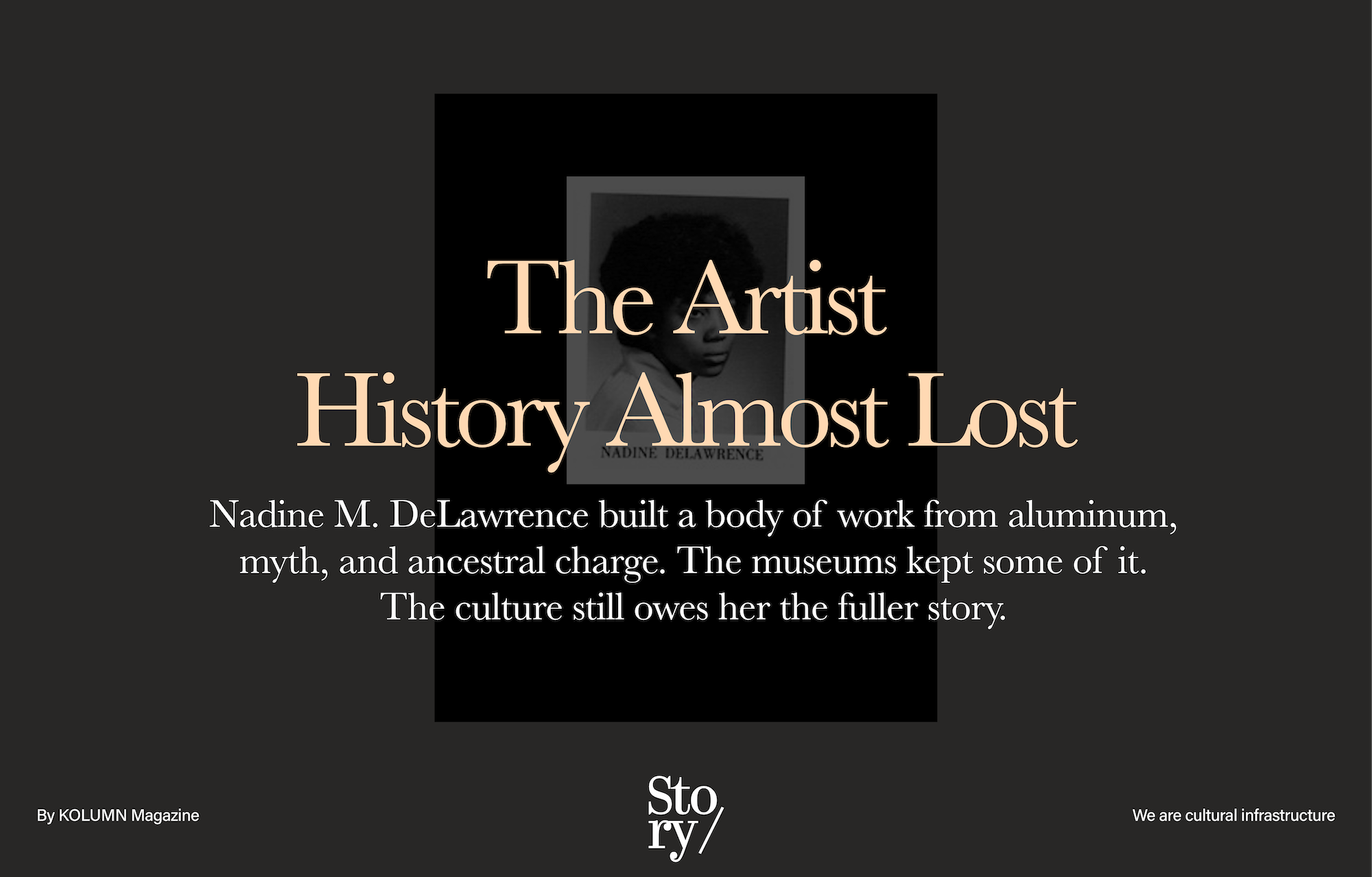
She was not a footnote orbiting bigger names. She was building a visual language of Black spirit, symbol, and selfhood in plain sight.
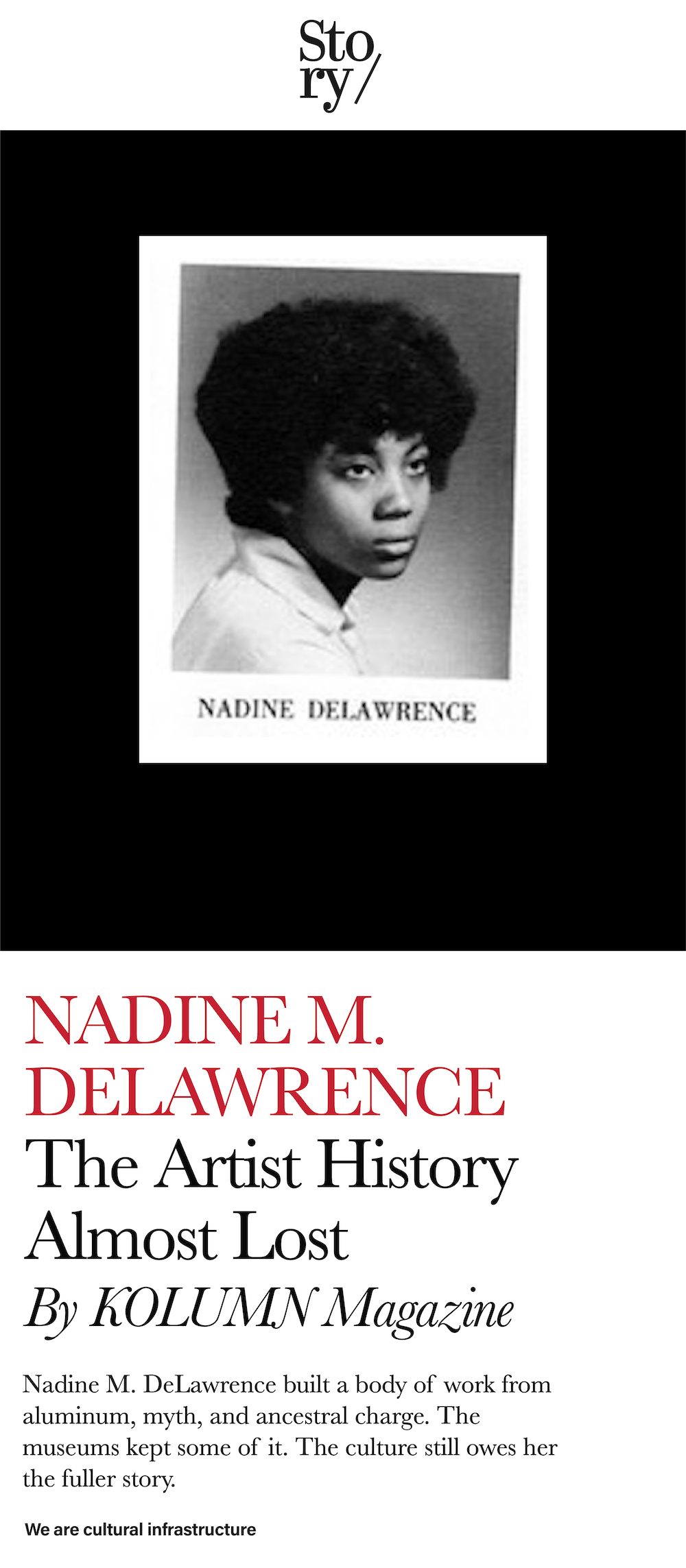
She was not a footnote orbiting bigger names. She was building a visual language of Black spirit, symbol, and selfhood in plain sight.
By KOLUMN Magazine
There are artists whose fame arrives on time, and there are artists whose relevance has to be recovered from the edges of memory, from museum checklists, scattered catalogs, archival mentions, and the surviving force of the work itself. Nadine M. DeLawrence belongs to the second category. She was born in Hartford, educated at RISD, worked in both sculpture and printmaking, built a serious exhibition record in New York and beyond, and died in 1992 at just 39 years old. The facts alone should have secured her a larger place in the public story of late-20th-century American art. They did not. That gap between achievement and recognition is exactly why DeLawrence matters now.
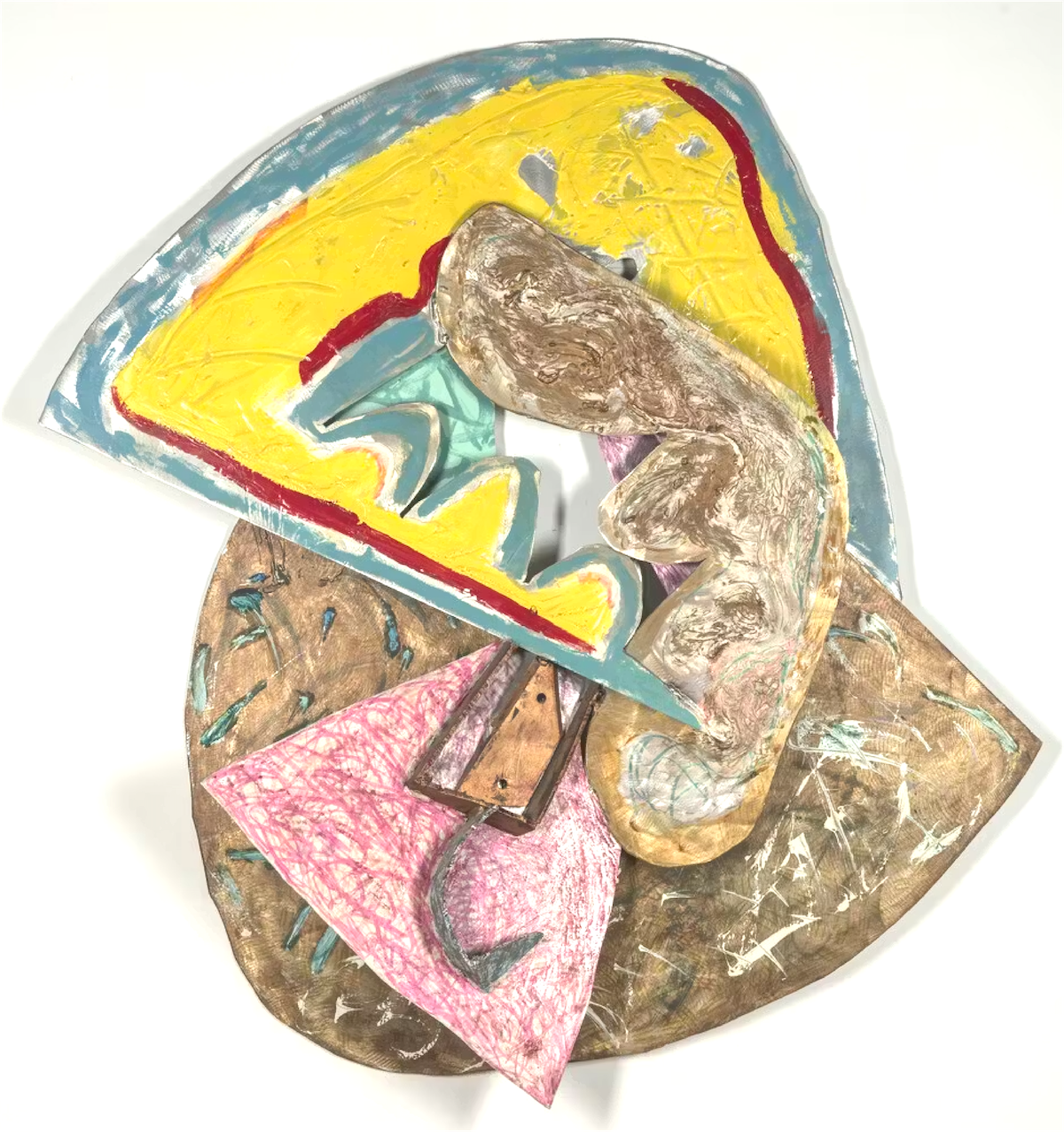
KOLUMN begins there: not with a sentimental rescue mission, but with a correction. She was not a footnote orbiting more canonized names. She was a serious artist with a distinct symbolic vocabulary, a command of material, and a clearly legible investment in African spiritual systems, Black interiority, and abstraction as a vessel rather than an escape hatch. The institutional record that does exist shows an artist who moved through major spaces, from the Studio Museum in Harlem to MoMA PS1, and whose work remains in museum collections. The issue is not whether she was significant. The issue is how thoroughly the culture failed to narrate that significance at scale.
That makes DeLawrence especially resonant for KOLUMN, whose recent artist-centered editorial lane has already made space for figures whose cultural weight exceeds the size of their mainstream footprint. In that sense, this piece sits naturally beside our work on artists like Bing Davis: not because the two artists are identical, but because both reveal what happens when Black visual language carries history, spirituality, and place without flattening itself to easy explanation. DeLawrence’s story asks for that same seriousness. It also asks for sharper language. She was not simply “influenced by Africa,” the kind of vague phrasing that too often gets used when critics do not want to do the harder work. She was building a sculptural idiom that treated African cosmology, symbolic naming, and Black selfhood as living structure.
Hartford made the artist before New York named the scene
DeLawrence was born in Hartford, Connecticut, on July 8, 1953, to Ruth Atkins DeLawrence and Joseph J. DeLawrence Jr. She graduated from Weaver High School in 1971, where she was identified as a merit scholar, and she was involved in Katarah, an African American cultural society. Those details matter because they place her formation inside a Black civic and educational world that was already asking questions about culture, identity, and representation before the broader art market found fashionable ways to speak about them. Hartford was not incidental background. It was part of the intellectual soil.
Her years at the Rhode Island School of Design sharpened those questions. According to the surviving record, DeLawrence participated in RISD’s European honors program in 1974–75. More importantly, she appears in the March 8, 1974 issue of the RISD Press as the author of a letter addressing racism on campus. Even in outline, that fact is revealing. It suggests an artist who did not treat aesthetics as sealed off from institutional life. She was not merely learning form; she was contesting the terms of belonging inside a major art school. That matters when reading the later work, which repeatedly returns to identity not as a fixed portrait but as a charged, multidimensional condition.
This is one of the most telling through lines in her biography. Too often, Black artists are written about as though politics arrives after the studio, as though formal experimentation happens in one room and racial reality in another. DeLawrence’s record suggests something more integrated. The young woman willing to challenge campus racism becomes the mature artist who, years later, would describe her work as “an exploration into the multiplicity of dimensions of self.” That statement survives in Studio Museum archival writing, and it reads less like a slogan than a method. Multiplicity was not decoration in DeLawrence’s practice. It was the point.
An artist of many mediums, and one serious vocabulary
After RISD, DeLawrence returned to Hartford and worked at SAND Art Studio as a director before moving to New York City in 1981. There she worked with the Solomon R. Guggenheim Museum’s Learning Through Art program for public school children, and she continued developing her printmaking through Robert Blackburn’s workshop. Even in compressed biography, the pattern is striking: teaching, institution-building, printmaking, sculpture, installation. DeLawrence was not a single-medium artist with a narrow lane. She was building across forms and across publics.
The breadth of that practice helps explain why her work resists easy categorization. The available records variously identify her as a sculptor, installation artist, painter, printmaker, and educator. That is not curatorial indecision. It is evidence of a practice that moved fluidly between object, surface, symbol, and environment. The surviving works most visible online include polychromed aluminum sculpture, but the archive also points to painting and print portfolios. Brooklyn Museum holds her 1983 color viscosity print A-Pik. The Studio Museum in Harlem lists Maya, Chamma, and Eye of Horus III. The result is an oeuvre that appears compact in the public record but conceptually expansive in form.
That formal range is central to understanding her significance. DeLawrence came of age during a period when Black artists were often forced into false choices by critical discourse. Be figurative or be invisible. Be explicitly political or be accused of evasion. Be “ethnic” enough for multicultural appetite but not so conceptually demanding that institutions lose their footing. DeLawrence’s work seems to refuse those terms. She used abstraction, but not as purity. She used symbolic naming, but not as ethnographic display. She used sculptural material, especially metal, in ways that allowed spiritual reference, modernist edge, and emotional charge to sit inside the same object.
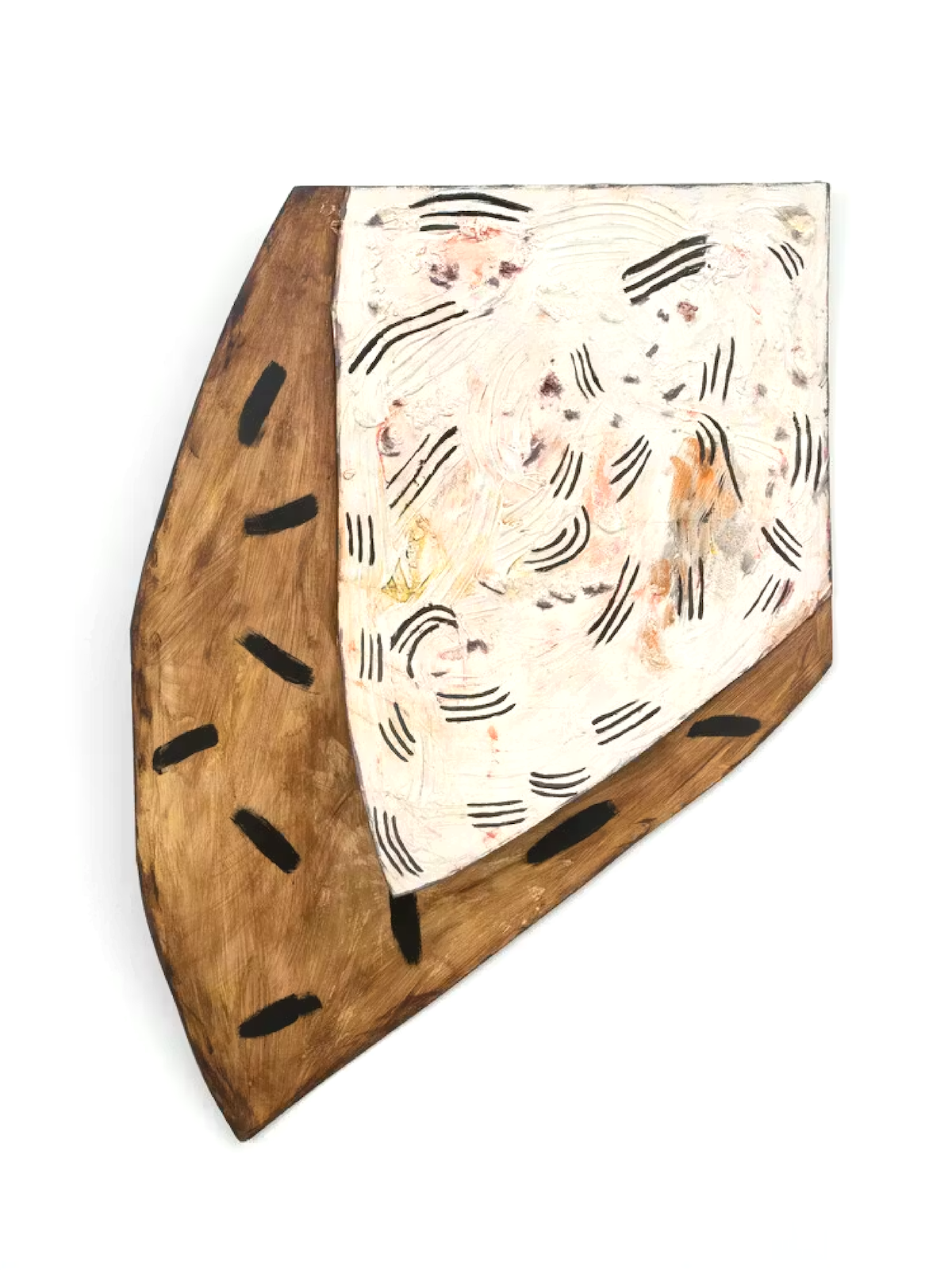
There is something especially compelling about the material fact of that choice. Aluminum can feel industrial, even impersonal. Yet in DeLawrence’s hands, the available works and documentation suggest something else: curvature, incision, silhouette, mask-like contour, winged extension, and surface color that keep the metal from ever feeling cold. Her sculpture does not deny hardness; it converts hardness into ceremony. That is one reason her work still feels contemporary. In a culture newly fluent in talking about ritual, lineage, and Black speculative aesthetics, DeLawrence’s forms read less like relics and more like unfinished conversations we are only now catching up to.
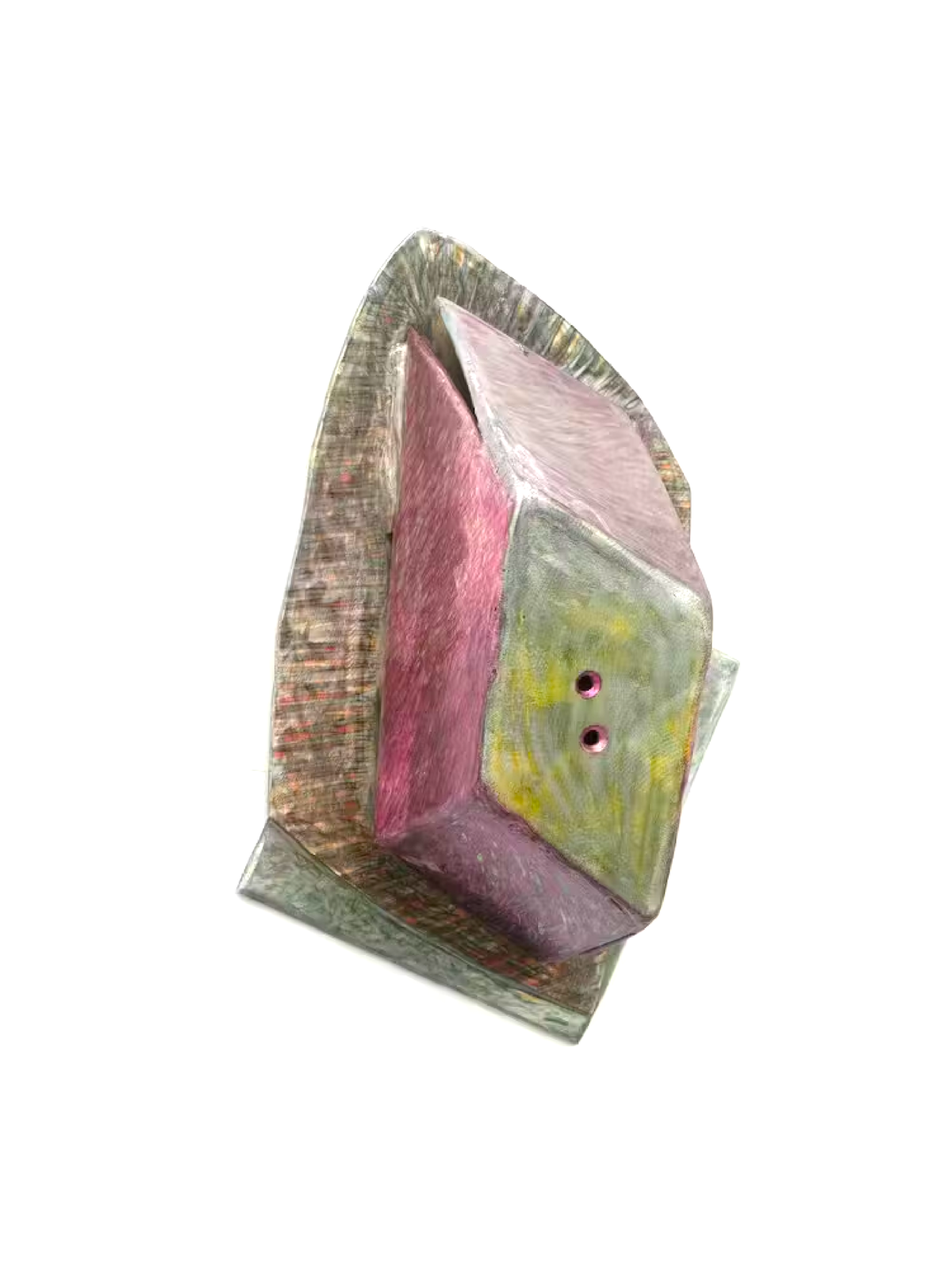
The Studio Museum years were not minor; they were foundational
Any serious account of DeLawrence has to pause at the Studio Museum in Harlem. The museum identifies her as a 1985–86 Artist in Residence, and later archival writing makes plain how consequential that period was. In a 2022 essay for the museum, Eliana Smith revisited the brochure for the 1985–86 Artists-in-Residence exhibition, which paired DeLawrence-Maine with Kerry James Marshall. Smith’s essay does something vital: it restores the ordinary material evidence of artistic life. The brochure recorded their education, awards, prior exhibitions, and included a statement from DeLawrence on her work. It also centered her sculpture DESCENSION on the cover.
That pairing with Marshall is not useful because it lets us borrow his fame retroactively. It is useful because it situates DeLawrence exactly where she belonged: inside one of the most important Black art institutions in the country, in active dialogue with a generation shaping new futures for Black visual culture. Smith notes that Marshall would move toward the figuration for which he became famous, while DeLawrence’s archive remains less extensively narrated. But the essay does not treat her as incidental. On the contrary, it underscores how much depends on archival survival. To put it plainly, DeLawrence is an example of how an artist can be institutionally validated and historically under-told at the same time.
That tension is one of the hardest facts in Black art history. Recognition is not the same as remembrance. Exhibition is not the same as canonization. Possession by a museum is not the same as sustained interpretation. DeLawrence had the markers many artists fight for: residence, exhibition history, museum acquisition, national and international exposure. Yet the present-day public record remains startlingly thin. That thinness should not be mistaken for slightness of achievement. It should be understood as evidence of the structural fragility of Black women’s art histories, especially when careers are cut short.
The Studio Museum record also gives us one of the cleanest entry points into her own thinking. Smith cites DeLawrence’s description of her art as “an exploration into the multiplicity of dimensions of self.” That sentence earns lingering attention. It does not announce a program of autobiography in the narrow confessional sense. It opens onto layered identity: psychic, ancestral, cultural, spiritual, bodily, historical. The phrase feels especially apt when placed beside works titled Maya, Chamma, and Eye of Horus III. These are not neutral titles. They point to naming as invocation. They imply that form can be a threshold rather than merely an object.
Reading the work through its surviving titles
Because DeLawrence remains under-documented in mainstream criticism, titles and exhibition contexts do unusual interpretive labor. That is not a weakness; it is an invitation to look closely. Eye of Horus III, held by the Studio Museum, dates to 1988–89 and is made of polychromed aluminum. The title reaches directly into Egyptian iconography, where the Eye of Horus carries associations of protection, healing, and restored wholeness. It is reasonable to read DeLawrence’s use of that title not as casual borrowing but as part of a broader artistic vocabulary shaped by African religions and symbolic systems. The work’s very naming asks the viewer to encounter abstraction as cosmological address.
The same is true of Isis II, a 1990 work documented in the Smithsonian Anacostia Community Museum materials for Locating the Spirit: Religion and Spirituality in African American Art. The work appeared in an exhibition devoted explicitly to religion and spirituality in African American art, and curator Deborah Willis discussed it in a 1999 gallery walkthrough recorded for the museum’s archives. That context is critical. It anchors DeLawrence not on the margins of spiritual discourse but inside a serious curatorial framework that treated Black art, religion, ritual, and symbolism as interconnected fields of inquiry.
Then there is Chamma, the 1987–88 polychromed aluminum work at the Studio Museum, and Maya, dated 1985. Even without overclaiming meanings that the archive does not fully spell out, one can see a pattern. These titles refuse generic modernist numbering. They do not announce themselves as pure formal exercises. They gesture toward worlds, names, entities, spiritual registers, or philosophical concepts. DeLawrence’s abstraction was not mute. It spoke in coded, sourced, referential ways. It trusted that shape, color, and title together could produce a fuller field of meaning than representation alone.
This is precisely where a sharper magazine voice matters. Too much writing on Black abstraction defaults either to mystification or flattening. DeLawrence deserves neither. Her work was neither obscure for obscurity’s sake nor reducible to symbolic illustration. It staged encounter. The bends and points of her metal forms, the painted surfaces, the mythic naming, the exhibition history around spirituality and Black identity: together they suggest a practice interested in what cannot be held by plain language alone. She was making objects that operate like portals, emblems, shields, fragments, and presences all at once.
The African spiritual archive was not backdrop. It was structure.
One of the most consistent descriptions of DeLawrence’s work is that it was shaped by her interest in African religions. Even in brief obituary and biographical summaries, that point recurs. It also aligns with the evidence of the titles and the later inclusion of Isis II in a landmark exhibition on religion and spirituality in African American art. Put together, these records indicate an artist who treated African cosmology not as visual seasoning but as underlying architecture. That distinction matters. To call something an “influence” can sometimes drain it of seriousness. DeLawrence appears to have been doing something more rigorous: incorporating spiritual systems into the conceptual grammar of her practice.
That choice places her in a larger Black artistic lineage without collapsing her into any single predecessor. One might think of artists who turned to myth, ritual objects, ancestral signs, or sacred naming as a way of contesting Western secular assumptions about art. But DeLawrence’s work, as far as the surviving record shows, maintained an unusually crisp relation between material and metaphysical inquiry. The metal does not disappear into spirit. The spirit does not dissolve the object. Each insists on the other. That balance is part of what makes the work feel strong rather than illustrative.
The title Eye of Horus III also signals something else: repetition and seriality. The “III” implies an ongoing return, a sustained engagement rather than a one-off citation. Likewise Isis II. These are not random names pulled for atmosphere. They suggest iterative thinking, a revisiting of symbol as process. DeLawrence appears to have been working through spiritual forms the way other artists work through color or line: as evolving problems, revisable structures, recurring meditations. For an artist whose public archive is partial, that serial naming becomes especially revealing. It shows continuity of inquiry.
There is also a specifically Black intellectual dimension to this. In the late 20th century, many Black artists and thinkers sought ways to reconnect the African diaspora to spiritual and symbolic traditions that Western institutions had long treated as primitive, marginal, or anthropological rather than philosophical. DeLawrence’s practice seems to sit inside that broader reclamation. Her work does not ask permission to place African spiritual reference inside contemporary art. It presumes the legitimacy of that placement and moves forward from there. That is a profoundly modern gesture, and a deeply diasporic one.
The exhibition history tells a larger story than the market ever did
The sparse public narrative around DeLawrence can make it easy to underestimate the seriousness of her career. The exhibition record corrects that immediately. She showed work internationally, including at the National Gallery of Botswana and the French Embassy in New York City. Nationally, she appeared at the Studio Museum in Harlem, MoMA PS1, Miami-Dade Community College’s Frances Wolfson Art Center, and Fairleigh Dickinson University. MoMA’s own artist page confirms her inclusion in Progressions: A Cultural Legacy at MoMA PS1 in 1986. Whatever else the culture failed to do with her name later, the institutions of her time recognized the work.
That record matters because it places her beyond the familiar and diminishing category of “promising artist who died young.” DeLawrence was not merely promising. She was active, exhibited, collected, and professionally legible. The question is not whether she had arrived. It is why arrival did not translate into durable mainstream remembrance. Some of that answer lies in the ordinary cruelties of art history: limited critical infrastructure for Black women artists, uneven archiving, and the tendency of fame to consolidate around a few names while many others become “rediscoveries” decades later.
The later afterlife of her work proves the legacy never disappeared altogether. Rutgers’ Zimmerli Art Museum included her in Collective Yearning: Black Women Artists from the Zimmerli Art Museum, an exhibition framed as the institution’s first comprehensive review of its holdings by Black women artists. The very premise of that show is telling. It acknowledges that museums themselves are still doing the work of discovering what they have, what they overlooked, and how Black women’s artistic histories must be regrouped and reread. DeLawrence’s inclusion there is not just honorary. It places her inside a present-tense revision of the canon.
The Anacostia exhibition record does something similar from another angle. By situating Isis II inside a major exhibition on spirituality in African American art, it effectively argues that DeLawrence belongs in the conversation not only about Black women artists, but also about Black sacred aesthetics, diasporic symbolism, and the religious dimensions of modern and contemporary art. That is a wider frame, and a better one. She should not only be recovered as an overlooked individual; she should be repositioned inside the fields her work was already helping define.
The tragedy of a shortened life, and the problem of a shortened archive
DeLawrence died of cancer in New York City on November 22, 1992, at age 39. Any account of her legacy has to reckon with how much a death that early can distort public memory. Artists are often canonized not only by the quality of their work, but by the length of time they remain available for interview, retrospective framing, teaching, networking, self-archiving, and institutional repetition. A life cut short interrupts all of that. In DeLawrence’s case, it seems to have left behind a body of work strong enough to endure and an archive too thin to keep pace with it.
That is one reason the surviving museum records feel so important. The Studio Museum’s holdings, the Brooklyn Museum print, the Rutgers inclusion, the MoMA exhibition listing, the Smithsonian archival traces: these are not mere reference points. They are the scaffolding of memory. They allow us to say, with confidence, that DeLawrence was here, she mattered, and the work circulated in serious spaces. Eliana Smith’s archival essay is especially valuable because it names what many scholars of Black cultural production already know: records are not passive containers. They are active defenses against erasure.
There is a temptation, when writing about artists like DeLawrence, to lean too hard on absence. But absence is only half the story. The other half is persistence. Her mother, Ruth DeLawrence, gifted Chamma to the Studio Museum in 1995. That fact carries emotional as well as institutional weight. It suggests familial stewardship, a refusal to let the work vanish into private neglect. The preservation of an artist’s legacy often depends on exactly this kind of intimate labor, long before the academy or market catches up.
That familial and institutional relay is the hidden infrastructure of Black art history. Someone saves the object. Someone saves the brochure. Someone saves the slide, the checklist, the photograph, the title. Then decades later, another curator, critic, archivist, or editor pieces together enough evidence to restore proportion to the story. DeLawrence’s afterlife so far has unfolded in precisely that way. It is not glamorous. It is exacting. It is how recovery actually works.
Why Nadine M. DeLawrence feels urgent now
So why now? Why DeLawrence, and why this renewed attention? The clearest answer is that the culture has finally developed better language for what her work was already doing. In the past decade, museums, scholars, and readers have become more attentive to Black abstraction, Black women’s archives, diasporic spiritual practice, and the politics of who gets remembered. DeLawrence sits at the crossroads of all four. She is not newly relevant because our times are generous. She is newly legible because our vocabulary has improved.
Her work also presses against a stale idea that Black art must choose between social statement and formal daring. DeLawrence’s surviving record suggests a practice in which form itself is the statement. Her use of aluminum, serial titles, symbolic invocation, and sculptural silhouette produces a language that is resolutely contemporary while remaining anchored in Black spiritual and cultural reference. She did not need to illustrate Blackness literally to make Black thought visible. She built structures that carried it.
For younger artists and critics, that may be one of the most valuable lessons in her career. DeLawrence models a way of working that is interdisciplinary without being diffuse, symbolic without being mannered, and spiritually charged without becoming doctrinal. She offers a map for artists who want to work in relation to ancestry, ritual, and diaspora while still claiming abstraction, experimentation, and material rigor as fully theirs. That is not a narrow legacy. It is a living proposition.
There is also something restorative in placing her back into public conversation beside other artists of her era. The Studio Museum archive links her, materially and historically, to Kerry James Marshall. The Anacostia record places her among a sweeping genealogy of African American artists engaging religion and spirituality. The Zimmerli exhibition returns her to a collective history of Black women artists. Each frame expands her without dissolving her individuality. That, in the end, is the task: not to make DeLawrence famous by analogy, but to restore the networks in which her work was already meaningful.
Not rediscovered, but re-centered
It may be tempting to call Nadine M. DeLawrence “rediscovered.” But that word gives too much credit to the present, as though she had no continuity before we arrived. A better phrase is re-centered. The work was never wholly gone. Museums held it. Archives named it. Curators included it. What has been missing is sufficient narrative force around it. The real work now is not simply to praise her, but to write her properly into the histories she already belongs to: Black abstraction, Black women’s art, diasporic spirituality in contemporary practice, and the institutional story of the Studio Museum generation.
What survives of DeLawrence points to an artist of steel and symbol, discipline and interiority, modernism and memory. It points to someone who understood that selfhood has multiple dimensions, and that art could hold those dimensions without flattening them into a lesson plan. It points, too, to the unfinished business of criticism. Not every important artist is missing because the work lacked force. Some are missing because the world lacked attentiveness. DeLawrence deserves better than that old inattentiveness.
And that is where this story should end, or rather begin again. Nadine M. DeLawrence did not leave behind a sprawling career with endless interviews and blockbuster retrospectives. She left something harder and, in some ways, more demanding: a body of evidence strong enough to insist on her importance, but partial enough to require care. The call now is clear. Curators should show more of the work. Critics should write it with specificity. Editors should stop treating Black women’s under-recognition as natural weather. And readers should understand DeLawrence not as an obscure aside, but as one of the artists who helps explain what Black art in the late 20th century was capable of becoming.
In other words: Nadine M. DeLawrence belongs in the room. She belonged there all along.
More great stories

Afro Sheen, Wall Street, and the Architecture of Black Possibility
July 6, 2026
No Comments
The Fire Inside the Fourth
July 5, 2026
No Comments