


It was the best decision I ever made.
It was the best decision I ever made.
By KOLUMN Magazine
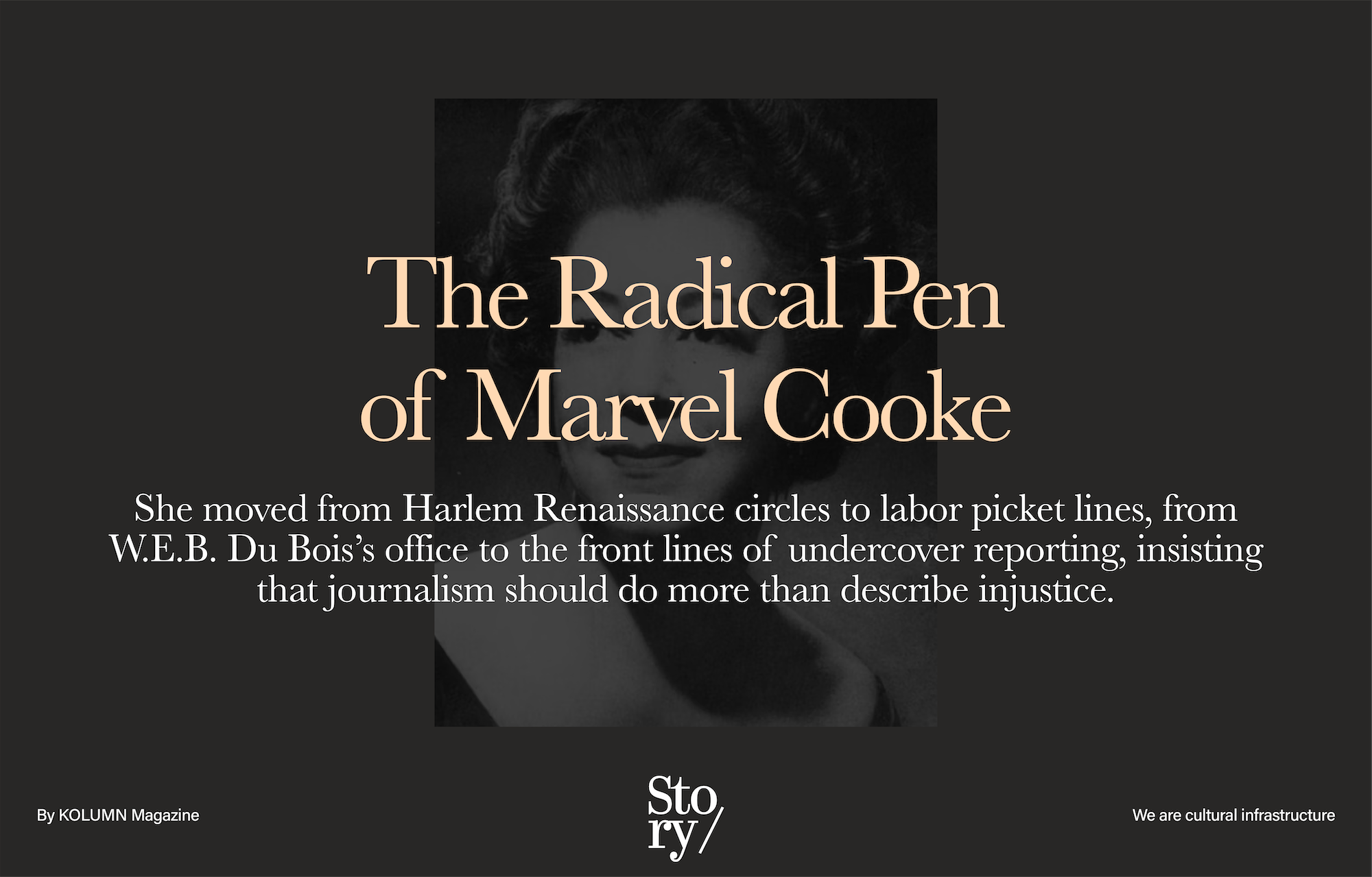
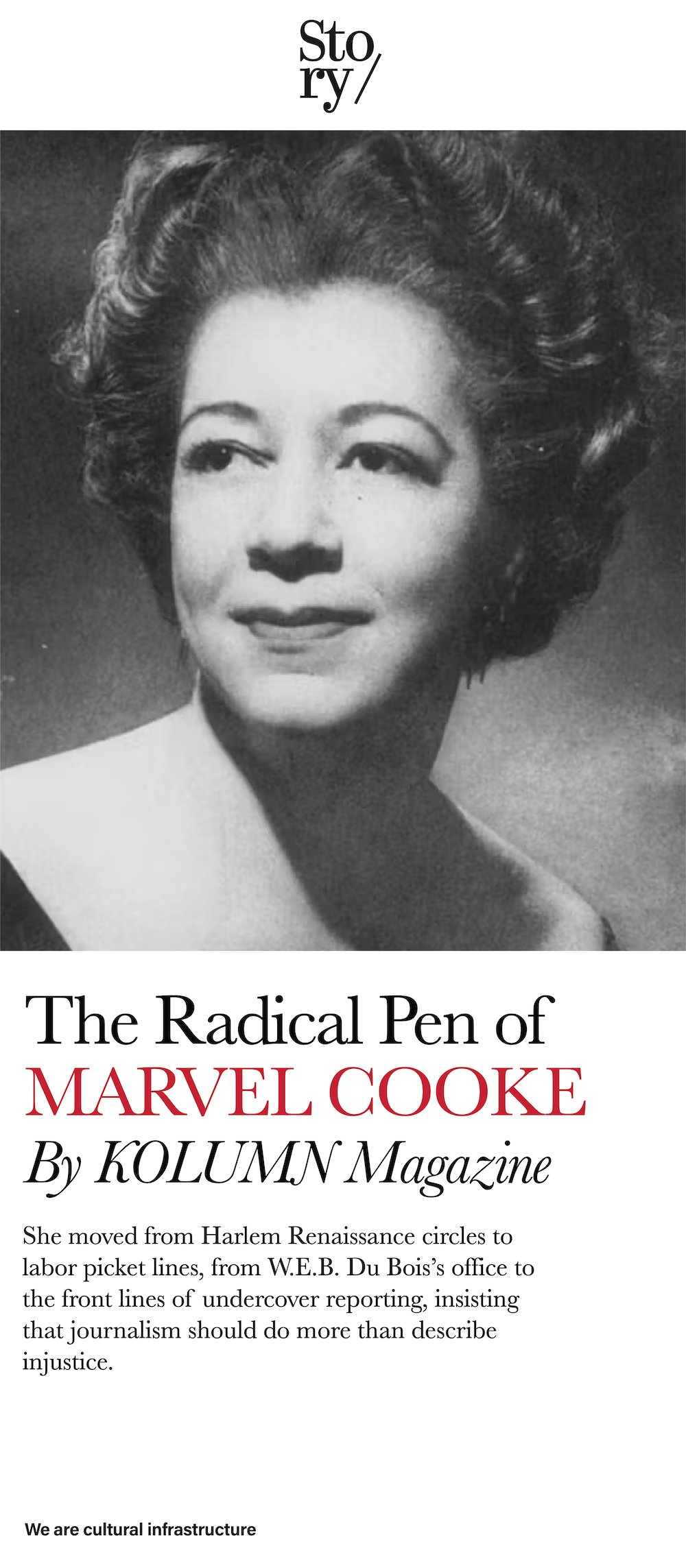
Marvel Cooke is often introduced through the language of precedent. She was the first Black woman to work full-time as a reporter at a mainstream white-owned daily newspaper. She was also the first woman reporter at the New York Amsterdam News. She worked for W.E.B. Du Bois at The Crisis, moved through Harlem at the height of the Harlem Renaissance, helped organize the Newspaper Guild, investigated the exploitation of Black domestic workers, endured McCarthy-era scrutiny, and later joined the movement to defend Angela Davis. Those facts are true, and they matter. But they are also a little too neat. They can make Cooke seem like a tidy milestone when she was, in fact, much more unruly than that.
What made Cooke significant was not simply that she entered rooms where Black women had been excluded. It was that once she got inside, she challenged the terms of belonging. She did not treat journalism as a genteel profession or a ladder into respectability. She treated it as a weapon, a craft, a public service, and sometimes a fight. Her reporting exposed how race, class, gender, and labor overlapped in everyday life. Her activism insisted that newsroom workers were workers. Her politics, which grew more explicitly radical over time, made her difficult to fit into sanitized histories of the press. That difficulty is part of why she remains less famous than she should be. Later scholarship has emphasized her role in connecting Black women’s labor, left politics, and investigative reporting, not as separate chapters but as one continuous practice.
Cooke’s life also resists the easy split between journalist and activist. In her case, the reporting was the activism. She did not merely cover structural inequality; she named it, inhabited it, and pressed her readers to see it as a system rather than a string of isolated indignities. That is why her work still feels startlingly current. Read now, Marvel Cooke sounds less like an artifact than like a missing ancestor in the story of modern accountability journalism.
Born into contradiction
Even the basic biographical record around Cooke carries a small historical lesson: some reputable entries list her birth year as 1901, while several archival and oral-history references list April 4, 1903. The New York Public Library archive for her oral history and the Washington Press Club Foundation timeline use 1903, while some historical summaries and obituaries used 1901. That discrepancy is worth noting because it hints at a broader truth about Black women in public history: even when they are important enough to remember, the record is often uneven.
What is not disputed is the world that shaped her. Cooke was born in Mankato, Minnesota, and grew up in Minneapolis in a family whose ambitions and politics ran well ahead of what white America was willing to allow. Her father, Madison Jackson, was law-trained but blocked by racial discrimination from practicing as he had hoped; he instead worked as a Pullman porter. Her mother, Amy Wood Jackson, had been a teacher. The family became the first Black residents of Minneapolis’s Prospect Park neighborhood, where white resistance was immediate enough that public meetings were reportedly held to pressure them to leave. They stayed. That act of staying matters. Long before Marvel Cooke ever wrote an exposé, she had already lived inside the American ritual of exclusion and refusal.
She also learned early that discrimination did not always arrive wearing a Southern accent. In later recollections, Cooke described growing up among white classmates and neighbors while learning, in intimate ways, what the boundaries of belonging really were. Minnesota was not the Jim Crow South, but it was still a racial order, and Cooke grasped that young. In one recollection preserved in historical summaries, she described the moment she decided she was not going to stay in Minneapolis. Harlem, by contrast, represented not perfection but possibility: a Black world expansive enough for ambition.
That decision to leave was not just geographic. It was ideological. Cooke came from a politically engaged family; later accounts describe her father as sympathetic to socialist ideas and her mother as deeply admiring of Du Bois. So when Harlem appeared on the horizon, it was not merely a career move. It was an entry into a Black intellectual and political tradition that would shape the rest of her life.
Harlem gave her a profession and a public
After graduating from the University of Minnesota in 1925, Cooke moved to New York in 1926 and joined The Crisis, the NAACP magazine edited by W.E.B. Du Bois. By her own recollection, she had not set out imagining a conventional journalism career. She arrived as an office worker and learned the magazine from the inside, gradually taking on editorial responsibilities and writing. In a PBS interview, she recalled that she “came to Harlem as fast as I could come” after receiving Du Bois’s offer, and described the move as the turning point of her life.
That apprenticeship mattered because The Crisis was not simply a magazine. It was one of the central organs of Black public argument in the early twentieth century. To work there was to stand at the intersection of politics, literature, visual culture, and movement strategy. Cooke learned layout, editing, and the demands of publication. She also entered a social world that included Langston Hughes, Countee Cullen, Paul Robeson, Elizabeth Catlett, Richard Wright, and other figures whose names now define the era. Washington Post and Post obituary accounts alike place her squarely in that circle.
It is tempting to romanticize this period as one long salon in Harlem, but Cooke’s importance lies partly in how unromantic she remained. She appreciated art, knew artists, and moved among them, but she was not primarily interested in glamour. Even in cultural spaces, she seemed drawn toward function, purpose, and argument. She was already forming the instinct that would define her best work: to see culture and politics not as separate categories but as mutually revealing ones.
That sensibility distinguished her from a narrower model of race journalism that focused only on uplift or social polish. Cooke did care about representation, but she cared more about power. That difference would become clearer once she left Du Bois’s orbit and entered the newspaper world in earnest.
At the Amsterdam News, she found both the story and the fight
Cooke joined the New York Amsterdam News in the late 1920s and became its first woman reporter, a striking fact in itself for one of the country’s most important Black newspapers. Multiple historical sources also credit her with helping organize the first Newspaper Guild unit at a Black-owned newspaper. That dual role tells you a great deal about her. She was not content merely to break a gender barrier in the newsroom; she immediately engaged the power relations inside the institution itself.
The romance of the Black press has sometimes obscured the labor realities inside Black newspapers. Cooke refused that sentimentality. She understood that Black ownership did not automatically produce justice for Black workers. During the bitter labor dispute at the Amsterdam News, she joined an eleven-week strike and was jailed for picketing. One summary of her recollections quotes her saying that “the bosses are not necessarily in your corner, even if they are your own color.” That is a sharp sentence, and it captures a worldview she never abandoned: racial solidarity could not excuse exploitation.
This is one reason Cooke feels so contemporary. She understood, earlier than many of her peers, that institutions serving Black audiences could still reproduce hierarchy, and that workers inside moral or movement-adjacent organizations were still workers. In other words, she would have understood every modern newsroom contradiction immediately. She would not have been shocked by a publication that speaks the language of justice while underpaying staff. She had already seen it.
She also developed her reporting voice there. Cooke increasingly chafed at sensational crime coverage and at headlines that reduced Black life to spectacle. In later interviews she made clear that she wanted journalism to do something more useful than feed appetite. That desire pushed her toward stories about labor conditions, community survival, and the mechanics of racial inequality. It also pushed her away from journalistic styles that treated suffering as lurid content rather than evidence.
Marvel Cooke did not believe that description was enough. She wanted reporting to reveal how indignity was organized.
She saw Black women’s labor for what it was
If Cooke deserves a permanent place in American journalism history, “The Bronx Slave Market” is a major reason why. The phrase first appeared in a 1935 Crisis article co-bylined with Ella Baker, describing the street-corner hiring system through which Black women domestic workers waited for white employers to select them for underpaid day labor. The article named specific Bronx locations and described the racialized humiliations built into the process. It remains one of the sharpest pieces of reporting on Black women’s labor in the Depression era.
Years later, Cooke revisited the subject at the Daily Compass, where she worked after stints at The People’s Voice and elsewhere. There she went undercover, posing as a jobseeker, and turned the old structure of exploitation into unforgettable first-person reportage. The New York Public Library’s account of the “Bronx Slave Markets” notes that women often waited on corners, outside stores, and in empty lots while prospective employers bargained them down to wages as low as 15 to 20 cents an hour or about a dollar a day. Cooke’s reporting described not only wage theft and overwork but also sexual harassment, humiliation, and the psychic violence of being inspected and purchased in public.
One reason the series still lands so hard is that Cooke refused euphemism. She understood that the language of slavery was not metaphorical excess in this context; it was analytic precision. In the 1950 series, she wrote that she felt the weight of a century of indignity while standing there to be bought. NYPL’s historical essay also notes the continuities she traced between antebellum bondage and modern racial capitalism. Cooke’s brilliance was to make those continuities legible without flattening the differences. She was not claiming that 1950 was 1850. She was claiming that the afterlife of slavery was visible in the labor market if one had the courage to look.
The reporting also mattered because it focused on Black women workers who were routinely ignored by both mainstream labor histories and respectable press narratives. Domestic labor was often treated as private, informal, or merely “women’s work,” which made it easier to underpay and under-theorize. Cooke and Baker insisted it was political economy. Their work exposed how race and gender sorted Black women into a labor niche considered natural for them and therefore undeserving of dignity or protection. Later scholarship has explicitly read Cooke’s labor journalism as a vital precursor to Black feminist analyses of work.
Just as important, the stories did not end at pity. They registered resistance. NYPL’s account notes that workers banded together informally, demanded base wages when they could, and wore watches because employers were known to set clocks back to steal labor time. Cooke was interested in exploitation, yes, but she was equally interested in tactics of survival. That combination gave her reporting moral force without stripping its subjects of agency.
Long before “intersectionality” became common language, Cooke was reporting how race, gender, and labor collided on a Bronx street corner.
The Daily Compass and the problem of being the only one
Cooke’s move to the Daily Compass marked another threshold. Historical and archival sources describe her as the first Black woman to work as a full-time reporter at a mainstream white-owned daily newspaper, and she later recalled the workplace in blunt terms: “there were no black workers there and no women.” That line deserves to survive because it says so much with so little. It is not just a memory of isolation. It is a diagnosis of institutional design.
There is a tendency in retrospective celebration to turn such firsts into triumphant endings. Cooke’s own life argues the opposite. Being first did not mean being comfortable, secure, or embraced. It meant being hypervisible and yet still marginal inside the institution. It meant carrying the representational burden of a breakthrough while also doing the ordinary work of reporting under hostile or indifferent conditions. Cooke knew that symbolic progress could coexist with practical exclusion. The point was not to enjoy the symbolism; it was to use the access.
And she used it. At the Compass, she produced work on prostitution, youth drug use, and domestic labor exploitation. Some later summaries credit her reporting on child heroin use with helping spur official attention to teenage addiction. Whether one emphasizes direct policy effect or broader agenda-setting, the record is clear that Cooke did not waste institutional access on safe assignments. She pushed toward the stories that exposed how poverty and race shaped urban life.
There is also something revealing in the kinds of stories she chose. They were stories about people considered disposable by respectable society and often disposable by respectable journalism. Black domestics. Poor children. Women in the informal economy. The exploited and the stigmatized. Cooke gravitated toward the places where public hypocrisy was easiest to see. That is not accidental. It reflects a politics of attention. She understood that if journalism only humanizes people already recognized as worthy, then it is not doing much democratic work at all.
Her radicalism was not a sidebar
Cooke’s political radicalism is sometimes treated as a complication tacked onto her journalism career, as though she began as a journalist and then somehow veered into politics. The record suggests something else. Her politics and her reporting developed together. During the labor struggle at the Amsterdam News, she joined the Communist Party, and by her own later explanation, the Party’s stated commitments to racial equality and social welfare aligned with goals she already held. The Washington Post obituary notes that she described those aims as her aims too.
That does not mean every position she held should be romanticized or stripped of Cold War context. It means that to understand Cooke honestly, one has to place her within the Black left rather than trying to rescue her from it. Too many historical narratives are comfortable celebrating Black pioneers only after sanding down their ideological edges. Cooke does not survive that sanding very well. Her commitments to labor organizing, anti-racism, civil liberties, and internationalist causes were not PR accessories. They were central to her understanding of the world.
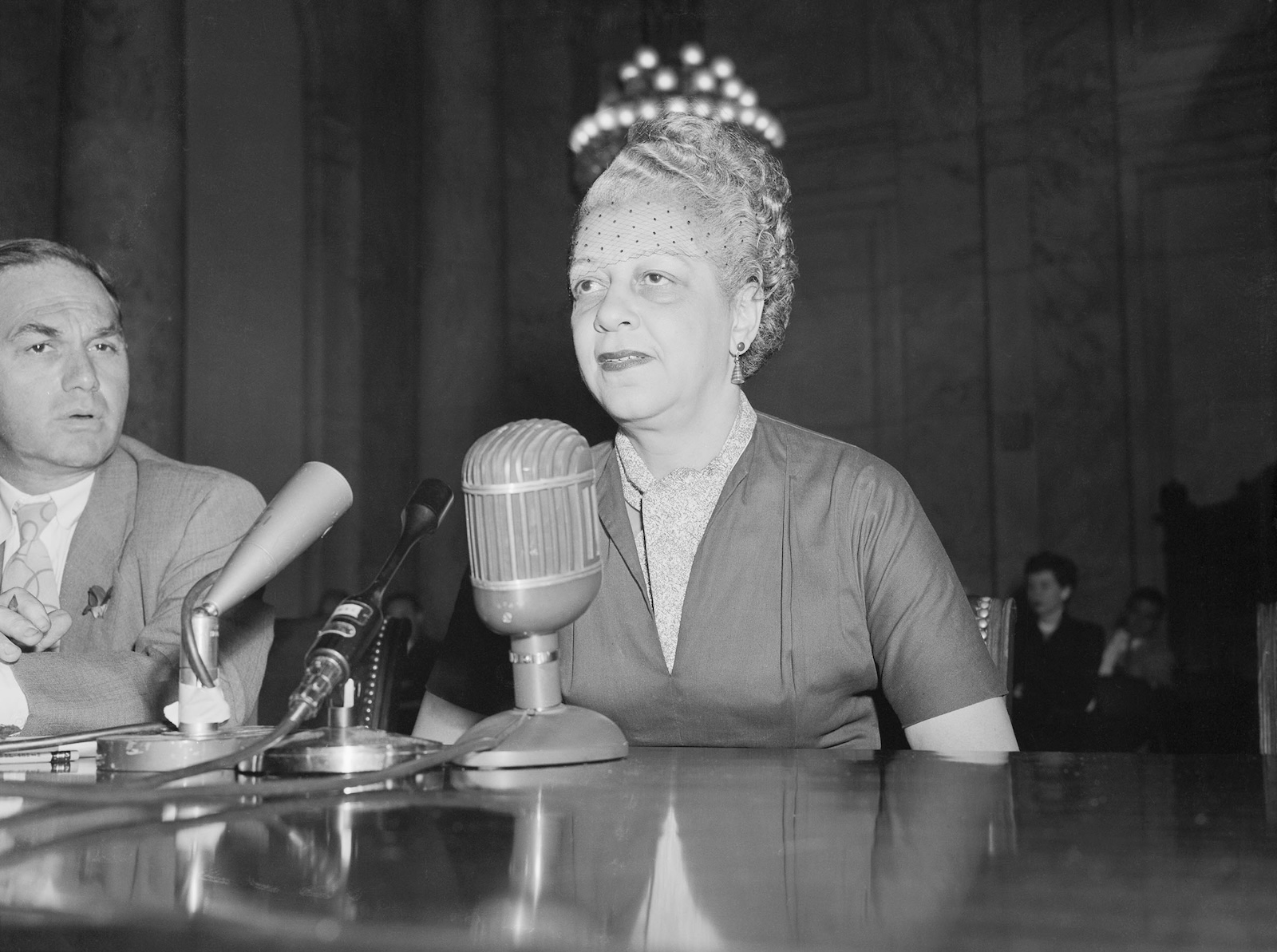
Those commitments also carried costs. In the McCarthy era, Cooke was called to testify and invoked the Fifth Amendment. She later recalled, with characteristic wit, replying to a question about her birthplace by saying she was born in Minnesota, across the St. Croix from where McCarthy came, “but we’re not all the same out that way.” The line reportedly drew laughter, but the larger context was no joke. Red-baiting narrowed career options, distorted reputations, and helped push many left-leaning Black journalists toward the margins of institutional memory.
This part of Cooke’s story matters now for another reason. It complicates the lazy idea that journalistic objectivity has always meant political innocence. Cooke made visible what many reporters have preferred to hide: that journalism is practiced by people with commitments, situated inside systems of power, making choices about what counts as news and who counts as human. Her politics were unusually explicit. But explicit politics are not the same as dishonesty. In Cooke’s case, they often sharpened the clarity of what she could see.
The long arc of movement work
Cooke did not stop after the classic period of her reporting. She remained active in political and cultural organizations through the decades, including work with the National Council of Arts, Sciences and Professions and later the Angela Davis Defense Fund. The Washington Post obituary notes that in the 1970s she served as treasurer of the Angela Davis Defense Fund, which raised money for Davis during the highly publicized prosecution that ended in acquittal. That detail is telling. By then Cooke was not a young newsroom insurgent. She was an elder still placing her labor where the struggle was.
That consistency is one of the most impressive things about her. Many people live long enough to see their early ideals recoded as youthful excess. Cooke seems instead to have deepened her commitments. The causes changed shape with the times, but the throughline remained: anti-racism, labor rights, civil liberties, peace politics, and a stubborn refusal to narrow Black freedom to whatever was presently fashionable or institutionally safe.
She also remained, by many accounts, a vivid witness to the century she had crossed. The 1993 Washington Post profile portrays visitors arriving at her Harlem apartment to hear stories about Du Bois, Richard Wright, Paul Robeson, McCarthyism, and the Black freedom struggle. That image feels almost too perfect: Marvel Cooke in Sugar Hill, a living archive of argument. But what stands out in that profile is not nostalgia. It is her insistence on recounting what she had seen because she understood memory itself as a duty.
Why she still matters
Marvel Cooke matters because she expands the definition of what a journalist can be. She was not a neutral stenographer, not a celebrity columnist, not a professional moderate flattering power with the language of balance. She was an investigator of labor, race, and class. She understood that a story was not finished once the event had been described; the system producing the event also had to be named. That remains a hard standard. It is easier to narrate scandal than to map structure. Cooke pushed herself toward the harder thing.
She also matters because her work challenges the chronology many Americans carry around in their heads. We often talk as though serious public language about structural inequality arrived recently, perhaps with civil rights legislation, perhaps with Black feminism, perhaps with contemporary social movements. But Cooke was already doing that work decades earlier. She was already writing Black women’s labor as political economy. She was already exposing how the private household could function as a site of racial domination. She was already treating poor Black workers as worthy of investigative attention rather than sociological pity.
There is another reason she matters, and it is maybe the simplest. She helps correct the history of American journalism itself. Too often, that history is told through white-owned papers, white editors, and a few tokenized Black breakthroughs. Cooke reminds us that the real story runs through the Black press, through women’s labor, through radical organizations, and through people whose careers do not fit the self-congratulatory mythology of the profession. To remember her properly is to admit that some of the best journalism in America has come from people who were never fully welcomed into journalism’s official house.
And maybe that is the last thing to say about Marvel Cooke. She was never just the first. “First” is a museum label. Cooke was a working reporter, a labor organizer, a radical witness, and a Black woman who kept insisting that the world could be read more truthfully than power preferred. Her legacy is not simply that she arrived before others did. It is that she left behind a method: go where exploitation hides, listen to the people who endure it, and write in a way that makes evasion impossible.
Marvel Cooke’s greatest achievement was not crossing the color line of American journalism. It was refusing to let journalism stop at the line.
More great stories
Afro Sheen, Wall Street, and the Architecture of Black Possibility
July 6, 2026
No Comments
The Fire Inside the Fourth
July 5, 2026
No Comments