



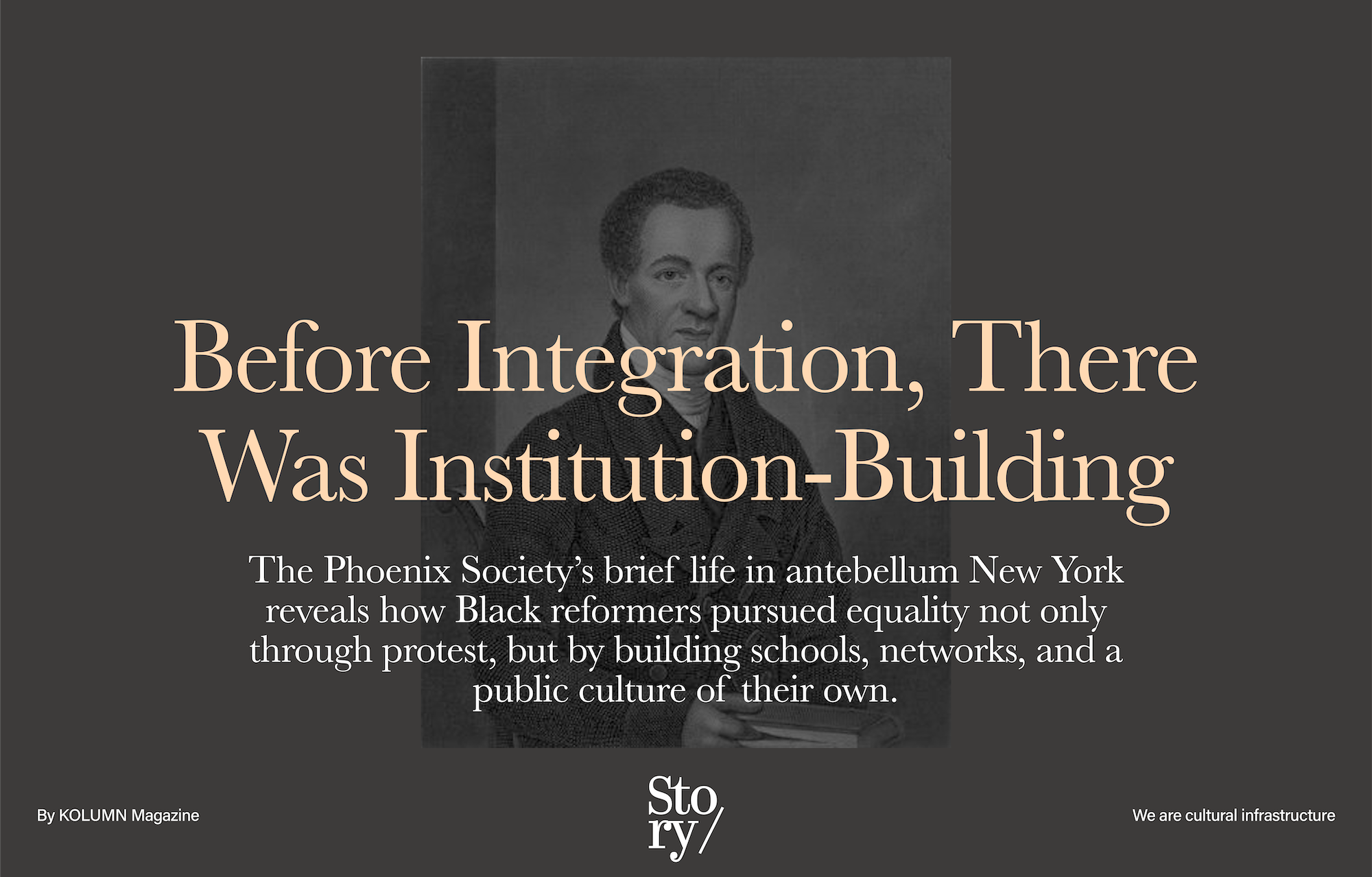
The Phoenix Society treated education not as a private good, but as infrastructure for Black freedom.
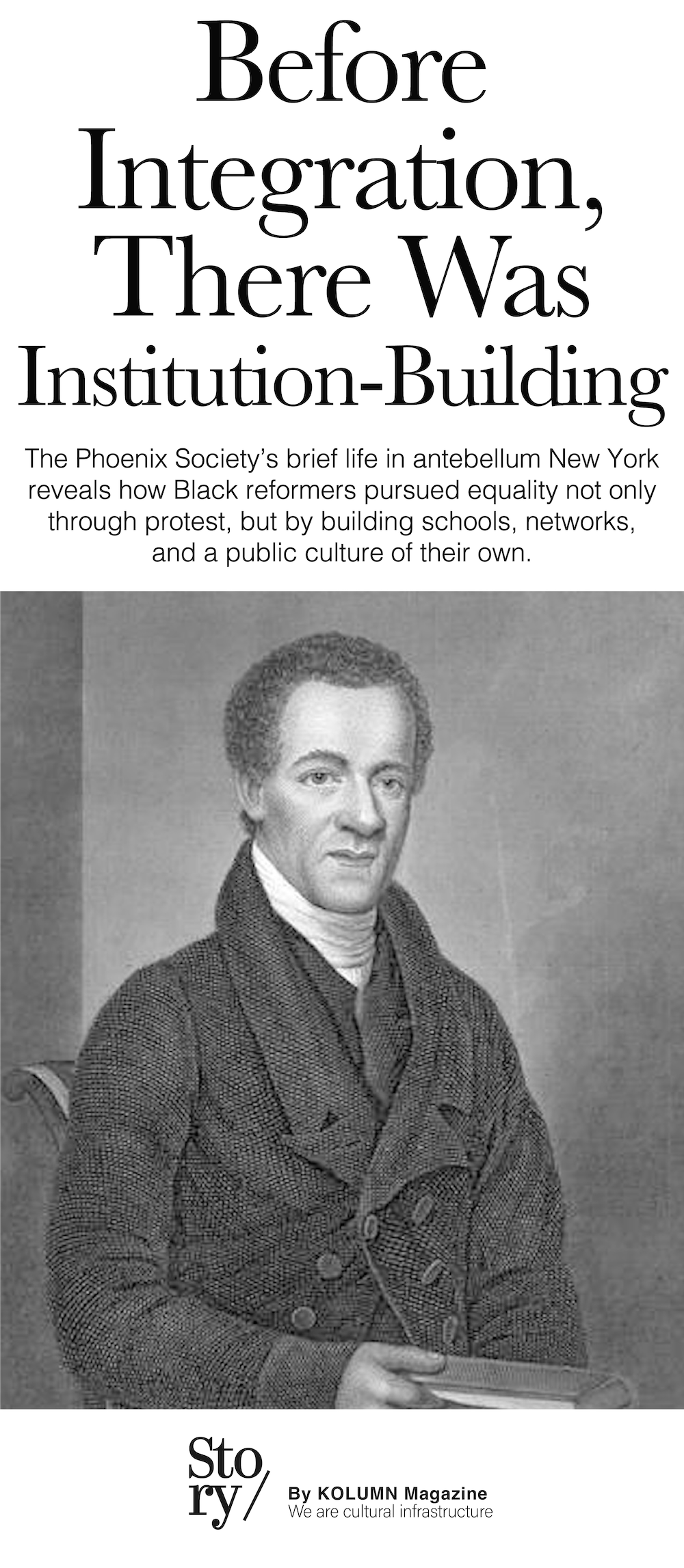
The Phoenix Society treated education not as a private good, but as infrastructure for Black freedom.
By KOLUMN Magazine
The Phoenix Society did not emerge in a quiet moment. It was born in a city that liked to congratulate itself for progress while denying Black people the substance of it. New York had formally abolished slavery in 1827, but freedom on paper did not end racial exclusion, economic vulnerability, educational inequality, or the very real danger of anti-Black violence and kidnapping. In that atmosphere, the Phoenix Society represented something larger than a benevolent club. It was a Black-led wager that institutions could do political work. Build schools, circulate books, organize families, support workers, cultivate speech and intellect, and you were not merely helping individuals get ahead. You were constructing a people’s claim to citizenship.
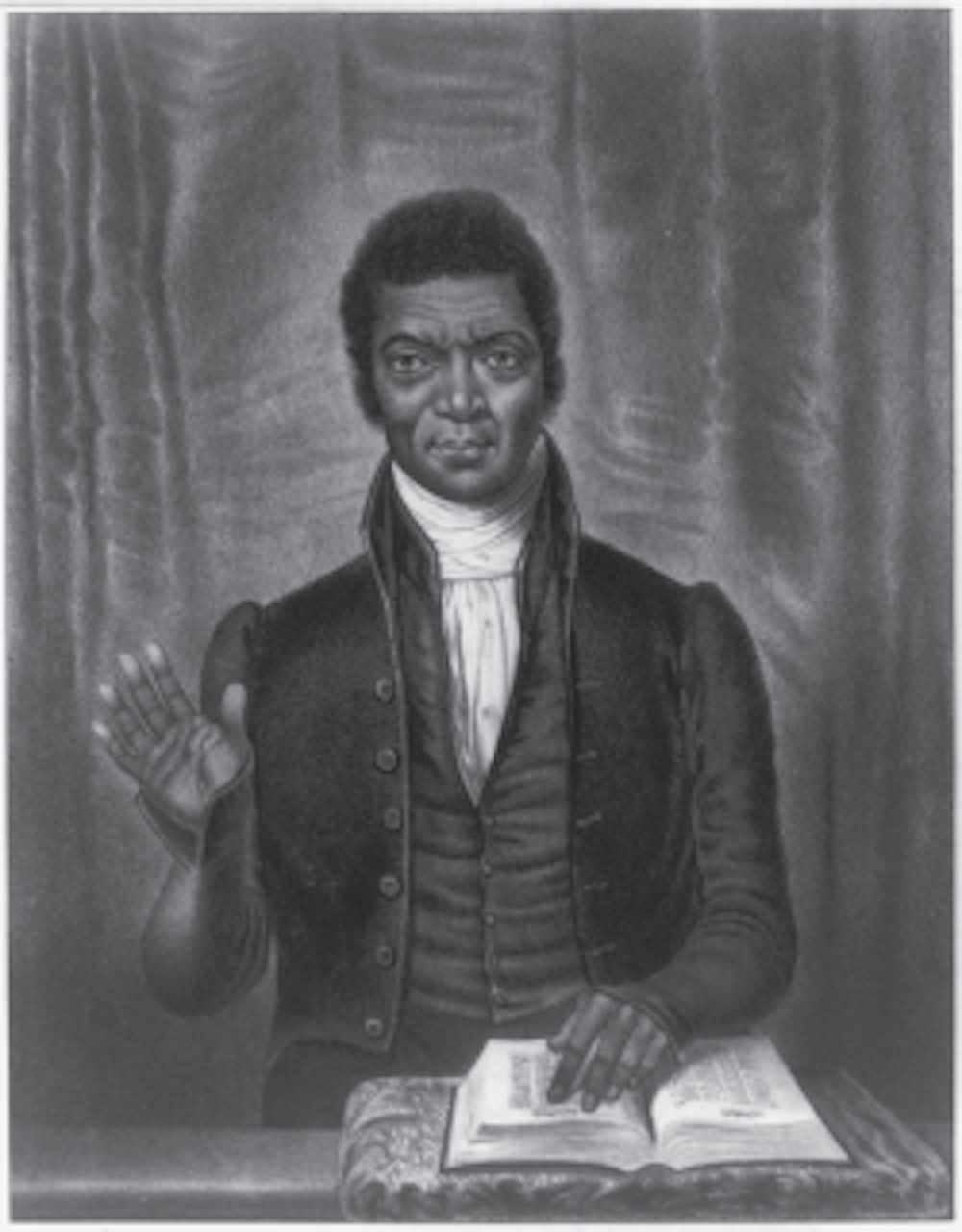
Founded in 1833 by a circle of prominent Black New Yorkers that included Samuel Cornish, Theodore S. Wright, Peter Williams Jr., and Christopher Rush, the Society stood at the crossroads of abolitionism, church leadership, literary culture, and practical neighborhood organizing. Its officers and supporters were not interested in a narrow, single-issue effort. They wanted a broad architecture for Black advancement: schools for children and adults, ward-based libraries, public lectures, job connections, relief for poor families, and moral reform understood not as respectability for its own sake, but as a strategy for communal survival in a society eager to depict Black life as unfit for freedom.
That ambition is what makes the Phoenix Society historically significant. It was not simply reacting to racism. It was answering a central question of Black life in the North: if emancipation was incomplete, what kinds of institutions would have to be built to make freedom real? The Society’s life was relatively brief, and many of its plans were constrained by money, politics, and the small size of the Black middle class that had to sustain such work. But its short existence mattered because it crystallized a pattern that would recur throughout Black history: when access to public goods is blocked, Black communities build parallel structures and, in building them, redefine democracy itself.
A city that ended slavery without ending inequality
To understand the Phoenix Society, you have to begin with the contradiction that shaped Black New York after 1827. Emancipation ended legal slavery in the state, but it did not produce equal citizenship. White New Yorkers still controlled the labor market, the schools, most political institutions, and the social definitions of merit and belonging. The city’s economy also remained deeply entangled with the slave South. As historians of the period have noted, New York’s commercial class profited from the circulation of slave-grown commodities, especially cotton. That economic reality mattered because it helped sustain a political culture in which Black freedom was tolerated only so long as it did not threaten white power or profit.
This was also a place where freedom could be frighteningly unstable. Even after emancipation, Black New Yorkers were vulnerable to kidnapping networks and pro-slavery interests that sought to drag free people south into bondage. By 1835, David Ruggles and the New York Committee of Vigilance were organizing to protect “endangered persons of color” from precisely that threat. The fact that such a committee was necessary in supposedly free New York says a great deal about the world in which the Phoenix Society operated. Black institution-building in the city was not an abstract cultural preference. It was a practical response to insecurity.
Education sat at the center of this struggle. The New York African Free School, created in 1787 under the auspices of the New York Manumission Society, had for decades offered formal schooling to Black children and helped produce notable alumni, including James McCune Smith and Henry Highland Garnet. Its official mission presented Black education as a path toward equality. But Black parents and leaders increasingly challenged white control over these institutions and the paternalism embedded within them. By the 1830s, Black New Yorkers were pressing for more authority over curriculum, staffing, and the future of their children. In that sense, the Phoenix Society did not begin the fight for Black education in New York. It radicalized it by insisting that Black communities should shape their own educational agenda.
The men behind the movement
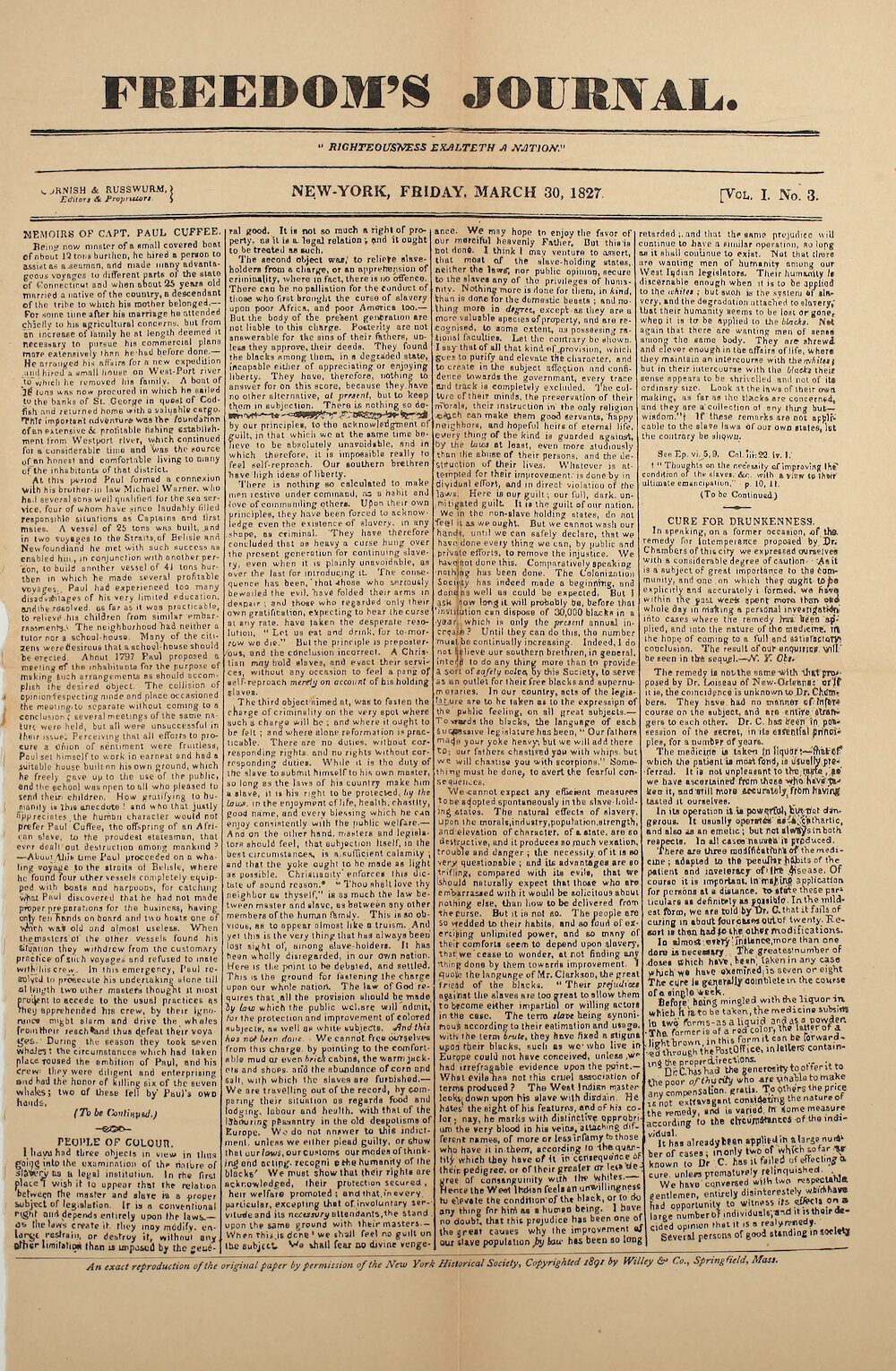
The Society’s founders were not obscure local functionaries. They were part of the most important network of Black leadership in antebellum New York. Samuel Eli Cornish was already known as a minister and co-founder of Freedom’s Journal, the first Black-owned newspaper in the United States. Peter Williams Jr. was an Episcopal priest and abolitionist deeply invested in Black education and self-help. Theodore Sedgwick Wright was a Presbyterian minister and a major abolitionist voice. Christopher Rush, another founding figure, helped lead the African Methodist Episcopal Zion Church and belonged to the generation of Black religious leaders who understood church work and political work as intertwined.
These men brought distinct talents, but they shared a worldview. They believed the struggle against slavery and racial degradation required more than denunciation. It required organizational life. Newspapers could sharpen political consciousness. Churches could stabilize families and communities. Literary societies could cultivate intellect and debate. Schools could produce leaders. Mutual aid could keep the poor alive long enough to imagine something beyond bare survival. The Phoenix Society sat at the intersection of all these traditions.
There is another reason the founders matter. They reveal how much of antebellum Black politics was built through overlapping memberships and institutions. These were ministers, editors, teachers, antislavery activists, and reformers working across multiple fronts at once. The Phoenix Society was never just one organization among many. It was a node in a larger Black associational culture that included churches, conventions, schools, vigilance committees, and literary societies. That web of activity is central to its significance. The Society shows that long before the modern nonprofit era, Black Americans were already practicing a sophisticated form of civic organizing.
The program was astonishingly expansive
One of the best windows into the Society’s vision is the 1833 statement of its objectives, published in The Liberator and preserved through later documentary collections. The list is striking in both its scale and detail. The Society aimed to visit every family in each ward, register basic demographic and educational information, recruit members according to ability to pay, get children into school, draw adults into school and church, expand subscriptions to abolitionist newspapers, encourage women’s Dorcas societies, clothe poor children so they could attend school, establish circulating libraries, hold “mental feasts” and lyceums, assist promising young men in securing liberal education, and help skilled mechanics and youths find placement in trades and on farms.
Read slowly, that agenda tells you exactly what the founders thought Black freedom required. They were trying to build a census system, a membership organization, an educational network, a lecture circuit, a literary culture, a poor-relief apparatus, and an employment bureau all at once. They wanted data, not just sentiment. They wanted reading, not just exhortation. They wanted clothes, schools, and jobs. They wanted collective discipline, but they also wanted material access. This is one reason the Phoenix Society feels so modern. It recognized that inequality is structural and therefore has to be confronted on multiple levels at the same time.
The language of “moral societies” and “vicious and demoralizing practice” can sound stiff or judgmental to modern ears, and there is no reason to romanticize every part of nineteenth-century uplift rhetoric. But in context, this language was also defensive. Black New Yorkers were living under a regime of constant racist surveillance. Claims about Black ignorance, disorder, or incapacity were used to justify exclusion from schools, jobs, voting, and civic belonging. The Phoenix Society’s emphasis on study, conduct, and self-improvement was not merely accommodation. It was also rebuttal, an organized refusal of the lie that Black people were unprepared for freedom.
The classroom was the heart of the project
For all its ambitions, the Phoenix Society is remembered most powerfully for its educational work. That is not accidental. In the Black politics of the 1830s, education was increasingly viewed as both symbol and instrument: a sign of full humanity in a racist republic, and a practical means of creating leadership for the future. Kristopher Burrell’s research on Black educational institutions in antebellum New York describes the Phoenix Society as the largest of the city’s African American educational societies and notes that it pursued this work despite chronic financial problems.
The Society established a classical high school in December 1833, beginning with a small number of students. A few years later it promoted the Phoenix High School for Colored Youth, while also trying to raise the money necessary to sustain it. Burrell notes that annual operating costs were estimated at roughly $1,500 to $1,800, while the Society sought $1,000 in donations to close the gap. Those numbers matter because they show that the barrier was not vision. It was resources. Black New Yorkers had formulated an educational program that reached beyond elementary instruction and into the realm of secondary and classical schooling. What they lacked was stable capital.
This push for higher learning was quietly radical. At a time when many white Americans openly doubted that Black people should receive advanced education at all, Phoenix Society leaders insisted the opposite. They were aligned with a broader current in Black thought that viewed classical and manual education alike as necessary for racial elevation and political equality. That insistence was not naïve. The founders understood the job market was discriminatory. They understood schooling alone would not defeat prejudice. But they also understood that denying Black intellectual capacity was one of racism’s foundational moves. A Black high school therefore carried enormous symbolic weight. It announced that Black youth were entitled to the same horizons of thought as anyone else.
Henry Highland Garnet, who would later become one of the nineteenth century’s most forceful abolitionist voices, was among the students linked to the Phoenix High School after his years at the African Free School. That fact gives the Society a human scale. The organization did not just talk about future leadership in the abstract. It helped shape at least some of the young people who would go on to define Black public life.
The Society’s work extended beyond a boys’ school. Sources connected to later legal and historical accounts note that it also sponsored an Evening School for Colored People and helped support education for young women. One source describes the women’s school as more successful in attracting students than some of the Society’s other efforts. That matters because it complicates any too-simple story about antebellum Black institution-building as exclusively male-led or male-focused. Even when the archival record privileges male officers and founders, the Society’s actual program reached across households and generations.
The membership model revealed both strength and fragility
The Phoenix Society’s organizational model also deserves attention. According to Burrell, members paid a $1 initiation fee and 25 cents per quarter, while the Society aimed to enroll people according to ability to pay. That structure reflects a familiar Black institutional pattern: communities with limited wealth funding ambitious public work through dues, donations, and volunteer labor. It also explains why so many such organizations lived with permanent financial precarity. The Black middle class in 1830s New York was small. Membership rolls overlapped across multiple reform and literary societies. The same people were being asked, repeatedly, to subsidize a whole ecology of Black associational life.
That financial pressure helps explain why the Society’s agenda was both impressive and hard to sustain. It was trying to serve poor children, establish libraries, support schools, convene lectures, and place workers in jobs, while also navigating the economics of a racially exclusionary city. White abolitionists such as Arthur Tappan were involved, and Burrell notes that white officers gave the Society greater capacity to make fundraising appeals. But even that interracial support had limits. Patronage could help, but it could not substitute for a durable Black institutional base in a society that had systematically restricted Black wealth accumulation.
In that sense, the Phoenix Society’s struggles were not evidence of organizational failure so much as evidence of structural constraint. A great deal of Black reform history looks this way: a burst of sophisticated collective planning colliding with the hard reality that oppression impoverishes the very communities it expects to self-rescue. The Society’s founders were not poor strategists. They were working inside a system designed to make independent Black institution-building difficult.
Why the Society mattered beyond schooling
It would be a mistake to reduce the Phoenix Society to a school-support group. Its most interesting contribution may be the way it fused education, information, and social welfare into one coherent political vision. The objective of registering every Black family in a ward suggests early community mapping. The call to circulate abolitionist newspapers shows an understanding that political literacy mattered. The emphasis on libraries, lyceums, and public speaking reveals a belief that reading and oratory were tools of self-defense and democratic participation. The concern for mechanics and apprentices shows sensitivity to labor and mobility. This was not philanthropy in the narrow sense. It was Black civic planning.
The Society’s inclusion of Dorcas societies and clothing drives for poor schoolchildren is especially revealing. Here the line between education and survival collapses. A child who lacks proper clothing may not attend school. A family without mutual aid may not stay stable enough for children to learn. A community without women’s organizing cannot maintain the material texture of institutional life. The Phoenix Society understood these relationships. That is one reason its program still feels legible today, in an era when educators and organizers speak about wraparound services, community schools, and social determinants of opportunity. The vocabulary has changed. The logic has not.
Its “mental feasts” deserve a pause, too. The phrase sounds lyrical, almost tender. But it carried serious meaning. The Society wanted spaces for intellectual cultivation and improvement, lectures in the sciences, and training in speech. In a society where Black minds were routinely demeaned, to gather for mental feasts was to insist that intellect belonged to the people, not only to white elites. It was a declaration that Black reading and reasoning were themselves political acts.
A brief life, a long legacy
The Phoenix Society eventually folded later in the decade, largely because of lack of funds. On one level, that fact can make the organization look like a promising but temporary experiment. On another, it clarifies its real legacy. The Society did not disappear because its ideas were marginal. It disappeared because its ideas were expensive, and the people who most needed them had been denied the resources to sustain them at full scale. Yet the goals it articulated did not vanish. As the National Humanities Center summary notes, other Black mutual-aid and literary societies in New York continued to pursue the kinds of aims the Phoenix Society had set out.
That continuation matters. The Society belongs to a lineage rather than an isolated episode. It sits alongside Black conventions, literary societies, churches, vigilance committees, self-help associations, women’s aid networks, and later freedom struggles that all understood institutional autonomy as part of political freedom. Even where the Phoenix Society itself proved short-lived, the model endured: organize locally, educate collectively, publish aggressively, aid materially, and speak for yourselves.
It also belongs in the history of Black education more specifically. Too often, the story of nineteenth-century Black schooling gets told through white philanthropists, missionary systems, or later battles over segregation. The Phoenix Society reminds us that Black educational thought in the North was already sophisticated in the 1830s. Black leaders were not simply asking to be included in white institutions. They were formulating their own theories about curriculum, leadership, moral development, literacy, and the relationship between schooling and citizenship.
What the Phoenix Society tells us now
There is a temptation, when writing about organizations like the Phoenix Society, to make them tidy ancestors of modern civil-rights work. That is partly true, but it is not enough. The Society was not just a precursor. It was a reminder that Black political life has long involved building parallel civic capacity in the face of exclusion. Sometimes that takes the form of schools. Sometimes it takes the form of newspapers, relief funds, voter drives, reading circles, legal defense networks, or neighborhood data collection. The mechanism changes. The premise remains: communities denied equal protection often survive by becoming their own infrastructure.
The Society also complicates contemporary assumptions about what counts as political action. Today, protest tends to dominate the visual grammar of movement history: marches, speeches, arrests, confrontations, viral images. The Phoenix Society points to another register of politics, quieter but no less consequential. Visiting families. Keeping records. Finding clothes for children. Creating libraries. Raising tuition money. Recruiting subscribers to abolitionist papers. Helping young people study and workers find placements. None of that looks cinematic. All of it is political.
And maybe that is the most durable lesson. The Phoenix Society’s genius was its refusal to separate dignity from structure. Its leaders understood that freedom required emotional courage, certainly, but also institutions sturdy enough to carry ordinary life: where children learned, where adults read, where workers connected to opportunity, where families found relief, where ideas circulated, where speech was sharpened, where the poor were not abandoned. That is a profoundly democratic vision, and also a profoundly Black one in the American context, because it emerged from a people who had every reason to know that rights mean little when no structure exists to exercise them.
The Phoenix Society’s history is significant, then, not because it solved the problems of Black life in antebellum New York. It did not. Nor because it lasted long enough to become a permanent pillar. It did not do that either. Its significance lies in the clarity of its diagnosis and the boldness of its response. It saw that emancipation without access, knowledge, employment, safety, and collective organization would remain a thin freedom. So it tried to build thickness around freedom. It tried to give it schools, books, lectures, dues, membership, clothing, jobs, and civic form.
For a brief moment in the 1830s, a group of Black New Yorkers looked at a city that offered them little beyond nominal liberty and decided not merely to protest that condition, but to out-organize it. That is the Phoenix Society’s real story. Not a footnote, not an elegant curiosity, but an early blueprint for how Black communities have repeatedly answered abandonment: by inventing the institutions they were told not to expect.
More great stories
Afro Sheen, Wall Street, and the Architecture of Black Possibility
July 6, 2026
No Comments
The Fire Inside the Fourth
July 5, 2026
No Comments