



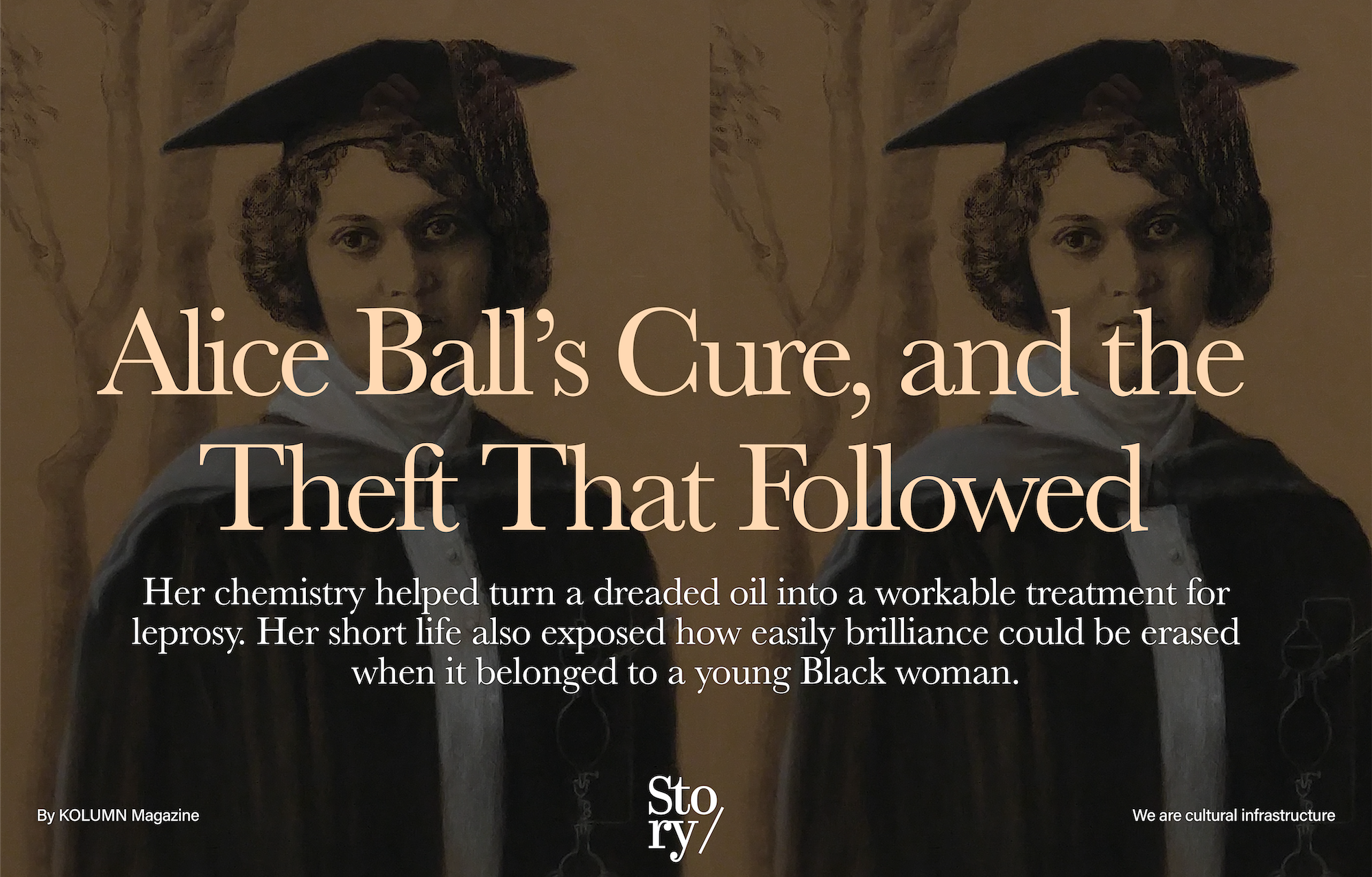
A young Black woman could solve a biomedical problem and still be narratively demoted once she was no longer alive to defend authorship.
A young Black woman could solve a biomedical problem and still be narratively demoted once she was no longer alive to defend authorship.
By KOLUMN Magazine
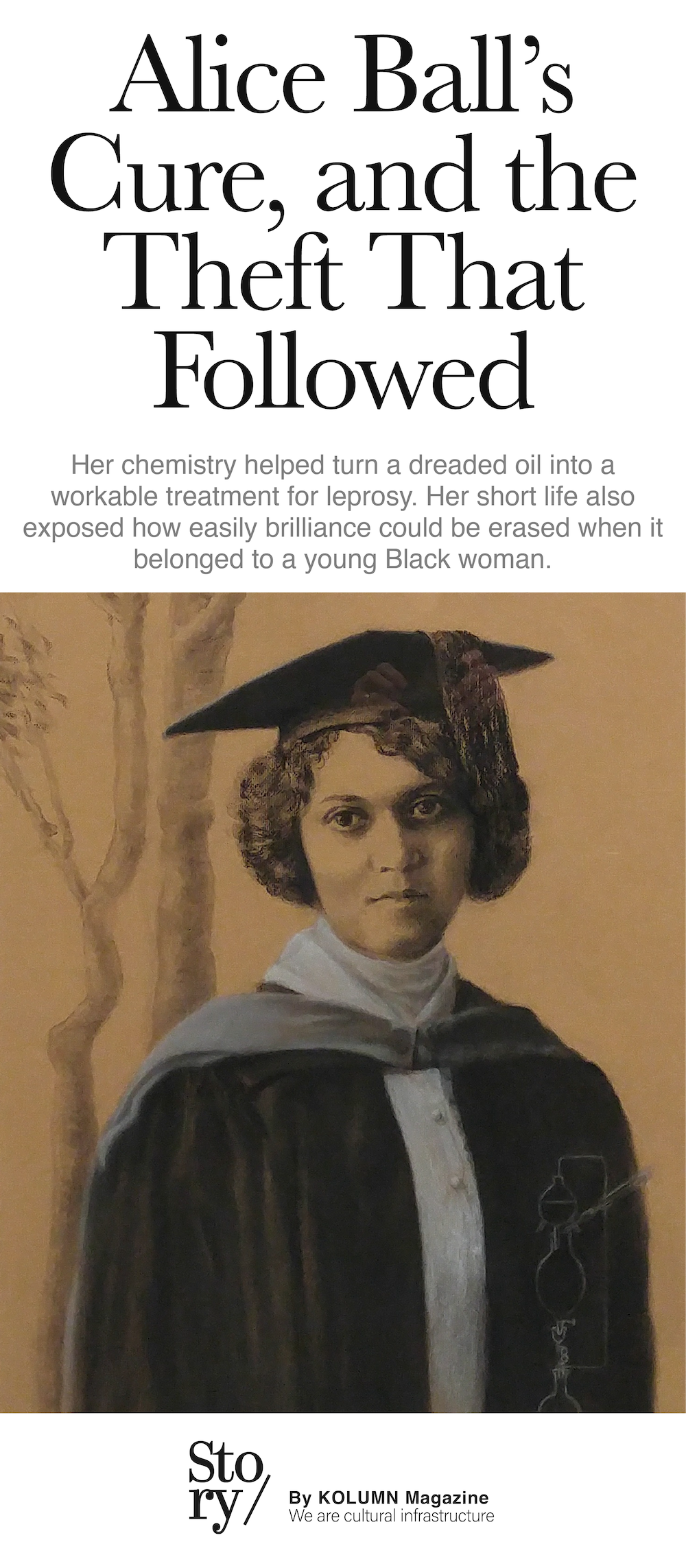
There are some historical figures who arrive in the archive already mythic. Their papers are preserved, their portraits restored, their names attached to buildings, prizes, and tidy narratives about genius. Alice Augusta Ball did not get that kind of entrance. She got fragments. A few photographs. A handful of scientific papers. A campus memory half-buried under institutional habit. A treatment method that changed lives. And then, for decades, a story told as though somebody else had done the important part.
Ball was born in Seattle in 1892 into a distinguished, intellectually active family. Her father, James Presley Ball Jr., worked as a lawyer, journalist, and photographer. Her mother, Laura Louise Howard Ball, was also a photographer. Her grandfather, James Presley Ball Sr., was one of the most prominent Black photographers of the nineteenth century, known for portraits of figures including Frederick Douglass and Charles Dickens. Historians and institutional biographers alike have pointed to that family environment—especially the chemistry-adjacent processes of early photography—as part of the atmosphere that nurtured Ball’s early interest in science.
That detail matters because Ball’s life is sometimes flattened into an inspirational shorthand: young Black woman scientist, discovered treatment, died young, was robbed of credit. All true. Also incomplete. She was not an accidental genius who somehow wandered into a laboratory and did something astonishing on raw instinct. She was rigorously trained. She was already publishing serious chemistry early in adulthood. She was working at the intersection of pharmacy, organic chemistry, extraction techniques, and applied medical need. The tragedy of her story is not merely that she was forgotten. It is that someone demonstrably qualified, ambitious, and scientifically original was treated by history as though she were incidental to her own breakthrough.
That line, preserved from her high school yearbook, reads today with a painful double resonance. On one level it sounds like the classic dissatisfaction of a serious student—the restless internal standard of someone who sees how much more there is to master. On another, it feels like a haunting preview of the historical record that would follow: enormous work, delayed recognition, and the almost unbelievable spectacle of a lifesaving contribution being made to seem like a side note.
A family history of images, a future in chemistry
Ball spent part of her childhood in Hawaiʻi after her family moved there hoping the climate would ease her grandfather’s arthritis. After his death, they returned to Washington. Back in Seattle, Ball excelled academically. She attended Seattle High School, where she was one of only a small number of Black students, and then entered the University of Washington. There she earned a degree in pharmaceutical chemistry in 1912 and a second degree in pharmacy in 1914. According to the National Women’s History Museum, she became the first Black woman to graduate from the university with a degree in pharmaceutical chemistry.
That alone would make her notable. But Ball was doing more than collecting credentials. While still tied to the University of Washington, she co-authored scientific work on benzoylation chemistry that appeared in the Journal of the American Chemical Society. Later sources from the University of Hawaiʻi and the National Women’s History Museum point to that publication record as evidence of how unusual Ball’s early research profile was, especially for a woman and especially for a Black woman in the 1910s. Paul Wermager, the retired University of Hawaiʻi librarian who became one of Ball’s most persistent historical advocates, has argued that she was likely among the first African Americans published in JACS.
In the popular retelling of science, publication often gets overshadowed by the single big breakthrough. But publication matters because it demonstrates method. It shows a person already inside the discipline—not just adjacent to it. Ball was not merely brilliant in a romantic sense; she had technical fluency, laboratory discipline, and the kind of research background that made other scientists notice her. That was one reason she received a scholarship to pursue graduate study at the College of Hawaiʻi, now the University of Hawaiʻi. There, she continued research on kava and the extraction of active compounds, work that sharpened the exact kind of chemical problem-solving that would define her legacy.
In 1915, Ball earned her master’s degree in chemistry from the College of Hawaiʻi. By university accounts, she was the first woman and the first African American to do so there. More recent University of Hawaiʻi coverage has also framed her as the first African American and woman in the United States to earn a master’s degree in chemistry in 1915, reflecting the institution’s current understanding of the distinction. She was then offered an instructor position in chemistry, making her the school’s first Black and first female chemistry instructor. In an era when higher education and laboratory science were structured to exclude both women and Black scholars, that sequence of firsts was not ceremonial. It was structural. Ball was crossing barriers at every step.
The disease behind the breakthrough
To understand Ball’s significance, you have to understand the problem she was recruited to confront. Hansen’s disease, long known as leprosy, carried more than medical consequences. It carried terror, stigma, moral judgment, visible bodily damage, and in Hawaiʻi a regime of state-enforced exile. The American Chemical Society notes that before effective therapies, diagnosis often meant shame, disfigurement, and social isolation. The National Park Service and Hawaiʻi state sources document that from 1866 to 1969, around 8,000 people—mostly Native Hawaiians—were forcibly removed to Kalaupapa under compulsory segregation policies.
That context is essential. Ball’s work was not just a laboratory feat in the abstract. It emerged inside a system where the disease itself had been turned into a mechanism of dispossession. Smithsonian’s account emphasizes that while white patients could, in some instances, leave Hawaiʻi for treatment elsewhere, Hawaiians sent to Kalaupapa were often expected to remain for life. Doug Herman of the Pacific Worlds Institute described the arrangement as a “total double standard.” In other words, Ball’s chemistry sat at the intersection of colonial medicine, racial hierarchy, and the desperate search for something—anything—that could interrupt the sentence of banishment.
Before Ball, chaulmoogra oil had long been known as a possible treatment. But “possible” is doing a lot of work there. The oil had a reputation, not a reliable delivery system. Patients could ingest it, but that often caused nausea and vomiting. It could be applied topically, but results were limited. It could be injected, but its viscosity made administration painful and impractical. The problem was not simply whether chaulmoogra contained useful compounds. The problem was how to render those compounds absorbable, injectable, and medically usable. That is the sort of difficulty that separates folklore from pharmaceutical chemistry.
Harry T. Hollmann, a physician working with leprosy patients in Hawaiʻi, recognized that Ball’s work on extracting active compounds from kava might translate to chaulmoogra. He approached her with the problem. The National Women’s History Museum says Hollmann wondered whether Ball could do for chaulmoogra what she had done for kava: isolate the active ingredients in a way that made the treatment clinically viable. She did.
The Ball Method
Ball’s breakthrough was chemical, not rhetorical, which is part of why it can be underappreciated outside scientific circles. She isolated and modified the fatty acid components of chaulmoogra oil into ethyl esters that were water-soluble enough to be injected and absorbed by the body. ACS describes this as the adaptation of chaulmoogra’s active ingredients into a form that was more effective and easier to administer. The National Women’s History Museum similarly notes that Ball isolated the ethyl esters of the fatty acids, making injection feasible. The result became known as the Ball Method.
That phrase—“the Ball Method”—deserves to be heard not as branding but as precision. Ball did not invent chaulmoogra. She solved the delivery problem that had kept it from becoming a viable modern therapy. In medicine, that distinction is the difference between hope and treatment. A substance can have theoretical benefit for generations and still fail patients because it cannot be reliably administered. Ball changed that equation.
The implications were immediate and profound. According to ACS, the treatment did not require highly sophisticated equipment, which meant it could be prepared in remote locations with limited resources. The treatment became the most viable therapy for Hansen’s disease in the early twentieth century and remained important until sulfone drugs and later antibiotic approaches displaced it in the 1940s. The University of Hawaiʻi says Ball’s method was used on thousands of patients worldwide and allowed people at Kalaupapa and elsewhere to return to their families after confinement.
Even careful historians avoid overstating the treatment. It was not a miracle cure in the contemporary sense, and it did not eliminate the disease overnight. But it was the first genuinely workable treatment option. That distinction matters because it honors both the science and the patients. Ball’s contribution was not mythic perfection. It was a decisive medical advance that altered prognosis, practice, and possibility.
She did not discover a fantasy cure. She solved a real chemical problem for a real disease inside a brutal system of exile—and that is precisely why her work mattered.
One of the clearest pieces of evidence for Ball’s role comes from Hollmann himself. As quoted by the National Women’s History Museum, he later wrote, “After a great deal of experimental work, Miss Ball solved the problem for me.” That sentence is unusually direct. Not assisted. Not contributed to. Solved. In a scientific culture often careful about authorship language, the clarity is striking.
A life cut short
Ball died on December 31, 1916, at just 24 years old, before she could fully publish her findings on chaulmoogra. The precise cause of death remains uncertain. Some later accounts say she became gravely ill after inhaling chlorine gas during a laboratory demonstration involving gas masks; Smithsonian notes that this was reported in some retellings. But Smithsonian also notes that tuberculosis was listed as the cause on her death certificate, and the National Women’s History Museum likewise treats the chlorine explanation as possible rather than definitive. In a story already shaped by institutional neglect, uncertainty around the terms of her death only adds to the sense of historical incompletion.
The emotional force of Ball’s biography often concentrates here: the lost future. ACS quotes chemistry professor Gregory Petsko reflecting in 2023 that most chemists do not hit their stride until their thirties or forties and asking readers to imagine what else she might have done had she lived. The remark is effective because it refuses the sentimental trap of praising only what she completed. Ball’s life invites a second, sharper grief: not only for what she achieved, but for the entire body of work history never got to see..
And yet the most infuriating chapter begins after her death.
Credit reassigned
Because Ball died before formally publishing the full chaulmoogra work, others inherited access to her research. Arthur L. Dean, then president of the College of Hawaiʻi and a chemist himself, continued the work, oversaw production of the injectable treatment, and published findings without properly crediting Ball. University of Hawaiʻi sources say he failed to mention the key research she had conducted and attached his own name to the method, which circulated as the “Dean Method.” The National Women’s History Museum is blunter: a male colleague later claimed credit for her discoveries. Smithsonian frames the pattern as part of a male-centric historical narrative that erased Ball from the story of the breakthrough.
There is a temptation, in modern retellings, to turn this into a simple morality play: villain steals from heroine. The facts support moral outrage, but the deeper issue is systemic. Ball’s erasure was possible because the institutions around her were already practiced in recognizing authority in certain bodies and treating others as provisional, even disposable. A young Black woman could solve a biomedical problem and still be narratively demoted once she was no longer alive to defend authorship. Her absence made appropriation easier, but the culture made it legible.
The historical record was not entirely silent, however. In 1922, Hollmann published an article in Archives of Dermatology and Syphilology that credited Ball and referred to the injectable formulation as the “Ball Method.” The JAMA archive confirms the publication and date of Hollmann’s paper. University of Hawaiʻi and other institutional sources describe this article as the key document that helped rescue Ball’s authorship from oblivion. Without it, later historians might have had a much harder time reconstructing the trail.
That, too, says something sobering about how scientific history works. Recognition is not just a function of discovery. It is a function of who writes, who archives, who names, who cites, and who gets treated as credible after they are gone.
The long delay in recognition
Ball was not immediately restored to her rightful place. It took decades. According to Smithsonian and University of Hawaiʻi accounts, researchers and historians including Kathryn Waddell Takara, Stanley Ali, and later Paul Wermager played major roles in resurfacing Ball’s life and work. Their efforts led to a more public reckoning with the record and, eventually, formal honors.
The University of Hawaiʻi dedicated a plaque to Ball in 2000 near a chaulmoogra tree on campus. In 2007, the Board of Regents awarded her the Medal of Distinction, the institution’s highest honor. In 2022, Hawaiʻi formally proclaimed Alice Augusta Ball Day. In 2024, the university celebrated additional milestones, including plans for a life-sized bronze bust and the approval of an ACS National Historic Chemical Landmark designation. In February 2026, ACS formally designated the Ball Method as a National Historic Chemical Landmark.
These honors matter. They are not trivial. Public memory is built through plaques, proclamations, scholarship endowments, portraits, sculptures, landmarks, and curricular presence. But recognition, especially delayed recognition, has a complicated moral texture. It honors Ball, yes. It also tells on the institutions doing the honoring. Every posthumous celebration carries an implicit confession: you should have been impossible to ignore in the first place.
Recognition came, but it came with an indictment built in: the science had always been there. The failure was historical, not chemical.
Paul Wermager has perhaps done as much as anyone to make that historical failure visible. Smithsonian quotes him saying, “Since we cannot bring Alice back to life, the least we can do is tell the story of her life as honestly and thoroughly as possible.” It is a modest sentence on its face, but it contains a whole ethic of repair. Not invention. Not mythology. Honest and thorough. Ball does not need embellishment. She needs accuracy.
Why Alice Ball matters now
There is an easy version of Alice Ball’s significance: she was a pioneering Black woman chemist who invented an early treatment for leprosy. That sentence is fine as an introduction, but it is too small for what her life actually reveals.
She matters first because the science was consequential. Ball helped make the first viable treatment for Hansen’s disease available at a time when patients otherwise faced pain, stigma, and often lifelong segregation. Her work represented a concrete improvement in medical practice. It helped turn a notoriously difficult botanical remedy into a standardized therapeutic method. This is not symbolic significance. It is material significance.
She matters second because her story exposes how scientific credit operates. Ball’s erasure was not a bizarre exception from an otherwise fair system. It was one instance of a broader pattern in which women and scientists of color were structurally vulnerable to appropriation, diminishment, or omission. ACS says her case underscores the obstacles women and Black scientists have historically faced in establishing themselves as leaders in their fields. Ball’s life remains instructive precisely because the mechanism of her disappearance is so familiar.
She matters third because her work is inseparable from Hawaiian history. To discuss Ball only as a “woman in STEM” icon is to miss the colonial and racial geography of the crisis she addressed. Kalaupapa was not merely a hospital setting. It was a site of forced exile, family rupture, and Native Hawaiian suffering under state policy. Ball’s chemistry cannot redeem that system. But it did offer a crack in it, a means by which some people could return from medical banishment toward ordinary life.
She matters fourth because she complicates our public imagination of genius. Ball was not old. She was not institutionally powerful. She did not leave behind a giant body of self-authored books and memoirs. Her importance has to be reconstructed from technique, effect, and corroboration. That means her story asks readers to value scientific labor even when it comes without the usual monuments of prestige.
And finally, she matters because she helps clarify what historical justice can and cannot do. It can restore a name. It can rename a method. It can place a plaque, commission a bust, designate a landmark, fund a scholarship, assign a classroom reading, publish an overdue obituary. What it cannot do is return the decades in which her contribution was missing from public consciousness. It cannot give her the career she was denied by death or the authority she was denied by theft. Restoration is necessary. It is not the same thing as repair.
The lesson beyond the legend
Alice Augusta Ball’s story is powerful partly because it satisfies a moral urge. We want the forgotten genius found. We want the stolen work given back. We want the archive corrected. And in her case, some of that has happened. Her method bears her name. Her legacy is increasingly taught. Her institution now publicly celebrates her. The scientific community has formally landmarked her achievement.
But the harder lesson is not simply “remember Alice Ball.” It is to ask what present-day structures still decide whose rigor counts, whose work is seen as primary, and whose brilliance is treated as improbable until someone else repeats it. Ball’s life is not only a historical episode. It is a template for reading institutions skeptically. When credit flows upward, when archives feel oddly incomplete, when the official version centers power more than process, her story teaches you where to look.
In that sense, Ball belongs not just to the history of chemistry or Black history or women’s history, but to the broader history of how knowledge is made public. Discovery alone is never enough. Discovery has to survive narration. It has to survive hierarchy. It has to survive the human appetite for attaching achievement to the most institutionally comfortable name in the room. Ball did not survive those forces in her lifetime. Her work did. That may be the miracle and the indictment together.
There is something almost unbearably modern about that. A young expert solves a specialized problem, others manage the recognition, and history later has to untangle what the institution preferred to say. The details are early twentieth century. The pattern is not.
So when Alice Ball is remembered now, she should not be remembered only as an inspirational first. She should be remembered as a chemist of real technical consequence, a Black woman scholar whose early publication record and laboratory skill made her breakthrough possible, a figure whose work touched a brutal chapter in Hawaiian public health history, and a caution against allowing institutions to narrate discovery without scrutiny. That is the fuller measure of her significance.
The proper ending to her story is not sentimentality. It is precision. Alice Augusta Ball helped make the first viable injectable treatment for Hansen’s disease. Her work brought relief and hope to patients who had been treated as socially disposable. She died before she could secure authorship in the ordinary way. Others benefited from that absence. Later scholars, librarians, historians, and institutions pieced the truth back together. Now the record is clearer. Not complete, not healed, but clearer. And maybe that is where responsible history begins: by saying, without hedging, that she solved the problem.
More great stories
Before “Global Black Politics” Had a Name, Vicki Garvin Was Living It
March 13, 2026
No Comments
When Bobby Hutton Fell
March 13, 2026
No Comments