


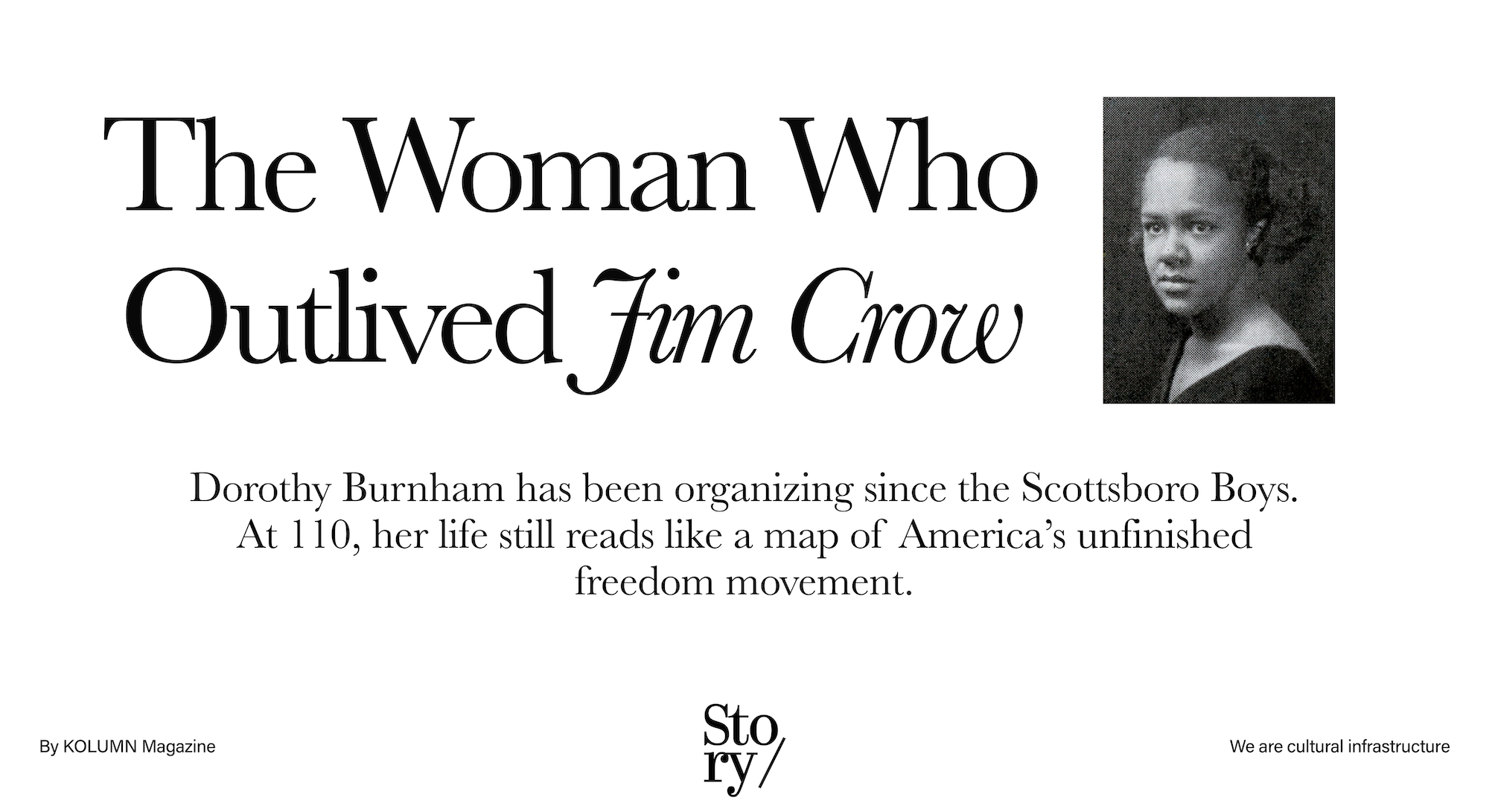
Burnham has always been: a worker in movements, a builder of institutions, a strategist who understood that rights are not bestowed so much as organized into existence.
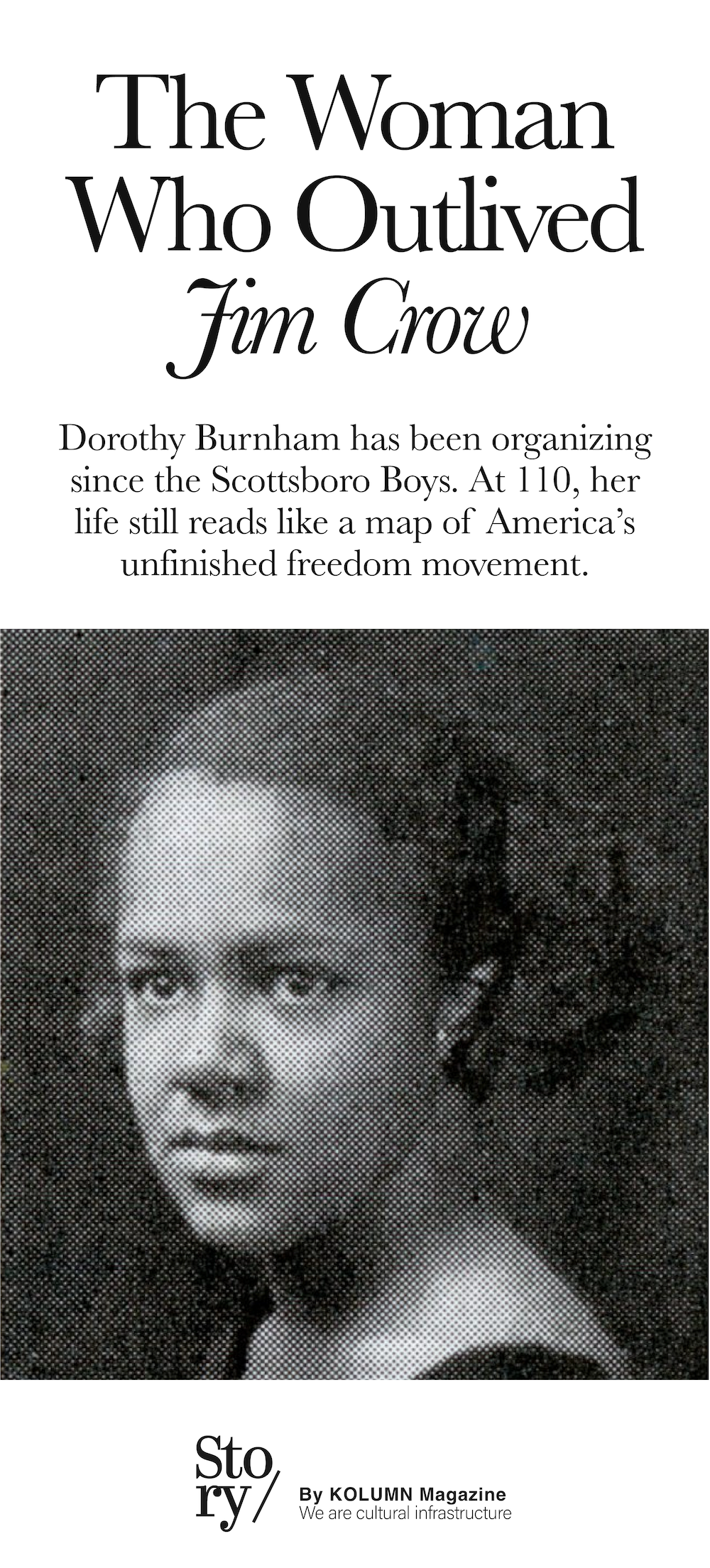
Burnham has always been: a worker in movements, a builder of institutions, a strategist who understood that rights are not bestowed so much as organized into existence.
By KOLUMN Magazine
On a March afternoon in Jamaica Plain, beneath gold balloons shaped into a number that looks almost like a dare, Dorothy Burnham stood with the careful assistance of a walker and the practiced steadiness of a woman who has crossed more precarious thresholds than any birthday party can simulate. One hundred and ten is an age that turns biography into weather—an atmosphere a room must adjust to. It is also a number that begs the public to treat her as an emblem of endurance rather than as what she has always been: a worker in movements, a builder of institutions, a strategist who understood that rights are not bestowed so much as organized into existence. The Boston Globe’s reporting on her 110th birthday framed her life in the language that newspapers reach for when the calendar becomes a plot device—love, service, education.
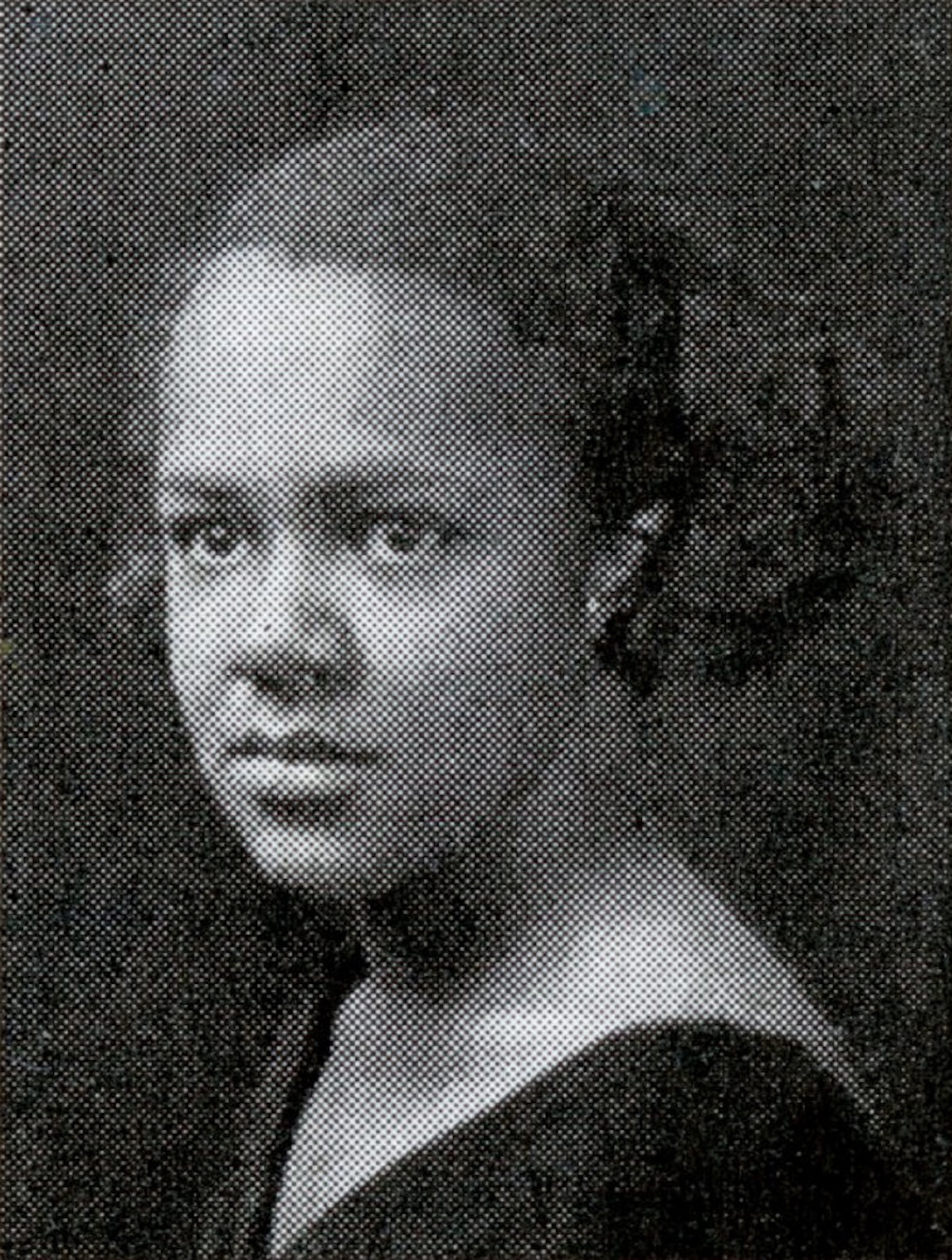
But Dorothy Burnham’s significance is not only that she has lived long enough to be celebrated in the present tense. It is that the most formative chapters of her activism unfolded in a portion of civil rights history that is often blurred out by the nation’s preferred storyboards—a period before Montgomery was a shorthand, before Birmingham was a TV spectacle, before the movement was comfortably narrated as a morality play led by a few recognizable male protagonists. Burnham’s life presses against that simplification. Her political coming-of-age was shaped by the Scottsboro Boys case and the Depression; her organizing matured in the 1940s through the Southern Negro Youth Congress (SNYC), a militant interracial formation that fused civil rights with labor rights; her later decades braided anti-apartheid work, feminist organizing, peace activism, and the patient labor of teaching working-class students the sciences.
To tell her story with integrity is to resist a familiar editorial temptation: to isolate the civil rights movement from the political ecosystems that fed it. Dorothy Burnham’s activism, like that of many organizers whose names do not get the granite treatment, moved through left-led networks that were later targeted by Cold War repression and anticommunist policing. Those networks were not footnotes; they were scaffolding. They trained people, published newspapers, funded travel, organized youth, hosted meetings, and—crucially—made it possible for Black Southerners and Northern migrants alike to imagine collective power as something larger than local grievance. The Brooklyn Public Library, tracing the roots of Burnham’s family and activism, describes how she met students and teachers connected to Communist Party circles at Brooklyn College, and how, after graduating with a science degree, she poured herself into civil rights organizing when stable employment proved elusive.
Burnham’s significance sits at the intersection of three often separated histories: the Black freedom struggle, the labor movement, and the American Left’s long battle with state repression. She also embodies a fourth: Black women’s political labor as infrastructure, not ornament. In an era when the public memory of activism is increasingly filtered through hashtags and anniversary posts, Dorothy Burnham stands as a reminder that movements are built by people who spend decades doing the unphotogenic work—teaching, convening, writing, fundraising, mentoring, sustaining.
A Brooklyn beginning, and the politics of immigrant Black New York
Dorothy Burnham was born Dorothy Challenor in 1915 in New York City to Barbadian immigrant parents, part of a Caribbean diaspora that helped shape Harlem and Brooklyn’s political life in the early 20th century. In those neighborhoods, Black internationalism was not a theory but a lived condition: families carried imperial histories in their accents and remittances; newspapers reported on Ethiopia as if it were next door; debates about colonialism and racism folded naturally into debates about wages, rent, and schooling.
Burnham’s early education ran through Brooklyn’s public institutions—Girls’ High School, then Brooklyn College—at a time when higher education for Black women still came with social suspicion and economic constraint. She studied biology and microbiology, training for a scientific career that would later matter not only as employment but as identity: the scientist as organizer is a different figure than the preacher as leader. Her record complicates the assumption that radical politics were the refuge of the uncredentialed. Burnham’s mind was technical, her training disciplined, and her politics—by the testimony of those who have written about her—were shaped by a sense that knowledge should be usable, portable, and communal.
In the 1930s, the Scottsboro case became a kind of political weather system for young Black activists, especially those in cities where organizing networks could translate outrage into action. Herb Boyd’s profile of Burnham in the New York Amsterdam News situates her awakening in that world—an era when the injustice visited upon Black teenagers in Alabama was discussed in Brooklyn kitchens and campus corridors as both an outrage and a call to disciplined political work. The case’s legal defense, heavily associated in the public mind with Communist-linked organizing, helped make the Left legible to a generation of Black youth as one of the few organized forces willing to confront racist courts and mob violence with national attention and resources.
The Brooklyn Public Library’s account adds texture: Burnham became executive secretary of the Brooklyn Negro Youth Federation of the National Negro Congress, and worked in and around civic and labor-adjacent youth organizations in the borough. This matters because it places her in a pipeline of leadership development that is often under-credited. The National Negro Congress (NNC), founded in the mid-1930s, attempted to build a broad Black-led coalition linking civil rights demands to working-class politics. Dorothy Burnham’s early role in a youth federation affiliated with that ecosystem suggests she was not simply “inspired” by events; she was trained by organizations that treated strategy as a craft.
Meeting Louis Burnham, and choosing Birmingham
In 1941, Dorothy Challenor married Louis E. Burnham, a journalist and organizer whose own trajectory ran through Harlem activism, youth formations, and the SNYC. Together they moved to Birmingham, Alabama—an audacious decision that should be read not as romantic adventure but as political assignment. It is easy, in retrospective storytelling, to treat the South as the stage and Northern activists as visiting actors. For Dorothy Burnham and her circle, the South was the strategic center of gravity. Birmingham was an industrial city with a large Black working class and a hard-edged segregation regime; it was also a place where labor struggles and racial terror overlapped in daily life.
SNYC, founded in 1937, was one of the more daring organizations of its era: interracial, youth-led, committed to civil rights and labor rights, and willing to contest the myth that the South’s racial order was stable. The Brooklyn Public Library summarizes SNYC’s agenda bluntly—campaigns against lynching, police brutality, segregation, employment discrimination, and poll taxes, alongside organizing among farmers and industrial and domestic workers. That list reads like a contemporary platform, which is part of the point: the movement’s demands were not new in the 1960s; they were sharpened earlier and carried forward, sometimes underground, sometimes in public, often at great personal risk.
The story of SNYC is also the story of how anticommunism deformed public memory. Because the organization included Communists and fellow travelers and because it challenged Southern elites in interracial ways that threatened the region’s economic order, it became a target. Scholarship on SNYC and related Southern left formations emphasizes the intensifying pressure of Cold War politics and the state’s willingness to treat interracial organizing as subversion. In Louisville, Birmingham, and beyond, police departments and legislative committees acted as if political dissent were an infection to be quarantined.
Louis Burnham’s biography includes episodes that illuminate the climate in which Dorothy Burnham organized. In Birmingham, city officials and police threatened and harassed SNYC leaders; Louis Burnham was explicitly confronted by Birmingham’s power structure over the organization’s interracial gatherings and its descriptions of Southern racial violence. Those confrontations were not abstract. For organizers, they translated into surveillance, job loss, evictions, arrests, and the constant calculation of whether a meeting place would still be available tomorrow.
Dorothy Burnham’s activism in this period is often described through the work the organization did rather than through her individual heroics, and that is appropriate. SNYC’s genius was infrastructural: leadership training schools, conferences, political education, and coalition work between Black communities and sympathetic white allies in labor and progressive churches. If the later civil rights movement is remembered for its public confrontations with segregation, SNYC’s period should be remembered for building capacity—teaching people how to run meetings, write leaflets, register voters, and connect local grievances to national politics.
The costs of repression, and the politics of disappearance
By the late 1940s, the Cold War tightened its grip. As the Brooklyn Public Library notes, anti-communist pressure contributed to SNYC’s dissolution after its final conference in 1948. The group’s disappearance from mainstream memory is not simply the result of historical forgetfulness; it is also the product of an intentional American project to define respectable civil rights activism as separate from left politics.
This is where Dorothy Burnham becomes a critical figure for contemporary readers. Her life demonstrates that the nation’s dominant narrative of civil rights—safe, linear, culminating—was never the only narrative available. There were other tributaries: organizations willing to link segregation to capitalism; coalitions that treated labor rights as civil rights; activists who saw international anti-colonial struggles as connected to domestic racism. These tributaries were pruned from popular history not because they were marginal, but because they were dangerous to the Cold War consensus.
Burnham’s own long association with Communist Party circles is documented in multiple profiles and biographical accounts. That fact is often presented in American discourse as either a scandal or a curiosity. A more journalistic approach is to ask what that association meant in the context of the era. For many Black activists in the 1930s and 1940s, Communist-linked organizations offered tangible tools: legal defense campaigns, interracial networks, and a language that named economic exploitation as part of racial oppression. The state’s later effort to criminalize and stigmatize those associations had the effect of isolating activists and narrowing the public imagination of what freedom politics could include.
If you want to understand why some of Dorothy Burnham’s achievements remain under-credited, you have to understand what it cost to be associated with the Left in mid-century America. Organizations dissolved; newspapers folded; people were blacklisted; some activists changed tactics, some changed names, some became cautious, and others—like Burnham—kept working, often in roles that were less visible but no less consequential.
Building Freedomways, and the politics of culture as movement
After returning to Brooklyn, Dorothy and Louis Burnham remained embedded in movement work. One of their enduring contributions was helping launch Freedomways, the influential quarterly journal that ran from 1961 to 1985 and served as a platform for Black political and cultural thought. Freedomways matters because it represents another kind of activism: not the march, but the editorial meeting; not the mass rally, but the slow work of shaping intellectual climate.
Accounts linked to Empire State University’s scholarship page describe Burnham as a board member and writer for Freedomways throughout its run. Herb Boyd’s Amsterdam News profile notes her writing, including an essay titled “Children of the Slave Community in the U.S.” published in 1979. These details may look, at first glance, like the softer side of activism. They are not. In a country that often treats politics as separate from culture, Freedomways insisted that Black freedom required aesthetic and intellectual self-determination—and that essays, poems, and criticism could function as organizing tools.
The journal’s existence also complicates the common assumption that the cultural flowering of Black America in the mid-20th century was separate from radical politics. Freedomways belonged to a tradition in which art and analysis were forms of movement maintenance, especially in periods when public protest was constrained by repression or fatigue. To sustain a movement across decades, you need not only campaigns but also stories about why the campaigns matter. Dorothy Burnham helped keep that engine running.
A sudden death, and the realities of Black women’s economic burden
In 1960, Louis Burnham died suddenly. Dorothy Burnham, now responsible for supporting a family, became what too many women in movement history became: the person who absorbed private crisis while remaining publicly committed. The Empire State University donor page describing her legacy notes that she became the family’s sole breadwinner after his death. That single sentence points to an entire hidden history: the economic strain that underwrites activism, the way movements often depend on women’s unpaid or underpaid labor, and the way political commitment can collide with the simple necessity of rent and groceries.
Burnham’s response was not retreat but adaptation. She continued to teach and to work in scientific and educational settings, including teaching biology and health sciences in the CUNY system and serving in academic roles later associated with Empire State University. Her scientific training was not merely a credential; it became a lifeline that allowed her to remain politically active while supporting children.
This is a core theme of her significance: Dorothy Burnham’s life reveals how activists sustain themselves across decades not through inspirational slogans but through work—often teaching, often caregiving, often holding multiple roles at once. The movement is not only what happens in public squares. It is also what happens in classrooms at night, in community colleges, in kitchens where organizers plan meetings after grading papers.
The educator as organizer
Burnham’s teaching career included Hostos Community College and later Empire State University, where she eventually became professor emeritus. Labor Arts, in honoring her with a Clara Lemlich Award, emphasizes the rarity of women—particularly Black women—in higher education teaching roles in earlier decades and frames Burnham’s work as part of a broader labor and human rights legacy. That recognition is revealing. The labor movement’s cultural institutions do not typically honor people for longevity alone; they honor them for an ethos—organizing as a life practice.
To understand Burnham’s pedagogy as activism, consider where she taught. Community colleges, CUNY campuses, and nontraditional higher education institutions are often the places where the children of workers, immigrants, and the formerly excluded go to build new lives. Teaching biology and health sciences in those settings is not neutral. It is an intervention in who gets access to scientific literacy, who gets credentialed, who gets to imagine themselves as professionals. It is also a form of movement work because education shapes political capacity. A student who learns to analyze data, to understand systems, to think critically about health and environment, is a student equipped to see society’s patterns—and to challenge them.
The Empire State University news release celebrating her 110th birthday describes her as a living testament to education, science, and social justice, framing these as linked commitments rather than separate chapters. This is not mere institutional praise. It captures a truth about her life: Burnham’s activism was never confined to protest; it flowed through the institutions where she could help redistribute knowledge and confidence.
Women’s organizing, peace work, and international solidarity
Burnham’s post-1960 activism included involvement in women’s and peace organizations such as the Women’s International League for Peace and Freedom, and participation in groups opposing South African apartheid. Biographical materials also connect her to Women for Racial and Economic Equality and to feminist formations referenced as “Genes and Gender” (sometimes appearing as “Jeans and Gender” in secondary accounts), reflecting a sustained commitment to women’s liberation as inseparable from racial and economic justice.
This portion of Burnham’s life is easy to summarize as “she stayed active.” A better framing is that she followed the movement’s center of gravity as it shifted across decades. When U.S. civil rights campaigns changed shape, Burnham’s activism did not end; it migrated into international solidarity work and feminist organizing that addressed the afterlives of segregation—housing, employment, education, foreign policy, militarism.
One reason Dorothy Burnham’s story matters now is that contemporary activism often rediscovers, in cycles, the idea of intersectionality—the recognition that oppression is not single-issue. Burnham’s life is a case study in intersectional practice long before the term became mainstream. Her networks linked civil rights to labor; her later commitments linked racial justice to women’s equality and international anti-apartheid work.
The archive inside the person
In recent years, Burnham’s life has also been preserved through oral history. A video interview identifies her by name and birth date and captures her voice recounting her own history, a form of primary source that matters because it resists the flattening that often occurs when lives are reduced to celebratory paragraphs. The HistoryMakers biography likewise provides a structured account of her organizational involvement and long arc of activism.
Oral histories do not simply record facts; they record cadence, emphasis, the emotional logic of a life. For activists whose work was conducted in the shadows—because repression made shadows necessary—these recordings are a form of repair. They return the subject to the center of her own narrative.
They also highlight a question journalism should ask more often: what happens when an organizer becomes a living archive? At 110, Burnham’s memory spans Jim Crow’s height, World War II, the Cold War, the civil rights era, the collapse of apartheid, and the current age of renewed voter suppression debates and labor resurgence. Her very presence unsettles the American tendency to treat struggles as seasonal. For Burnham, the struggle was not a season. It was a career, a vocation, a moral posture.
Why Dorothy Burnham has not been more famous
The simplest answer is that she was a woman, and movement fame has historically skewed male. Another answer is that she worked in organizations later stigmatized by anticommunism, and the United States has a long habit of laundering civil rights history to remove radicals. A third answer is that Burnham’s work was often institutional rather than spectacular: youth federations, training schools, journals, classrooms.
The Amsterdam News profile, written with admiration, suggests that her vita is “stocked with achievements,” yet the very need for that profile hints at how often the mainstream press bypasses figures like Burnham until a milestone birthday makes them legible as human-interest stories. When the Boston Globe covered her at 110, it did so in the metro mode—local celebration as a hook into a long life. Both kinds of pieces are valuable; neither fully addresses the structural reasons she has not been routinely cited alongside more canonical civil rights leaders.
There is also a more uncomfortable answer: Dorothy Burnham’s life complicates the national desire for a tidy civil rights myth. She was associated with Communist Party circles; she worked in interracial left formations; she insisted—through her organizational choices—that economic justice and racial justice were braided. That insistence remains politically inconvenient in a country that often celebrates civil rights as a triumph of moral persuasion rather than as a struggle over power and resources.
The significance of SNYC, and Burnham’s place within it
SNYC deserves more attention in public memory not simply because it existed, but because it anticipated the later movement’s strategies while pushing them further in certain directions. It was youth-led, which meant it treated young people as political actors rather than as mascots. It was explicitly engaged with labor issues, which meant it treated wages and working conditions as civil rights terrain. And it was interracial, which meant it challenged segregation not only in law but in social practice.
Academic work on SNYC emphasizes its commitments to unionizing, education, voter registration, and exposing racial violence, as well as its relocation and organizational evolution over time. Secondary historical scholarship on Southern radicalism similarly situates SNYC as part of a broader ecosystem of Black-led organizing that collaborated with CIO unions and other progressive formations, underscoring how tightly civil rights and labor politics were intertwined.
Dorothy Burnham’s place in this history is crucial because she illustrates how such organizations functioned through families and partnerships, not just through individual stars. She and Louis Burnham worked together; they collaborated with James and Esther Cooper Jackson; they later helped create institutions like Freedomways that carried the movement’s intellectual life forward. In other words, Burnham’s legacy is networked. It is about relationships, shared labor, and intergenerational mentorship.
A present-tense legacy: Scholarships, honors, and the politics of naming
Institutions have begun to attach Burnham’s name to formal recognition. Empire State University news releases note her emeritus status and celebrate her life; scholarship and donor pages have been created in her honor, framing her as an educator and activist whose work deserves material support for future students. These gestures matter because naming is a form of historical correction. When a scholarship carries an organizer’s name, it signals that activism and intellectual life belong together—and that the university is willing, at least symbolically, to honor a figure whose politics were not always welcomed by mainstream institutions.
There is also the Louis E. Burnham Award, an organizing and journalism honor connected to the legacy of her late husband, with Dorothy Burnham listed among the committee names. This too is part of her significance: she has helped sustain memory not as nostalgia but as a living practice of recognizing work that advances Black freedom and progressive politics.
What Dorothy Burnham offers the current moment
In an age when the language of “activism” can sometimes become detached from durable organizing, Dorothy Burnham’s life offers a harder standard. She models what it looks like to treat activism as a long project rather than a viral moment. She also models a politics that refuses compartmentalization. Civil rights were not merely about access to lunch counters; they were about wages, housing, schooling, and state violence. Women’s rights were not merely about representation; they were about power inside movements and in economic life. International solidarity was not an optional moral accessory; it was part of understanding how white supremacy and exploitation operated globally.
Her life also offers a warning about historical amnesia. The repression that helped destroy or weaken organizations like SNYC did not simply end those organizations; it narrowed the range of acceptable politics in the public mind. When we forget those earlier formations, we lose not only names but strategies. We lose evidence that interracial organizing in the South was possible earlier than popular memory admits. We lose examples of how youth formations can produce disciplined leadership. We lose a roadmap for linking civil rights to labor without apology.
And yet, Burnham’s story is not simply a lament. It is evidence of survival and continuity. The institutions she helped build—journals, networks, educational pathways—continued even after repression tightened. The friendships and collaborations she maintained became the connective tissue that allowed later movements to inherit earlier lessons. If the American story often treats progress as inevitable, Dorothy Burnham’s story suggests something more precise: progress is organized, contested, and maintained by people willing to do the work for longer than the headlines last.
The final measure
The photo from her 110th celebration captures a small scene—family, room light, a moment of steadiness—and invites the reader to think of her as a remarkable elder. But Dorothy Burnham’s life asks us to think beyond admiration. It asks what kind of society requires people to spend a century fighting for basic dignity, and what kind of historical storytelling makes that century seem like an anomaly rather than like a clue.
If you follow her path from Brooklyn College into Depression-era organizing; from Birmingham’s interracial coalitions into the Cold War crackdown; from the editorial labor of Freedomways into the classrooms where science and selfhood were taught side by side; from anti-apartheid solidarity into the present day, where a supercentenarian organizer still draws people to celebrate not only her age but her example—you see something that is both sobering and strangely hopeful.
Dorothy Burnham is significant not because she is the last of a generation, but because she reveals how much of that generation’s work still structures our possibilities. She is, in a very literal sense, a living testament. The question her life leaves behind is not whether she will be remembered—milestone birthdays tend to guarantee a measure of remembrance. The question is whether we will remember the right things: the organizations that trained her, the repression that tried to silence her, the institutions she helped build, and the insistence—quiet, relentless—that freedom is not an event. It is a practice.
More great stories
Afro Sheen, Wall Street, and the Architecture of Black Possibility
July 6, 2026
No Comments
The Fire Inside the Fourth
July 5, 2026
No Comments