




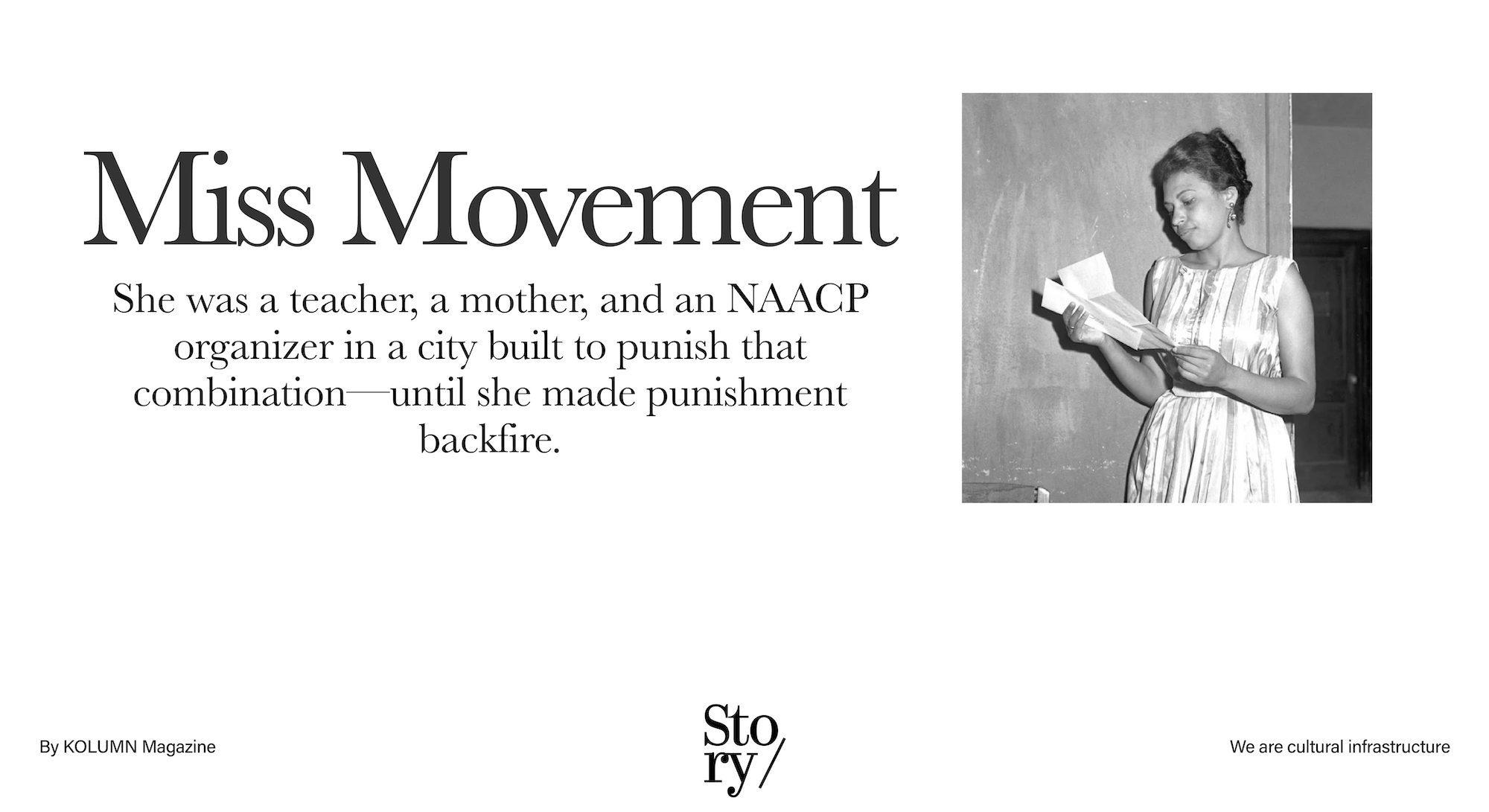
Gloria Rackley Blackwell helped force a segregated institution to answer for itself.
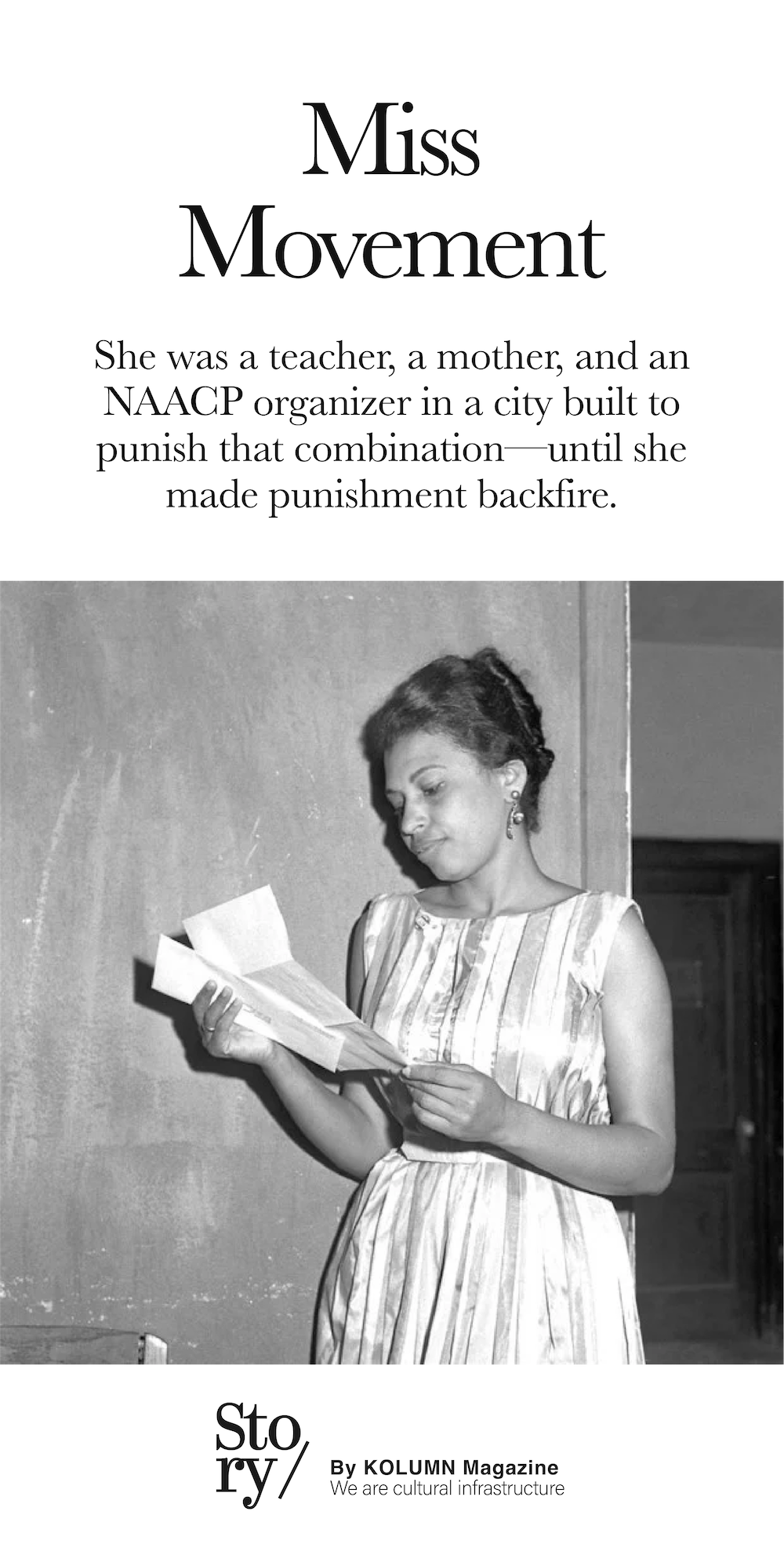
Gloria Rackley Blackwell helped force a segregated institution to answer for itself.
By KOLUMN Magazine
In the public imagination, the Civil Rights Movement often reads like a relay of famous men and famous moments: a boycott in Montgomery, a bridge in Selma, a dream in Washington. The story compresses itself into iconography—microphones, fire hoses, dogs, and the solemn geometry of marches. But the movement’s real infrastructure, the kind that made national spectacle possible, was built in smaller rooms: church basements, school hallways, courthouse corridors, and, in the case of Gloria Rackley Blackwell, the waiting area of a segregated hospital in Orangeburg, South Carolina. What looks like local indignity in one telling becomes, in another, the seed crystal of institutional change. Blackwell’s life is a reminder that the movement was not only a contest for public conscience; it was also a struggle over policy, employment, municipal power, and the everyday architecture of humiliation—where you could sit, where you could be treated, and what it cost to insist on your own dignity.
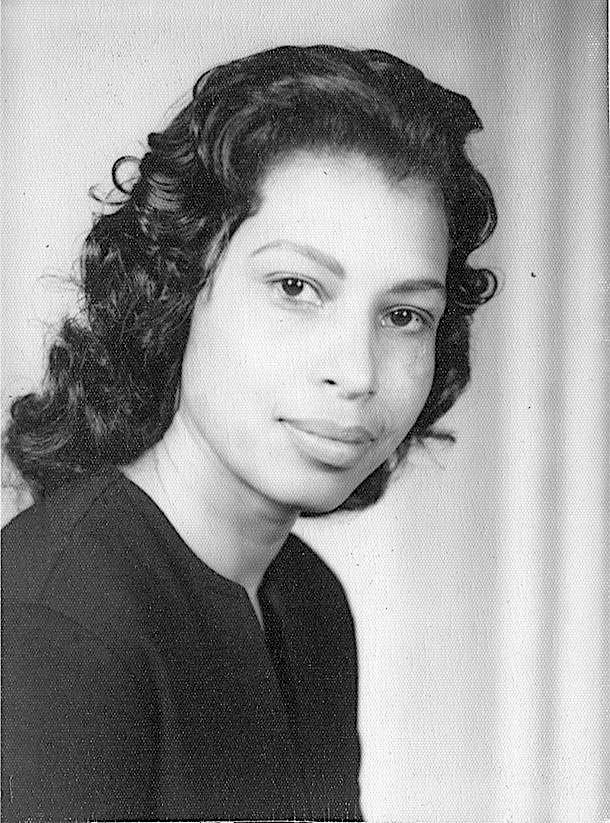
Even her name suggests how the record can blur women who operated outside the national spotlight. During the most visible years of her activism in Orangeburg, she was widely known by a married name—Gloria Rackley—and later used her maiden name professionally, in part to reduce confusion and in part because reinvention was sometimes a survival strategy for women whose reputations were made and unmade by hostile local press and informal white power.
This article focuses on Dr. Gloria Blackwell, the mid-20th-century South Carolina educator and civil rights activist; she should not be confused with Gloria L. Blackwell, a contemporary nonprofit and gender-equity leader associated with AAUW.
A South Carolina upbringing and the making of a “church woman” dissenter
Gloria Thomasina Blackwell was born in 1927 in Dillon County, South Carolina, in the rural corridor that shaped many Black Southern lives: land, labor, church, and the tight constraints of Jim Crow’s etiquette and violence. Those constraints were not only legal; they were intimate, enforced through the constant calibration of risk. A person could be punished for the wrong tone, the wrong glance, the wrong insistence on being served, hired, or heard.
In Orangeburg, the movement’s early organizing muscle often ran through Black churches—not simply as sanctuaries, but as institutions with networks, leadership, and the moral language to turn private suffering into public claim-making. Blackwell’s own formation reflected that. Later accounts emphasize her deep ties to the Methodist church and the way protest in Orangeburg frequently began with prayer, a ritual that was not only spiritual but tactical: it bound people together and framed confrontation with the state as a test of moral legitimacy rather than mere provocation.
Her path into education was itself a kind of statement. She attended Claflin, the historically Black college in Orangeburg founded in the Methodist tradition, completing her degree in 1953. In that era, teaching was one of the most respected professions available to Black women in the South—yet it was also precarious, because white school boards and superintendents controlled hiring and could punish political dissent through dismissals thinly dressed as “fitness” concerns. For Black women who became visible activists, the classroom could become both platform and vulnerability: a place where they shaped children’s minds and a place from which they could be ejected to warn others against stepping out of line.
Blackwell married multiple times across her life, and her personal story includes tragedy—most notably the death of a young child in a car accident, which also left her with a facial scar. Later, when asked why she did not try to remove the scar, she treated it as irrelevant compared to what she had lost. The anecdote is telling not because the scar matters in itself, but because it reveals how women activists were routinely appraised through a gendered lens—appearance, comportment, “respectability”—even as they confronted brutal systems. The movement demanded courage; the world demanded women be pleasing while they exercised it.
Orangeburg’s civil-rights terrain—and why it mattered
Orangeburg was not Birmingham or Jackson in the national press, but it was a pivotal South Carolina city for Black civic life. It was home to two historically Black colleges—South Carolina State and Claflin—making it a place where young people, ideas, and institutional ambition met a state political order determined to maintain segregation. The presence of students mattered: it created a labor pool for demonstrations, a constituency for moral urgency, and a built-in public narrative about youth and the future. It also created a target. When student protest surged in Orangeburg in the early 1960s and later in the late 1960s, the authorities responded with arrests, expulsions, and—infamously in 1968—lethal violence.
But the city’s significance was not only in its eruptions; it was in the steady, grinding fights over public accommodations and municipal practice. Orangeburg’s story helps correct a common misunderstanding: that desegregation advanced primarily through federal edict and moral conversion. In reality, progress often came because local activists forced institutions into court, made segregation expensive, and exposed the contradictions between “public” funding and “private” discrimination. Blackwell would become central to precisely this kind of campaign.
The hospital waiting room: Motherhood as a civil-rights catalyst
In October 1961, Blackwell’s daughter Jamelle—fourteen years old—was injured in a playground accident and taken to Orangeburg Regional Hospital. What happened next is one of those scenes that could be staged as a single dramatic moment, but is better understood as a case study in how segregation was maintained: through confusion, redirection, and the presumption that Black people would comply.
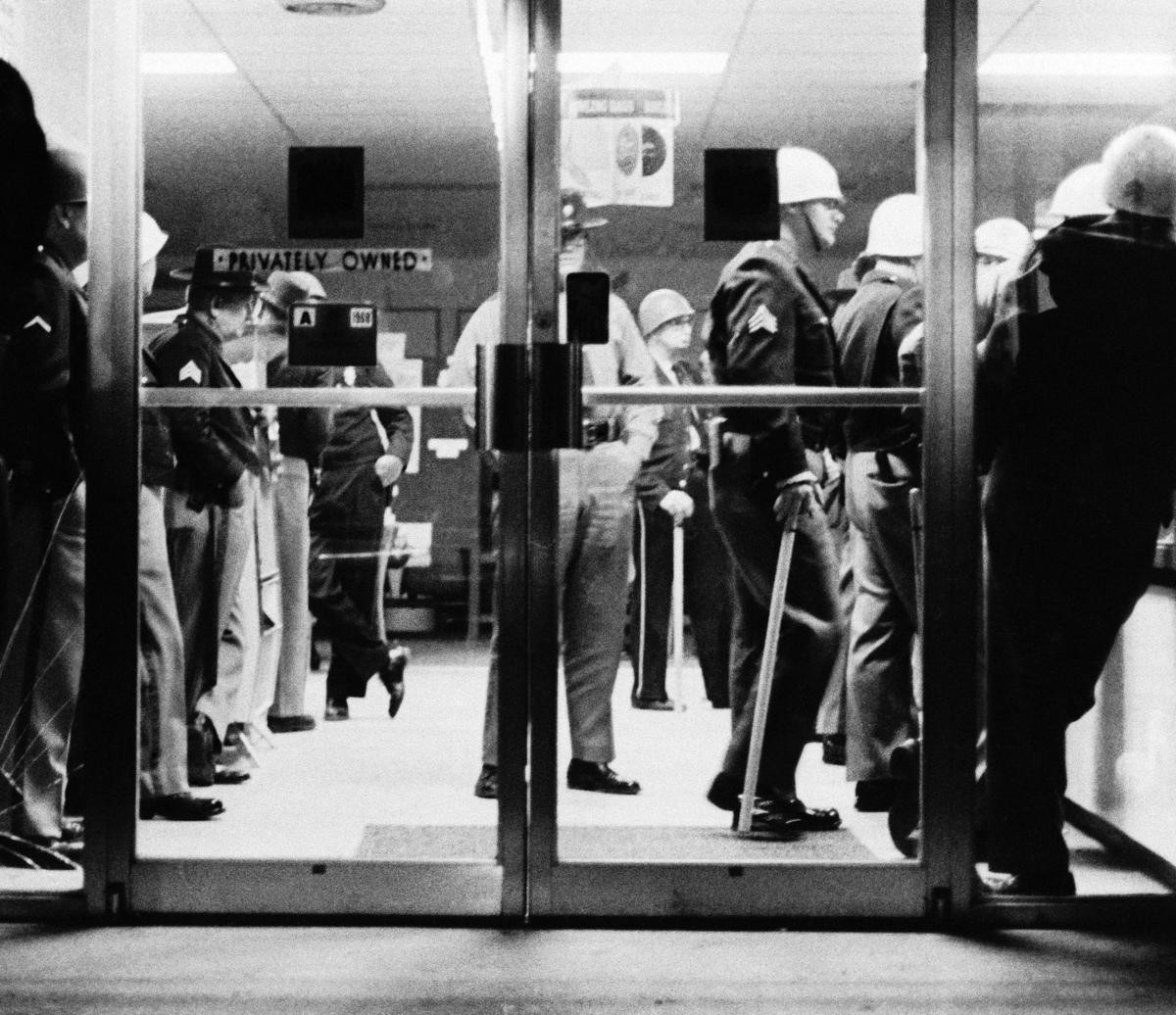
According to a federal appellate account of the incident, Blackwell waited first in the emergency room, then was directed to a waiting room, and later “without explanation” was shown to another waiting room—understood to be the one used by Black patients’ families. She refused to enter it, returned to the first waiting room, and was told by police that she would have to leave or be arrested. Two weeks later, mother and daughter returned; Blackwell again sat in the same waiting room. After a sequence of exchanges with medical staff and the hospital director, she was arrested for “disturbing the business of the hospital.”
The details matter because they show segregation’s reliance on “procedure”—the ability of an institution to claim it was merely following policy, merely managing flow, merely avoiding disruption. In this framing, the person who insists on equal treatment is recast as the aggressor. It is the logic of Jim Crow bureaucracy: order is the alibi; inequality is the outcome.
What Blackwell did next separated her from thousands of others who endured similar humiliations in silence. She made the incident actionable. She and her daughter became plaintiffs in litigation that challenged the hospital’s maintenance of separate facilities for white and Black patients and families.
The legal record shows a long, difficult road rather than an instant win. In 1962, the Fourth Circuit considered an appeal involving a preliminary injunction. The court described the case as seeking to restrain the hospital from “maintaining distinct facilities for white and colored,” noted that the hospital was a county institution, and emphasized that the complaint addressed segregation across facilities, not only a single room. The appellate court ultimately affirmed denial of the preliminary injunction but reversed the lower court’s decision to strike key allegations from the complaint and remanded for further proceedings. In other words: the court did not hand the Rackleys an immediate victory, but it kept the legal challenge alive in a way that mattered—because survival in court is often the first stage of institutional defeat.
Subsequent proceedings in related hospital desegregation litigation are part of the broader legal push that made “separate” increasingly untenable for publicly supported institutions. For activists, the point was not only the final decision; it was the leverage created by the act of suing: public scrutiny, legal costs, administrative anxiety, and the growing mismatch between federal civil-rights doctrine and local practice.
To understand the personal risk Blackwell took, it helps to remember how expensive dissent could be. A lawsuit did not only target an institution; it marked a family. It branded the plaintiff as “trouble,” which in a Jim Crow town could mean job loss, credit denial, eviction threats, and social isolation. Retaliation was not always dramatic; it could be administrative, whispered, and systematic.
“Unfit”: The politics of firing a teacher
By 1963, Blackwell’s activism was sufficiently visible that her employment became a battlefield. The Atlanta Journal-Constitution later reported that she was fired from her job as a public school teacher in Orangeburg for being an NAACP field organizer—declared “unfit,” dismissed, and then reinstated after she sued.
This is one of the most revealing patterns of the mid-century civil-rights South: the use of “fitness” as a weapon against Black educators. Teaching was supposed to be a “respectable” profession; officials used that respectability as a leash. If a teacher protested, she was recast as radical, unstable, disruptive, a danger to children. It was not enough to disagree with her politics; the goal was to delegitimize her character.
Blackwell’s story also shows the gendered dimension of this tactic. A male activist might be framed as threatening; a woman activist might be framed as unruly, immoral, or hysterical—someone who had stepped outside the expected boundaries of womanhood. Some local portrayals of her reportedly leaned into this trope, treating her as “wild” and dangerous because she refused the quiet script offered to Black women under segregation.
What made Blackwell formidable was that she did not accept firing as a final verdict. She treated it as another arena for contest. The fact that she sued and won reinstatement is not only a personal triumph; it is an illustration of how civil-rights activism functioned as a continuous negotiation with power—pressing in the streets, then pressing in court, then pressing in the workplace, forcing the system to respond on multiple fronts.
The Justice for All digital exhibition—produced through the University of South Carolina’s civil-rights history initiatives and supported by the National Park Service’s African American Civil Rights Grant Program—explicitly frames this kind of employment punishment as part of a broader pattern: civil-rights activism and even NAACP membership triggering economic retaliation, from firing to financial squeeze tactics. Blackwell’s life, in this sense, becomes not just an inspiring narrative but an evidentiary one: proof that the movement was fought not only against segregation signs but against the economic system that enforced them.
A movement nickname and the charisma of persistence
In Orangeburg, Blackwell’s visibility earned her a nickname: “Miss Movement.” It can read as affectionate, but it also hints at something deeper—how an individual can become a symbol in a small city, for better and worse. Symbol-making is a form of power. It can rally supporters, and it can give opponents a single target for their anger.
Her activism involved promoting NAACP membership and participating in demonstrations to desegregate public venues. In a period when the NAACP was often treated as a subversive threat by Southern officials, recruiting members could itself be dangerous. The organization’s legal strategy, its insistence on federal enforcement, and its challenge to white local control made it a prime target for harassment and surveillance. In many towns, to join the NAACP was to risk your livelihood.
Blackwell also operated in a movement ecosystem that included students and campus networks—particularly those at South Carolina State—who sometimes traveled with organizers to push for membership and to demonstrate. This intergenerational collaboration was crucial. Students brought numbers and urgency. Adult organizers brought strategy, continuity, and the long view of institutional change.
And then there was the role of family. Blackwell’s daughters were not merely bystanders; they were part of the moral theater segregation tried to disrupt. When a mother protests with her children present, it undermines the segregationist claim that activists are outsiders or agitators detached from the community. It forces a town to face the human stakes: this is not abstract politics; it is the life your children will inherit.
Orangeburg after 1964: Leaving the frontline without leaving the work
After the Civil Rights Act of 1964, the legal landscape changed, but the lived landscape remained hostile. Many activists had to decide whether to stay and continue battling a resistant local order or leave and build lives elsewhere. Blackwell and her husband left South Carolina and moved to Norfolk, Virginia, where she taught in the English department at Norfolk State (then Norfolk State College).
Her subsequent career reads like a map of Black higher education in the latter half of the twentieth century. She directed African American studies at American International College in Massachusetts from the late 1960s into 1970, then earned her doctorate in American studies at Emory University in 1973. She later taught at Atlanta University (now Clark Atlanta University) for decades, including leadership roles in the English department, and retired in the early 1990s.
This arc matters because it challenges a narrow notion of “activist” as someone who protests and then fades. For many women of the movement, the next stage of their public contribution was education—formal, sustained, institution-building work that shaped generations. If protest is one form of movement labor, teaching is another. And for Black women, teaching in the post–civil-rights era could be a way of translating lived struggle into intellectual inheritance: ensuring that students understood not only what changed, but how it changed.
The overlooked scale of her significance
Why hasn’t Gloria Blackwell’s name become as widely known as some of her male contemporaries or even some female counterparts whose stories have been more frequently retold? The answer lies partly in how fame works and partly in how journalism historically allocated attention. National outlets often flocked to conflict zones that were already legible to readers—cities with dramatic confrontations, organizations with media strategies, leaders with national platforms. A local teacher suing a hospital in Orangeburg, or being fired for NAACP organizing, could be treated as a regional story rather than a national one.
But if you measure significance by function rather than fame, Blackwell’s importance sharpens.
First, her hospital litigation placed a core Jim Crow institution—healthcare—under legal and moral scrutiny at a moment when segregated medical treatment remained a brutal reality for Black Southerners. The case record reveals how a single act of refusal could become a vehicle for civil-rights law to move through the courts, forcing public institutions to defend practices they preferred to treat as “custom.”
Second, her employment fight exposed the economy of retaliation that kept segregation stable. The decision to punish her as “unfit” was not incidental; it was central. She showed that the movement had to fight not only discriminatory service but the mechanisms used to deter dissent.
Third, her life offers a lesson about women’s leadership in civil-rights communities. Much of the movement’s day-to-day work—recruiting, organizing meetings, turning outrage into strategy—was done by women whose names did not always travel. When women did become visible, they were often criticized not only for what they did but for violating social expectations of how women should behave. Blackwell’s story illustrates how that critique functioned as discipline—and how some women refused to be disciplined.
Finally, her post-Orangeburg career shows the movement’s afterlife. Civil rights was not only about opening a lunch counter; it was about building a society in which Black people could claim full citizenship. That required educators, program builders, department chairs—people who translated political gains into cultural and intellectual infrastructure. Blackwell did that work for decades.
A fuller picture of the person: Tenderness, rigor, and everyday joy
One of the easiest mistakes in writing about movement figures is turning them into granite—pure courage, pure conflict, pure righteousness. Obituaries and recollections sometimes preserve the human textures that activism narratives erase. When Blackwell died in 2010, the Atlanta Journal-Constitution described her as someone who cared for students across race and class and encouraged protégés to pursue advanced education. It also included details that feel almost defiant in their ordinariness: a favorite color (green), a love of word games, a local Scrabble club she oversaw, and the nickname “Queen of Scrabble.”
These details are not fluff. They are evidence of wholeness. They show how activists sustained themselves, how they insisted on pleasure and intellect in a world that often demanded only struggle. They remind us that the movement was carried by people who were also parents, teachers, mentors—people whose lives contained delight alongside danger.
The Orangeburg shadow: Violence, memory, and what came after
Any account of civil-rights Orangeburg eventually meets the city’s most traumatic chapter: the Orangeburg Massacre of February 8, 1968, when law enforcement opened fire on student protesters, killing three and wounding dozens. Blackwell’s most intense Orangeburg activism preceded that moment, and she had already relocated by the time the massacre occurred, but her story belongs to the same continuum: the city’s civil-rights struggle, the role of students and local leadership, and the state’s readiness to use coercion to reassert control.
The Justice for All exhibition describes the massacre as the culmination of days of demonstrations tied to segregation at a local bowling alley, and it emphasizes how many of the wounded were shot while fleeing—underscoring the asymmetry of force. To place Blackwell’s earlier activism beside this later violence is to understand the spectrum of resistance and response: from courtroom battles over waiting rooms to bullets on a campus edge. Both were part of the same fight over who counted as fully human in a “public” space.
That continuum also helps explain why activists sometimes left. The costs were not theoretical. A person could be fired, arrested, surveilled, or worse. When Blackwell moved into academic life beyond South Carolina, she did not abandon the struggle; she changed theaters. She carried the movement into classrooms and institutions that could shape national conversations in slower but durable ways.
What journalists should learn from Gloria Blackwell
Writing about a figure like Gloria Blackwell is also a test of journalistic habit. The temptation is to treat her as a footnote to better-known leaders or to reduce her life to a few dramatic acts. But her story argues for a different approach.
It argues for seeing the movement through systems rather than through celebrity: healthcare segregation, employment retaliation, local press vilification, church-based organizing, and the interplay between legal strategy and community protest. It argues for attention to the women who did not always claim the microphone but often held the line.
And it argues for a more precise understanding of bravery. Bravery is not only marching in a crowd; it is walking into an institution alone, refusing to sit where you are told, and accepting that your insistence may cost you your job. It is deciding that your child’s injury will not be used to discipline you into compliance. It is believing that a “local” fight can—and should—set precedent.
The court record of the Rackley case preserves, in formal language, what a Jim Crow hospital encounter looked like when it was translated into law: the quiet rerouting, the threat of arrest, the decision to sit anyway, the eventual charge of “disturbing the business,” and the long grind of litigation. The obituary record preserves what that grind looked like in a life: repeated arrests, the nickname “Miss Movement,” the firing and reinstatement, the eventual relocation and academic career, and the enduring reputation of a teacher who was both demanding and generous.
Put together, they show a figure whose significance is not measured by the size of her stage but by the durability of her impact. Gloria Rackley Blackwell helped force a segregated institution to answer for itself. She exposed the retaliatory logic that punished Black citizenship claims. She modeled a form of leadership that combined motherhood, faith, legal acuity, and public confrontation. And she spent decades afterward educating students—quietly, methodically—so that the next generation could understand not only what freedom meant, but how hard it had been to make it real.
More great stories
Afro Sheen, Wall Street, and the Architecture of Black Possibility
July 6, 2026
No Comments
The Fire Inside the Fourth
July 5, 2026
No Comments