





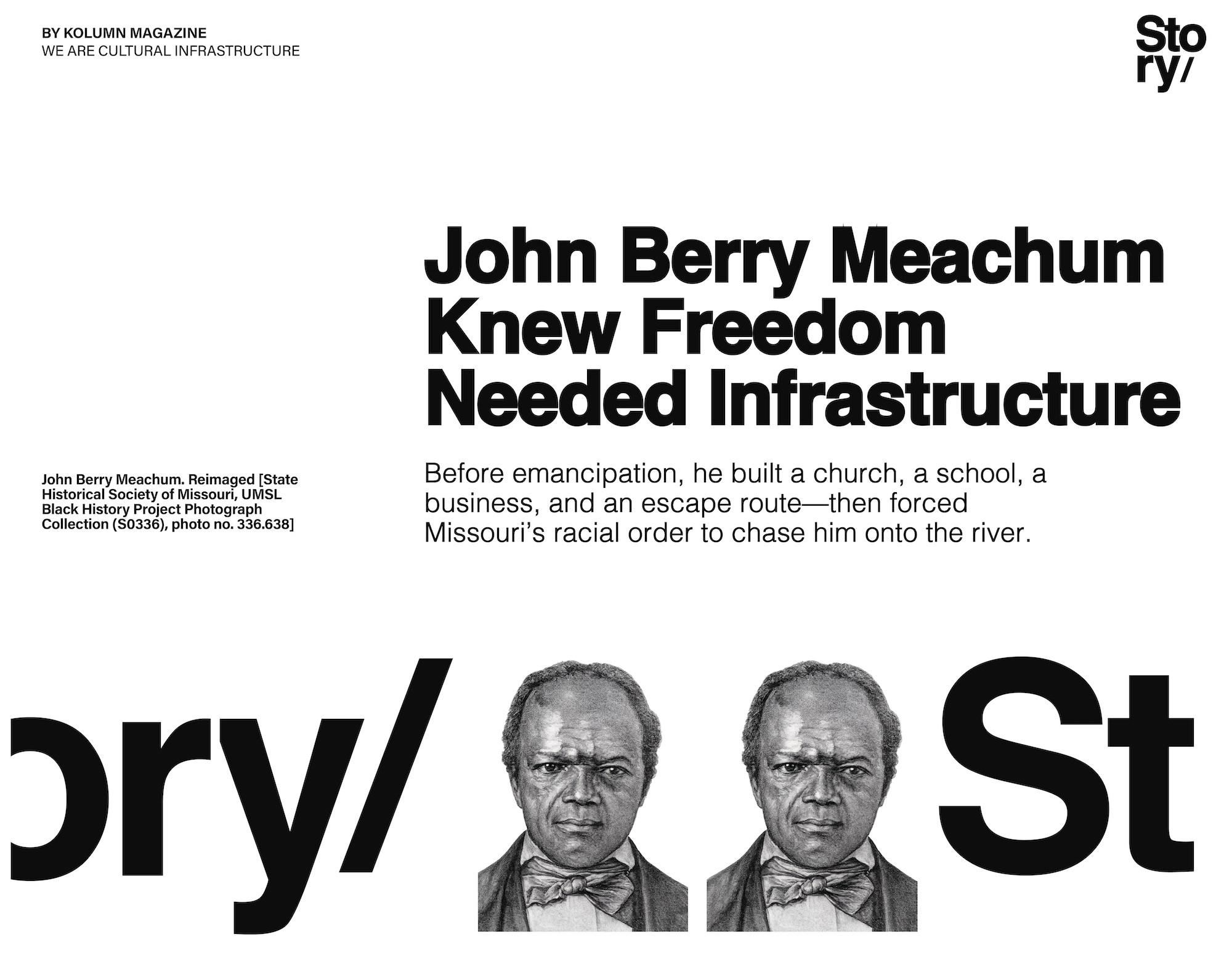
John Berry Meachum did not just denounce slavery. He built working alternatives inside its shadow.
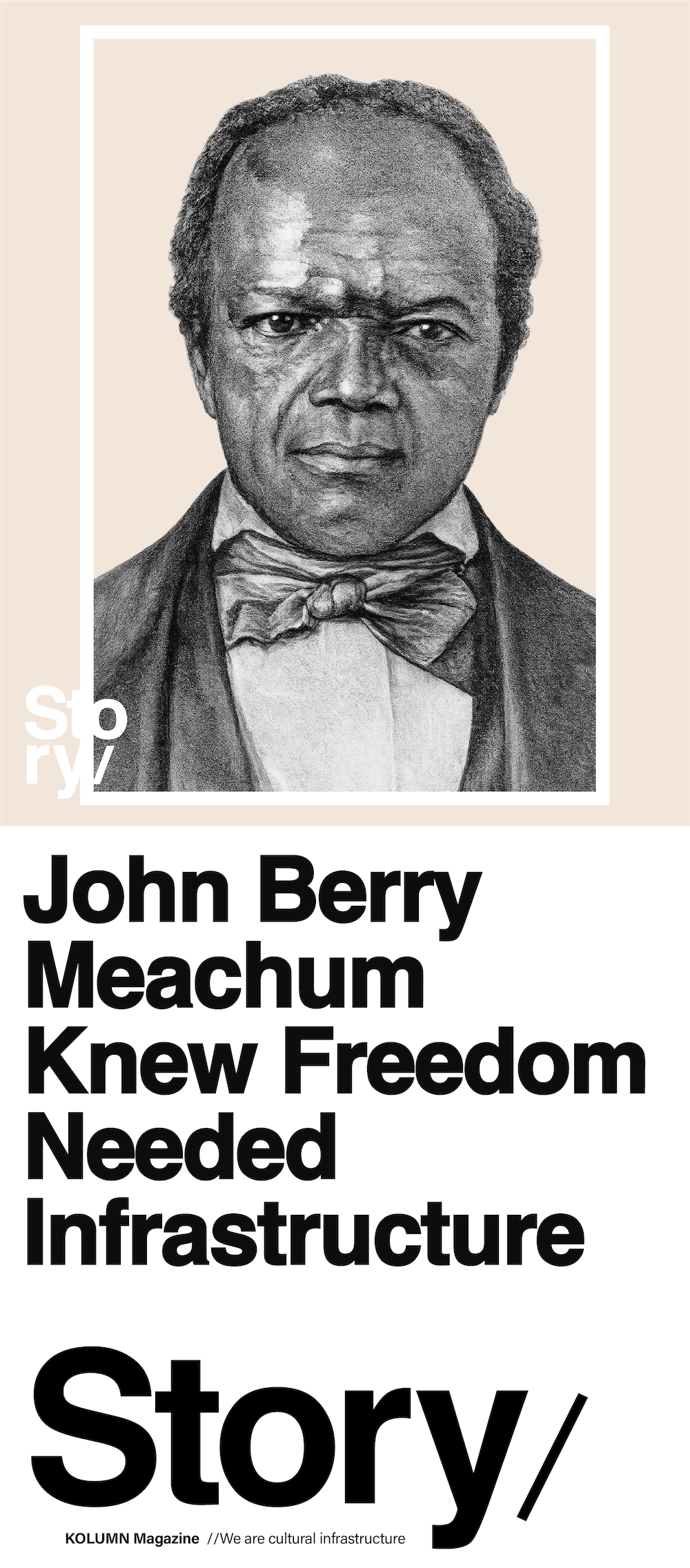
John Berry Meachum did not just denounce slavery. He built working alternatives inside its shadow.
By KOLUMN Magazine
There are some figures in Black history whose names should be household names and somehow still are not. John Berry Meachum is one of them. He did not leave behind the kind of myth-ready public image that America tends to reward. He was not a president, not a military general, not the face of a single climactic march. He was something more durable and, in many ways, more difficult to summarize: a builder. He built a life out of bondage. He built a business in a slave state. He built a church that would become a foundational Black institution in St. Louis. He built a school when Black literacy was treated as dangerous. And when Missouri tried to shut that school down, he built another one on a steamboat in the Mississippi River, outside the easy reach of the law.
That detail alone—the Floating Freedom School—can make Meachum sound almost legendary, like a character from the kind of history we tell children when we want them to believe ingenuity can outwit cruelty. But the deeper story is not just that he outsmarted the law. It is that he understood something essential about power in America: freedom is never only a moral claim. It is also an institutional one. It has to be taught, financed, housed, defended, and reproduced. Meachum grasped that early, and he spent his life creating the infrastructure for Black autonomy in a city and state determined to constrain it.
Born into slavery in Goochland County, Virginia, on May 3, 1789, Meachum moved with his enslaver through North Carolina and eventually to Kentucky. As a young man, he learned skilled trades, including carpentry and coopering, and used that training to earn money. In time, he purchased his own freedom and then his father’s. Later, after moving to St. Louis in 1815, he bought the freedom of his wife Mary and their children as well. Those facts matter not just because they are biographical milestones, but because they reveal the shape of his politics before he ever published a pamphlet or preached a sermon: Meachum believed liberation had to be made materially possible.
To understand why Meachum matters, it helps to place him not only in abolitionist history, but in the history of Black institution-building. He belongs in that lineage with people who recognized that in a hostile republic, survival required more than courage. It required organization. Churches, schools, mutual aid, job training, literacy, commerce, property, mobility—Meachum tied all of those together. That is why his legacy feels so contemporary. He was arguing, in practice, that you cannot separate education from economic power, or spiritual life from civic life, or dignity from self-determination.
Born into slavery, shaped by skill
Meachum’s early life was defined by the ordinary brutality of slavery’s mobility. He was born in Virginia and moved with his enslaver to North Carolina and then Kentucky. That forced migration was common in the early republic, but it also meant Black families lived under permanent instability, their lives subject to the financial decisions of white owners. Meachum later described his own origins in the preface to his 1846 pamphlet An Address to All the Colored Citizens of the United States, identifying Goochland County as his birthplace and recounting his enslavement under Paul Meachum. That surviving text gives us something rare: a first-person anchor in a life so often narrated by institutions after the fact.
What distinguishes Meachum’s early years is not that he learned a trade—many enslaved men were forced into skilled labor—but that he managed to leverage those skills into purchase of freedom. He apprenticed under a white carpenter and learned cabinetmaking and coopering. By age 21, according to later accounts, he had earned enough money to buy himself. He then secured his father’s freedom too. In a nation structured to convert Black labor into white wealth, that act was already a kind of counter-economy: using mastery of craft to puncture, however partially, the legal regime of human ownership.
This is one of the central themes of Meachum’s life. He did not romanticize freedom as an abstraction. He knew its price down to the dollar, the hour, the task, the skill. That knowledge stayed with him. Much later, in his published address, he urged Black Americans toward industry, farming, discipline, and collective uplift—not because he had internalized the moral logic of respectability, as some modern readers may too quickly assume, but because he understood the economic architecture of dependency. A people denied education and property would remain vulnerable even when nominally free.
His language can sound stern to modern ears. In the address, Meachum emphasized labor, sobriety, order, cooperation, and self-respect. He argued that Black Americans needed practical education and productive habits to secure better living conditions and public regard. Those arguments were shaped by the 1840s world he inhabited: a slaveholding republic in which free Black life was constantly scrutinized, demeaned, and restricted. His prescriptions were conservative in tone, but radical in implication. He was insisting that Black people deserved the full civic and economic capacities that white America tried to monopolize.
St. Louis: a border city, a pressure point
When Meachum moved to St. Louis in 1815, he entered one of the most revealing cities in the antebellum United States. St. Louis was a river city, a commercial city, a Catholic and Protestant crossroads, a western gateway, and a slaveholding place perched beside the free state of Illinois. That geography mattered. Border cities generate contradiction, and contradiction generates opportunity and danger in equal measure. For Black people, St. Louis was a place where slavery, free labor, migration, religion, and resistance collided every day.
Meachum arrived there for profoundly personal reasons: his wife Mary had been taken to St. Louis by her owner, and he followed her. Once there, he worked, saved, and eventually purchased her freedom. He also found a city with demand for skilled labor, particularly the carpentry and barrel-making work he knew well. He opened a cooperage shop and became economically successful enough to expand his activities beyond simple subsistence. That financial base would become essential to everything else he did. Meachum’s later influence as a minister and educator rested partly on the fact that he was not only a preacher. He was a businessman.
This combination unsettled the logic of the slave society around him. A free Black man with technical skill, commercial acumen, religious authority, and community standing represented the possibility that Black life could organize itself beyond white paternal control. That is one reason Meachum is so important. He embodied a form of Black leadership that was neither incidental nor merely symbolic. It was structural. He connected economic independence to communal authority.
The church as more than a church
In St. Louis, Meachum worked with Baptist missionaries John Mason Peck and James Welch, who organized Sunday school and religious services for Black residents beginning in 1817. Those early integrated or semi-integrated religious settings did not last in that form. As Black membership grew, a separate congregation emerged, with Meachum increasingly at its center. After his ordination in 1825, he founded the First African Baptist Church of St. Louis and became its first pastor. A brick church building followed in 1827. At that point, membership was about 220, roughly 200 of them enslaved.
That membership composition is worth sitting with. An enslaved-majority congregation under Black pastoral leadership in a slave state was not simply a devotional gathering. It was a social world. It was a site of instruction, solidarity, networking, and perhaps most importantly, collective imagination. The church represented a place where enslaved and free Black St. Louisans could gather under a Black leader who understood both the theological and practical stakes of their condition.
The First African Baptist Church would become the oldest Black church in Missouri and among the earliest Black religious institutions west of the Mississippi. But its historical significance is larger than age. It helped establish a template that would recur throughout Black American history: the church as sanctuary, schoolhouse, civic hall, aid society, and political incubator all at once. Meachum did not treat the sacred and the social as separate domains. He used one to sustain the other.
“For Meachum, the church was never only about worship. It was a headquarters for literacy, discipline, mutual aid, and Black possibility.”
That integrated vision helps explain why Meachum’s ministry cannot be reduced to piety. He preached, yes. But he also organized a community around literacy and self-development. He saw no contradiction there. In fact, for him, religious life seems to have demanded educational work. A people denied reading were being denied not just books, but scripture, contracts, correspondence, law, and the basic tools of interpretation. Literacy was not ancillary. It was liberating.
The Candle Tallow School and the politics of literacy
Beginning in the 1820s, Meachum taught both free and enslaved Black students in St. Louis. Sources connected to the church describe the effort as the “Candle Tallow School,” an undercover day school operating under the cover of Sunday instruction. Tuition was charged to those who could afford it, but students were not turned away for lack of money. By one later account, the school attracted hundreds of pupils. This was likely the first known school for Black students in Missouri.
The schooling itself was both religious and secular. That matters because anti-Black laws often tried to distinguish between permitted religious training and forbidden intellectual advancement. Meachum refused that division. In practice, he understood that religious instruction presupposed basic literacy. More importantly, he seems to have believed Black children deserved education not merely to become better Christians, but to become more capable human beings in a world organized against them. Scholar Jeffrey Durst, writing on Meachum’s religious history, notes that his efforts aimed to equip children for a future beyond slavery and poverty.
White authorities recognized the threat. In the early 1820s, St. Louis officials passed ordinances prohibiting the education of Black people, free and enslaved alike. Enforcement was inconsistent, but the purpose was clear. Black literacy threatened the ideological and practical foundations of bondage. Literate people could read antislavery literature, understand passes and contracts, communicate independently, interpret scripture for themselves, and imagine lives not defined by ownership. The law framed education as disorder because the system understood exactly what education could do.
At one point, according to Durst’s account, Meachum and a white teacher he had hired were arrested while instructing students in the church basement. The school was forced to close through threats and official pressure. That episode reveals a recurring pattern in Black educational history: the campaign against Black learning was not incidental to slavery. It was central to it. And every clandestine classroom was therefore a political act.
When Missouri banned Black education, Meachum moved the classroom to the river
In 1847, Missouri enacted a statewide ban on educating Black people. By then, Meachum had already spent years trying to keep literacy alive in St. Louis despite local hostility. The new law narrowed the space even further. So he did something that now reads like both legal improvisation and moral theater: he moved the school onto a steamboat anchored on the Mississippi River, beyond Missouri’s easy jurisdiction. There he outfitted the vessel with desks, chairs, and books and continued teaching Black students. The school became known as the Floating Freedom School.
There is a reason this story keeps resurfacing in public history projects, tourism features, and commemorations. It is not just inspiring. It is clarifying. The Floating Freedom School demonstrates that Black resistance was often less about dramatic confrontation than about tactical redesign. If the land was policed, move to the water. If the law named your education illegal, teach in a place where its reach was harder to enforce. If a schoolhouse could be closed, turn a boat into a schoolhouse.
The move also symbolized something deeper. Rivers in nineteenth-century America were commercial arteries, escape routes, borders, and metaphors all at once. The Mississippi, in particular, was a line between slavery and freedom, but also a zone of movement that resisted neat political containment. By placing education on the river, Meachum effectively declared literacy part of the traffic of liberation. He made the classroom mobile, liminal, and impossible to understand apart from the broader struggle for Black freedom in a borderland city.
Among those believed to have studied at the Floating Freedom School was James Milton Turner, who later became a major educator, political leader, and U.S. minister to Liberia. The National Park Service notes that Turner likely received much of his education there. That detail matters because it turns the school from symbol into lineage. Meachum’s work did not stop with one generation. It fed another.
The contradictions of emancipation by purchase
No serious account of Meachum should ignore the hardest part of his legacy. He and Mary Meachum purchased enslaved people, trained them in trades, and freed many of them after they had worked and, in effect, repaid part of their purchase price. The National Park Service states that John freed twenty enslaved men who worked at his carpentry shop between 1826 and 1836. But not everyone accepted this arrangement as benevolent. Some of the enslaved workers sued him in freedom suits.
This is the kind of fact that resists clean celebration, and it should. It places Meachum in the morally excruciating terrain that many Black people in slave societies had to navigate. On one hand, he appears to have used wealth to liberate people and train them for life beyond bondage. On the other hand, he still participated in the legal structure of ownership while doing so. That some workers filed freedom suits tells us that whatever his intentions, the people under his power did not all experience the arrangement as emancipatory on his terms.
There is no honest way around that contradiction. But there is a way through it. Meachum’s life illustrates how slavery deformed every available moral choice. To free people through purchase required operating within the marketplace of slavery. To train people for independence could still mean exercising coercive authority over them first. This does not excuse the tension. It historicizes it. Meachum was trying to create pathways out of bondage inside a system built to reproduce bondage. That effort produced both liberation and grievance.
For modern readers, the temptation is to resolve that discomfort too quickly, either by treating Meachum as spotless or by disqualifying his larger legacy. Both approaches flatten history. Better to say this: Meachum was a freedom worker whose methods reflected the brutal constraints of his time, and some of those methods remain ethically troubling. That truth makes his story more complicated, but also more human.
Mary Meachum and the partnership at the center
John Berry Meachum’s story is impossible to tell fully without Mary Meachum. She was not a footnote or simply the widow who continued the work after his death. She was a partner in the Meachums’ project of liberation while John was alive, and after his death she carried that work forward at great risk. The National Park Service describes John and Mary together as prominent abolitionists and conductors on the Underground Railroad in St. Louis. They educated Black residents, made their home a safe place, and helped freedom seekers cross the Mississippi River into Illinois.
Mary’s 1855 arrest while attempting to help a group of enslaved people cross the river remains the better-known public episode today, in part because the Mary Meachum Freedom Crossing has become a major commemorative site in St. Louis. But that memorialization should also sharpen our understanding of John. Their work was collaborative. The home, church, school, workshop, and river route formed a network, not isolated gestures. John’s death in 1854 did not begin Mary’s abolitionism; it simply meant she continued it without him.
This partnership also underscores something often overlooked in narratives of Black male leadership: the household itself was a political unit. The Meachums’ domestic and institutional lives were intertwined. They freed family members, housed others, taught children, operated businesses, and aided escape. That is one reason their legacy feels larger than biography. It becomes a model of community-making under siege.
A published philosophy of Black self-determination
In 1846, Meachum published An Address to All the Colored Citizens of the United States in Philadelphia. The title alone tells you something about his ambition. He was not writing only to St. Louis, only to Missouri, or only to his church. He was addressing Black America. The text combines autobiography, exhortation, religious reflection, and practical advice. It stresses union, industry, agriculture, moral discipline, and education. It is the work of a man who had spent decades thinking not just about escape from slavery, but about how a people might live with dignity under oppression and beyond it.
Some of its argument is plainly shaped by nineteenth-century uplift politics. Meachum encourages Black Americans to avoid destructive habits, cooperate, value productive labor, and consider farming as an independent livelihood. Yet the document should not be read as mere moral scolding. It is also an economic and civic program. He is asking what conditions make freedom durable. How does a community become less vulnerable to exploitation? How does it build stability, landholding, skill, and public esteem in a country built against it?
His emphasis on union is especially notable. Near the end of the text, the call for collective action is unmistakable. He frames the condition of Black Americans as a shared problem requiring organized response. That sensibility links Meachum to the broader Black convention movement and to a tradition of antebellum Black political thought that is still underappreciated in mainstream memory. He was not simply a local pastor with good instincts. He was part of a national conversation about Black future-making.
Why he still matters
Meachum died in 1854 while speaking to his congregation during church services, according to the Missouri Encyclopedia. The image is almost too apt: a man who spent his life preaching and building, dying in the very institution he helped create. He was buried in St. Louis, and the institutions and memory attached to his name have continued in different forms, from the surviving First Baptist Church tradition to the John Berry Meachum Scholarship at Saint Louis University.
But his significance is not just commemorative. It is interpretive. Meachum helps us read the antebellum Midwest differently. He reminds us that the struggle over Black education was not confined to the Deep South. He shows that the Mississippi River was not only a commercial route or national symbol, but also a space of Black strategy. He reveals that Black churches on the frontier were not peripheral institutions; they were engines of social organization. And he complicates easy distinctions between abolitionism, entrepreneurship, ministry, and pedagogy. In Meachum’s life, these were not separate careers. They were one project.
There is something especially resonant, too, about his insistence on literacy. Every authoritarian system fears people who can read the world for themselves. In Meachum’s century, that fear showed up in laws banning Black education. In ours, the tactics look different, but the stakes are familiar. Who gets access to knowledge? Who controls the terms of citizenship? Who is expected merely to labor, and who is expected to interpret, decide, and govern? Meachum understood that these questions were connected.
If American public memory were more precise, John Berry Meachum would be recognized not only as the man behind a famous floating school, but as one of the early Black architects of institutional freedom in the United States. He used craft to buy liberty, faith to organize community, commerce to underwrite independence, and education to widen the horizon of what Black life could be. That is not a side story in American history. That is the story.
And maybe that is the clearest measure of his legacy. John Berry Meachum did not wait for the nation to become decent before acting as though Black people deserved schools, sanctuaries, skills, and futures. He created those things anyway. In a country that kept trying to make Black life provisional, he worked to make it permanent.
More great stories
Afro Sheen, Wall Street, and the Architecture of Black Possibility
July 6, 2026
No Comments
The Fire Inside the Fourth
July 5, 2026
No Comments