




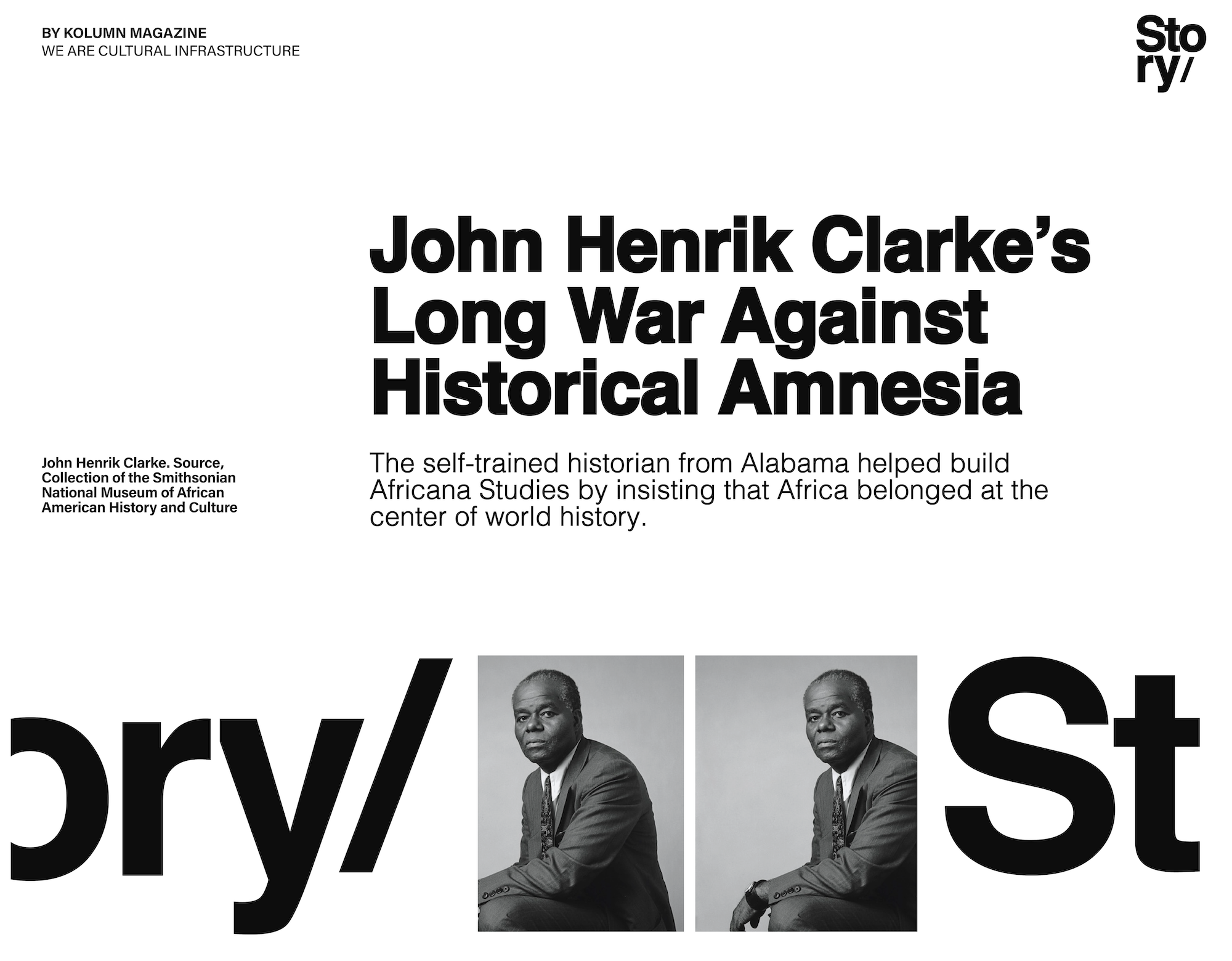
Clarke did not simply study history. He fought over who had the power to define it.
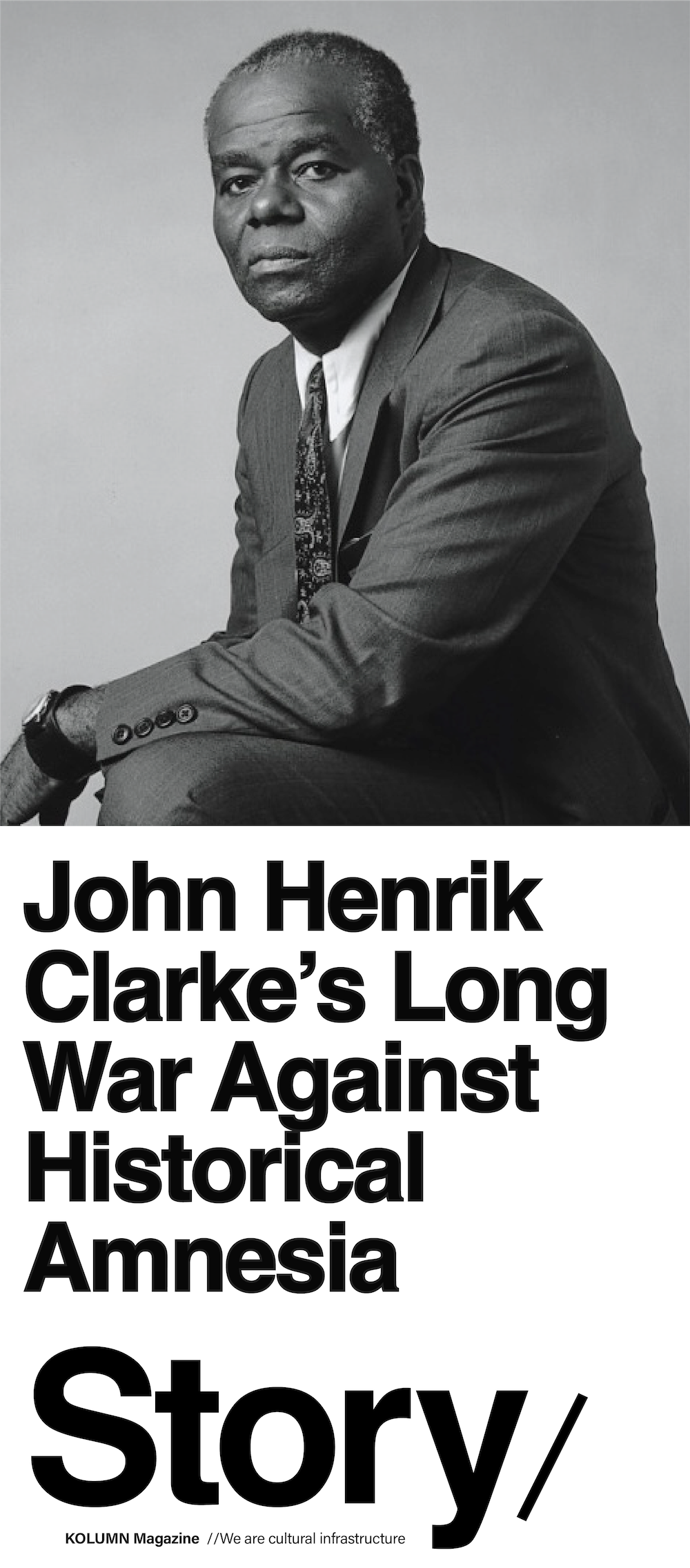
Clarke did not simply study history. He fought over who had the power to define it.
By KOLUMN Magazine
John Henrik Clarke understood history as more than a discipline. To him, history was machinery: a clock, a compass, a warning system, a weapon. It could orient a people, or it could be used to disorient them. It could restore dignity, or manufacture inferiority. It could explain power, or disguise it. “History is not everything,” Clarke famously said, “but it is a starting point,” a formulation preserved by the John Henrik Clarke Africana Library at Cornell University, which bears his name because of his foundational role in Africana Studies.
Born in 1915 into an Alabama sharecropping family, Clarke became one of the most influential Black historians of the twentieth century without the usual academic passport. The Schomburg Center for Research in Black Culture, which houses his papers, describes him as a “self-trained historian” and a leading figure in the development of African heritage and Black Studies programs nationwide. That description sounds modest. In Clarke’s case, it was almost insurgent. He trained himself because the institutions built to certify knowledge had not been built to recognize the full authority of African people.
Clarke’s work belongs squarely inside KOLUMN Magazine’s broader editorial concern with Black memory as cultural infrastructure. In KOLUMN features on figures such as Arna Bontemps, Fred Gray, Ottobah Cugoano, Henry Dumas, and Max Robinson, the central question has often been the same: what does a people build when the official record refuses to hold them fully? Clarke’s answer was blunt. They build their own record. They build institutions, syllabi, archives, journals, lectures, and libraries. They build the intellectual architecture of survival.
From Sharecropping Country to Harlem’s Radical Classroom
John Henrik Clarke was born John Henry Clark on January 1, 1915, in Union Springs, Alabama, according to the Schomburg Center. He was the oldest son of an Alabama sharecropper family, and that beginning mattered. Sharecropping was not merely an occupation; it was a post-emancipation labor regime that kept many Black Southern families trapped inside debt, dependency, and white land control. Clarke’s later insistence on historical recovery was rooted in this world, where Black labor sustained American life while Black intelligence was systematically discounted.
The Los Angeles Times, in its 1998 obituary, reported that Clarke left Georgia in 1933 and made his way to Harlem. That journey placed him inside the long arc of the Great Migration, the mass relocation of Black Southerners who carried rural memory, political wounds, labor skill, church culture, blues cadences, and new ambitions into Northern cities. Harlem did not give Clarke a traditional university education. It gave him something more combustible: street-corner debates, writers’ workshops, political clubs, bookstores, Pan-African circles, lectures, newspapers, and elders who treated study as survival.
The Schomburg Center’s finding aid notes that Clarke developed as a writer and lecturer through the radical movements of the Depression years and through study circles such as the Harlem History Club and the Harlem Writers’ Workshop. This is essential to understanding him. Clarke did not emerge from the academy and later discover the people. He emerged from the people and then entered the academy carrying their questions.
Harlem in the 1930s was no longer only the Harlem Renaissance of polished literary memory. It was also Harlem under Depression pressure, Harlem after the Italian invasion of Ethiopia, Harlem debating socialism, nationalism, labor, colonialism, art, and survival. Clarke’s intellectual life formed in that charged atmosphere. The Los Angeles Times reported that his activism began early, including opposition to Italy’s invasion of Ethiopia in the 1930s. Ethiopia mattered to Black people across the diaspora because it represented African sovereignty in a world of colonial conquest. For Clarke, the crisis sharpened a lifelong belief: Black history was international history.
The Archive as Battlefield
Clarke’s papers at the Schomburg Center occupy 52 linear feet across 49 boxes, consisting mainly of correspondence, lecture notes, course outlines, writings, research material, organizational records, and printed matter. The scale of the archive is itself a correction. Clarke is sometimes remembered as a thunderous lecturer, an elder with a rasping voice and impatient certainty. But he was also a builder of paper trails. He left behind the practical material of movement scholarship: syllabi, outlines, notes, letters, curricula, and organizational records.
“For Clarke, the archive was not a quiet room. It was a battleground.”
The Schomburg Center also records that Clarke served during World War II as a sergeant-major in a segregated unit at Kelly Field, Texas, helping train African American enlisted men for mess and maintenance duties. The detail is bracing. Clarke lived inside the contradiction of a country that demanded Black military service while enforcing racial subordination. His later critique of American democracy was not abstract. He had seen, in uniform, how citizenship could be requested in war and refused in peace.
After the war, Clarke deepened his work across Black literary and political institutions. The Schomburg Center records that he co-founded Harlem Quarterly from 1949 to 1951 and later served as an associate editor of Freedomways, one of the defining journals of Black radical thought. These editorial roles matter because Clarke’s intellectual labor was never confined to the solitary scholar’s desk. He understood publishing as infrastructure. Journals and anthologies create fields. They gather voices, organize debate, and preserve arguments that dominant institutions might otherwise ignore.
The same archival biography notes Clarke’s work as director of the African Heritage unit of Harlem Youth Opportunities Unlimited, known as HARYOU-ACT, and as a consultant and coordinator for the Columbia University-WCBS television series Black Heritage. These projects show the range of his method. He moved between youth education, television, community history, university curriculum, political organizations, and print culture because he believed historical knowledge had to travel.
Building Black Studies Before It Was Safe
By the late 1960s, Black students across the country were demanding that colleges tell the truth. They wanted faculty, courses, departments, archives, and institutional power. They wanted schools to stop treating Black people as marginal subjects of sociology or pathology and begin treating them as makers of civilization, law, art, labor, politics, and ideas. Cornell’s overview of the John Henrik Clarke Africana Library places Clarke’s legacy inside this Black Studies Movement, noting that Black students demanded programs that would include them in the study of history and challenge racist stereotypes.
Clarke was not the only architect of Black Studies, but he was among its clearest and most relentless voices. Cornell’s John Henrik Clarke Africana Library states that he played an important role in the early history of Cornell’s Africana Studies and Research Center, served as a Distinguished Visiting Professor of African History there in the 1970s, and made an invaluable contribution to its curricula. At Hunter College, Cornell records, Clarke was appointed in 1969 as the founding chairman of the Black and Puerto Rican Studies Department.
That appointment was not routine. It was a rupture. The Los Angeles Times described Clarke as a pioneer in urging African and African American studies at Hunter College, where he taught from 1968 to 1985 and developed much of the department’s curriculum. Curriculum, in Clarke’s hands, was not an administrative document. It was a liberation document. It told students where they came from, what had been hidden, and why knowledge itself had become contested terrain.
A thin version of Black history begins with enslavement and proceeds through injury. Clarke insisted on a longer chronology. He wanted students to encounter ancient Africa, Nile Valley civilizations, West African empires, anti-colonial movements, maroon communities, diaspora intellectual traditions, slave rebellions, abolitionist networks, Pan-African congresses, and twentieth-century freedom struggles as part of one vast historical field. He wanted them to know not only what had been done to Black people, but what Black people had made, defended, remembered, and imagined.
The Professor Without Permission
Clarke’s rise inside higher education remains one of the most remarkable facts of his life. He became a professor, department chair, curriculum builder, and elder scholar without traveling the standard credentialed road. The Schomburg Center identifies him as self-trained, while Cornell recognizes him as a pioneer in Africana Studies. The New York Times Magazine later published Robin D. G. Kelley’s “Self-Made Angry Man,” a title that captured both Clarke’s autodidactic force and the righteous impatience that made him unforgettable.
“Clarke’s great intervention was not that he added Africa to history. It was that he challenged the architecture of history itself.”
This was part of Clarke’s symbolic power. He represented an older Black intellectual formation in which scholarship did not wait for institutional permission. Before Black Studies was professionalized, it was carried by librarians, bibliophiles, journalists, ministers, poets, organizers, independent historians, teachers, and community archivists. Their credentials were measured in discipline, memory, and service.
That does not mean Clarke was beyond critique. Like many figures associated with Afrocentric and Black nationalist intellectual traditions, his work provoked debate over evidence, interpretation, and historical method. A fair account must acknowledge that some of his claims were contested, especially where broad civilizational arguments crossed into polemic. But any serious assessment must also acknowledge the condition he was confronting: a mainstream historiography that had long minimized Africa, distorted Black life, and treated European experience as universal.
Clarke’s great intervention was not that he merely added Africa to history. It was that he challenged the architecture of history itself.
Pan-Africanism as Historical Method
Clarke’s Pan-Africanism was not decorative. It shaped how he read the world. Cornell’s John Henrik Clarke Africana Library describes him as widely known for his lifelong devotion to studying and documenting the histories and contributions of African peoples in Africa and the diaspora. That phrase—Africa and the diaspora—contains the core of his worldview. Clarke refused to sever Black America from Africa. He saw the Middle Passage not as a clean break but as a catastrophic rupture that still left continuities of culture, politics, spirituality, resistance, and imagination.
This is one reason Clarke remains so useful to KOLUMN’s editorial universe. KOLUMN’s strongest historical work often returns to spaces where Black memory survives against erasure: Green Book sites, Black banks, civil rights law offices, independent Black media, Black literary traditions, massacre sites, schools, churches, and creative communities. Clarke belongs in that continuum because he was not preserving history for nostalgia. He was building usable memory.
The Los Angeles Times reported that Clarke helped forge links between Africans and African Americans and was close to Malcolm X. The same obituary reported that he was instrumental in drawing up the charter of Malcolm X’s Organization of Afro-American Unity. That connection places Clarke inside one of the central Black political questions of the 1960s: should the Black freedom struggle in the United States be treated as a domestic civil rights matter, or as part of a global human rights struggle? Clarke’s answer was clear. The Black freedom struggle belonged to the world.
Malcolm, Memory, and the World Stage
The Organization of Afro-American Unity, founded by Malcolm X in 1964 after his break with the Nation of Islam, sought to internationalize the Black freedom struggle. Clarke’s reported role in helping shape its charter, as noted by the Los Angeles Times, was not incidental. Malcolm’s late political vision required history. It required Black people to understand themselves not merely as a minority inside the United States, but as part of a global African majority confronting colonialism, racism, and economic domination.
Clarke supplied the long view. He believed political consciousness without historical memory was fragile. A movement that did not know its ancestors, geographies, defeats, and victories could be made reactive, trapped in the emergency of the present. With history, it could understand itself as part of a centuries-long struggle for sovereignty.
That is why Clarke’s lectures often felt urgent. He taught as though memory had a deadline. He wanted Black people to know what Europe had done, but he did not want Europe to remain the center of the story. He wanted Africa restored as subject, not object. He wanted Black people to stop asking whether they had contributed to civilization and begin asking why anyone had been permitted to deny it.
The Institutional Man
Clarke was a critic of institutions, but he was also an institution builder. Cornell’s John Henrik Clarke Africana Library states that in 1968, along with the Black Caucus of the African Studies Association, Clarke founded the African Heritage Studies Association. The Schomburg Center identifies him as the founding president of that association.
Associations are rarely glamorous. They do not produce the immediate electricity of a packed lecture hall. But they create continuity. They organize conferences, standards, disputes, mentorship, bibliographies, and alliances. Clarke knew that a movement without institutions could be erased by the next backlash, the next dean, the next budget cut, the next wave of ideological panic.
He also understood the symbolic power of naming. Cornell’s library history states that the faculty of the Africana Studies and Research Center named the library in Clarke’s honor during the summer of 1985, recognizing his instrumental role in establishing the center’s curriculum in the 1970s and teaching Black history courses there. A library named for Clarke is more than a memorial. It is a continuation of his method. Shelves become argument. Catalogs become counter-memory. Students who enter such a space encounter the premise Clarke spent his life defending: African people are not marginal to world history; they are central to it.
A Public Historian Before the Phrase Became Fashionable
Clarke’s audience was never limited to professors. Cornell’s articles bibliography shows his presence across Black newspapers and public forums, including the New York Amsterdam News, Chicago Defender, Pittsburgh Courier, Michigan Chronicle, and The Philadelphia Tribune. This public reach was central to his significance. Clarke helped democratize historical knowledge. He made African history available to people who were not enrolled in a course, who did not have access to elite libraries, and who had been told that rigorous study belonged somewhere else.
His style carried both lecture hall and pulpit. He could be aphoristic, impatient, funny, sharp, and unsparing. He spoke with the urgency of someone trying to wake a room before the building burned. That style made him beloved, and it made him polarizing. Clarke did not practice the cool detachment often rewarded by academia. He believed detachment could become complicity when the record itself had been distorted.
The 1996 documentary John Henrik Clarke: A Great and Mighty Walk, directed by St. Clair Bourne and narrated by Wesley Snipes, helped preserve Clarke’s voice for later generations; Full Frame Documentary Film Festival describes the film as Bourne’s exploration of Clarke’s life and worldview. Democracy Now! later aired excerpts from the documentary, noting that it took listeners through five millenniums of history through Clarke’s narration.
The Question of Africa
Clarke’s most enduring intellectual project was to challenge the demotion of Africa in Western historiography. He argued that African civilizations had been minimized, misrepresented, or severed from the story of world development. He pushed students and readers to consider Egypt, Nile Valley civilizations, West African empires, African resistance to slavery and colonialism, and diaspora intellectual traditions as part of a continuous historical field.
This was not simply pride work. It was corrective work. Cornell’s overview of the Africana Library describes the Black Studies Movement as a response to racist ideas that denied the historical contributions of people of African descent. Clarke’s scholarship directly confronted that intellectual violence. He pushed against a world in which European history was treated as universal history and African history as special interest.
His insistence on Africa’s civilizational importance helped energize generations of readers, especially during and after the Black Power era. It also placed him within debates over Afrocentrism, evidence, myth, and historical method. Serious history requires scrutiny, and Clarke’s body of work deserves to be read critically as well as reverently. But the demand at the center of his career remains unassailable: Africa must not be written out of the human story.
The Writer and Editor
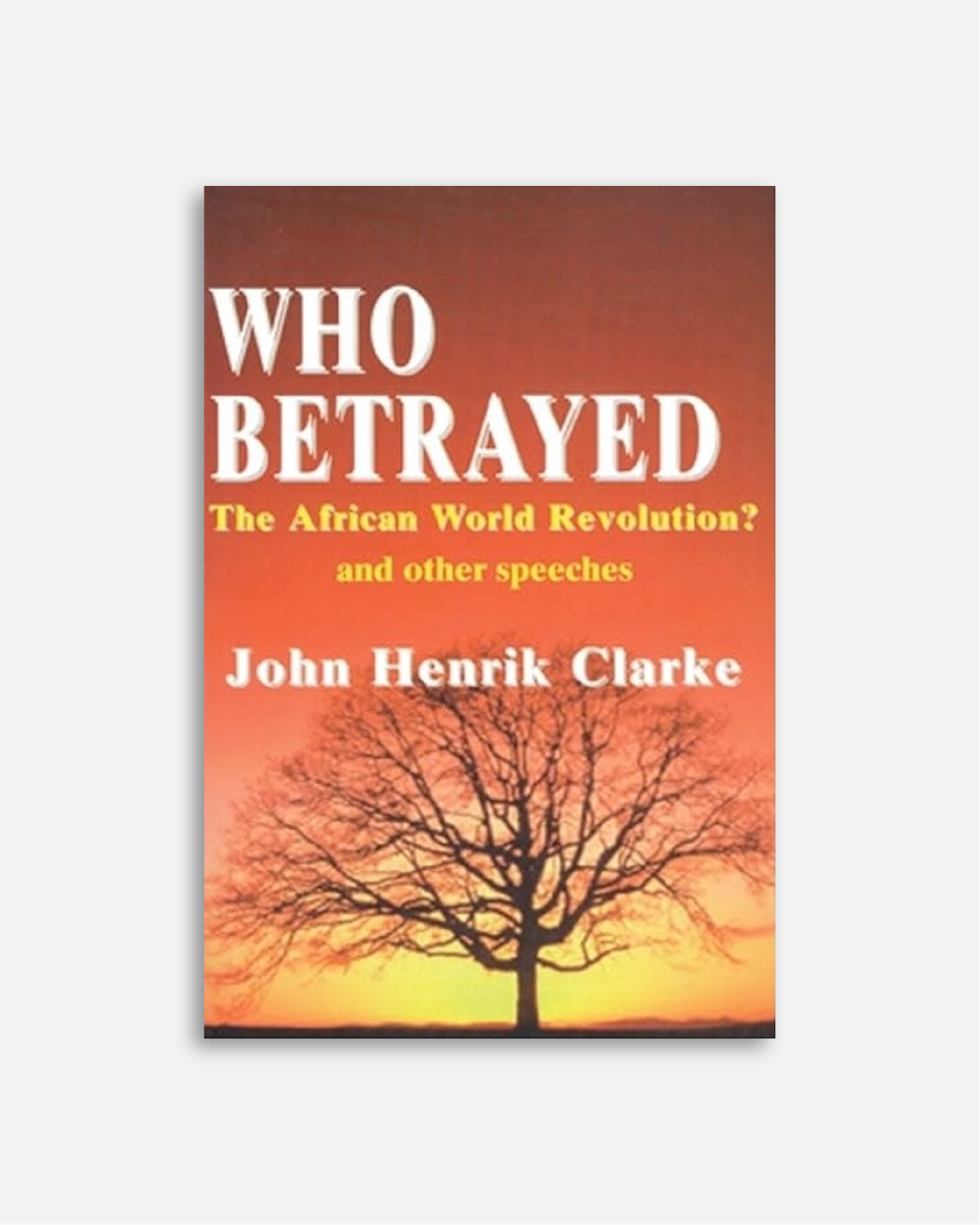
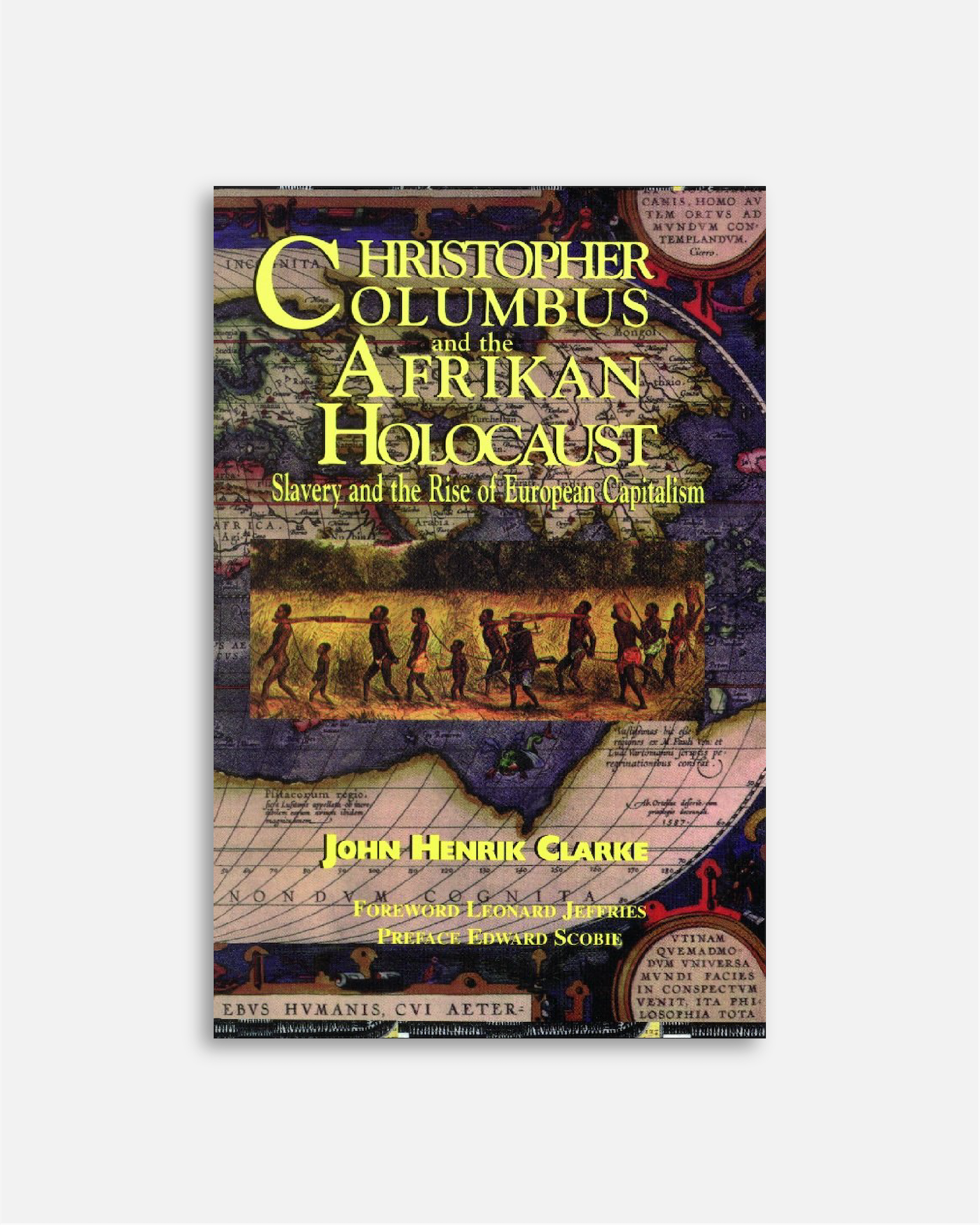
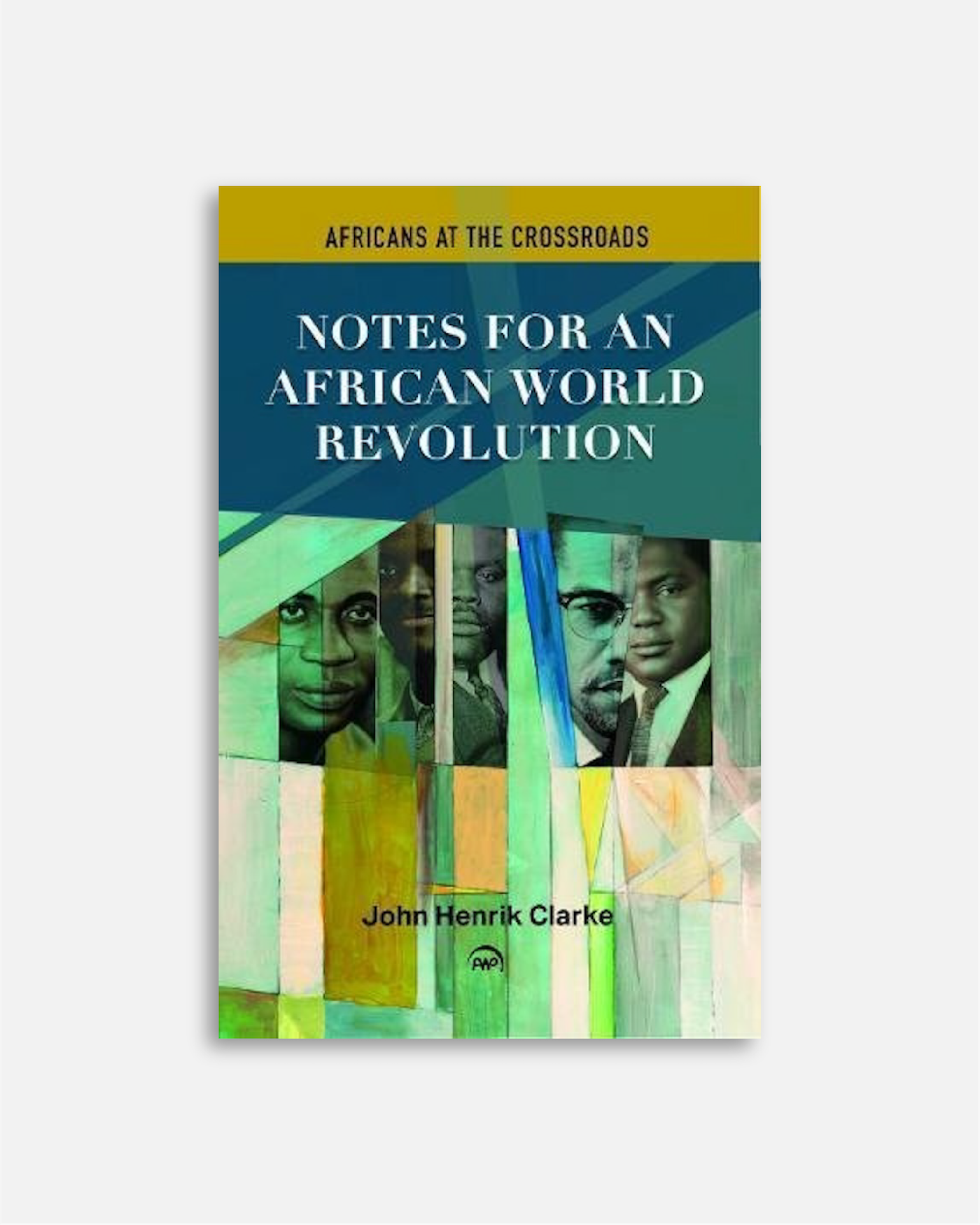
Clarke’s bibliography was broad. Cornell’s John Henrik Clarke Africana Library notes that he authored numerous articles and served as author, contributor, or editor of 24 books. The Los Angeles Times reported that he wrote or edited 27 books and highlighted his 1966 editing of American Negro Short Stories. The Schomburg Center says he wrote or edited more than thirty books.
“Clarke’s books were not monuments. They were tools.”
These differing counts reflect the breadth of his output: books, anthologies, essays, lectures, introductions, edited collections, public education materials, and scholarly articles. Clarke did not write for a single audience. He wrote for students, activists, readers, organizers, and communities trying to build a usable past.
His editorial work is especially important. Anthologies alter the field by gathering dispersed voices into a common frame. In bringing Black writing and historical thought together, Clarke helped shape what readers could recognize as a tradition. He did what editors at their best do: he created context.
This aligns him with figures such as Arna Bontemps and Arturo Schomburg, who understood that preservation is never passive. To preserve Black work in a hostile culture is to intervene in the future.
The Curriculum as a Declaration
At Hunter College, Clarke’s curriculum work helped institutionalize Black and Puerto Rican Studies during a period of student activism and educational transformation. Cornell’s John Henrik Clarke Africana Library states that Clarke became the founding chairman of Hunter’s Black and Puerto Rican Studies Department in 1969. Hunter College’s own library guide notes that Clarke began as a lecturer at Hunter College in 1969 and was a former chairman of the department.
Curriculum is often discussed in bureaucratic language: requirements, credits, approvals, outcomes. Clarke understood it as a declaration of human worth. What a school chooses to teach tells students who matters. What it omits tells them who can be forgotten.
For Black and Puerto Rican students at Hunter, a department organized around their histories was not symbolic inclusion. It was structural correction. It said their communities were not case studies in urban pathology, not footnotes to national progress, not problems to be solved by experts. They were producers of knowledge.
That idea remains contested today. The fights over African American history, ethnic studies, public school curricula, museum interpretation, and library access show that Clarke’s central question has not disappeared. It has only changed vocabulary. Who gets to define the past? Who is made uncomfortable by the truth? Who calls memory divisive when it threatens power?
Clarke’s life offers one answer: history becomes dangerous when it stops asking permission.
The Sharp Edges
A responsible account of Clarke must resist turning him into a saint of consensus. He was a Black nationalist, Pan-Africanist, polemicist, institution builder, public historian, and intellectual insurgent. His work attracted admiration and criticism. His arguments often pushed hard against academic convention, and some of his claims sat inside broader Afrocentric debates that scholars continue to assess.
But the sharpness was part of the man. Clarke had no interest in a polite multiculturalism that merely added Black names to an unchanged structure. He wanted a reordering of historical consciousness. He wanted Black people to ask different questions, and he wanted institutions to answer for what they had hidden.
The Schomburg Center notes that Clarke received the Phelps-Stokes Fund’s Aggrey Medal in 1994 for his role “as a public philosopher and relentless critic of injustice and inequality.” That phrase—relentless critic—captures the Clarke who could not be comfortably absorbed into ceremonial history. Even when honored, he remained a challenge.
The Elder and the Afterlife
John Henrik Clarke died in 1998. The Los Angeles Times reported that he died at 83 after a heart attack at St. Luke’s Roosevelt Hospital in New York City. The Schomburg Center records his death in the same year, closing the biographical arc but not the intellectual one.
His afterlife is visible in institutions, syllabi, documentary footage, public lectures, community study groups, and the ongoing debates over Black history. It is visible in Cornell’s John Henrik Clarke Africana Library, in the Schomburg Center’s archival holdings, and in the generations of students who encountered him not only as a professor, but as a model of historical self-determination.
Clarke’s work matters now because the struggle over history is never only about the past. It is about power in the present. It is about who gets innocence, who gets complexity, who gets archives, who gets monuments, who gets footnotes, who gets silence.
In a moment when African American history remains contested in classrooms, legislatures, museums, libraries, and media, Clarke feels less like a relic than a warning. He understood that historical erasure is not accidental. It is a political act. So is remembrance.
His significance is not that every claim he made should be received without scrutiny. Serious history requires evidence, revision, argument, and debate. Clarke’s significance is that he forced open a field of inquiry narrowed by racism and colonial arrogance. He insisted that African people had histories older than bondage, philosophies deeper than stereotype, and futures that required memory as foundation.
He helped build the institutions that made Africana Studies possible. He trained generations of students to think historically about Black life. He carried scholarship into public spaces. He turned the archive into a community resource. He gave language to people who knew they had been lied to but needed tools to explain how.
John Henrik Clarke did not ask America to include Africa as a courtesy. He demanded that history be reorganized around truth. For KOLUMN, and for any publication committed to Black memory as cultural infrastructure, that demand remains urgent.
History is still a clock. Clarke spent his life teaching people how to read the time.
More great stories
Afro Sheen, Wall Street, and the Architecture of Black Possibility
July 6, 2026
No Comments
The Fire Inside the Fourth
July 5, 2026
No Comments