





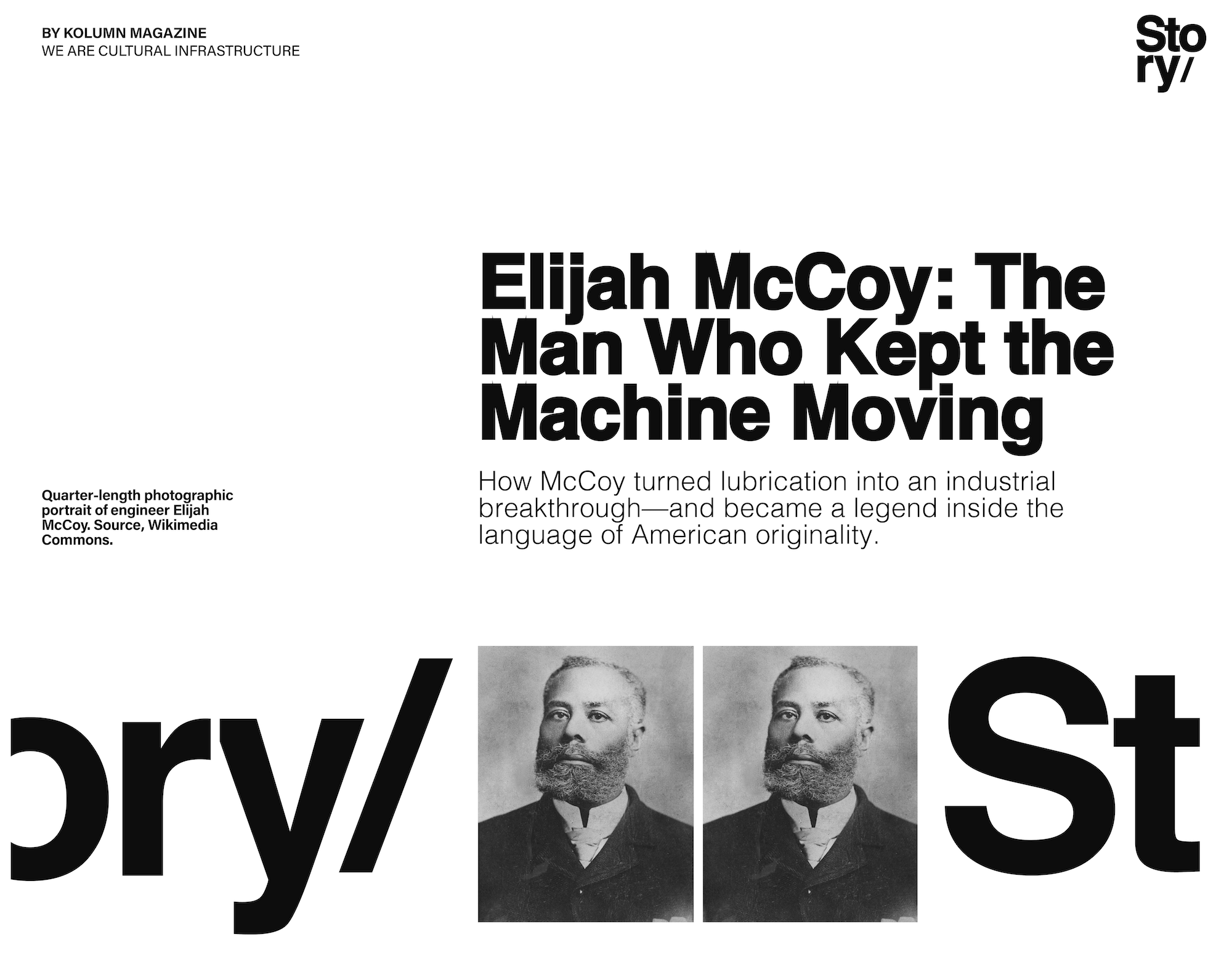
McCoy did not merely invent a device. He invented continuity—the ability of a machine, and a nation, to keep moving without stopping to admit who made motion possible.
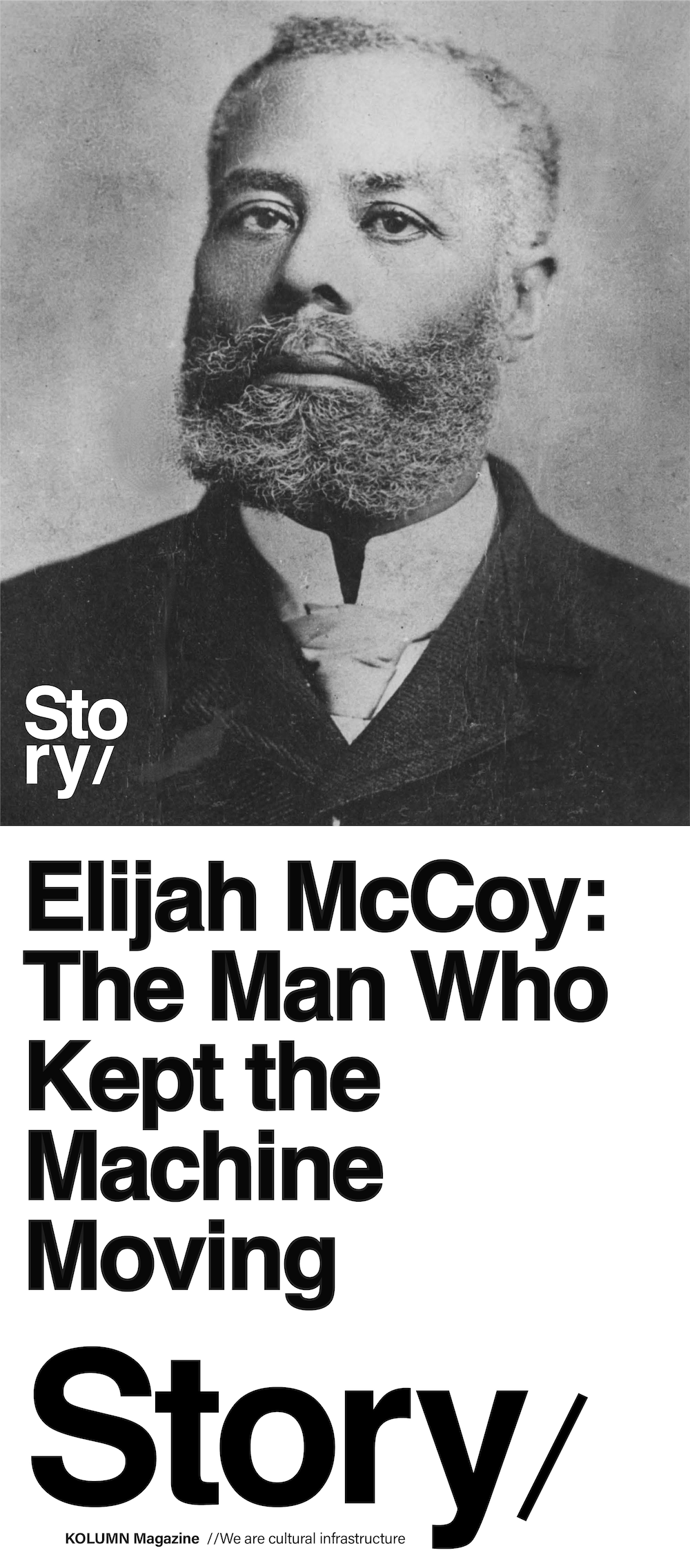
McCoy did not merely invent a device. He invented continuity—the ability of a machine, and a nation, to keep moving without stopping to admit who made motion possible.
By KOLUMN Magazine
There is a particular kind of American genius that does not announce itself with grandeur. It arrives in the form of a small device, a refinement, a pressure solved, a failure prevented before anyone notices the danger. Elijah McCoy’s great invention did not tower over a city or carry passengers across a continent by itself. It sat inside the hard, hot logic of steam power and did what the industrial age desperately needed: it kept machinery moving.
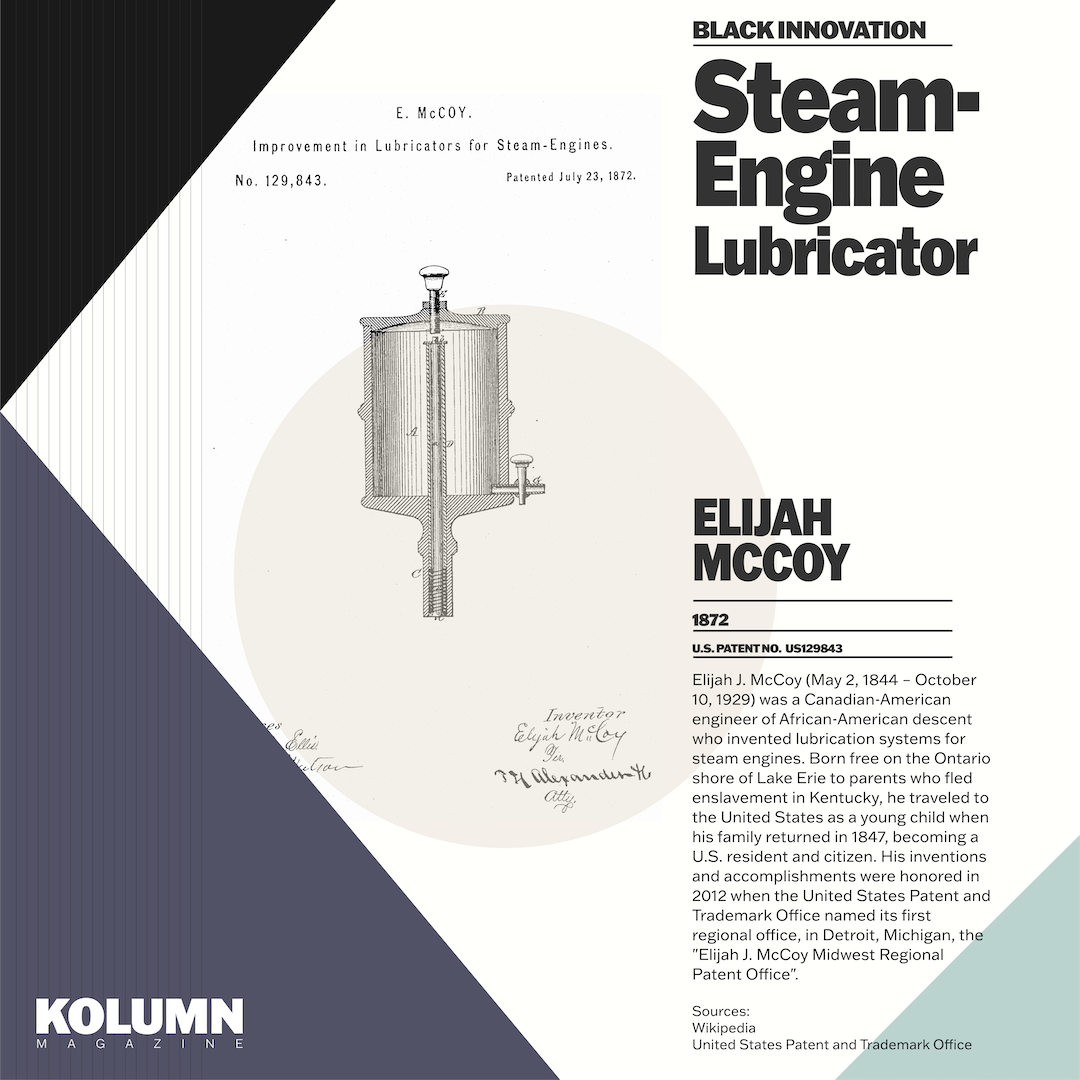
McCoy, born in Colchester, Ontario, on May 2, 1844, according to the National Park Service, became one of the most important Black inventors of the 19th century. His parents, George and Mildred McCoy, had escaped enslavement in Kentucky and fled to Canada through the Underground Railroad, a fact preserved in accounts from the Detroit Historical Society and The Canadian Encyclopedia. The child born into that freedom would grow into a mechanical engineer whose work helped change railroads, factories, ships, and the culture of American invention.
His most famous breakthrough was an automatic lubricator for steam engines, patented on July 23, 1872, as an “Improvement in Lubricators for Steam-Engines,” according to Google Patents. Before such systems became standard, steam engines required regular manual lubrication; machinery often had to be slowed or stopped so oil could be applied to moving parts. McCoy’s device fed oil steadily to engine components while they were running, reducing downtime and improving efficiency, as the National Inventors Hall of Fame notes in its profile of the inventor.
The phrase “the real McCoy” has long been linked to his name, though historians treat the origin story with caution. The popular version holds that railroad engineers, wary of inferior imitations, asked whether a locomotive had “the real McCoy” lubricator, according to Smithsonian Magazine and Britannica. Whether the phrase began with him or merely attached itself to him, the symbolism endures: McCoy became a shorthand for authenticity in a country that often made Black innovation prove itself twice.
A Freedom Story at the Border
Elijah McCoy’s life begins not with the railroad but with escape. His parents’ journey from Kentucky to Canada placed his birth inside a larger geography of Black flight, resistance, and self-determination. Canada was not a paradise, and Black communities there still faced discrimination, but for families fleeing slavery in the United States, the Canadian side of the border could represent legal freedom and the possibility of a future outside the immediate reach of American slaveholders.
The McCoy family settled in Colchester, Ontario, a community connected to the wider Black settlements of Essex County. The Canadian Encyclopedia identifies McCoy as an African-Canadian mechanical engineer and inventor whose parents had escaped enslavement through the Underground Railroad. That origin matters because McCoy’s engineering career was not simply a tale of individual talent. It was the consequence of a freedom struggle that made education, mobility, and skilled work imaginable for a child born to parents who had been treated as property.
As a boy, McCoy showed an early fascination with machines. The Detroit Historical Society describes him as a child who took mechanical devices apart and reassembled them. That image—young Elijah studying the hidden order of things—has become central to his legend because it foreshadows his mature gift. McCoy’s genius was not merely invention in the dramatic sense. It was attention. He understood that machines fail at points of friction, heat, timing, and neglect.
At age 15, McCoy was sent to Scotland for training in mechanical engineering, according to the University of Edinburgh and the National Park Service. That journey placed him within one of the great engineering centers of the 19th-century world. Scotland, with its industrial expertise and mechanical traditions, offered the kind of technical education that would have been difficult for a Black youth to secure in North America.
When McCoy returned, however, skill did not protect him from racism. He had trained as an engineer, but the American labor market did not receive him as one. In Michigan, he found work with the Michigan Central Railroad as a fireman and oiler rather than as a mechanical engineer, according to the Detroit Historical Society. The job was demanding, dirty, and physically dangerous. It also placed him close to the problem that would define his career.
The Railroad as Classroom
The railroad was one of the defining technologies of McCoy’s century. It remade time, commerce, migration, war, and settlement. But the romance of the locomotive—the whistle, the iron track, the speed—depended on an unforgiving mechanical reality. Steam engines generated heat. Moving parts created friction. Bearings, pistons, cylinders, and valves needed lubrication to prevent wear, overheating, and failure.
McCoy’s assigned work as an oiler may have been beneath his formal training, but it gave him direct access to the system’s weaknesses. The oiler’s job was not ornamental. It was essential. Without lubrication, a machine could destroy itself. Without steady maintenance, progress stopped.
“The indignity of McCoy’s job became the intelligence of his invention. The railroad would not hire him as the engineer he had trained to be, so he engineered from the place where the machine revealed its flaws.”
His 1872 patent addressed a practical problem with elegant force. The patent, filed under the title “Improvement in Lubricators for Steam-Engines,” described a device designed to deliver lubrication automatically, according to Google Patents. The National Inventors Hall of Fame explains the significance clearly: McCoy’s invention allowed engines to be lubricated while running, saving time and money because engines no longer had to be stopped for lubrication.
That may sound modest to modern ears accustomed to digital revolutions and moonshot rhetoric. But in the economy of steam, reduced stoppage meant increased productivity. A train that did not need to halt as often could move freight more efficiently. A factory engine that stayed lubricated could run more dependably. A ship’s machinery could operate with less interruption. McCoy’s invention did not change what steam power was; it changed what steam power could sustain.
KOLUMN Magazine has previously framed Black invention as a matter of receipts and recovery through its Black Innovators & Inventors archive, which gathers the work of Black contributors to science, art, and literature. McCoy’s story belongs at the center of that tradition because his work exposes a recurring pattern: Black inventors were often indispensable to American modernization while being denied full access to capital, credit, and institutional power.
The Patent and the Problem of Ownership
McCoy received U.S. Patent No. 129,843 in 1872, according to both the National Inventors Hall of Fame and Google Patents. The patent system offered him a form of legal recognition, but recognition is not the same as control. For many Black inventors of the 19th century, patents could certify originality without guaranteeing wealth.
This distinction is crucial. McCoy was prolific. The National Park Service states that he held more than 57 patents during his lifetime, many connected to lubrication systems. Inventors Digest similarly notes that most of his patents involved lubricating systems for steam engines used in locomotives, ships, and factory equipment. Yet the mythology of invention often skips the business machinery that determines who profits.
McCoy frequently assigned rights or sold patents to others, a reality that reflected the limited access Black inventors often had to manufacturing capital and industrial networks. He was not alone. KOLUMN’s own pages on inventors such as Thomas L. Jennings, the first known African American patent holder, and Sarah Boone, who patented an improvement to the ironing board, show how Black inventors repeatedly navigated hostile systems to secure legal claims over practical genius.
The automatic lubricator became McCoy’s signature because it met industry where industry lived: in cost, speed, maintenance, and reliability. It was a product of mechanical imagination, but also of intimate labor knowledge. He knew the machine because he had served it. He knew the wasted time because he had watched it disappear. He knew the danger because he had worked near it.
“The Real McCoy” and the Burden of Authenticity
No part of McCoy’s story has traveled farther than the phrase “the real McCoy.” It is both gift and trap. It keeps his name alive, but it can also flatten him into folklore.
The common account suggests that railroad workers and engineers, frustrated by inferior copies of his lubricator, requested the authentic version by asking for “the real McCoy.” The National Inventors Hall of Fame presents this theory as part of his legacy, while Smithsonian Magazine describes McCoy as a prolific inventor whose name became associated with the idiom. Britannica also notes that customers reportedly asked for McCoy’s designs by name.
“The question is not only whether Elijah McCoy gave America a phrase. It is whether America knows what to do with a Black inventor whose work was more consequential than the myth attached to him.”
But responsible storytelling requires precision. The phrase has competing origin theories, and no single documentary trail conclusively proves that McCoy alone created it. The more careful claim is that his reputation became one of the phrase’s strongest and most enduring associations. That uncertainty does not diminish him. In fact, it sharpens the lesson. Black historical figures are too often asked to carry legends because the archive failed to fully carry them.
The phrase remains powerful because it points to something true about McCoy’s work. His lubricators were valued because they worked. They solved a problem at scale. They performed under pressure. They became desirable not because of charity or symbolism but because industry needed what he made.
Beyond the Lubricating Cup
McCoy’s career did not end with the 1872 lubricator. He continued improving lubrication systems and developing other inventions across decades. The National Park Service notes that in 1916 he invented a graphite lubricator that allowed superheated machinery to be oiled. The same source also identifies other inventions associated with him, including a movable ironing board and a lawn sprinkler.
That range matters. McCoy was not a one-device inventor. He was a systems thinker. Lubrication, in his hands, was not merely oil applied to metal. It was a science of endurance. He repeatedly returned to the same family of problems: how to reduce friction, regulate flow, protect machinery, and extend operation. In modern terms, he worked at the intersection of mechanical engineering, maintenance design, and industrial reliability.
The Windsor Public Library summarizes the broader significance of his 1872 invention by noting that the same principle was later applied to other steam engines and industrial machinery. That is the mark of a consequential invention: it migrates. It leaves the original setting and becomes a principle that others adapt.
In a different era, McCoy might have become the head of a major manufacturing concern much earlier in life. Instead, he spent much of his career inventing within constraints. He eventually established the Elijah McCoy Manufacturing Company in 1920, according to the National Park Service. By then, he was an older man, and the industrial world he helped improve had already absorbed much of his genius.
Black Genius Inside the Industrial Age
McCoy’s importance is not only technological. It is historical. His life forces a correction in how the industrial age is remembered.
Too often, American industrial history is told through owners, financiers, railroad barons, and captains of industry. The names most often celebrated are the men who consolidated capital. McCoy represents another kind of industrial actor: the Black engineer whose innovation improved the systems that capital depended on, even as racism limited his advancement.
The Smithsonian Institution has recognized McCoy within the broader history of African American invention and innovation, including an exhibition that placed him among prominent Black inventors and anonymous contributors whose work shaped American technology. That framing is essential. McCoy’s story is not an exception to Black history; it is a portal into it.
He belongs beside inventors, builders, and technical thinkers whose work made daily life more efficient, safer, and more modern. KOLUMN’s Black Innovators & Inventors archive similarly treats Black invention as a central strand of cultural memory, not a seasonal footnote. McCoy’s life offers a perfect case study in why that approach matters. Black innovation did not merely decorate American progress. It powered it.
The Cost of Being First-Class in a Second-Class System
The wound in McCoy’s biography is not that he failed. He did not fail. The wound is that he succeeded inside a structure determined to shrink the meaning of his success.
He trained abroad as a mechanical engineer, then returned to a labor market that reduced him to work as a fireman and oiler. He invented a device that improved industrial efficiency, then navigated a patent and manufacturing environment in which others often had greater capital and control. He became famous enough for his name to symbolize authenticity, yet he did not receive the full wealth or institutional standing that a white inventor of comparable usefulness might have expected.
“McCoy’s story should not be reduced to perseverance. Perseverance explains how he survived the obstacle; it does not absolve the society that built it.”
This is the paradox of Black excellence in America: the achievement is real, but so is the theft, obstruction, and delay surrounding it.
McCoy’s life also complicates the easy inspirational version of invention. It is tempting to tell children that he overcame adversity and leave the matter there. But adversity is not a weather system. It is made by policy, custom, hiring practices, capital markets, schools, and racial ideology. McCoy’s underemployment after formal training was not an accident. It was part of a society that needed Black labor but resisted Black authority.
Detroit, Memory, and the Patent Office That Bears His Name
McCoy’s connection to Michigan remains central to his legacy. He worked in Ypsilanti and Detroit, and his name is now attached to one of the nation’s most important intellectual-property institutions. The U.S. Patent and Trademark Office identifies the Midwest Elijah J. McCoy Regional Outreach Office as located in Detroit. The office opened in 2012 and was the first regional office in USPTO history, according to the USPTO.
There is poetic force in that naming. A Black inventor who had to fight for recognition within the patent system is now memorialized by the federal agency responsible for protecting invention. The honor does not repair the inequities he faced, but it does place his name where aspiring inventors can see it. It makes McCoy not only a figure of the past but a symbolic gatekeeper for future claims of originality.
The USPTO describes the Detroit office as serving inventors and entrepreneurs across the Midwest. That mission matters in McCoy’s case because access has always been the hidden question behind invention. Who gets training? Who gets capital? Who gets legal protection? Who gets believed? Who gets called a genius before death, not after?
The Final Years
McCoy’s later life carried loss. His second wife, Mary Eleanora Delaney McCoy, died after a 1922 automobile accident in which McCoy was also injured, according to accounts summarized by the National Park Service and other historical profiles. McCoy died on October 10, 1929, in Michigan, according to the National Park Service. He is buried at Detroit Memorial Park East in Warren, Michigan, the same source notes.
By the time of his death, the world he had helped engineer was moving into another era. Steam was giving way to new forms of power. Automobiles, electricity, petroleum, and mass manufacturing were remaking industry again. Yet the principle behind McCoy’s work remained modern: machines require systems of maintenance; progress depends on unseen care; efficiency is often born from someone paying attention to what everyone else accepts as routine.
That is why McCoy’s life still speaks. He was not simply a man who made trains run better. He was a thinker who understood that the future often turns on small interventions at critical points of friction.
Why Elijah McCoy Still Matters
Elijah McCoy matters because he forces us to rethink the architecture of progress. Industrial America was not built only by financiers and factory owners. It was built by enslaved people and fugitives, machinists and oilers, engineers denied titles, inventors denied capital, and Black families who turned freedom into technical ambition.
“To call something ‘the real McCoy’ is to invoke authenticity. To study Elijah McCoy is to confront the systems that made Black authenticity fight for proof.”
His life also matters because it challenges the way Black history is often packaged. McCoy is frequently introduced during Black History Month as the man behind “the real McCoy.” That is useful as an entry point, but insufficient as a conclusion. The phrase should lead us into the machinery, not away from it. It should make us ask what problem he solved, what industry gained, what barriers he faced, and why so much Black invention has been remembered as trivia rather than infrastructure.
KOLUMN’s previous attention to Black innovators, including its Elijah McCoy entry and broader Black Innovators & Inventors archive, reflects an urgent editorial truth: Black history cannot be reduced to commemoration. It must be organized as evidence. McCoy’s patent, his engineering training, his railroad work, and his long list of inventions are all evidence of a larger claim—that Black technical imagination has been central to the making of the modern world.
In the end, McCoy’s genius was not only that he kept engines lubricated. It was that he understood motion as a problem of justice as well as mechanics. A machine cannot run if friction is ignored. Neither can a country.
More great stories
Afro Sheen, Wall Street, and the Architecture of Black Possibility
July 6, 2026
No Comments
The Fire Inside the Fourth
July 5, 2026
No Comments