




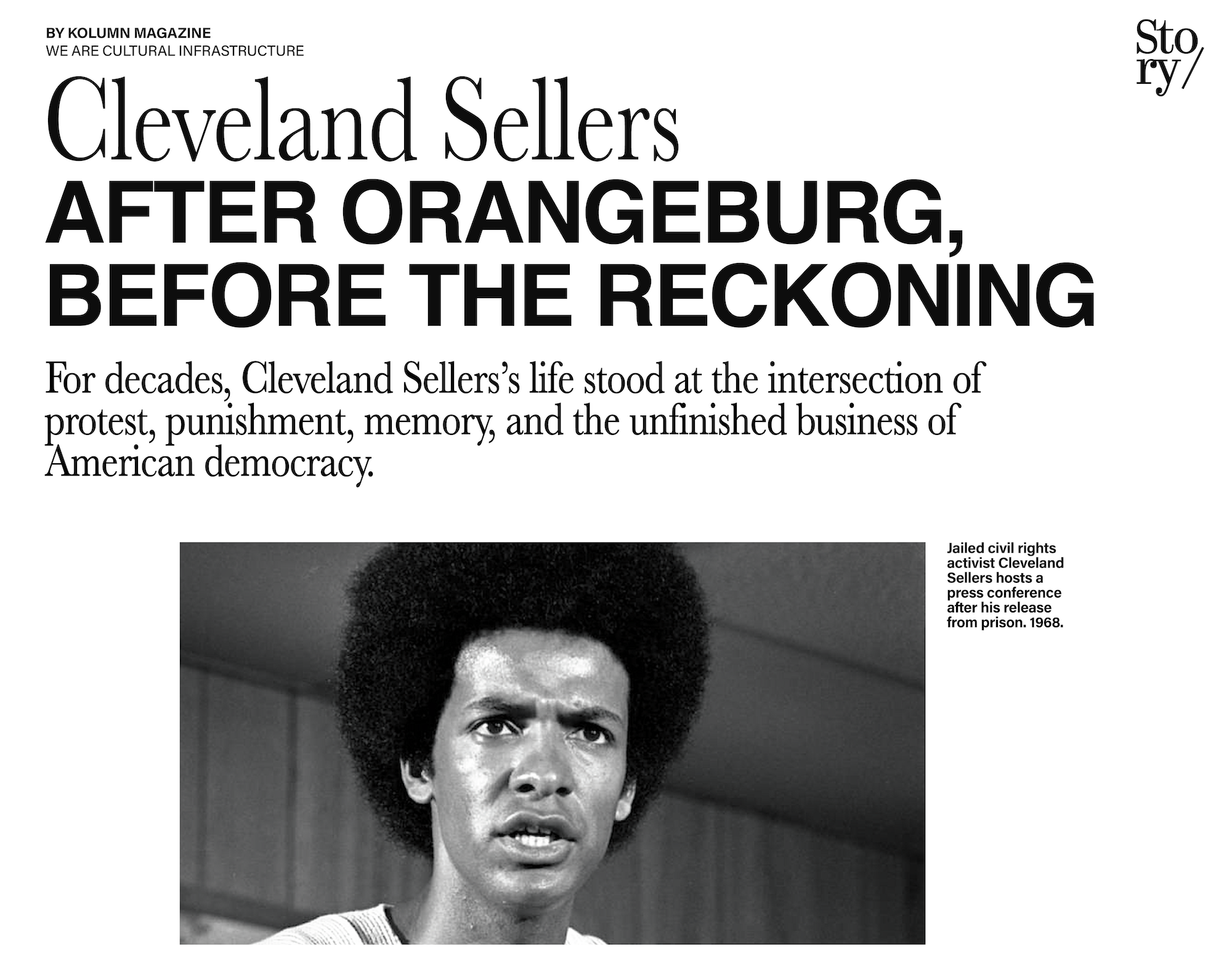
Cleveland Sellers’s story is not only about surviving state violence. It is about surviving the lie told afterward.
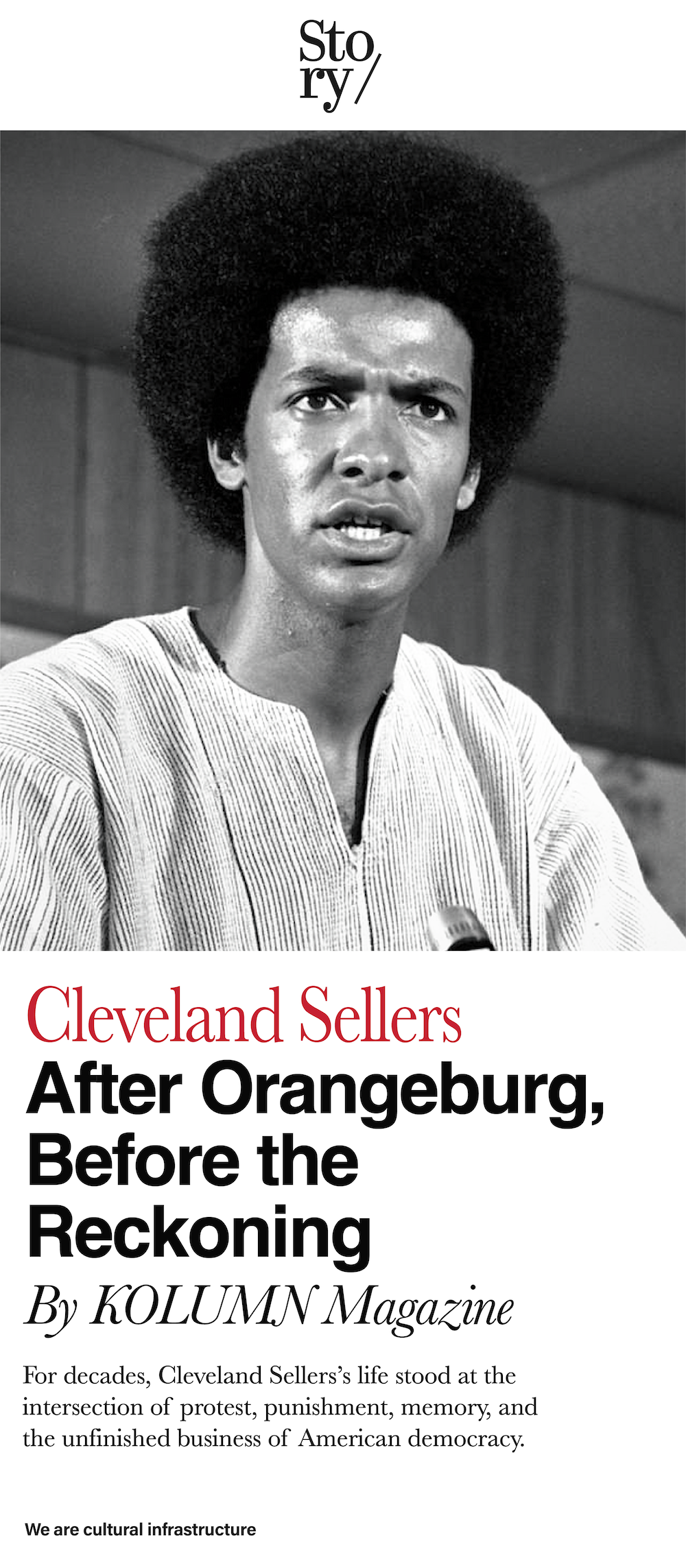
Cleveland Sellers’s story is not only about surviving state violence. It is about surviving the lie told afterward.
By KOLUMN Magazine
There are civil rights figures whose names entered the national canon almost immediately, pressed into textbooks and anniversaries, fitted for monument. Then there are those whose lives reveal something harsher about American memory: that the nation does not merely forget, it sorts. It selects which martyrs deserve national grief, which organizers get reduced to side notes, and which survivors are asked to carry the burden of both history and its erasure. Cleveland Sellers belongs to that latter category. To write about him is to write about the civil rights movement not as a finished morality play but as an unfinished argument over power, punishment, and who gets believed. Sellers was not only a movement insider. He was also, in the fullest sense, one of the people the state tried to make an example of.
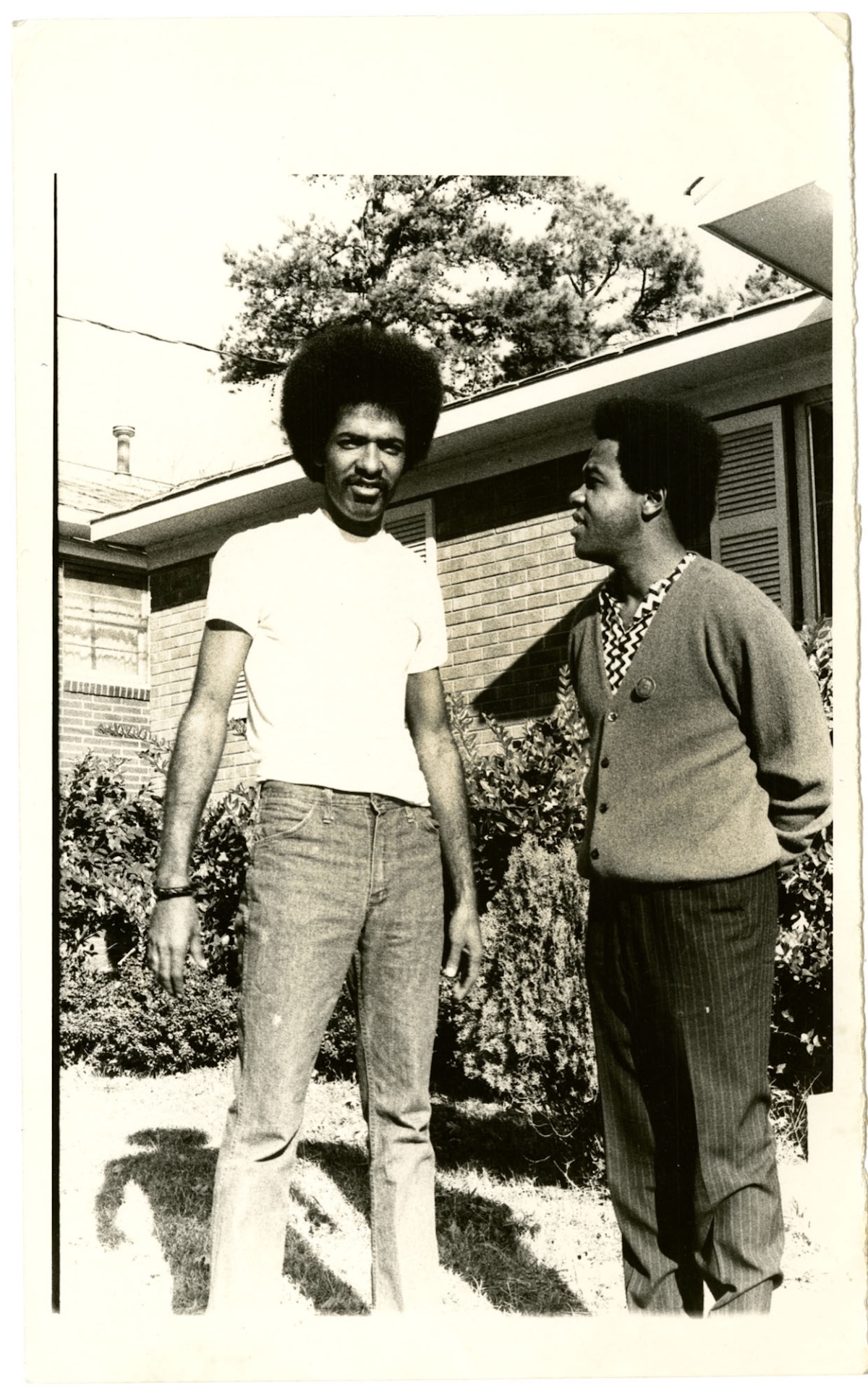
That is what makes his life so instructive, and so unsettling. Sellers moved through several of the central political vocabularies of Black freedom struggle in the 1960s: student protest, grassroots organizing, institution-building, nonviolent discipline, impatience with liberal gradualism, and the turn toward Black political power. He worked within the Student Nonviolent Coordinating Committee at the moment SNCC was evolving from an organization associated in the public mind with lunch counters and moral witness into one more willing to speak the language of self-determination, independent power, and structural critique. He was present not on the movement’s margins but near its nerve center.
And yet Sellers is known most widely not for his organizing brilliance but for the calamity that followed him home to South Carolina in 1968. That year, during protests tied to the segregationist practices of a local bowling alley in Orangeburg, state patrolmen opened fire on Black students at South Carolina State College. Three young Black men were killed. Many more were wounded. Sellers himself was shot. Still, it was Sellers—not the officers who opened fire—who became the one person convicted and jailed in the aftermath. Twenty-five years later, the state pardoned him. But pardon is not the same thing as repair. In the long American archive of racial injustice, Sellers’s life marks the distance between official exoneration and genuine reckoning.
For a KOLUMN audience, Sellers belongs in the same conversation as figures like Irene Morgan and David Richmond, people whose lives expose how history is often carried by those forced to fight twice: once in the moment itself and again in the struggle over what that moment would later mean. Sellers’s importance lies not only in what happened to him, but in what his life reveals about the country that happened around him. His biography is a map of the modern United States: segregated hometowns, student radicalism, federal hesitation, white backlash, criminalized dissent, delayed apology, and, finally, the long labor of teaching younger generations what their elders were never meant to know.
A child of Black South Carolina
Cleveland Sellers Jr. was born on November 8, 1944, in Denmark, South Carolina, a small town shaped by the realities of Jim Crow and by the parallel institutions Black communities built within it. Accounts of Sellers’s early life emphasize that he did not come from the most economically precarious stratum of Black Southern life. His mother was an educator. His father was an entrepreneur. He grew up in a family that valued discipline, ambition, and race pride. That matters because it complicates the lazy mythology that only deprivation radicalizes people. Sometimes what radicalizes a young person is not simply suffering, but the intolerable contradiction between a community’s dignity and a system designed to humiliate it anyway.
Denmark was also inseparable from Voorhees, the historically Black educational institution that would later become central to Sellers’s life in more ways than one. He attended Voorhees High School and graduated in 1962. Long before he became the president of Voorhees College decades later, he was a child of its orbit, someone whose life was shaped by Black institution-building before he would himself become one of its stewards. That detail has the symmetry of a novel, but it is also politically revealing. For Sellers, activism and education were never separate worlds. In the Black South, schools were not merely places of instruction. They were incubators of citizenship, strategy, aspiration, and insurgent memory.
If Sellers’s later reputation would be tied to SNCC and Orangeburg, his formative years remind us that the movement did not appear from nowhere. It emerged from homes, churches, campuses, principals’ offices, small towns, and local traditions of mutual seriousness. The civil rights generation was not simply “born courageous.” It was formed by Black adults who had already learned how to survive with discipline inside hostile systems. Sellers inherited that seriousness early. What he would later add to it was a sharper impatience.
SNCC and the movement’s internal weather
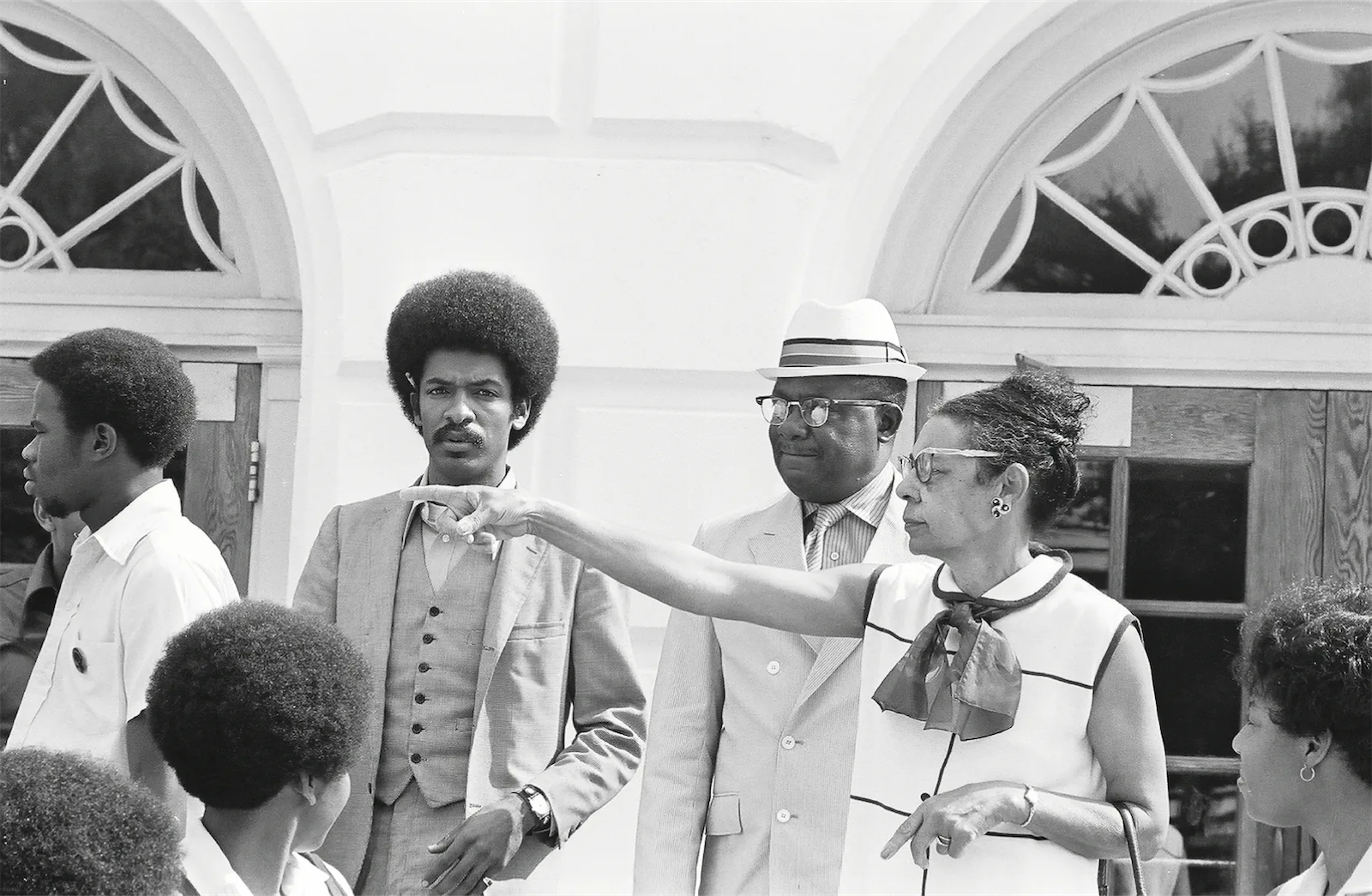
By the mid-1960s, Sellers had become part of SNCC, one of the most important organizations in the Black freedom struggle and one of the most intellectually restless. Public memory often flattens SNCC into a single mood: brave young people in suits and dresses, seated at lunch counters or registering voters under threat of murder. All of that was true. But SNCC was also an arena of strategic argument. It was a place where the limits of interracial liberalism, the frustrations of federal timidity, and the daily reality of Southern terror pushed organizers toward more militant analyses of power. Sellers was part of that ideological weather system, not an observer to it.
SNCC Digital Gateway describes Sellers as a key figure in pushing the organization toward “concrete Black political power at the grassroots level.” He was elected program secretary in 1965, and he was close to some of the movement’s most important thinkers and organizers, including Stokely Carmichael. He stood near the moment when “Black Power” moved from slogan to organizing framework, and from feared phrase to enduring political language. That proximity is essential to understanding why Sellers later became such an easy target for the state. Once officials and white moderates decide that a Black organizer represents not protest but threat, they become available for scapegoating in ways that more domesticated reformers do not.
This was the hinge in the movement: the period when nonviolence as moral spectacle began to coexist uneasily with harder questions. What is freedom without enforcement? What is citizenship without power? What is the point of winning formal access if white institutions remain structurally armed against Black life? Sellers’s political life was forged in that transition. To some Americans, that made him visionary. To others, it made him dangerous. Often the difference between those labels depends entirely on who is doing the naming.
To say Sellers moved with SNCC into Black Power is not to say he abandoned the movement’s ethical seriousness. It is to say he understood something many in the country did not want to hear: that appeals to conscience alone could not secure safety, dignity, or control over Black futures. This was the lesson the movement kept teaching, and the nation kept resisting. The more clearly Black organizers named power, the more aggressively institutions framed them as destabilizing. Sellers’s life would become one of the clearest cases of that mechanism.
Returning home to a state on edge
In the late 1960s, Sellers returned to South Carolina and became involved with student protests in Orangeburg. The immediate issue was the All-Star Bowling Lane, a local business whose segregationist practices had become a symbol of the broader insult Black students were expected to endure. Even after federal civil rights legislation, local white power remained adept at finding ways to preserve racial hierarchy through custom, intimidation, and selective enforcement. Students at South Carolina State challenged that order directly. Their protest was about a bowling alley, yes, but only in the way lunch-counter sit-ins had been about stools and coffee. The venue was local; the argument was national.
The atmosphere in Orangeburg had been worsening for days before the shooting on February 8, 1968. Students had attempted to desegregate the bowling alley and were turned away. Arrests followed. Larger demonstrations followed the arrests. Police beat students, including women, with heavy batons. Tensions escalated as rumors of “Black Power threats” circulated through the town and law enforcement amassed force. Contemporary reporting and later recollections make clear that officials were primed to view the students not as citizens asserting rights, but as a disturbance requiring suppression.
Sellers later recalled seeing armed officers and immediately recognizing the danger. He tried to urge students to move back toward the dorms or auditorium. Then came the gunfire. The shooting lasted only seconds, but like so many episodes of state violence, its duration has little to do with its enormity. Three young Black men—Samuel Hammond Jr., Henry Smith, and Delano Middleton—were killed. More than two dozen people were wounded. Sellers was shot in the shoulder. Evidence later showed that many victims were hit from behind or in the soles of their feet while fleeing or lying prone, facts that devastated official claims of self-defense.
The Orangeburg Massacre, as it came to be known, preceded Kent State by more than two years, yet it never secured the same place in the national consciousness. That discrepancy is one of the enduring scandals surrounding the event. The Guardian, Washington Post, and later retrospectives have all pointed to Orangeburg as a warning the country failed to heed. The massacre on a Black campus, involving Black victims, never became the national parable that Kent State did. Orangeburg was not only a tragedy; it was an early lesson in how racial hierarchy governs remembrance itself.
The making of a scapegoat
After the shooting, authorities did what authorities in racial crises often do: they began constructing a story that could protect the legitimacy of the state. Then-Governor Robert McNair blamed “outside Black Power agitators,” a familiar script that converts organized dissent into outside contamination and excuses force as restoration. In that script, Cleveland Sellers was useful. He had SNCC credentials. He had political clarity. He had returned to South Carolina with a reputation. He could be made to stand in for a broader white panic about militant Black organizing.
Federal prosecutors brought excessive-force charges against officers involved in the shooting, but those officers were acquitted. Sellers, by contrast, was prosecuted and ultimately convicted for allegedly inciting a riot and failing to disperse. He served seven months in prison. It remains one of the cruelest inversions in civil rights-era legal history: a wounded survivor of police gunfire becoming the only person incarcerated as a result of the massacre. The moral obscenity of that outcome did not require subtle interpretation then, and it does not now.
What happened to Sellers was not an aberration from the movement story; it was one of its core patterns. States often could not openly defend segregation forever, so they shifted to criminalizing its opponents. The courtroom became another site where white authority translated Black dissent into disorder. If Selma showed the brutality of the sheriff’s posse, Orangeburg showed the longer administrative elegance of punishment: investigation, accusation, conviction, imprisonment, memory distortion. Sellers’s case demonstrates that state violence is often most effective not at the moment the trigger is pulled, but in the paper trail that follows.
There is also something revealing in the way Sellers’s punishment lingered. The imprisonment was not long by the standards of American incarceration. Seven months. That brevity can tempt some readers into minimizing its significance. But movement history teaches otherwise. The point of such punishment is not only to confine a body. It is to mark a reputation, break momentum, isolate a dissenter, and warn others. To be shot, criminalized, and publicly cast as the cause of the catastrophe one survived is not a footnote in a life. It is an attempt at political annihilation. Sellers lived through it. That he remained publicly productive afterward is part of his significance.
Writing against disappearance
During his imprisonment, Sellers worked on what would become The River of No Return, his autobiography and one of the important insider texts on SNCC and the movement’s ideological transitions. The book has endured because it offers what official narratives could not: a first-person account of how a generation of Black activists understood the world they were trying to change. Reviewers and scholars have returned to it repeatedly as a vivid account of both the movement’s promise and its internal fractures. Sellers was not writing from academic distance. He was writing from inside the wreckage.
That memoir matters for more than literary reasons. In Black political history, memoir has often functioned as counter-archive, a way of preserving facts and feeling against the official record. Sellers wrote not only to narrate his life but to contest disappearance. He documented the movement from within, including the rise of Black consciousness and the costs of principled struggle. In doing so, he refused the state’s attempt to define him solely by criminal accusation. The book became, in effect, a political act of self-restoration.
The title itself feels apt in retrospect. There is no easy return after a life like Sellers’s, because the events that shape such a life do not stay in the past. Orangeburg returned in anniversaries, classrooms, documentaries, family histories, and public silences. SNCC returned whenever the country rediscovered the language of youth protest. The movement returned whenever the United States once again faced the question it never resolved: whether Black demands for safety and power would be heard as democratic claims or punished as threats. Sellers’s writing belongs to that return.
The long road to pardon
In 1993, twenty-five years after Orangeburg, South Carolina granted Cleveland Sellers a full pardon. Contemporary accounts and later retrospectives framed the decision as a long-delayed recognition of injustice. Sellers himself reportedly described the pardon as closing a chapter, though he did not seek to erase the record entirely. Some accounts note that he kept the conviction as a kind of “badge of honor,” a sign not of guilt but of the system he had endured. That distinction matters. In racial justice struggles, expungement may clear the file, but memory preserves the indictment—sometimes against the state rather than the accused.
Even then, pardon did not settle the matter of public accountability. A pardon acknowledges wrong done to an individual; it does not by itself produce a full reckoning with the broader machinery that made the wrong possible. Years later, Governor Jim Hodges publicly expressed regret over the massacre, becoming the first governor to attend the annual memorial. South Carolina State University has continued to mark the anniversary each year, and in 2022 it added bronze busts of the three young men killed to the memorial landscape. These are meaningful acts. They are also reminders of how long institutions can postpone plain speech about their own violence.
The delayed character of that recognition tells its own story. Orangeburg did not vanish because there was no evidence. It receded because the country preferred other symbols. The massacre was documented by reporters, survivors, and later historians. Yet for decades it remained marginal in mainstream memory. That is the broader context in which Sellers’s pardon must be understood. It was not only legal correction. It was a partial breach in the wall of forgetting.
From movement veteran to educator
If Sellers’s earlier life was defined by movement combat, his later life demonstrates another tradition within Black political leadership: the turn toward institution-building through education. He completed his undergraduate degree at Shaw University, earned a master’s degree at Harvard, and later earned a doctorate from the University of North Carolina at Greensboro. Those credentials were not ornamental add-ons to an activist résumé. They signaled a serious commitment to the intellectual work of transmitting history, building programs, and shaping students.
At the University of South Carolina, Sellers served as director of the African-American Studies Program and taught history and African American studies. Colleagues described him not as a symbolic elder wheeled out for ceremonial purposes, but as an active academic presence—deeply knowledgeable, influential with students, and instrumental in recruiting scholars. In 2019, USC announced his return to teach a class on civil rights history, presenting him as a living bridge between the era itself and current students who risked inheriting only its simplifications. A university calling him “living history” may sound familiar, even easy. But in Sellers’s case the phrase is exact. He lived history, and then he taught against its dilution.
This part of his biography deserves more emphasis than it often gets. American culture is comfortable with the activist as relic, less so with the activist as educator and epistemic authority. Sellers’s later career insisted that movement veterans are not only symbols of courage. They are also analysts, interpreters, custodians of method. He understood that if a new generation learned civil rights history only as a parade of saints and villains, it would miss the more difficult lesson: movements are strategic, contested, unfinished, and always vulnerable to state rewriting.
Coming home to Voorhees
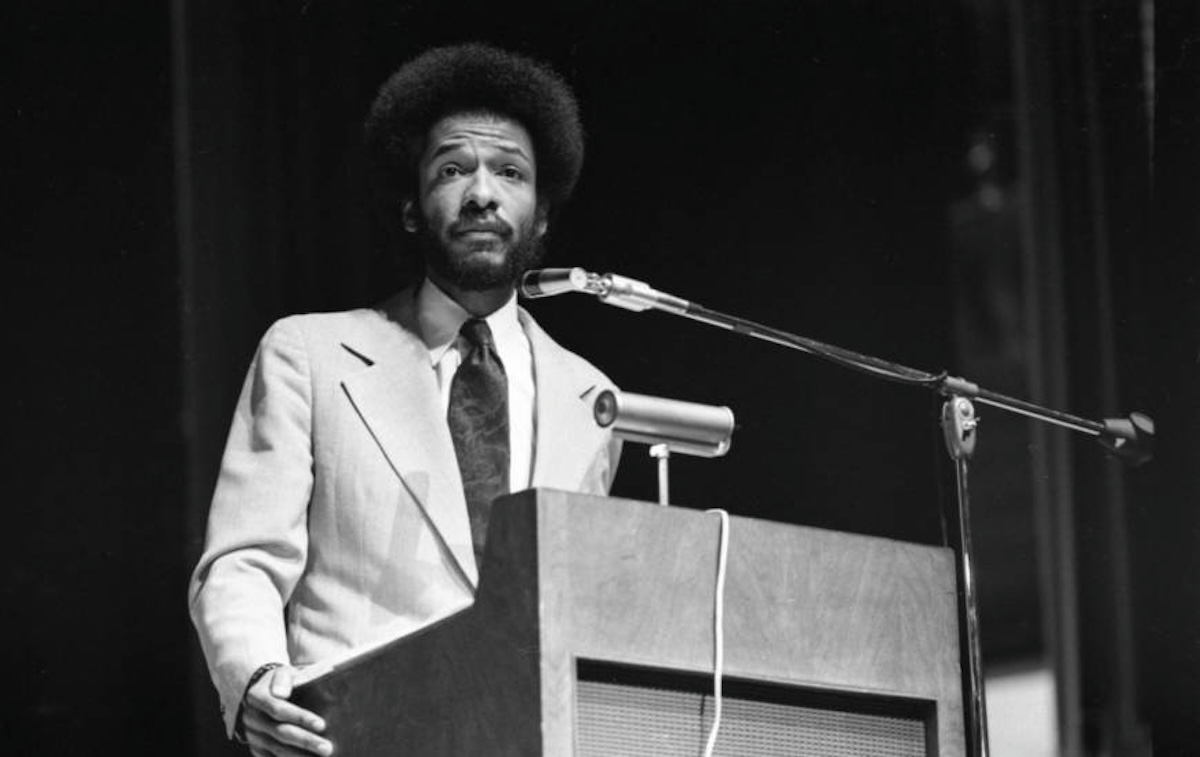
In 2008, Sellers became president of Voorhees College in Denmark, South Carolina, the institution whose orbit had shaped him as a boy. There is a particular beauty in that return, though beauty is not the only word for it. There is also historical compression. A Black child formed by segregated South Carolina grows into a national movement figure, survives state violence and criminalization, earns advanced degrees, teaches civil rights history, and then comes back to lead the school world that first held him. The arc is almost too neat. Life, of course, was not. But the symbolism remains powerful.
As president, Sellers embodied a model of HBCU leadership rooted in experience rather than branding. He understood historically Black colleges not as nostalgic emblems but as civic engines—places where history, discipline, race consciousness, and social responsibility converge. That understanding makes sense given the trajectory of his life. He had seen firsthand what happens when Black institutions are weakened, misremembered, or treated as peripheral. To lead Voorhees was, in a sense, to keep faith with the infrastructures that made movements possible in the first place.
His later public appearances continued that through-line. Speaker biographies from the 2010s routinely described him as both civil rights veteran and lifelong educator. The dual identity is not incidental. It is the thesis. Sellers spent the first part of his public life fighting power in the streets and the second ensuring that power could not so easily erase what had happened there.
Why Orangeburg still matters
To understand Cleveland Sellers fully, one must resist reducing him to the victim-survivor axis of Orangeburg, even as one must also refuse to soft-pedal Orangeburg’s centrality. The massacre matters because it reveals the deep continuity between segregation-era policing and later forms of state violence. It matters because officials blamed the people under attack. It matters because the legal system failed to hold shooters accountable. It matters because the event was under-covered and under-remembered. And it matters because the man made to bear its criminal burden went on living long enough to expose the architecture of that injustice in public.
The afterlife of Orangeburg is visible in every modern debate about protest and public order. Again and again, Black dissent is described as provocation while state force is described as response. Again and again, the record shows disproportionality, distortion, or outright fabrication. Again and again, the victims must litigate memory long after the event itself. Sellers’s life offers not merely a historical anecdote but a template for reading the present. That is one reason journalists and historians have returned to Orangeburg in moments of renewed national unrest. The story never stopped being contemporary.
It also matters because of the students who died alongside Sellers’s survival: Samuel Hammond Jr., Henry Smith, and Delano Middleton. Sellers’s story should not eclipse theirs. Rather, his survival has helped carry theirs forward. South Carolina State’s annual commemorations, memorials, and continuing public history work help insist that Orangeburg is not a local curiosity. It is a national site of memory, one that reveals how the United States absorbs anti-Black violence into its bloodstream and then too often demands gratitude for belated acknowledgement.
The measure of the man
So what, finally, is Cleveland Sellers’s significance? He was a movement strategist during one of the most ideologically consequential phases of SNCC. He was a witness to and victim of one of the defining but under-remembered atrocities of the late civil rights era. He was the target of an injustice so brazen that the state eventually had to retract it. He was a memoirist who helped preserve the movement’s internal voice. He was an educator and academic leader who treated history as a living responsibility. He was, in other words, not one thing but several kinds of public figure at once. That plurality is part of why he resists easy summarizing.
But perhaps the clearest way to put it is this: Cleveland Sellers helps us see the civil rights movement after the photograph. He lets us look beyond the iconic image into the bureaucracy, backlash, prison cell, classroom, and memorial service. He reminds us that movements do not end when cameras leave and that the state’s most durable weapon is often not force alone but interpretation. To study Sellers is to study the contest over meaning itself. Who caused the violence? Who told the story? Who carried the blame? Who kept the record? In the United States, those questions are often the real battleground.
There is a temptation, when writing about civil rights veterans, to finish with uplift. Redemption. Closure. America learning, slowly but surely. Sellers’s life does not fully permit that ending. Yes, he was pardoned. Yes, governors eventually expressed regret. Yes, universities now honor what their states once denied. But the underlying pattern—the criminalization of Black protest, the selective mourning of Black deaths, the delayed recognition of state wrongdoing—has not vanished. Sellers’s biography remains sharp because the country around it remains unfinished.
And that may be the deepest reason to keep writing him into the center of the American story. Cleveland Sellers is not significant because he fits neatly into a triumphalist narrative. He is significant because he ruins one. He forces us to confront a version of the civil rights era in which bravery did not guarantee protection, truth did not guarantee vindication, and innocence did not prevent punishment. Yet he also offers another, harder form of hope: the hope embodied by people who keep teaching, building, writing, and remembering after the state has tried to reduce them to warning signs. In that sense, Sellers stands as both witness and rebuke. He is a reminder that history is not only what happened. It is what survives being denied.
More great stories
Afro Sheen, Wall Street, and the Architecture of Black Possibility
July 6, 2026
No Comments
The Fire Inside the Fourth
July 5, 2026
No Comments