


Mary Louise Smith was not a warm-up act for history. She was part of the mechanism that made history move.
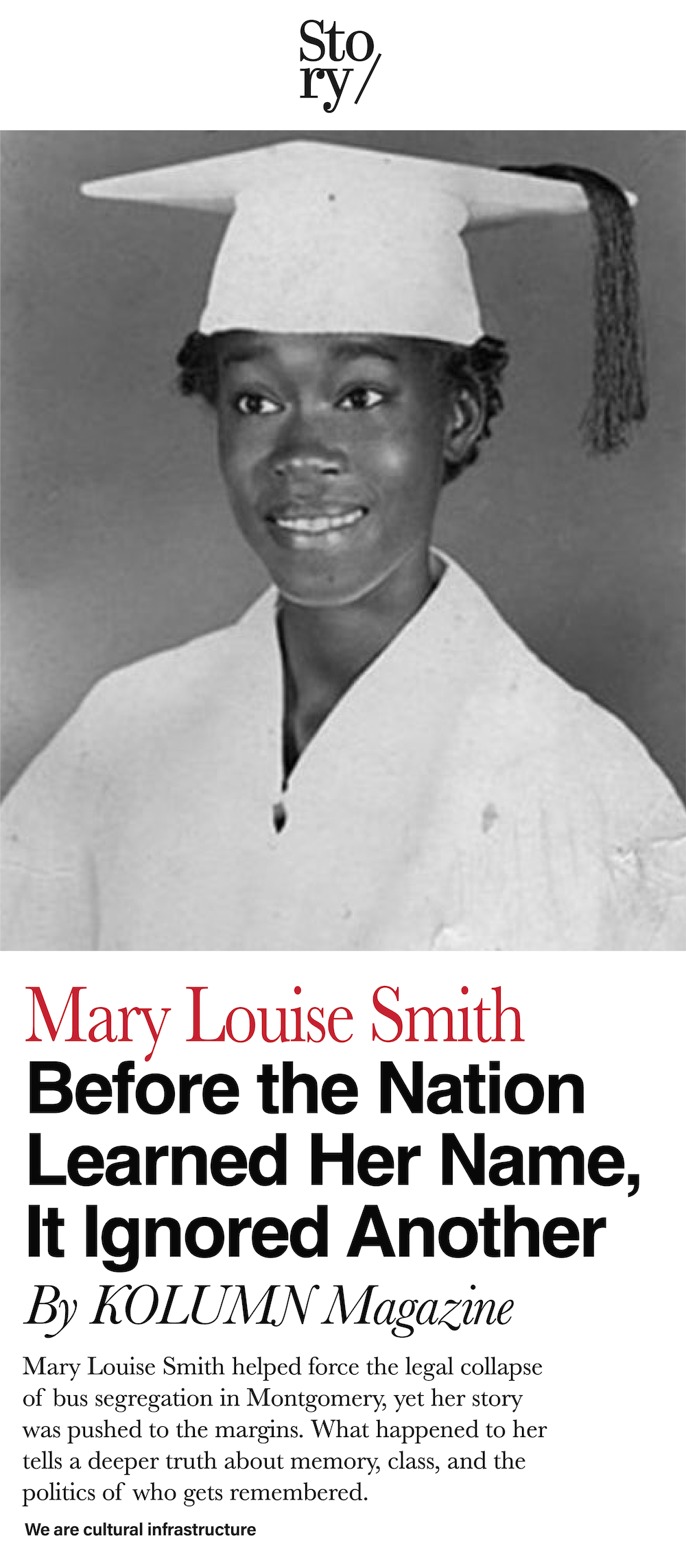
Mary Louise Smith was not a warm-up act for history. She was part of the mechanism that made history move.
By KOLUMN Magazine
The standard version of the Montgomery story is one of the most efficient myths in American life. Rosa Parks was tired. She stayed in her seat. A city rose. Martin Luther King Jr. emerged. The modern civil rights movement found its moral center. The story is tidy, teachable, and emotionally satisfying. It is also incomplete in a way that matters. It reduces a movement into a parable, compresses years of organizing into a single moment, and treats constitutional change as though it sprang fully formed from one act of refusal. That is not how movements work. It is certainly not how Montgomery worked.
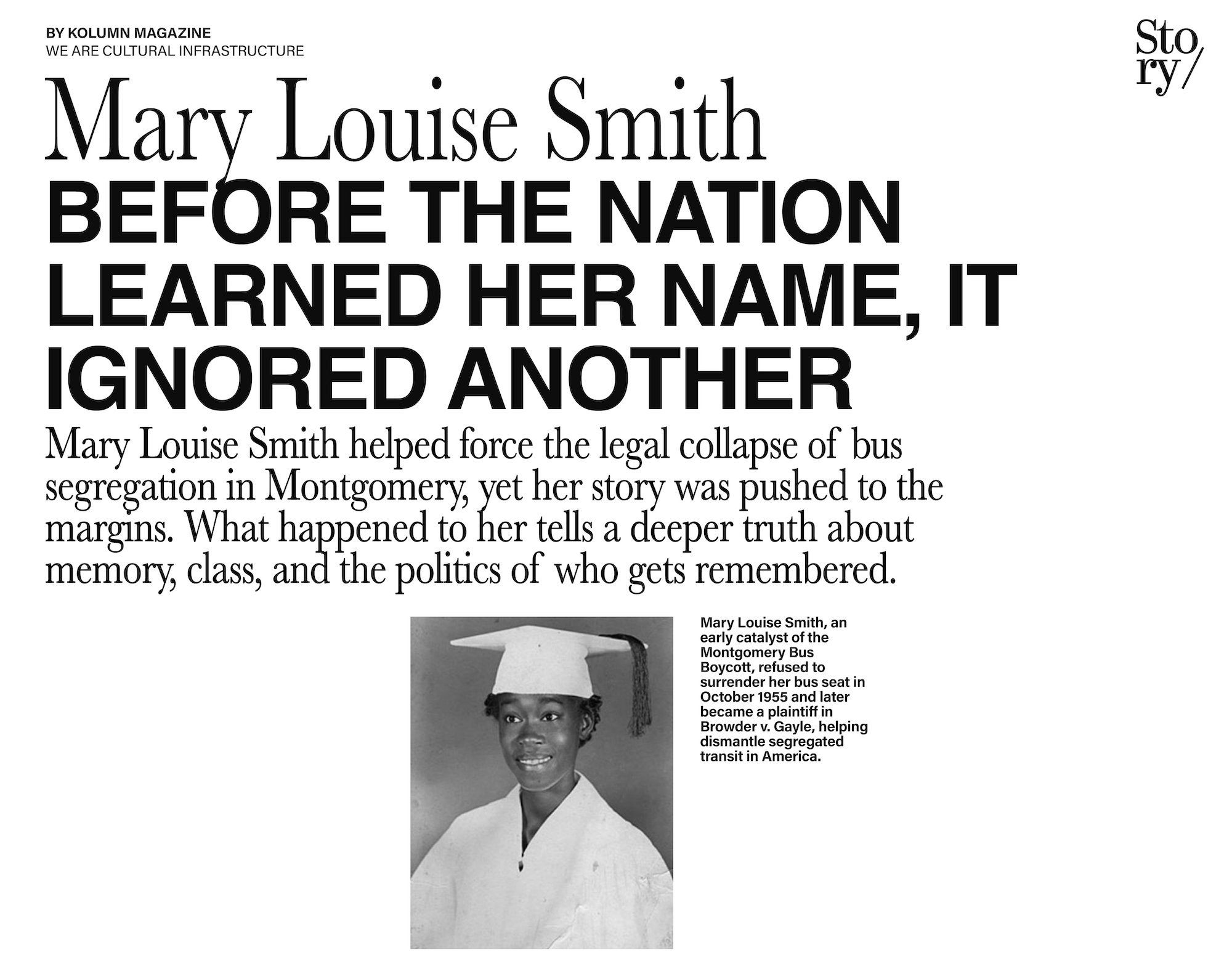
In that more difficult, more accurate version of the story stands Mary Louise Smith, an 18-year-old Black woman in Montgomery who refused to give up her bus seat to a white passenger on October 21, 1955, forty days before Parks’s famous arrest. Smith was arrested, fined, and largely denied the national afterlife granted to others. Yet she was not merely an early echo of a better-known event. She became one of the plaintiffs in Browder v. Gayle, the federal lawsuit that actually struck down Montgomery’s bus segregation system. If Parks helped ignite the boycott in the public imagination, Smith helped anchor the legal architecture that brought segregation down.
That distinction is not a technical footnote. It is the difference between symbolic ignition and constitutional victory. The Montgomery Bus Boycott is often remembered as though moral witness alone defeated the law. In reality, the boycott, the Women’s Political Council, Black church networks, Fred Gray’s litigation strategy, and the willingness of women like Mary Louise Smith to become plaintiffs together forced the crisis into court. Once that frame comes into focus, Smith stops looking like a prelude and starts looking like what she was: part of the load-bearing structure of one of the most important victories of the civil rights era.
The city that trained Black riders in humiliation
To understand Mary Louise Smith’s significance, it helps to restore Montgomery before it became a national metaphor. In 1955, the city’s buses were not merely a site of inconvenience. They were among the most intimate daily theaters of Jim Crow power. Black riders composed most of the bus company’s customers, yet drivers wielded enormous discretion over how racial seating rules were enforced. Black passengers could be told to move, forced to stand, passed by entirely, or humiliated for asserting the smallest claim to dignity. The buses were less a transit system than a moving lesson in racial subordination.
Montgomery’s Black community had not been waiting passively for a usable symbol. The Women’s Political Council had already spent years complaining about bus conditions and warning city officials that mistreatment could trigger organized protest. Stanford’s King Institute notes that other women had also resisted before Parks, including Claudette Colvin in March 1955 and Mary Louise Smith later that year. By the time Parks was arrested on December 1, the terrain had already been prepared by repeated indignities, prior acts of courage, and an organizing culture ready to turn outrage into action.
This is one of the central truths that American civic memory resists. The nation prefers a single moral lightning strike because it spares us the labor of understanding movement-building. But Montgomery was not born on the day the cameras learned where to look. It was built in meetings, grievances, church networks, women’s committees, and small acts of refusal that did not all become legend. Smith belongs to that subterranean history of preparation.
Mary Louise Smith’s “no”
Mary Louise Smith grew up in Montgomery in a Catholic family and attended St. Jude Educational Institute, a detail that matters because it places her inside a Black religious and educational world too often flattened out of civil rights storytelling. Recent reporting around a historical marker for the Smith family described her as a Black Catholic forerunner of the Montgomery Bus Boycott, and later accounts tied her family’s civic life to St. Jude. The point is not denominational trivia. It is that Smith came from an institutionally rooted Black world with its own values, networks, and discipline, even if national memory would later treat her as socially expendable.
The day of her arrest was shaped not by abstract destiny but by the hard grain of working-class life. In a 2015 WBHM interview, Smith Ware recalled that she had worked the previous week as a housekeeper for a white family and expected to be paid, but was not. She returned by bus to the family’s home to collect what she was owed, only to find no one there. Angry, tired, and still out her wages, she boarded the bus again. A white passenger got on. A man rose. She was expected to surrender her seat and stand the rest of the way. She refused. Smith later recalled, “I am not moving. Not one step.” Police were called. She was arrested, fingerprinted, and fined.
The Washington Post’s classic 1998 feature “The Ladies Before Rosa” captured the same essential contour with brutal clarity: Smith was an 18-year-old maid earning $2 a day, stiffed on pay, angry before she ever reboarded the bus, and “that close to history” while remaining “that far away from it.” TIME’s later interview with Smith reinforces the emotional reality of the moment. She said she was already upset and did not feel it was right to stand nearly another mile because someone else thought whiteness entitled them to her place.
That detail matters because it punctures the sentimental way the country often narrates Black protest. Mary Louise Smith was not an immaculate icon descending into history. She was a young Black working woman dealing with exploitation, exhaustion, and the ordinary theft of dignity that structured Southern life. Her refusal did not come gift-wrapped for civic religion. It came from a person who had been pushed far enough and decided, in one specific moment, that she would not yield.
Why she did not become the face
The question that hangs over Smith’s story is not whether she was brave enough. It is why her courage did not become the movement’s chosen emblem. The answer leads directly into the thicket of respectability politics, class judgment, and strategic image-making that shaped even righteous movements. Smith later said that movement leaders did not consider her suitable because she did not “represent the middle class.” The Washington Post reported that stories circulated portraying her father as a drunk, a characterization her family and neighbors rejected. Whether every rumor was true mattered less than the fact that such rumors could function as a veto. She was brave, but not thought marketable enough.
TIME’s 2020 account adds another layer. It notes Rosa Parks’s own recollection that Smith’s father paid her fine and did not press a broader protest, which made her less attractive as an appellate vehicle in the eyes of movement strategists. The article also underscores that Smith and Claudette Colvin were both very young, and that youth itself became part of the hesitation around who could bear the full pressure of white scrutiny, legal exposure, and public symbolism.
This is where American memory often becomes dishonest out of politeness. It wants to say that Rosa Parks emerged because she was brave, full stop. Parks was brave. She was also already a seasoned activist, respected in Montgomery, and legible to institutions that understood the value of a plaintiff or symbol who could withstand press, courts, and retaliation. The Library of Congress notes that Parks was later omitted from Browder v. Gayle for procedural reasons, but she was central to the boycott’s public spark. The problem comes when strategy hardens into memory and memory becomes myth. Then the people once judged inconvenient get treated as marginal rather than essential.
Jeanne Theoharis and Say Burgin made a related point in a Washington Post essay about how reducing Montgomery to a contest between one “right” heroine and other supposedly less suitable women distorts history. The distortion is not only factual. It is moral. It lets the public imagine movements as if they naturally elevate the most deserving, when in fact they also reproduce anxieties about class, gender, youth, sexuality, and respectability. Smith’s life sits right inside that contradiction. She was needed by history and screened out by narrative preference.
There is no need to create a false antagonism between Mary Louise Smith and Rosa Parks to tell that truth. The better frame is harder and more honest: Parks was indispensable, and so were the women history shoved behind her silhouette. Smith’s obscurity does not expose some fraud at the center of Montgomery. It exposes the cost of simplifying collective struggle into a single sanctified image.
The boycott was infrastructure, not mood
When the Montgomery Bus Boycott began on December 5, 1955, it did not remain a symbolic gesture for long. It became a system. The National Park Service records that the initial one-day boycott was about 90 percent effective, and the sustained campaign that followed relied on a large, disciplined carpool structure with dozens of dispatchers, volunteer drivers, and roughly 100 pickup stations. People walked to work, shared rides, raised money, and endured retaliation for more than a year. The boycott succeeded not because outrage is magical, but because a Black community built logistics sturdy enough to convert outrage into leverage.
That practical machinery is crucial to understanding Smith’s place in the story. By the time the boycott was underway, civil rights lawyers and organizers knew that public protest required a legal flank. Fred Gray, then the Montgomery Improvement Association’s chief counsel, had long wanted to challenge bus segregation in federal court. The Library of Congress explains that on February 1, 1956, he filed Browder v. Gayle on behalf of five women: Aurelia Browder, Susie McDonald, Jeanetta Reese, Claudette Colvin, and Mary Louise Smith. Rosa Parks was omitted because of a technical issue tied to her ongoing state case. Smith, in other words, moved from being one of several women mistreated on the buses to being one of the women whose names would carry the constitutional fight.
The National Park Service, Stanford’s King Institute, and KOLUMN’s own January 2026 feature on Claudette Colvin all converge on the same point: Browder v. Gayle was the legal instrument that dismantled bus segregation in Montgomery. Gray gathered women who had already experienced mistreatment under the city’s segregation regime. Reese later withdrew under pressure, but Smith remained among the plaintiffs tied to the case’s historical meaning. The legal challenge did not replace the boycott. It completed it.
This is why Smith’s story cannot be left at “she came before Rosa Parks.” That formulation is not wrong, but it is too weak. Mary Louise Smith’s greater significance is that she helped translate daily humiliation into federal litigation. Her name belongs not only to the prehistory of the boycott, but to the actual mechanism by which segregation law was broken.
The case that changed the law
On June 5, 1956, a three-judge federal panel ruled in Browder v. Gayle that Montgomery’s bus segregation laws violated the Fourteenth Amendment. The National Park Service notes that Gray used the same equal-protection logic that had undercut school segregation in Brown v. Board of Education. The Supreme Court affirmed the ruling in November 1956, denied rehearing in December, and the order was served on Montgomery officials on December 20. The next day, the buses were desegregated. These dates matter because they separate legend from legal sequence. Parks’s arrest sparked the boycott. Browder v. Gayle ended segregated bus seating. Mary Louise Smith helped make that ruling possible.
The case also clarifies a recurring American confusion about civil rights victories. We like the visible trigger and neglect the legal file. But constitutional history often turns on the work least likely to become mythic. A plaintiff list. A district court ruling. A strategic decision to bypass a state system expected to delay justice. TIME’s reporting notes that the case was filed directly in federal court to avoid the kind of stalling that had frustrated earlier efforts. Smith’s name entered that federal arena because organizers finally needed women whose experiences could stand in for the broader harms of the bus system.
Smith later recalled, in interviews, that when she was asked whether she would do it again, her answer was yes. WBHM preserved that dimension of her voice, and it deserves more attention than it gets. Her importance is not only that she occupied a useful legal position. It is that she understood the moral stakes of what had happened to her and did not retreat from them. Her life after 1955 does not read like someone chasing sainthood. It reads like someone who knew she had been wronged, knew the system was wrong, and never quite lost sight of either fact.
After Montgomery, she did not disappear
One of the subtler injustices of Smith’s public memory is that she is often treated as though she briefly entered the archive and then dissolved. In fact, later reporting shows she remained connected to the long civil rights struggle, even if she avoided the spotlight. TIME reported that she followed the movement as it developed and attended the 1963 March on Washington with permission from her employer. WBHM described her as someone who largely stayed out of limelight rather than someone detached from the meaning of what she had done. That distinction matters. A person can refuse celebrity without relinquishing political consciousness.
The strongest evidence that Smith’s public life continued comes from the family’s later role in the Montgomery YMCA desegregation case. WSFA reported in 2023 that Mary Louise Smith and her sister Annie Ruth Smith consented in 1969 for their young sons to become plaintiffs in a racial-discrimination suit against the Montgomery YMCA. The Southern Poverty Law Center’s case docket explains that the YMCA had continued segregation practices even after formal desegregation orders by exploiting the fiction of private status while effectively carrying public recreational functions. Encyclopedia of Alabama notes that the case was filed in 1969 and decided in 1972 against the YMCA. Smith’s family did not merely witness one earlier breakthrough. They reappeared in another battle over the afterlife of segregation in the same city.
That continuity complicates the overly narrow framing of Smith as simply “one of the women before Rosa.” It suggests a civil rights family whose encounters with power did not begin and end with one bus ride. The 2023 historical marker for “The Smiths: A Civil Rights Family” makes exactly that point, linking Mary Louise Smith’s 1955 arrest to later activism by her relatives and descendants. Recognition came late, but when it came, it emphasized lineage rather than isolated episode.
Recognition also arrived in symbolic public spaces. TIME reported that Smith attended the 2019 unveiling of the Rosa Parks statue in Montgomery, alongside markers honoring the Browder v. Gayle plaintiffs. It is a telling image: a woman long overshadowed by the mythology of Montgomery appearing at a ceremony that, at least partially, corrected the record. Smith was not there as an antagonist to Parks. She was there as living evidence that the movement was always larger than the nation’s most convenient version of it.
What Mary Louise Smith reveals about the movement
Mary Louise Smith’s life matters partly because of what she did. It matters just as much because of what her treatment reveals. The civil rights movement was full of principled strategy, extraordinary courage, and world-changing institution building. It was also shaped by calculations about optics, respectability, and what kinds of Black womanhood would be publicly defendable. Smith’s case lays bare the fact that movements fighting oppression do not float above social hierarchy. They contend with it, absorb parts of it, and sometimes reproduce it.
That is one reason her story remains useful now. It interrupts the soothing belief that history naturally finds and rewards the purest hero. It reminds us that some people are too poor, too young, too working-class, too uncurated, or too difficult for institutions to place at center stage, even when those same people have already taken the risk. Smith’s later obscurity was not the result of insignificance. It was produced by narrative sorting.
Historian Blair L.M. Kelley told TIME that resistance to segregated transit belongs to a continuum rather than a single pivotal moment. That observation is especially helpful here. Smith’s defiance fits into a much longer tradition of Black transportation protest, stretching back before Montgomery and forward into later fights over access, mobility, and public citizenship. Her place in that continuum helps break the habit of teaching civil rights as a handful of isolated miracles.
This broader frame also aligns with KOLUMN’s own recent editorial work. The magazine’s January feature on Claudette Colvin emphasized that Browder v. Gayle rested on lesser-known plaintiffs whose names were rarely celebrated with the same fervor as Rosa Parks’s. Its recent Montgomery-centered essay likewise argued that the standard story is not exactly wrong, only drastically incomplete. Writing Mary Louise Smith into that lineage is not a forced act of recovery. It is a direct continuation of the magazine’s existing project of narrative correction.
The politics of remembrance
There is a way to honor Mary Louise Smith that still leaves the deeper problem untouched. It goes like this: add her name to the list, call her “unsung,” and move on. But “unsung” can become a decorative word if it does not lead to structural honesty. The more serious question is why some Black women become national shorthand and others become specialist knowledge. The answer is usually not importance. It is narrative convenience. Parks can be taught as a singular moral icon. Smith, like Claudette Colvin or Aurelia Browder, forces the story outward into class, strategy, legal process, and the discomforting truth that history is collective.
KOLUMN’s own recent work on figures like Claudette Colvin and Sarah Keys has already pushed against that convenience, showing that transportation resistance did not begin or end with one sainted image on one city bus. Those pieces matter here because they model the kind of memory work Smith demands: not substituting one heroine for another, but widening the frame until the structure of Black resistance comes into view. Smith belongs in that widened frame because she helps explain both the courage of the movement and the politics of how that courage gets curated afterward.
What makes Smith especially resonant is that her story refuses polish. She had been denied wages. She was angry. She may have cursed. She did not perform respectability on command. And still, or rather therefore, her defiance carries a special force. It restores civil rights history to the world of ordinary people under pressure, not marble saints waiting for a plaque.
The life and significance of Mary Louise Smith
So what is Mary Louise Smith’s significance, finally, beyond the corrective appeal of a forgotten name? It lies first in the act itself: an 18-year-old Black woman on a Montgomery bus refusing the racial order of the day. It lies second in the legal consequence: her role as a plaintiff in the case that helped bring bus segregation down. It lies third in the historical lesson her life carries: that movements are made by more people than memory prefers to hold.
Her life also sharpens how we talk about courage. Smith did not become more significant because the nation later recognized her. If anything, the reverse is true. The nation’s slow recognition only demonstrates how much it had missed. Her importance was present in 1955, present in 1956, present again in the later YMCA litigation around her family, and present through the decades in which her story survived mostly through local memory, interviews, and the work of historians and archivists willing to look past the mythic spotlight.
Mary Louise Smith is significant because she makes Montgomery harder to simplify. She reminds us that Rosa Parks was not the beginning of Black refusal, that the boycott was not just a sermon but a system, and that the end of bus segregation came through litigation carried by women whose names should be as familiar as the movement’s most polished symbols. She also reminds us that Black women’s labor has repeatedly been used to move the nation forward while their stories are pared down, subordinated, or postponed.
Near the center of her story remains one stubborn image. A young woman boards a city bus after being cheated out of her wages. A white passenger appears. Someone decides she should stand. She decides she will not. The police are called. She is taken away. The republic, for the moment, keeps moving as though this is ordinary. But the law does not stay where it was. That is often how freedom enters the record: not in one immaculate scene, but in the accumulated force of people who refuse to accept what the country has called normal.
Mary Louise Smith deserves more than honorable mention. She deserves precision. She deserves placement at the center of any serious account of Montgomery. And she deserves what Black women who change the country are too rarely given in real time: memory without distortion, gratitude without simplification, and a historical record broad enough to hold the full truth of what they did.
More great stories
Afro Sheen, Wall Street, and the Architecture of Black Possibility
July 6, 2026
No Comments
The Fire Inside the Fourth
July 5, 2026
No Comments