



Should my demand be refused, I cannot be responsible for the fate of your command.
Should my demand be refused, I cannot be responsible for the fate of your command.
By KOLUMN Magazine
There are Civil War battles that settled campaigns, and there are Civil War episodes that cracked open the moral logic of the conflict. Fort Pillow belongs decisively in the second category. On April 12, 1864, at a Confederate-built fort on the Chickasaw Bluffs above the Mississippi River in Lauderdale County, Tennessee, Confederate forces under Major General Nathan Bedford Forrest attacked a Union garrison composed of both white Unionists and Black troops from the United States Colored Troops. What followed has been argued over for more than 160 years, but the broad outline is no longer especially mysterious: a military assault became a racial slaughter, and the meaning of that slaughter echoed far beyond the earthworks where it happened.
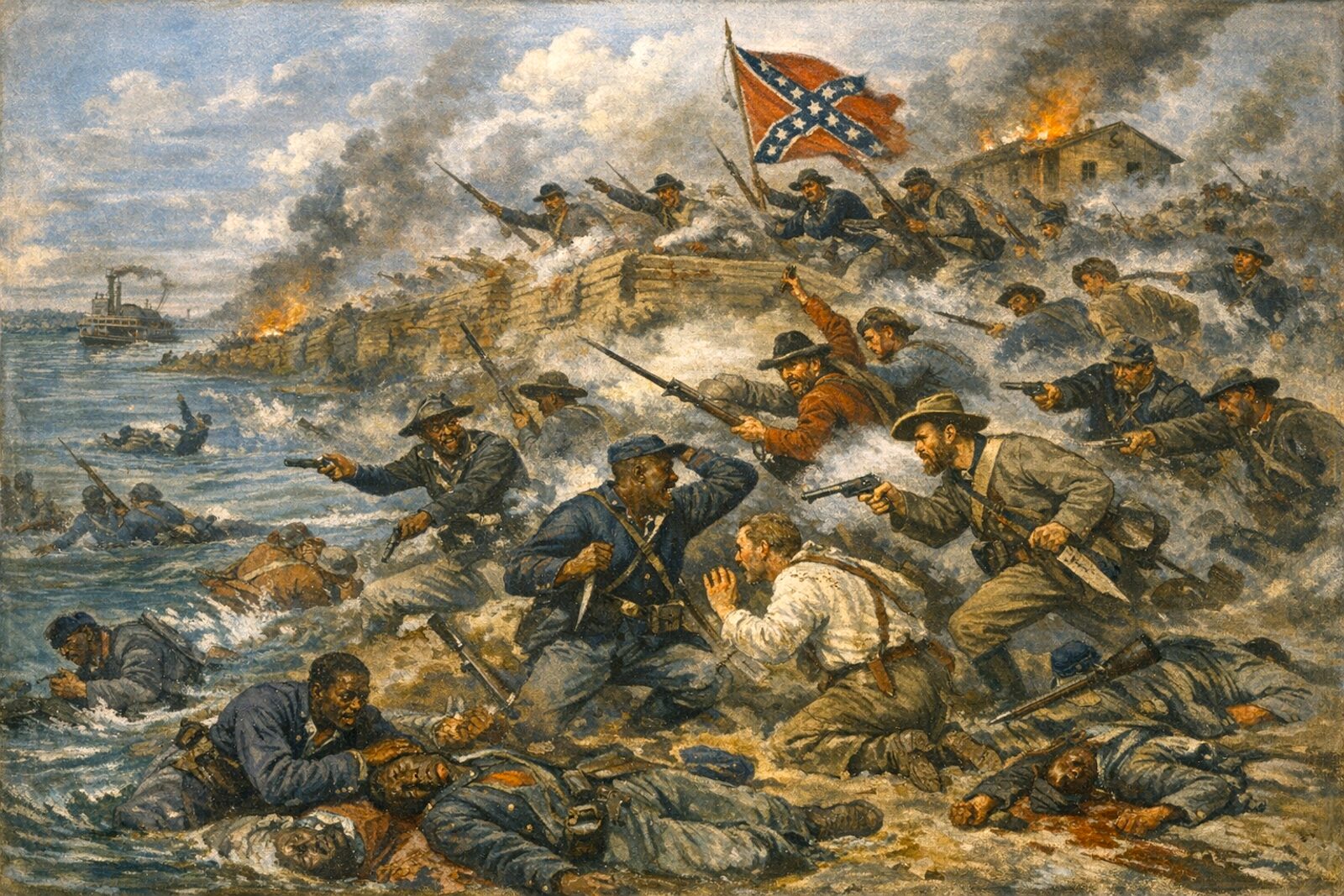
Fort Pillow matters because it compresses so many of the Civil War’s hardest truths into one terrible afternoon. It tells us about military desperation in the western theater. It tells us about the Confederacy’s refusal to recognize Black men in Union blue as legitimate soldiers. It tells us about the fragility of surrender when race determines who is allowed the protections of war. And it tells us, too, about memory: how atrocity becomes argument, how argument becomes myth, and how myth gets recruited into public commemoration, denial, and politics long after the guns go quiet.
A lot of Americans know Fort Pillow, if they know it at all, as shorthand for a notorious phrase: “Remember Fort Pillow.” But slogans flatten. The event was not just a symbolic outrage. It was a concrete massacre with a location, a chain of command, sworn testimony, casualty patterns, and a very specific racial context. To write about Fort Pillow responsibly is to resist two temptations at once: the temptation to sensationalize, and the temptation to euphemize. What happened there was not simply the fog of war. Nor is it best understood as an isolated spasm detached from the politics of slavery and emancipation. It was an atrocity produced by the central question of the Civil War itself: what happens when a slave society is forced to face Black freedom with a rifle in its hands.
Before the massacre, a fort with strategic value but limited glamour
Fort Pillow was originally built by Confederates in 1861 and named for General Gideon J. Pillow. Perched on the First Chickasaw Bluff, it overlooked an important stretch of the Mississippi River and functioned as part of the river defense network. Union forces took control in 1862, and in the years that followed the site served less as a glamorous battlefield than as a useful military post and supply point. In early 1864, however, it became vulnerable: isolated, imperfectly commanded, and exposed to raids in a region where Forrest’s cavalry excelled at fast, disruptive warfare.
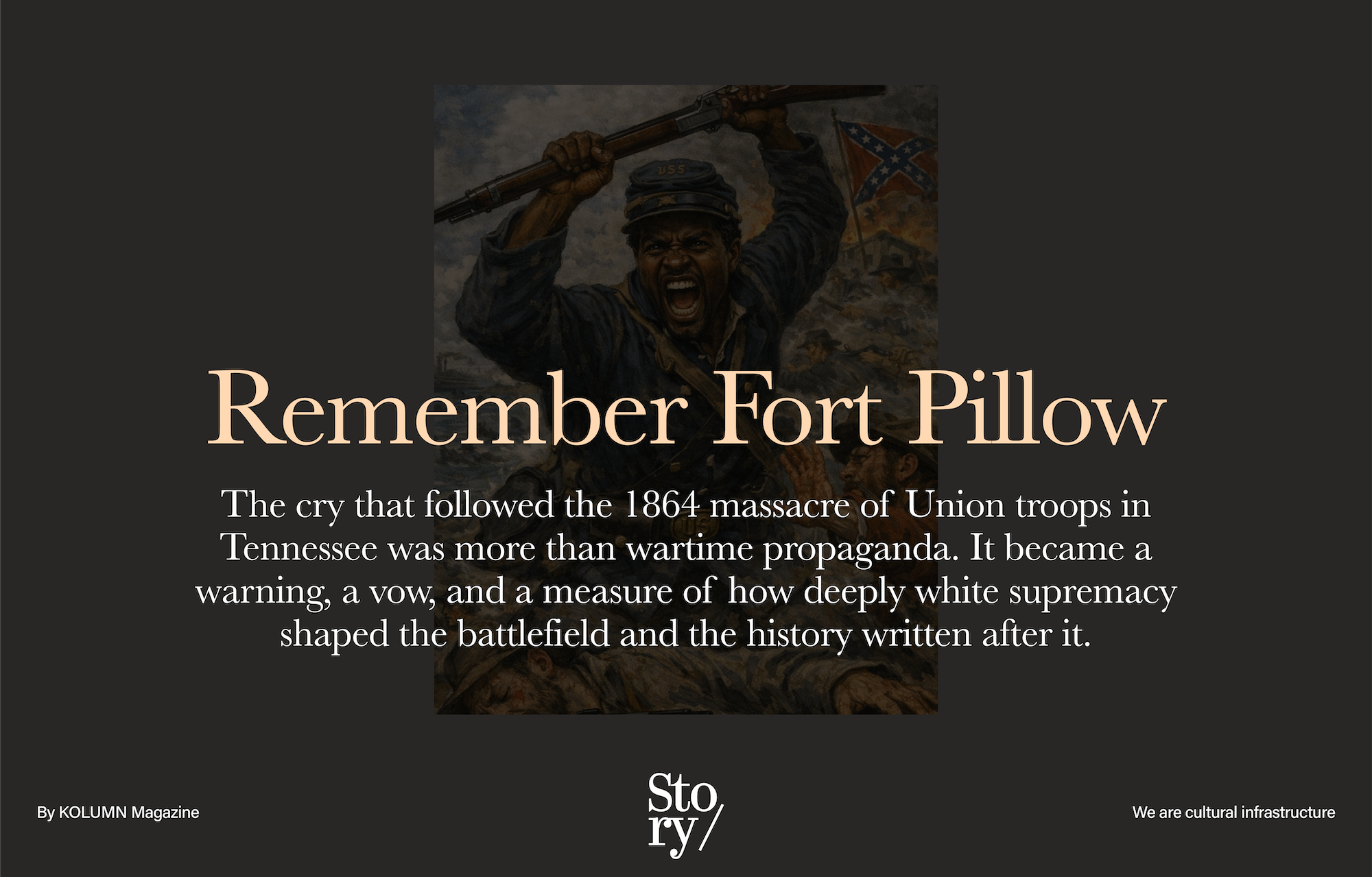
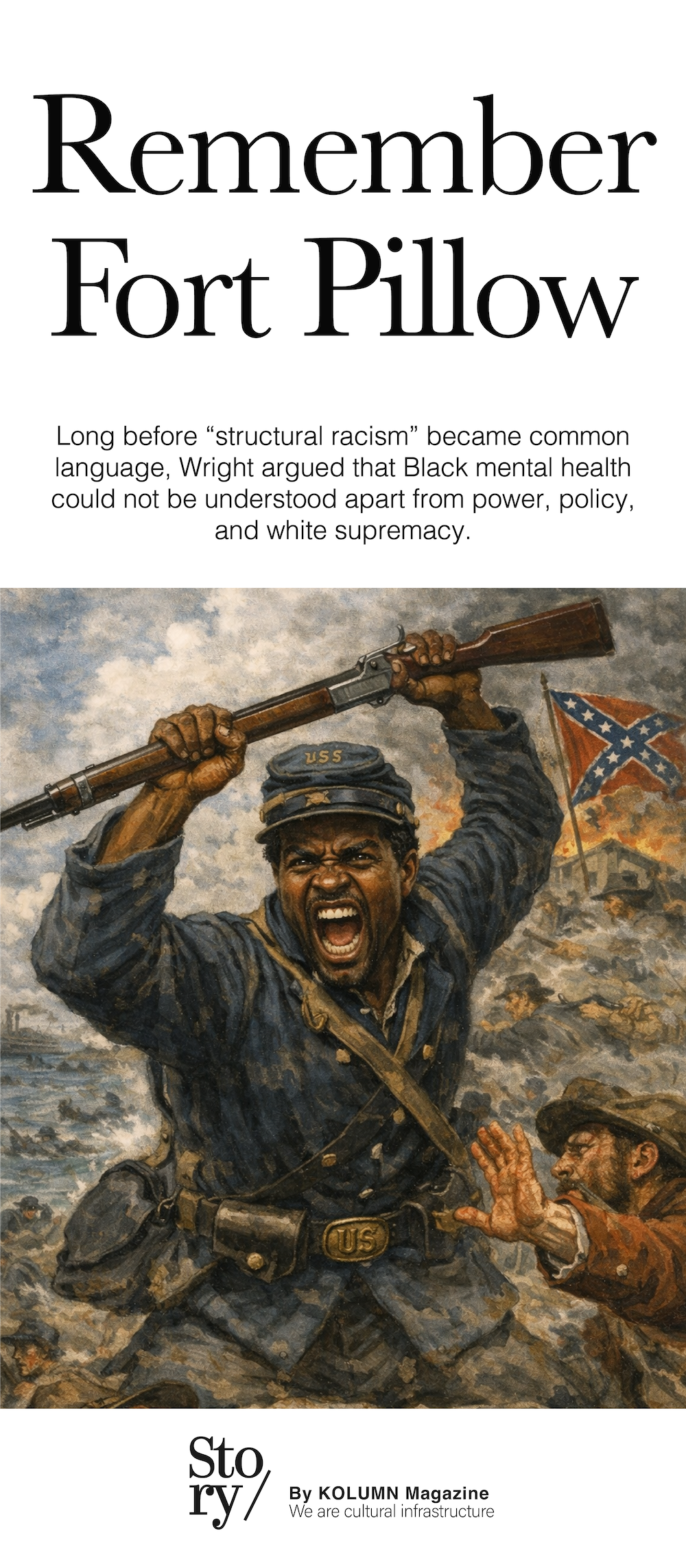
By the spring of 1864, the garrison at Fort Pillow numbered roughly 585 to 605 men. It consisted primarily of Black artillerymen from the Sixth U.S. Heavy Artillery and a section of the Second U.S. Light Artillery, alongside white Unionists from the Thirteenth Tennessee Cavalry. That composition mattered. These were not just Union troops in the abstract. A substantial portion of the defenders were Black soldiers in federal service, and many had direct personal stakes in emancipation. To Confederates steeped in a slaveholding racial order, that fact changed the emotional and ideological valence of the fight. The presence of armed Black men in Union uniform was, in the words of later historians quoted by Smithsonian, “their worst racial nightmare.”
The military situation inside the fort was also messy. Major Lionel F. Booth had command, with Major William F. Bradford of the Thirteenth Tennessee Cavalry as second in command, but prior orders had created ambiguity about authority and consultation. Historians have long noted that the garrison’s leadership structure was less than ideal. That does not explain away what happened later, but it does explain part of why the defense devolved into confusion when the attack intensified and Booth was killed by sniper fire early in the day. Fort Pillow was not a well-oiled machine waiting to be overwhelmed; it was a post under stress, with imperfect leadership, limited room, and no guarantee of timely relief.
The attack, the demand to surrender, and the collapse of the line
Forrest’s troops, numbering somewhere between roughly 1,500 and 2,500 depending on the source and the moment in the campaign, closed in on Fort Pillow on April 12. The Confederates used terrain skillfully, tightening around the position and taking advantageous firing points. By midafternoon, they had pressed close enough that Forrest believed the fort was effectively his. At around 3:30 p.m., he sent a flag of truce and a demand for unconditional surrender, promising that the garrison would be treated as prisoners of war. His message contained a line that has become infamous in hindsight: “Should my demand be refused, I cannot be responsible for the fate of your command.”
That sentence has been read in different ways across the generations. Forrest’s defenders have treated it as nothing more than a standard threat attached to a surrender demand. His critics have long seen it as a warning that the ordinary safeguards of surrender might not apply, especially to Black troops. Either way, the exchange is essential because it shows the question of quarter and prisoner treatment was explicitly on the table before the fort fell. Major Bradford delayed, hoping for time and perhaps help from the river, but the request for an hour’s consultation went nowhere. The Union officers ultimately refused to surrender.
Once the final assault came, events moved fast. The defenders were already under intense pressure. Some fought on. Some began to retreat toward the river. Some tried to follow contradictory commands in a collapsing tactical environment. This is the point where those who want to avoid the word “massacre” often concentrate their attention, emphasizing confusion, conflicting orders, battlefield adrenaline, and the undeniable fact that some Union men were still resisting while others were trying to flee or surrender. There is truth in that narrow description. The closing phase was chaotic. But chaos is not exculpation. In fact, the surviving evidence suggests that confusion provided the conditions in which racially selective killing could flourish.
The fort broke in minutes, not hours. Men ran toward the riverbank, toward Cold Creek, back toward the fort, or into the water itself. Some drowned. Some were shot while swimming. Some were shot after throwing down their arms. Some were shot while begging for mercy. Confederate officers later claimed that the continued firing reflected the difficulty of stopping men already carried away by combat. Yet multiple accounts, including testimony from Union survivors and some Confederate observers, describe killings that went beyond hot-blooded pursuit. The phrase “No quarter!” appears repeatedly in the record. So do racial slurs. So does testimony that Black soldiers were singled out.
“Remember Fort Pillow!” was not born as a piece of abstraction. It was born from the knowledge that for Black troops, surrender might not save you.
Why historians call it a massacre
The central question around Fort Pillow has never really been whether a lot of men died. It has been whether they died as the lawful, if brutal, result of a stormed fort, or whether Confederate troops committed mass murder after resistance had effectively ended. For decades, Lost Cause defenders and Forrest admirers leaned hard into the first interpretation, often portraying the congressional investigation as partisan anti-Confederate propaganda and the event itself as tragic but militarily ordinary. Modern scholarship has not erased every ambiguity, but it has narrowed the room for evasions considerably.
The most important evidence is not a single sensational testimony. It is the accumulation of different kinds of evidence pointing the same way. Eyewitness accounts describe men shot after surrendering, men burned, men clubbed or sabred, and men in Black units specifically hunted. The U.S. Capitol’s summary of the Joint Committee investigation states plainly that the April 12 attack “ended in a slaughter targeting African Americans among the surrendering Union troops.” The National Park Service, while careful in tone, also identifies the event as a massacre and emphasizes its impact on Black soldiers and wartime memory.
Then there are the numbers. In their influential statistical study, historians John Cimprich and Robert Mainfort found that between 585 and 605 Union troops were present, and that between 277 and 297 were killed or mortally wounded. More strikingly, Black troops suffered a casualty rate nearly double that of white troops: about 64 percent for Black soldiers compared with about 31 to 34 percent for white soldiers. Their conclusion was not based on vibes or rhetoric; it was based on regimental and service records, survivor categories, and comparison of outcomes by race. They found the disparity so pronounced that chance could not plausibly explain it.
That differential is the kind of evidence that changes a historical argument. In any assault on a fortified position, casualties will be uneven. But a gulf this large, paired with testimonial evidence about race-based killing and the Confederacy’s ideological hostility to Black troops, points toward selective slaughter, not merely battlefield spillover. Smithsonian’s recent account, drawing on historians and descendant memory, framed the outcome starkly: around 20 percent of white Union soldiers died, while about 70 percent of the U.S. Colored Troops at Fort Pillow were killed. The precise percentages vary slightly by source and methodology, but the core conclusion does not: Black men died at catastrophic rates that cannot be explained by random combat alone.
To be clear, some historians still note that Forrest may not have issued a direct, explicit order saying “massacre the garrison.” Even sympathetic treatments concede that he lost control of his men or failed to stop the killing. That distinction matters for command responsibility debates, but it does not save the event from its name. A massacre does not require a signed memo. If troops under your command overrun a fort, if surrendering men are killed in large numbers, if Black troops are targeted disproportionately, and if the carnage continues beyond legitimate combat, the historical category fits. Fort Pillow has remained controversial less because the evidence is evenly balanced than because the implications for Confederate memory are so damaging.
Race was not incidental. It was the point.
Any telling of Fort Pillow that treats race as secondary misses the event. The Civil War was already, by 1864, not only a war over Union but a war over slavery, emancipation, and Black citizenship. The creation of the United States Colored Troops in 1863 formalized a radical transformation: formerly enslaved and free Black men were entering the federal army in large numbers, armed, organized, and invested with public authority. By war’s end, more than 170,000 men had served in the USCT. Their service was both military and political. It made emancipation harder to reverse, because Black freedom was now defended by Black men in uniform.
That very fact enraged Confederates. The Confederacy had long resisted recognizing Black Union soldiers as lawful belligerents. In practice and in rhetoric, Confederate authorities often treated captured Black troops not as prisoners of war entitled to exchange and protection, but as rebellious property or criminal insurrectionists. Fort Pillow unfolded inside that worldview. A Confederate postwar defense could talk about confusion and combat intensity, but the racial language in the testimony tells you what many attackers thought they were doing. The killing was not just anti-Union. It was anti-Black, and anti-white-Unionist-by-association. Some men from the Thirteenth Tennessee Cavalry were denounced because they fought “side by side” with Black troops.
One of the most chilling features of Fort Pillow is the way it exposed the unstable meaning of surrender for Black soldiers. White troops, while far from safe, had a better chance of survival. Black troops had good reason to believe that laying down their arms did not guarantee prisoner status at all. Smithsonian quotes historians arguing that after Fort Pillow, Black soldiers knew they “did not have the racial privilege of surrendering.” That is a brutal but accurate formulation. The laws of war existed on paper. At Fort Pillow, race overruled them.
Fort Pillow was not simply about men being killed in battle. It was about who counted as a soldier when the shooting stopped.
The national reaction: outrage, investigation, and a harder war
News of Fort Pillow traveled quickly. It horrified many in the North, not only because of the body count but because it seemed to confirm the worst fears about what the Confederacy intended to do with Black troops and their white officers. Congress investigated. The Joint Committee on the Conduct of the War collected testimony and produced a report that described the event as an atrocity. Critics then and later charged the committee with partisanship, and certainly the report had political uses. But dismissing it as mere propaganda has not survived serious scrutiny, particularly when later scholarship and independent records corroborate the basic reality of selective slaughter.
The massacre also fed into federal policy and the larger collapse of prisoner exchange arrangements. The issue of Black prisoners had already strained exchange talks, but Fort Pillow intensified the urgency. The National Park Service notes that Ulysses S. Grant cited the murder of surrendering African American soldiers at Fort Pillow when insisting that Black and white Union soldiers had to receive identical treatment in prisoner exchanges. Grant told Benjamin Butler that “no distinction whatever” could be made between white and colored prisoners, and that Confederate refusal would amount to refusal of further exchanges.
Abraham Lincoln, characteristically cautious in public, did not immediately launch retaliatory killings. He insisted on investigation and proof. But even that caution tells us something: Fort Pillow was serious enough to raise the gravest questions of retribution, military law, and national honor at the highest level of government. One contemporary Lincoln document, preserved in the Library of Congress, explicitly frames the issue in terms of whether a large number of surrendered Black soldiers and white officers had been massacred and insists that such men were entitled to be treated as prisoners of war. The question was no longer hypothetical. Fort Pillow had made it urgent.
On the ground, the effect was simpler and in some ways more consequential. “Remember Fort Pillow!” became a battle cry among Union troops, especially Black soldiers, for the remainder of the war. The phrase carried grief, rage, and instruction. It meant: do not expect quarter. It meant: the Confederacy has shown you what capture may look like. It meant: fight with the knowledge that your status as a soldier is contested even when your uniform is not. The slogan spread because the massacre had made a hard war harder, and racial violence more explicit.
Nathan Bedford Forrest and the problem of command
It is impossible to write about Fort Pillow without writing about Nathan Bedford Forrest, and it is equally impossible to write about Forrest honestly without addressing the long American habit of cordoning off military brilliance from moral horror. Forrest has often been treated, especially in Lost Cause traditions, as a tactical genius first and a controversial figure second. But Fort Pillow resists that neat sorting. Here the tactical and the moral are fused. Whatever one thinks of Forrest’s cavalry skill, he was the commanding general at the scene of one of the Civil War’s most infamous massacres. Later he would also become associated with the Ku Klux Klan, which only sharpens the interpretive stakes.
The cleanest defense of Forrest is that he did not explicitly order the massacre and that once the fort was stormed, events outran command control. Even some historians who reject the stronger apologetics allow that no direct written order to massacre has surfaced. But command responsibility is not erased by indirection. Forrest set the terms of the engagement. He threatened consequences if surrender was refused. He led troops operating within a Confederate racial ideology that denied Black soldiers equal standing. And afterward, he hardly spoke like a man horrified by a breakdown in discipline. According to the historical study prepared for the site, Forrest later reported, “It is hoped that these facts will demonstrate to the Northern people that negro soldiers cannot cope with Southerners.” That is not the language of regret. It is the language of racial instruction.
The broader issue here is one journalists and historians both run into all the time: Americans are often more comfortable debating whether a man personally uttered a criminal order than confronting the world of assumptions that made the crime plausible, legible, and popular among his followers. Fort Pillow was not a random mutiny against Forrest’s wishes. It occurred inside a command culture and a racial order that made Black surrender precarious from the outset. Whether Forrest intended every act is, in one sense, a fair historical question. Whether he bears responsibility for what his men did under his command at Fort Pillow is not much of a question at all.
Public memory: from battlefield to argument
Fort Pillow did not stay in 1864. It entered public memory almost immediately, and memory has been one of the story’s main battlegrounds ever since. Historians such as John Cimprich have emphasized that Fort Pillow is not only an event but a case study in how Americans remember conflict, race, and national violence. The massacre became a Northern rallying point during the war, but later generations often tried to soften, dispute, or compartmentalize it, especially when defending Forrest’s reputation. That pattern is familiar in American history: atrocity gets acknowledged when politically useful, then minimized when it threatens heroic narratives.
The site itself reflects those tensions. Today Fort Pillow is preserved as Fort Pillow State Historic Park, and the landscape can look almost deceptively calm. NPS and Tennessee interpreters have worked in recent years to present the place more directly as a site of racial violence against U.S. Colored Troops, not merely as a generic battlefield. Smithsonian’s reporting on current interpretation and descendant remembrance underscores how much labor it has taken to move the site away from neglect and euphemism. Descendants and local advocates have pressed for ceremonies, clearer signage, and fuller acknowledgment of the Black dead. In 1867, federal authorities moved 258 bodies, including 109 U.S. Colored Troops, from temporary burials near the battlefield to Memphis National Cemetery. Even burial and commemoration became part of the long afterlife of the massacre.
There is something especially American about the way Fort Pillow forces a fight between pastoral scenery and historical truth. People visit parks expecting terrain, not terror. But some landscapes are not redeemed by beauty. They are made more unsettling by it. The quietness of Fort Pillow today can either soften the past into abstraction or sharpen it by reminding visitors that atrocities often occur in ordinary-looking places. That is one reason interpretation matters so much. Without it, the site risks becoming another green expanse where the language of “controversy” replaces the language of evidence.
Why Fort Pillow still matters
Fort Pillow still matters because it punctures comforting myths. It punctures the myth that the Civil War can be remembered as a contest of valor untethered from slavery and white supremacy. It punctures the myth that all surrendering soldiers stood on equal ground before the laws of war. It punctures the myth that postwar reconciliation was merely generous healing rather than, often, a trade in which Black suffering was deemphasized so white sectional reunion could proceed more smoothly. Fort Pillow insists that race was not background noise. It was central to the conflict and central to the violence that followed emancipation onto the battlefield.
It also matters because it speaks to a recurring American problem: the conversion of documented racial brutality into endless semantic debate. Was it a battle or a massacre? Was Forrest a genius or a butcher? Did command break down or was the outcome effectively intended? Those questions are not meaningless, but they can become a form of evasion if they distract from the core fact that large numbers of Black soldiers trying to surrender or escape were killed under Confederate assault. Historical seriousness requires precision, yes, but not false balance. In the case of Fort Pillow, precision now points toward massacre.
And there is another, deeper significance. Fort Pillow reveals something about citizenship under construction. The Black men at the fort were not only fighting for Union victory. They were fighting for recognition: as soldiers, as men, as people whose surrender should bind the enemy under the customs of war. The massacre exposed how far the Confederacy would go to deny that recognition. Yet the aftermath also showed that the denial failed in one sense. The outrage over Fort Pillow hardened federal resolve, energized Black troops, and made the contradiction impossible to ignore. The massacre did not stop Black military service. It made its political meaning even clearer.
“Remember Fort Pillow” therefore belongs in the American lexicon alongside other phrases born from trauma and turned toward purpose. It was a cry of mourning, but also of analysis. It named the world as it was. It told Black troops, and the country around them, that this was a war in which freedom without force was fantasy, and force without recognition was deadly. That is why Fort Pillow has never been only about one day in Tennessee. It is about the terms on which the United States confronted slavery’s collapse and the lengths to which its defenders would go to make Black freedom bleed.
The honest ending
The temptation with a story like Fort Pillow is to close with uplift. To say the dead were not forgotten. To say the truth prevailed. To say the nation learned. That would be too easy. The truth is messier. The dead were remembered unevenly. The truth had to be fought for and re-fought for. And the nation has repeatedly shown how willing it is to sentimentalize the Civil War while dodging the racial order that produced both the conflict and atrocities like this one.
But there is still a reason to write Fort Pillow into the present with clarity. Historical honesty is not consolation, but it is a form of respect. Respect for the Black soldiers who stood in federal uniform on a bluff above the Mississippi and discovered, in the most violent way imaginable, that many of their enemies would not recognize surrender. Respect for the survivors who testified. Respect for descendants who kept memory alive when institutions lagged. Respect for readers now, who deserve more than myth dressed up as heritage.
Fort Pillow was a massacre. It was also a warning, a political turning point, and a lasting measure of what the Civil War was truly about. Not just territory. Not just tactics. Not just the Union in the abstract. It was about whether Black people could claim the rights of citizenship, military service, and human dignity in a nation built on their bondage. At Fort Pillow, the answer from the Confederacy was written in gunfire. The answer from history, if we are willing to read it plainly, is that the massacre revealed the stakes with terrible precision.
More great stories
Afro Sheen, Wall Street, and the Architecture of Black Possibility
July 6, 2026
No Comments
The Fire Inside the Fourth
July 5, 2026
No Comments