



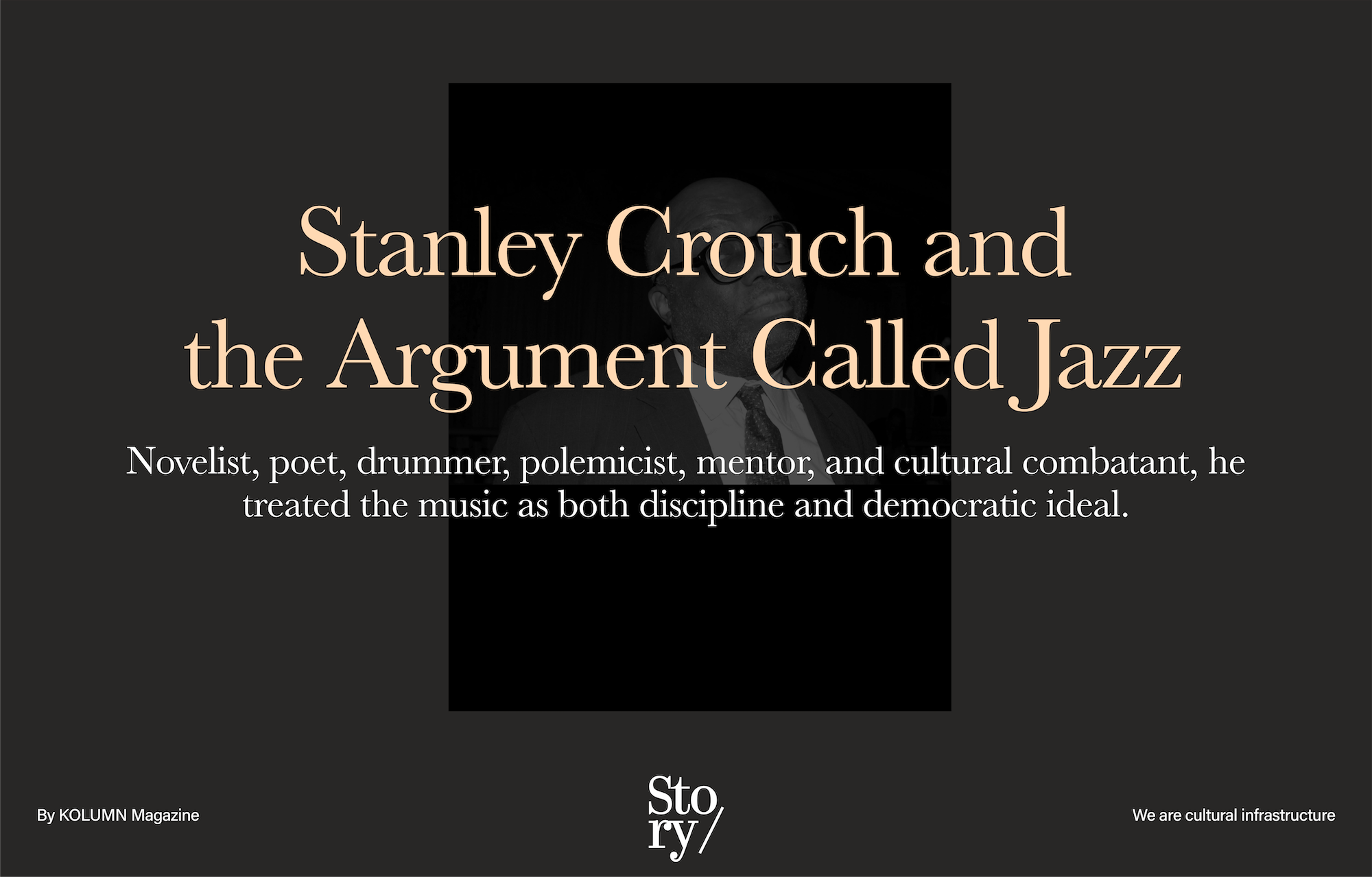
Stanley Crouch did not simply argue about jazz. He argued through it, using the music as a vocabulary for freedom, discipline, ego, inheritance, and risk.
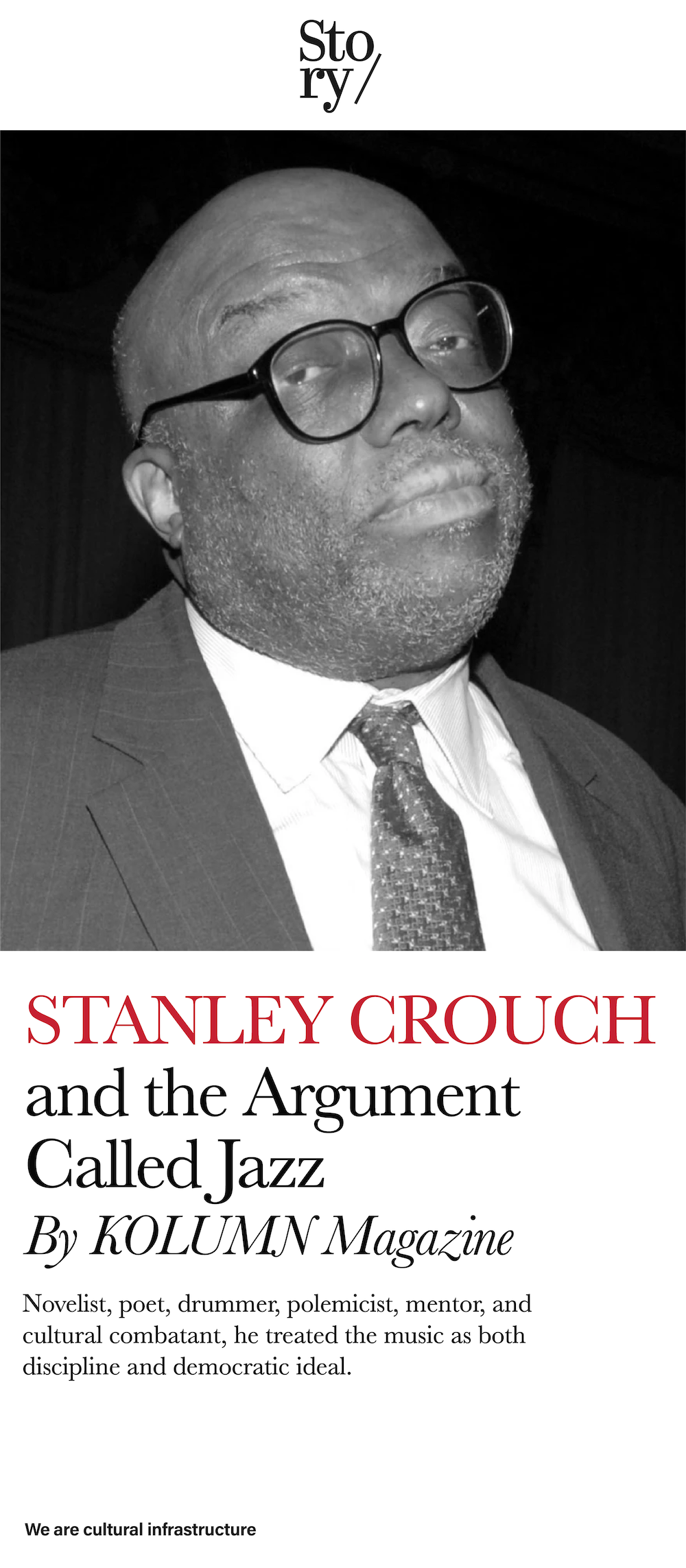
Stanley Crouch did not simply argue about jazz. He argued through it, using the music as a vocabulary for freedom, discipline, ego, inheritance, and risk.
By KOLUMN Magazine
Stanley Crouch spent much of his life insisting that jazz was not merely an art form, not merely a Black art form, and certainly not a boutique interest for connoisseurs. It was, to him, one of the deepest expressions of American possibility: improvised but disciplined, individual yet collective, irreverent without collapsing into chaos. That conviction animated nearly everything he wrote, from his essays and reviews to his speeches, columns, television appearances, and the massive Charlie Parker biography that became one of his signature late works. When Crouch died in September 2020 at 74, the obituaries struggled to compress him into a single lane. He had been a poet, playwright, drummer, professor, columnist, novelist, biographer, jazz advocate, and professional dissenter. The simplest descriptor—critic—was accurate, but also much too small.
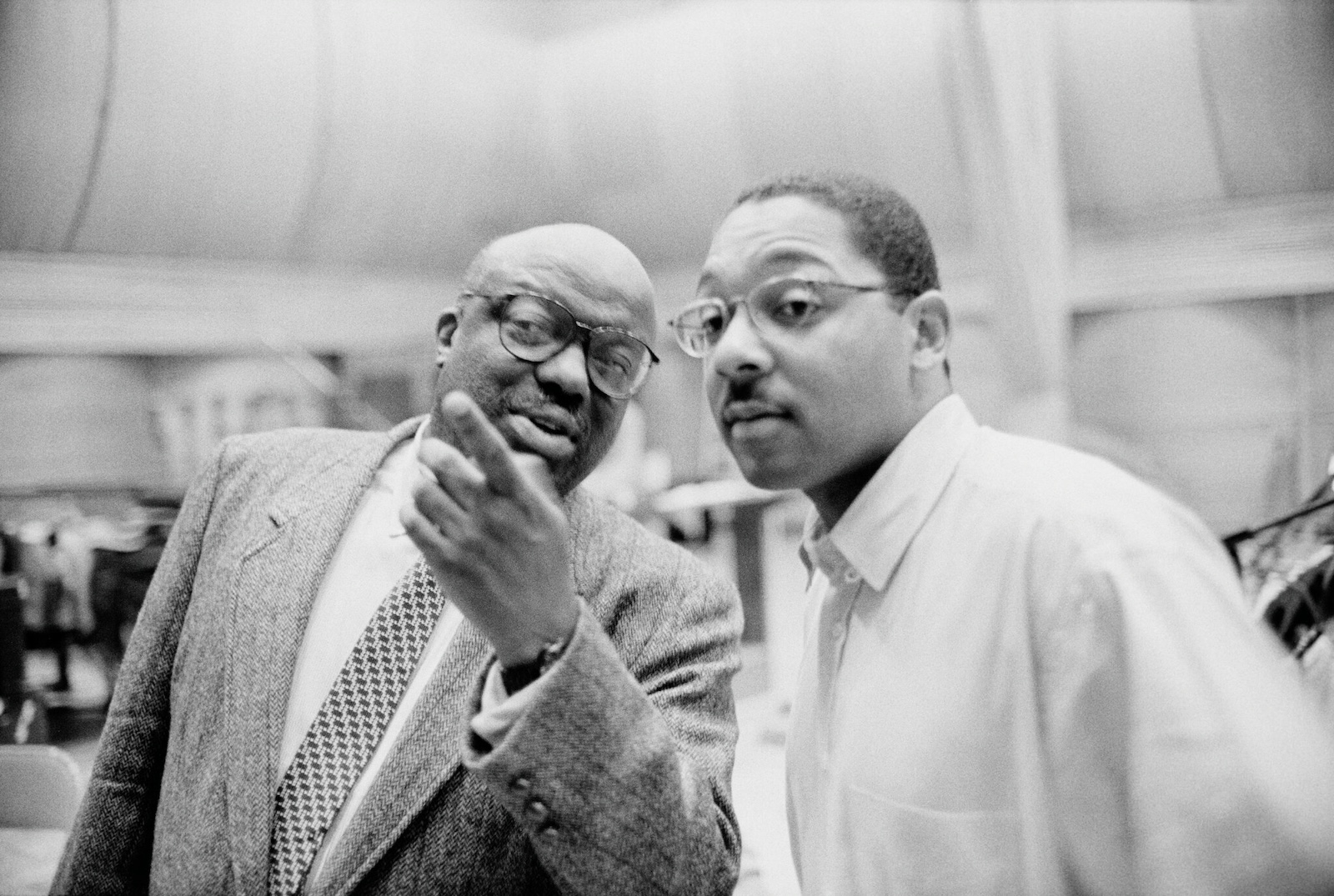
What made Crouch matter was not just that he wrote about jazz. Plenty of people did. It was that he wrote about jazz as if it contained a theory of civilization. He heard in Louis Armstrong, Duke Ellington, Charlie Parker, and later in the neotraditionalist jazz orbit around Wynton Marsalis, a set of hard lessons about style, risk, memory, technique, swing, and moral seriousness. He distrusted cant, fashion, piety, and anything he regarded as empty posturing. He also distrusted laziness masquerading as rebellion. That combination made him exhilarating to admirers and infuriating to detractors. He was one of those rare public intellectuals whose sentences could feel like uppercuts, yet whose best prose could also slow down and savor the textures of a solo, a neighborhood, a phrase, or a vanished American mood.
To write about Stanley Crouch now is to write about a figure who was both central and impossible to stabilize. He was too literary for some music critics, too musical for some literary critics, too conservative for parts of Black cultural life, too unruly for ideological conservatives, too combative for polite institutions, and too institutionally influential to be mistaken for an outsider alone. He spent years as an artistic consultant to Jazz at Lincoln Center after helping found the committee that led to the institution’s summer jazz programs, and in 2019 the National Endowment for the Arts recognized him with the A.B. Spellman NEA Jazz Masters Fellowship for Jazz Advocacy. By then, he had already received a Guggenheim Fellowship, a Whiting Award, a MacArthur Fellowship, and the Windham-Campbell Prize in nonfiction. The establishment honored him repeatedly, even as he built a career attacking whatever he believed deserved attack.
That tension is part of why he still feels contemporary. Stanley Crouch anticipated a style of public criticism that has since become common—personal, polarizing, omnivorous, always ready to escalate—but he came from a more demanding intellectual tradition. He believed in reading, in form, in history, in the granular study of artists and traditions. He also believed that criticism should risk offense if offense was the price of clarity. The trouble, of course, is that he often seemed to enjoy the offense too much. You cannot honestly write about him without admitting both sides of the ledger: the brilliance and the abrasiveness, the interpretive depth and the absolutist tendencies, the elegant defense of American complexity and the bruising dismissals that alienated many readers who might otherwise have learned from him.
A Los Angeles beginning
Crouch was born in Los Angeles on December 14, 1945, and was raised in a single-parent household. Institutional biographies and memorials consistently emphasize a young Stanley immersed in books, poetry, old movies, and African American music. Before he became a famous talker, he was a voracious listener. Before he became a feared critic, he was a self-taught drummer trying to locate himself inside the sound. That early combination matters. The Crouch who later wrote with such authority about jazz was never just an observer looking in from the press box; he had entered the music physically, through rhythm, repetition, and aspiration, even if he ultimately concluded that his deepest gift was verbal rather than instrumental.
His educational path was unorthodox, and that too became part of his legend. He attended East Los Angeles and Southwest junior colleges but did not earn a degree. Yet he still moved into teaching and arts work early, eventually becoming poet-in-residence at Pitzer College and the first full-time faculty member at the Claremont Colleges’ Black Studies Center from 1968 to 1975. During that period he wrote and directed plays, published poetry, and participated in the intellectual and artistic ferment of the Black Arts and Black Studies era in Southern California. The credentials were irregular; the seriousness was not. Crouch’s career became one long rebuke to the idea that institutional polish is the same thing as intellectual force.
He also led an avant-garde jazz group called Black Music Infinity, which included musicians who would go on to major careers, among them David Murray, Arthur Blythe, James Newton, and Mark Dresser. That fact is especially important because it complicates the caricature of Stanley Crouch as merely a doctrinaire traditionalist who showed up fully formed to denounce the avant-garde. He knew that world from the inside. He played in it. He was not rejecting an abstraction; he was repudiating a path he had once traveled. Later, when he attacked what he saw as the excesses of free jazz, fusion, and posturing experimentation, he did so as an apostate, which may explain why the rhetoric could sound so fierce. Apostates rarely speak mildly.
New York, byline, reputation
In 1975, Crouch moved to Manhattan to concentrate on writing. That decision changed his life and, in a very real sense, changed American jazz criticism. New York gave him the city, the audience, the argument, and the access. Over time he became a busy freelancer and then a familiar byline at the Village Voice, The New Republic, New York Daily News, Slate, and elsewhere. He wrote about music, literature, race, politics, and culture with the same improvisatory confidence that he admired in jazz masters. One reason readers kept returning to him, even when they were furious, was that he rarely sounded prefabricated. His sentences had swagger, asymmetry, and attack. They could also carry historical sweep.
The reputation that formed around him in the 1980s and 1990s was double-edged. He was widely regarded as one of the most original critics in American life, and just as widely regarded as one of the most argumentative. Robert Boynton’s New Yorker profile captured him as a magnetic public figure navigating the city’s jazz and intellectual worlds, a man attacked by critics and courted by admirers, nourished by friendships with figures like Ralph Ellison, Albert Murray, and Wynton Marsalis, yet always prone to provoke. Publishers Weekly, looking back after his death, described five decades of “iconoclastic” interventions across race, jazz, politics, film criticism, and American culture. Even sympathetic accounts tended to use words like “pugnacious,” “polemic,” “contentious,” and “combative.” Those were not incidental adjectives. They were the point.
His own preferred political description, “radical pragmatist,” says something about how he wanted to be understood. He rejected the more predictable ideological boxes that commentators tried to place him in. He was deeply shaped by Black intellectual traditions, but skeptical of racial essentialism. He defended American democracy in terms that could sound defiantly integrationist, but he was no bland consensus liberal. He attacked both left and right. He could sound like a contrarian because he was one, but contrarianism alone was not the engine. The engine was his conviction that categories—especially racial and political categories—could become decoys that prevented more serious judgments about quality, honesty, and civic possibility.
That made him unusually hard to summarize in the compressed language of culture-war bookkeeping. He was too skeptical of Black nationalism and Afrocentrism for many Black radicals, yet too rooted in Black music and Black intellectual history to fit cleanly into neoconservative praise narratives. He could celebrate the sweep of American democracy and then write with devastating precision about American fraudulence. He could champion jazz as the supreme American art and still savage musicians he believed betrayed its values. There was no broad coalition for Stanley Crouch. There were readers who loved him, readers who hated him, and readers who understood that he had become unavoidable.
Why jazz was never just music
The surest way into Crouch’s worldview is to understand that he treated jazz as an art of earned freedom. Improvisation, in his conception, was not the opposite of discipline; it was discipline brought to life in public. Swing was not decorative. Conversation inside an ensemble was not merely sonic. Jazz modeled a democratic ideal in which singular voices find themselves by listening, answering, and testing one another. That is why he could write about the music with such civic heat. He did not hear solos as isolated acts of genius. He heard them as examples of how individuality becomes meaningful inside a larger shared order.
This is also why Armstrong, Ellington, and Parker loom so large in his work. For Crouch, those figures were not just canonical because they were famous or influential. They were canonical because they demonstrated what jazz, at its highest level, could reveal about the American condition. Armstrong transformed personality into music without surrendering form. Ellington turned orchestra into a grand social intelligence. Parker altered the grammar of improvisation altogether. Crouch’s great talent was to make these claims feel neither academic nor museum-like. He wrote with the urgency of someone insisting that the listener’s moral and intellectual life was at stake.
He also had an extraordinary feel for jazz as language. That does not mean he wrote like a musician in any literal sense. Plenty of critics strain to imitate music on the page and end up sounding overripe. Crouch could certainly overdo it, but at his best he translated musical structure into prose tempo. He knew when to build, when to pivot, when to repeat with variation, when to land a phrase like a snare crack. The Windham-Campbell citation for his work on Kansas City Lightning praised its “grand Biblical style” and vernacular rhythm, a useful description not just of that book but of his larger method: high and low registers meeting, scriptural amplitude fused to streetwise cadence.
That method made him unusually persuasive when he was writing about music history as national history. In his account, bebop did not emerge from nowhere. It grew from cities, vice economies, migration, race relations, musicians’ discipline, and the hard lesson that virtuosity is social before it is individual. He wanted readers to hear that complexity. One reason his Charlie Parker project took so many years is that he refused the narrow life-and-works template. By his own account, the task required placing Parker in the round, inside the history of the Midwest, the country, and jazz itself. That ambition explains both the depth of the result and the sprawl that some readers found exasperating. Crouch almost never chose the small frame when a continental one was available.
The Parker obsession
If one book crystallizes Stanley Crouch’s mature significance in music writing, it is Kansas City Lightning: The Rise and Times of Charlie Parker, published in 2013 after a famously long incubation. The project had been gestating for decades. Publishers Weekly reported that Crouch had started working on it in 1981, and the Schomburg Center later noted that his archive includes recordings and transcripts from more than 150 interviews conducted for the biography, with figures including Dizzy Gillespie, Max Roach, and Rebecca Parker. Those details matter because they reveal the scale of the enterprise. This was not simply a critic dashing off a reverent portrait of a hero. It was archival labor, oral history, historical synthesis, and literary performance combined.
The book was widely recognized as substantial, even by reviewers who had reservations. The Guardian noted that anyone attempting a serious Parker biography would eventually have to confront the nature of genius itself, which is exactly the kind of challenge Crouch relished. His book did not settle for chronology. It tried to build a whole atmosphere around Parker’s emergence: Kansas City corruption, Black migration, performance culture, masculine aspiration, musical apprenticeship, and the intoxicating danger of virtuosity. In other words, it tried to explain not just who Parker was but what conditions made Bird possible. That was classic Crouch—biography as national x-ray.
The book also clarified something essential about Crouch’s criticism. He was not merely a preservationist defending old records against modern error. He was a storyteller. Even the people who found his pronouncements exhausting often conceded that he could narrate a world into being. In Kansas City Lightning, the storytelling impulse became inseparable from the critical one. Parker, the revolutionary improviser, became a vehicle for writing about speed, brilliance, vice, race, appetite, and national style. Crouch seemed to understand that Parker’s music posed a problem every biographer must face: how do you narrate genius without flattening it into anecdote? His answer was to widen the frame until the country itself entered the book.
There is also something poignant about the way the Parker book stands in his legacy. Stanley Crouch spent years championing jazz masters whose stature he felt had been obscured, distorted, or inadequately explained. Then, late in life, he produced a work whose own long delay became part of its myth. It arrived as the product of patience bordering on obsession. That feels fitting. He was never a fast-food critic. Even his newspaper columns had the air of someone reaching backward into a private library of arguments, phrases, grudges, and exemplars. The Parker biography was that habit made monumental.
Marsalis, institutions, and influence
Any serious account of Stanley Crouch’s music significance has to wrestle with his relationship to Wynton Marsalis and Jazz at Lincoln Center. For some critics, this is where Crouch’s influence becomes suspect: too close to power, too invested in a canon, too committed to a version of jazz history that privileged certain lineages while sidelining others. But even critics of that institutional project generally concede that Crouch played a formative role in helping define the language through which jazz was presented to broader audiences in the late 20th century. He was not just writing about the music from the sidelines. He was helping build one of its most visible public homes.
The alliance with Marsalis made sense aesthetically and philosophically. Both men believed that jazz had core values worth defending against dilution, especially the kinds of dilution they associated with fusion, market calculation, and loose standards masquerading as innovation. Both valued lineage, swing, compositional rigor, and historical literacy. Both also believed that jazz deserved institutional seriousness equal to that granted European classical music. In that sense, Crouch’s role in the Jazz at Lincoln Center universe was not incidental. He helped frame jazz as a repertory tradition and a high public art without stripping it of its vernacular roots. Whether one agrees with the hierarchy he endorsed is a different question. The influence itself is beyond dispute.
This is where Crouch’s legacy becomes especially consequential. He was one of the people who helped move jazz into a new register of civic respectability and institutional stature. But the very act of canon formation produces exclusions. Musicians and critics who favored freer, more expansive, or more electrified conceptions of jazz often saw Crouch as less guardian than gatekeeper. His opposition to avant-garde and fusion currents was not merely analytical; it could be scornful. The Schomburg archive notes that at the Village Voice he became known for attacks on what he regarded as “empty” and “phony” music, including fusion and avant-garde movements. That was not a marginal quarrel. It shaped decades of debate about who gets to define the center of jazz history.
Still, it would be a mistake to reduce him to anti-avant-garde polemic. Even his fiercest disagreements came from a belief that jazz mattered enough to fight over. He treated the music as a civilizational achievement, and so arguments about repertoire, rhythm, phrasing, and lineage were never small to him. That intensity can look excessive in a media age trained to flatten all disputes into “takes.” But in another sense it is exactly why he endured. Crouch never sounded like a content producer. He sounded like a man defending a tradition he believed had taught him how to think.
The controversy was real
There is no responsible way to write a longform piece on Stanley Crouch without dwelling on the people he alienated. His criticisms of avant-garde jazz and fusion were only one part of the story. He also attacked gangsta rap, condemned aspects of Black nationalist and Afrocentric thought, and made notoriously harsh comments about cultural figures ranging from Toni Morrison to Spike Lee and Cornel West. Andscape’s remembrance of him put it bluntly: he was elegant and impassioned in prose, but infamous for a pugilistic defense of that prose. The offense was not collateral damage. Sometimes it was the method.
Some of those interventions now read as principled dissent; others read as blinkered, needlessly cruel, or both. He was capable of brilliant argument against reductionist racial thinking, but also capable of such sweeping denunciation that debate narrowed instead of expanded. His line on Toni Morrison’s Beloved remains one of the most cited examples, not because it was his most thoughtful criticism, but because it demonstrated his appetite for incendiary phrasing. Likewise, his hostility toward gangsta rap often blurred the distinction between arguing against a commercial form and dismissing a wider field of contemporary Black expression. The problem with Crouch at his worst was not simply that he offended people. It was that the offense could become more memorable than the analysis.
Yet even here, simplification misses something. Crouch’s objections were rarely rooted in easy respectability politics alone. He believed culture trained perception and conduct. He worried that empty sensationalism, violence sold as glamour, and identity deployed as insulation against criticism degraded public life. One can reject his conclusions and still see that they were connected to a larger, consistent theory: art should deepen experience, not flatten it; it should complicate appetite, not merely monetize it. The challenge for readers, then and now, is that his valid concerns were often delivered in language so abrasive that it made serious engagement harder. That was his gift and his flaw: he could make you pay attention, but not always in the way wisdom requires.
The writer beyond the reputation
One of the quieter distortions in the public memory of Stanley Crouch is that the man of argument can overshadow the man of style. He was, indisputably, a polemicist. But he was also a very good writer, and not only when he was being mean. The range of his work—poetry, essays, reviews, criticism, fiction, biography—matters because it reveals someone who did not think criticism belonged in a small professional box. He wrote as a literary artist who had chosen criticism as one of his principal forms. The MacArthur Foundation, in awarding him a fellowship in 1993, stressed that his work drew on his identity as an American and joined African American musical tradition to a broader modernist spirit. That remains a useful shorthand for the ambition of the prose itself.
His books underline that range. Notes of a Hanging Judge, The All-American Skin Game, Always in Pursuit, The Artificial White Man, Considering Genius, the novel Don’t the Moon Look Lonesome?, and Kansas City Lightning do not represent a narrow specialist. They represent a writer circling recurring themes through different forms: authenticity and fraud, Blackness and Americanness, the seductions of ideology, the discipline of art, the theater of public life. Music was often the portal, but hardly the only subject. Even in his most jazz-centered work, he tended to spiral outward into films, boxers, neighborhoods, speech habits, political pathologies, and old myths of the republic.
The institutional record now reinforces that breadth. The Schomburg Center’s stewardship of his papers matters not just as an archival footnote but as a statement about scale. His collection includes writings, correspondence, photographs, notes, drafts, and the interview materials that supported his biographical work. That kind of archive confirms what readers already sensed: Stanley Crouch was not improvising his authority out of thin air. He read, hoarded, interviewed, revised, and built. For all his preference for spontaneity in public debate, there was serious method behind the thunder.
How to place him now
So what is Stanley Crouch’s place in the story of American music? He was not a musician of the first rank. He was not a neutral historian. He was not a universally trusted arbiter. What he was, instead, was one of the most consequential interpreters jazz ever had in American public life. He helped explain the music to broad audiences without dumbing it down. He helped institutionalize it without pretending it had emerged from clean rooms. He linked it to larger arguments about democracy, language, race, masculinity, style, and national identity. He made jazz criticism feel dangerous again, even when he made it exasperating.
He also forced readers to confront an uncomfortable truth: criticism is not valuable because it is agreeable. It is valuable when it sharpens perception. Crouch did that constantly. Not always fairly, and not always with proportion, but constantly. A critic like him changes the weather. After enough years of Stanley Crouch, other critics had to decide whether to answer him, evade him, imitate him, or define themselves against him. That kind of influence is difficult to quantify, but impossible to miss.
There is a temptation, after the death of any major cultural figure, to smooth the rough edges and call the contradictions complexity. Stanley Crouch deserves better than embalming. The rough edges are the story. He could be profound and unfair in adjacent paragraphs. He could hear beauty and still speak with contempt. He could defend democratic pluralism while sounding almost ecclesiastical about his own jazz doctrines. He could be a brilliant explicator of Black American achievement and a wearying antagonist inside Black public debate. To acknowledge all that is not to diminish him. It is to describe him accurately.
In the end, perhaps the most durable thing about Stanley Crouch is the standard he kept trying to impose: that art, especially jazz, should be taken seriously enough to argue over in public, with actual stakes attached. He refused the soft language of lifestyle appreciation. He wanted judgment. He wanted history. He wanted language commensurate with greatness. He wanted American culture to stop lying to itself—about race, about art, about excellence, about vulgarity, about democracy, about what it means to listen. He did not always live up to the rigor he demanded. But he demanded it, and in that demand there was something bracingly old-fashioned and still useful.
Stanley Crouch heard in jazz a model of how a country might conduct itself: with memory, argument, virtuosity, humor, and risk; with the confidence to solo and the discipline to listen; with room for invention but not contempt for form. That America has never fully existed. Maybe that is why he kept writing toward it. He was not just defending a music. He was defending a possibility. And even those who could not stand him often understood that much. Beneath the polemics was a man trying, in his own thunderous way, to keep the national ear from going dull.
More great stories
Afro Sheen, Wall Street, and the Architecture of Black Possibility
July 6, 2026
No Comments
The Fire Inside the Fourth
July 5, 2026
No Comments