



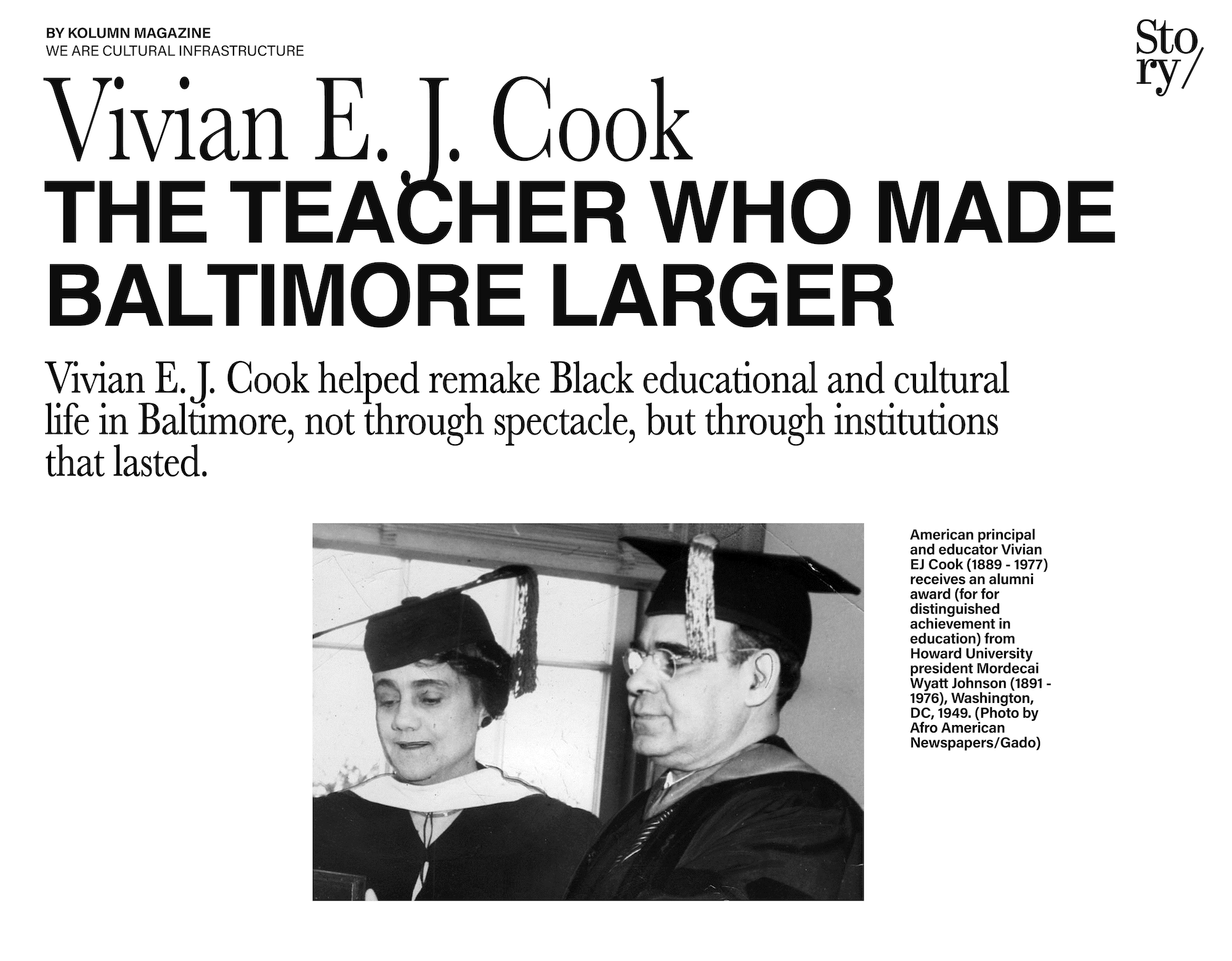
Vivian E. J. Cook’s life argues that administration can be a form of activism when institutions are designed to exclude the people you are determined to serve.
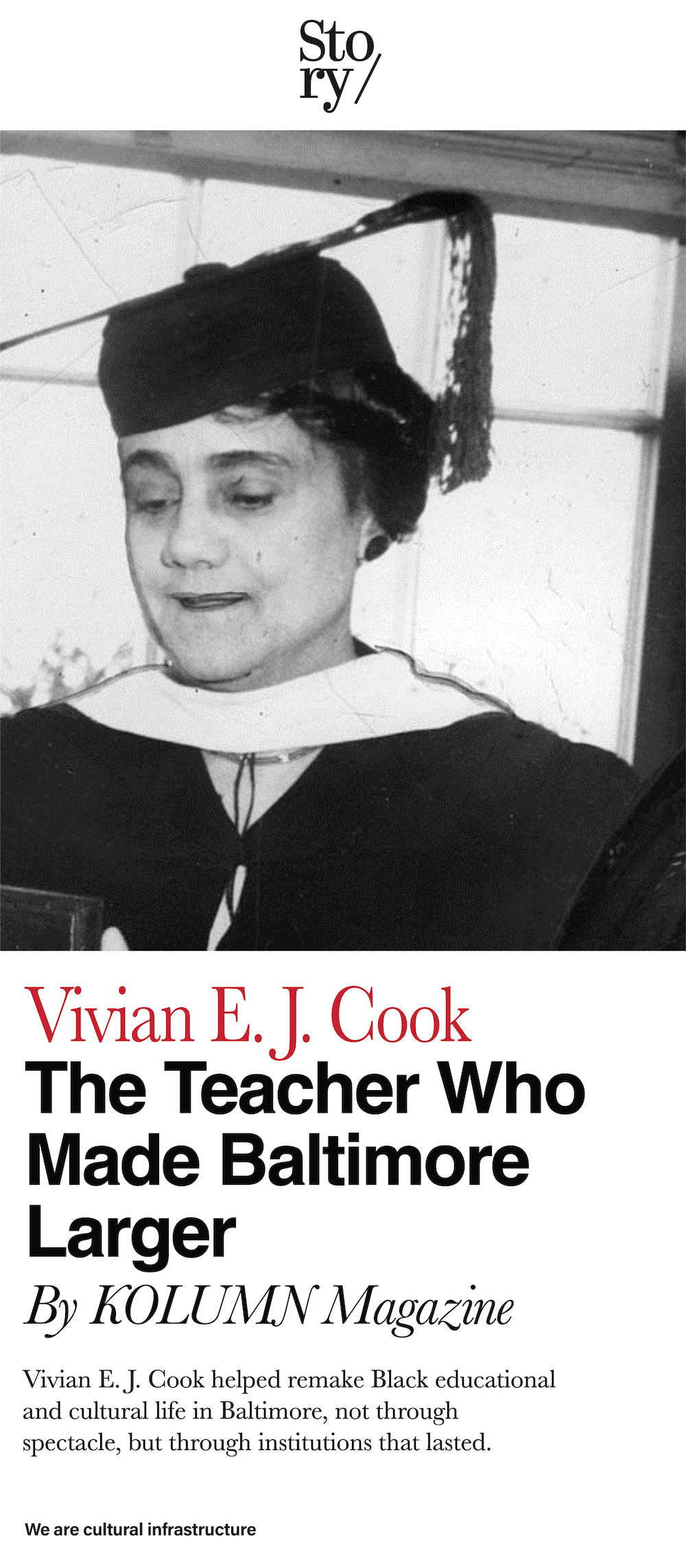
Vivian E. J. Cook’s life argues that administration can be a form of activism when institutions are designed to exclude the people you are determined to serve.
By KOLUMN Magazine
There are some figures in Black history whose fame arrives quickly and stays visible. Their names travel easily because they are attached to a court case, a speech, a march, a photograph, a headline. Then there are people like Vivian E. J. Cook, whose public legacy is harder to compress into one iconic moment. She did not become a national shorthand. She became something more durable and, in some ways, more elusive: an institution builder. Cook’s life makes the strongest case for a broader understanding of activism, one that includes not only protest and confrontation, but also teaching, administration, club work, cultural stewardship, and the patient construction of Black civic life.
Cook was born Vivian Elma Johnson on October 6, 1889, in Collierville, Tennessee, to Caroline Alley and Spencer Johnson, both of whom had been born into slavery. Her mother became the first African American schoolteacher in Fayette County, Tennessee, and the family’s emphasis on education appears to have shaped Vivian Cook’s worldview at the deepest level. That background matters because it places Cook in a lineage of post-Emancipation Black ambition rooted in schooling not merely as personal uplift, but as communal defense and collective advancement.
That origin story is not a decorative biographical detail. It is the key to the rest of her career. Cook came of age in the long aftermath of Reconstruction, in a United States that had already begun tightening the legal, social, and cultural machinery of Jim Crow. For Black families in that moment, education was not abstract virtue. It was strategy. It was protection. It was proof of personhood in a country structured to deny full citizenship. When Cook later moved through classrooms, principal’s offices, women’s organizations, and museum committees, she seems to have carried that inheritance with her: the belief that education had to be rigorous, public, and inseparable from dignity. That interpretation is partly inferential, but it is strongly supported by the arc of her training, career, and civic work.
A Black woman’s education as public argument
Cook graduated from Howard University in 1912, earning a B.S. in biology, and later received an M.A. in education from Columbia University Teachers College. Before settling in Baltimore, she taught at Tuskegee Institute, then in Cincinnati, and later at Sumner High School in St. Louis. Those stops matter because they reveal a woman moving through some of the most important Black educational spaces of the early 20th century, gathering both credentials and a wider sense of Black institutional life. The Washington Post obituary also noted that she taught for a year under Booker T. Washington at Tuskegee, a detail that further connects her to one of the defining educational networks of the era.
By the time Cook arrived in Baltimore after her 1918 marriage to Ralph Victor Cook, she was already more than a teacher. She was part of a generation of highly trained Black women who used education as an entry point into leadership, even when formal power structures were hostile to them. In a period when Black women were often expected to perform impossible balances between respectability, service, and subordination, Cook built a career that translated scholarly attainment into administrative authority. That alone was significant. But in Baltimore, it became historic.
The available record shows that Cook worked across several major schools in Baltimore, including Frederick Douglass High School, Booker T. Washington High School, Dunbar Junior-Senior High School, Harvey Johnson Junior High School, and later Morgan State College, where one source says she joined the faculty in 1956. Most notably, she became the first Black woman in Baltimore to hold an administrative position at a secondary school; the Washington Post later described her as the first Black woman to serve as principal of a public high school in Baltimore. The precise phrasing varies by source, but the underlying fact is clear: Cook broke a major racial and gender barrier in Baltimore public education.
That distinction is important because principalship is often described as managerial rather than political. In Cook’s case, the opposite is true. To become a Black woman administrator in a segregated city school system was itself a political fact. It meant occupying authority in a structure built on racial hierarchy. It meant shaping what Black students saw when they looked at leadership. It meant establishing standards for scholarship and conduct in environments where Black educational aspirations were routinely underfunded, patronized, or ignored by the broader civic order. Cook’s career suggests that she understood administration not as bureaucracy for its own sake, but as a platform from which to widen the horizon of Black possibility. That is an interpretation, but it is one grounded in the positions she held and the organizations she led.
What counted as activism
Calling Cook an activist may initially strike some readers as an expansion of the term. She was not primarily known as a marcher, litigant, or nationally visible movement leader. Yet the archival and biographical record repeatedly identifies her as both educator and activist, and the evidence supports that language. She was active in Alpha Kappa Alpha, the Baltimore chapter of the National Association of College Women, the Philomatheans Club, the Baltimore Urban League, the Women’s International League for Peace and Freedom, and the Women’s Cooperative Civic League, where the Washington Post said she served as president. She also chaired the Human Relations Committee of the National Association of College Women. This is not incidental club membership. It is organized Black public life.
What these affiliations show is that Cook belonged to a Black women’s leadership tradition that often gets flattened in mainstream accounts of American activism. This tradition was built through sororities, literary societies, service clubs, college women’s organizations, churches, peace groups, and civic leagues. It was often dismissed by outsiders as genteel or merely social. In practice, it created infrastructure: scholarships, cultural programming, policy influence, youth mentorship, fundraising, public forums, and a disciplined class of Black women leaders who could move between education, social welfare, and politics. Cook’s career sits squarely inside that ecosystem.
Her role in helping organize the graduate chapter of Alpha Kappa Alpha in Baltimore is especially telling. Black Greek-letter organizations were not simply ceremonial associations. They were engines of mutual support, educational advancement, and civic engagement, especially for Black women who had been excluded from white institutional networks. Likewise, the Philomatheans Club, which the Post said Cook founded with Vashti T. Murphy in the 1930s, was described as an “organ of cultural and intellectual stimulation for black women.” That phrase is revealing. It captures the extent to which Black women had to create their own spaces for thought, exchange, refinement, and strategy in a segregated city.
To read Cook’s life properly, then, one has to resist the temptation to separate cultural work from political work. For Black women of her generation, the cultivation of mind, taste, and intellectual seriousness was itself part of a broader fight against racial diminishment. A reading circle, an art committee, a scholarship effort, a school leadership role, a sorority chapter, a human relations committee: these were not disconnected refinements floating above politics. They were methods of building Black power in forms that institutions could not easily dismiss, even when they were slow to honor them.
Baltimore as proving ground
Baltimore mattered to Cook’s story because Baltimore was, and remains, a city where Black civic life has long been powerful, intricate, and contested. It produced a deep culture of Black education, journalism, clubwomen’s leadership, church organizing, labor activism, and civil rights struggle. Cook did not invent that world, but she helped enlarge it. Her career unfolded in a city where Black achievement was visible enough to be formidable and constrained enough to require constant negotiation. In that setting, leadership required polish, endurance, tactical intelligence, and the ability to work across sectors. Cook seems to have had all four.
The record of her school service across Baltimore suggests a leader trusted with serious responsibilities over a long span. It also suggests breadth: she was not confined to one institution or one role. She moved across secondary education and, later, higher education. That range matters. It means Cook was not simply shaping individual students in a single building. She was participating in an educational pipeline, influencing Black youth at multiple stages while also embodying a model of Black female authority for colleagues, families, and the city around her.
There is also something telling in the fact that public memory has preserved Cook more clearly as “prominent” and “civic” than as flamboyant or charismatic. The Washington Post obituary frames her as a “Baltimore civic leader,” which is a phrase that can sound modest until one pauses over what it really implies. Civic leadership is not accidental prestige. It means sustained public usefulness. It means presence across institutions. It means that when communities needed organizers, stewards, trustees, committee heads, conveners, or people whose names could lend seriousness to a cause, Cook was one of those people.
The museum question
One of the most compelling parts of Cook’s legacy lies outside the schoolhouse. In 1938, she served on the African American subcommittee of the Baltimore Museum of Art’s Committee of the City. According to the Baltimore Museum of Art–Johns Hopkins collaborative project Black Artists in the Museum, Cook emphasized that the museum should play an educational role and offered suggestions for how it might better achieve its outreach goals. That is an extraordinary intervention when placed in context. A Black educator in segregated America was effectively telling a major cultural institution that art was not just for display; it was for instruction, access, and public inclusion.
The next year, the museum mounted Contemporary Negro Art, a 1939 exhibition documented in BMA archival materials and listed in the museum’s publication records. Cook was not the curator, but the BMA project notes that she advocated for an educational component to that exhibition and remained engaged with the museum over the long term. The significance here is larger than one exhibition. Cook appears to have understood that museums, like schools, are places where cultural authority is organized. Who gets shown, who gets explained, who gets contextualized, who gets collected—these are not neutral decisions. They shape public memory.
That may be the most modern thing about Vivian E. J. Cook. She recognized, decades before the current language of inclusion became widespread in museum culture, that representation without interpretation is incomplete. To put Black art on the wall without building educational pathways around it would have been insufficient. Cook seems to have wanted more than visibility. She wanted transmission. She wanted Black art to be legible, teachable, and institutionally anchored.
“She understood that a museum, like a school, could either rehearse exclusion or teach the public how to see Black life more fully.”
That insight led to material results. The BMA project credits Cook, working through the Women’s Cooperative Civic League, with organizing the acquisition of a Dox Thrash watercolor in 1941 and a Jacob Lawrence watercolor in 1946. The project’s Collecting at the BMA page states plainly that these were among the first pieces by African American artists to enter the museum’s collection and that Cook helped organize those acquisitions. In other words, her activism did not end with advice. It changed the collection.
This is where Cook’s significance expands. Many people can be applauded for supporting Black culture in principle. Cook helped move Black artists into the holdings of a major institution. That matters because collections outlast rhetoric. Exhibitions close; accessions remain. A work that enters a museum can be studied, loaned, reproduced, taught, rediscovered, and recontextualized for decades. When Cook helped bring Dox Thrash and Jacob Lawrence into the BMA’s orbit, she was not simply sponsoring events. She was intervening in the archive of American art.
The artists involved underline the seriousness of that intervention. Dox Thrash was an important printmaker and painter associated with Black modernist experimentation, while Jacob Lawrence would become one of the central visual historians of the Black experience in the United States. Cook’s support for their work places her at a crucial intersection of Black education and Black cultural patronage. She was not merely consuming culture; she was helping institutionalize it.
The style of her leadership
What made Cook effective? The record does not leave behind a large public speaking archive or a shelf of widely cited books through which her personal voice can be easily recovered. Her papers at Howard University appear to document not only her life and career but also the broader Johnson and Cook families, suggesting a rich though underused archive for future researchers. Because the public record is relatively thin, any answer has to be careful. But several traits emerge consistently: educational seriousness, administrative competence, organizational range, and a long commitment to collective institutions rather than personal celebrity.
Cook also appears to have been a bridge figure. She moved between the world of formal schooling and the world of civic organizations. She moved between Black educational advancement and Black cultural advocacy. She moved between local leadership and broader currents in Black women’s club and sorority organizing. People who can move across those spaces are often the ones who make communities cohere. They carry information, credibility, and standards from one institution to another. They make sure that the school is not isolated from the club, the club not isolated from the museum, and the museum not isolated from the larger Black public. That bridging function is not spelled out in a single source, but it is a strong inference from the range of Cook’s documented roles.
There is also the matter of discipline. Black women who became institutional leaders in the first half of the 20th century usually had little margin for error. They were judged more harshly, rewarded less generously, and expected to carry both racial representation and professional excellence at once. Cook’s ascent into school administration, her prominence in Baltimore civic life, and her sustained engagement with arts and women’s organizations suggest a figure of unusual steadiness. She was not a one-season reformer. She endured.
Why she is not better known
One of the unsettling things about writing on Vivian E. J. Cook is realizing how little mainstream national coverage she appears to have received relative to the magnitude of her achievements. In research for this piece, readily discoverable coverage in major outlets named in your brief was sparse. The clearest substantial legacy journalism located among those outlets was a 1977 Washington Post obituary. I did not find meaningful dedicated coverage in easily accessible searches of The Guardian, Word In Black, Ebony, The Root, or The Atlantic, and access limitations prevented full verification of potential New York Times results. That scarcity is itself part of the story.
The under-documentation of women like Cook follows an old pattern. Black women who built institutions were often essential to public life and yet relegated to the margins of public memory. Their names survived in obituaries, committee rosters, local histories, sorority records, and family papers, while their white counterparts—or Black male figures with more public-facing roles—were more likely to be narrativized as singular leaders. Cook’s relative obscurity today does not indicate modest impact. It indicates the habits of the archive and the newsroom. That is an interpretive conclusion, but one that fits the available evidence around the thinness of broad-profile coverage and the density of her actual work.
That is precisely why writing about Cook now matters. Recovering lives like hers changes the scale at which we understand Black history. It reminds us that transformation did not happen only through watershed court cases or front-page confrontations. It also happened through principals who insisted on excellence, clubwomen who created intellectual circles, civic leaders who sat on boards, and arts advocates who pushed museums to take Black culture seriously. Cook belongs to that wider architecture.
The Black women’s club tradition, in one life
If one wanted to teach the Black women’s club tradition through a single biography, Cook would be a strong candidate. Her life links nearly all of its major elements: higher education, service, civic reform, cultural elevation, institutional governance, and racial advancement. The tradition itself has sometimes been caricatured as elite or respectability-bound, and certainly class tensions existed within it. But to stop there would be analytically lazy. For Black women in the early to mid-20th century, club life and civic association were among the few available means of organized influence. They offered structure, money, networks, venues, and disciplined channels through which ideas could become public action. Cook used those channels extensively.
Her involvement with the Women’s International League for Peace and Freedom is especially intriguing because it suggests her civic vision was not narrowly local, even though Baltimore was her base. The same is true of her work with the National Association of College Women. These affiliations imply a political imagination that connected education, race, gender, human relations, and peace. The surviving public summaries do not give enough detail to fully map her ideology, so caution is warranted. But they do show that Cook’s activism was not confined to school administration. She participated in broader conversations about public life and social ethics.
Legacy in the classroom, legacy in the collection
There are at least two lasting ways to think about Vivian E. J. Cook’s legacy. The first is pedagogical. She changed what authority looked like for Black students in Baltimore. Her career offered a living rebuttal to systems that expected Black women to serve without governing. She demonstrated that Black female intellect could occupy leadership at the highest levels available within segregated education and beyond it. For the students and younger educators who passed through her orbit, that example was not symbolic fluff. It was lived evidence.
“Her activism was not only about opening doors. It was about deciding what would be waiting inside once those doors opened.”
The second is curatorial. Through her work with the Baltimore Museum of Art and the Women’s Cooperative Civic League, Cook contributed to the placement of Black art inside an institution that would preserve and interpret it. That contribution reverberates beyond her lifetime. In an era when museums are still reckoning with the racial politics of collecting, Cook’s work looks not peripheral but prophetic. She saw early that institutions do not become inclusive by sentiment alone. They change when people inside and outside them force new habits of acquisition, interpretation, and access.
The problem of scale
One challenge in assessing Cook is scale. Was she primarily a local figure, or does she deserve a larger place in national Black history? The answer is that localness should not be mistaken for smallness. American democracy is built, or broken, at the municipal and institutional level. Cities, schools, clubs, churches, museums, boards, and civic leagues are where power becomes livable or unbearable. Someone who helps shape those spaces over decades is not minor. She is foundational. Cook’s achievements may have unfolded in Baltimore, but their themes are national: Black educational advancement, Black women’s leadership, the politics of cultural representation, and the building of durable civic infrastructure.
This is also why the category “activist” fits her so well. It is broad enough to include people who do not merely oppose injustice rhetorically, but create counter-institutions and improved practices. Cook was an activist of standards, of structure, of access, of cultivation. She may not have led the kind of activism that makes immediate television drama. She led the kind that changes what a city can produce.
Death, memory, and the archive
Cook died in Baltimore on July 28, 1977, reportedly of a heart attack at Provident Hospital. The Washington Post obituary noted that she was survived by two nephews and that the family asked for memorial contributions to the Endowment Fund of the Church of St. Catherine of Alexandria. Those details are intimate, but they also underscore how quickly a prominent life can slip from broad public view after death. What remains now are fragments: an obituary, biographical entries, museum scholarship, a finding aid, and the traces of institutions she helped strengthen.
Her papers at Howard University may prove especially important to future scholarship. The finding-aid summary indicates that they extensively document the Johnson and Cook families as well as Vivian Johnson Cook’s life and career. For historians of Black education, Black women’s civic leadership, Baltimore history, museum history, and African American cultural patronage, that archive could be invaluable. In truth, Cook feels like the kind of figure who is waiting not merely to be remembered, but to be more fully researched.
That possibility points to an ethical dimension of journalism and history alike. Some lives are not forgotten because they lacked significance. They are forgotten because institutions of memory have finite attention and patterned bias. One responsibility of serious reporting is to look again at those lives and ask whether the archive has been read at the right angle. In Cook’s case, the answer is almost certainly no. She deserves more than cameo status in lists of notable Black educators. She deserves treatment as a major civic actor in 20th-century Baltimore and a revealing exemplar of how Black women changed American institutions from within and around them.
What Vivian E. J. Cook means now
Vivian E. J. Cook matters now because contemporary arguments about education, diversity, cultural representation, and civic trust are often framed as if they are new. They are not. Cook was already living those questions generations ago. She was already arguing, through action, that schools should be sites of Black excellence, that women’s organizations could be engines of public leadership, that museums had educational obligations, and that Black culture belonged inside major institutions not as token display but as collected, interpreted, and sustained inheritance.
Her life also pushes back against the shallow binary between “respectable” leadership and “radical” change. Cook’s methods were disciplined, formal, institution-facing. But their implications were transformative. Every Black woman who entered leadership after her in Baltimore schools inherited a world she helped alter. Every museum visitor who encounters Black art in a collection shaped by the earlier work of advocates like Cook moves through a cultural landscape she helped widen. That is not moderate impact. That is structural impact.
In the end, Cook’s life suggests that activism is not always loudest where it is strongest. Sometimes it is strongest where it is most sustained: in the faculty office, in the civic league, in the committee memo, in the school corridor, in the acquisition effort, in the insistence that Black minds deserve seriousness and Black art deserves institutional permanence. Vivian E. J. Cook built that kind of activism. She made Baltimore larger than the city had intended to be. And that is exactly why she belongs in the story of American democracy.
More great stories
Afro Sheen, Wall Street, and the Architecture of Black Possibility
July 6, 2026
No Comments
The Fire Inside the Fourth
July 5, 2026
No Comments