




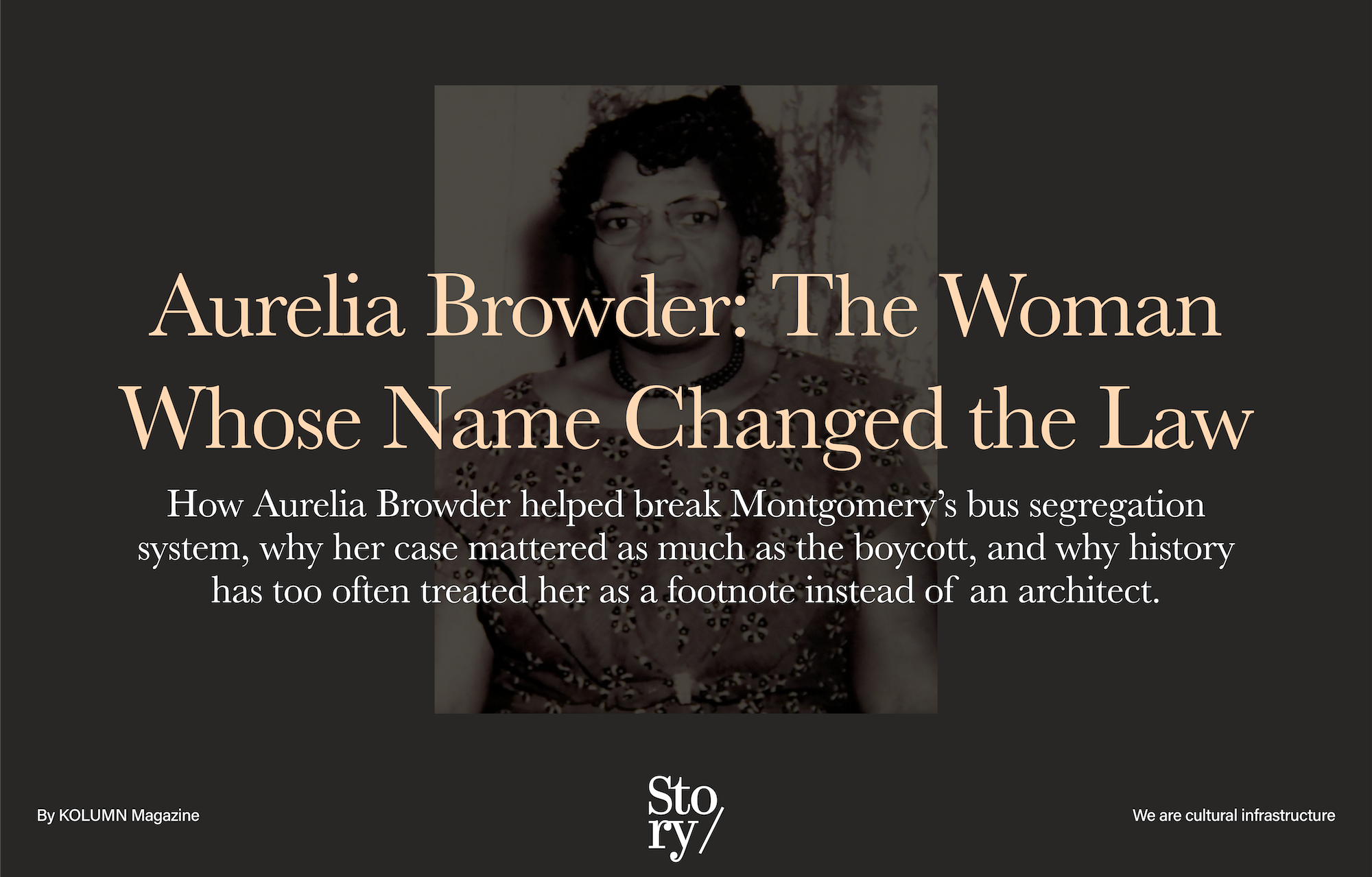
Aurelia Browder was not a side character in the Montgomery saga. She was part of the mechanism that turned protest into law.
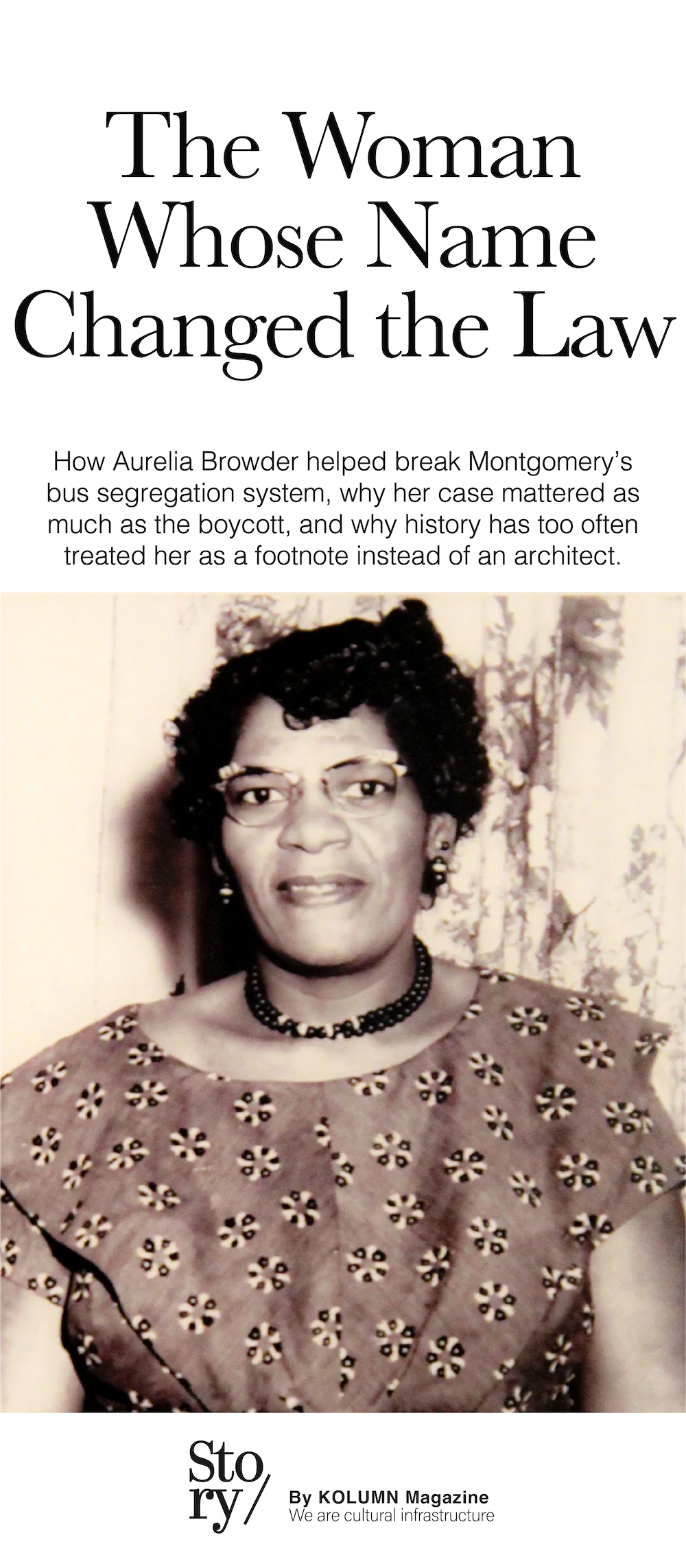
Aurelia Browder was not a side character in the Montgomery saga. She was part of the mechanism that turned protest into law.
By KOLUMN Magazine
There is a familiar version of the Montgomery story that most Americans can recite on command. Rosa Parks refuses to surrender her seat. Martin Luther King Jr. rises to national prominence. The boycott lasts more than a year. The buses are desegregated. It is not wrong, exactly. It is just incomplete in a way that reveals something about how public memory works in the United States. It prefers one saintly symbol, one heroic preacher, one clean turning point. What it has less patience for is the messier truth that movements are sustained by networks, by women, by local strategy, by legal craftsmanship, and by people whose names do not fit easily inside a textbook caption. Aurelia Browder sits squarely in that neglected space.
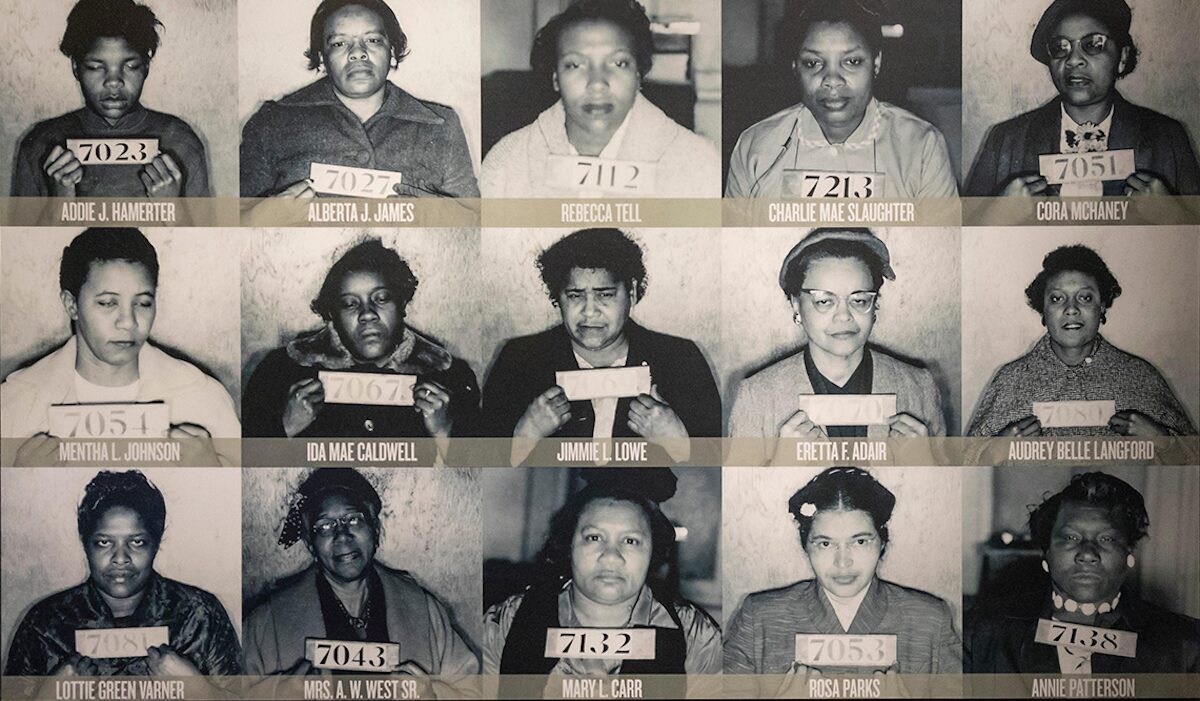
Browder was not an ornament to the Montgomery story. She was one of its engines. A Montgomery native, a mother, a seamstress, a teacher, a midwife, and an organizer, she became the lead plaintiff in Browder v. Gayle, the federal case that struck down segregated seating on Montgomery’s buses. The boycott made segregation costly and politically explosive. Browder’s case made it unconstitutional. If you want to understand what actually ended bus segregation in Montgomery, you have to say her name and say it with precision.
That distinction matters because the symbolic history of the movement and the operational history of the movement are not always the same. The symbolic history gives us icons. The operational history tells us who filed, organized, testified, drove, risked retaliation, and kept going when the cameras were elsewhere. In Browder’s case, the record is especially telling. The legal action carried her name in the caption. The district court’s ruling named her first. The Supreme Court upheld that judgment. And yet, decades later, large numbers of Americans still know the boycott while having little idea who Aurelia Browder was.
To write about Browder seriously is to write about civil rights memory itself: what it elevates, what it flattens, and what it still resists saying plainly. It also means resisting the temptation to turn her into a corrective symbol so tidy that she becomes another oversimplification. She was not “the real Rosa Parks,” and history gains nothing from that kind of lazy substitution. Browder’s importance is her own. She helps us see the Montgomery movement as it actually functioned: collective, female-driven in crucial respects, legally sophisticated, and built by people whose courage did not always arrive with national recognition attached.
The life beneath the caption
Aurelia Shines Browder Coleman was born in Montgomery in 1919 and lived there her entire life. The surviving public sketches of her life are revealing in their specifics. She finished high school in her thirties, later graduated from Alabama State with honors, and worked across several occupations, including seamstress, teacher, and nurse-midwife. Sources also describe her as a widow and the principal support for her children, which places her squarely in the tradition of Black Southern women whose political clarity was inseparable from the demands of labor, caregiving, and survival.
That profile alone should complicate any effort to cast the movement’s local women as merely spontaneous resisters. Browder was educated, politically engaged, and by all accounts formidable. A 1998 Washington Post feature lamented how little she was remembered and sketched her as a woman of intellectual drive and deep self-possession, someone who returned to school, earned a degree, and carried herself with steadiness even when history did not repay her with fame. The point is not to romanticize her. It is to see that Browder did not emerge from nowhere in 1956. She was already the kind of person for whom inequality was intolerable, and who had already developed the discipline to act against it.
Other accounts fill in the political contours. Biographical sketches associated with the Montgomery movement describe Browder as active in organizations including the NAACP, the Montgomery Improvement Association, the Southern Christian Leadership Conference, and, in some accounts, the Women’s Political Council. She also participated in the voter-rights struggle, tutoring Black residents for the discriminatory voter registration exam, working against the poll tax, and helping transport people to register or vote. Whether one foregrounds the formal membership lists or the broader ecosystem of movement work, the pattern is clear: Browder’s activism was not confined to one lawsuit, one bus ride, or one celebrated moment.
This is one of the reasons she matters so much. Browder represented a type that civil rights storytelling often underplays: the local Black woman activist who was not simply reacting to humiliation but building civic capacity. She understood transportation as a civil-rights issue, but she also understood voting, mobility, respect, and economic independence as connected questions. In the South of the 1950s, they were. A segregated bus seat was not just a seat. It was part of an entire architecture of control.
Why Montgomery’s buses mattered so much
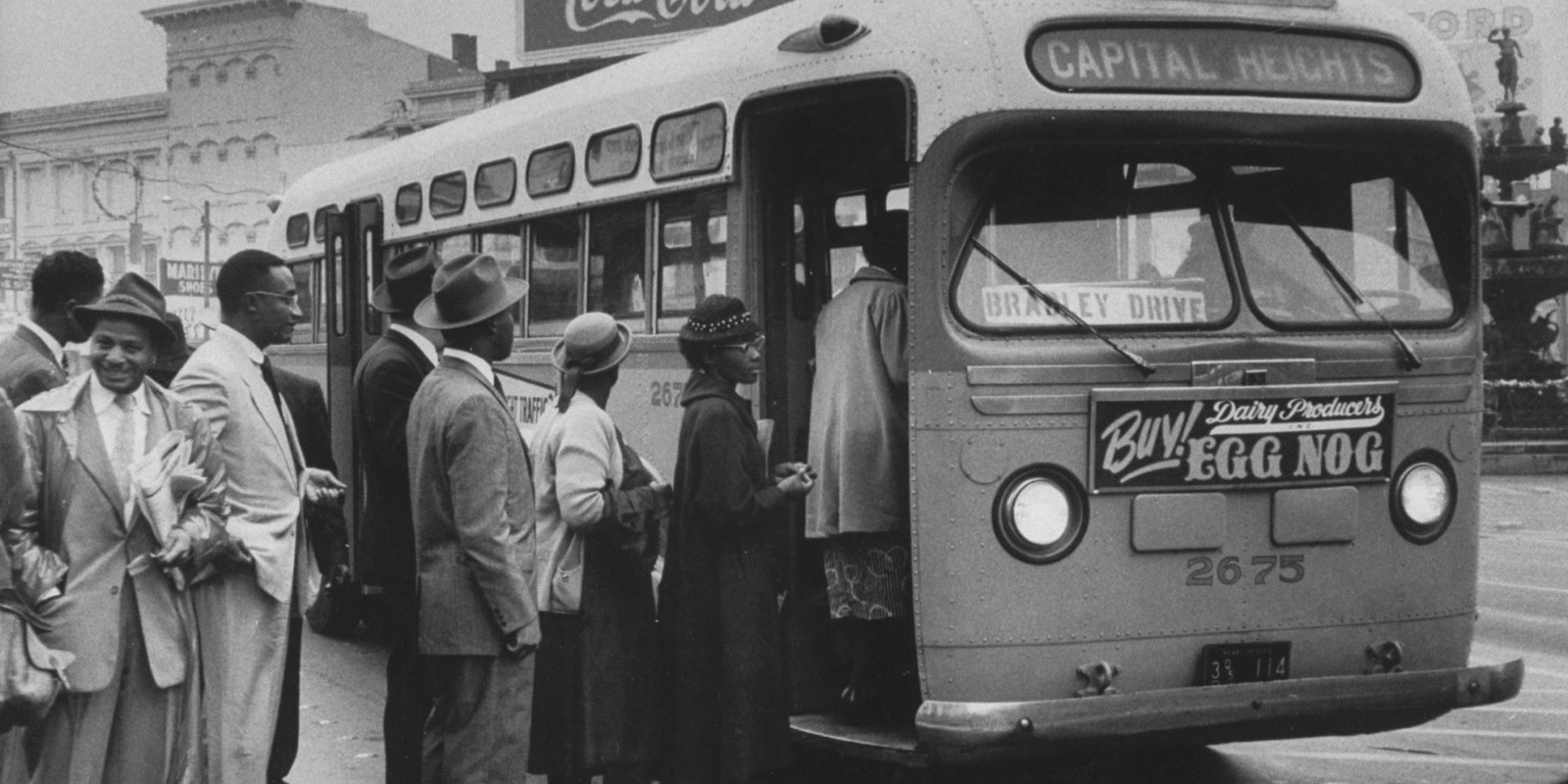
To get Browder’s significance right, you have to appreciate what the buses represented in Montgomery before the boycott. Segregation on city buses was not a quirky local custom or an unpleasant inconvenience. It was a daily ritual of degradation that structured movement, labor, and social hierarchy. Black riders made up a substantial share of the bus system’s customers, yet they were required to sit in designated sections, move on command, and tolerate driver abuse and police enforcement. The system communicated a basic civic lesson every day: Black people could pay full fare and still be treated as contingent occupants of public space.
The buses were not just where segregation appeared. They were where segregation had to be endured, in public, on schedule, over and over again.
The Women’s Political Council and other Black leaders in Montgomery had been discussing a boycott well before Rosa Parks’s arrest. Jo Ann Robinson’s memoir makes plain that Black women were not waiting for history to begin; they were preparing, thinking, agitating, and watching for the moment when collective action could be made durable. The buses had become a pressure point because they concentrated indignity into the most ordinary rhythms of life: commuting, shopping, school, work, childcare. Segregation was visible there, but more important, it was felt there.
By the time Parks was arrested in December 1955, the city was already sitting atop years of grievance and organization. Claudette Colvin had been arrested earlier in 1955. Other women, including Aurelia Browder, Susie McDonald, and Mary Louise Smith, had also been mistreated or arrested on the buses. The standard public narrative often treats Parks as a lone rupture in an otherwise static landscape. The fuller history shows a sequence of acts, a reservoir of anger, and a movement infrastructure that recognized the buses as one of Jim Crow’s most vulnerable points.
That broader frame does not diminish Parks. It clarifies the world she helped ignite. And it places Browder where she belongs: among the women whose experiences made a legal test case possible and persuasive. When we say the movement was bigger than one person, Browder is one of the names that proves it.
The road to Browder v. Gayle
The decision to file a federal lawsuit was strategic, not incidental. After Parks’s arrest, civil rights leaders explored how best to challenge segregation. Rosa Parks’s own case was moving through the state system, which posed delays and procedural complications. According to the Library of Congress and the King Institute, Fred Gray, with guidance from NAACP lawyers including Thurgood Marshall and Robert L. Carter, pursued a federal action that would squarely test the constitutionality of bus segregation under the Fourteenth Amendment. On February 1, 1956, Gray filed Browder v. Gayle on behalf of Aurelia Browder, Susie McDonald, Claudette Colvin, Mary Louise Smith, and Jeanetta Reese. Reese later withdrew after intimidation. Parks was not included because leaders wanted the federal case to focus cleanly on the segregation laws rather than become entangled with her pending prosecution.
This was sophisticated legal strategy. It is sometimes treated as a backroom technicality, but that misses the point. The movement in Montgomery was not only morally compelling; it was tactically nimble. Protest in the streets and a lawsuit in federal court were not competing approaches. They were mutually reinforcing. The boycott generated pressure, solidarity, and national attention. The case translated lived injury into constitutional argument. Browder’s name became the vehicle through which ordinary humiliation was rendered legible as a matter of equal protection.
The caption of the case matters more than people realize. In federal litigation, the named plaintiff is not just a label. The name frames the case in the historical record. The district court opinion begins with Browder. The Stanford King Institute summary identifies Aurelia S. Browder v. William A. Gayle as the challenge to Alabama’s bus segregation laws. In a movement filled with famous speeches and celebrated arrests, the court file is refreshingly blunt about who stood in the line of fire.
Why Browder as lead plaintiff? Historical accounts point partly to her maturity and credibility. She was in her thirties, older than Colvin and Smith, younger than McDonald, and well positioned to represent the plaintiffs as a composed adult witness. But there is another way to read that decision. Browder embodied the respectable, hardworking, church-and-community-grounded Black woman whom white power structures often presumed they could dismiss until she entered the formal machinery of the law and refused to bend. In other words, her selection was strategic because she was credible to the movement and difficult to caricature.
Browder on the stand
One reason Browder’s story feels so contemporary is that it reveals how often gatekeepers misjudge the people history later depends on. Some movement insiders reportedly worried about who could best withstand scrutiny and hostile cross-examination. But Browder’s courtroom testimony, as remembered in later accounts, suggests a woman who knew exactly what was at stake. The Washington Post reproduced a brief exchange from the surviving transcripts in which Browder insisted, “It is the segregation laws of Alabama that caused all of it,” rejecting the idea that outside agitators had planted the grievance in her mind.
Browder’s genius was not spectacle. It was steadiness under pressure.
That sentence deserves to live longer than it has. It contains a sharp theory of power. Browder was refusing one of segregation’s favorite evasions: the claim that Black protest did not arise from Black experience but from manipulation by leaders, lawyers, or radicals. Her answer cut straight through that script. The injury was structural. The source was the law itself. She was not a puppet. She was a citizen describing what the state had done to her.
Even the way later writers remember her testimony is revealing. The Southern Poverty Law Center, drawing on family memory and local interpretation, described Browder as “bootstrappy” and “strong-willed,” not intimidated on the stand. That language is colloquial, maybe even a little homespun, but it gets at something substantial. Browder was not simply brave in the abstract. She was sturdy. She had the kind of lived authority that comes from having already carried responsibility in public and private life. When the city’s lawyers tried to narrow or trivialize her grievance, she had no interest in helping them.
The importance of testimony in civil-rights litigation is often underappreciated because the constitutional holdings feel so grand in retrospect. But cases are built from people willing to say, in public and under hostile questioning, what happened to them and why it violated their rights. Browder did that. She did it in a legal culture still saturated with deference to segregation, and in a city where retaliation was not theoretical. That kind of witness work is its own form of activism.
The ruling that changed everything
On June 5, 1956, a three-judge federal panel ruled 2-1 that segregation on Montgomery’s buses was unconstitutional. The court’s opinion placed bus segregation inside the constitutional logic emerging from Brown v. Board of Education. As the National Park Service summarizes it, the judges concluded that Plessy v. Ferguson had effectively been stripped of legal validity in this context and that the separate-but-equal doctrine could no longer rationally govern public carrier transportation. The district court opinion itself is even more explicit, stating that “the separate but equal doctrine of Plessy v. Ferguson … can no longer be regarded as a correct statement of the law.”
That was not a rhetorical flourish. It was a judicial demolition of the legal premise that had upheld segregation for decades. The city and the state appealed. On November 13, 1956, the Supreme Court affirmed the ruling, and after further efforts to delay, the final order reached Montgomery in December. On December 20, the Montgomery Improvement Association voted to end the 381-day boycott; integrated buses began operating the next day. The boycott had not simply “worked” through moral witness alone. It had culminated in a constitutional victory.
This is the point where the national story usually glides too quickly past the lawyers and the plaintiffs, eager to return to the more cinematic dimensions of Montgomery. But the actual mechanism of desegregation was legal compulsion grounded in federal constitutional law. That does not make the mass protest less important. It makes the relationship between protest and law impossible to ignore. Browder’s name is attached to that relationship. Her case is where the boycott’s moral force became binding doctrine.
Martin Luther King Jr. recognized the magnitude of the decision. The King Institute records that he called the Supreme Court’s action “a reaffirmation of the principle that separate facilities are inherently unequal.” That quote is often used to underscore King’s leadership, which is fair enough. But it also inadvertently points back to Browder. King was interpreting a victory that came through a case bearing her name.
The problem of being overshadowed
If Aurelia Browder’s historical importance is so plain in the record, why has she remained comparatively obscure? The answer is not singular, but several patterns are easy to see. First, public memory likes emblematic figures. Rosa Parks became the indispensable icon of bus protest because her story was legible, moral, and photographically reproducible. Second, national civil-rights memory often overcenters charismatic male leadership and undercredits the women and local organizers who set the stage, built the networks, and shouldered the logistics. Third, legal victories can be oddly invisible to popular culture unless they come with a single personality large enough to dominate the narrative. Browder had the law. Parks had the myth.
What was forgotten about Aurelia Browder was not her role. It was our willingness to tell the fuller story.
The consequences of that imbalance have been felt for generations. In the Washington Post feature from 1998, Butler Browder reflected on how rarely his mother’s name appeared in standard histories and commemorative volumes. His frustration was not petty. It was historiographical. The case that changed the law had not been granted commensurate place in the story the country told about itself. The result was a familiar American distortion: honoring the movement while quietly narrowing the roster of people allowed to personify it.
Modern historians and interpreters have increasingly challenged that narrowing. The Encyclopedia of Alabama explicitly notes that despite the case’s importance, the legacy of the Montgomery Bus Boycott has centered disproportionately on Rosa Parks while the stories of Browder, Colvin, McDonald, Smith, and Reese receded from view. That is not a criticism of Parks so much as a criticism of how selective commemoration works. Once a national narrative hardens, it tends to protect its simplicity. Browder complicates that simplicity in productive ways.
Michelle Browder, Aurelia Browder’s relative and a Montgomery public historian, has said that it is “her time” for people to dig deeper into this history. That phrasing is telling because it implies two things at once: that the evidence has long been available, and that the failure to foreground Browder was not really about lack of documentation. It was about what kinds of stories institutions, schools, and media were willing to amplify.
Browder beyond the lawsuit
There is another way Browder has sometimes been flattened: by being remembered only as a legal name. That misses the breadth of her contribution. During the boycott, she did more than lend her name to a complaint. Sources indicate that she served as a volunteer driver and used vehicles she owned or leased to support the transportation system that sustained the boycott. That detail matters because the Montgomery Bus Boycott did not survive on righteousness alone. It survived on infrastructure: carpools, dispatching, church coordination, fundraising, discipline, and relentless mutual aid. Browder was part of that material backbone too.
This practical side of her activism is easy to miss precisely because it is practical. The movement’s glamorous images are speeches, marches, arrests, and mass meetings. But the movement’s daily reality was getting people to work, to school, to stores, to doctors, and back home without surrendering to a segregated bus system. A person who could help solve that problem was not ancillary. She was indispensable. Browder’s life as an entrepreneur, caregiver, and organizer fit naturally into that role.
Her civic commitments also extended past transportation. Accounts associated with the Browder family and movement biographies describe her work in voting-rights efforts and later community leadership. Even where public sources are sparse on the details, the pattern aligns with what we know about Montgomery’s activist culture: bus segregation, voting, schooling, and political representation were all part of the same democratic struggle. Browder’s biography belongs in that continuum, not just in a legal sidebar about 1956.
She died in 1971, just 52 years old. That early death may be one reason her public presence never expanded the way it might have in the commemorative decades that followed. Some movement figures lived long enough to publish memoirs, speak on anniversary panels, or be rediscovered by television producers and textbook committees. Browder, by contrast, was left to the custody of family memory, local institutions, legal records, and a handful of historians willing to insist that the caption of a case should mean something.
Memory work in Montgomery
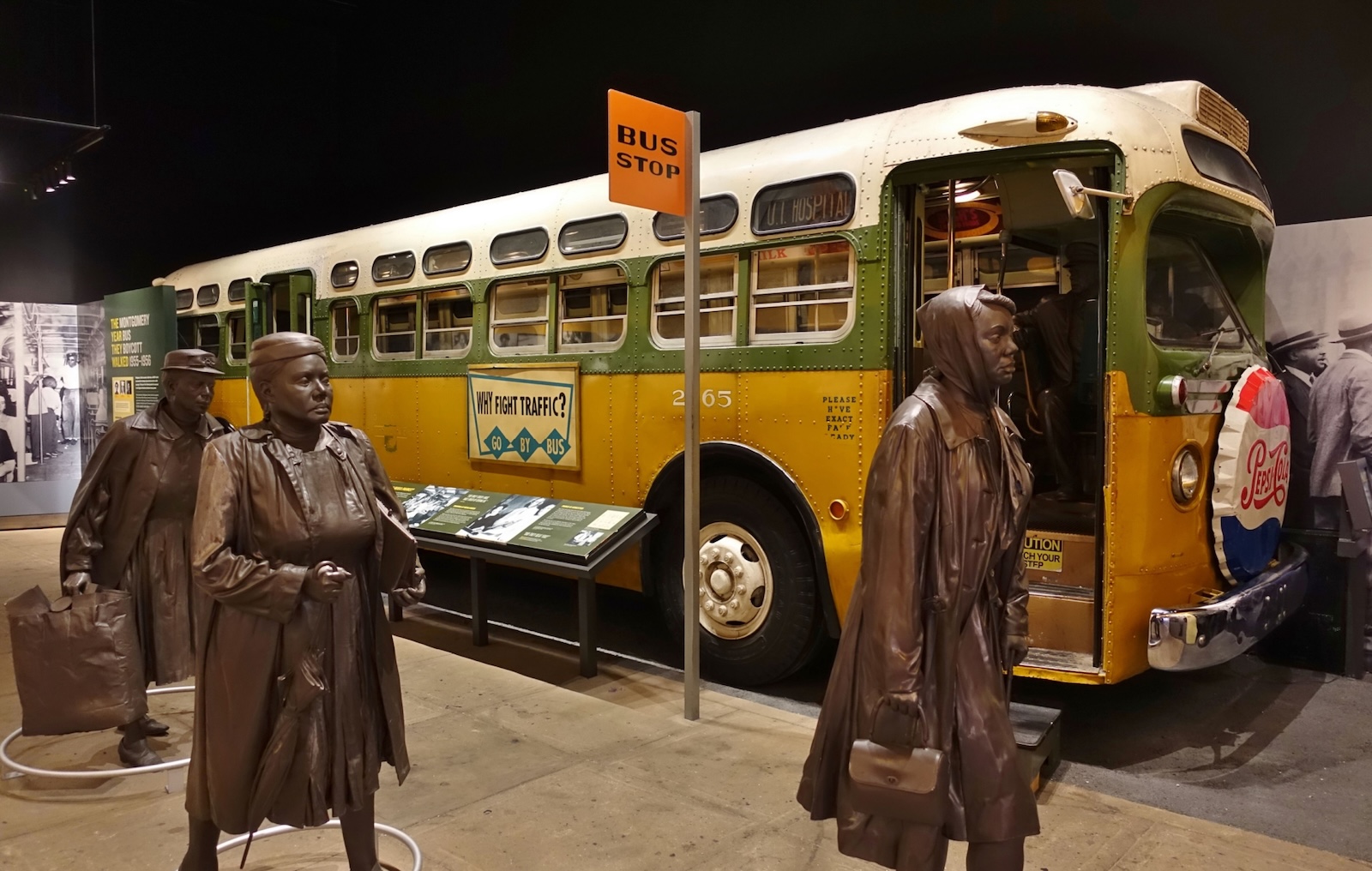
In recent years, Montgomery has made visible efforts to honor Browder more directly. Her home at 1012 Highland Avenue was placed on the Montgomery Registry of Historic Places in 2010, and local advocates have continued to use the house and foundation as a site of education and remembrance. In 2019, when the city unveiled a Rosa Parks statue, it also dedicated markers honoring the four women plaintiffs in Browder v. Gayle: Browder, Claudette Colvin, Susie McDonald, and Mary Louise Smith. The placement was symbolically apt. It suggested that Parks’s commemoration need not come at the expense of the women whose federal case delivered the legal win.
Those memorial choices are more than civic housekeeping. They are interventions in public history. They acknowledge that Montgomery’s story cannot be responsibly told through a single figure alone. They also match a broader shift in civil-rights interpretation, one that is increasingly attentive to women’s labor, local organizing, and the interplay of litigation with direct action. The Equal Justice Initiative’s continued investment in Montgomery’s public memory landscape, including new interpretive sites about ordinary people who did extraordinary things, fits that same current.
Still, commemoration is not the same thing as integration into mainstream historical consciousness. A marker helps. A statue helps. A house museum helps. But the deeper question is whether Browder becomes part of the default story students, readers, and journalists tell when Montgomery comes up. That shift is slower because it requires editing not only monuments but habits of narration.
What Aurelia Browder means now
Aurelia Browder’s significance is not limited to correcting a footnote. Her story changes the way we understand how democratic change happens in the United States. It reminds us that social transformation rarely arrives as a single dramatic act. It comes through accumulation: through the insult repeated too many times, the organizer who has been preparing for years, the woman who refuses, the lawyer who files, the witness who holds firm, the community that keeps walking, the court that finally acknowledges what should have been obvious all along.
It also sharpens our sense of what courage looks like. Parks’s courage has rightly been celebrated as calm defiance in a public instant. Browder’s courage was slightly different in texture. It included the willingness to become a named plaintiff, to endure cross-examination, to attach one’s life to a constitutional challenge in a hostile city, and to keep doing community work while history mostly looked elsewhere. That is not lesser courage. In some ways, it is harder to narrate because it lacks the clean visual shorthand that makes legends easy. But it may be more representative of how change is actually won.
There is also a lesson here about journalism. The press has often been both a witness to history and a machine for simplification. Stories need frames; readers need points of entry. But there is an ethical difference between making a story legible and making it false by omission. A responsible press culture has to keep reopening canonical narratives and asking who has been edited out. In the case of Montgomery, Browder’s relative obscurity is not just an accident of memory. It is part of a longer pattern in which Black women’s intellectual, legal, and organizational labor gets treated as support work for more famous names.
To say her name now is not an exercise in trendy revisionism. It is an act of historical accuracy. The buses in Montgomery were desegregated because a movement pressured the city, because ordinary Black citizens sustained a 381-day boycott, because lawyers built a constitutional challenge, and because Aurelia Browder and the other plaintiffs were willing to stand in court and force the nation’s legal system to confront its own contradictions. That is the story. Or at least, it is closer to the full one than the country has usually allowed.
In the end, Aurelia Browder exposes the cost of preferring myth to mechanism. Myth gives us inspiration. Mechanism tells us how the victory happened. Browder belongs to the mechanism: the legal lever, the civic discipline, the witness under pressure, the community backbone. Once you see her there, the Montgomery story does not become smaller. It becomes more honest, more collective, and more impressive. That is the gift of recovering her life with care. It returns not only a woman to history, but history to itself.
More great stories
Afro Sheen, Wall Street, and the Architecture of Black Possibility
July 6, 2026
No Comments
The Fire Inside the Fourth
July 5, 2026
No Comments