



I want freedom when I write.
I want freedom when I write.
By KOLUMN Magazine
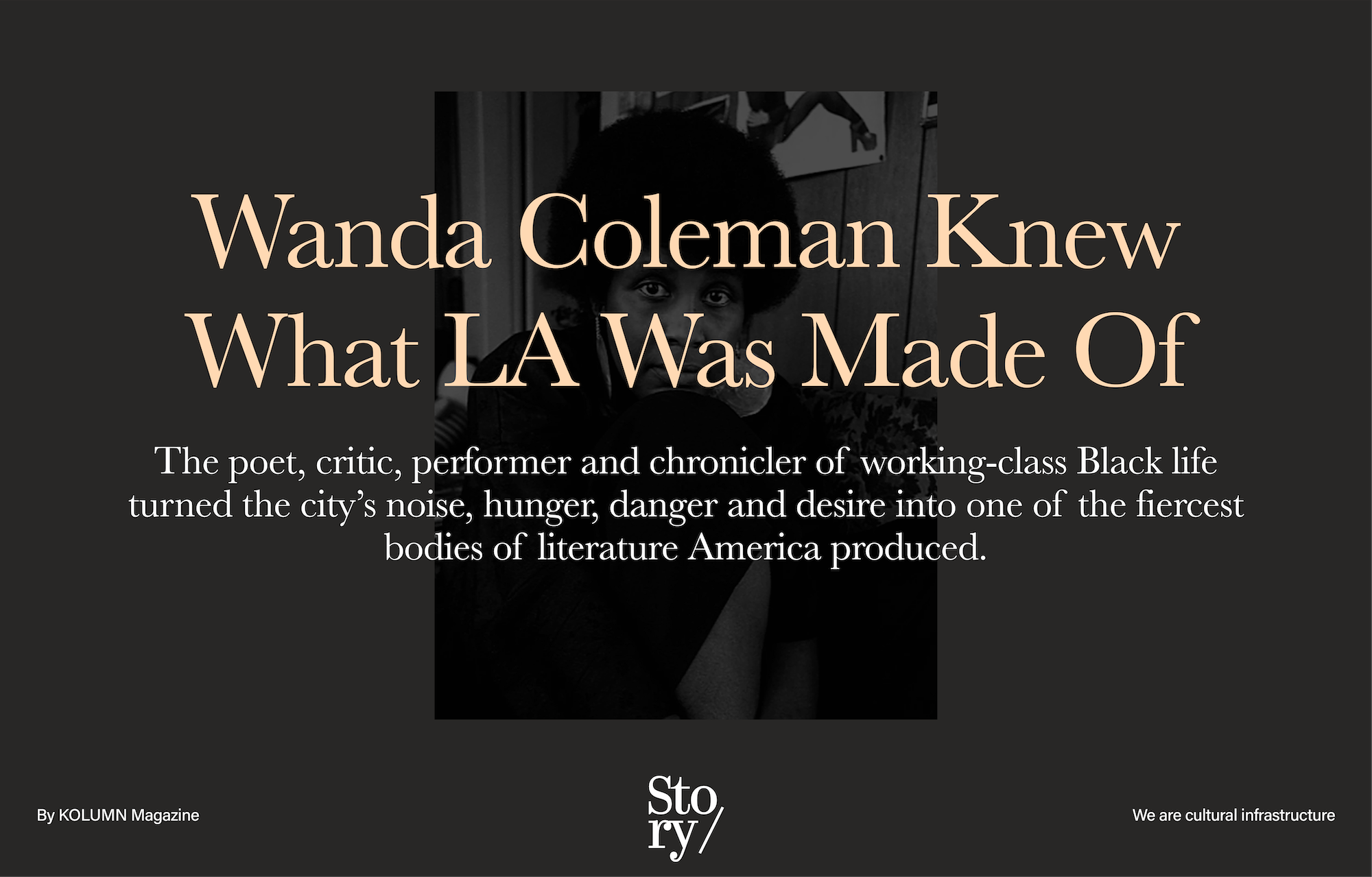
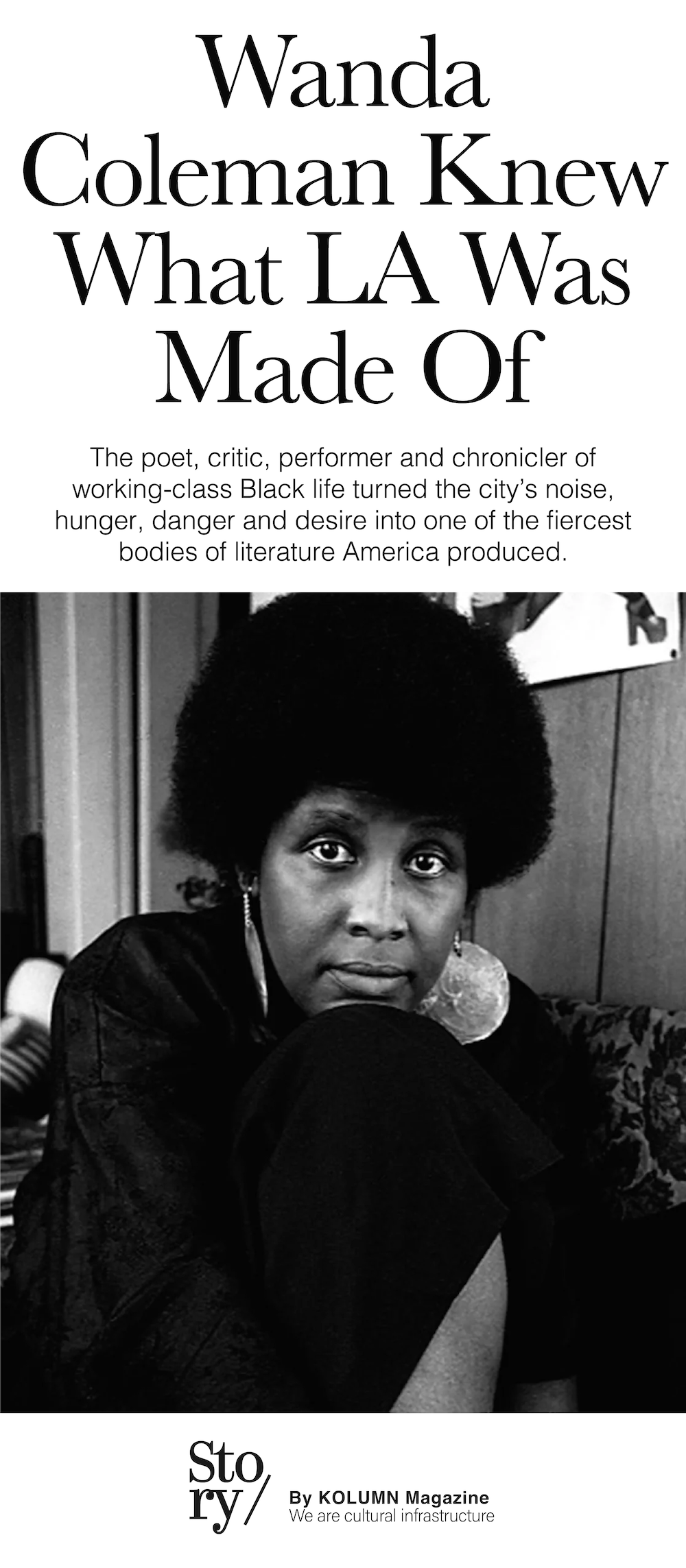
Wanda Coleman never fit neatly into the boxes American literary culture likes to build. She was too jagged for respectability, too funny for solemnity, too formally inventive for anyone eager to flatten her into a “voice of the community,” and too unsparing to become an easy symbol. She wrote poems, stories, essays, reviews and journalism. She worked day jobs, raised children young, moved through workshops and literary scenes, wrote for television, won serious prizes, alienated some people, inspired many more, and kept producing work that refused to behave. By the time she died in 2013 at 67, she had become what Los Angeles had long known she was: one of its essential writers, often called the city’s unofficial poet laureate.
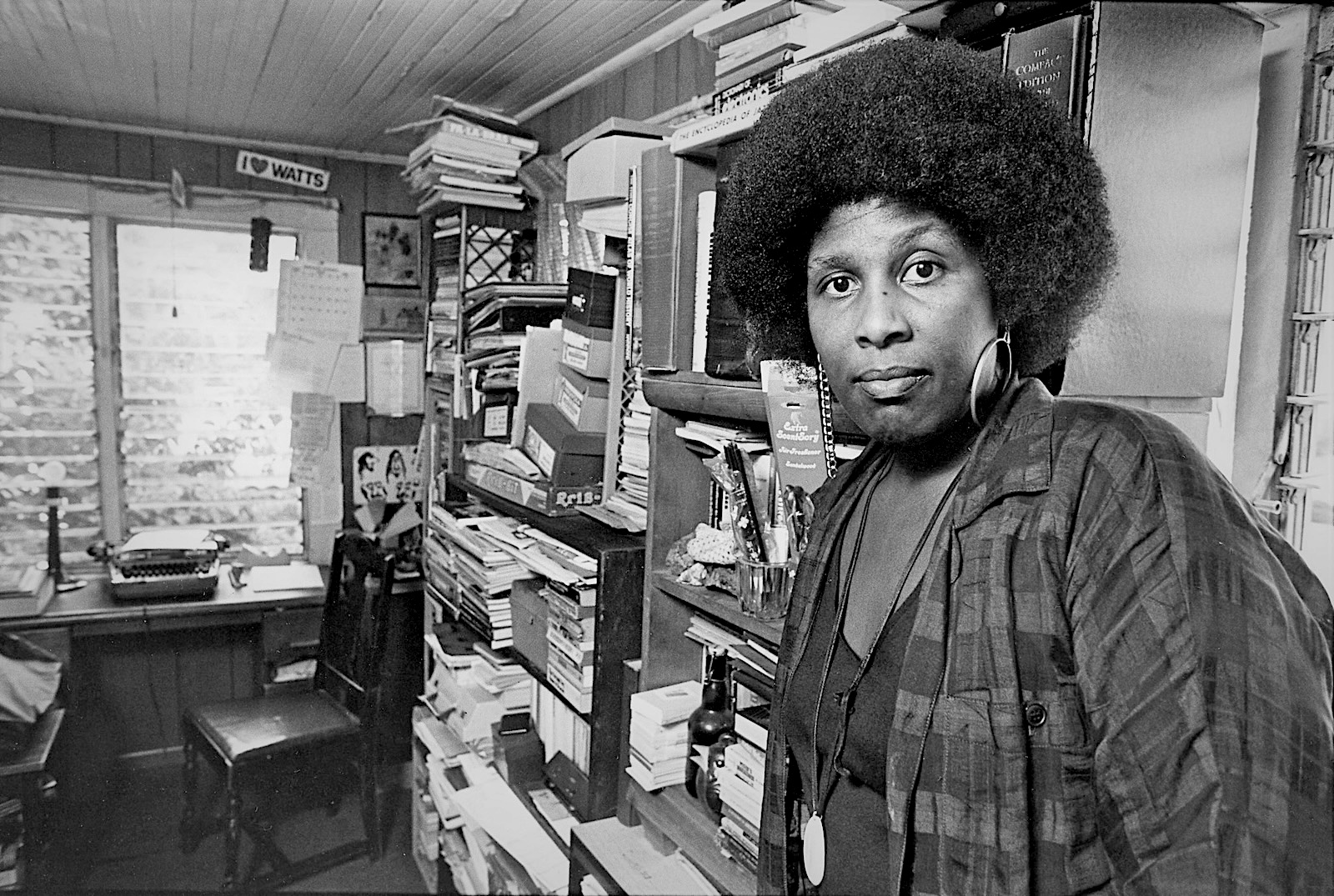
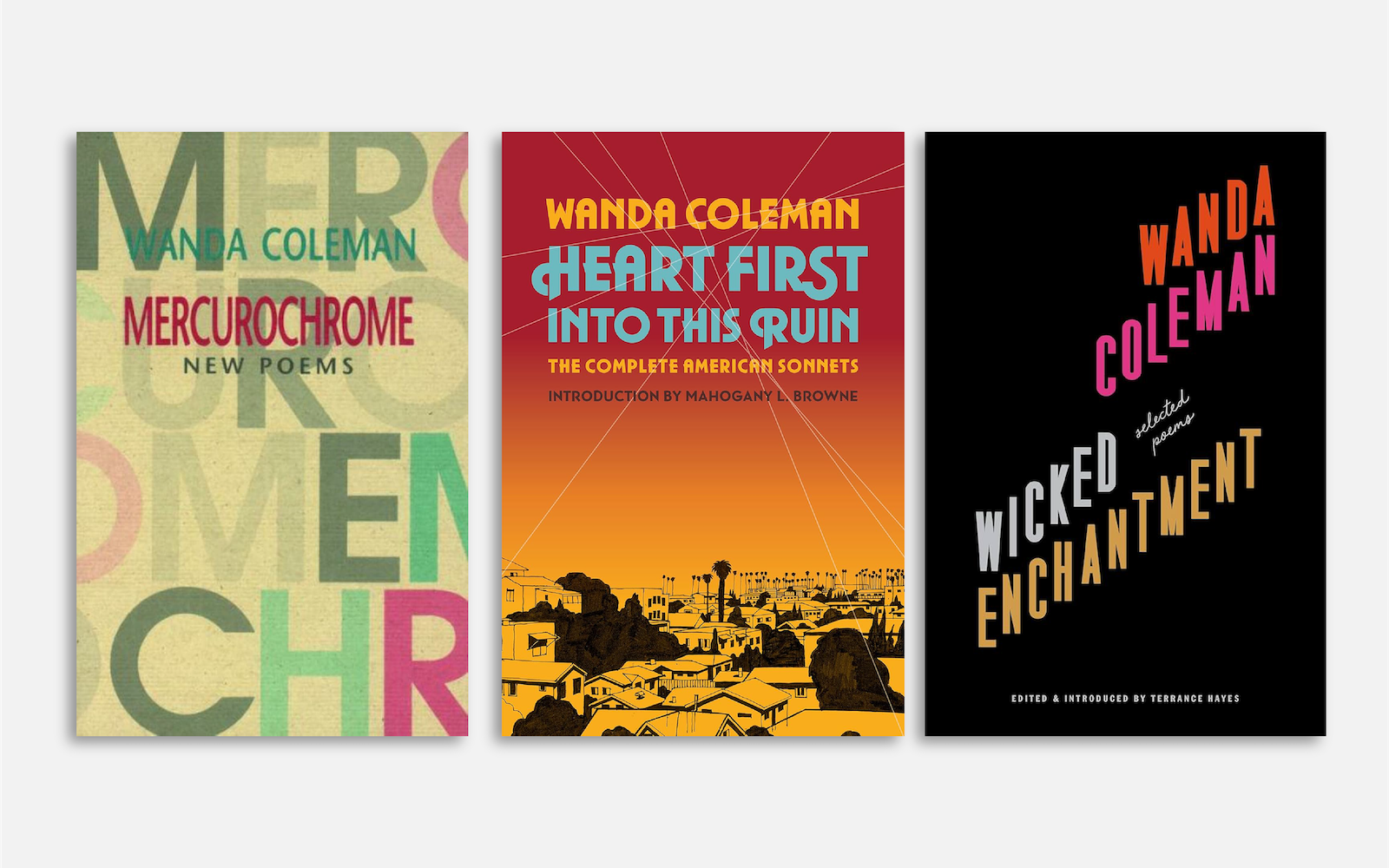
That label, though, can undersell her. Coleman was not merely a local legend, not merely a “Black L.A.” poet, not merely an eccentric genius with cult prestige. She was one of the most original American writers of the late 20th century, and the case for that has only gotten stronger since her death. When Black Sparrow Press relaunched in 2020 with Wicked Enchantment: Selected Poems, edited and introduced by Terrance Hayes, critics treated the book not as a nostalgia exercise but as a correction. The Washington Post called the volume a deeply engaging introduction to a poet whose significance had not been fully appreciated in her lifetime, while The New Yorker described Coleman as among the greatest poets ever to come out of Los Angeles.
That delayed recognition matters, because Coleman spent much of her career writing from the sharp edge of literary marginality while also understanding, probably better than many of her peers, exactly how canons get built and how they exclude. Her work is full of resentment, yes, but also of virtuosity, satire, sensuality, grief and a relentless intelligence about power. She wrote about race, class, hunger, bureaucracy, sex, family, failure, city life and artistic ambition without prettifying any of it. Even when she used inherited forms, especially the sonnet, she treated them less like sacred objects than like structures to improvise inside until they started to sound like her.
That demand for freedom may be the cleanest way into her significance. Coleman wanted freedom in diction, in subject matter, in form, in politics, in self-presentation. She wanted the freedom to be ugly when ugliness was the honest register. She wanted the freedom to be gorgeous without apology. She wanted the freedom to write the poor and the unwanted without turning them into moral props. And she wanted the freedom to remain contradictory, which is one reason she still feels so contemporary. In a culture that likes its artists legible, Wanda Coleman insisted on complexity.
A writer made in Watts and South Central
Coleman was born Wanda Evans on November 13, 1946, in the Watts neighborhood of Los Angeles, and she grew up in the larger geography of South Central. The specifics of that upbringing matter because her work is unimaginable apart from the city that made and tested her. According to the Poetry Foundation and the Academy of American Poets, she was encouraged to read by her parents, began writing poetry around age 5, and published poems in a local newspaper at 13. That early seriousness about language arrived alongside deep dissatisfaction with public schooling, which she later described as dehumanizing.
Los Angeles in Coleman’s work is not the fantasy capital of sunshine and reinvention that mainstream American culture has so often sold back to itself. It is a stratified place, racialized and improvisational, full of labor and humiliation, glamour and debris. The city appears in her poetry as lived contradiction: the freeway and the want ad, the fake sable coat and the unpaid bill, the jazz line and the siren. Richard Modiano of Beyond Baroque put it plainly after her death, saying she wrote not just about the Black experience in Los Angeles but about the whole configuration of the city, its politics and social life. That broader civic vision is a major reason the “unofficial poet laureate” phrase stuck.
The usual temptation with a writer like Coleman is to make geography feel decorative, as though Watts simply added authenticity to a preexisting talent. But in her case place was not accessory. It was method. It shaped her ear, her pressure points, her moral field and her sense of who gets erased when literature becomes too polished. The Poetry Foundation notes that after the Watts uprising and in the literary ecosystem around it, Coleman developed her craft through workshops including Frank Greenwood’s Saturday workshop, Budd Schulberg’s Watts Writers Workshop, Studio Watts and Beyond Baroque. She built herself not through one neat institutional pipeline but through overlapping public scenes and hard-won apprenticeship.
That path also helps explain why she never sounded entirely like anyone else. Coleman absorbed high literary traditions and the Afro-American blues and jazz tradition at the same time. In a Poetry Society interview, she described her inheritance as a “complex mishmosh” and said her tradition was split, even “shattered,” between the best of Western civilization as taught in mid-century Los Angeles schools and the Black musical tradition of blues and jazz. That self-diagnosis is also an artistic program. Coleman was not trying to choose between formal inheritance and vernacular improvisation. She was determined to force them into contact.
Her tradition, she said, was “split” — or better, “shattered.”
A working writer before she was a fully recognized one
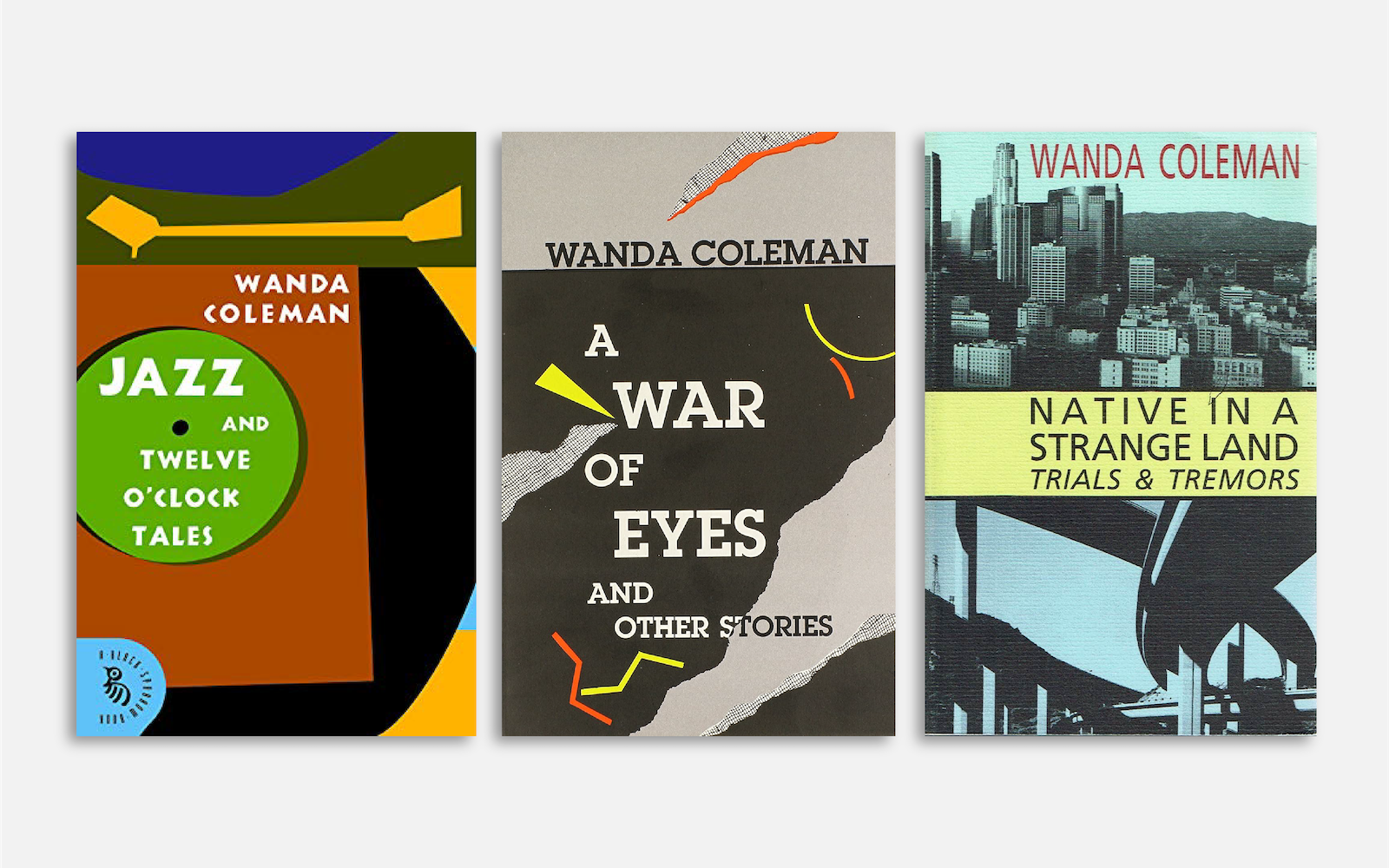
Part of Wanda Coleman’s legend is that she was always more versatile than the literary establishment seemed prepared to credit. Before the canonizing afterlife, before the revived editions and retrospective essays, there was the practical business of surviving. She married young, became a mother of two by age 20, and worked a range of jobs. The Academy of American Poets lists medical secretary, magazine editor, journalist and Emmy Award-winning scriptwriter among her roles. The Poetry Foundation adds that she published fiction in Negro Digest/Black World in 1970 and spent the 1970s experimenting across theater, dance, television and journalism.
That Emmy often startles people who come to Coleman through poetry first. She won it for her writing on Days of Our Lives in the mid-1970s, a credential that does not fit the standard myth of the isolated lyric genius. But that mismatch is revealing. Coleman was not isolated from mass culture; she knew how it worked. She had been inside the machinery of popular narrative and commercial writing, and that experience seems to have sharpened rather than diluted her literary instincts. She understood voice as performance, understood audience, understood compression, and understood the ways institutions decide whose language gets rewarded.
Her career also unfolded through the crucial patronage of small-press and avant-garde literary culture, especially Black Sparrow Press. John Martin, Black Sparrow’s founder, became a mentor, and Coleman published much of her major work there. That mattered enormously. If mainstream publishing often struggled to know what to do with a writer as abrasive and formally restless as Coleman, Black Sparrow was willing to let the work remain itself. The result was a catalog that now looks astonishingly rich: Mad Dog Black Lady, Imagoes, Heavy Daughter Blues, African Sleeping Sickness, Hand Dance, Native in a Strange Land, Bathwater Wine, Mercurochrome and more.
These were not minor achievements happening in obscurity. The honors accumulated. The Poetry Foundation records an NEA grant in 1981–82, a Guggenheim Fellowship in 1984, the Harriette Simpson Arnow Prize for fiction in 1990, the Lenore Marshall Poetry Prize in 1999 for Bathwater Wine, and National Book Award finalist status in 2001 for Mercurochrome. She also received California Arts Council awards and the first literary award from the city’s Department of Cultural Affairs. The résumé is the résumé of a major writer, even if the major-writer treatment from American culture came inconsistently.
The language jumps off the page
Trying to summarize Coleman’s style in a sentence is almost a setup for failure, because style in her work is so bound up with permission. She gave herself permission to switch registers, to move from lyric concentration to streetwise snap, from confessional injury to savage joke, from erotic candor to civic indictment. Her poems can sound scorched, tender, mocking, lush, procedural, exhausted and ecstatic, sometimes in a matter of lines. The Washington Post said her vernacular practically jumps off the page, and that gets at something central: Coleman’s language feels bodily. It arrives with momentum.
She was also, as critics have increasingly emphasized, a formal inventor. The New Yorker described her as a great mender in American verse, someone who found extra wear in old forms like the sonnet and scavenged new forms from aptitude tests, medical reports and want ads. That is a vivid way of describing what Coleman did so well: she treated form less as inheritance than as salvage and pressure. A poem could be an argument with a tradition, but it could also be a document, a rant, a test, a parody, a riff, a blues structure dressed as a sonnet or a sonnet dressed as an urban dispatch.
Her subject matter was similarly expansive. The Poetry Foundation notes that her work focused on racism and the outcast status of living below the poverty line in California, especially Los Angeles. But that description, while true, can sound more schematic than the poems themselves. Coleman does not write social conditions as abstractions. Poverty in her work is rent, food, clothing, survival improvisation, exhaustion, bodily risk and corrosive memory. Race is not a topic; it is an organizing pressure on everyday perception. Desire is not detachable from economics. Motherhood is not detachable from labor. Beauty is not detachable from ridicule or threat.
This is one reason her poems resist moral simplification. Coleman could write with enormous sympathy toward the vulnerable without sentimentalizing them. She knew too much about humiliation to polish it into uplift. And she knew too much about performance to pretend sincerity alone made art. Her work wants truth, but not the bland truth of tasteful realism. It wants the overcharged truth that comes from collision: of forms, idioms, classes, fantasies, histories.
The American sonnets and the remaking of a form
If Wanda Coleman’s reputation now has a central pillar, it is probably the American Sonnets. They are widely treated as one of her signature achievements, and for good reason. The sequence, written across years and scattered through several books, took the most canonical of lyric forms and turned it into a vehicle for volatility, compression, fury and play. The Poetry Foundation calls the series her magnum opus and describes the sonnets as “jazzified,” high-octane and utterly original.
Coleman herself was wonderfully blunt about what she was doing. As summarized by the Poetry Foundation, she said the poems “go absolutely bonkers within that constraint.” That phrase is perfect, because it captures both discipline and revolt. Coleman kept enough of the sonnet’s compactness and turn to retain its pressure, but she rejected any idea that the form required decorum. In her hands the sonnet could carry bureaucracy, invective, surrealism, street speech, lyric ache and anti-American analysis all at once.
Coleman’s sonnets “go absolutely bonkers within that constraint.”
The series also matters because of what it did to literary lineage. Terrance Hayes, whose American Sonnets for My Past and Future Assassin helped renew broad attention to the form, has explicitly credited Coleman. The Washington Post noted that her American Sonnets influenced later poets, especially Hayes, and the Poetry Foundation observes that poets from Hayes to Billy Collins and Gerald Stern borrowed from her signature form, not always with adequate acknowledgment. That is both tribute and indictment. Coleman was influential enough to be absorbed, but not always centrally credited in real time.
What makes the sonnets endure is not merely that they are innovative. Innovation alone ages quickly. They endure because they are analytically alive. According to the Poetry Foundation’s reading of the sequence, these poems offer a sustained and incisive critique of American culture and its injustices. They are charged with the conditions of urban deprivation, health care failures, state indifference, market absurdity and racial violence, yet they rarely settle into slogan. Their music keeps thinking. Their anger keeps shaping itself.
Coleman once explained that she originally conceived the American Sonnets partly because the title sounded academic enough that it might help her earn entry into the canon, or as she put it, the priesthood. That confession is funny, strategic and sad all at once. It reveals a writer who knew institutional power intimately and understood that form could be a kind of credentialing device. But Coleman did not submit to the canon’s terms. She used the sonnet to sabotage the very respectability it supposedly promised.
Wanda Coleman and the argument with Black literary respectability
Any honest account of Coleman has to include the fact that she was not simply neglected. She was also controversial, abrasive and sometimes wounding. She wrote criticism with a blade in it. She was capable of devastating appraisals of other writers, including major Black writers. The most famous example remains her 2002 review of Maya Angelou’s A Song Flung Up to Heaven in the Los Angeles Times. As Poetry Foundation’s Lizzy LeRud recounts, Coleman called the prose “bad to God-awful” and deemed the book “a sloppily written fake.” The fallout was real: she lost speaking engagements and was banned from Eso Won, the prominent Black-owned bookstore in Los Angeles. (The Poetry Foundation)
It would be easy to use that episode as a morality play, either to celebrate Coleman’s honesty or to denounce her cruelty. Neither is sufficient. The more interesting point is that Coleman’s criticism came from a deep frustration with the way Black literature was discussed, rewarded and flattened. LeRud notes that Coleman wanted more rigorous distinctions and more serious criticism, even within Black literary culture. She was not interested in ceremonial praise. She was interested in standards, argument and degrees of excellence.
That does not excuse everything she wrote. Some of her criticism, including her review of Audre Lorde’s collected poetry, has rightly been described as excessive and in parts troubling. But the broader conflict says something important about her place in American letters. Coleman distrusted the consolations of symbolic inclusion. She was too suspicious of prestige to treat visibility as proof of merit. That stance cost her. It also made her unusually hard to domesticate.
There is a pattern here that recurs in the careers of difficult Black artists, especially women: if they are candid, they are punished as bitter; if they are experimental, they are sidelined as unruly; if they critique their own cultural institutions, they are treated as disloyal. Coleman met all three conditions. The result was a career in which admiration and marginalization often ran side by side. That tension is part of the work’s atmosphere. You can feel in her poems the knowledge that talent does not guarantee placement, that genius can remain underpaid, and that literary citizenship is often conditional.
A Los Angeles writer, not a regional footnote
One of the strongest arguments for Coleman’s importance is that she solved a problem many writers fail to solve: how to write a city so specifically that it becomes more than local, without losing specificity in the process. Coleman’s Los Angeles is not backdrop. It is engine, texture and argument. The city’s sprawl, class divisions, racial choreography, improvisational economies and private loneliness all shape the voice. Yet she is never only “regional.” Her Los Angeles becomes a scale model of American life under pressure.
This may be why so many critics writing after her death sounded corrective, almost chastened. Dan Chiasson in The New Yorker argued that her work tallies and transcends the difficulties of being a Black woman in a profession that hardly pays. That “tallies and transcends” formulation is useful. Coleman records damage, but she is not reducible to witness. Her poems do not merely document; they transform. They metabolize urban life into form and cadence.
Los Angeles has produced many literary myths about itself: noir city, movie city, reinvention city, apocalypse city. Coleman added another, or maybe stripped away the others. In her work L.A. becomes the city of the undercounted, the bureaucratically bruised, the sexually complicated, the artistically restless and the economically cornered. She writes the people who make the city function without owning the fantasy of it. That is one reason she remains indispensable to any serious account of Los Angeles literature.
And yet “Los Angeles writer” can still be too small. Coleman belongs in the broader national story of postwar American poetry, Black women’s writing, experimental vernacular poetics and the literature of labor and survival. To say she was a great Los Angeles poet is true. To stop there is to miss the scale of the achievement.
Why recognition came late
Why was Wanda Coleman not more fully canonized during her lifetime? There is no single answer, but several likely ones emerge from the record. She was difficult to market. She moved between genres. She could sound fiercely literary and anti-literary in the same breath. She wrote about the poor without middle-class reassurance. She offended people. She never simplified herself into a brand. And, as several critics have suggested, she paid the familiar penalty for being a Black woman whose candor exceeded what institutions were comfortable rewarding.
There is also the matter of infrastructure. Much of her work appeared with Black Sparrow Press, a legendary but still relatively niche independent press. That gave her freedom, but it also meant uneven circulation. A writer can be central to peers, scenes and future poets while remaining less visible in the broad market than her talent warrants. When Wicked Enchantment appeared in 2020, the response made clear that many readers were encountering the scale of Coleman’s achievement in concentrated form for the first time.
Terrance Hayes’s role in that revival was important not because he “rescued” Coleman, but because he helped widen the audience for work that had never stopped mattering. His admiration, and that of other later poets, clarified lineage. So did critics who framed Coleman not as a regional curiosity but as a central innovator. Retrospective recognition can be frustrating, but it can also sharpen the record. In Coleman’s case it has encouraged a fuller view of the oeuvre rather than a single-token poem or anecdote.
The work after the work
Posthumous reputation is always a little dangerous. It can smooth away the discomfort that made an artist important in the first place. Coleman’s afterlife has, so far, avoided some of that trap. The best criticism on her has not tried to make her nice. Instead it has emphasized her candor, her formal audacity and the sometimes abrasive integrity of her work. The Paris Review, through Hayes, called attention to her hunger for freedom in language. The Poetry Foundation stressed how her poems challenged the rot of American racism. The Washington Post highlighted the subversive wit and creative rage of the sonnets. These are not the terms of embalming. They are the terms of renewed relevance.
There is also something especially contemporary about Coleman’s combination of genre fluidity and institutional skepticism. At a moment when readers are newly attentive to archives, recovery projects and the uneven mechanics of literary fame, Coleman looks less like an exception than like a case study in how American literature misrecognizes some of its best writers until later generations do the repair work. But what makes that repair meaningful is the work itself. Canon revision without aesthetic force is just bookkeeping. Coleman’s poems survive because they still feel dangerous, alive and technically surprising.
Her influence also keeps spreading in ways not always easy to chart. Some of it is direct, through poets explicitly citing the American Sonnets. Some of it is tonal and structural: a willingness to let lyric intensity coexist with vernacular abrasion, documentary residue and anti-pious humor. Some of it lies in permission. Coleman gives later writers permission to be impure on the page, to let the poem hold class anxiety, political disgust, bodily comedy and formal intelligence without sorting them into separate containers.
What Wanda Coleman still says to America
Wanda Coleman’s life and significance cannot be reduced to the comforting line that she was ahead of her time, though she was. That phrase is often a polite way of avoiding the reasons a culture failed to fully recognize someone while she was alive. Coleman was not invisible because readers lacked the tools. Plenty of writers and critics saw her brilliance. She was insufficiently centered because the culture that made room for her only intermittently was, and remains, unevenly equipped for art that is both formally rigorous and socially abrasive, both intimate and anti-sentimental, both Black and uninterested in respectability performance.
What she still says to America is not simple encouragement. It is closer to a dare. Write the city without cleaning it up. Write race without euphemism. Write poverty without making it ennobling. Write desire without pretending it is separate from power. Write in forms you inherit, but do not let those forms inherit you. And above all, do not confuse recognition with worth. Coleman knew too much about institutions to make that mistake.
Her work also insists that literature is not merely a record of pain. It is a way of remaking pressure into speech. The gift of Coleman’s poems is that they do not merely tell us what was wrong. They show what the mind can do inside wrongness: joke, scavenge, improvise, seduce, indict, sing. That range is why she matters beyond category. She belongs not only to Black literature, not only to women’s writing, not only to Los Angeles, but to the wider story of what American poetry can be when it stops asking permission.
In the end, the strongest case for Wanda Coleman is the one her work keeps making on its own. She took a city many people wrote about superficially and made it speak from the gut. She took forms many people treated reverently and made them sweat. She took the injuries of American life and refused to turn them into piety. That combination of candor, craft and nerve is rare. It is what makes her more than a neglected figure worthy of recovery. It makes her a major American author, full stop.
More great stories
Afro Sheen, Wall Street, and the Architecture of Black Possibility
July 6, 2026
No Comments
The Fire Inside the Fourth
July 5, 2026
No Comments