



We have come asking the enactment of legislation that will affirm the right to life, liberty and the pursuit of happiness.
We have come asking the enactment of legislation that will affirm the right to life, liberty and the pursuit of happiness.
By KOLUMN Magazine
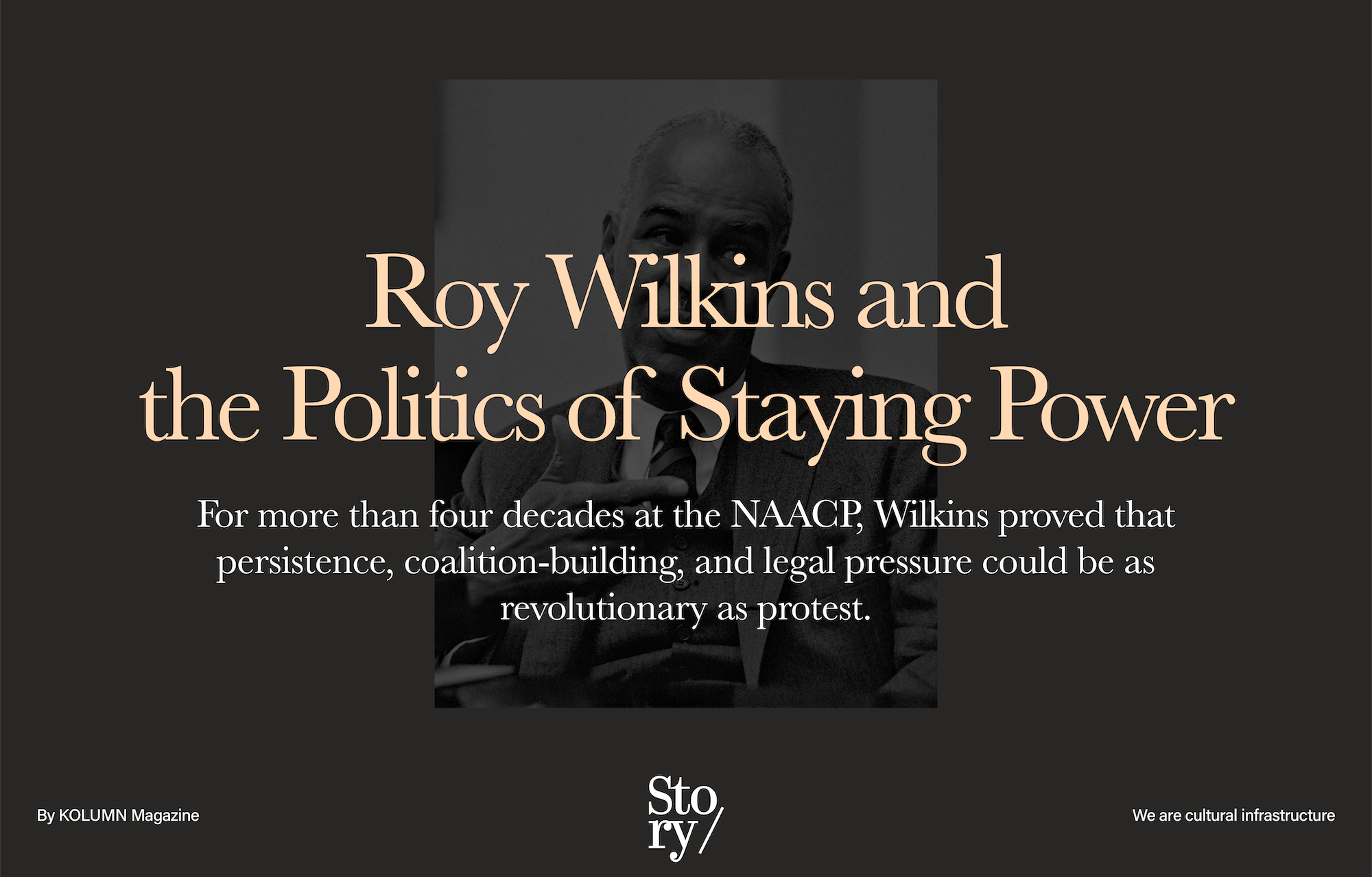
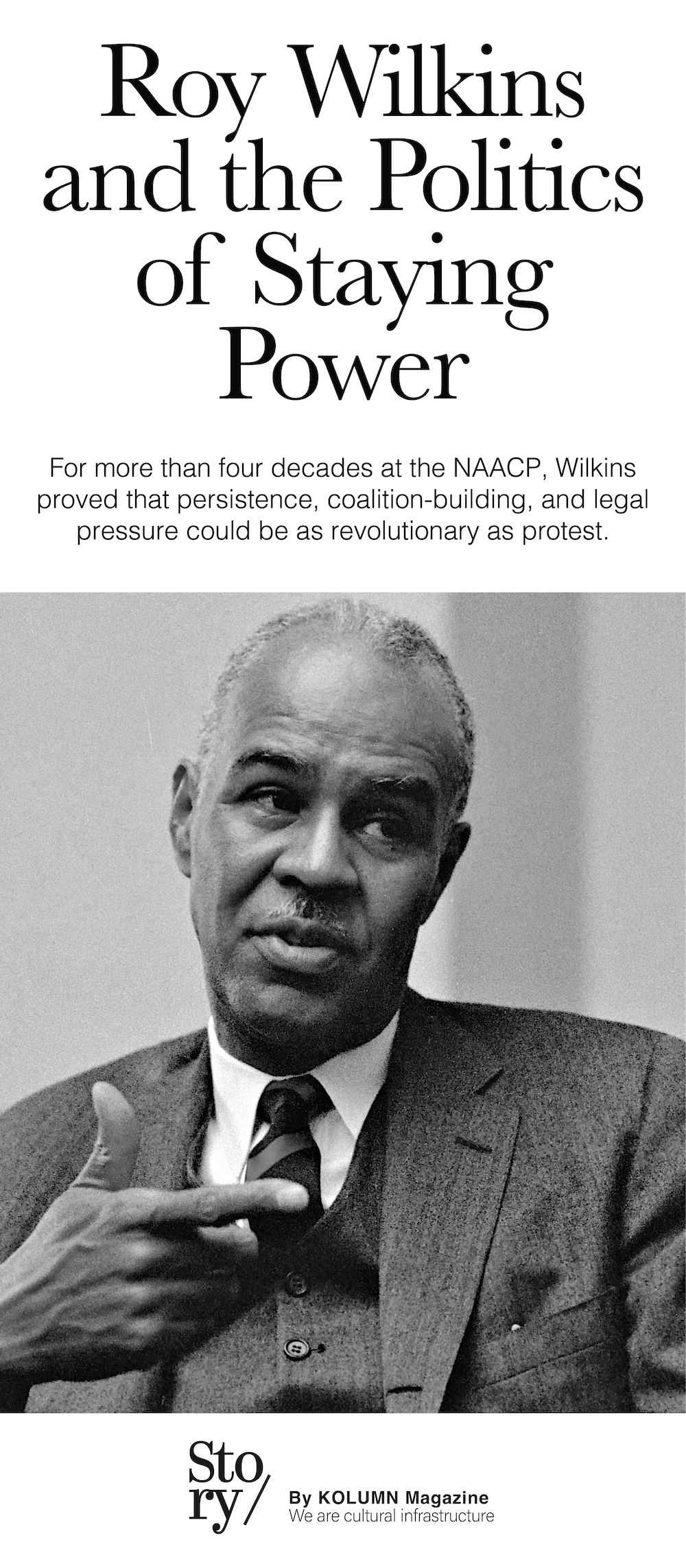
There are certain civil rights figures whose names arrive in American memory already haloed. Martin Luther King Jr. comes with the cadence. Malcolm X comes with the fire. Rosa Parks comes with the moral clarity of a single, historic refusal. Roy Wilkins usually arrives differently. He comes into the story wearing a suit, carrying briefing papers, navigating committees, leaning on presidents, editing copy, and pushing institutions to do what they had been refusing to do for generations. He is not always the first name people reach for when they tell the story of the Black freedom struggle. But that says more about the way America remembers movements than it does about Roy Wilkins’s actual importance. Wilkins was one of the movement’s master tacticians, one of its most durable institution-builders, and one of the clearest examples of how political change often depends not only on charismatic confrontation, but on disciplined, sustained pressure.
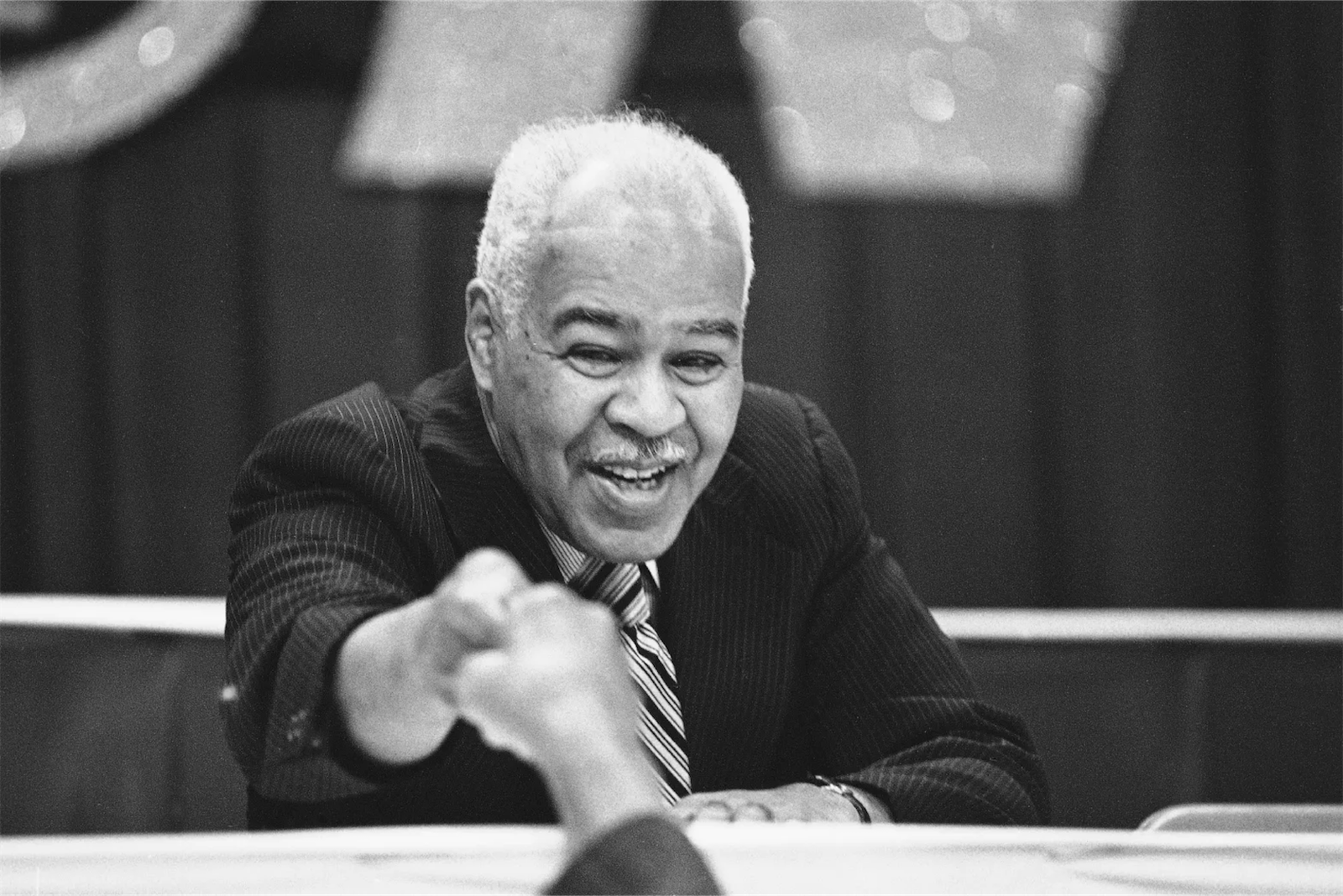
Wilkins spent more than four decades at the NAACP and led the organization from 1955 until 1977, a span that placed him at the center of the most consequential legal and legislative breakthroughs of the modern civil rights era. Under his stewardship, the NAACP helped drive the long afterlife of Brown v. Board of Education, pushed federal enforcement on school desegregation, fought for public accommodations, voting rights, and fair employment, and maintained a national branch structure that translated outrage into organized power. He was part of the March on Washington’s “Big Six,” but his significance was larger than any single march or speech. He represented something harder to romanticize and therefore easier to underrate: infrastructure.
That helps explain why Roy Wilkins still feels slightly out of phase with the popular civil rights canon. He was moderate, but not timid. He was patient, but never passive. He believed in integration, legislation, and constitutional argument with almost stubborn consistency. That made him deeply effective in one context and deeply controversial in another. Younger activists, particularly in the late 1960s, sometimes saw him as too cautious, too invested in white liberal approval, too skeptical of grassroots militancy and Black Power. Wilkins, for his part, saw racial separatism as both morally wrong and strategically disastrous. His whole life had been committed to forcing the United States to live up to its professed democratic ideals, not to abandoning those ideals as hopeless fraud. The tension between those positions is part of what makes him worth revisiting now. He was not simply a sainted elder. He was a consequential, complicated political actor in a movement that contained real disagreement about method, pace, and the meaning of freedom itself.
Before the NAACP, There Was the Newsroom
To understand Roy Wilkins, it helps to start with something that shaped both his politics and his temperament: he came to activism through journalism. Born in St. Louis in 1901 and raised largely in St. Paul, Minnesota, after his mother’s death, Wilkins did not emerge from the Deep South’s front lines in the way some other movement figures did. He came of age in the upper Midwest, attended integrated schools, studied sociology at the University of Minnesota, and worked in student and Black journalism before moving into national activism. That biographical route mattered. Journalism trained him to observe, frame, persuade, and prosecute a case before the public. It also gave him a professional respect for institutions, records, and facts. He was, in a sense, one of the civil rights movement’s great editors: a man who knew how to shape a national narrative while also minding the machinery beneath it.
His first major professional platform was the Kansas City Call, where he became editor in the 1920s. There, his journalism sharpened into advocacy. He wrote against Jim Crow, covered Black life with seriousness, and learned the practical relationship between media and political power. That background made him a natural fit for the NAACP when Walter White brought him to New York in 1931 as assistant secretary. A few years later, Wilkins replaced W.E.B. Du Bois as editor of The Crisis, the NAACP’s official magazine. Even that transition hints at his unusual place in movement history. Du Bois was prophetic, patrician, ideological, global. Wilkins was managerial, strategic, and relentlessly operational. He was not trying to become Du Bois. He was becoming Roy Wilkins, which meant turning a historic organization into a more disciplined instrument of mass democratic pressure.
There is a temptation, when writing about civil rights history, to divide leaders into clean types: the dreamer, the militant, the lawyer, the martyr, the preacher, the organizer. Wilkins doesn’t fit neatly into any one of those roles, which may be one reason he is less often mythologized. He was a journalist who became an executive. He was a public spokesman who also loved internal process. He believed in direct moral language but trusted legal strategy. He could address a crowd, but he was equally at home in negotiation with presidents, legislators, and organizational allies. In 1950 he helped found the Leadership Conference on Civil Rights, a coalition that became one of the central legislative engines behind major civil rights law. That is quintessential Wilkins: not a single symbolic act, but the construction of durable leverage.
The Long Fight After Brown
When Walter White died in 1955, Wilkins took over the NAACP at a pivotal moment. Brown v. Board of Education had been decided the year before, but anyone who thought the Supreme Court had ended school segregation with one ruling quickly ran into the brutal reality of “massive resistance,” delay, terror, and token compliance. Wilkins understood that Brown was not a finish line; it was a breach in the wall that had to be widened through enforcement, publicity, branch organizing, litigation, and national political pressure. He was among the leaders who insisted that civil rights victories meant little if the federal government would not actually make hostile states obey the law. That insistence became a throughline of his leadership.
“Every added year of such treatment is a leg iron upon our men and women.”
Wilkins’s approach to school desegregation helps explain his broader politics. In a 1958 Atlantic essay, he attacked the culture of delay surrounding desegregation, arguing that too many people kept telling Black Americans to “go slow” while denying them ordinary citizenship. He had no patience for genteel calls for gradualism that left children in Jim Crow schools and families in segregated neighborhoods. This is one of the most useful correctives to the caricature of Wilkins as merely cautious. He was cautious about tactics that he believed would backfire, but he was not cautious about equality itself. He wanted movement demands translated into enforceable state action, and he wanted that action now.
If Wilkins sometimes appeared less dramatic than other movement leaders, that was partly because the NAACP’s mode of operation was often cumulative rather than theatrical. The organization had long invested in litigation, local branches, membership drives, public education, and lobbying. Under Wilkins, that strategy did not disappear when the movement entered its most visible era; it expanded. He supported local activists under economic retaliation, including efforts to help Black communities denied credit by white-controlled banking systems. He worked to maintain national coherence across hundreds of branches while the political stakes kept rising. He had to think not only about the moral urgency of the moment, but also about organizational survival, donor confidence, legislative timing, and the federal government’s shifting willingness to intervene. That is not the glamorous side of movement history. It is often the decisive side.
The March on Washington and the Making of Federal Law
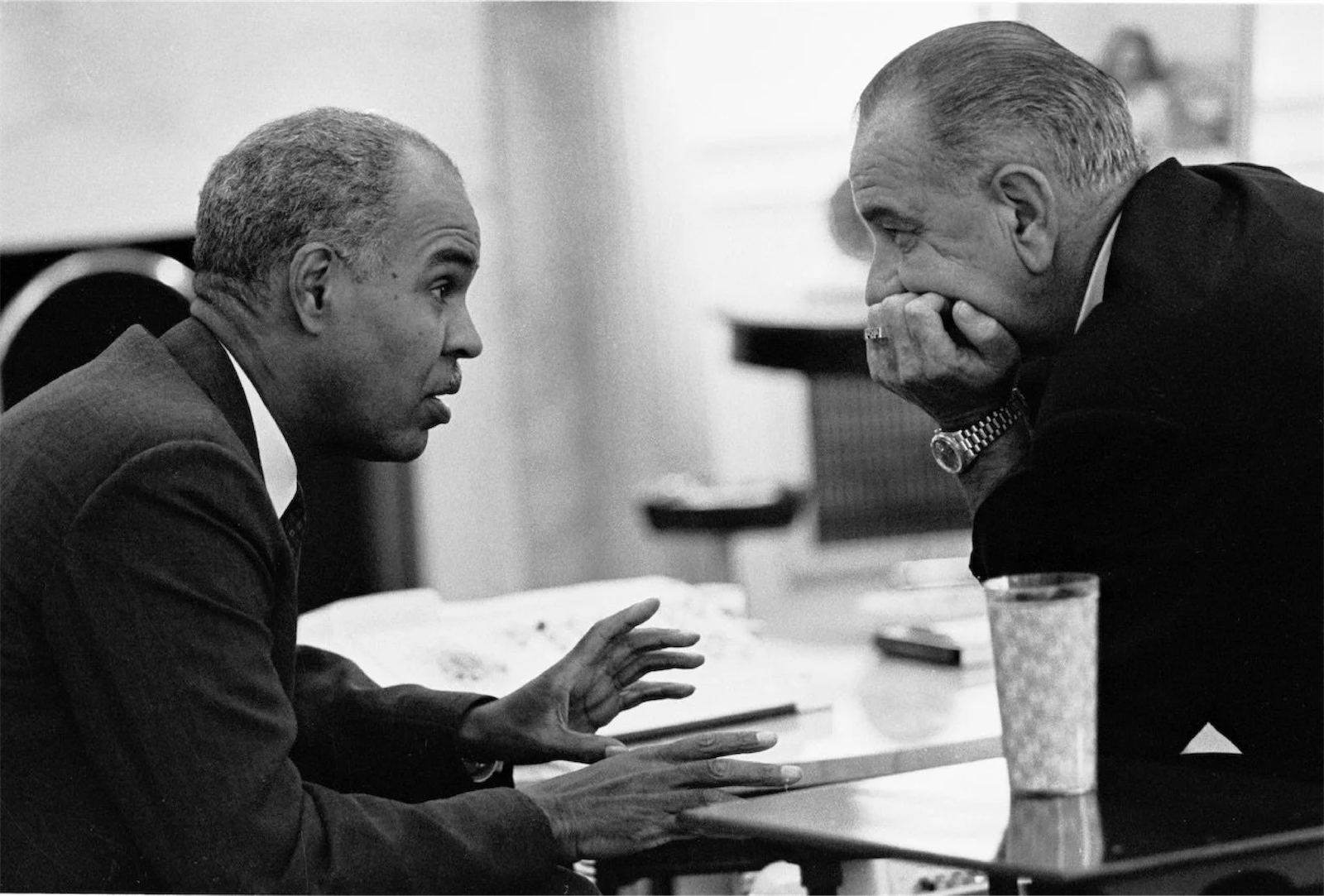
The March on Washington in 1963 is the place where many Americans most clearly encounter Wilkins, even if they do not always recognize him. He helped organize the march and addressed the crowd at the Lincoln Memorial alongside the other major leaders of the day. Public memory, understandably, has been flattened around King’s “I Have a Dream” speech. But Wilkins’s remarks were a reminder that the march was not only an exercise in uplift. It was a demand for legislation. He talked plainly about jobs, public accommodations, school desegregation, police violence, and federal enforcement. This was not abstract brotherhood; it was a list of state obligations. The Library of Congress identifies him specifically as speaking about pending civil rights legislation, and recordings of the event show just how legislative and concrete his demands were.
There was another revealing moment that day. W.E.B. Du Bois had died the previous day in Ghana. Wilkins and Du Bois had a fraught history, and Du Bois’s later radicalism had long put him at odds with the NAACP establishment. Yet Wilkins used the march to acknowledge him, telling the crowd that at the dawn of the twentieth century, Du Bois’s was the voice calling them to gather in that cause. It was a graceful act of historical placement, and also a useful reminder that Wilkins was not unaware of movement lineage or symbolism. He simply expressed those things through a different register. He was not uninterested in history’s poetry; he just kept returning to history’s paperwork.
In the years immediately surrounding the march, Wilkins was working the federal relationship as hard as anybody in the movement. He could be scathing when presidents dodged the issue. A Washington Post review of his autobiography notes that he felt disappointed especially by Franklin Roosevelt and Dwight Eisenhower, while responding more favorably to Harry Truman’s willingness to act and to the eventual commitments of John Kennedy and Lyndon Johnson. That pattern matters. Wilkins was neither a blind loyalist nor a purist outsider. He pressured, criticized, collaborated, and extracted. He judged presidents by whether they would use federal power to move civil rights from rhetoric into law.
His relationship with Kennedy is a good example. Wilkins grew frustrated when Kennedy relied on executive action and delay rather than immediately pursuing broad civil rights legislation. But once Birmingham and Jackson made the crisis undeniable and Kennedy embraced a sweeping bill, Wilkins recognized the shift. Later, with Johnson, he found the kind of presidential intensity he had long wanted. Johnson pushed the Civil Rights Act of 1964 with extraordinary force, and Wilkins was one of the civil rights leaders closest to that legislative grind. According to the Post’s account of Standing Fast, Wilkins regarded the 1964 law as a “Magna Carta for the race,” language that captures both his historical sensibility and his profound investment in federal statute as a tool of Black freedom.
The same was true of the Voting Rights Act of 1965. Wilkins had spent years fighting over disenfranchisement and federal reluctance. When Johnson finally put the force of the presidency behind voting rights after Selma, Wilkins understood the scale of the moment. Jack Valenti later recalled that after the act passed, Wilkins told him that “God does move in strange and wondrous ways,” marveling that the most effective friend Black Americans had in that hour turned out to be a Southern president. Whatever one makes of that formulation, it reveals something essential about Wilkins’s political worldview: he believed in using the state, believed in surprising coalitions, and believed that democratic institutions, under sufficient pressure, could be made to deliver history-altering change.
Where Wilkins Clashed With a New Generation
That belief also helps explain the criticism he drew. By the mid-1960s, a younger generation was increasingly impatient with appeals to American ideals, bipartisan respectability, and integrationist language. The violence movement workers faced in the South, the slower-moving realities of the North, and the persistence of poverty and police abuse made legal victories feel incomplete. Stokely Carmichael’s call for Black Power electrified many who saw moderation as exhausted. Wilkins responded harshly. He argued that Black Power, however explained, carried antiwhite and separatist implications. In one of his bluntest formulations, he called it “a reverse Mississippi, a reverse Hitler, a reverse Ku Klux Klan.” For supporters of Black Power, this sounded reactionary and unfair. For Wilkins, it was a logical extension of everything he had spent his career rejecting: the moral legitimacy of race hierarchy, whether imposed by whites or mirrored in separatist form.
“We of the NAACP will have none of this.”
This is the point in Roy Wilkins’s story where easy celebration stops being enough. He was right about some things and limited on others. He was right that separatism could become politically self-defeating, that institutions matter, and that federal law changes lives. He was right that white supremacy is not defeated by inverting its racial logic. But he was also less able than some of his younger contemporaries to absorb the emotional and strategic force of Black Power as a language of self-determination, frustration, and political autonomy. He sometimes treated militancy as mere recklessness rather than as a response to the limits of liberalism and the exhaustion of asking politely. That tension does not cancel his legacy. It makes it more historically honest.
The same mixed assessment applies to his relationship with grassroots organizing. Wilkins valued local branches and knew the importance of national membership, but he could be wary of decentralized protest cultures that did not fit the NAACP’s preferred modes of discipline and message control. Scholars of the period have noted that he hesitated to commit the association too fully to civil disobedience or to bottom-up organizing styles associated with SNCC. He was more comfortable with coalition politics anchored to national institutions and the liberal wing of the Democratic Party. That preference gave the NAACP durability and access. It also left Wilkins vulnerable to the charge that he underestimated insurgent energy until it forced itself onto the national agenda.
Still, one of the laziest habits in civil rights storytelling is to set “moderates” and “militants” against each other as if only one side moved history. In reality, figures like Wilkins often became more effective because the movement contained a wider spectrum of pressure. Federal officials who found Wilkins responsible and manageable were often responding in the shadow of far more disruptive forces. Wilkins knew this, even when he disliked the rhetoric or tactics involved. The movement’s ecosystem included courtroom lawyers, clergy, students, labor leaders, field organizers, editors, donors, local branch presidents, and national executives. Wilkins was not the whole movement. He was one of its indispensable coordinators.
The Black Press, the Cold War, and the Politics of Respectability
His own self-presentation contributed to the way history has treated him. Wilkins was not especially interested in performing radical glamour. He once noted that he had a reputation for being “a quiet, rather boring fellow,” but the line is almost too modest. Quiet, yes. Boring, not at all. The record shows a man who traveled relentlessly, handled endless organizational conflict, engaged seven presidents, defended the Scottsboro Boys, went to jail in Mississippi with Medgar Evers, and spent half a century at the nerve center of the Black freedom struggle. The absence of theatrical flourish should not be mistaken for the absence of courage or imagination. It simply means his style of courage was procedural as well as public.
It is also worth remembering how much Wilkins’s work was shaped by the Black press. Before he was a national executive, he was a newspaper man. That mattered because the Black press had long served as one of the movement’s most important civic infrastructures: documenting lynching, circulating strategy, legitimizing demands, and building a shared political vocabulary across regions. Word In Black’s retrospective on Walter White points out that White and, later, Wilkins belonged to a lineage in which journalism and civil rights leadership were deeply intertwined. Wilkins did not leave journalism behind when he joined the NAACP. He brought its habits with him: the instinct to define the issue, marshal evidence, and force a wider public to confront what it preferred not to see.
That lineage also helps explain Wilkins’s skill as a public explainer. When he spoke, he often translated structural injustice into accessible civic language. Listen to his March on Washington remarks and one hears a man who understood that a movement needed not only moral witness but crisp argument: about schools, jobs, law enforcement, housing, and the responsibilities of Congress. Even his sarcasm could be razor-sharp. In the march speech, he mocked special exemptions for discriminatory lodging owners by noting that if someone opened their doors to the public, they might encounter not only a Black traveler but also “a white procurer or a white embezzler too.” It was classic Wilkins: dry, legalistic, funny, and absolutely unwilling to let segregation hide behind the language of private preference.
For all his investment in domestic law, Wilkins was also shaped by the wider ideological pressures of the Cold War. He believed strongly in American democratic ideals and was deeply hostile to communism within or around the movement. This position aligned him with mainstream liberal anticommunism and, in some cases, put him sharply at odds with Black radicals such as Paul Robeson and the later Du Bois. Defenders would say he understood the political environment and kept the NAACP viable in an era when any whiff of communism could be weaponized to destroy civil rights organizations. Critics would say he sometimes accommodated that environment too readily. Both arguments contain truth. Wilkins’s anti-communism was not incidental; it was part of how he understood citizenship, legitimacy, and the route to reform.
His stance on Vietnam similarly exposed the limits of his liberal consensus politics. While many civil rights leaders and activists grew more critical of the war, Wilkins remained supportive of Lyndon Johnson’s policy for much of the conflict, a position scholars have noted set him apart from large parts of the broader freedom movement. For Wilkins, foreign policy and military service could still be framed through a rights-bearing conception of citizenship. For others, Vietnam made the contradictions of American democracy impossible to ignore. Here again, Wilkins appears as a figure whose strengths in one political era did not automatically transfer to every new crisis of the next.
Citizenship Was His Core Argument
Yet even where his judgment is contestable, his seriousness is not. Roy Wilkins kept returning to the same bedrock claim: Black Americans were citizens, not supplicants. They were not punctuation marks in some legislative theory, as he later put it in his autobiography, but people entitled to dignity, protection, and equal standing under the law. That kind of citizenship language can sound restrained today compared with the bolder vocabularies of abolition, liberation, or decolonization. But in Wilkins’s era, insisting that the Constitution and Declaration of Independence apply fully to Black people was neither small nor safe. It was a frontal challenge to the lived architecture of American apartheid.
“I would die believing in our country and our Constitution.”
By the time Wilkins retired from the NAACP in 1977, the country had changed dramatically from the one he had entered as a young organizer. Legal segregation had been dismantled. Major civil rights statutes had passed. Voting protections had expanded. Federal enforcement, however inconsistent, was now a central expectation rather than an absurd dream. None of that happened because of Roy Wilkins alone, and he never should be treated as a solitary hero standing above a mass movement. But it also did not happen without people like him: leaders who could keep organizations alive for decades, survive ideological quarrels, maintain donor and branch confidence, translate local suffering into national demands, and stay in the fight long enough to see laws change. The NAACP honored him as Director Emeritus after his retirement, and his autobiography, Standing Fast, was published posthumously in 1982.
His death in 1981 closed one of the longest continuous leadership arcs in twentieth-century Black politics. Britannica notes that he was often called the “senior statesman” of the civil rights movement, a label that can sound dusty until one pauses over what it actually means. Wilkins became a senior statesman not because he was establishment in the shallow sense, but because he endured. He belonged to the generation that carried the struggle from anti-lynching battles and the Scottsboro era into the age of Brown, the March on Washington, and the landmark legislation of the 1960s. He is one of the few figures whose career spans so much of the movement’s institutional development.
Why Roy Wilkins Still Matters
The challenge of remembering Roy Wilkins is that his legacy does not fit comfortably into a culture that prefers either saints or rebels. He was neither. He was a democratic strategist with a reformist faith so intense it could look conservative beside revolutionary impatience. He believed America could be shamed, lobbied, sued, organized, and legislated into being better. He believed in integration not as etiquette but as equal citizenship. He believed federal power, properly used, could protect Black life. He believed that institutions mattered enough to be fought over rather than abandoned. Those beliefs can sound almost quaint in a time of broad institutional distrust. But the history he helped make is a stubborn argument that institutions, however compromised, remain terrain worth contesting.
And this may be why Roy Wilkins matters so much right now. We live in a political moment saturated with visibility, reaction, and rhetorical maximalism. Wilkins reminds us that movements also need administrators, coalition-builders, policy obsessives, and people willing to spend years doing the unromantic work of implementation. He reminds us that outrage without infrastructure burns hot and fast. He reminds us, too, that moderation is not automatically moral and militancy is not automatically wise; both have to be judged against results, ethics, and historical conditions. Most of all, he reminds us that the struggle for Black freedom has always required multiple tempos at once: urgency in the streets, patience in the courts, discipline in organizations, and imagination in public life. Wilkins supplied one of those tempos with unusual consistency.
There is a reason his story keeps resurfacing whenever people return to the mechanics of the movement rather than only its mythology. The NAACP page on his life emphasizes that he spent more than forty years with the organization and twenty-two as its top leader. That span is not just a résumé line. It is a measure of trust, stamina, and historical centrality. The Root’s capsule history places him among the leaders whose tenure helped produce Brown, the Civil Rights Act, and the Voting Rights Act. Word In Black places him within the Big Six and the broader Black press tradition that helped sustain the freedom struggle. The Washington Post’s reflections on his life and autobiography capture the striking combination of modest manner and immense consequence. Taken together, those portraits show a figure who may never dominate posters or movie scenes in the way others do, but who remains impossible to remove from the architecture of modern American democracy.
Roy Wilkins did not offer America the most electrifying version of civil rights leadership. He offered something rarer: a durable one. He believed that citizenship had to be made real in statute, enforcement, and daily life. He spent decades testing whether the nation’s founding documents were merely ceremonial or could still be forced into service of justice. He did not always read the future perfectly. He did not satisfy every wing of the movement. He was sometimes too wary, sometimes too tied to liberal respectability, sometimes too dismissive of radical impatience. But he was also one of the people who helped make it possible for the movement’s moral thunder to become federal law. That is no small legacy. It is one of the central legacies of the era.
In the end, Roy Wilkins’s life argues for a more mature way of telling civil rights history. Not every giant arrives with a dream sequence. Some arrive with minutes from a meeting, a coalition memo, a speech draft, a magazine editorial, a call to the White House, and a lifetime of insisting that Black Americans are owed the full protection of the republic. The movement needed prophets. It also needed Roy Wilkins.
More great stories
Afro Sheen, Wall Street, and the Architecture of Black Possibility
July 6, 2026
No Comments
The Fire Inside the Fourth
July 5, 2026
No Comments