



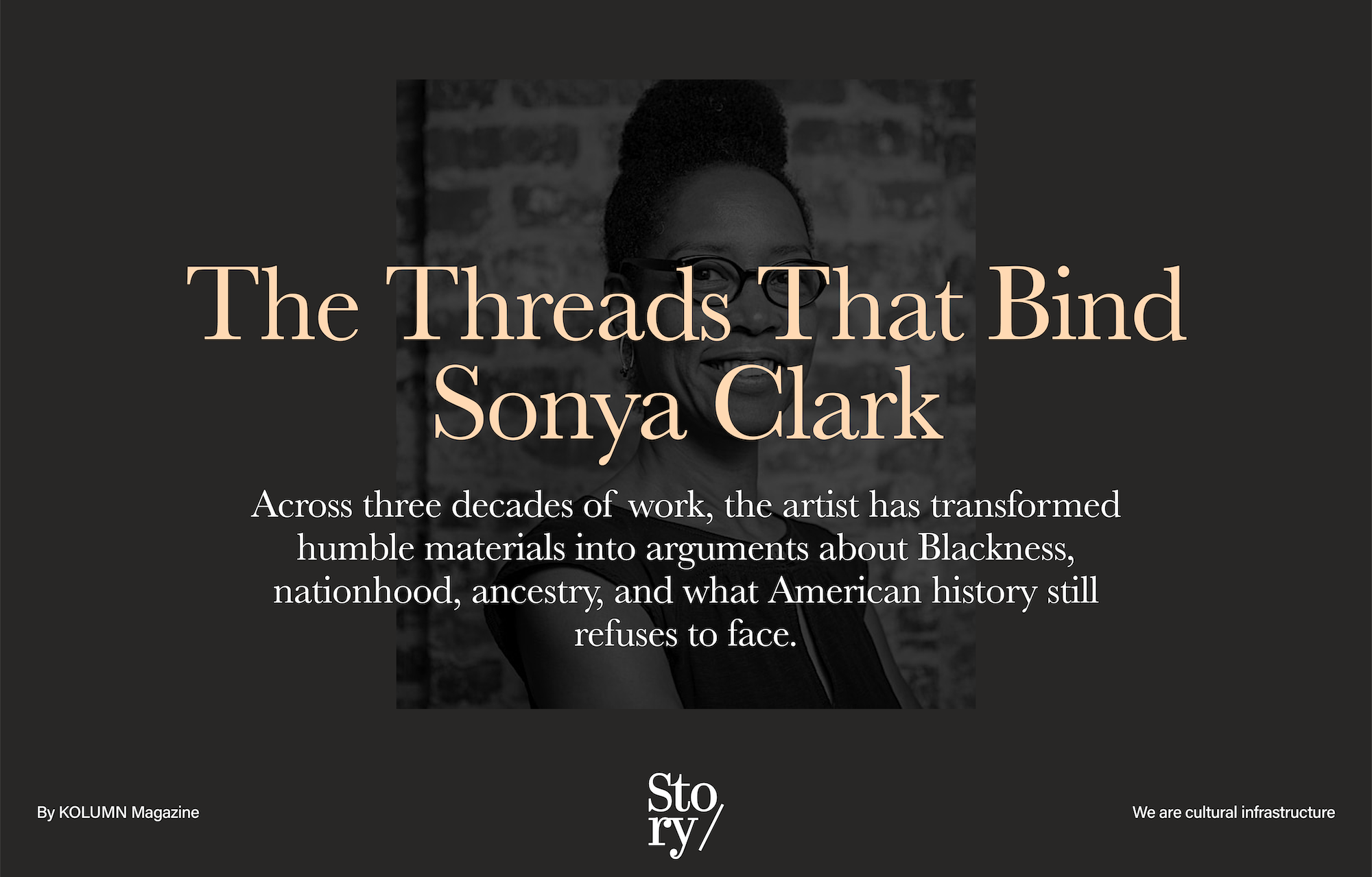
I value the stories held in objects.
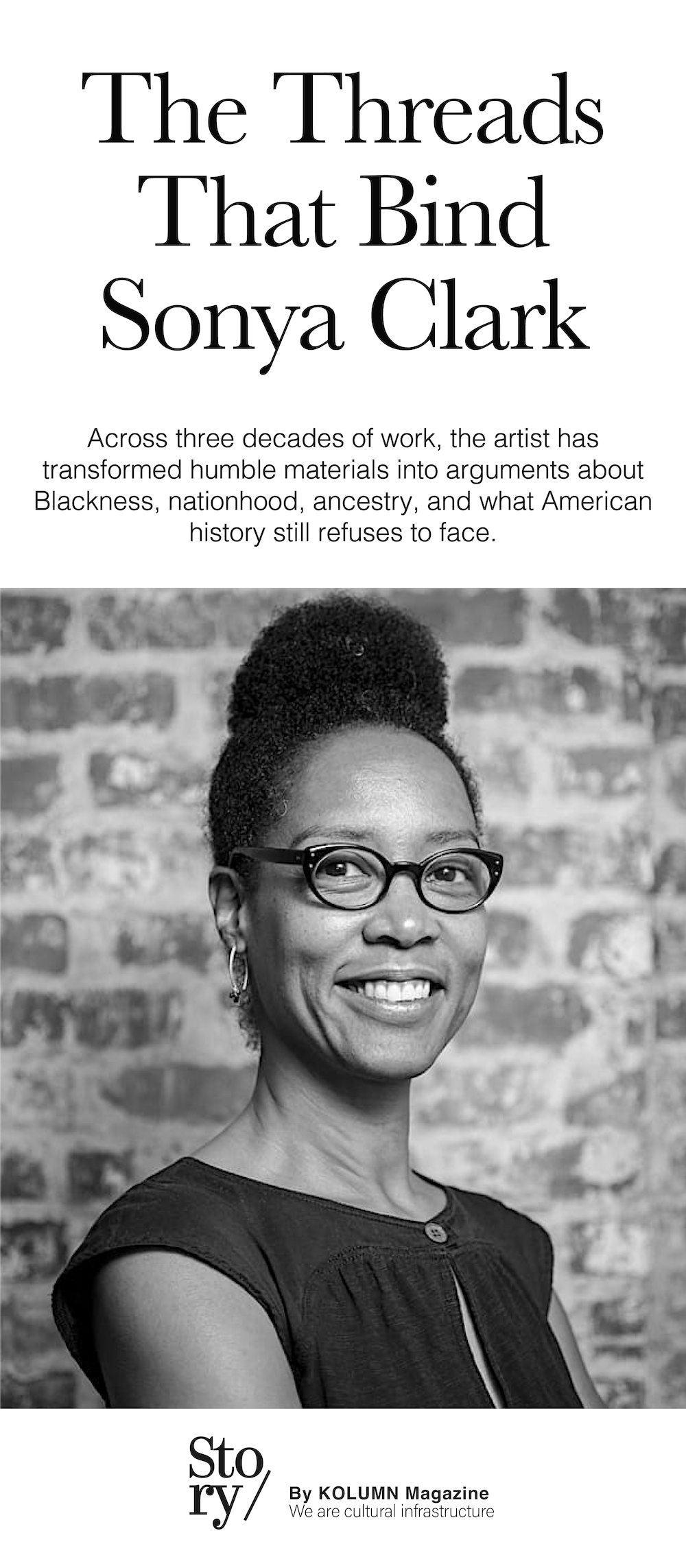
I value the stories held in objects.
By KOLUMN Magazine
There are artists who specialize in image. There are artists who specialize in scale. There are artists who specialize in seduction, turning materials into atmosphere so persuasive that the viewer almost forgets to ask what the work is actually doing. Sonya Clark belongs to another category entirely. She specializes in meaning under pressure. Give her a comb, a bead, a cotton boll, a flag, a strand of hair, a chair, a length of cloth, a relic from the American archive, and she will worry it until it speaks. Not decoratively. Not politely. She makes objects confess.
That is one way to understand Clark’s significance: she is among the most incisive contemporary American artists working with the so-called minor materials of everyday life, and she has spent decades proving that those materials are not minor at all. Hair carries race and intimacy. Thread carries labor. Cloth carries nationhood. Combs carry beauty culture, commerce, and class. A towel can carry surrender. An object, in Clark’s practice, is never merely itself. It is also a social record, a historical witness, a cultural code, and occasionally a trap door into the buried story beneath the official one.
Clark was born in Washington, D.C., in 1967, and has described herself as the daughter of a Trinidadian psychiatrist and a Jamaican nurse. She has also repeatedly pointed to the handmade knowledge in her family, especially the influence of her maternal grandmother, a professional tailor, as central to how she learned to value craft, skill, and the stories held inside objects. The National Museum of Women in the Arts situates her work within race, visibility, Blackness, and historical redress; the High Museum frames her career as a sustained engagement with the African diaspora and with the social power of making. Those are museum phrases, yes, but they fit because they name something real: Clark’s work has long operated at the intersection of beauty and evidence.
That sentence, simple as it is, helps explain why Clark matters. She is not just making sculptures, installations, and participatory works. She is changing the terms under which viewers encounter American history. She asks people to look again at the familiar national symbol, the inherited social ritual, the discarded material, the ordinary tool. Then she reveals that “ordinary” is often just a word for histories we have stopped noticing.
The making of an artist, and the making of her method
Clark’s formal education moved across disciplines in a way that now seems almost inevitable for the kind of artist she became. In her 2022 oral history with the Smithsonian’s Archives of American Art, she said she earned a bachelor’s degree in psychology from Amherst College, while also taking many Black Studies courses, then completed a BFA at the School of the Art Institute of Chicago and later pursued graduate study at Cranbrook Academy of Art. Her official biography and gallery materials confirm that educational arc, as well as her later academic career, including her long tenure at Virginia Commonwealth University and her current role as Professor of Art at Amherst College.
That training matters because Clark’s work does not come from only one lineage. She is a fiber artist, yes, but that description is too small if read narrowly. The psychology background sharpens her sensitivity to human behavior, projection, bodily coding, and social reading. Her art-school and craft training gave her command of material languages often marginalized by fine-art hierarchies. Her relationship to Black Studies helped ground her in history, diaspora, and power. When she says in the oral history that formal education does not capture everything important to her, she is also naming something essential about her practice: it was shaped by schools, but also by family, Black cultural knowledge, diasporic inheritance, and the embodied intelligence of makers whose work is too often excluded from canonical art history.
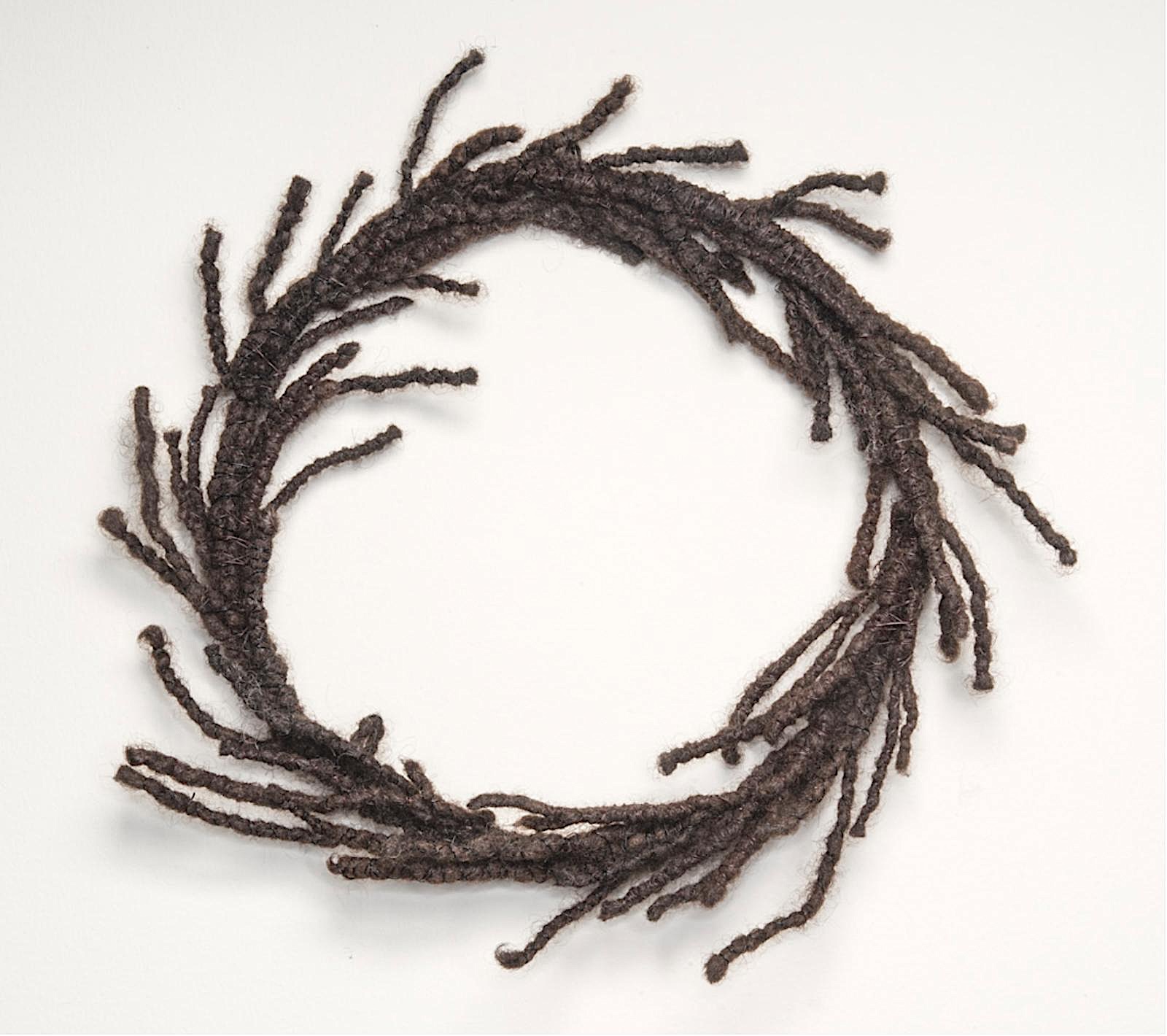
This is part of why Clark’s art often feels at once scholarly and intimate. It can withstand the weight of curatorial theory, but it never loses touch with touch itself. You see it in the way she thinks through textiles and hair not as abstract symbols but as substances tied to the body. In the oral history, Clark describes hair as “the fiber that we grow,” a remark that sounds almost offhand until you realize how much it unlocks. Hair is biological and cultural, public and private, sensual and political. It is DNA and style, inheritance and self-fashioning. It can mark belonging; it can trigger discrimination; it can be cherished, policed, cut, saved, displayed, or hidden. Few contemporary artists have worked that terrain with Clark’s conceptual range.
Before Clark became widely recognized as a major contemporary artist, she was already assembling the intellectual architecture of her career: a refusal of the false division between art and craft, and an insistence that the handmade carries philosophy as surely as any painted canvas or cast bronze. In a 2021 interview, she discussed labor, collaboration, and the “false hierarchy” between art and craft. That phrase matters because her career has been, in many ways, a sustained rebuttal to cultural systems that trivialize the traditions most associated with women, Black communities, domestic labor, beauty work, and vernacular making.
Combs, cotton, hair: the politics inside everyday materials
One of Clark’s signature achievements has been her ability to elevate everyday Black material culture without domesticating it. The pocket comb, for instance, becomes in her hands something far bigger than a grooming tool. The Washington Post noted as early as 2011 that Clark transformed drugstore combs and thread into sculptural forms reminiscent of kente cloth, locating an object of ordinary use inside a transatlantic visual and political conversation. The point was never simply formal cleverness. Clark understood that a comb is a design unit, a social artifact, a commodity, and a racialized object. In multiplication, it becomes both pattern and argument.
At NMWA, museum materials emphasized how Clark’s survey Tatter, Bristle, and Mend brought together black pocket combs, human hair, thread, flags, currency, cotton plants, books, typewriters, and a hair salon chair. That inventory is revealing in itself. These are objects tied to labor, literacy, body politics, domesticity, Black enterprise, nationhood, and the afterlife of slavery. Clark’s choice of materials is never random. Even when the work first seduces by craft and design, the social charge is already there, waiting for the viewer to catch up.
Consider a work like Cotton to Hair, held by NMWA, in which cotton and Black hair meet in a single sculptural proposition. The juxtaposition is elegant, but it also lands with force. Cotton is not neutral in the American imagination; it is inseparable from plantation labor, enslavement, extraction, and national wealth. Hair, too, is not neutral, especially Black hair, which carries the burden of beauty norms, employment discrimination, desirability politics, and resistance. To place cotton and hair into relation is to stage a compressed history of Black labor and Black embodiment in America. The work does not need to scream. Clark rarely does. She lets the materials make the indictment.
She has also used hair to honor Black figures and Black forms of expertise. NMWA notes that Clark is especially known for artworks that honor craftspeople such as hairdressers and notable African American figures including Madam C.J. Walker and Barack Obama. Smithsonian reporting on her large-scale comb portrait of Walker in Indianapolis makes the case even more directly: the combs speak to Walker’s career in hair care while also invoking the national politics of Black hair, labor, and the low status historically assigned to African American women’s work. Clark turns that hierarchy inside out. The “low” material becomes monumental. The dismissed labor becomes a site of brilliance.
This is where Clark’s art feels especially sharp. She does not merely represent Black history; she re-materializes it. She uses objects implicated in that history, so that the work carries the residue of lived experience. A comb remembers touch. Hair remembers the body. Cotton remembers the field. Thread remembers repair. When Clark assembles these things, she is not illustrating a thesis. She is making a counter-archive.
Hair as archive, hair as language
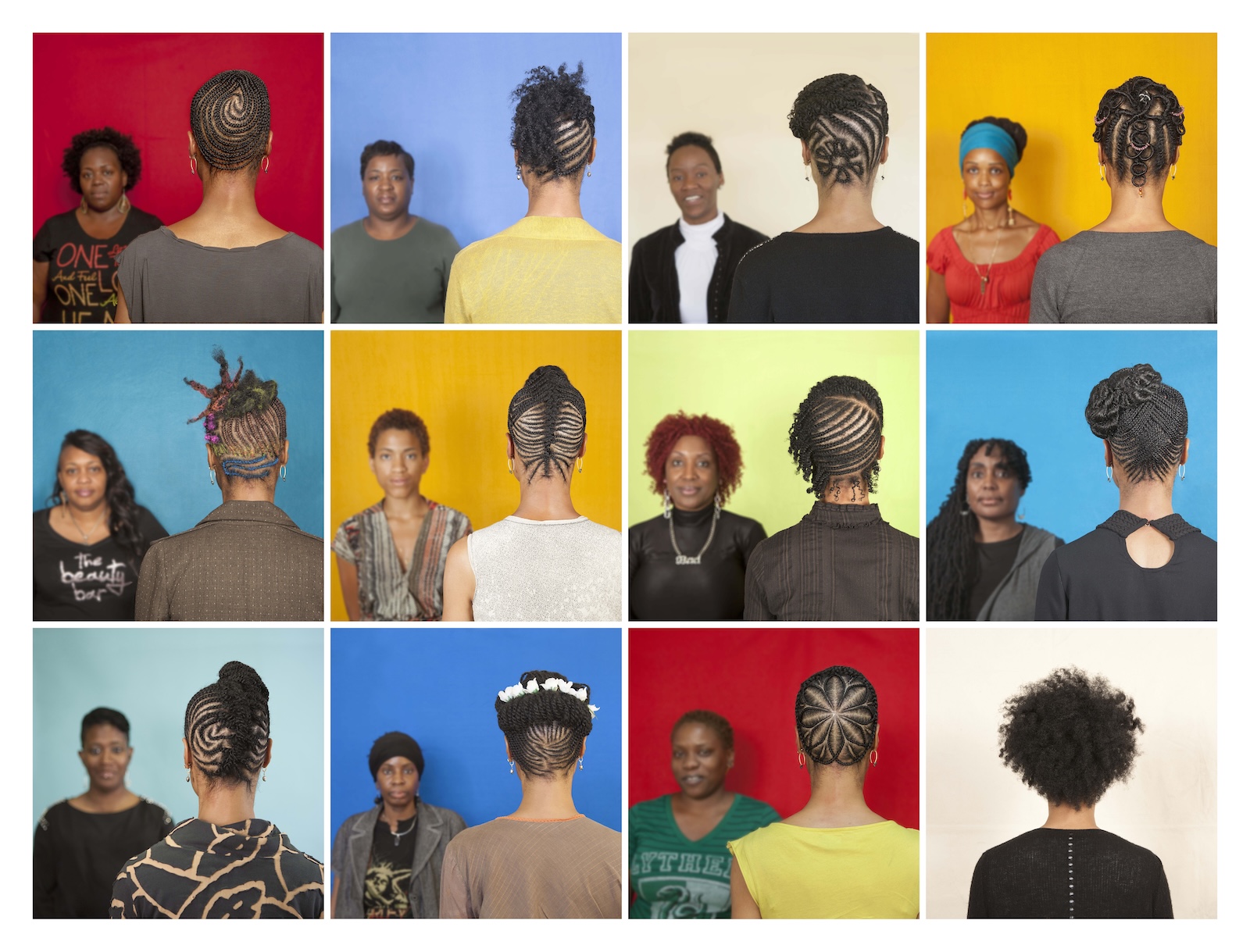
If there is one material that has given Clark a singular place in contemporary art, it may be hair. Not because no one else has used it, but because few artists have worked through its contradictions with such sophistication. In the Smithsonian oral history, Clark explains hair as both connective and divisive: something encoded with ancestry and common humanity, yet repeatedly used to sort people into racial categories and social hierarchies. That double logic is key to her art. Hair is intimate enough to feel almost too personal for public display, and public enough to become a battleground for law, labor, fashion, and belonging.
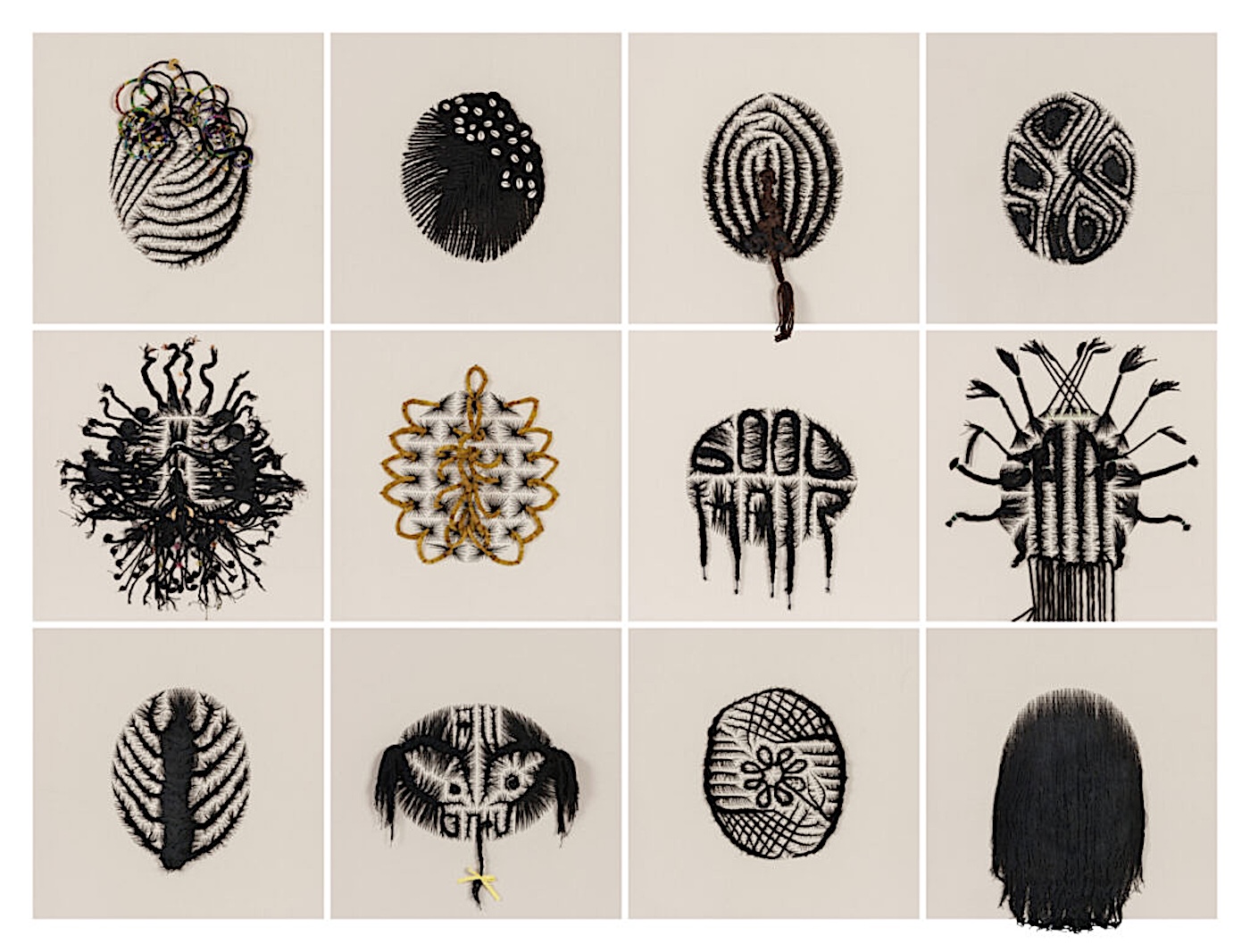
Clark’s Hair Craft Project makes this politics wonderfully explicit. According to the High Museum, the project was a collaboration with Black hairstylists, whom Clark claims as fellow textile artists. Using her own head as canvas, she worked with stylists in a way meant to break down the barrier between hair salons and art institutions as sites of craft, improvisation, aesthetics, and commerce. It is a deceptively radical move. Museums have long celebrated the “artist’s hand” while ignoring the virtuosity of Black beauty labor. Clark collapses that distinction. The salon becomes studio. The stylist becomes artist. The body becomes both subject and site.
That move also sits inside a broader Black feminist argument, whether Clark states it that way or not: much of the most intellectually rich and aesthetically refined work in Black life has happened in spaces not traditionally validated by elite art discourse. Kitchens, churches, porches, workshops, sewing rooms, barbershops, beauty salons. Clark’s practice keeps returning to those zones of undervalued expertise. She does not “elevate” them so much as reveal that they were already elevated; the culture just refused to look closely.
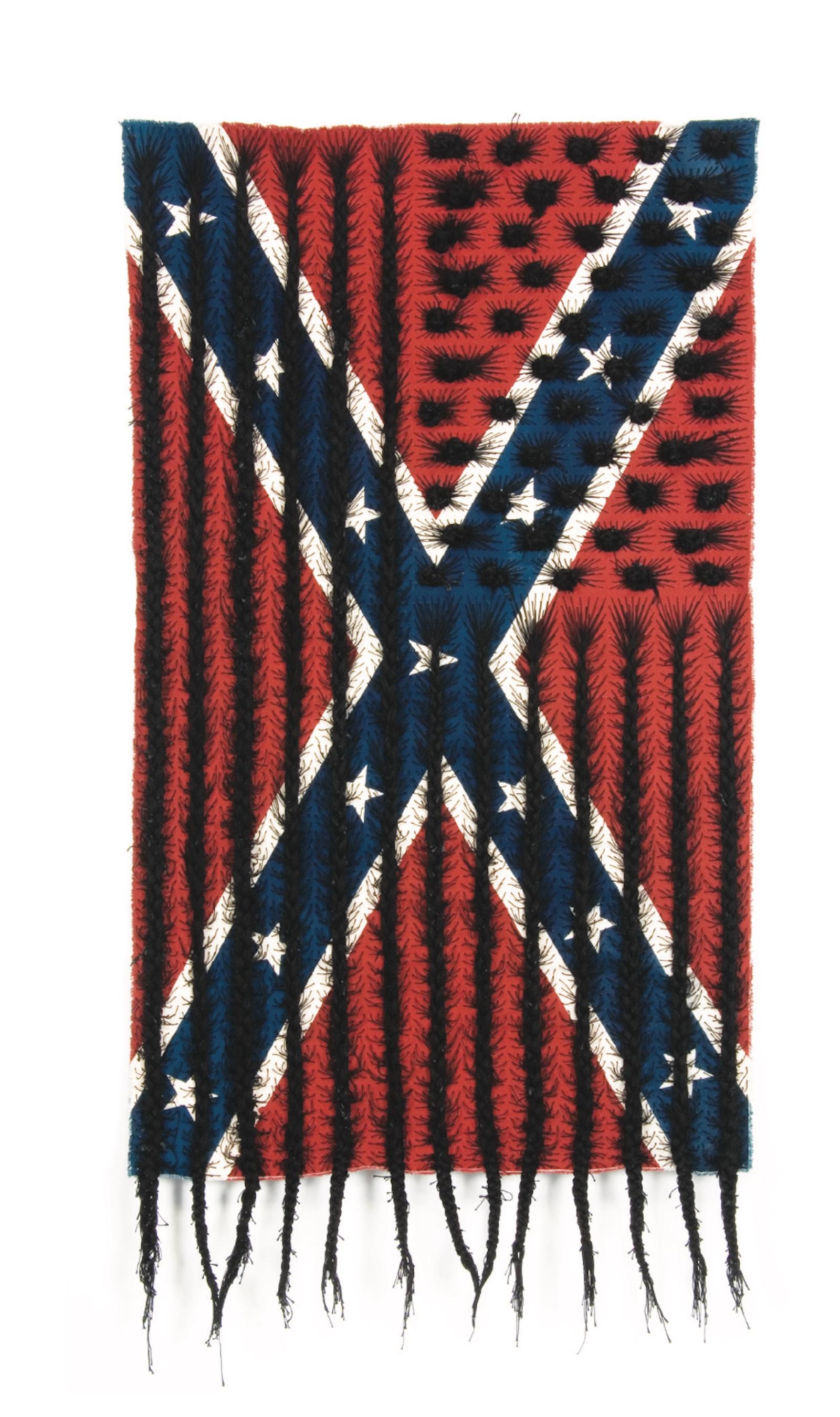
The Root’s early coverage of Black Hair Flag caught part of this dynamic, even if in a lighter register. The publication described a Confederate battle flag sewn through with Black hair, with cornrows forming stripes and Bantu knots standing in for stars. That alone tells you a lot about Clark’s method. She is able to seize an emblem of white supremacy and rework it through Black bodily knowledge and Black aesthetics, forcing the symbol into a confrontation with the very people it was built to subordinate. It is reclamation, yes, but not the soft kind. It is more like ideological sabotage via beauty culture.
In Sonya Clark’s art, Black hair is not just style. It is theory, testimony, and resistance made visible.
There is another layer here too: Clark treats hair as a medium that exposes the instability of the categories people use to police one another. In her oral history, she reflects on how hair can connect us genetically even as it becomes the basis for racial separation. That is a profound conceptual hinge. Hair lets Clark work on the fault line between sameness and difference, reminding viewers that what societies racialize is often biologically trivial and politically devastating.
Unraveling the Confederacy, thread by thread
If Clark has a breakout theme in the broader public imagination, it is likely her sustained engagement with Confederate symbols. This is not accidental. Few artists have found a more powerful way to interrogate the persistence of Confederate iconography in American life. Clark does not just condemn the symbol from a safe distance. She enters it materially. She unweaves it. She remakes it. She gives the flag back its substance so she can strip away its myth.
The Atlantic noted in 2015 that Clark had begun Unraveling, a work involving the painstaking removal of threads from a Confederate flag, before the Charleston church massacre that year, and that the work took on an even more urgent resonance after the killings and South Carolina’s removal of the flag from state grounds. That timing matters. Clark was not opportunistically reacting to the news cycle. She had already identified the Confederacy’s continued symbolic power as a live problem in American public culture. Charleston only made undeniable what Black Americans already knew: these emblems were not heritage in the abstract. They were active instruments of intimidation and grief.
Unraveling is compelling because it literalizes a national desire many Americans claim to share while rarely performing: the wish to dismantle white supremacy. Clark does not remove the flag through spectacle or destruction alone. She undoes it slowly. Laboriously. Thread by thread. The action feels ceremonial, patient, almost devotional, but the politics are ruthless. There is no shortcut. If a nation is woven from violence, then unmaking part of that violence will also take work. Her process becomes a civics lesson most politicians are too timid to teach.
Clark extended that inquiry through Monumental Cloth, The Flag We Should Know, a 2019 exhibition at The Fabric Workshop and Museum. The exhibition centered on the Confederate Flag of Truce used at Appomattox, a simple dishcloth that signaled surrender and helped broker peace at the end of the Civil War. Museum materials describe Clark’s project as a role reversal: elevating the truce flag as a monumental alternative to the more familiar Confederate battle flag, and asking what it would mean if the symbol Americans remembered was not the banner of rebellion but the cloth of surrender.
This is classic Clark: a historical intervention accomplished by reframing an object. The battle flag endured because propaganda, nostalgia, Lost Cause mythology, and racist politics kept it visible. Clark’s answer is not only to criticize that endurance, but to propose another visual memory. What if the true emblem of the Confederacy was not swagger but defeat? Not mythic martial pride, but capitulation? Not red spectacle, but a plain dishrag used to stop the killing? The conceptual elegance is almost brutal.
The Smithsonian American Art Museum has since placed Monumental in the Renwick conversation about craft and civic meaning, and Smithsonian writing quotes the question at the heart of the piece: what if this flag of truce were the flag Americans actually knew? It is one of the smartest public-history questions an artist has posed in recent years, because it goes beyond denunciation and into symbolic reconstruction. Clark is not just tearing down one memory. She is building another.
Collaboration, community, and the refusal of the solitary-genius myth
Though Clark is often discussed through her material choices, another major part of her significance lies in how deeply collaborative her practice can be. This is especially evident in projects like The Beaded Prayers Project, which the High Museum describes as a long-term participatory artwork involving more than five thousand people in dozens of countries. Participants create prayer packets or amulets containing written hopes or prayers. The project emerges from Clark’s research into the shared etymology of “bead” and “prayer,” but more importantly, it rejects the idea of art as a sealed object produced by a lone genius.
That rejection is not incidental. It is ideological. Clark’s work often honors collective making, distributed care, and inherited technique. These are values historically downgraded in Western art discourse, which prefers the signature gesture, the singular breakthrough, the heroic innovator. Clark’s art offers another model: meaning can be accumulated, shared, and built through participation. Art can operate like social fabric, not just visual commodity.
The same is true of We Are Each Other, the recent exhibition co-organized by the High Museum, Cranbrook Art Museum, and the Museum of Arts and Design. The exhibition frames Clark’s career around collective accountability and a shared colonial past, presenting the title itself as both declaration and invitation. That phrasing gets at something core in her work. Clark is not interested in making viewers feel cleanly detached from history. She presses toward entanglement. We are implicated in one another. We inherit one another’s structures. We are shaped by what prior generations built, denied, repaired, and ignored.
Sonya Clark’s art refuses innocence. It asks not only what happened, but who benefits from forgetting.
That ethical dimension is one reason her work resonates beyond the gallery. It is visually persuasive, yes, but also civic-minded in a serious way. It asks the viewer to do something harder than admire: to reckon.
Rewriting the national script
Clark’s most recent major public work only reinforces how persistent her concerns have been. In 2024, The Guardian and The Washington Post both covered The Descendants of Monticello, her installation at Philadelphia’s Declaration House. The project filled the building’s windows with blinking eyes of descendants of people enslaved at Monticello, including descendants of the Hemings family, visually repopulating a site associated with Thomas Jefferson and the writing of the Declaration of Independence. Clark told The Guardian that the building, once devoted to Jefferson’s authorship of freedom, was now “full again,” with watchful eyes focused on what the nation is doing with “the business of freedom and unfreedom.”
This is exactly the kind of intervention Clark has spent her career preparing to make. She takes a canonical American site and changes the terms of attention. Jefferson remains present, but no longer alone. The enslaved are not background figures or historical footnotes; they become the visual and moral center. The installation is not merely additive. It is corrective. It asks what American democracy looks like when the descendants of those excluded from its promises are positioned not at the margins, but literally in the windows, looking back.
That phrase “looking back” is important. Clark’s work is full of reversals of gaze and power. A chair reveals labor where comfort once hid it. A flag of surrender displaces a flag of pride. Hair deemed trivial becomes monumental. The descendants of the enslaved watch the tourists, not the other way around. Her art repeatedly takes the visual habits of American history and flips them so the silenced become visible, and the supposedly stable story begins to wobble.
Why Sonya Clark matters now
Clark’s significance is partly artistic and partly historical, but it is also institutional. Over the last decade and a half, she has moved from being admired in craft and contemporary-art circles to being recognized as a major national artist, with museum surveys, major awards, prominent academic appointments, and works held in significant collections. NMWA notes honors including the Anonymous Was A Woman Award and the Smithsonian Artist Research Fellowship. Other sources note the Rappaport Prize and the expanding museum attention around her practice. That trajectory is meaningful not just as career success, but as a sign that institutions are slowly, belatedly catching up to what her work has long made clear.
But there is a more interesting reason she matters now: Clark has developed an artistic vocabulary equal to a period in which American public life is obsessed with symbols and often incapable of reading them. Flags, monuments, hair politics, racial memory, decorative tradition, public ritual, the meaning of “heritage,” the language of repair, the gap between national ideals and national practice, the lingering material residue of slavery and segregation: all of this is in her wheelhouse. Her work offers a way to think through these matters without reducing them to slogans.
She is also one of the few artists whose work genuinely bridges audiences. Scholars can write about diaspora, semiotics, phenomenology, Black feminist craft discourse, and the afterlives of colonialism in relation to Clark, and they would have plenty to say. But a general viewer can also walk into one of her exhibitions and feel, almost immediately, the emotional and political charge. The entry point is often tactile. You recognize the comb, the thread, the braid, the cloth. Then the work opens. Then the history arrives. Then the unease. Then, sometimes, the possibility of repair.
That sequence may be the deepest secret of her art. Clark understands that beauty can be a method of access without becoming a method of avoidance. She makes seductive work, but not evasive work. Even at its loveliest, it carries grit.
The legacy still unfolding
It is tempting, when writing about an artist like Sonya Clark, to reach for finality. To say she has secured her place. To say her legacy is established. Those things are true enough, but they are also a little premature in the best possible way. Clark is still working, still teaching, still producing new public interventions, still pushing her materials into fresh political and poetic territory. The legacy is not complete because the argument is still being made.
What can be said already is that she has changed the conversation around craft in contemporary American art. She has shown, with uncommon rigor, that fiber and related materials are not peripheral to the hardest questions of U.S. history; they are central to them. She has broadened the field’s understanding of what counts as artistic intelligence. She has insisted that Black beauty practices belong within serious aesthetic discourse. She has treated hairdressers, tailors, and other makers not as colorful cultural references but as intellectual companions. And she has given the country a new way to think about symbols it has too often accepted uncritically.
In Sonya Clark’s hands, the archive does not sit quietly. It frays. It braids. It knots. It sheds. It mends. It remembers what the nation would rather smooth over. And that may be her greatest significance of all. She reminds us that history is not only written in documents and speeches. It is also held in the things people touch every day. In cloth. In combs. In hair. In the domestic object. In the leftover thing. In what survives, despite everything, in human hands.
For an America still fighting over who belongs inside its story, Sonya Clark has become one of its most essential artists not because she offers easy reconciliation, but because she knows reconciliation without truth is just another kind of myth. Her art does not flatter the national conscience. It tests it. And then, if we are willing, it asks us to make something more honest from the threads left behind.
More great stories
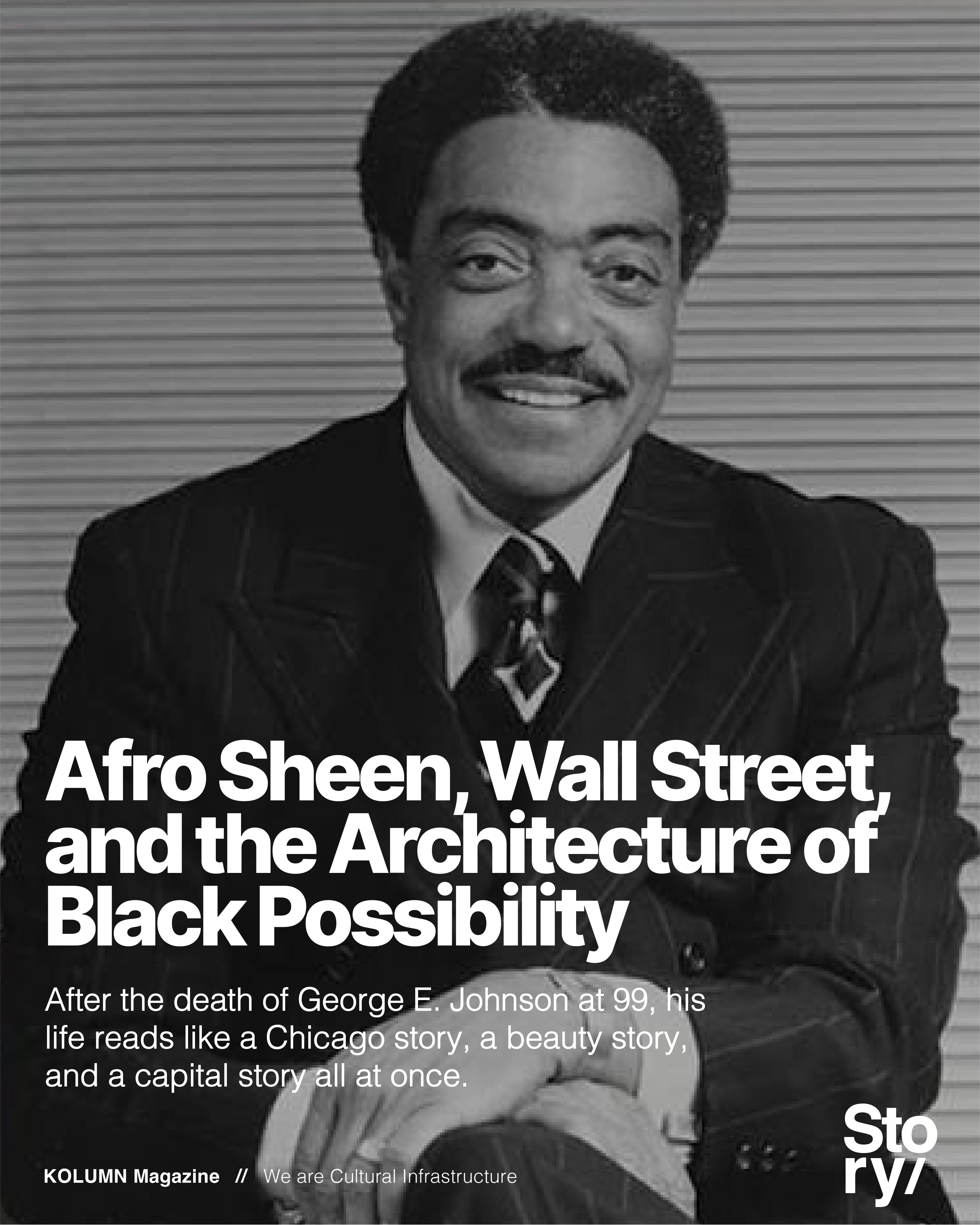
Afro Sheen, Wall Street, and the Architecture of Black Possibility
July 6, 2026
No Comments
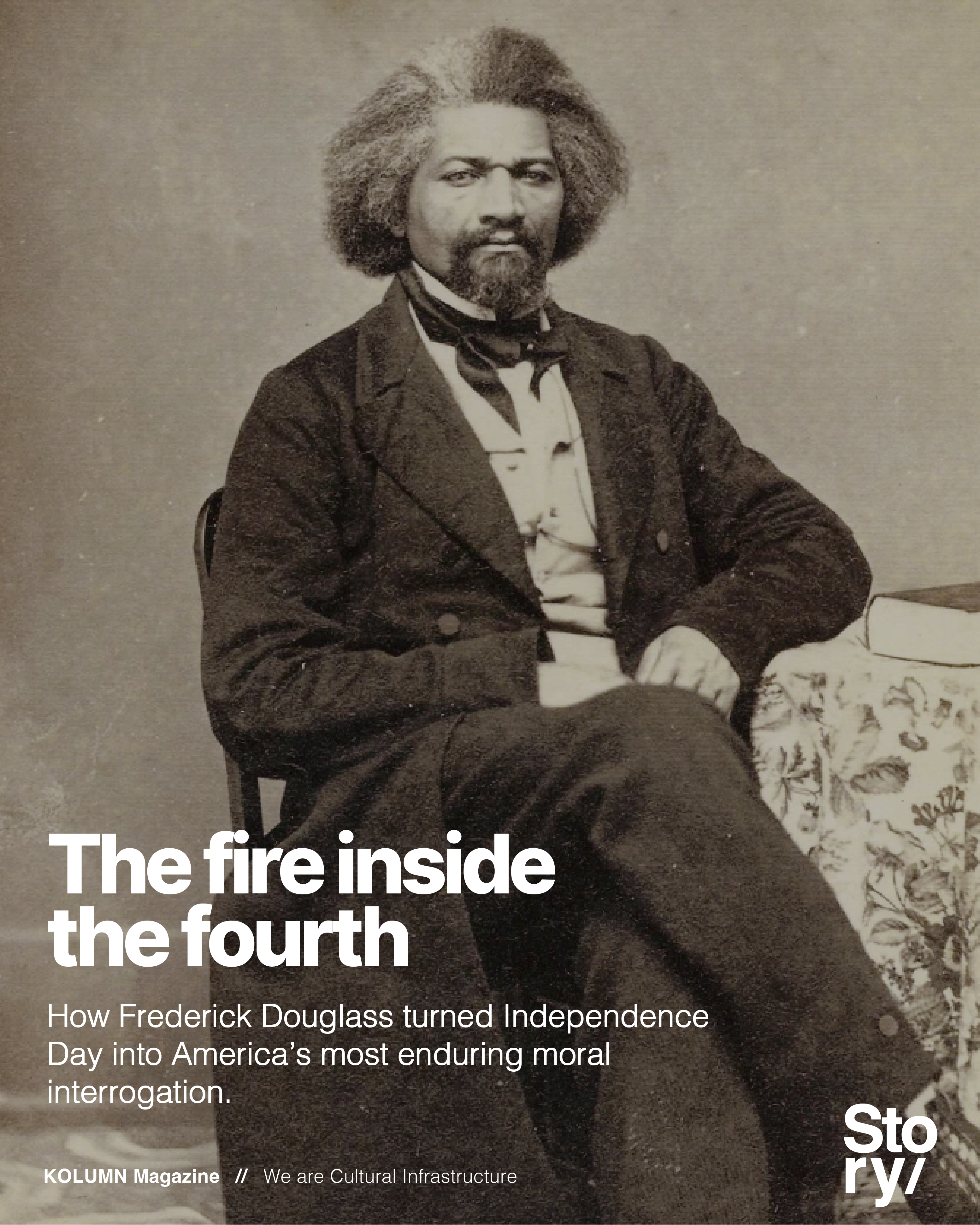
The Fire Inside the Fourth
July 5, 2026
No Comments