




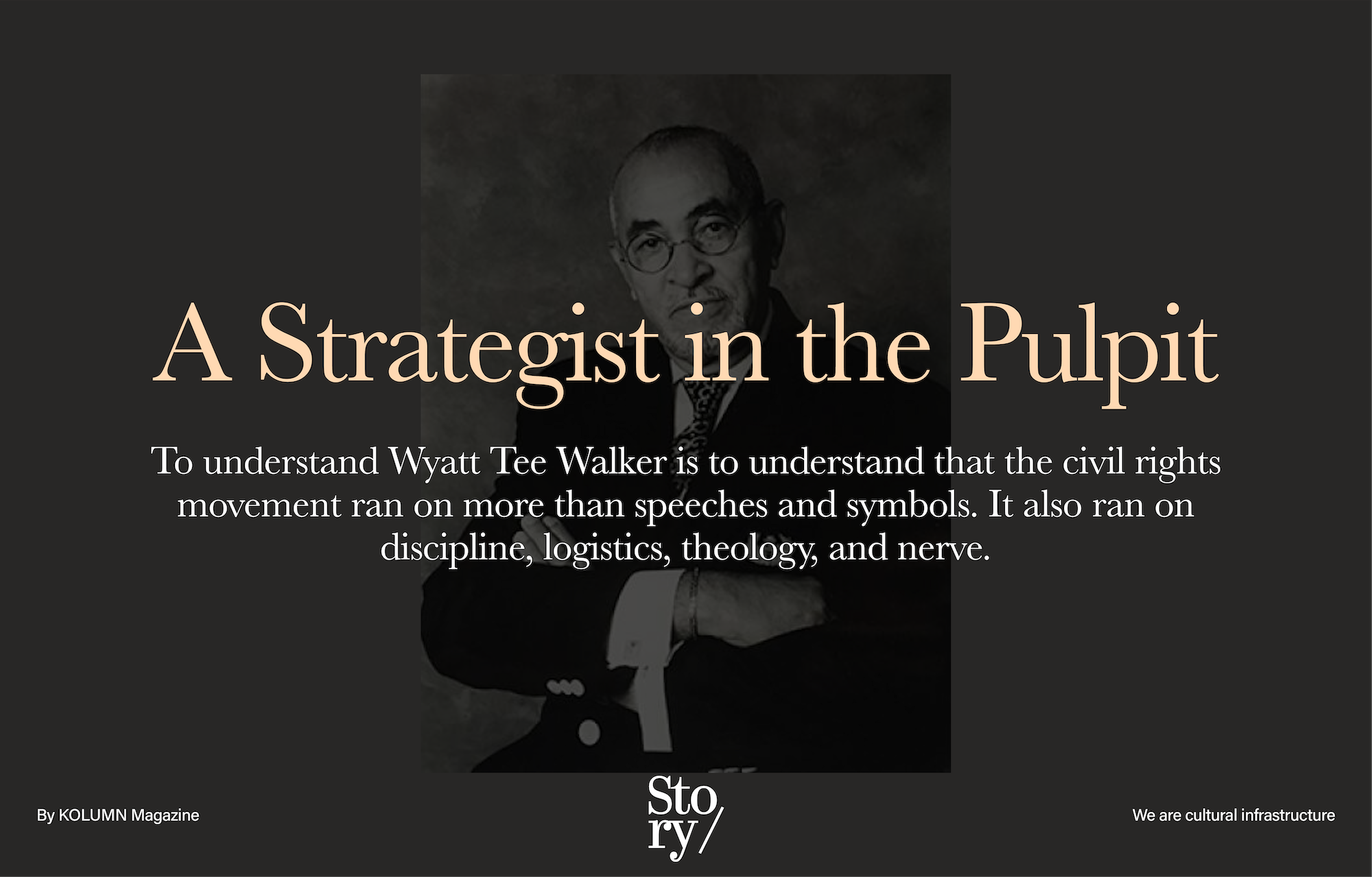
Wyatt Tee Walker understood something American history keeps trying to forget: justice does not advance on inspiration alone. It advances on strategy.
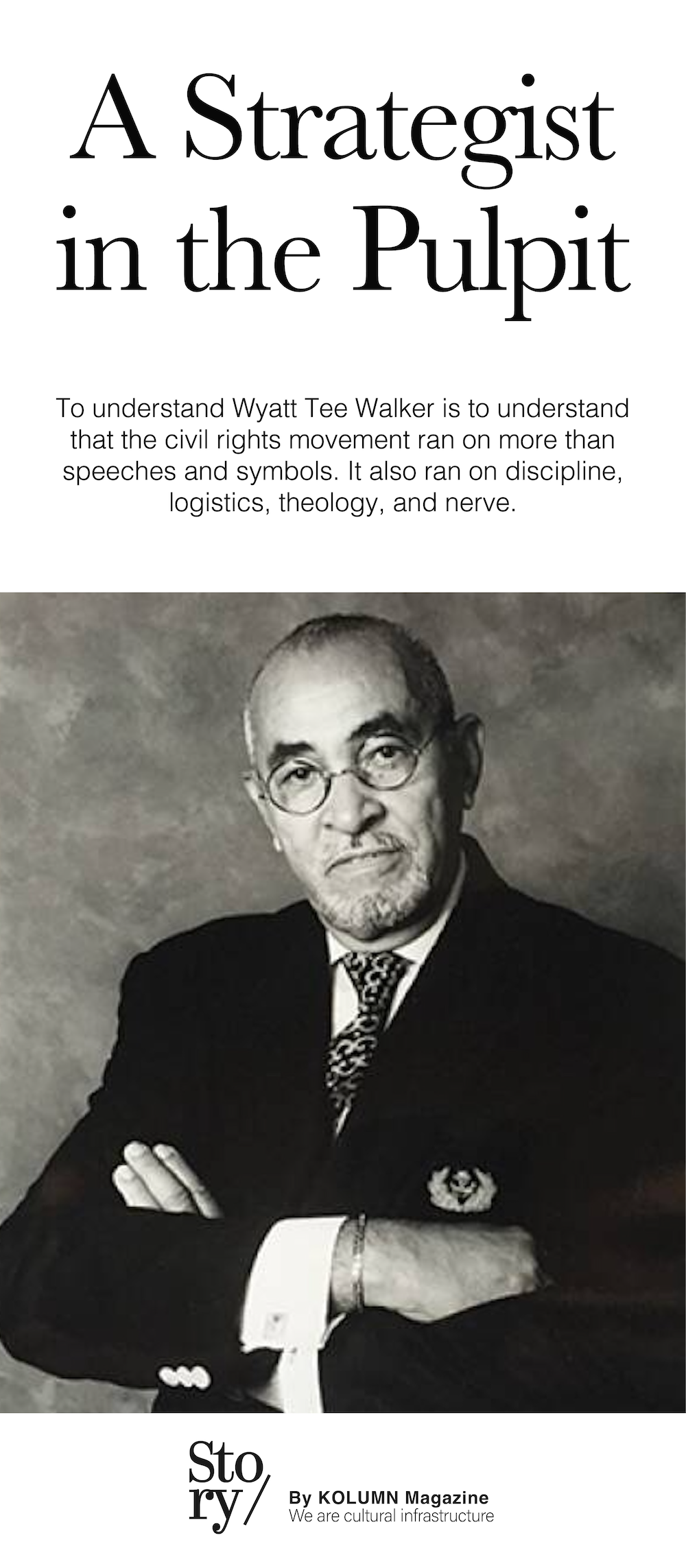
Wyatt Tee Walker understood something American history keeps trying to forget: justice does not advance on inspiration alone. It advances on strategy.
By KOLUMN Magazine
The American memory of the civil rights movement is often organized around a familiar cast of giants. Martin Luther King Jr. stands at the center, as he should. Rosa Parks is remembered in stillness and steel. John Lewis is remembered crossing bridges and taking blows. Ella Baker is increasingly, and rightly, restored to the frame as one of the movement’s clearest democratic minds. But movements are not sustained by icons alone. They also depend on people who can translate moral force into operational force, who understand that righteous anger needs structure, that mass protest needs coordination, and that charisma without machinery rarely changes law or life. Wyatt Tee Walker was one of those people. He was a pastor, organizer, strategist, theologian, scholar, and public intellectual whose fingerprints are all over the modern freedom struggle, even when his name is not.
Walker’s public reputation has long been compressed into a convenient phrase: Martin Luther King Jr.’s chief of staff. That is true, but it is not nearly enough. He was an architect of campaigns, a builder of institutions, a field general of nonviolent confrontation, and one of the movement’s strongest believers in disciplined planning. As executive director of the Southern Christian Leadership Conference in the early 1960s, he helped transform SCLC from an important but still-forming organization into a national instrument of disruption and persuasion. He helped shape the Birmingham campaign, worked on the March on Washington, and played a key role in getting King’s “Letter from Birmingham Jail” into public circulation. Later, he spent decades in Harlem as senior pastor of Canaan Baptist Church of Christ, where he folded civil rights into housing, education, economic development, and anti-apartheid activism. He was not simply close to history. He helped engineer it.
What made Walker so significant was not only what he did, but how he thought. He believed the church could be a political instrument without losing its spiritual center. He believed nonviolence was not passive but tactical. He believed media mattered. He believed timing mattered. He believed that movements needed both prophetic language and administrative competence. In that sense, Walker belongs in a line of Black leaders who understood that moral appeal alone would never be enough; it had to be paired with planning rigorous enough to unsettle the state, expose the hypocrisy of segregation, and make inaction politically expensive.
Before the national stage, there was Petersburg
Wyatt Tee Walker was born in Brockton, Massachusetts, on August 16, 1929, though some family records later produced confusion about whether the year was 1928 or 1929. Multiple authoritative biographical sources, including the Martin Luther King Jr. Research and Education Institute and Virginia state historical materials, list 1929. He grew up primarily in Merchantville, New Jersey, in a large family headed by Pastor John Wise Walker and Maude Pinn Walker. The combination of church life, intellectual seriousness, and racial reality formed him early. According to Virginia sources, one childhood experience that stayed with him was being turned away from a segregated movie theater, a reminder that even in the North-adjacent spaces of his youth, Black dignity was always vulnerable to insult.
Long before the cameras followed King, Walker had already learned how local protest could expose the nation to itself.
At Virginia Union University, Walker studied chemistry and physics and graduated magna cum laude in 1950. He then completed his divinity training at the university’s Graduate School of Religion in 1953, where he also served as student body president. That academic mix matters. Too often, religious leaders are imagined as existing in opposition to technocratic or analytic thinking, but Walker’s later career suggests the opposite. He had a scientific cast of mind as well as a preacher’s cadence. He could move between moral vocabulary and systems thinking with unusual ease. The future strategist of Birmingham did not emerge out of thin air. He was being built in classrooms, chapel culture, and Black institutional life that demanded both intellect and discipline.
Walker’s first major pastoral post was Gillfield Baptist Church in Petersburg, Virginia, beginning in 1953. Gillfield was no ordinary congregation; it was one of the nation’s oldest Black churches, with a long history of religious authority and communal leadership. In Petersburg, Walker’s ministry rapidly became inseparable from civil rights organizing. He served as president of the local NAACP chapter, became a state leader in CORE activity, and helped found the Petersburg Improvement Association, modeled in part on the Montgomery Improvement Association. These were not symbolic affiliations. Under his leadership, local protest targeted segregation in libraries, parks, and transportation facilities, and his activism repeatedly placed him in direct confrontation with white power.
One early episode captures Walker’s mix of seriousness and edge. He was arrested after leading Black residents into a whites-only public library in Petersburg; one account notes that he specifically tried to check out a biography of Robert E. Lee. The detail matters because it reveals something about his sensibility. Walker was never content merely to denounce segregation in the abstract. He liked exposing its absurdity. He understood that protest could be morally grave and theatrically sharp at the same time. In another local fight, activists challenged exclusion at a public pool in Lee Park, prompting the city to shut the park rather than integrate it. That kind of white reaction became a recurring lesson of the era: segregationists would often sabotage public goods entirely before sharing them with Black citizens. Walker learned early that one function of protest was to make that cruelty visible.
Petersburg was, in many ways, Walker’s proving ground. It was where he practiced the fusion that would define his life: pulpit leadership, direct action, institutional organizing, and disciplined media-conscious confrontation. By the time Martin Luther King Jr. drew him deeper into SCLC, Walker was not some promising young clergyman waiting to be discovered. He was already a seasoned local movement leader with a tested sense of tactics.
The organizer King needed
Walker met King through clerical and seminary networks and was soon drawn into the orbit of what would become the Southern Christian Leadership Conference. He helped found SCLC in the late 1950s and, by 1958, had joined its board. In 1960, at King’s invitation, he moved to Atlanta to become the organization’s first full-time executive director. The title sounds administrative. In reality, it was political, tactical, and existential. SCLC was trying to become more than a loose fellowship of ministers. It needed money, coherence, staffing, campaign planning, and a way to convert King’s national visibility into sustained movement pressure. Walker helped provide all of that.
This was the role that made him indispensable. King was the movement’s most consequential public moral voice, but even the greatest public voice needs an operational system around it. Walker helped build that system. Accounts from Stanford’s King Institute and later remembrances emphasize his administrative strength, his insistence on discipline, and his willingness to be the hard-edged organizer in rooms where others preferred consensus or improvisation. He was not universally beloved in every movement quarter. Some activists aligned with the tradition of Ella Baker and the Student Nonviolent Coordinating Committee regarded SCLC’s top-down tendencies with suspicion, and Walker did little to disguise his belief that strong centralized leadership was sometimes necessary. That tension is part of his legacy, and it should not be airbrushed away. He stood for a model of movement governance that prized coordination, message discipline, and executive decisiveness.
That tension also tells us something important about the broader civil rights movement: it was never a single style of politics. It contained ministers and students, institution-builders and insurgents, careful tacticians and decentralists, pragmatists and visionaries. Walker belonged firmly to the camp that believed protest had to be carefully staged to achieve maximum effect. He was not anti-spontaneity because he lacked passion. He was anti-spontaneity because he understood the opposition. Segregation was entrenched in courthouses, police departments, chambers of commerce, school boards, and city halls. To beat that machinery, the movement needed machinery of its own.
His later oral history reflections reinforce this image. Walker spoke as someone who understood that campaigns were made out of details: routes, targets, schedules, communications, pressure points. That kind of labor rarely produces the mythology reserved for speeches. But it produces outcomes. In a political culture obsessed with personalities, Walker reminds us that infrastructure has heroes too.
Birmingham and the craft of confrontation
If you want to understand Walker at full power, look at Birmingham in 1963. Project C, with the “C” standing for confrontation, was one of the movement’s most consequential campaigns, and Walker was a principal strategist behind it. Birmingham was not chosen at random. It was one of the South’s most violently segregated cities, and local activists had already built organizing muscle there. Walker helped develop a plan rooted in disruption, media visibility, and calibrated escalation. He studied targets, routes, distances, and fallback options. He understood that nonviolent protest needed not only courage but choreography.
This is where Walker’s genius becomes especially visible. He understood that dramatic confrontation was not merely about expression; it was about forcing a choice. Either the authorities would negotiate, or they would reveal to the world the brutality required to maintain segregation. Birmingham’s police commissioner, Eugene “Bull” Connor, obliged in the ugliest possible terms, unleashing dogs and fire hoses on demonstrators, including children. Those images ricocheted through the national press and onto television screens, intensifying pressure on the Kennedy administration and shifting public opinion. Walker did not create Bull Connor’s cruelty, of course. He created conditions in which that cruelty became impossible for America to ignore.
This was not cynicism. It was strategy grounded in moral clarity. Nonviolent protest, in Walker’s hands, was never just a symbolic appeal to conscience. It was also a tactical method for producing a crisis that would reveal the true character of segregation. That is why Project C remains so important. It showed that disciplined confrontation could function simultaneously as ethical witness and political leverage. Walker helped make that synthesis real.
His connection to Birmingham was not only strategic but documentary. After King’s arrest there, Walker played a central role in extracting, assembling, and circulating what became “Letter from Birmingham Jail.” Contemporary and retrospective sources credit him with helping piece together King’s text from scraps written in the margins of newspapers and on available paper in the jail. The letter first reached the public through movement channels and then spread widely. It is now canon. But before it was canon, it was a logistical problem. Someone had to get it out, decode it, type it, and distribute it. Walker was central to that chain. Even one of the era’s defining moral texts required backstage labor.
He also smuggled in a camera during King’s confinement, producing an image of King behind bars that became iconic in its own right. That episode captures Walker’s instinctive understanding of media. He grasped that movements do not simply make history; they also make images, and those images can travel where organizers cannot. They can humanize leaders, dramatize injustice, and lock a political moment into national consciousness. Walker treated publicity not as vanity but as a tool of struggle.
The March on Washington and the problem of memory
Walker also helped organize the 1963 March on Washington for Jobs and Freedom, a fact that often gets buried beneath the immensity of King’s speech and the larger public memory of the day. The march is commonly recalled as a singular oratorical triumph. It was that. But it was also a massive feat of coalition-building, scheduling, communications, security management, and political negotiation. Walker was among the men who helped do the hard work behind the spectacle. The March on Washington did not materialize because history decided to be cinematic. It was built.
One of the most famous anecdotes tied to Walker involves the “I Have a Dream” refrain itself. Reporting from The Guardian on the speech’s history recounts Walker urging King not to lean on that phrase, worrying it had become overused. History famously moved in another direction once Mahalia Jackson called out from behind King and the speech pivoted into its most enduring cadence. The anecdote has sometimes been used to suggest Walker misread the moment. That is too simple. What it really shows is that Walker approached rhetoric the way he approached campaigns: with discipline, editorial judgment, and an instinct to avoid sentimentality unless it could land with force. He was not against inspiration. He was against clichés that failed to do political work.
There is something revealing in that story. Walker was, by temperament, a builder of frameworks. King, at his greatest, could transcend the frame. The movement needed both kinds of talent. It needed the people who made the stage and the people who, once on it, could remake language. Too much historical memory prizes only the second category. Walker’s life is a corrective. He reminds us that history is full of figures whose genius lies in making transformative moments possible without necessarily owning them in the public eye.
That relative invisibility is part of why Walker’s legacy deserves fuller attention. American memory loves a clean story. It likes a singular hero, a singular speech, a singular breakthrough. Walker belonged to the messier truth: movements are plural, victories are assembled, and even transcendent moments emerge from memos, phone calls, route maps, staffing plans, and arguments late into the night.
More than a movement aide
After leaving SCLC in 1964, Walker did not disappear into the afterglow of the civil rights era. He moved into educational publishing for a time and then, in 1967, accepted a call to Canaan Baptist Church of Christ in Harlem, where he would serve as senior pastor for 37 years. That chapter is essential to understanding him. Too often, the lives of civil rights veterans are narrated as though their significance ended once the movement’s best-known legislative victories were won. Walker’s Harlem years show the opposite. He continued to interpret freedom not as a closed chapter but as an ongoing struggle over institutions, neighborhoods, schools, and global solidarities.
At Canaan Baptist, Walker presided over one of Harlem’s major Black pulpits. King himself spoke at Walker’s installation there in 1968, underscoring both their closeness and the significance of the post. But Walker’s Harlem ministry was never confined to Sunday preaching. He became involved in fair housing, local development, and public policy. Sources from public history archives and later recollections note his role in community development efforts, including leadership tied to affordable housing and senior housing in Harlem. In 1989, Canaan Baptist partnered with the federal Department of Housing and Urban Development on an 80-unit senior residence that came to bear Walker’s name. This was activism translated into brick, mortar, and permanence.
That evolution matters because it reveals Walker as something broader than the caricature of a movement tactician. He was a theorist of Black institutional power. He believed churches could be engines of economic development and civic intervention. He wrote about the relationship between the Black church and community uplift. He chaired development efforts in Central Harlem. And he engaged education reform, including support for charter schooling in Harlem, a position that placed him in one of the more complicated policy debates in Black politics. Whether one agrees with his education politics or not, it is clear that Walker never surrendered the conviction that institutions had to be remade, not merely criticized.
During these years he also deepened his scholarly life, earning a doctorate from Colgate Rochester Divinity School and pursuing additional study in West Africa. He wrote on religion, music, history, and liberation. Theologian, historian, and organizer were not separate identities for him. They were part of one intellectual project: understanding Black struggle in historical and global context, and using that understanding to animate action in the present.
Harlem widened his politics, not softened them
Walker’s later activism included a serious commitment to the anti-apartheid struggle. Historical records and biographical accounts credit him with founding or helping lead organizations that linked Black religious leadership in the United States to resistance in South Africa. He helped found the Religious Action Network of the American Committee on Africa and was active in broader anti-apartheid efforts. This was not an incidental add-on to his résumé. It fit his worldview. Walker understood Black freedom as diasporic, not merely national. Harlem, in his hands, became not a retreat from movement politics but a platform for connecting local Black struggle to global liberation fights.
For Walker, freedom was never just a Southern story and never just a past-tense one.
This globalism is one of the most underappreciated parts of his legacy. The standard civil rights narrative too often stops at the U.S. South and ends around 1965. Walker’s life pushes against both limits. He carried the movement north into urban policy and outward into international solidarity. He hosted African leaders, engaged anti-colonial conversations, and treated apartheid as morally continuous with Jim Crow. That perspective now feels prescient rather than expansive. In an age when activists more readily speak of transnational systems, Walker looks strikingly contemporary.
He also stayed politically engaged in New York’s own racial struggles. Commentary remembering Walker notes his fair-housing advocacy and continued role in urban affairs. Older reporting from The Guardian places him among public figures joining protest around the police killing of Amadou Diallo. That through-line matters. Walker did not become a monument to the 1960s. He remained alert to the fact that Black protest would need to keep reappearing wherever state violence, exclusion, or inequality adapted itself into new forms.
The complications in the legend
To write honestly about Wyatt Tee Walker is not to turn him into a saint. It is to take him seriously enough to note the tensions around his style and politics. He represented a more hierarchical organizational model than some movement peers preferred. Admirers saw rigor, discipline, and clarity. Critics sometimes saw centralization and a diminished tolerance for participatory messiness. The friction between SCLC-style executive coordination and SNCC-style grassroots democracy was real, and Walker stood on one side of that divide more often than the other. That does not reduce his importance. It places him accurately within the ideological and strategic debates of the movement.
It is also fair to say that his later positions, particularly around charter schools, sit in a more mixed historical field. Some saw his work there as an extension of his lifelong insistence that Black communities could not wait indefinitely for failing public systems to correct themselves. Others have argued that charter advocacy became entangled with broader trends in privatization and uneven accountability. The point here is not to flatten those debates into easy praise or easy condemnation. It is to recognize that Walker remained a working political thinker, not a frozen relic. He continued making judgments about power, institutions, and urgency, and those judgments did not always fit neatly into progressive orthodoxy.
Even the basic biographical record carries some ambiguity, including the confusion around his birth year. That small uncertainty feels oddly fitting. Walker lived adjacent to immense public events, yet parts of his own story remain less cleanly archived than those of the movement’s most canonized figures. History often does that to organizers. It takes their labor and leaves the edges of their lives blurry.
Still, none of these complications diminish the central fact: Walker was one of the sharpest strategic minds of the civil rights era and one of the clearest examples of how Black religious leadership functioned as political leadership in the twentieth century. If anything, the complications make him more useful to us now. They restore him as a real actor navigating real choices rather than a flattened commemorative figure.
Why Wyatt Tee Walker matters now
Walker died in January 2018 in Chester, Virginia, after years of declining health. He was remembered by major newspapers, Black institutions, historians, and fellow activists as a giant of the freedom struggle. President Barack Obama had earlier recognized him with the Presidential Medal of Freedom, the nation’s highest civilian honor, an official acknowledgement that his contributions extended far beyond any single campaign. Yet public recognition, while deserved, still has not fully caught up to the scope of his life.
His relevance now is not ceremonial. It is analytical. We live in a time when activism is hyper-visible but often structurally fragile. We are surrounded by rhetoric, virality, and symbolic gesture, but not always by durable organization. Walker’s career offers a counter-model. He insists that successful movements require planning, institutions, leadership development, communications strategy, and logistical competence. He also insists that churches, community organizations, and local institutions can be more than sites of comfort; they can be engines of pressure and transformation.
He matters too because he explodes the false choice between the sacred and the strategic. In Walker’s life, theology was not a veil over politics, and politics was not a corruption of faith. The two were braided. He preached, organized, studied, and built with the same underlying conviction: that Black people were entitled to dignity in public space, political life, education, housing, and the global human community. That framework remains deeply instructive in a period when public discourse often separates moral witness from institutional action, as though one can survive long without the other. Walker knew better.
He also matters because he helps correct the mythology of lone greatness. The civil rights movement did not succeed because one extraordinary man stood before the Lincoln Memorial and dreamed aloud. It succeeded because networks of organizers, pastors, students, workers, strategists, donors, local citizens, and movement intellectuals kept grinding forward under extraordinary pressure. Walker stands for that broader truth. He was close enough to King to be overshadowed by him and important enough that the story makes less sense without him.
In the end, Wyatt Tee Walker’s legacy is not merely that he helped history happen. It is that he understood what history required. It required courage, yes, but also infrastructure. It required eloquence, but also editing. It required faith, but also planning. It required protest, but also institutions that could carry the struggle after the cameras left town. That is the part of freedom work Americans are always in danger of underestimating. Walker spent his life making sure it got done anyway.
More great stories
Afro Sheen, Wall Street, and the Architecture of Black Possibility
July 6, 2026
No Comments
The Fire Inside the Fourth
July 5, 2026
No Comments