




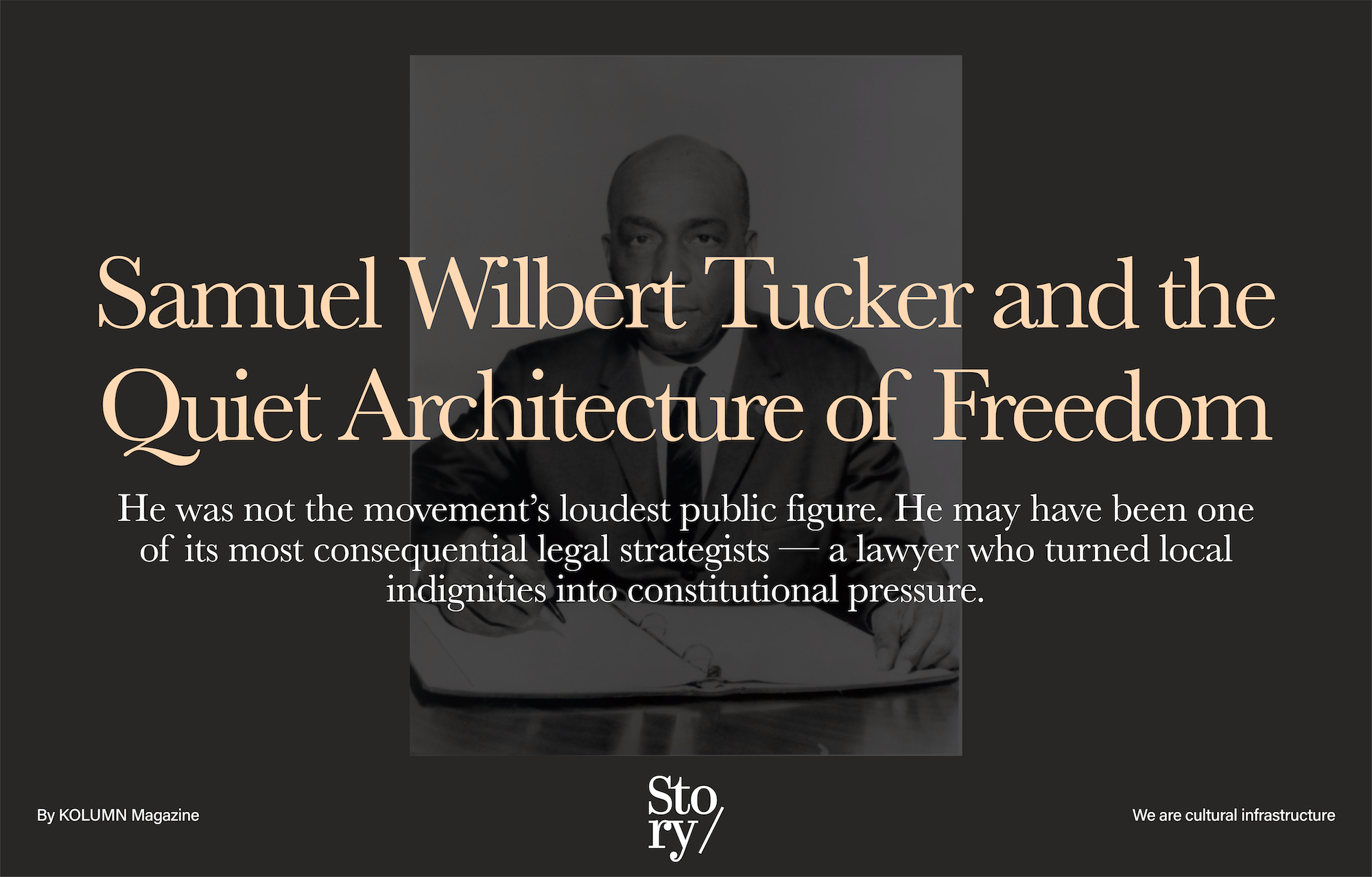
His name isn’t among those you think of as a leader in the movement, but all the leaders knew him.
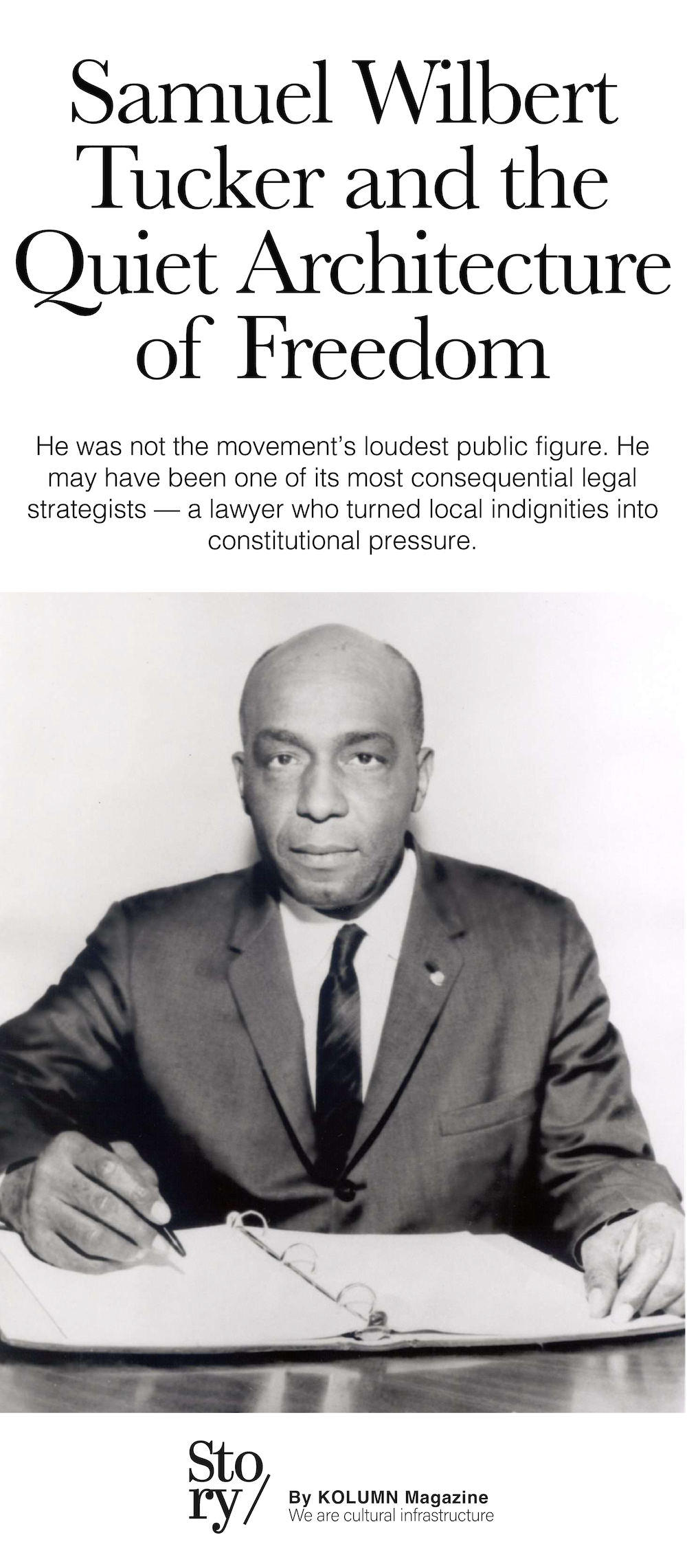
His name isn’t among those you think of as a leader in the movement, but all the leaders knew him.
By KOLUMN Magazine
There are certain figures in Black freedom struggle history whose names arrive already burnished by repetition. Thurgood Marshall. Rosa Parks. Ella Baker. Martin Luther King Jr. And then there are the essential people who helped build the road beneath those names — the tacticians, local architects, movement lawyers, institutional antagonists, the ones who spent years translating moral clarity into legal leverage. Samuel Wilbert Tucker belongs firmly in that second category. He was not obscure because he lacked importance. He was overlooked because his work often happened where history is least glamorous: municipal files, trial transcripts, school-board disputes, committee hearings, appellate briefs, the thick procedural undergrowth where injustice learns how to hide.
Tucker’s life offers a corrective to the overly simplified way Americans still tell the civil rights story. The popular version tends to move from Montgomery to Birmingham to Washington to Selma, as if freedom advanced mainly through spectacular confrontation and charismatic oratory. Tucker reminds us that the movement was also an argument — technical, disciplined, relentless, often local, and deeply informed by the hard fact that segregation was upheld not only by mobs and customs but by forms, budgets, ordinances, school assignments, and the evasive language of officials pretending not to understand what equality required. Tucker spent a career stripping away that pretense.
He was, in the most durable sense, a movement lawyer. He organized one of the earliest recorded civil rights sit-ins in the country at the segregated Alexandria Library in 1939, long before lunch-counter protests became a defining image of the 1960s. Later, as one of Virginia’s leading NAACP attorneys, he challenged segregated juries, discriminatory criminal punishment, school segregation, and the legal harassment deployed by Virginia officials to cripple the NAACP itself. He argued in the Supreme Court. He confronted senators. He ran for Congress when victory was improbable because public witness mattered. And in 1968, in Green v. County School Board of New Kent County, he helped secure a ruling that made clear that school districts could no longer hide behind paper compliance; they had to actually dismantle dual systems “root and branch.”
That may be the cleanest way to begin understanding his significance. Samuel Wilbert Tucker was not merely adjacent to the movement. He was one of the people who taught it how to press.
Born into the argument
Tucker was born in Alexandria, Virginia, on June 18, 1913, into a Black community already living with the layered humiliations of Jim Crow. Alexandria, located just across the Potomac from Washington, was close enough to the federal capital to absorb some of its contradictions and far enough south to preserve the habits of racial caste. Tucker attended Parker-Gray School. But when it came time for high school, Alexandria had no high school for Black students, so he crossed into Washington to attend Armstrong High School. The arrangement itself was an education in American hierarchy: the city would tax Black residents, regulate their lives, and deny them equal civic infrastructure — then expect gratitude for whatever partial workarounds they managed to improvise.
One of the revealing things about Tucker’s early life is how quickly he learned that the law could wound and the law could also be used back against power. As a teenager, he was arrested in a streetcar incident after a white woman claimed he and his companions were encroaching on white seating. Thomas Watson, a white attorney whose office was connected to Tucker’s father’s work, defended him, and a jury acquitted the young men. The episode seems to have left a mark. The courts were by no means neutral terrain, but Tucker saw that legal structures were not perfectly sealed against pressure. They could be contested. Procedure could be weaponized from below.
His educational path was similarly unconventional and telling. He went on to Howard University, graduating in 1933, at a moment when Howard was emerging as perhaps the central incubator of Black legal strategy in the United States. There he encountered the intellectual atmosphere shaped by Charles Hamilton Houston and a broader culture of Black institutional ambition that insisted segregation was not simply immoral but vulnerable. Rather than attend law school in the standard way, Tucker pursued independent legal training, passed the Virginia bar examination at age 20, and was sworn in as an attorney in late 1934 once he was old enough to practice. There is something almost symbolic in that route: Tucker was, from the beginning, a lawyer who understood that rules were neither natural nor sacred. They were constructed. And what had been constructed could be challenged.
To say he “became” a civil rights lawyer almost understates the matter. Civil rights was not a specialty Tucker wandered into after establishing a conventional career. It was the condition of his life and therefore the substance of his practice. In a recollection preserved by later accounts, he described his entry into the movement with a line that remains as sharp as it is unsentimental: he got involved on the day he was born, because he was born Black in Alexandria. That sentence contains his politics in miniature. No melodrama. No abstract sermon. Just a lucid account of how race organized the terms of American citizenship.
The 1939 library sit-in that should be better known
If Tucker had done nothing else, the 1939 Alexandria Library sit-in would be enough to justify a larger place in national memory. In August of that year, he orchestrated a peaceful protest at the city’s whites-only public library. Five well-dressed Black men entered separately, requested library cards, were refused, then each selected a book, sat down, and began to read. It was a calculated piece of movement theater before that vocabulary fully existed: disciplined, respectful in outward manner, openly confrontational in constitutional substance. The men were arrested for disorderly conduct. Reporters showed up. A photograph was taken. A local indignity became public evidence.
“I refuse and I will always refuse to accept a card … in lieu of a card to be used at the existing library.”
The sit-in now reads as prophetic, almost uncannily so. This was more than two decades before the wave of lunch-counter demonstrations that would enter textbooks as a hallmark of the civil rights movement. Tucker clearly understood the value of nonviolent direct action not as spontaneous moral display but as a legal and political trigger. The point was not merely to protest exclusion. It was to create a factual record, provoke official overreaction, attract public attention, and strengthen a larger challenge to the policy itself. In that sense, Tucker’s protest was not a precursor by accident. It was a prototype.
The local context made the action even more pointed. Alexandria’s Black residents were systematically denied access to public cultural resources. Black children had inferior schooling. Black citizens could not use the main public library. Tucker had already attempted a more formal route earlier in 1939 by seeking access through ordinary petition and court process. But as the case moved slowly, city officials began constructing a separate library for Black residents. Tucker recognized the pattern instantly. This was Jim Crow’s genius move: concede just enough infrastructure to preserve the principle of caste. Offer a branch, a duplicate, a hand-me-down institution, and call it progress. Tucker refused that logic.
The city’s response vindicated his skepticism. Officials accelerated the creation of the Robert Robinson Library for Black Alexandrians. It was segregated, smaller, and stocked with castoff materials. The charges against the demonstrators were dropped, and Black residents were technically granted access to library service — but only through the separate facility. Tucker answered with one of the defining statements of his public life: he refused to accept a library card “in lieu of” a card to the existing library. That distinction matters. He was not fighting for Black access to books in the abstract. He was challenging the legal and moral grammar of segregation itself.
That sentence deserves to sit beside far more famous civil rights quotations because it captures a central truth about the period. Segregation often survived by asking Black Americans to confuse accommodation with equality. Tucker would not.
War, Southside Virginia, and the hard edge of legal practice
World War II interrupted Tucker’s early legal career. He served as an officer in the all-Black 366th Infantry in Italy, rising to the rank of major according to later accounts. Military service, for many Black veterans, intensified rather than softened the contradiction of American democracy: a nation willing to deploy Black patriotism abroad while rationing Black citizenship at home. Tucker returned from war to a South that had not learned enough from the global language of freedom it had just helped weaponize.
After the war, Tucker relocated to Emporia in Southside Virginia, where he practiced in a region with large Black populations and almost no Black legal representation. That move is easy to miss if one focuses only on his later Supreme Court work, but it may be one of the clearest markers of his seriousness. He did not simply remain near symbolic sites. He went where the law’s violence was intimate, routine, and thickly protected by local custom. In Emporia and the surrounding counties, there were Black defendants, Black laborers, Black families, Black communities under pressure — and virtually no Black attorneys positioned to defend them. Tucker became that lawyer.
This phase of his life matters because it reveals Tucker not only as a strategist of landmark cases but as a practitioner in the oldest sense: the lawyer who takes the calls, visits the jail, knows the courthouse personnel, understands the local power map, and is willing to stand in front of hostile judges and all-white juries on behalf of clients whom the system has already marked as disposable. The heroic mythology of civil rights can sometimes flatten this daily labor. Tucker’s career restores its texture. He handled civil and criminal matters alike. He represented poor Black clients in places where the courtroom itself was part of the racial order being contested.
He also learned, and taught by example, that criminal law was a civil rights battlefield. The post-Brown public memory can tilt toward schools and public accommodations, but Tucker understood that racial power was equally visible in jury selection, charging practices, sentencing disparities, and the presumed expendability of Black defendants. In the case of Jodie Bailey, Tucker challenged the systematic exclusion of Black jurors with statistical evidence documenting the long absence of Black participation on trial juries. In the case of the Martinsville Seven — seven Black men sentenced to die for raping a white woman — he again used statistics to expose racial asymmetry, noting that Virginia had executed dozens of Black men for raping white women while no white man had been executed for rape. The courts rejected the argument at the time. But Tucker’s willingness to frame criminal punishment itself as a site of racialized constitutional injury was, in historical terms, prescient.
The Martinsville Seven episode remains especially painful because the legal system did not bend. The executions went forward. Yet Tucker later viewed the case as deeply influential. That judgment makes sense. Movement lawyering is not only the story of victories. It is also the story of arguments introduced before the judiciary is ready to hear them, records created for future generations, constitutional visions made legible years before courts concede them. Tucker’s work in these cases widened the legal imagination of racial justice even when it could not yet force the result.
Brown was not the end of the fight. For Tucker, it was the beginning of a harder one
When Brown v. Board of Education was decided in 1954 and then followed by the “all deliberate speed” language of Brown II in 1955, the ruling was monumental but incomplete. Tucker appears among the lawyers who understood immediately that the opinion’s greatness would be measured not by its rhetoric but by the ferocity of white resistance that followed. In Virginia, that resistance became doctrine. Senator Harry F. Byrd Sr. and his allies built what came to be known as Massive Resistance: a political program designed to evade, delay, and, where possible, nullify school desegregation. Tucker became one of the NAACP’s principal legal combatants in that environment.
He filed suits across Virginia — in nearly 50 counties and cities, according to The Washington Post — pressing school boards and local officials to comply with federal constitutional requirements. This was not glamorous work. It was repetitive, document-heavy, geographically dispersed, and politically dangerous. It required stamina as much as brilliance. Tucker was not merely arguing for a new constitutional principle; he was chasing officials who had perfected the art of procedural bad faith. A district would submit a plan with loopholes. A judge would permit delay. A legislature would invent a new form of resistance. A county would move money around. A board would invoke “choice” while maintaining an obviously dual system. Tucker kept coming back.
Virginia did not just resist desegregation through school policy. It also tried to neutralize the lawyers making desegregation possible. In 1956, the General Assembly passed a package of laws targeting NAACP legal activity, broadening doctrines like barratry, champerty, and maintenance to cast civil rights representation as unethical solicitation. This was a sophisticated maneuver. The state did not say openly that Black citizens should be denied constitutional advocacy. Instead, it used professional-regulation language to criminalize or cripple the machinery of civil rights litigation. Tucker saw the move for what it was: an attack on the messengers because the message could not easily be defeated on the merits.
He became one of the lawyers directly targeted. State officials sought to discipline him, even revoke his license. Courtrooms filled with Black supporters. NAACP leaders rallied. Tucker and his colleagues contested the charges relentlessly. The legal campaign against the NAACP culminated in NAACP v. Button, a 1963 Supreme Court ruling striking down Virginia’s effort to suppress the organization’s litigation strategy. The Court held that the statutes, as applied to the NAACP’s civil rights work, violated constitutional protections. It was a crucial decision not only for the association but for public-interest law more broadly: a recognition that litigation itself can be a form of political expression and collective petition.
That episode gets at something fundamental about Tucker’s place in history. He was not simply asking the law to protect Black citizens. He was also defending the very right to use the law in that way. He understood that white supremacist governance feared organized legal action because organized legal action converts private grievance into public obligation.
Prince Edward, New Kent, and what desegregation was supposed to mean
Among Tucker’s most consequential chapters was his work in the long struggle over Virginia schools after Brown. In Prince Edward County, white officials went so far as to close the entire public school system rather than integrate, while white students received support to attend segregated private academies. Black children were left with church basements, makeshift arrangements, out-of-state placements, or no real schooling at all for years. The cruelty of the arrangement was so stark that it became national news. Tucker was among the NAACP lawyers working to force the reopening of the schools on an integrated basis.
Prince Edward exposed the limits of euphemism. This was not “gradualism.” It was the state deciding that if equal public education had to be shared, it would rather destroy public education than honor Black citizenship. Tucker’s involvement there helps explain why his later triumph in Green mattered so much. By the late 1960s, Southern districts had become expert at symbolic compliance. Many claimed desegregation by offering “freedom-of-choice” plans under which students could theoretically choose which school to attend. In practice, such plans left the structure of segregation intact, burdening Black families with the risks of integration while preserving overwhelmingly white and overwhelmingly Black schools.
In New Kent County, the system was particularly stark: just two schools, one historically white and one historically Black, in a county without residential segregation severe enough to explain the pattern by neighborhood alone. Under the “freedom-of-choice” plan, no white student chose the Black school, and the vast majority of Black students remained in the formerly Black school. Tucker argued that the burden belonged to the school board, not to Black children and their parents. That legal theory sounds obvious now. It was not treated as obvious then.
The Supreme Court agreed in 1968. In Green v. County School Board of New Kent County, the Court held that a desegregation plan must promise realistically to work now and that plans failing to provide meaningful assurance of prompt and effective dismantling of dual systems were intolerable. The Court rejected New Kent’s arrangement and emphasized the continuing duty of school officials to convert to a unitary, nonracial system. In one of the ruling’s most cited lines, the Court insisted that state-imposed segregation had to be eliminated “root and branch.” Tucker argued the case for the petitioners alongside Jack Greenberg, with Henry L. Marsh III and others on the brief.
Desegregation, Tucker argued in effect, could not be measured by paperwork. It had to be measured by what children actually lived.
The significance of Green is difficult to overstate. If Brown declared segregated schooling unconstitutional, Green forced courts and districts to confront the inadequacy of evasive implementation. It shifted the question from whether districts had adopted a formal plan to whether that plan actually dismantled segregation. In practical terms, it helped usher in a more demanding era of enforcement, including zoning, reassignment, and busing remedies where necessary. Tucker had helped move desegregation law from aspiration to accountability.
A lawyer who understood power, not just doctrine
One reason Tucker remains so compelling is that he was never naïve about institutions. He believed in constitutional enforcement, but he did not confuse legal victory with automatic justice. That realism sharpened his work. He knew public officials lied. He knew legislatures could weaponize technical language. He knew courts could delay until delay itself became a form of substantive defeat. And he knew that the law’s authority depended on whether someone was willing to insist that public officials actually follow it.
That quality was visible when he testified before the Senate Judiciary Committee in opposition to Judge Clement Haynsworth’s nomination to the Supreme Court. Tucker criticized Haynsworth’s record on segregation cases and sparred with Senator Sam Ervin, a master of constitutional theatrics and a defender of Southern racial order. When Ervin pressed the familiar segregationist line that integration violated the liberties of parents and communities, Tucker replied without flinching: there is no liberty in segregation; there is no vested right in segregation. It was a lawyer’s sentence, but also a political philosophy. Rights language, Tucker was saying, could not be allowed to become a decorative screen for domination.
This is part of why he mattered beyond Virginia. Tucker represented a form of Black legal thought that was unseduced by civility as performance. He could be courteous, even understated, but he was not conciliatory where the stakes were constitutional. He appears, in contemporaneous accounts, as a man of soft voice and hard spine — rumpled, deliberate, unfancy, uninterested in self-mythology, but absolutely prepared to stand toe to toe with senators, judges, bar panels, and entrenched local oligarchies. Former Senator Edward Brooke called him “one of the most brilliant minds” he knew; Henry Marsh later called him “the brains behind the movement.” Those are not small tributes, and they came from people positioned to know the difference between celebrity and substance.
There is also something important in Tucker’s refusal to separate law from politics. He ran for Congress twice in Virginia’s Fourth District against segregationist incumbent Watkins Abbitt, once in 1964 and again in 1968. He did not harbor illusions about the odds. Later accounts note that he knew he was unlikely to get more than around 30 percent of the vote. He ran anyway, in part to register Black political aspiration and Black dissent in a district where both had long been minimized. That, too, was movement work: forcing the record to show that disenfranchised people were not consenting to the order under which they lived.
Why he remains less famous than he should be
Samuel Wilbert Tucker died in 1990, but his public recognition has lagged behind his actual influence. That lag says as much about American memory as it does about Tucker himself. The civil rights movement is often narrated through images that are easy to circulate: the march, the bus, the lunch counter, the bridge. Tucker’s work was often less photogenic in the conventional sense. He inhabited the medium-range terrain between protest and precedent. He was the connective tissue between the dramatic moral act and the enforceable legal consequence. And connective tissue is easy to forget until the body fails without it.
There is also the matter of geography. Tucker worked largely in Virginia, though the implications of his work traveled nationally. American historical memory still tends to privilege a handful of iconic Southern sites while understating the complexity of states like Virginia, where the resistance to desegregation was often particularly bureaucratic, legally elaborate, and institutionally networked. Tucker’s genius was precisely his ability to operate in that environment. He understood that when white supremacy dresses itself in procedure, the response cannot be only prophetic. It must also be exacting. (Justia Law)
And then there is Tucker’s own style. He was not a self-promoter. He wrote no canonical memoir, did not become a ubiquitous national television presence, and seems to have accepted that some of the most necessary work happens without applause. In a media culture that often mistakes visibility for historical weight, that modesty became another kind of erasure. But the record is there for anyone willing to read it: the 1939 sit-in, the criminal appeals, the battles against Massive Resistance, the defense of NAACP litigation, the Supreme Court arguments, the congressional campaigns, the continuing insistence that constitutional promises mean very little unless they are administratively real.
Tucker’s significance now
Samuel Wilbert Tucker’s life is significant not just because he was early, brave, or brilliant, though he was all three. It is significant because he grasped a truth that still feels uncomfortably current: democratic backsliding often happens through process. Access can be denied by eligibility rules, jurisdictional games, professional codes, funding formulas, assignment systems, waiting periods, and strategic delay. Whole classes of people can be told that their rights exist in theory while institutions make those rights unusable in practice. Tucker’s career was a sustained refusal to let form outrun substance.
That is why the library sit-in still matters. It was about books, yes, but also about civic belonging and public space. It was about who gets to claim the city and on what terms. That is why Green still matters. It was about schools, yes, but also about whether the state can discharge constitutional duty by giving oppressed people a nominal choice inside a coercive structure. That is why Button still matters. It was about legal ethics on paper, yes, but also about whether movements may organize themselves into effective constitutional actors. Tucker kept pushing the country toward a more adult understanding of equality: not sentiment, not symbolism, not segregated substitutes, not procedural camouflage — equality with operative force.
If he remains underrecognized, that may be because his work asks more of us than hero worship. Tucker’s example does not allow the comfort of thinking justice arrives once a great speech is delivered or once a court finally says the obvious. His life says the struggle continues in implementation, in enforcement, in budgeting, in licensing, in who gets heard, in who gets protected, in whether institutions are permitted to redefine compliance so loosely that inequality survives untouched. He forces a harder reading of civil rights history — and a more useful one.
By the end of his career, Tucker had helped alter the legal architecture of American public life. He had organized one of the earliest sit-ins in the modern struggle, defended Black defendants against racist court systems, challenged state efforts to criminalize civil rights lawyering, and helped win a Supreme Court decision that made desegregation measurable by outcome. That is not a supporting résumé. That is central-movement work.
Samuel Wilbert Tucker did not merely ask America to live up to its laws. He spent a lifetime making it harder for the country to lie about what those laws required.
And maybe that is the cleanest measure of his legacy. He was a civil rights lawyer in the deepest sense: a man who understood that rights are not self-executing, that power rarely corrects itself, and that dignity sometimes has to enter the library, sit down, open a book, and refuse to move.
More great stories
Afro Sheen, Wall Street, and the Architecture of Black Possibility
July 6, 2026
No Comments
The Fire Inside the Fourth
July 5, 2026
No Comments