


A strategist and storyteller at a moment of movement acceleration.
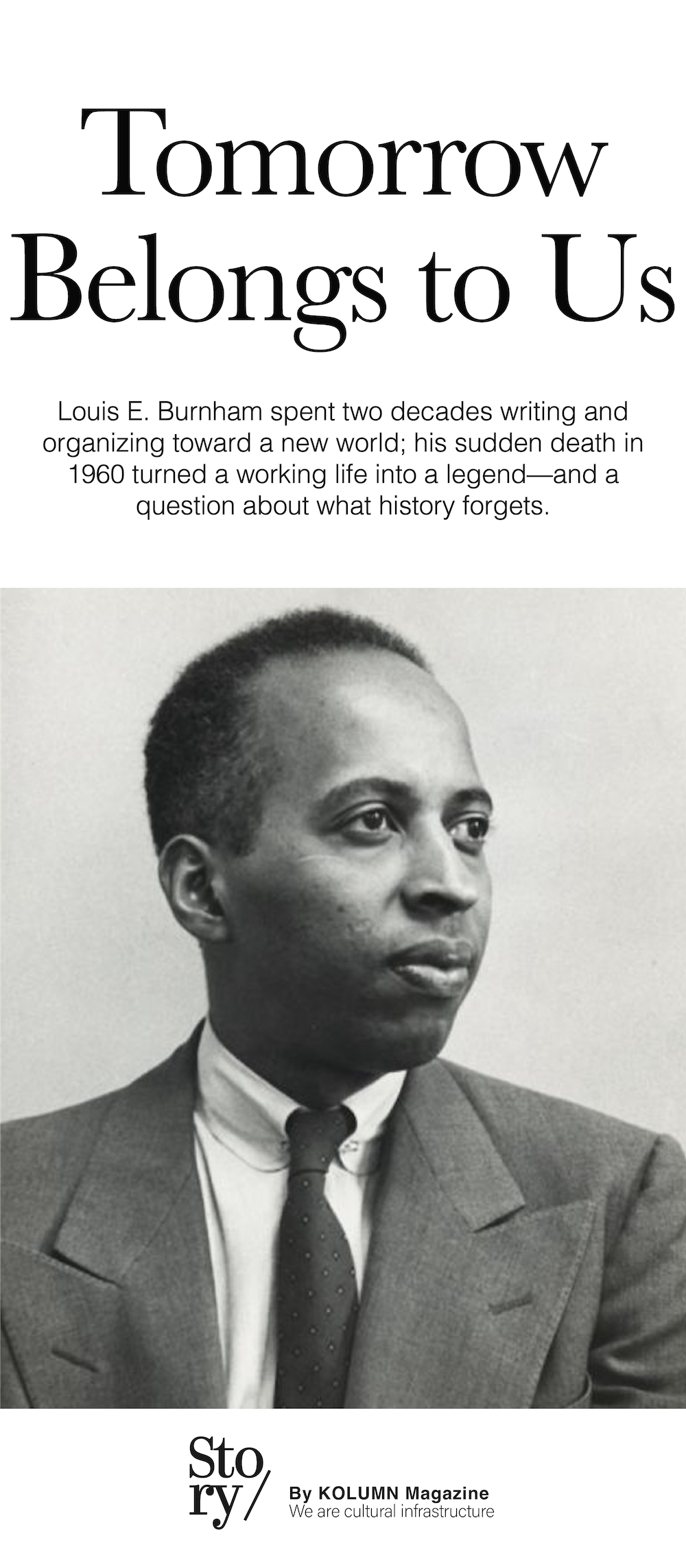
A strategist and storyteller at a moment of movement acceleration.
By KOLUMN Magazine
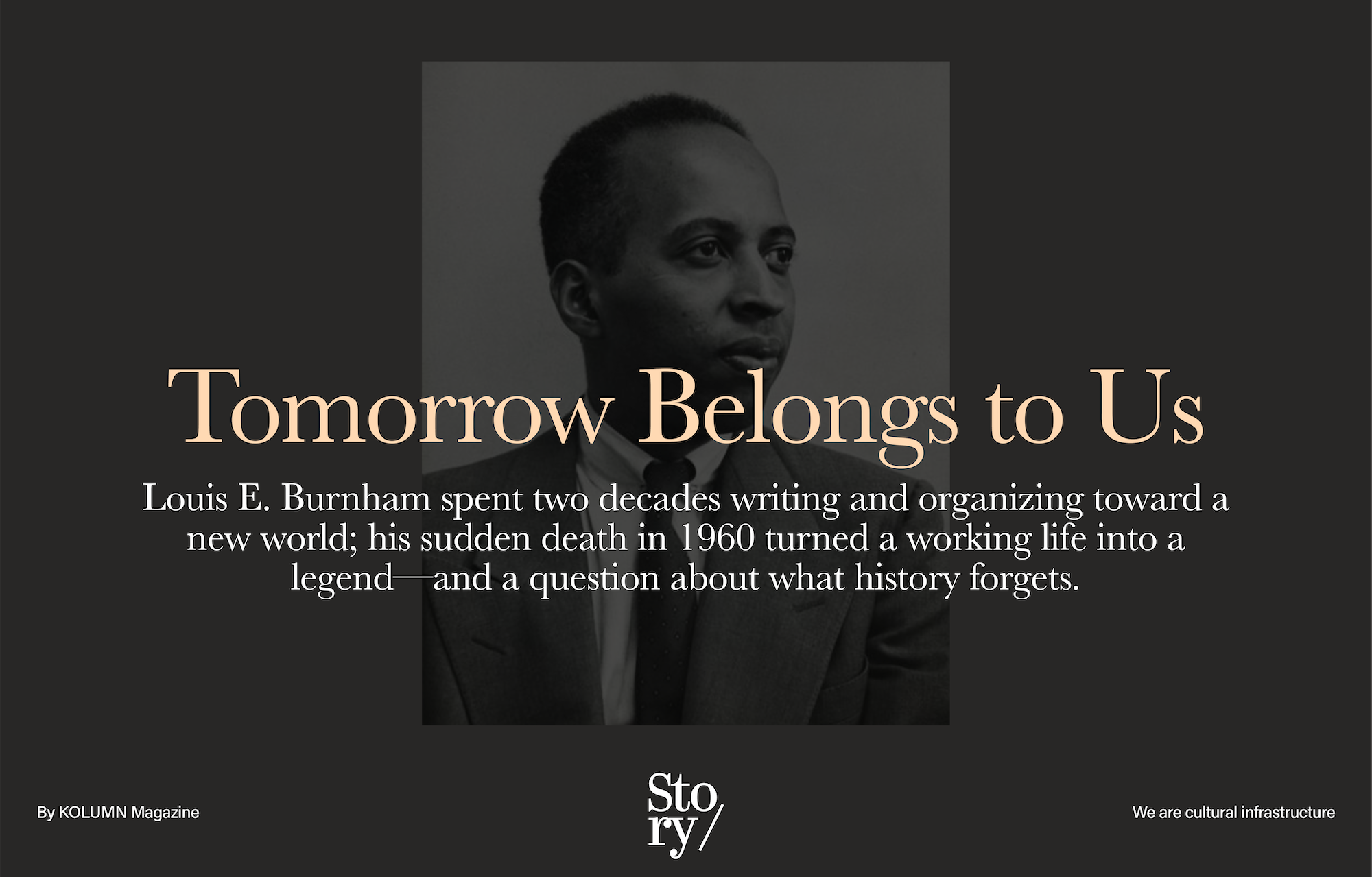
On paper, Louis Everett Burnham’s life has the clean geometry of a mid-century political biography: born in 1915, shaped by Harlem’s ferment, radicalized in the 1930s, sent South to organize in the 1940s, then pulled back North by the tightening vise of McCarthyism—only to die in 1960, at 44, while delivering a talk about Africa and freedom.
In practice, Burnham’s story is messier, more instructive, and more revealing about how movements actually get made. His work ran through the connective tissue of Black freedom politics at a time when the dominant public narrative tried to separate “civil rights” from “labor,” “anti-lynching” from “anti-imperialism,” and “American democracy” from the realities of state repression. Burnham refused those separations. He treated racial hierarchy as a political system with local enforcement, national policy cover, and international echoes—and he insisted that any serious journalism about Black life had to name all three.
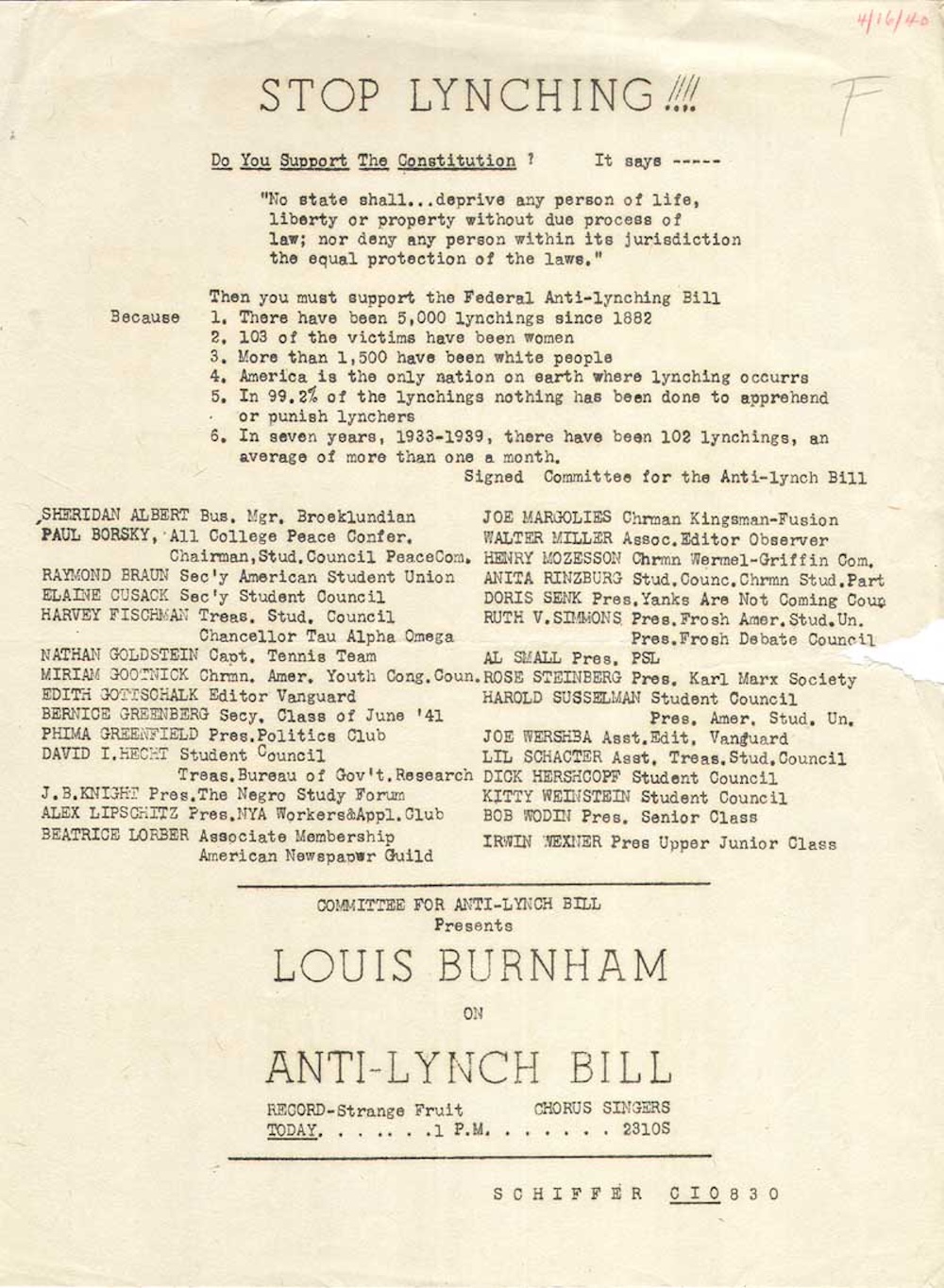
Burnham is often introduced today as the founding editor of Freedom, the Harlem newspaper launched with Paul Robeson, and as an organizer with the Southern Negro Youth Congress (SNYC). Both are accurate, but neither fully captures his role. Burnham was a builder of infrastructure: of youth organizations, of campaigns, of publications, of relationships between writers and organizers, between Northern and Southern struggles, between Black American demands and the decolonizing world. When later generations spoke of “the movement,” they typically meant the visible crest of the 1950s and 1960s. Burnham’s life sits in the earlier swell—less photogenic, more dangerous in certain ways, and deeply instructive about what it cost to organize while being watched, blacklisted, and threatened.
A Harlem childhood and a Caribbean inheritance
The facts of Burnham’s origins carry a useful tension. Many accounts place his birth in Harlem; others indicate Barbados. What is less disputed is that his parents were Barbadian immigrants and that the household carried a strong political consciousness, shaped in part by the Garvey movement’s wide reach across Black Atlantic communities. His mother’s admiration for Marcus Garvey mattered not just as ideological formation but as a practical education in self-help institutions and racial pride—forms of politics that, in Harlem, overlapped and competed with socialist and communist organizing during the Depression years.
This matters because Burnham’s later politics are sometimes flattened into a single label—“Communist,” “Black left,” “radical.” Those terms are not wrong, but they can obscure the blend of influences that produced his particular outlook: a Harlem generation whose worldview was shaped by the Scottsboro case, by Ethiopia’s invasion, by the Popular Front’s anti-fascism, and by a diasporic sensibility that did not treat U.S. racism as an isolated domestic problem.
Burnham attended City College of New York (CCNY), a legendary incubator for political debate in the 1930s, and moved through student organizations that treated anti-racism as inseparable from anti-fascism and labor struggle. His campus activism—his role in Black student organizing and his work pushing institutions toward African-American history—signals an early tendency that would define his adult life: he was less interested in solitary achievement than in the collective capacity to tell the truth, educate, and mobilize.
The political education of youth organizing
Burnham’s entry into youth organizing was not merely a stepping-stone toward later prominence. In the 1930s and 1940s, youth politics—student unions, anti-lynching campaigns, jobs campaigns, anti-war debates—served as laboratories for the tactics and alliances that would later be recognized as “civil rights strategy.” Burnham’s work in Harlem and then with the Southern Negro Youth Congress placed him at the center of that laboratory.
SNYC, founded in 1937, has sometimes been treated as a prelude to the better-known organizations of the 1950s and 1960s. But that framing understates what it accomplished in the teeth of the Jim Crow South and in the shadow of wartime nationalism and postwar anti-communism. Scholars of SNYC have emphasized its interracial character, its labor connections, and its willingness to push a politics of voting rights and public accommodations long before those demands became safe enough to be mainstream. Burnham did not simply join SNYC; he became one of its key administrators and strategists, ultimately serving as executive secretary.
This is also where Burnham’s personal life became inseparable from his political commitments. In 1941 he married Dorothy Challenor Burnham, herself an activist whose long life would come to embody a century of Black left organizing, education, and feminist politics. Their partnership—intellectual and practical—matters because it counters a common historical habit: telling movement stories as if women were supporting characters in the lives of male leaders. Dorothy Burnham was not a footnote; she was a co-worker, organizer, and later a guardian of the archive and memory of that era.
Birmingham: organizing under Bull Connor before the cameras arrived
When the Burnhams moved to Birmingham, Alabama, they stepped into a city that would later become globally infamous in 1963—police dogs, fire hoses, children in the streets. But in the 1940s, Birmingham was already a hard place to do any interracial organizing, voting rights work, or labor agitation. The violence was not always televised; it was still systematic.
Burnham’s Birmingham years demonstrate a crucial point about movement history: there is almost always a “before,” when people test tactics, build networks, and absorb the costs, without the moral clarity and media attention that later moments receive. Burnham helped build SNYC chapters at Black colleges, worked on voting rights, and pushed campaigns that confronted the daily mechanics of segregation.
He also ran into Eugene “Bull” Connor—well before Connor became an international symbol of Southern brutality. Accounts of the period describe Connor’s harassment and intimidation of SNYC organizers and Burnham personally, including threats of vagrancy arrest and the policing of interracial association. If the popular memory of Birmingham centers on 1963, Burnham’s memory should expand that frame: Connor’s machinery of control was long-running, and it took years of organizing pressure before the world paid attention.
SNYC’s wartime politics also complicate the usual story. Rather than treating World War II as an automatic engine of progress, SNYC pushed for concrete demands—desegregation in the military, defense industry jobs, elimination of the poll tax—while insisting that democracy abroad was hollow without democracy at home. Burnham appears in accounts of SNYC delegations that engaged federal officials on these questions, an early example of a strategy that later civil rights organizations would refine: local organizing paired with pressure on national institutions.
The Red Scare and the narrowing of “acceptable” civil rights
Burnham’s political affiliations—particularly his ties to communist and left-labor circles—cannot be treated as incidental. They were central to what he believed, how he worked, and why his name fell out of broader public memory.
In mid-century America, anti-communism functioned not only as foreign policy ideology but as a domestic policing apparatus. It disciplined unions, targeted interracial coalitions, criminalized dissent, and narrowed the spectrum of “acceptable” civil rights activism. Organizations with left ties were pressured, surveilled, defunded, and isolated. The collapse of SNYC by the late 1940s fits this pattern, as Cold War politics made it easier for segregationists to brand integrationists as subversives and for liberal institutions to abandon controversial allies.
Burnham’s career therefore offers a lesson in how movements are shaped not only by their enemies on the Right but also by the boundaries imposed by the center. If you want to understand why certain civil rights stories became canonical and others were marginalized, you have to track the pressures that pushed “respectability” as strategy and forced radical organizers into smaller, more precarious spaces.
Burnham did not retreat into silence. He pivoted into publishing, which—done well—can be a form of organizing by other means.
Freedom: the newspaper that tried to keep the window open
In 1950, Burnham helped found and then edited Freedom, the Harlem paper associated with Paul Robeson. In a period when Robeson was being punished by the U.S. state—his passport revoked, his concerts disrupted, his name treated as a contagion—Freedom served as a platform for civil rights, labor coverage, and anti-colonial solidarity.
The newspaper’s significance is not only that it existed. It is what it insisted on printing in a moment designed to produce fear. Freedom “openly challenged racism, imperialism, colonialism, and political repression,” and it positioned Black struggle as part of a global fight for human rights and self-determination. That editorial posture—linking domestic racism to colonialism abroad—would later become familiar in Black internationalist thought, but in the early 1950s it came with steep costs.
Burnham’s editorial work also shaped American letters. He mentored young writers, most famously Lorraine Hansberry, who worked at Freedom and later became a defining playwright of the era. The point is not celebrity association; it is the role of a movement newsroom as a training ground. Freedom was not only reporting the struggle; it was producing the people who would narrate it.
The paper’s network of contributors and associates reads like a map of Black left cultural life: Robeson, W. E. B. Du Bois, Alice Childress, and others who treated art, politics, and journalism as mutually reinforcing. Burnham’s gift was to make that network coherent on the page—to tie local housing fights to labor struggles to decolonization, without losing the human stakes.
Journalism as fieldwork: listening where power doesn’t
By the late 1950s, Burnham was writing for the National Guardian as an associate editor covering civil rights and national liberties, reporting from the South and from Northern cities where racial conflict was often framed as mere “urban problems.” of his reporting emphasize a method that today might be described as immersion journalism with an organizer’s instincts: spending time with workers, in barbershops, on lunch breaks, on the street—treating ordinary people as sources of political analysis, not just as subjects of tragedy.
This approach matters because it reflects a deeper theory of change. Burnham did not believe that freedom would be granted by enlightened elites. He believed that freedom had to be organized into existence, and that the public needed journalism that described not only injustice but capacity—who was building power, how they were learning, where confidence was rising, where repression was mutating.
That sensibility runs through the projects he undertook, including pamphleteering. His writing on the lynching of Emmett Till—published as Behind the Lynching of Emmett Louis Till—is part of a tradition of activist reportage that sought to document violence, analyze its enabling conditions, and argue for remedies. In a country that often treated anti-Black violence as regional pathology rather than national policy, such work aimed to make denial harder.
“We Charge Genocide” and the language of human rights
Burnham’s name appears among the signers of We Charge Genocide, the 1951 petition to the United Nations that argued the U.S. government was complicit in violence against Black people. The petition remains controversial in some circles, in part because it challenged a Cold War narrative that positioned the United States as the world’s democratic standard-bearer. But historically, it marks an important turn: the use of international human rights frameworks to describe American racism.
Burnham’s involvement here aligns with the through-line of his life: the insistence that Black freedom struggle was not a narrow domestic “civil rights issue,” but a fundamental question of human rights in an international order. That framing has returned in contemporary activism—often without full credit to the mid-century figures who first took the risk of making the claim.
Freedomways: the journal he helped imagine, but didn’t live to edit
Perhaps the most poignant measure of Burnham’s significance is what he almost did next. Near the end of his life, Burnham and fellow veterans of SNYC envisioned a Black political and cultural quarterly that would carry forward the editorial spirit of Freedom in a new era of rising mass protest. The result became Freedomways, launched in 1961, with founders including Burnham, Edward Strong, W. E. B. Du Bois, and Shirley Graham Du Bois.
Burnham was supposed to be the editor. He died before the first issue appeared.
It is hard to overstate what that means in symbolic terms. Burnham’s career bridged the Depression-era Black left, the wartime fight over democracy, the early Cold War crackdown, and the emergence of a new civil rights insurgency. Freedomways became one of the leading journals of Black political and cultural thought for decades, publishing essays, poetry, criticism, and movement analysis that shaped intellectual life from the early 1960s through the 1980s. Burnham’s absence from its masthead is one of those historical absences that changes what we remember. The journal’s existence testifies to the networks he helped build; the fact that he did not get to edit it testifies to how fragile those networks were under pressure and how quickly a life could end.
A sudden death in mid-sentence
Burnham died on February 12, 1960, while speaking at a Negro History Week event in New York, delivering a lecture on “Emerging Africa and the Negro People’s Fight for Freedom,” according to accounts preserved in archives and later summaries. The manner of his death—heart failure during a public talk—carries a kind of tragic clarity. He died doing what he had done for two decades: teaching, urging, insisting that struggle was not only necessary but winnable.
Eulogies and memorial materials preserved in university archives underscore how his peers understood the loss—not simply personal grief, but the disappearance of a strategist and storyteller at a moment of movement acceleration. In many civil rights timelines, 1960 is the beginning of a decade. For Burnham, it was the end—just as the sit-in movement was igniting and as the organizational ecosystem he helped seed was about to expand.
Why Louis Burnham matters now
Burnham’s significance is not reducible to a list of accomplishments—though the list is substantial. It is better understood as a set of lessons about movement making, journalism, and historical memory.
First, Burnham’s life shows that civil rights was not a single-issue struggle for desegregation; it was entangled with labor rights, anti-lynching work, voting rights, and global decolonization. Burnham’s insistence on these connections is part of why he was targeted and part of why his work remains useful: it resists the sanitized version of the past that treats freedom as a polite request rather than a political conflict.
Second, Burnham demonstrates the power of publishing as organizing. Freedom was a small operation with outsized influence, a “visible” institution of Black left cultural life during the early 1950s, and it helped shape writers and readers who carried its sensibility forward. In an era when media ecosystems are again contested, Burnham’s model—journalism grounded in movement knowledge, international awareness, and working-class sources—feels less like nostalgia than like a blueprint.
Third, Burnham’s marginality in mainstream memory is itself instructive. The Cold War did not only suppress organizations; it reshaped the archive of American virtue. It rewarded narratives that excluded radicals and punished those who connected racism to capitalism, colonialism, and state violence. Burnham’s life is a case study in how a democracy can claim progress while narrowing the range of permissible dissent.
Finally, Burnham’s legacy persists in the institutions and people that carried forward his work. Freedomways became a major journal. His mentoring helped shape Lorraine Hansberry’s early development. His family—Dorothy Burnham, and later their children and comrades—preserved and extended the political commitments he lived. And the existence of the Burnham Award, established to honor organizing, scholarship, and journalism impacting African-American communities, is a contemporary attempt to keep his name attached to the values he practiced.
The simplest way to describe Louis Burnham is as a civil rights activist and journalist. The more accurate way is to say he was a connective figure—between Harlem and Birmingham, between labor and civil rights, between the United States and a decolonizing world, between the newsroom and the street. In an American story that too often remembers its heroes only when they fit a narrow script, Burnham’s life is a reminder that some of the most consequential people are the ones who make the infrastructure, keep the record, train the next voice, and refuse to lie about what power is doing.
If history is, in part, the story of who gets remembered, then Burnham’s life poses a challenge worthy of his own journalism: not whether he mattered—he did—but what we lose when our public memory trims away the radical editors and organizers who insisted that freedom was global, structural, and urgent.
More great stories
Afro Sheen, Wall Street, and the Architecture of Black Possibility
July 6, 2026
No Comments
The Fire Inside the Fourth
July 5, 2026
No Comments