

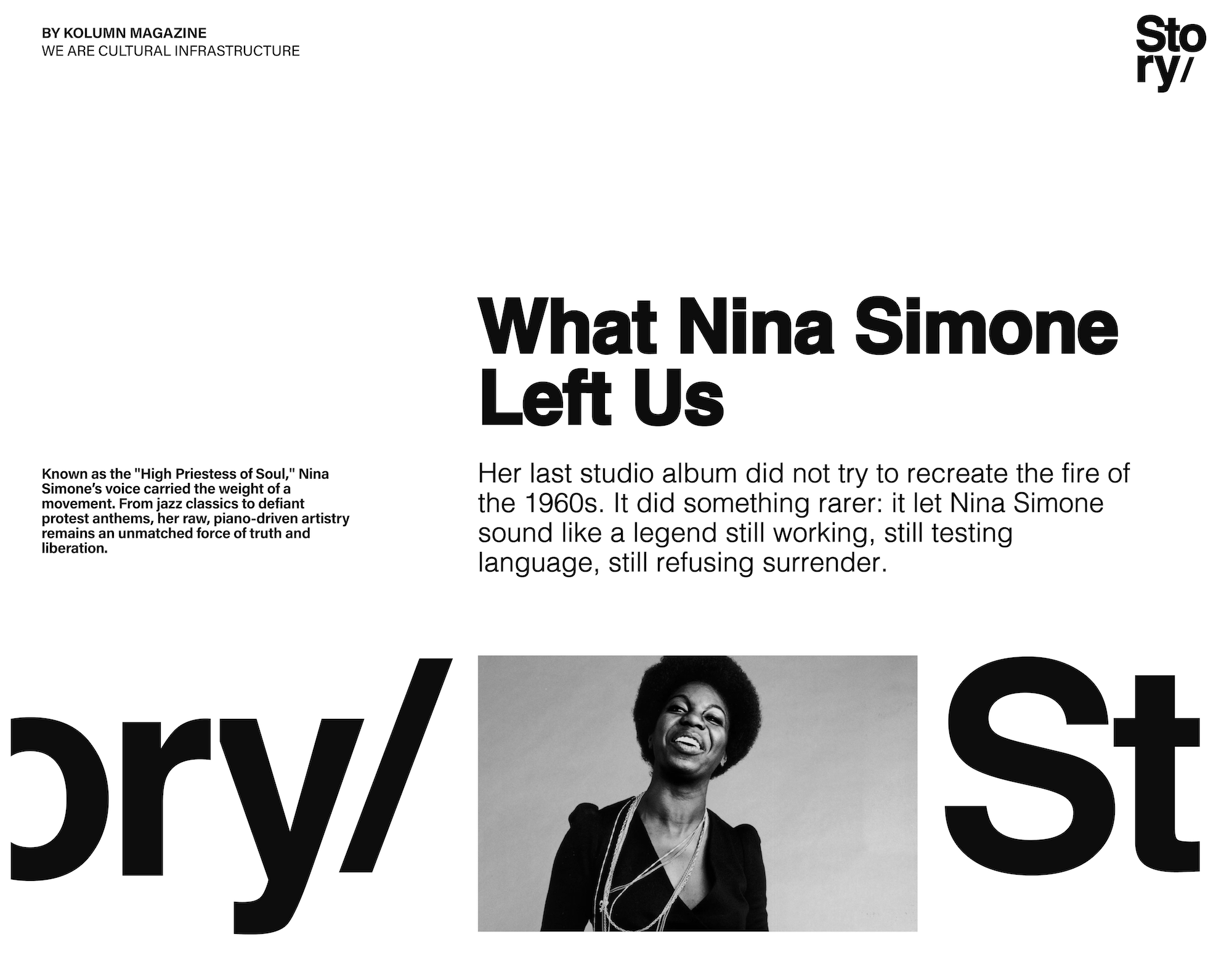
Nina Simone’s final album is not a retreat from her power. It is power in a different temperature.
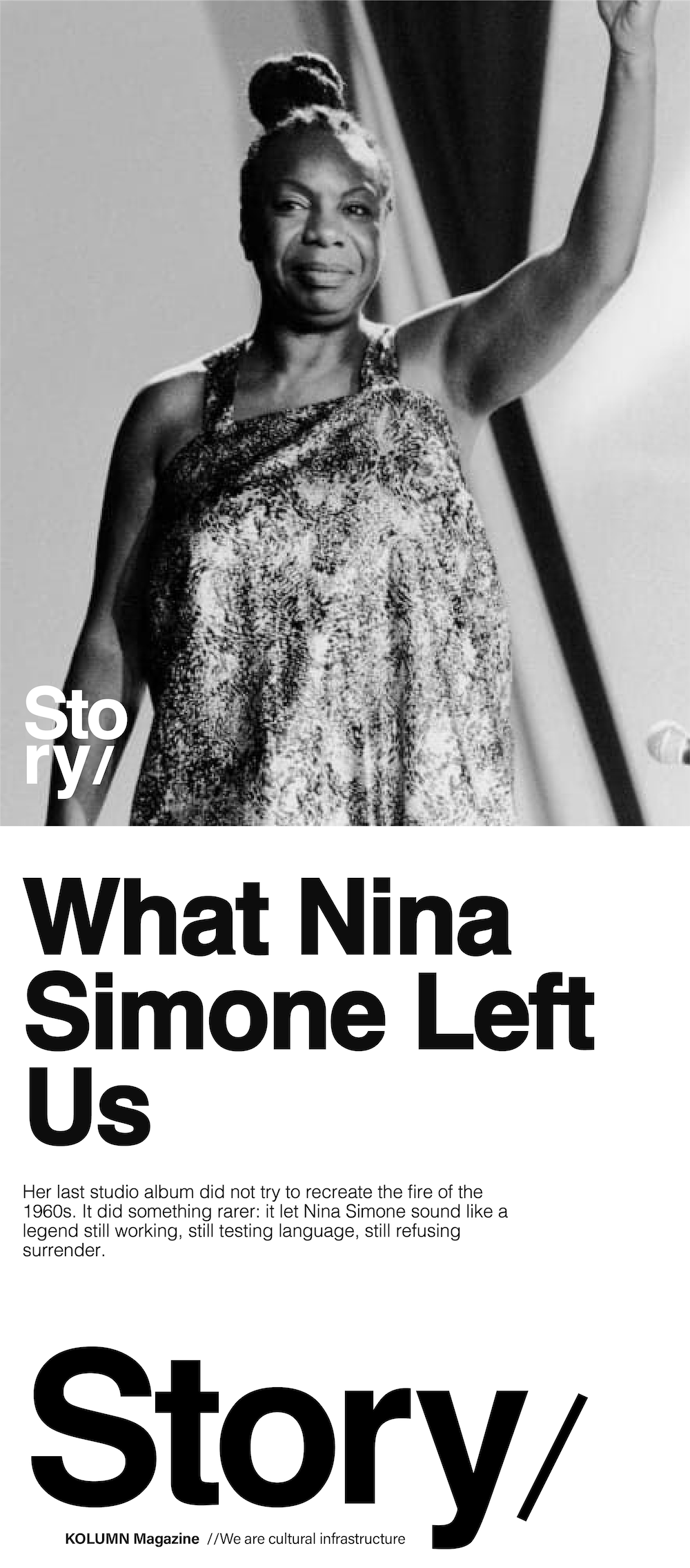
Nina Simone’s final album is not a retreat from her power. It is power in a different temperature.
By KOLUMN Magazine
When people talk about Nina Simone, they usually start in the obvious places: Mississippi Goddam, Four Women, I Put a Spell on You, Sinnerman, To Be Young, Gifted and Black. They start with the thunder. They start with the records that changed the vocabulary of American music and helped define the moral sound of the civil-rights era. What tends to get less attention is the fact that Simone’s final studio album released during her lifetime, A Single Woman, arrived in 1993, after decades of reinvention, disappointment, exile, and survival. It was issued by Elektra after sessions recorded in Los Angeles, and both the official Nina Simone archive and later reissue materials identify it as her last studio album.
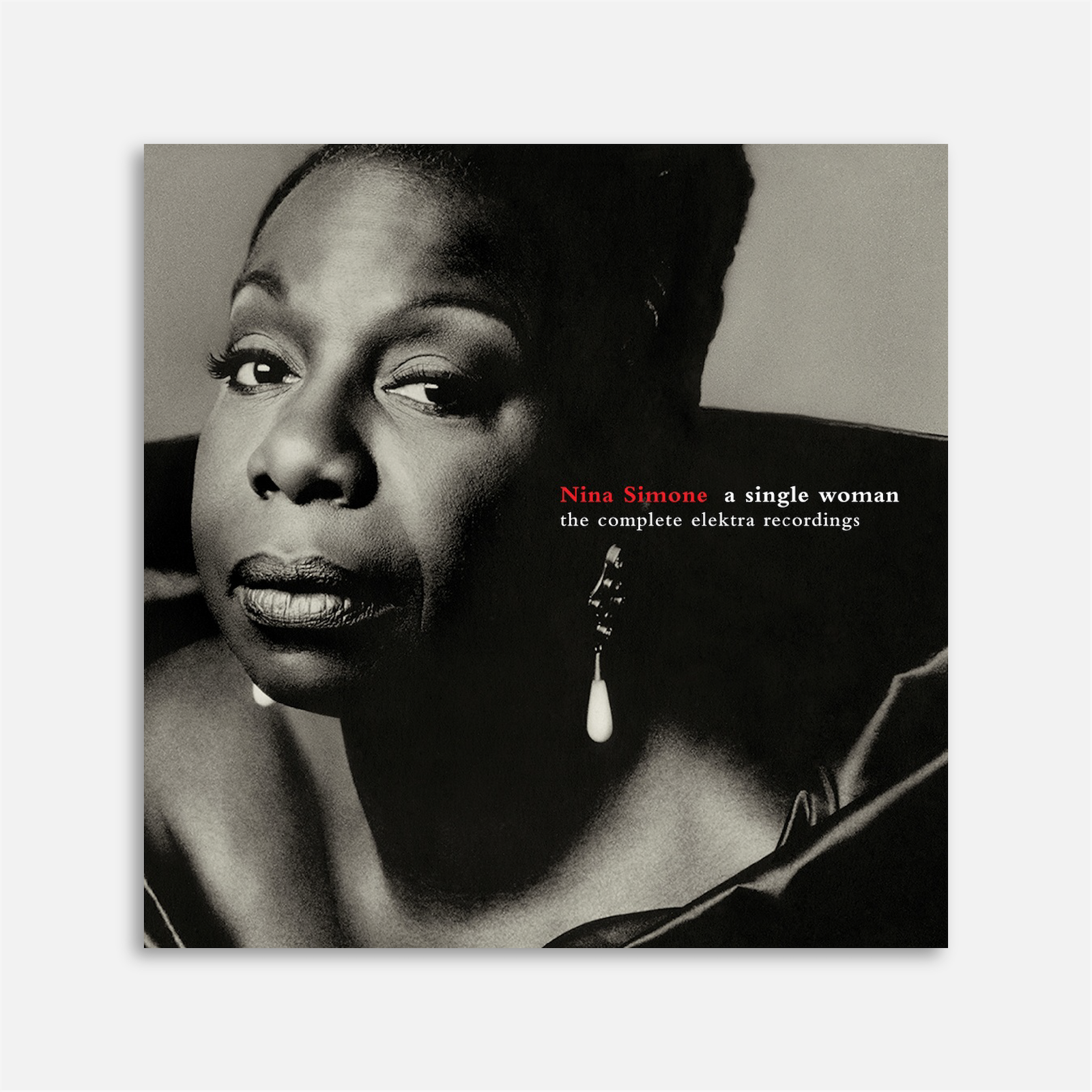
That matters because “last album” can be a messy category with an artist like Simone. There were live records before it, archival sets after it, reissues later, and in 2025 a fuller version of the project, A Single Woman: The Complete Elektra Recordings, expanded the story of those sessions with previously unissued tracks. But if the question is which album served as Simone’s final studio statement in her lifetime, the answer is A Single Woman. The official biography on Simone’s own site places that 1993 Elektra record at the far end of a career arc stretching from “I Loves You, Porgy” to the title song “A Single Woman,” and the later Omnivore reissue explicitly describes it as her “final studio album.”
And yet the album still sits awkwardly in the public imagination. It does not have the mythic centrality of her 1960s work, nor the cult aura of Fodder on My Wings. It is not the Nina Simone record most newcomers are told to hear first. Some early critics found it too polished, too orchestrated, too “late-career.” Others heard something else: a voice deepened by time, sharpened by experience, and still fully capable of bending a song until it belonged to her. That split in reception has only made the album more interesting with age.
By the time she made it, Nina Simone had already lived several artistic lives
To understand why A Single Woman matters, you have to understand where Simone was by 1993. Born Eunice Waymon in Tryon, North Carolina, she was classically trained, a formidable pianist before the world fully understood her as a singer, and a performer whose music never stayed obedient to category. Britannica describes her as an artist of “urgent emotional intensity,” moving among love songs, protest songs, and Black empowerment with a dramatic, rough-edged style. The Washington Post, in its obituary, emphasized the same boundary-breaking quality, noting how she blurred jazz, pop, blues, spirituals, folk, chansons, and contemporary songwriting into one fiercely individual body of work.
That refusal to stay in one lane helped make Simone singular, but it also complicated her place in the industry. She was too classical for the jazz box, too political for easy pop packaging, too musically omnivorous for the tidy genre stories record companies like to tell. The New Yorker’s portrait of Simone argued that she was excluded from standard histories for years in part because her eclecticism strained the definitions critics wanted to impose. The National Women’s History Museum makes a similar point more directly: scholars and gatekeepers often overlooked her because her music crossed too many categories to be easily sorted.
By the end of the 1960s and into the 1970s, the personal and professional pressures were immense. The New Yorker details a period marked by marital abuse, worsening mental-health struggles, financial instability, and a growing sense of alienation from the United States and from an industry that had repeatedly failed her. Simone would eventually live in Barbados, Liberia, Switzerland, the Netherlands, and France. By the time A Single Woman emerged, she was no longer the Nina Simone of Carnegie Hall in the mid-1960s, but neither was she some exhausted relic. She was a late-style artist: scarred, lucid, erratic at times, but still capable of startling command.
That late phase is too often described only in terms of decline, which misses the point. Yes, there were health struggles. Yes, there were public incidents that became part of the Simone legend, sometimes flattening her into caricature. But the last decade of her life also brought renewed recognition. Her official biography says she became a global catalog best-seller as CD culture, film and television exposure, and later internet discovery brought new audiences to her work. The 1990s did not restore her to a simplified version of stardom; they did something more complicated. They reminded the world that Nina Simone had outlived the terms on which it first misunderstood her.
The album began with a comeback opportunity, not a farewell announcement
One of the most revealing facts about A Single Woman is that it was not framed, at the time, as a grand valedictory statement. According to Omnivore’s account of the sessions, Simone was approached after a triumphant 1992 concert at Carnegie Hall by Elektra A&R executive Michael Alago. The idea was not simply to capture a legend for prestige value. It was to make a new Nina Simone record, properly financed, with a serious producer and orchestral setting. Simone’s reported response—“Get me the money… then we can talk!”—sounds exactly like the Nina who had spent decades battling the business side of music and had no interest in being patronized.
“By 1993, Simone no longer needed to prove that she could be explosive. What she offered instead was harder to fake: gravitas.”
The Elektra sessions were produced by André Fischer and, according to the reissue notes, backed by a 50-piece orchestra. Omnivore says the project was modeled in part on Frank Sinatra’s A Man Alone and Billie Holiday’s Lady in Satin—two records where mature voices, orchestral texture, and biography become inseparable. That is a revealing lineage. It suggests that the people around the record were not trying to recreate Simone’s 1960s protest years or force her into contemporary radio formats. They were constructing a late-life space around the voice itself: lived-in, weathered, unsentimental, still devastating.
The official Nina Simone archive echoes that sonic description from another angle. Its album page frames A Single Woman as a record where strings and guitars hold Simone’s voice rather than smother it, letting the emotional nuances of the songs “float and penetrate.” The language is promotional, yes, but the basic point holds. This is not an album built around virtuoso disruption. It is built around placement, shading, patience, and the authority of tone. Simone had always known how to attack a lyric. Here, just as often, she hovers over it.
That is one reason the album can surprise listeners who come expecting either the righteous attack of “Mississippi Goddam” or the ecstatic propulsion of “Sinnerman.” A Single Woman does not perform urgency in those terms. It works more like a chamber drama. The tensions are interior. The stakes are emotional and existential rather than overtly agitational. Yet that does not make the record apolitical. With Simone, even intimacy has context. A Black woman singing about love, self-definition, grief, desire, and solitude at this stage of life is not exiting history. She is carrying history into private space.
Why the title matters so much
The title A Single Woman is almost suspiciously perfect. Not because it flatters Simone with some tidy feminist branding, but because it names a condition she had been singing toward, around, and against for years. The album page on the official site reads the title track as the voice of “a full grown woman in love,” a woman defining her own fate and acknowledging her needs without shame. That framing matters, especially for Simone, whose public life was so often narrated through conflict—industry conflict, political conflict, domestic conflict, racial conflict, mental-health conflict—rather than through autonomy.
The phrase “single woman” also lands differently when attached to Nina Simone than it might to a younger singer being marketed through romantic intrigue. By 1993 Simone was not selling ingénue vulnerability. She was past the point where heartbreak alone could be the whole story. On this album, solitude is not only loneliness; it is sovereignty, damage, memory, erotic knowledge, and hard-won self-recognition. Even when the official liner-note language turns lush, it circles that core idea: a woman deciding the terms on which she will be understood.
That is why the record’s love songs feel less like genre exercises than like studies in emotional weather. The official album notes describe songs such as “Lonesome Cities,” “If I Should Lose You,” “Papa, Can You Hear Me?,” “Il N’y A Pas D’Amour Heureux,” and “Just Say I Love Him” as moving through flirtation, tenderness, and vulnerability. You hear not a singer pretending innocence, but a singer inventorying what love costs after a life fully lived. The difference is everything.
In that sense, the album is a late-career act of reframing. Simone had long been public property: sampled, mythologized, feared, admired, flattened into “High Priestess of Soul,” and constantly recruited as symbol. A Single Woman resists that recruitment by narrowing the lens. It says, in effect: here is not the movement icon, not the cautionary tale, not the impossible diva, but a woman and a voice in relation to longing. That refusal to perform only the public Nina may be one reason the album was initially undervalued. Audiences often claim they want the whole artist; what they usually want is the most familiar version.
The sound of the record: strings, shadows, and deliberate restraint
One of the easiest mistakes to make about A Single Woman is to confuse softness with submission. The orchestral setting can make the record seem, on first pass, more conventional than Simone’s most abrasive or radical work. Rolling Stone’s contemporary review, at least from the surviving snippet, treated the album as too pleasant, too polite, too constrained by its arrangements. That response is historically useful because it captures what some critics expected from Simone: a performer whose greatness had to remain jagged, defiant, and visibly difficult.
But that is only one reading. The Guardian, in a later appreciation by Mica Paris, argued the opposite—that A Single Woman was “as powerful as anything” Simone had done earlier and proved she still possessed that indefinable force. Wax Poetics later summarized the split cleanly: some critics dismissed the album, while defenders heard it as formidable late work. That divergence is not noise around the record. It is part of the record’s history.
Listen with time rather than expectation and the album starts to reveal its method. Simone’s voice here is lower, grainier, more openly marked by age. Her phrasing is unhurried in a way that can sound almost conversational, until suddenly it doesn’t. She knows exactly when to make a line hang, when to force a syllable into ache, when to withhold sentiment so that the song has to earn it. The orchestrations do not erase her edge. They frame it, sometimes even sharpen it by contrast. The Omnivore reissue’s comparison points—Sinatra’s A Man Alone and Holiday’s Lady in Satin—are helpful because both records understand that wear itself can become an expressive instrument.
There is also something fitting, maybe even sly, about the use of strings. Simone had classical ambitions from childhood. The industry often tried to contain her as a jazz or soul figure, terms she resisted when they denied her broader musical training. On A Single Woman, the orchestral environment can be heard not merely as adult-contemporary packaging but as one more way Simone re-entered a sound-world adjacent to the formal musical seriousness she had chased from the beginning. Not a return to the conservatory dream, exactly, but certainly not a surrender to cliché either.
A record about romance, yes—but not only romance
The official notes insist that A Single Woman is “about love, all kinds of love,” and that’s true as far as it goes. But love on a Nina Simone record is never just private feeling. It is always braided with power, vulnerability, memory, and the question of who gets to narrate whom. On earlier records, that could sound like confrontation. Here, it often sounds like a reckoning conducted at close range. Simone is not pleading for innocence or pretending that desire exists outside history. She sings as someone who knows that intimacy itself can be a site of unequal power and exhausted hope.
“On this album, Nina Simone does not ask to be decoded. She asks to be heard.”
That complexity is especially important because Simone’s public reputation has so often leaned on her role as political voice—accurately, but incompletely. The Washington Post obituary emphasized both sides of her art: “shimmering testimonials to the power of love” and “blistering social commentaries,” sometimes joined in the same body of work. A Single Woman is significant precisely because it reminds listeners that Simone’s political seriousness never canceled her investment in romance, family feeling, loneliness, and sensuality. It widened them.
Even “Papa, Can You Hear Me?” lands differently in Simone’s hands than it does in a standard show-tune context. The official notes group it with songs about the tender and the unprotected. That word—unprotected—feels like a key to the whole album. Simone had spent a lifetime in forms of exposure: racial exposure, artistic exposure, financial exposure, emotional exposure. To hear her in late career singing songs of longing is to hear not softness detached from struggle but softness after struggle. That is richer, and sadder, and more specific.
And then there is the title track itself, which now reads almost like a compressed thesis for Simone’s late career. A woman “caught in a world few people understand,” as the official page quotes it, is not merely a romantic solitary. She is a cultural type Simone knew from the inside: the Black woman genius too often admired in abstraction and misunderstood in person. In that sense, the album title is autobiographical without being confessional in a cheap way.
The politics of restraint
There is a temptation, especially in retrospective criticism, to treat Simone’s explicitly political songs as the real work and everything else as supplement. That is understandable, because those songs are monumental. But it is also reductive. The New Yorker’s account of Simone shows how deeply the movement shaped her life and art, while the Washington Post underscores how central she was to turning civil-rights outrage into public music. None of that disappears on A Single Woman. It changes register.
The politics of this album are not slogan politics. They are politics embedded in presence. A Black woman artist, born in segregation, denied full recognition by classical institutions, brutalized by the industry, and made into a symbol long before she was treated fairly as a worker, arrives in 1993 with a record centered on mature female interiority. That is not apolitical. It is a refusal of the demand that Black women only be publicly intelligible through service, struggle, or spectacle. Simone had given the world protest anthems. Here, she gives it self-possession.
The title becomes political in that light too. “Single woman” can imply marginality in a culture that still likes to measure women by attachment, especially older women, especially Black women, especially difficult women, especially women whose genius unsettles neat narratives of likability. Simone knew all of those conditions. To inhabit the phrase rather than apologize for it is one of the album’s quietest and toughest gestures.
This is where the late-style restraint becomes radical. Simone is not trying to out-shout her past. She is not reenacting the righteous fury audiences may have wanted her to embody forever. She is letting timbre, phrasing, and repertoire do subtler work. For some critics, that read as diminution. For others, and increasingly for later listeners, it reads as the sound of an artist stripping away performance habits until only authority remains. The album’s significance has grown partly because contemporary audiences are more willing to hear maturity not as a compromise but as an aesthetic.
The afterlife of the album has improved its standing
If A Single Woman was once treated as a minor entry in the Simone catalog, its afterlife has been kinder. The 2008 expanded edition added tracks from the Elektra sessions, and the official site lists those additions, including “The Long and Winding Road,” “No Woman, No Cry,” “The Times They Are A-Changin’,” and “Sign o’ The Times.” Those choices alone are revealing. They suggest that the original sessions were broader and perhaps stranger than the ten-track 1993 album conveyed, reaching toward Dylan, Marley, Prince, and the Beatles.
The 2025 Complete Elektra Recordings made that case even more strongly. Omnivore describes the expanded set as restoring the full breadth of what Simone recorded during those sessions, including four previously unissued performances and material that hinted at a possible follow-up album that never arrived. That does not change the status of A Single Woman as the last studio album issued in her lifetime. But it does change our sense of its scale. What once looked like a tidy coda now appears to have been one fragment of a larger late-career creative burst.
That larger view helps rescue the album from a common fate of final works: being heard only through mortality. Of course people listen for endings. Of course they hear the ghost of what comes next—Simone’s death in France in 2003, after years of illness, as documented by Britannica, the Washington Post, and the National Women’s History Museum. But the expanded archival picture reminds us that Simone in 1992 and 1993 was still making choices, still testing repertoire, still imagining continuation. A Single Woman is moving partly because it was not recorded under the sign of finality, even if history later placed it there.
Why it belongs in the serious Nina Simone conversation
There are at least two lazy ways to talk about late albums by canonical artists. One is to fetishize them just because they are final. The other is to dismiss them because they are not prime-era masterpieces. A Single Woman deserves neither treatment. It is not Simone’s most revolutionary album, nor her most influential, nor the best single gateway into her catalog. But it is one of her most revealing. It shows what remained when the historical spotlight dimmed, when the voice had thickened, when the body had paid its price, when the marketplace no longer knew exactly what to do with her, and when she still walked into the studio anyway.
It also enlarges the meaning of Nina Simone’s legacy. Too often her canonization has centered on righteous anger, as though her greatness can best be proved by the moments when she sounds most unmistakably political, most explosively unclassifiable, most easy to excerpt in documentary form. But Simone’s genius was never only rage. It was interpretation. It was control. It was the ability to make arrangement, repertoire, diction, and silence all carry biographical weight. A Single Woman offers that in abundance.
And there is something deeply fitting about the fact that her last studio album is not a monument. It is not trying to freeze Nina Simone in amber. It moves. It breathes. It worries at tenderness. It accepts lushness without becoming sentimental. It lets age be audible. In that way, it may be closer to Simone’s actual artistic ethic than any reverent “greatest hits” framing could ever be. She was always too alive, too contrary, too musically restless for embalming.
By the end of her life, the world was catching up to her again. Her official biography says she was enjoying unprecedented recognition. New generations were hearing the records, sampling the songs, rediscovering the performances. The institutions that once excluded or minimized her were beginning, belatedly, to hand over flowers. A Single Woman sits inside that late recognition but apart from it too. It is not a victory lap. It is a document of endurance.
The real significance of Nina Simone’s last released album
So what, finally, is the significance of Nina Simone’s last released album? It is significant because it proves that the final chapter of a major artist’s life does not have to sound like summary to sound profound. It is significant because it complicates Simone’s legend in the best possible way, insisting that the woman who gave us some of the fiercest political music of the twentieth century also deserved to be heard in late-life meditations on solitude, tenderness, and emotional memory. It is significant because it brings her classical seriousness, her refusal of genre boxes, and her unteachable gift for phrasing into one quietly formidable record.
Most of all, A Single Woman matters because it refuses the false choice between force and fragility. Simone had both. She always had both. On this album, perhaps more nakedly than on almost any other, she lets them share the same room. The result is not the loudest Nina Simone record. It may not even be the most immediately unforgettable. But it is one of the clearest windows onto what made her irreplaceable: not just the authority, not just the politics, not just the pain, but the capacity to make a song sound as though it had waited all its life for this exact voice, at this exact age, to tell the truth.
That is why A Single Woman should be heard not as an appendix to the Simone story, but as part of its argument. Nina Simone did not end as a museum piece, or as a pure protest emblem, or as a nostalgia act embalmed by reverence. She ended, at least in her last released studio album, as an interpreter of adult feeling so exacting that even restraint could feel incendiary. She ended where the greatest artists often do: not by becoming smaller, but by becoming impossible to mistake for anyone else.
More great stories

Afro Sheen, Wall Street, and the Architecture of Black Possibility
July 6, 2026
No Comments
The Fire Inside the Fourth
July 5, 2026
No Comments