



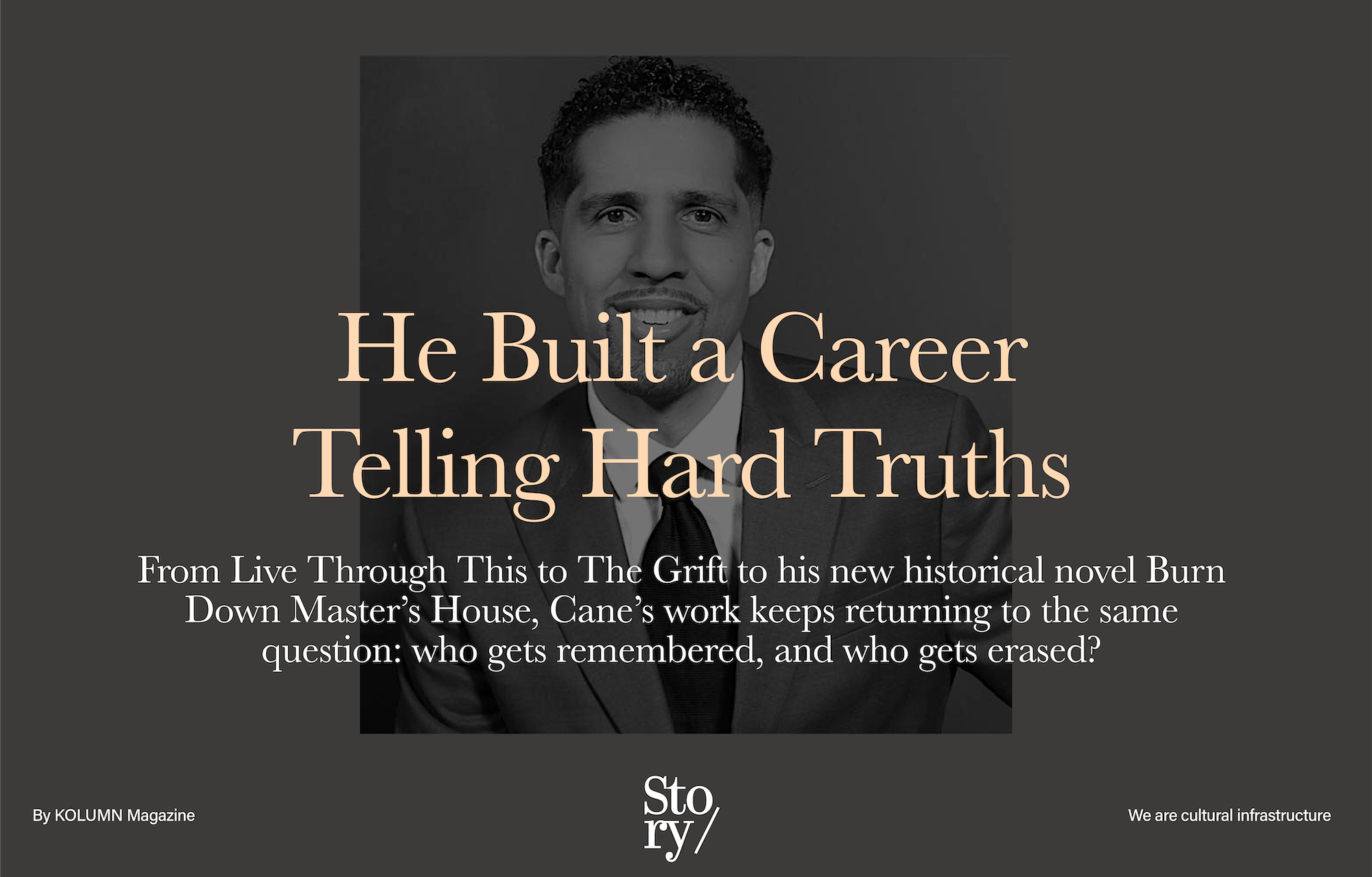
Clay Cane’s work is animated by one persistent demand: stop mistaking erasure for peace.
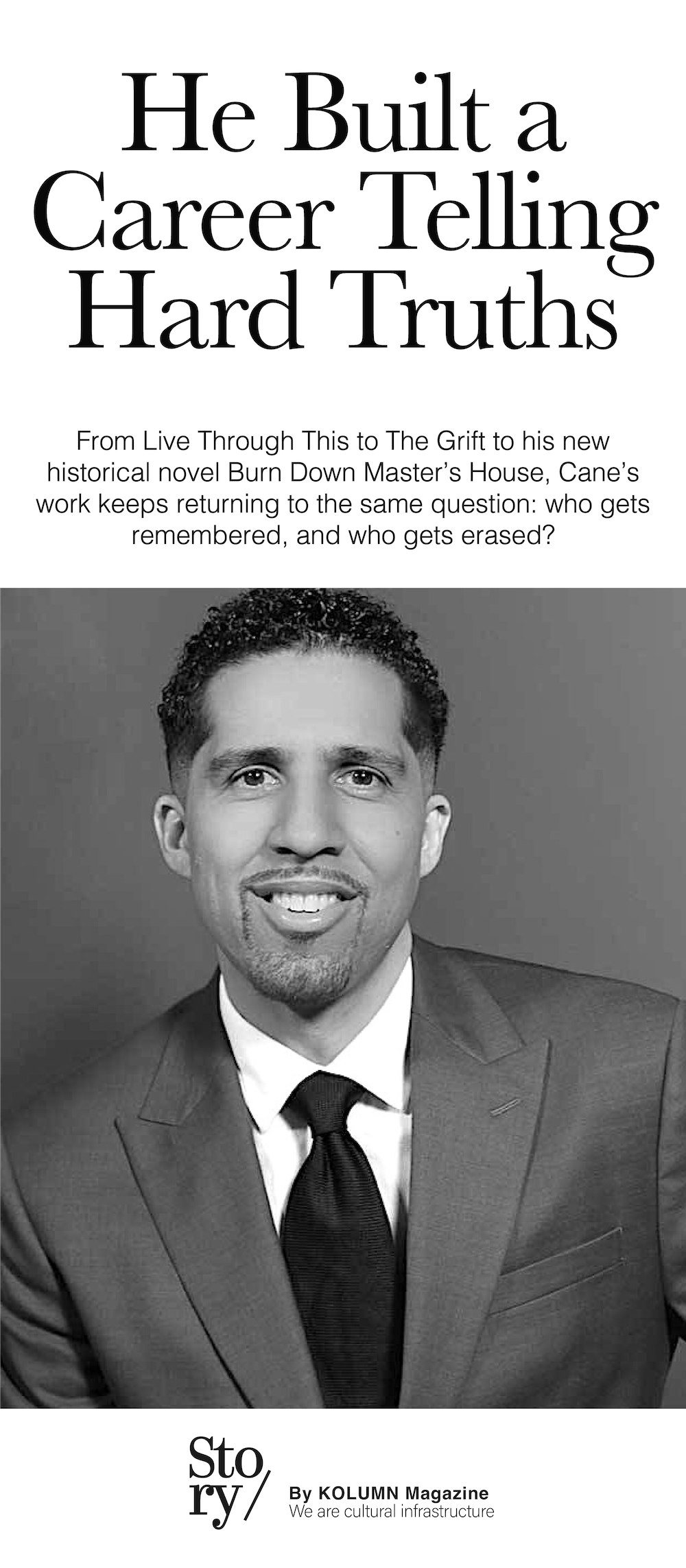
Clay Cane’s work is animated by one persistent demand: stop mistaking erasure for peace.
By KOLUMN Magazine
Clay Cane has built a career on a simple and increasingly radical premise: the truth is not automatically self-executing. It has to be argued for, repeated, defended, sharpened, and, when necessary, made impossible to ignore. Across essays, radio, documentary, memoir, political analysis, and now historical fiction, Cane has become one of those public figures whose body of work feels less like a set of separate projects than a sustained campaign against distortion. He does not merely comment on American culture. He interrogates the stories the country tells itself in order to avoid looking too closely at race, sexuality, faith, violence, and power.
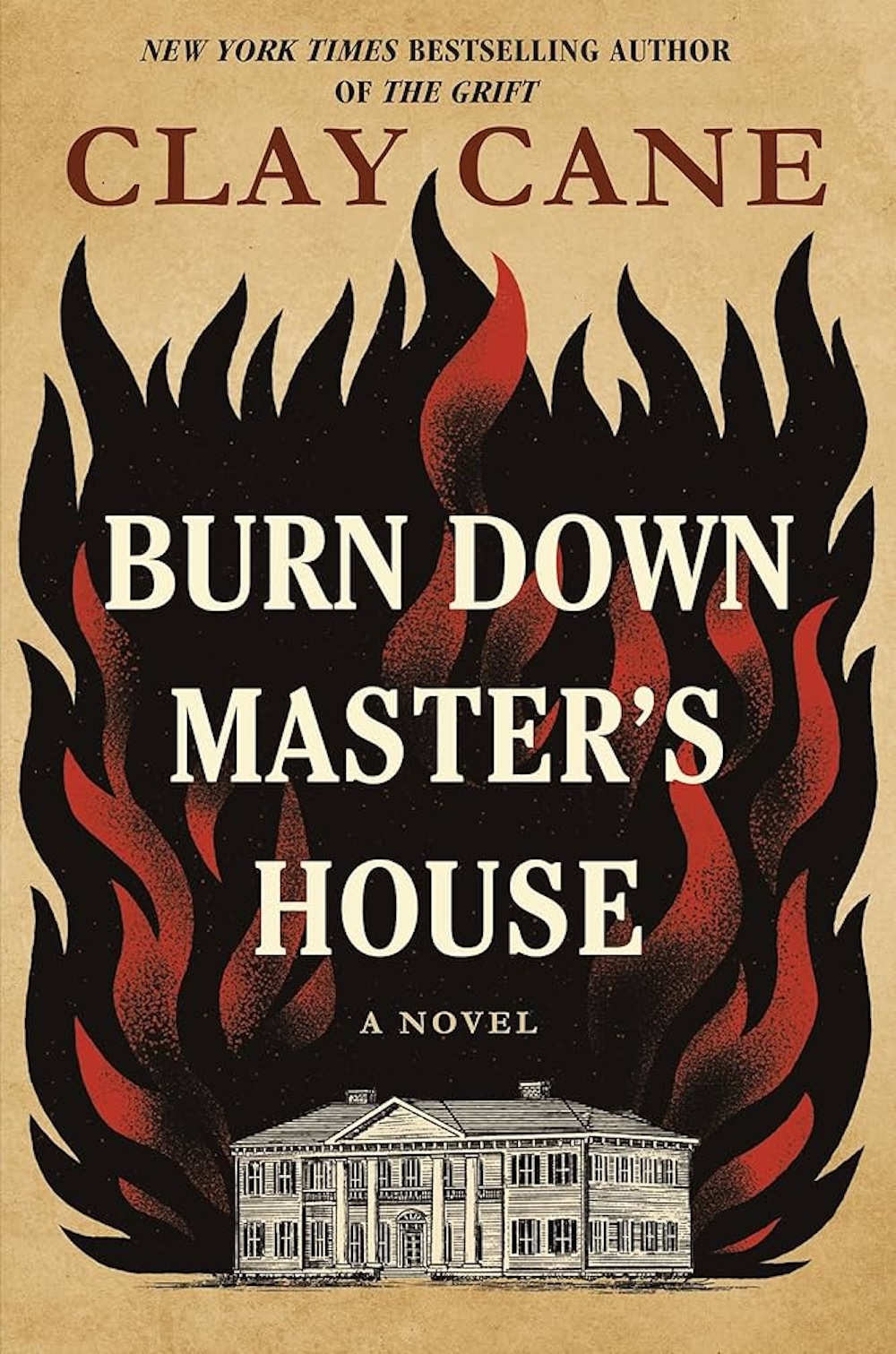
That makes the recent release of Burn Down Master’s House feel less like a detour than a culmination. Published on January 27, 2026, the novel is Cane’s adult fiction debut, and it arrived with immediate commercial force, landing as an instant New York Times and USA Today bestseller. The book is framed by its publisher as a historical novel inspired by “long-buried” true stories of enslaved people who resisted, rebelled, and refused the role history too often assigns them. It is, in other words, a Clay Cane project through and through: rigorously political, emotionally combustible, and organized around the conviction that the buried are not gone; they are waiting to be heard.
What distinguishes Cane from many contemporary commentators is not just that he is prolific. It is that he has developed a recognizable intellectual throughline while moving across genres that do not always talk to one another. He has written personally about the intersections of sexuality, race, and religion in Live Through This. He co-edited and contributed to the anthology For Colored Boys Who Have Considered Suicide When the Rainbow Is Still Not Enough. He directed the BET documentary Holler If You Hear Me: Black and Gay in the Church, which earned a GLAAD Media Award nomination. He then pivoted into sweeping political nonfiction with The Grift, a bestseller that examined the history and present-day performance of Black Republicanism. Now, with Burn Down Master’s House, he has carried those obsessions into historical fiction without softening any of them.
The result is a public career that feels unusually coherent. In Cane’s world, the argument is always about power: who has it, who launders it, who survives it, and who dares to revolt against it. That is true whether he is talking about conservative Black political figures, the psychic damage of homophobia in the Black church, or enslaved people plotting resistance in the antebellum South. The settings change. The target does not. Cane keeps returning to the institutions and narratives that demand submission, then asking what it takes to refuse them.
A voice forged in several Black publics
One reason Cane matters is that he does not belong neatly to just one lane of Black public discourse. He is a journalist and commentator. He is also a memoirist, a documentarian, a radio host, and an author whose work has traveled between intimate confession and broad political indictment. SiriusXM describes The Clay Cane Show as a place where he tackles some of America’s most controversial subjects and questions the status quo with a mix of truth-seeking and compassion. That framing matters because it captures the thing Cane’s supporters and critics alike tend to notice first: he is not interested in consensus as a performance. He is interested in pressure.
He launched The Clay Cane Show on SiriusXM Urban View in 2017, and the platform helped consolidate his role as a daily interpreter of the American mess. Rutgers materials describing his appearances note that the show airs on channel 126 and has become a venue for politics-and-culture conversation with activists, politicians, and public figures. Over time, that show has functioned as more than a media job. It has been the central infrastructure of his public voice, letting him move quickly between breaking politics, long historical memory, and the kind of unguarded reaction that formal print commentary often sands down.
There is also a structural significance to Cane’s presence on Urban View that should not be overlooked. Black talk media has long been one of the places where arguments that later migrate into mainstream politics first get tested in public. Cane works in that tradition, but with a distinctly millennial and cross-platform sensibility. He can speak in the language of Black studies, queer memoir, cable-news combat, and pop-cultural fluency without seeming to switch masks. That range has made him unusually legible to multiple audiences at once: progressive radio listeners, Black political readers, LGBTQ readers, and people who came to him first as a cultural critic.
That breadth is part of why Cane’s rise has felt durable rather than viral. He did not emerge overnight as a pundit who happened to write a book. He built, over years, a layered record of thinking and making. Official and institutional biographies consistently note his journalism, television commentary, radio work, and speaking career, but the more revealing part is how often those bios return to the same subject areas: race, social justice, sexuality, faith, and politics. Cane’s beat, in effect, is American contradiction.
Rutgers, Black studies, and the making of an argument
Cane’s formal academic background helps explain the shape of his later work. Rutgers identifies him as a graduate of Rutgers University–Newark, Phi Beta Kappa, with a B.A. in English and African American Studies. Those are not incidental credentials in his case. The combination is practically a map of his method: literary attention joined to historical and structural analysis. His sentences, even at their most polemical, usually show both impulses. He wants the archival fact, but he also wants the narrative heat.
Before Clay Cane wrote a bestseller about rebellion, he spent years learning how history gets edited into obedience.
Publishers Weekly offered perhaps the clearest window into how deeply that education shaped his fiction debut. Cane told the magazine that he began writing Burn Down Master’s House 24 years ago, after arriving at Rutgers and taking a Black studies course with Dr. Zain Abdullah. He described becoming “obsessed” with what were then commonly called slave narratives and feeling moved by the fact that enslaved people were writing their own stories from their own perspectives. That origin story is revealing because it places his novel inside a much longer intellectual apprenticeship. The book is new. The inquiry behind it is not.
That matters for understanding why Cane’s fiction does not seem to emerge from nowhere. In a media culture that often rewards reinvention for its own sake, Cane’s move into historical fiction looks more like delayed execution. The material had been with him for decades. Burn Down Master’s House appears to be the fruition of a question he had been carrying since college: what happens when the historical record of slavery is re-entered not as spectacle or moral backdrop, but as a site of agency, strategy, rage, intimacy, and rebellion?
It is useful here to resist flattening Black studies into mere subject matter. For many Black writers and thinkers, Black studies is not just an academic field; it is a disciplinary refusal of official narratives. Cane’s career bears that imprint. Again and again, he approaches the archive and the present tense as places where dominant stories conceal as much as they reveal. His work is not anti-history. It is anti-sanitization.
Before the bestsellers, the work of testimony
Long before The Grift and Burn Down Master’s House, Cane was already working in a register that mixed reportage, personal witness, and intervention. His 2017 book Live Through This: Surviving the Intersections of Sexuality, God, and Race was published as a collection of intimate essays about self-acceptance under the pressure of clashing social norms. The publisher’s summary describes a journey through faith, sexuality, and race. Reviews emphasized the book’s candid treatment of gender performance, family, Black identity, and the psychic labor of living at the intersection of communities that are often asked to understand one another only in theory.
To understand Cane’s later political sharpness, it helps to sit with this earlier mode. The memoirist and the polemicist are not separate people. The memoir gave him a place to think through how institutions—family, church, masculinity, race itself—discipline the body and language of a Black queer life. Once that analytic is in place, much of the later work makes a different kind of sense. Whether he is discussing conservative racial politics or the historical machinery of slavery, Cane is still preoccupied with how systems teach people to betray themselves or one another in exchange for protection, legitimacy, or survival.
That same set of concerns was visible in Holler If You Hear Me: Black and Gay in the Church, the BET documentary Cane created and produced. BET’s coverage of the GLAAD nomination emphasized the film’s focus on Black LGBT people navigating sexuality, faith, and race, and described the documentary as giving narrative control back to people too often spoken about rather than listened to. It is difficult to overstate how central that gesture is to Cane’s whole career. He keeps returning to communities and historical subjects that mainstream discourse treats as objects. His instinct is to restore interiority and conflict.
The documentary also positioned Cane within a longer Black queer intellectual tradition that refuses the false choice between racial truth-telling and sexual truth-telling. Too often, public Black discourse has required one of those to be subordinated to the other. Cane’s early work rejected that arrangement. The point was not to choose which wound counted more. The point was to expose the architecture that made those wounds seem separable in the first place.
That intellectual stubbornness partly explains why Cane has remained compelling even when one disagrees with him. He is not simply reactive. He has a frame. And that frame was visible well before bestseller lists made him unavoidable.
The break into wider political visibility
If Live Through This established Cane as a writer of testimony and Holler If You Hear Me marked him as a documentarian of difficult Black truths, The Grift dramatically expanded his footprint. Released in 2024, the book became an instant New York Times and USA Today bestseller. Its premise was blunt: Black Republicanism, in Cane’s telling, had traveled from a tradition rooted in liberation and postwar reconstruction toward a far more cynical formation, one increasingly defined by opportunism and complicity.
Booksellers’ summaries and author bios emphasized that The Grift combined history with cultural analysis, tracing Black Republicanism from Lincoln through the Trump era while focusing on figures such as Tim Scott and Clarence Thomas. Even those concise descriptions reveal something important about Cane’s style. He likes a large historical canvas, but he keeps pulling the reader back to the individuals who embody the contradiction. He is not satisfied with abstractions like “the Black right.” He wants names, careers, media performances, and political consequences.
The book’s success also altered the scale of Cane’s public authority. A radio host with a loyal audience is one thing. A bestselling political author with a clear thesis about one of the country’s most contentious ideological fault lines is another. With The Grift, Cane became harder for mainstream political conversation to ignore. He was no longer just a commentator reacting to the day’s headlines. He was someone advancing a historical account that demanded engagement.
But here is the more interesting point: The Grift did not really mark a new concern. It marked a new scale. Cane had long been interested in the cost of accommodation and the allure of legitimacy within hostile systems. Black Republicanism gave him a subject where that drama could be examined at the level of party politics and public careerism. Slavery, in Burn Down Master’s House, lets him move the same drama into the foundational violence of the republic itself.
Why Burn Down Master’s House matters
The easiest way to misunderstand Burn Down Master’s House is to treat it as a topical historical novel arriving in a moment of renewed contest over how American history gets taught. That is part of the story, but not the full one. The book matters because it enters an already crowded field of slavery narratives and insists on a different emphasis: not only suffering, but rebellion; not only brutality, but coordinated defiance; not only endurance, but strategy. Its official descriptions repeatedly foreground resistance. Cane himself has described the novel as rooted in suppressed or buried stories of enslaved people who fought back.
Cane’s fiction debut is not asking whether slavery was cruel. It is asking what resistance looked like when cruelty was the law.
That emphasis arrives at a particular cultural moment. Across school boards, legislatures, publishing, and mass media, the language of “remembering” American history has become inseparable from fights over what kinds of memory are politically tolerable. Stories of enslavement are often allowed public circulation only if they end in uplift, distance, or abstraction. Cane’s project, by contrast, appears to insist on slavery as an active political archive—one full of contradiction, violence, queer feeling, compromised Black intermediaries, and most of all the refusal of consent.
Barnes & Noble’s summary notes that the novel interweaves the lives of enslaved people across the South as rebellions that seem separate begin to fuel a larger “inferno of justice.” The language is dramatic, but it captures the book’s conceptual wager. Cane is not simply recounting isolated acts of rebellion. He is narrating resistance as connective tissue, as a dispersed but shared political imagination among the enslaved. That is a meaningful intervention in a culture that still too often narrates enslaved people as acted upon rather than acting.
The book also appears to widen the moral lens in ways that fit Cane’s broader interests. One of the most arresting details in bookseller copy is the presence of Nathaniel, a Black enslaver whose role exposes the layered corruptions of power inside the slave system. That is exactly the sort of complication Cane tends to be drawn to: the point where racial solidarity rhetoric is not enough, where power reorganizes identity and forces uglier questions. That thematic choice links the novel not only to Black historical fiction broadly, but specifically to Cane’s own nonfiction interest in complicity and betrayal.
The novel as continuation, not reinvention
One of the most persuasive things about Burn Down Master’s House is how little it feels like brand extension. Many first novels by already-known media figures read as adjacent to the public persona rather than deeply connected to it. Cane’s novel, by contrast, seems to emerge directly from the older questions in his work. The memoir asked what it costs to survive institutions that call your existence aberrant. The documentary asked what happens when Black queer people reclaim authorship over their own narratives. The Grift asked how Black identity can be weaponized in service of reaction. Burn Down Master’s House goes further back and asks what resistance looked like inside the institution that made so much of modern America possible.
There is also something telling about the amount of time Cane spent carrying the book. Publishers Weekly reports that he began writing it 24 years ago. That means the novel was alive in some form through multiple career phases: through his work in journalism, through the documentary, through memoir, through radio, through the political firestorm that produced The Grift. Rather than seeing the book as a pivot, it may be more accurate to see it as the subterranean text that shadowed everything else.
That long gestation can cut two ways. On one hand, it explains the seriousness of the undertaking. On the other, it places pressure on the result. A novel carried for decades invites larger expectations than a quick-turn topical project. Yet the early reception language from booksellers, event hosts, and endorsers suggests that readers are responding to its scope, urgency, and refusal to prettify its subject. Kane is not offering heritage fiction. He is offering confrontation through narrative.
And that may be the central point of Cane’s significance as an author. He does not seem especially interested in literature as prestige insulation. He uses books as instruments for forcing arguments that other platforms either cannot sustain or will not permit. A daily radio show can challenge a headline; a novel can challenge a national mythology. Cane now works in both registers.
Race, sexuality, faith, and the architecture of power
Any serious account of Cane has to grapple with the unusual continuity between his “identity” writing and his explicitly political writing. In lesser hands, those can become separate brands. With Cane, they function as linked sites of analysis. Sexuality and faith are not private side issues in his work; they are training grounds for understanding how power naturalizes itself. The Black church, masculinity, family expectation, and party politics all appear in his oeuvre as systems that reward conformity, punish dissent, and call that punishment morality or common sense.
This is one reason his commentary can feel sharper than that of many peers. He is not merely arguing with institutions from the outside. He has written about the interior experience of being shaped, wounded, and disciplined by them. That gives his political analysis a biographical depth without reducing it to autobiography. When Cane writes about erasure, legitimacy, or betrayal, he is writing from theory and history, yes, but also from lived understanding of how systems demand performance in exchange for belonging.
It also explains why Burn Down Master’s House matters beyond its plot. The novel’s investment in enslaved resistance is not just historical. It belongs to Cane’s larger moral framework, in which refusal itself becomes a form of self-definition. To fight back, to narrate oneself, to reject the legitimacy of a brutal order—these are recurring ethical acts in his work. The contexts differ wildly, but the grammar is familiar.
The public intellectual and the performer
Cane is not an academic, but he often functions as a public intellectual in the classic Black American sense: someone translating dense historical and political realities into sharp public argument without surrendering complexity. Yet he is also, unmistakably, a media performer. He understands cadence, conflict, timing, and emotional temperature. That combination is a large part of his effectiveness. He can move from archival seriousness to righteous impatience in a way that makes ideas travel.
There are costs to that style. Public figures who communicate with blunt force are often accused of reducing nuance, especially when the subjects are as combustible as race, sexuality, or partisan politics. Cane’s critics will likely say some of that about him, if they have not already. But one could argue the opposite: that his forcefulness is precisely what keeps the underlying complexity from being washed into bland civility. He is not trying to sound neutral about domination. He is trying to sound accurate about it. That distinction is central to his appeal.
In that sense, Cane belongs to a lineage of Black media figures for whom style is not ornamental. It is part of the politics. Sharpness is not just a vibe; it is a refusal to let the language of moderation obscure asymmetry. His work can be compassionate, but it is rarely mollifying.
What Clay Cane represents now
At this point in his career, Cane represents something larger than any single book. He stands for a particular model of Black public authorship in the 2020s: multiform, openly ideological, historically minded, and uninterested in severing personal truth from structural critique. He has managed to move between memoir, documentary, talk radio, essays, political history, and fiction while preserving a recognizable worldview. That alone is an accomplishment. More importantly, he has done it while insisting that Black historical memory is not a museum artifact. It is live ammunition.
Clay Cane’s career is a sustained argument that buried stories do not stay buried. They return as pressure, as witness, and sometimes as fire.
The timing of Burn Down Master’s House sharpens that significance. It arrives in a period when American institutions are aggressively contesting what can be said about slavery, racism, and the making of the nation. For Cane to release a novel centered on enslaved people who fight back—and to have that novel immediately become a bestseller—is culturally meaningful on its own terms. It suggests an audience still hungry for stories that do not sentimentalize the past or convert Black suffering into safe moral education.
There is also a symbolic elegance to the arc from The Grift to Burn Down Master’s House. One book exposes contemporary forms of racial accommodation and ideological cover. The next dives into the original structure from which so much of that accommodation descends. Together, they form a kind of diptych: one about the afterlives of power, one about power near the source.
And maybe that is the clearest way to understand Clay Cane’s significance. He is not simply a commentator with strong opinions, or a radio host who became a bestselling author, or a memoirist who turned to fiction. He is a chronicler of what America tries to forget when forgetting is politically useful. Sometimes he does that by speaking in his own voice. Sometimes he does it through history. Sometimes, now, he does it through characters set inside the republic’s founding violence. The platform changes. The demand remains the same: look again, and do not look away.
The long view
It is still too early to know the full literary afterlife of Burn Down Master’s House. What can be said now is that the novel has already altered the scale on which Cane will be read. He is no longer only a journalist-author or commentator-author. He is now a writer who has carried a political and moral vision across multiple forms and made each of them matter to the others. The memoir informs the polemic. The documentary informs the novel. The radio sharpened the public voice. The scholarship seeded the imagination.
In a media environment full of disposable outrage and accelerated opinion, Clay Cane’s work has a different center of gravity. Even at its most immediate, it is tethered to the longer story: the one about how people live under power, narrate themselves against it, and sometimes burn through the myths built to protect it. That is why his new novel matters. It is not merely a book release. It is the latest chapter in a career spent contesting America’s preferred alibis.
And that is why Clay Cane matters, too. Not because he is always agreeable, or because every reader will embrace every formulation. He matters because he has made himself into a durable, insistent witness against easy forgetting. In this country, that is not just a literary function. It is a civic one.
More great stories
Afro Sheen, Wall Street, and the Architecture of Black Possibility
July 6, 2026
No Comments
The Fire Inside the Fourth
July 5, 2026
No Comments