




I didn’t make it for today, I made it for tomorrow and tomorrow.
I didn’t make it for today, I made it for tomorrow and tomorrow.
By KOLUMN Magazine
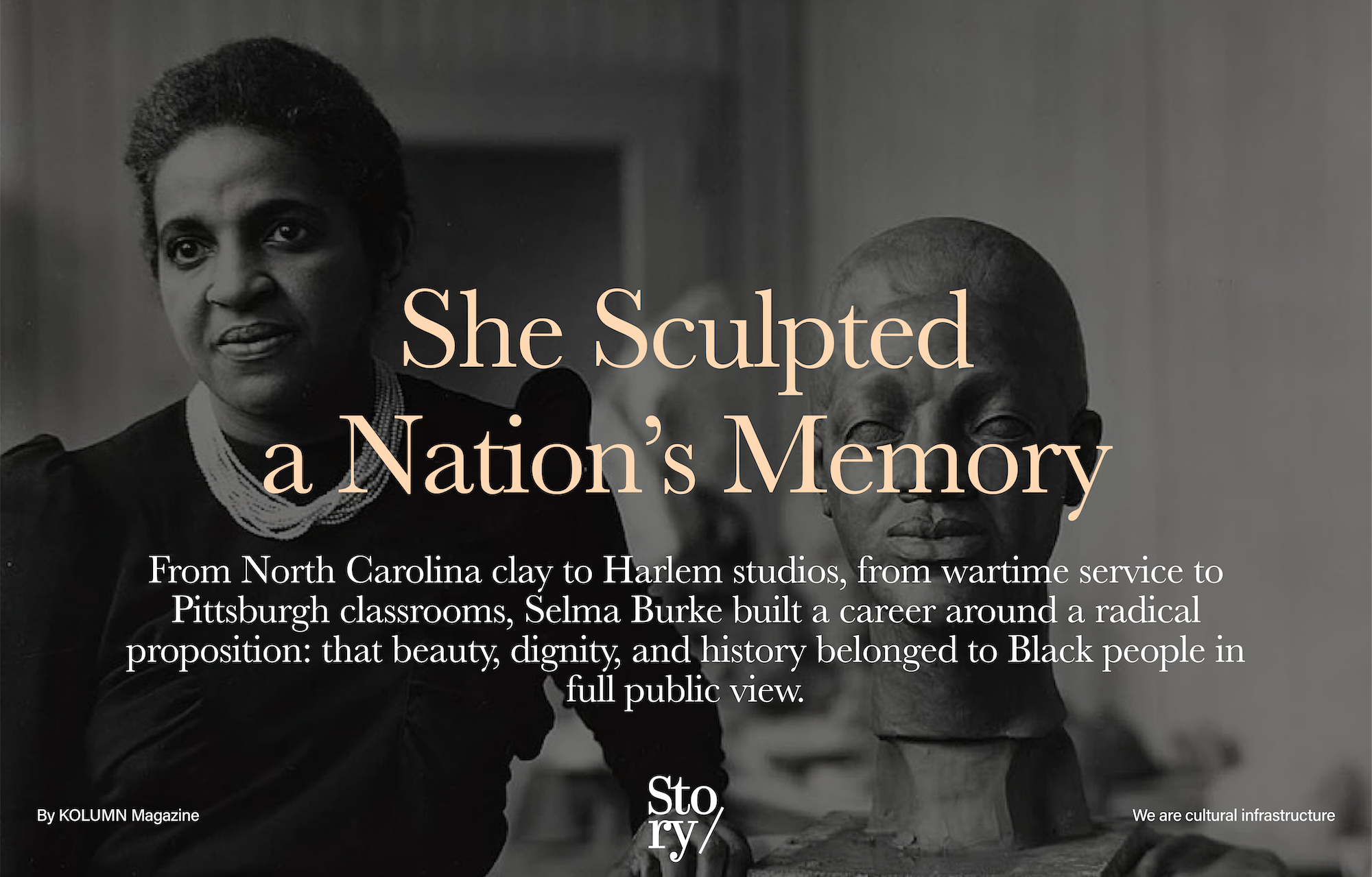
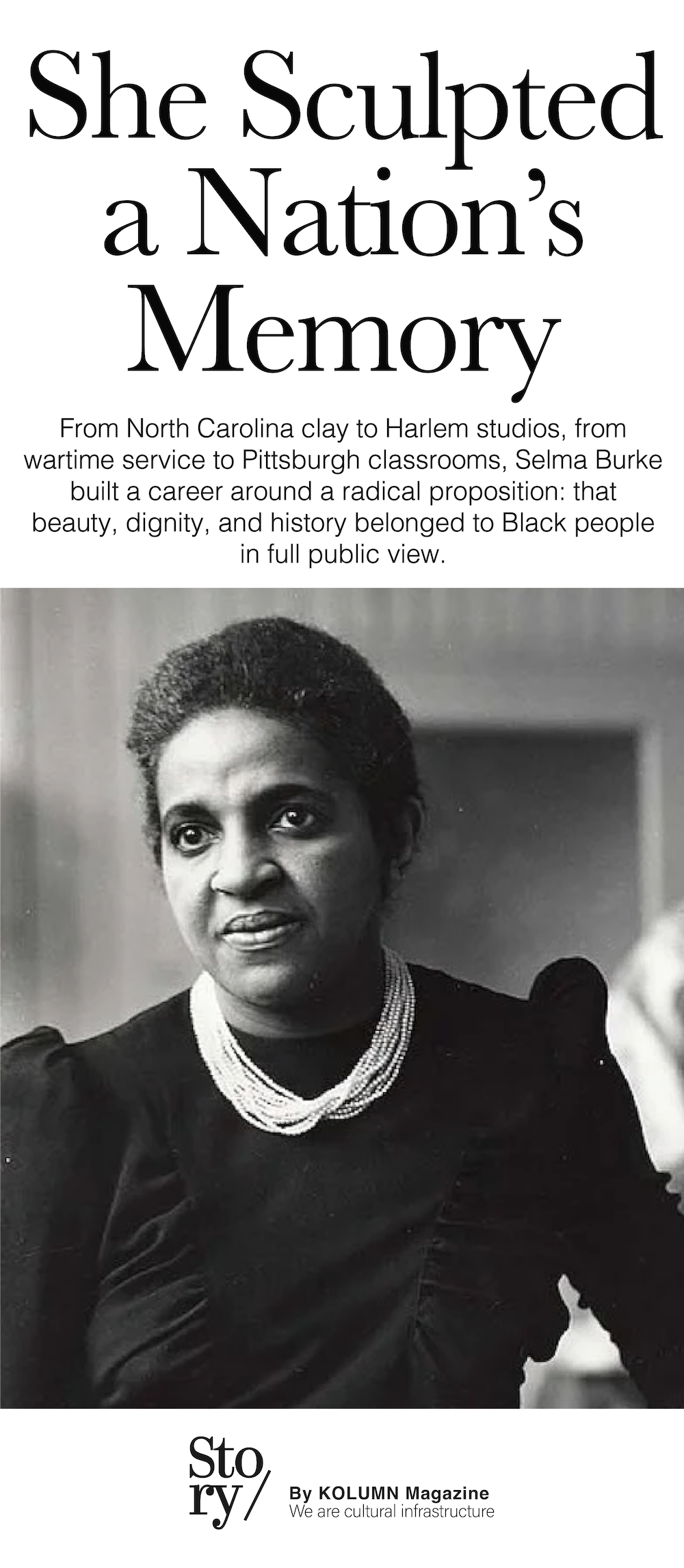
There are artists whose names live inside museums, and then there are artists whose work slips into daily life so thoroughly that millions of people encounter it without ever knowing who made it. Selma Burke belongs, in a complicated way, to both categories. She was a Harlem Renaissance sculptor, a teacher, an arts organizer, a nurse by training, a world traveler, and a maker of portraits that insisted Black life deserved permanence. She is also, depending on how one tells the story, the woman behind one of the most familiar profiles in American culture: Franklin Delano Roosevelt’s face on the dime. Officially, the U.S. Mint credits chief engraver John Sinnock with the coin’s design; art historians and institutions have long argued that Burke’s 1944 relief portrait of Roosevelt was the crucial model that shaped it. Even that debate, though, risks shrinking Burke into a footnote in someone else’s story. Her significance runs much deeper.
To understand Burke, you have to begin not with the dime but with her philosophy of sculpture. She described herself as “a people’s sculptor,” and that phrase matters because it clarifies what animated her work. She was not simply interested in celebrity likenesses or civic commissions. She wanted sculpture to be legible, public, tactile in feeling even when made in bronze or stone, and grounded in human character. Her work ranged from portraits of figures such as Booker T. Washington, Mary McLeod Bethune, Duke Ellington, and Martin Luther King Jr. to maternal and familial forms that turned intimacy into monument. Again and again, Burke returned to the body as a site of strength, care, endurance, and spiritual gravity.
What makes Burke especially compelling in the history of American art is that she refused the cramped categories available to Black women artists in the twentieth century. She was not satisfied being merely talented, nor merely respectable, nor merely inspirational. She pursued technique with rigor, studied abroad, earned an M.F.A. from Columbia University, opened schools, taught children and adults, and moved fluently among the worlds of Black cultural production, public art, and education. Her career mirrors the larger story of Black artists in America who had to become institution builders because the institutions around them were too narrow, too segregated, or too indifferent to hold them fully.
Clay, discipline, and the making of an artist
Selma Hortense Burke was born on December 31, 1900, in Mooresville, North Carolina, the seventh of ten children. Her father, Neal Burke, was a minister and wage earner whose work included railroad labor; her mother pushed her toward practical stability. As a child, Burke found clay near a creek and began shaping forms with her hands, an origin story that has the elemental quality of myth but is well documented in biographical accounts. The important detail is not just that she loved making things. It is that she found, very early, a material language for selfhood. The handprint in clay became both proof of presence and proof of possibility.
“I found that I could make something… something that I alone had created.”
Like many Black artists of her generation, Burke’s path into art was indirect because it had to be. She studied at what is now Winston-Salem State University and then trained as a nurse at St. Agnes Hospital’s nursing school in Raleigh, graduating as a registered nurse in 1924. That early professional life is easy to treat as detour, but it also sharpened qualities that later appeared in her sculpture: discipline, observation, patience, and a close attention to the human body. Nursing gave her a socially acceptable occupation in an era when art offered Black women little economic security. It also placed her in rooms where class, care, race, and vulnerability met face to face.
After moving to New York City in the late 1920s, Burke worked as a private nurse for Amelia Waring, an heiress whose patronage and social access widened Burke’s exposure to the arts. New York did what New York has done for generations of ambitious people: it accelerated her. Through Harlem’s intellectual and artistic circles, Burke entered a world alive with experiment, self-definition, and argument. The Harlem Renaissance is often narrated through writers and painters, but sculptors were there too, grappling with how Blackness might be rendered in form rather than only in language or pigment. Burke’s emergence in that environment mattered because she arrived as someone who already knew labor, caretaking, and Southern racial hierarchy. She did not approach art as pure abstraction. She approached it as a mode of human testimony.
Her involvement with Claude McKay, the Jamaican-born poet and novelist, has often colored retellings of her early New York years. Sources vary on the legal status of their marriage or partnership, but they agree on one point: the relationship was turbulent. What mattered more in artistic terms was that Burke was moving through an ecosystem of Black creativity intense enough to remake a life. When Waring died, Burke left nursing and committed fully to sculpture. She studied at Sarah Lawrence College, at times modeling to pay for classes, and began pushing beyond raw gift toward trained mastery.
Harlem, Europe, and the discipline of form
Burke’s development was not provincial. She studied with major European artists including Henri Matisse and Aristide Maillol after receiving fellowship support that allowed her to travel abroad in the late 1930s. That part of her biography is essential because it reminds us that Black American artists were not merely local interpreters of race experience. They were transnational thinkers and makers, studying modernist vocabularies while deciding what to borrow, what to resist, and what to transform. Burke’s work absorbed formal discipline without surrendering to coldness. She learned from European art, but her sculpture remained committed to the expressive weight of Black subjects and the moral clarity of recognizable bodies.
Back in New York, Burke worked within New Deal arts structures, including the Works Progress Administration and the Harlem Community Art Center, where Augusta Savage was a crucial mentor. That detail places Burke inside one of the most important networks in Black art history. Savage did not simply train artists; she modeled what it meant for Black women to create institutions where talent could survive hostile economies. Burke carried that lesson forward. By 1940 she had opened the Selma Burke School of Sculpture, and in 1941 she completed her M.F.A. at Columbia University. She was building a career with equal emphasis on practice and pedagogy, object and community.
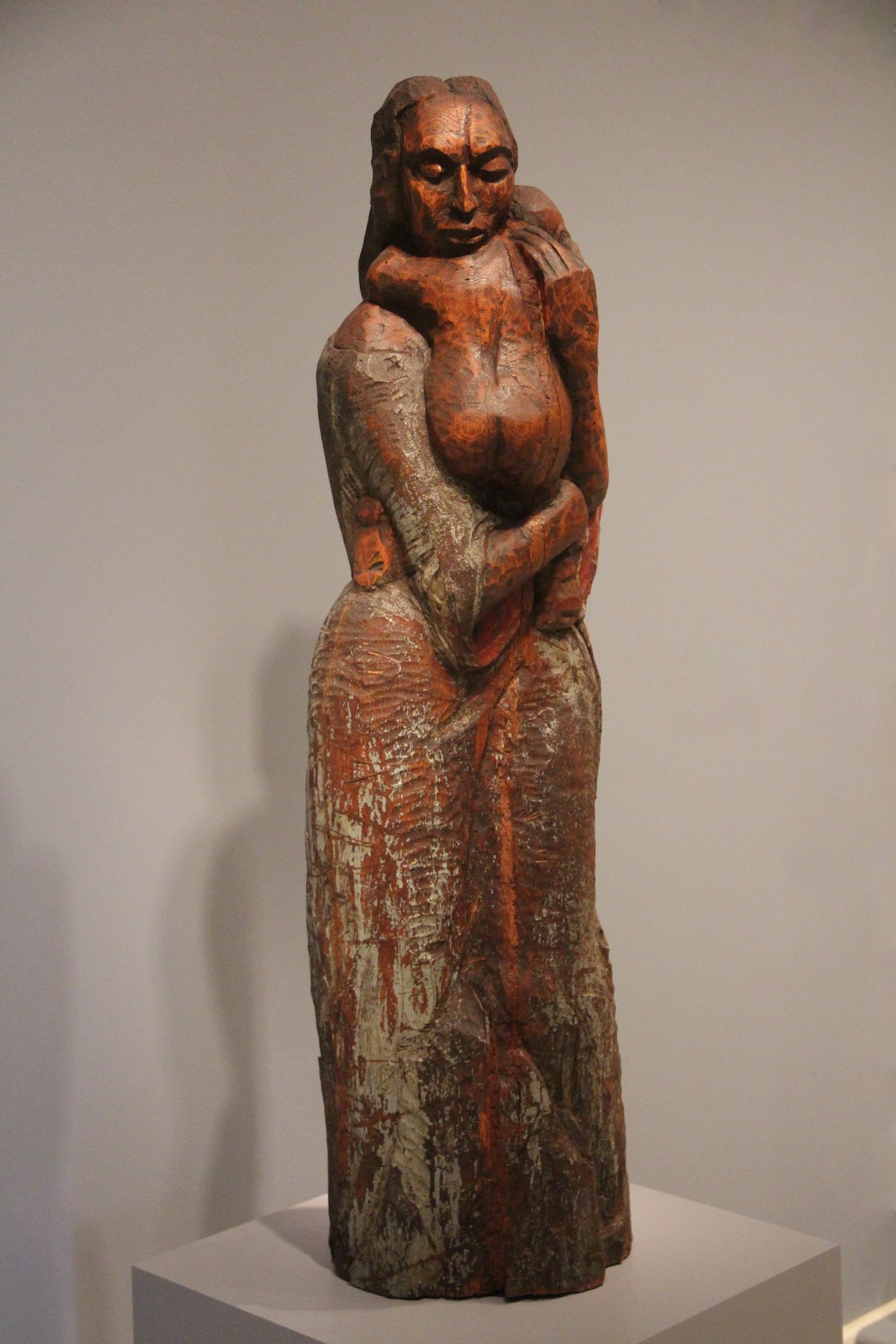
Her sculpture from these years and after frequently favored solidity over ornament. Even when tender, it had backbone. Smithsonian descriptions of her Untitled (Woman and Child) note how the figures seem to emerge from the wood itself, with the woman’s arm and child’s back merging to express closeness; the choice of red oak carried symbolic force tied to strength. That language helps explain Burke’s aesthetic. She was not interested in fragility for fragility’s sake. She wanted form to communicate emotional truth without losing structural authority. In Burke’s hands, family was not sentimentality. It was architecture.
That line is often quoted in relation to Roosevelt, but it could stand as a motto for Burke’s whole career. She made art for durability. She sculpted as though time itself were part of her medium.
The Roosevelt commission and the problem of recognition
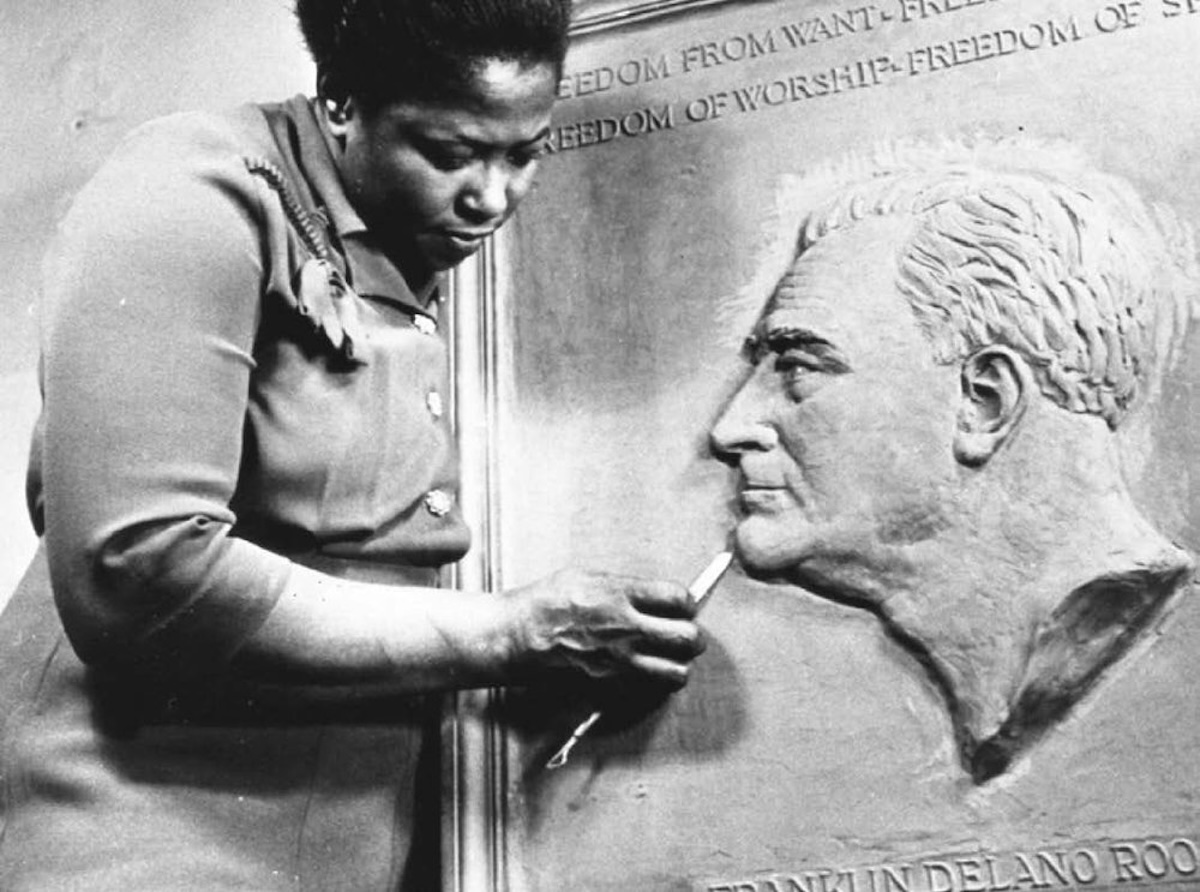
The story that made Burke broadly famous is also the story that has too often flattened her. During World War II, after enlisting in the Navy and becoming one of the first African American women to sign up, Burke injured her back while assigned to truck-driving duty at the Brooklyn Navy Yard. While recuperating, she entered and won a national competition to create a relief portrait of President Franklin D. Roosevelt for the Recorder of Deeds building in Washington, D.C. Finding photographs inadequate, she wrote to the White House asking for a live sitting. To her surprise, she got one. In February 1944, she sketched Roosevelt directly, producing the profile that would define one of the most public chapters of her career.
Roosevelt died in April 1945 before the work’s unveiling. President Harry S. Truman unveiled Burke’s plaque on September 24, 1945, at the Recorder of Deeds building. Eleanor Roosevelt reportedly felt the finished image made the president look younger than he had in his final years. Burke’s answer was revealing: she was not interested in documenting decline. She was shaping historical memory. The portrait was part likeness, part civic ideal, part argument about what kind of presence leadership should leave behind.
Then came the dime. The official U.S. Mint position credits chief engraver John Sinnock with the 1946 Roosevelt dime, and Mint materials continue to do so. Yet Smithsonian, NCpedia, the Smithsonian American Art Museum, the National Women’s History Museum, and the Studio Museum in Harlem have all described Burke’s relief as the model, inspiration, or basis for the dime’s profile. Sinnock denied copying Burke and pointed to earlier Roosevelt studies of his own. The careful, historically responsible conclusion is this: Burke’s role in shaping the public Roosevelt image is substantial and widely recognized by scholars and cultural institutions, while the Mint’s formal credit remains with Sinnock. That tension is not a minor footnote. It is practically a case study in how Black women’s contributions enter national culture: visible everywhere, credited unevenly.
The dime debate has lasted because it compresses several American habits into a single object. There is the habit of overlooking Black creators until a later generation rediscovers them. There is the habit of granting institutional authorship to the official officeholder while treating the artist working outside that office as anecdote. And there is the habit of using familiarity to erase origin. A dime passes through countless hands. Most people never stop to ask where an image came from, whose eye shaped it, whose labor fixed it in the national imagination. Burke’s story forces that question.
But focusing only on the dime does Burke a disservice. It turns a many-sided artist into a trivia answer. She did not spend a lifetime sculpting Black beauty, authority, grief, leadership, intimacy, and kinship just to be reduced to a possibly borrowed profile on U.S. coinage. The real scandal is not simply that she may have been denied fuller recognition for Roosevelt. It is that so much of her broader artistic achievement still has to be reintroduced at all.
A Black sculptor making public memory
Burke’s portraits of Black figures mattered because portraiture itself is political. In a society that routinely caricatured Black people, erased Black authorship, or treated Black subjects as sociological evidence rather than fully dimensional human beings, Burke sculpted dignity. Not generic uplift, but specific dignity: the set of a mouth, the alertness of posture, the force of character in the brow and jaw. She made Booker T. Washington, Mary McLeod Bethune, A. Philip Randolph, and Duke Ellington part of a sculptural record that refused disposability.
Her significance lies not only in who she portrayed but also in how she conceived the relationship between everyday people and public art. The Studio Museum notes that Burke aimed to speak to broad audiences through depictions of both famous and ordinary Black figures. That dual commitment is key. She understood that a people’s history cannot survive on elite subjects alone. A culture needs monuments to labor, love, family, and common life. Works like Together, which depicts a male and female nude holding an infant between their bodies, center family love and unity as themes worthy of durable form. In Burke’s practice, Black tenderness was not incidental to history. It was history.
That insistence placed her within a broader Black aesthetic tradition that joined beauty and social meaning. Burke’s art did not have to choose between formal seriousness and community recognition. She believed sculpture could be both accessible and sophisticated. That may sound obvious now, but it was a quietly radical position in art worlds that often treated abstraction as a higher intellectual plane and realism or figuration as somehow lesser. Burke resisted that hierarchy. She knew that legibility could carry its own power, especially for audiences long excluded from the institutions that defined “serious” art.
“Art didn’t start black or white, it just started.”
That statement, quoted in a scholarly essay on Burke’s legacy, captures both her universalism and its friction. She rejected limiting labels, yet she never detached herself from Black communities or Black cultural work. Instead, she navigated a difficult line: refusing reductive racial boxes while remaining deeply committed to making art within and for Black life. That balancing act became even more pronounced in her teaching.
The teacher as institution builder
If Burke had never made the Roosevelt plaque, she would still matter because of what she built as an educator. The Smithsonian American Art Museum credits her with establishing the Selma Burke Art School in New York City in 1946 and later the Selma Burke Art Center in Pittsburgh. Those institutions were extensions of her artistic philosophy. They were places where art was not only to be admired but practiced, taught, and integrated into everyday living.
Recent scholarship has sharpened our understanding of that pedagogical legacy. Rebecca Giordano’s essay in Panorama argues that Burke’s teaching was shaped by a progressive belief in experiential education and by a conviction that art could improve daily life across class lines. Burke’s phrase “the art of living” was not decorative rhetoric. It was an educational program. She imagined cultural spaces where making art might coexist with broader forms of development, community building, and personal transformation. In other words, she understood art education as civic education.
The Selma Burke Art Center in Pittsburgh, active in the 1970s and early 1980s, served the city’s Black community with classes and programming that extended beyond conventional studio instruction. Materials from the University of Pittsburgh describe it as providing accessible, high-quality arts education and playing a meaningful role in Pittsburgh’s cultural ecosystem. That work deserves more attention because it reveals Burke not just as an individual maker but as a designer of artistic infrastructure. She made room for others. She widened entry points. She treated cultural participation as something people could practice, not merely consume.
There were tensions, too. Giordano notes that Burke’s pedagogy eventually came into friction with aspects of the Black Arts Movement and with white philanthropic expectations that funded the center. Those tensions are important because they keep Burke from becoming a flattened icon. She was not universally embraced, nor was her vision beyond criticism. She was a Black woman artist working across generations and ideological shifts, trying to build sustaining institutions while navigating the demands of funders, communities, and changing political aesthetics. That complexity makes her more interesting, not less.
Late life, enduring work, and the shape of legacy
Burke’s later life in New Hope, Pennsylvania, did not mark a retreat from artistic seriousness. She continued working, teaching, collecting, and making. She donated a substantial body of work to Winston-Salem State University in the 1980s, including her own paintings and sculptures as well as works by major Black artists, broadening access to art in an institutional context tied to her roots. Even in her nineties, she remained active; one scholarly account notes that she was working on a federal commission of Rosa Parks near the time of her death in 1995. That image is fitting: Burke, well into old age, still sculpting Black history into form.
Her final monumental work completed during her lifetime was a statue of Martin Luther King Jr. in Charlotte, finished in 1980. There is something symbolically right about that. An artist formed in the Harlem Renaissance, sharpened by New Deal-era institutions, and publicly entangled with Roosevelt ended her monumental career helping to shape the sculptural memory of the civil rights era. Burke’s life linked major chapters of twentieth-century Black history without ever collapsing into any one of them.
She died on August 29, 1995, in Pennsylvania at age ninety-four. Her work now resides in collections including the Smithsonian American Art Museum, the Studio Museum in Harlem, Spelman College, Winston-Salem State University, and other institutions. Posthumous recognition has grown, but like so much recognition granted to Black women artists, it has often arrived in installments: a rediscovered biography here, an exhibition there, a cultural-history essay revisiting the dime controversy, a fresh institutional profile restoring the scale of her contributions. Recovery has value. But Burke’s career asks for more than recovery. It asks for placement where she always belonged: near the center of the story of American sculpture.
What, then, is Selma Burke’s significance? It is not only that she may have shaped the dime. It is that she treated Black life as a subject worthy of monumentality long before the culture at large learned to use that language. It is that she brought modern training, technical discipline, and public ambition to bear on subjects many institutions would have deemed marginal. It is that she taught, organized, and founded schools when access did not simply exist. It is that she insisted sculpture could serve both memory and community. And it is that her career exposes how America often absorbs Black creativity into its visual culture without fully absorbing Black creators into its canon.
There is a temptation, with artists like Burke, to end with delayed justice: to say that history has finally caught up. That feels too easy. History has not fully caught up. But it has left enough evidence to make evasion impossible. Selma Burke was not a marginal curiosity orbiting larger men and larger institutions. She was a major sculptor, a sophisticated educator, and an architect of Black public memory. She made presidents, artists, mothers, children, and movement figures endure in material form. She made the human figure carry both feeling and authority. She made art that ordinary people could recognize as theirs without diluting its seriousness. And if Americans still meet her most famous profile in the palm of a hand, that should not be the end of the story. It should be the beginning.
More great stories
Afro Sheen, Wall Street, and the Architecture of Black Possibility
July 6, 2026
No Comments
The Fire Inside the Fourth
July 5, 2026
No Comments