




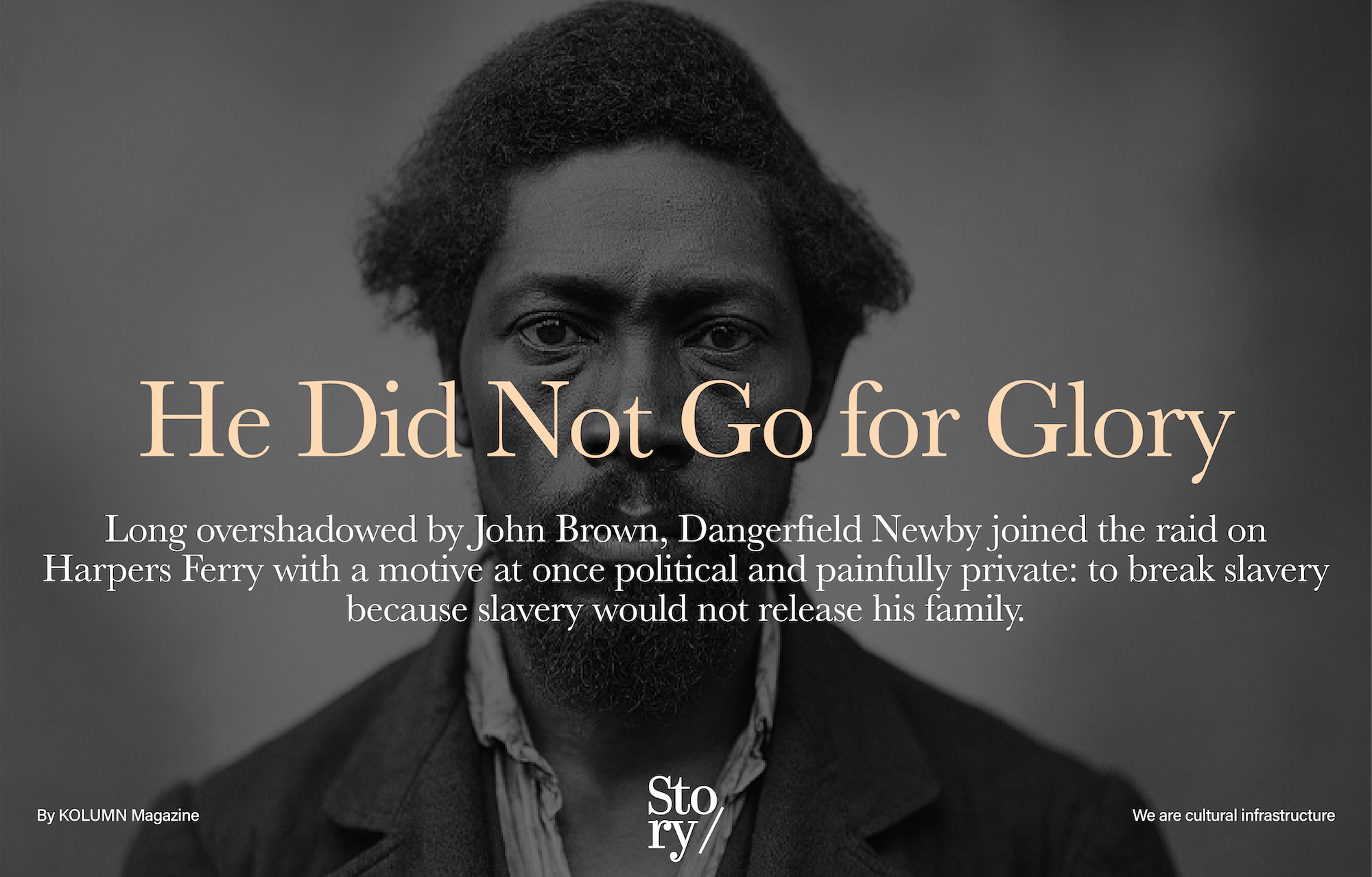
All my bright hopes of the future are blasted.
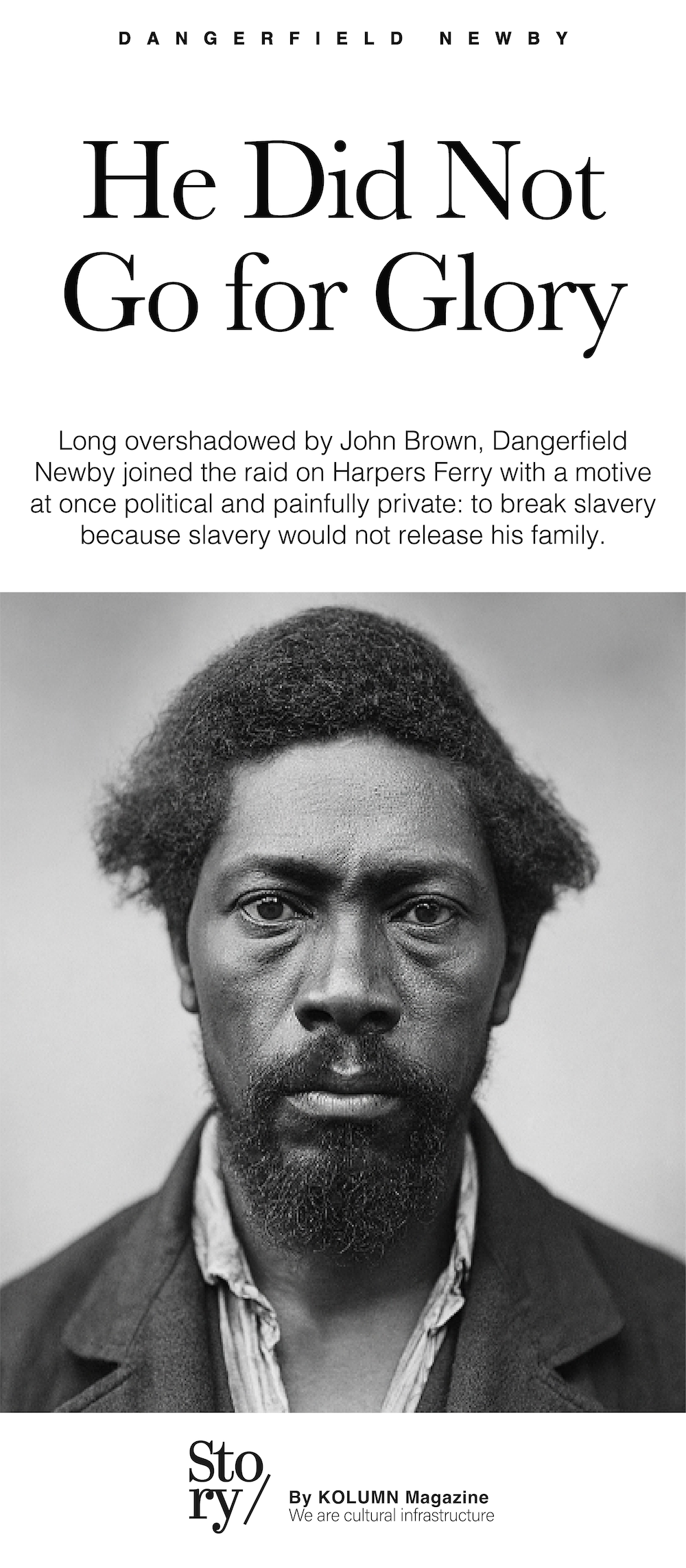
All my bright hopes of the future are blasted.
By KOLUMN Magazine
Dangerfield Newby is usually introduced as one of John Brown’s men, one of the Black raiders at Harpers Ferry, one of the first to die. All of that is true. It is also not enough. To leave him there, as a supporting figure in the mythology of Brown, is to miss what his life actually reveals. Newby’s story is not simply the story of a raid. It is the story of slavery as a machine for breaking families, of freedom as a legal fiction when the people you love remain in bondage, and of abolition not as an abstract moral position but as an emergency.
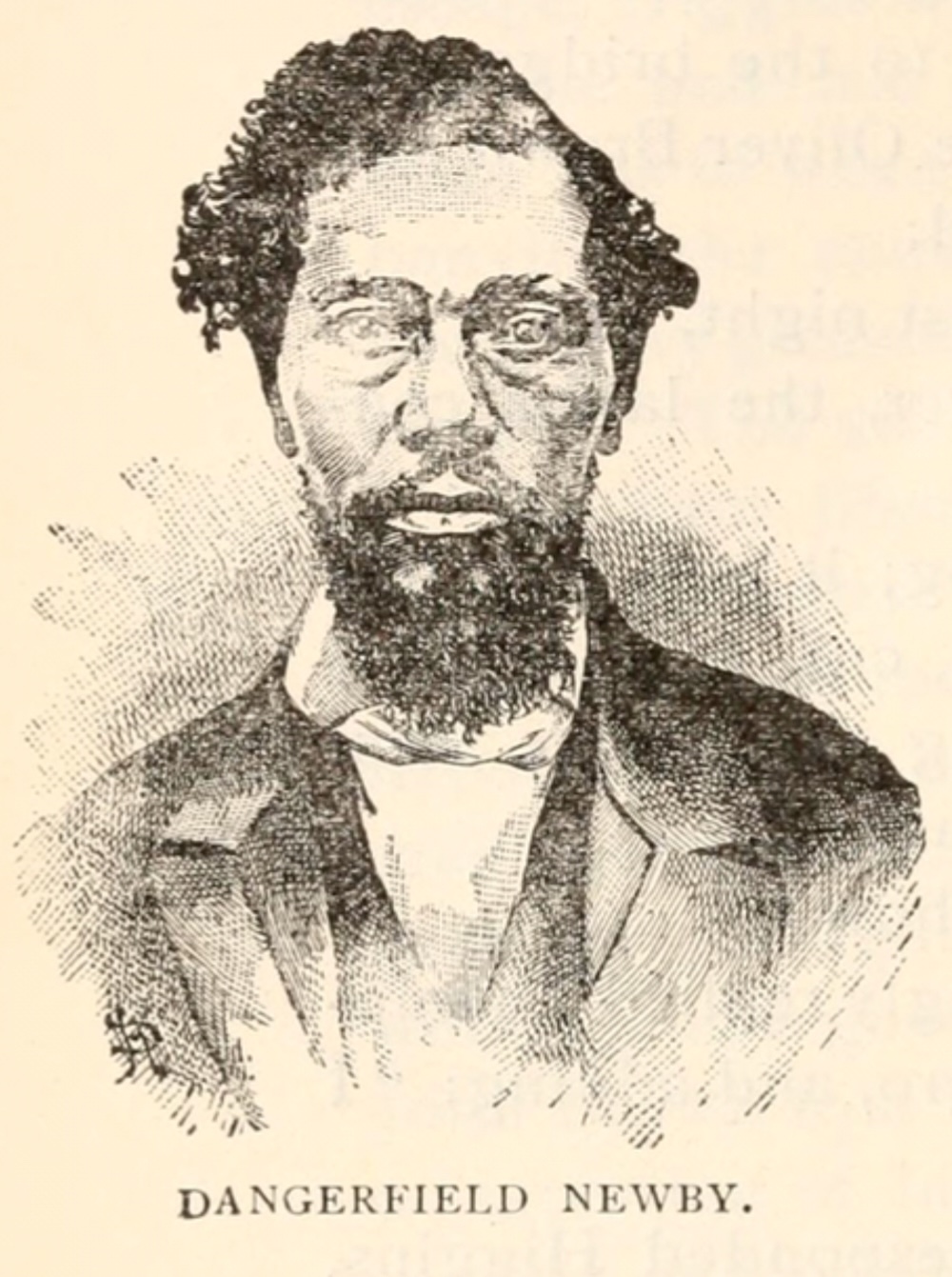
He was born in Virginia around 1820, the oldest child of Henry Newby, a white man, and Elsey Newby, an enslaved Black woman. That parentage tells us something essential before the narrative even begins. Dangerfield Newby entered a slave society structured by sexual coercion, racial hierarchy, and a legal regime in which a child inherited the status of the mother. Whatever his father’s identity or degree of involvement, Newby’s life began under a system that treated kinship as secondary to property. In Virginia, where enslaved marriage had no full legal standing, even the most intimate human bonds could be recognized socially and still be denied protection by law.
That contradiction ran through his entire life. Henry Newby eventually moved Elsey and their children to Ohio, where they became free in practical terms after crossing from slave territory into a free state. By 1858, Dangerfield Newby was living in Bridgeport, Ohio, and working as a blacksmith. On paper, he had escaped one of slavery’s central traps. In reality, he had only escaped part of it. His wife, Harriet, and their children remained enslaved in Virginia. Freedom, for him, was incomplete and unstable so long as the people who made up his family could still be sold.
That is the hinge on which his significance turns. Newby was not merely a formerly enslaved man who joined a famous insurrectionary plot. He was a husband and father caught in one of slavery’s cruelest arrangements: the partial escape that leaves loved ones behind. He worked to raise money to purchase Harriet and at least one of their children, but the sums demanded were punishing, and the price appears to have shifted in ways that reflected the capricious power of enslavers. The Library of Virginia notes that he raised nearly $742 toward a $1,000 price set for Harriet and one child, yet he still could not secure their freedom. That detail matters because it strips away any sentimental fiction that slavery could be moderated by patience, labor, and good faith. Newby tried the sanctioned route. It failed him.
And then there were Harriet’s letters.
They are among the most devastating documents attached to the Harpers Ferry story, not because they are ornate, but because they are plain. Harriet wrote in the spring and summer of 1859, repeatedly urging her husband to come, warning that her enslaver needed money and might sell her. “Come this fall with out fail monny or no monny,” she wrote. In another surviving passage, she said that if she were sold, “all my bright hops of the futer are blasted.” In perhaps the most arresting line, she told him that being with him was “one bright hope” amid her trouble. These were not philosophical reflections on freedom. They were alerts from inside the market. Harriet understood exactly what many enslaved people understood: the clock was always running.
“All my bright hopes of the future are blasted.” Harriet Newby’s words, found on her husband’s body, turn Harpers Ferry from legend into family history.
Those letters are central to understanding why Dangerfield Newby joined Brown. Popular memory has often flattened the raid into a story about one white abolitionist’s conscience, daring, and martyrdom. But Brown did not go to Harpers Ferry alone, and the Black men who went with him did not do so as props in his moral drama. As later reporting and public history projects have emphasized, five African American men were part of Brown’s force: Dangerfield Newby, Lewis Leary, John Anthony Copeland Jr., Shields Green, and Osborne Perry Anderson. Their reasons were varied, but Newby’s motive was especially immediate. Harriet’s possible sale made delay intolerable.
That distinction matters for the historical record and for the politics of memory. John Brown has long dominated the conversation because he fits an American appetite for singular, dramatic protagonists. He can be cast as prophet, fanatic, terrorist, martyr, or precursor to civil war, depending on who is telling the story. The National Archives notes that historians and commentators have debated whether Brown’s violence should be understood as revolution or terrorism. That debate has value, but it can also absorb all the oxygen in the room. When that happens, men like Dangerfield Newby disappear into a familiar pattern: Black actors become evidence in white narratives instead of subjects in their own right.
Newby’s life resists that erasure. He was not a passive follower swept up by Brown’s charisma. He was a man whose wife had told him, in effect, that the market might take her away for good. Eugene L. Meyer, writing in later historical reportage, underscores that Newby carried Harriet’s letters with him to the Kennedy Farm, where Brown’s raiders prepared for the assault. That image does not feel symbolic because it was literal. He took those letters with him into battle. Whatever larger theory Brown had about mountain warfare and a rolling slave insurrection, Newby also carried a husband’s calculus: slavery had left him with fewer and fewer nonviolent options.
The raid itself began on the night of October 16, 1859, when Brown and twenty-one followers entered Harpers Ferry and seized the federal arsenal and rifle works. Their goal was expansive and, in operational terms, wildly optimistic. Brown hoped to spark a broader uprising among enslaved people and create an “army of emancipation.” The Library of Congress notes that the raiders included three free Black men, one freed formerly enslaved man, and one fugitive from slavery. Brown imagined that once the action began, enslaved people across the region would flock to the cause. They did not. By daylight, the raiders were isolated, local militia companies were converging, and the odds had turned sharply against them.
Newby’s role in the fighting was not incidental. Accounts summarized by later historians indicate that he was deployed to guard a bridge and help preserve an escape route. In the course of the gunfight, he fatally shot at least one local man and possibly two, depending on the source. By late morning on October 17, he himself was shot and killed. The National Park Service’s timeline marks him as the first raider to die that day. Smithsonian’s account says the Jefferson Guards seized the railway bridge, killed Newby, and cut Brown off from escape.
What happened next is one of the ugliest truths in the entire Harpers Ferry story, and it deserves to be told plainly. Newby’s body was mutilated by enraged townspeople. PBS states that the crowd mutilated his body after he was killed. The Library of Congress notes that his ears were cut off as trophies. Meyer’s reporting, drawing on older accounts, describes a mob that stabbed, cut, and desecrated his corpse, leaving it exposed. This was not an incidental wartime indignity. It was racial terror performed on a dead Black body in public view. Whatever else Harpers Ferry was, it was also a stage on which white rage announced what it believed Black rebellion deserved.
Dangerfield Newby’s death did not end with the bullet. The mutilation of his body revealed the panic, hatred, and ritualized dehumanization that slavery had cultivated in public.
This is one of the reasons Newby’s story remains so important. He exposes the lie that slavery could be understood only as labor exploitation or constitutional controversy. It was also a regime of bodily domination, family separation, and spectacular violence. Newby’s life shows the structure; his death shows the enforcement mechanism. The same society that told him to be patient, earn money, and bargain for his family’s release also mutilated him when he chose armed resistance. In that sense, the moral world around Newby offered no safe lane. There was merely a choice between forms of vulnerability.
There is another hard fact here. Brown’s raid failed militarily. It did not launch the mass slave uprising Brown anticipated. It did not free Harriet Newby. It did not produce an immediate revolutionary corridor through the Appalachian mountains. Brown was captured by U.S. Marines under Robert E. Lee, tried, convicted, and later executed. Many of his men were killed or hanged. By immediate measures, the operation was a disaster. That reality should not be softened. Good history has to be honest about strategy as well as ideals.
But military failure and historical insignificance are not the same thing. The raid electrified the nation. The Library of Congress describes it as one of the country’s most controversial episodes and notes that some contemporaries later framed it as an opening skirmish of the Civil War. PBS says the event shook the nation and nudged it closer to war. Meyer likewise argues that the failed raid had a cataclysmic impact, helping polarize the nation further over slavery. Newby’s significance therefore sits at two levels at once: the intimate and the national. He joined because slavery threatened his family. His death occurred inside an event that pushed the republic closer to collapse.
That dual scale is what makes him such a powerful figure for longform historical work. In Newby, the macro and the micro do not compete; they illuminate each other. The coming Civil War was not only about tariffs, federalism, or sectional identity, however central those frameworks remain in some histories. It was also about whether men like Dangerfield Newby had any legitimate claim to wife, child, safety, or future. Harriet’s letters make that impossibly clear. The national crisis enters the archive not first as a Senate speech, but as a woman telling her husband she may be sold.
It is also important to notice how Newby complicates simplified narratives about Black political action before the Civil War. He is not easily categorized as either patient gradualist or romantic revolutionary. He tried accumulation. He tried negotiation. He worked. He saved. He sought to use the limited channels available to him. When those channels failed, he embraced force. That progression matters because it demonstrates that armed resistance did not emerge from irrationality or bloodlust. In Newby’s case, it emerged from a sequence of blocked avenues. The law had not protected his marriage. The market would not respect his labor enough to redeem his family. Slavery had already been violent. Brown’s raid did not introduce violence into an otherwise peaceful moral order; it answered violence with counter-violence.
This is one reason modern readers continue to wrestle with Brown and his comrades. The ethical question is not abstract. When institutions are built to deny a people lawful redress, what forms of resistance become thinkable? The National Archives discussion of Brown makes exactly this tension visible by distinguishing between open political systems and contexts in which people have no meaningful route to change. For enslaved people and their families, the “political process” was not open. They were excluded from it by design. Newby’s life is thus a rebuke to any analysis that judges enslaved people’s allies or actions without first taking seriously the totality of the coercive order they faced.
And yet, Newby is still not a household name.
That fact says something unflattering about American memory. Public remembrance often prefers a few recurring icons, while those who complicate our national myths stay buried under them. Eugene Meyer’s Washington Post essay puts the issue bluntly: the five African American raiders have long been overshadowed by Brown. Newby’s obscurity is not because his story lacks drama, documentary texture, or moral force. It is because histories of abolition and the Civil War have too often centered white conviction over Black stakes. Even when Black participants appear, they are sometimes rendered collectively, not individually, as if their reasons could be assumed rather than reconstructed.
Recovering Newby does more than diversify the cast. It changes the meaning of Harpers Ferry itself. Seen through Brown alone, the raid can look like a dramatic, doomed strike by a radical visionary. Seen through Newby, it becomes equally a story about an enslaved family under threat of sale, a husband pushed past hope in legal remedies, and a freedom struggle grounded in kinship as much as ideology. Brown dreamed of a war on slavery. Newby had skin in it, blood in it, children in it.
John Brown supplied the plan. Dangerfield Newby supplied something even harder: the lived knowledge that slavery would not stop at politics because slavery was already in the home.
There is also the matter of what happened to Harriet after the raid. Later evidence summarized by Meyer indicates that she and the children were likely sold south in early 1860, eventually ending up in Louisiana before she later remarried and returned to Virginia. The American Battlefield Trust similarly notes that she was sold south and eventually returned. That aftermath deepens the tragedy. Newby’s gamble did not secure the result he wanted for the people he loved most. History owes readers the full weight of that fact. Heroism does not guarantee rescue. Sacrifice does not always produce the deliverance toward which it is aimed.
Still, defeat is not the same as futility. The raid accelerated sectional fear and abolitionist fervor. Brown’s death became a political and spiritual symbol in the North. The event widened the sense, especially among slaveholders, that slavery could not coexist indefinitely with growing Northern resistance. In that widening breach, Newby’s life acquires still more meaning. He did not live to see emancipation, but his action formed part of the pressure that made the crisis irreversible. In that sense, he belongs not at the margins of Civil War prehistory but near its center.
To write about Dangerfield Newby now is also to confront the language of American reverence. The nation has many ways of honoring sacrifice once it no longer threatens existing arrangements. It can name markers, mount exhibits, circulate anniversary essays, and place the dead into a respectable civic story. Some of that recovery has happened. The Library of Virginia has recognized Newby as a historical changemaker and African American trailblazer. Public history institutions at Harpers Ferry and beyond now more openly interpret the roles of the Black raiders. This matters. But commemoration alone is not enough if it turns living conflict into decorative memory.
What Newby asks of us is more demanding. He asks whether we are willing to understand family separation not as metaphor but as policy. He asks whether we are willing to see love as a historical force rather than a private sentiment. Harriet’s letters are love letters, yes, but they are also documentary evidence of a political economy. They show how slavery monetized intimacy, how it turned wives and children into assets, how it taught people to measure hope against the possibility of sale. Newby’s decision to fight was not separate from love. It was shaped by it.
That may be the deepest reason his story endures. It collapses the false divide between the political and the personal. In the Newby household, those categories were never separate to begin with. The state permitted slavery. The market enforced it. The master profited from it. The family suffered it. And the husband responded to it. By the time Newby walked with Brown toward Harpers Ferry on that damp October night, the issue before him was not whether slavery was evil in theory. The issue was whether Harriet and the children would vanish into the domestic slave trade before he could reach them.
Dangerfield Newby should be remembered, then, not just as a raider, and not just as a martyr, but as a witness. His life witnesses to the instability of free Black existence in a slave republic. His marriage witnesses to the vulnerability of Black family life under law and custom. His death witnesses to the terror that greeted Black resistance. And the letters in his pocket witness to a form of historical truth that no monument can improve upon: that people fought slavery because slavery was unbearable, immediate, and personal.
If American memory has too often treated him as secondary, that is all the more reason to return to him now. Not to flatten him into sainthood. Not to sand away the raid’s violence or strategic failure. Not to make him useful only as a symbol. But to grant him what history so often withholds from Black participants in foundational American conflicts: full narrative weight. Dangerfield Newby did not enter Harpers Ferry as a footnote. He entered it as a man trying, by the most desperate means left to him, to reclaim his family from a system built to deny that family’s legitimacy in the first place.
And that is why he matters still. Because in his story, the coming Civil War ceases to be merely the crisis of a nation and becomes, unmistakably, the crisis of a home.
More great stories
Afro Sheen, Wall Street, and the Architecture of Black Possibility
July 6, 2026
No Comments
The Fire Inside the Fourth
July 5, 2026
No Comments