




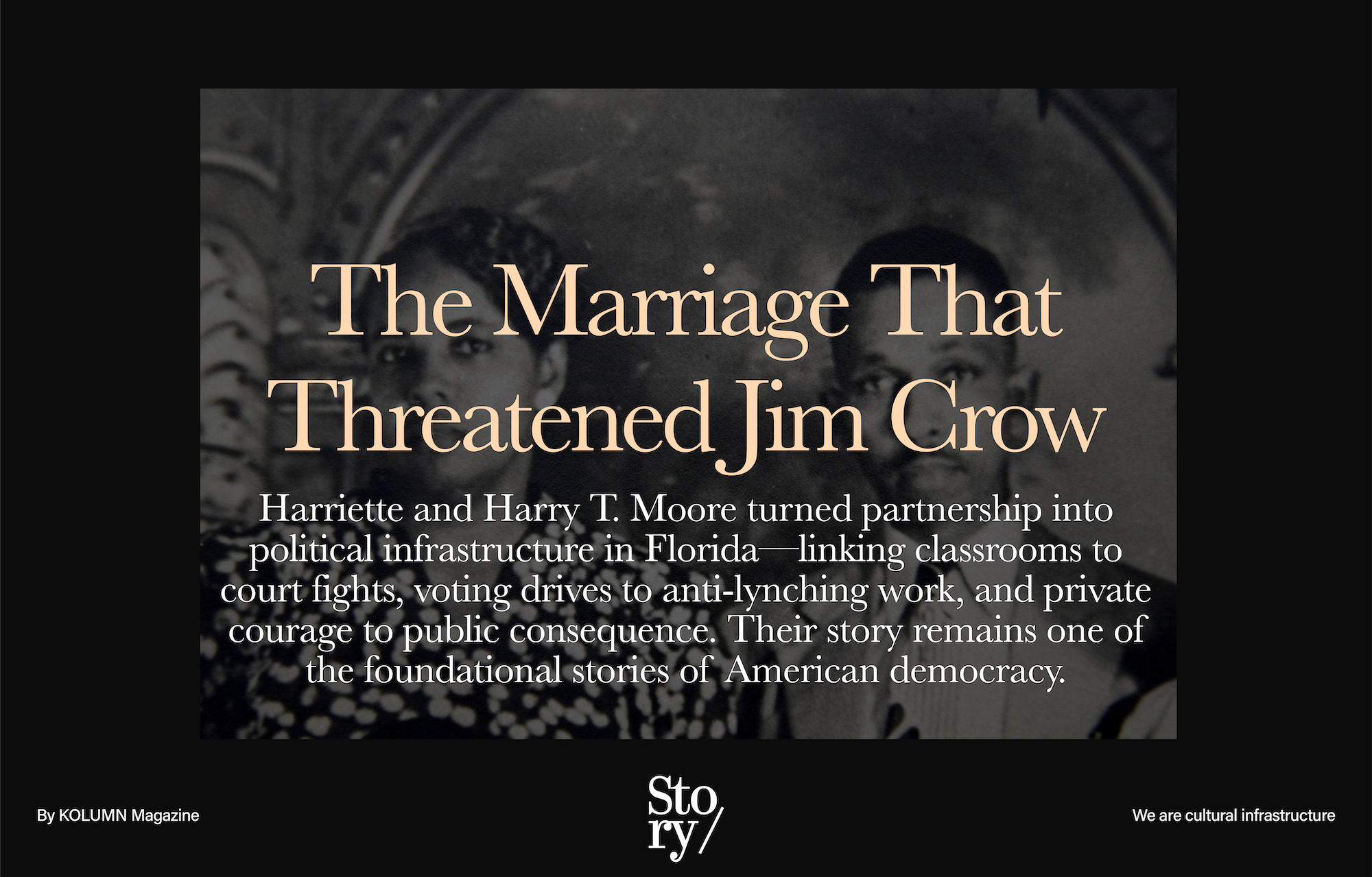
To remember Harriette Moore correctly is to remember that democracy in the South was built by people who were punished for teaching others how to claim it.
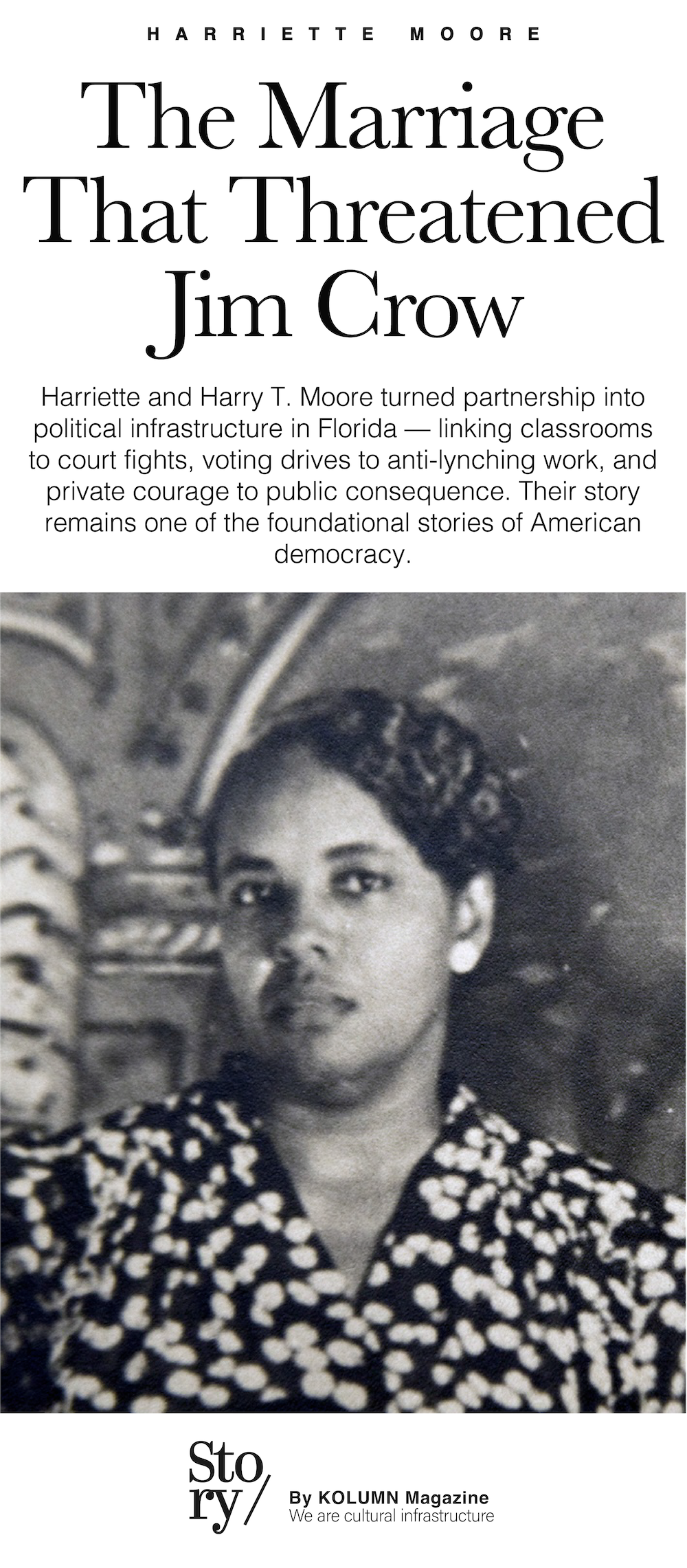
To remember Harriette Moore correctly is to remember that democracy in the South was built by people who were punished for teaching others how to claim it.
By KOLUMN Magazine
The story of Harriette Vyda Simms Moore is, in one sense, familiar. She was born in Florida, became an educator, married a fellow teacher, helped build a local NAACP branch, endured retaliation for civil rights work, and died after a Ku Klux Klan bombing tore through her home on Christmas night in 1951. In another sense, though, the story is maddeningly unfinished. Harriette Moore is often present in American memory only as part of a pair: Harry T. and Harriette Moore, the Moores, a husband and wife murdered for freedom. That description is true, but it is also incomplete. It turns a life into a hyphen. It compresses a political actor into a supporting role. And it misses what Harriette Moore’s life tells us about the architecture of early civil rights organizing in the South: that it was built not just by headline-makers, but by teachers, wives, mothers, clubwomen, and local organizers whose labor made the movement durable long before the nation learned to call it a movement.
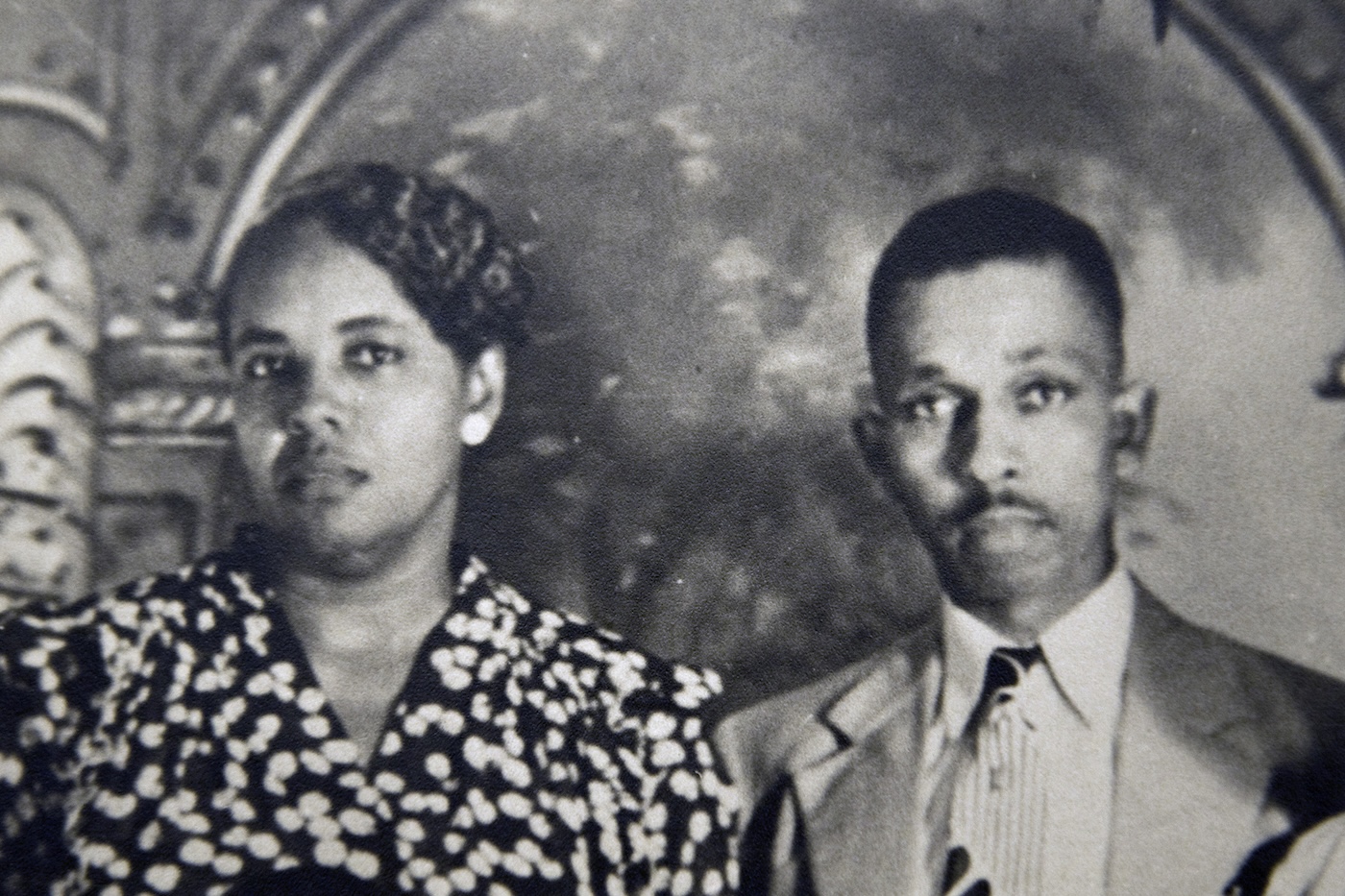
Harriette’s significance begins there, in the realm of the obscured but foundational. The public record on her is thinner than the record on her husband, and that imbalance is itself part of the story. The Smithsonian’s archival finding aid for the Harry T. and Harriette V. Moore collection documents a shared life of activism, but even there the materials chiefly chronicle Harry Moore’s correspondence and organizational work. The effect is revealing. Harriette appears in the archive the way many Black women reformers do: unmistakably present, deeply consequential, yet less individually centered by the institutions that inherited the paper trail. To write about her seriously is not to pretend the archive is fuller than it is. It is to read that scarcity honestly and ask what kinds of political work history has tended to preserve, and whose names it has allowed to stand alone.
Harriette Vyda Simms was born on June 19, 1902, in West Palm Beach, Florida, to David and Annie Simms. Before she became Harriette Moore, before the bombing and the martyrdom and the memorialization, she was a Black Floridian coming of age in a state that paired sunshine mythology with some of the South’s most brutal racial realities. Florida’s Jim Crow order was not a softer cousin to the Deep South; it was a violent regime in its own right, marked by disenfranchisement, segregated schools, routine racial terror, and active Ku Klux Klan presence. To understand Harriette Moore is to place her not in the margins of that world but in the middle of the Black institution-building that sought to survive and challenge it.
She met Harry T. Moore while working as an insurance agent for the Black-owned Atlanta Life Insurance Company in Cocoa. He, too, was supplementing his meager teaching salary through Atlanta Life. They married on Christmas Day in 1926, an anniversary that would later become inseparable from tragedy. After their marriage, according to the NAACP and the Smithsonian archive, they continued their education at Bethune-Cookman College and built a family that was tied tightly to Black educational aspiration. Their daughters, Annie Rosalea and Juanita Evangeline, would also attend Bethune-Cookman; the family was not merely adjacent to Black institution-building but saturated in it.
That educational arc matters because Harriette Moore was not simply “the wife of an activist.” She was an educator in her own right. The Smithsonian record notes that she worked as a teacher and lunch lady at various elementary schools in the region and later taught at Lake Park Colored School in Palm Beach County. It also records that she earned a teaching degree from Bethune-Cookman in 1941 and a bachelor’s degree in science in 1950. Taken together, those details sketch a woman who kept returning to study, to teaching, to credentialing, and to service—not as incidental tasks around somebody else’s calling, but as the substance of her own. In the segregated South, Black teachers were not only classroom instructors. They were civic brokers, literacy stewards, informal social workers, examples of middle-class aspiration, and often the connective tissue between community needs and political action. Harriette Moore belonged to that tradition.
It is tempting, with a figure like Harriette Moore, to reach quickly for the language of sacrifice. But sacrifice was not her starting point. Work was. The Moores joined the NAACP in the early 1930s, and by 1934 they had organized a local chapter in Brevard County. The Library of Congress states plainly that Harry and Harriette joined the NAACP in 1933, organized a local chapter in Brevard, and filed a lawsuit in 1937 challenging unequal pay for Black and white teachers—the first such suit in the South. The NAACP similarly credits the couple’s activism with helping press the equal-pay struggle for Black teachers in Florida. Harriette’s name belongs inside that fight, not outside it. Equal pay in this context was not a narrow workplace issue. It was a battle over whether Black professionalism, Black children, and Black public life would continue to be institutionally starved.
The equal-pay campaign also reveals something essential about the Moores’ politics. They understood that civil rights was not one issue. It was a structure. Teacher salaries, school resources, the vote, protection from racial terror, and access to legal recourse were all part of the same democratic argument. PBS notes that by the early 1940s Harry Moore had moved forcefully into anti-lynching and police-brutality investigations, while the NAACP describes the Moores as leaders who worked across voting rights, teacher pay, and criminal-justice issues. Harriette’s role emerges less as a parallel biography than as part of a political partnership whose power lay in its breadth. They were local enough to know the terrain and disciplined enough to link issues that segregation worked hard to keep fragmented.
This is one of the central reasons Harriette Moore matters. The civil rights movement is too often narrated as a sequence of famous set pieces: buses, bridges, lunch counters, churches, jails. But before the movement had those iconic images, it had organizers building membership lists, handling correspondence, teaching children during the day and movement principles after hours, enduring economic reprisals, and making politics legible to ordinary people. The Moores’ life in Mims, Florida, fits that earlier template. The Brevard County memorial site describes them as parents, educators, and leaders in the civil rights movement locally and nationally. That phrasing is useful because it refuses the false choice between domestic and political life. In Black freedom struggles, the household was often part of the headquarters.
The voter-registration work that made the Moores especially threatening to white power in Florida is usually told through Harry’s name, but Harriette was part of that apparatus of mobilization. After the Supreme Court’s 1944 ruling in Smith v. Allwright against the white primary, Harry organized the Progressive Voters’ League. PBS reports that in the next six years more than 116,000 Black voters were registered in the Florida Democratic Party, representing 31 percent of eligible Black voters in the state—higher than any other Southern state. The Southern Poverty Law Center, writing about a 2024 Florida voting-rights bill named for the Moores, put the figure more broadly, saying that by the time of their deaths the couple had helped register more than 100,000 Black voters across Florida. Whether one cites the more precise PBS figure or the rounded SPLC estimate, the underlying truth is the same: the Moores were helping convert disenfranchised Black communities into an organized electorate, and that was revolutionary.
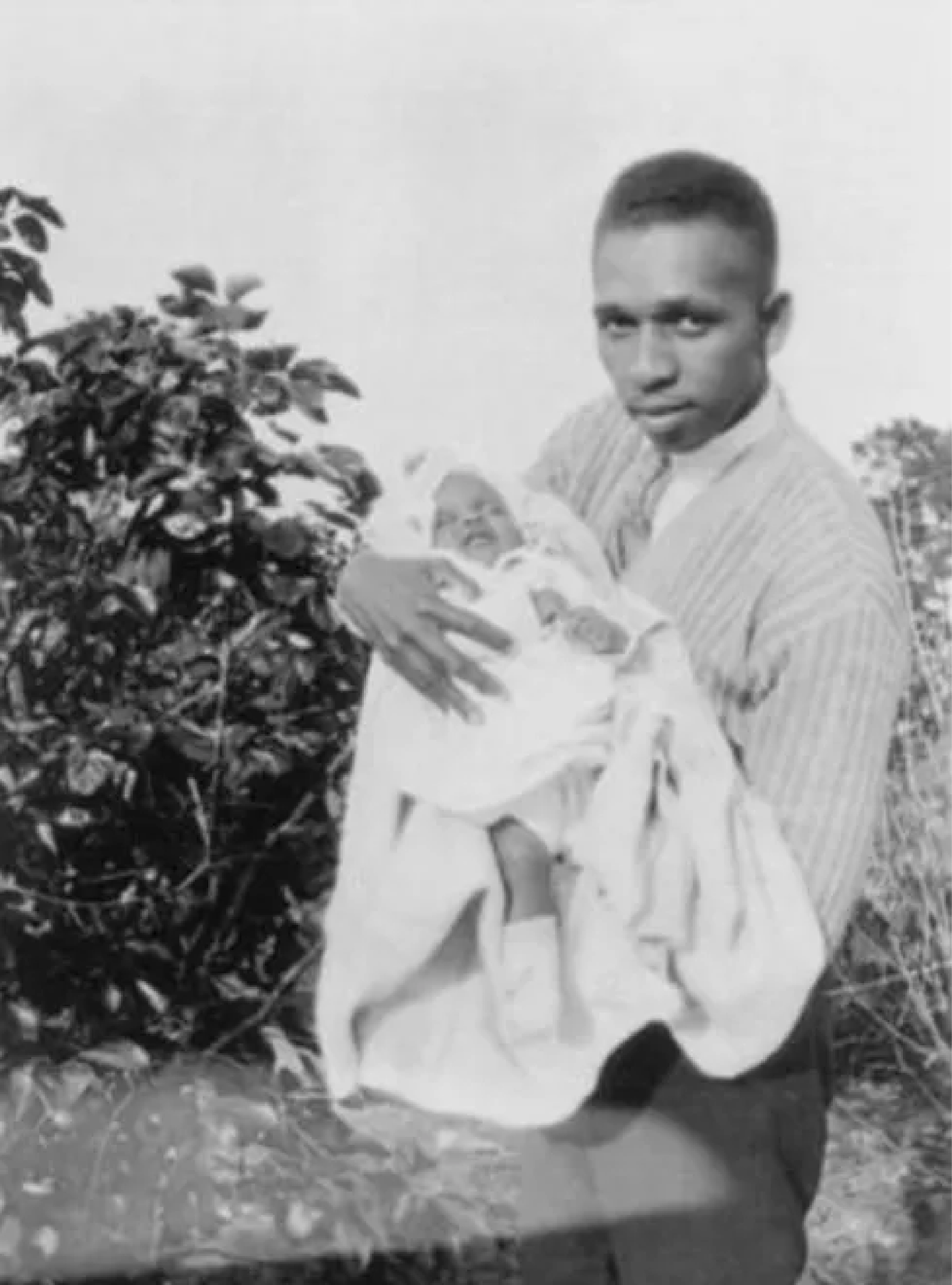
In Florida, that kind of work was not abstract. It was dangerous in ways both immediate and cumulative. The Department of Justice’s case-closing memo on the murders notes that Harry Moore’s civil rights advocacy made him a known target of the Klan and that in the early 1950s the Klan was large and active in central Florida, with community leaders, business owners, and law enforcement often either members or closely associated with Klan figures. The memo is written in legal prose, but the implications are chilling. When we say Harriette Moore lived under threat, we are not speaking metaphorically. She was helping build a political life for Black Floridians inside a landscape where the state, the social order, and racial terror were often intertwined.
The reprisals came before the bombing. In June 1946, Harry and Harriette Moore were both fired from their teaching jobs because of their activism. PBS says they paid a “terrible price” for political activity when both lost their positions; the Smithsonian timeline confirms that in 1946 they lost their teaching posts at Mims Elementary School as a result of civil rights work. Florida Humanities later put it plainly: Harriette and Harry “shared the cost of their activism.” That phrase lands because it is so exact. They did not merely share ideals. They shared consequences—economic punishment, blacklisting, insecurity, exposure. In the South, firing Black teachers was a common way to discipline Black political life, because it attacked both family income and community standing.
That detail also tells us something about gender and memory. Economic retaliation against activist men is typically narrated as a direct attack on their public leadership. Economic retaliation against activist women is more often folded into family hardship, as though the woman’s labor were secondary. But Harriette Moore was not collateral damage in Harry’s firing. She was a target, too. White authorities understood exactly what kind of woman she was: educated, employed, civically engaged, and politically unafraid. They knew that Black teachers helped produce Black publics. So they moved against both Moores. Any account that reduces Harriette to bereaved spouse misses that the segregationist state had already identified her as an adversary.
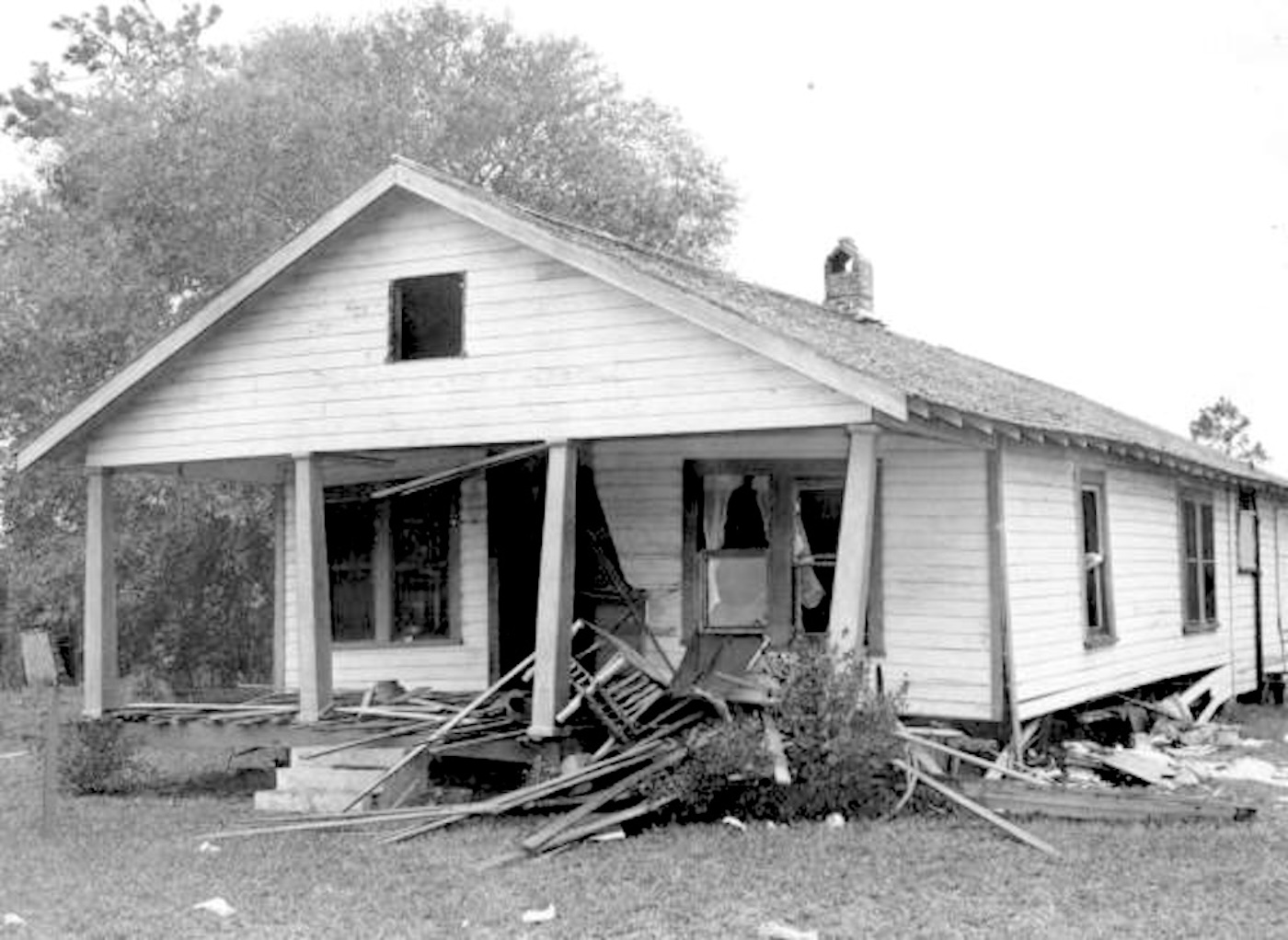
The question of the Groveland Four sharpened the danger further. The Guardian notes that the second trial in the Groveland case “had come about in no small part because of work by Harry and Harriette Moore” to overturn the convictions. The Smithsonian archive says many historians believe Harry Moore’s aggressive campaign against Sheriff Willis McCall after the Groveland shootings may have contributed to his murder, though the 2006 Florida investigation found no evidence directly linking the bombing to that case. Those two facts can coexist. The historical consensus is that the Moores had become highly visible antagonists to Florida’s racial order through voting work, equal-pay litigation, anti-lynching advocacy, and the Groveland campaign. In such an atmosphere, violence did not require a tidy singular motive. Jim Crow produced overlapping grievances against people who challenged it too effectively.
On Christmas night in 1951—the Moores’ 25th wedding anniversary—a bomb exploded beneath their bedroom in Mims. Harry died on the way to a hospital in Sanford that would treat Black patients. Harriette survived the initial blast but died of her injuries on January 3, 1952. The Smithsonian archive, Florida Humanities, the Department of Justice, and the Washington Post all recount the sequence with grim consistency. The bombing is regularly described as one of the earliest assassinations of the modern civil rights movement; some accounts call it the first civil rights assassination. The Washington Post, quoting biographer Ben Green, notes that the Moores were the only husband and wife to die in the civil rights struggle. Whatever phrasing one prefers, the point is devastatingly clear: long before the movement reached its most televised years, Black organizers in the South were already being murdered for making democracy real.
The country did notice, at least for a moment. The Smithsonian finding aid states that newspapers around the world criticized the United States for its treatment of African Americans and that the murders were discussed on the floor of the United Nations and in Congress. The Washington Post adds that the family tragedy inspired a poem by Langston Hughes. Yet attention is not the same as justice, and outrage is not the same as memory. The Department of Justice’s 2023 notice closing the file states that five criminal investigations ultimately revealed evidence implicating four Ku Klux Klan subjects in the bombing, but no arrests were ever made and all four suspects are now deceased. The state knew a great deal. It did not deliver accountability.
The DOJ memo is, in its own way, an indictment of historical America. It recounts an enormous initial FBI investigation, with nearly 80 agents and more than 1,000 interviews, and later reviews that pointed toward central Florida Klansmen including Earl J. Brooklyn, Tillman H. Belvin, Joseph Cox, and Edward Spivey. It describes floor plans of the Moore home, suspicious travel, incriminating remarks about dynamite, deathbed confessions, and Klan knowledge of Moore’s activism. And still: no trial, no convictions, no closure that could honestly be called closure. For Harriette Moore, the injustice was doubled. First came the act of terror; then came the civic lesson that Black suffering could be meticulously investigated and still remain unpunished.
There is another reason Harriette Moore’s story endures, and it has to do with sequence. The dominant mythology of the civil rights movement often begins in the mid-1950s—with Brown, with Emmett Till, with Montgomery, with Little Rock. But historians and archivists have spent decades pressing a corrective view: there were architects before the cameras arrived. PBS, the Library of Congress, and UCF historian Jim Clark all place the Moores among those forerunners. Clark has argued that Harry Moore was “so far ahead of his time” that the methods he used would not become widely legible until years later. That framing helps explain why Harriette Moore’s life can seem oddly underwritten in mainstream memory. She was part of a phase of the movement that was indispensable but less mythologized, locally grounded rather than nationally branded, strategic before it was spectacular.
And yet Harriette’s life also complicates the “before his time” argument in a useful way. She was not early because she happened to arrive before history got interesting. She was early because Black women like her had been doing this kind of citizenship work for generations. What changes in the 1930s and 1940s is not the existence of Black women’s political labor but the particular institutional configurations through which it moved: schools, NAACP branches, teacher networks, voter drives, local petitions, legal challenges, and family-based organizing. The Library of Congress and NAACP both situate the Moores’ campaign at the crossroads of education and politics. Harriette Moore helps us see that “movement work” was never just protest. It was pedagogy, administration, persuasion, and staying power.
This is why the tendency to remember Harriette mainly through martyrdom is too small for the life she lived. Martyrdom matters; it tells us about the stakes. But it is not the whole meaning. If we remember her only at the point of explosion, we miss her at the desk, in the classroom, in the church, in the county, in the long discipline of keeping a Black civic world intact. The Brevard County memorial park, opened on the site of the original home and later added to the U.S. Civil Rights Trail, tries to broaden that frame by honoring the Moores as parents, educators, and leaders. That is the right instinct. Harriette Moore’s significance lies partly in the way she collapses categories modern storytelling likes to separate. She was not a public figure despite being a teacher and mother. She was a public figure through those roles.
The afterlife of her memory has been uneven but meaningful. Brevard County restored the homesite and created the Harry T. and Harriette V. Moore Memorial Park and Museum; Congress renamed a Cocoa post office in their honor; the Moores were inducted into the Florida Civil Rights Hall of Fame; and in 2021 the Brevard County School Board passed a resolution acknowledging their unjust firings. The Southern Poverty Law Center reported in 2024 that Florida legislators introduced the Harry T. and Harriette V. Moore Florida Voting Rights Act, explicitly linking the couple’s legacy to contemporary struggles over ballot access. Those gestures do not erase the historical neglect, but they do suggest that Harriette Moore is being recovered not just as a victim of white terror but as a name attached to democratic expansion. That is an important distinction.
Still, commemoration can flatten as easily as it can reveal. Museums and markers often preserve the Moores as noble symbols, which they were, but symbols can become so polished that the harder edges disappear. Harriette Moore lived inside ordinary complexity. She worked. She studied. She married. She raised daughters. She lost her job. She kept going. She was not simply brave in a grand cinematic sense; she was brave in the repetitive, local, structurally vulnerable way that most organizers are brave. That may be why her story feels so modern. She reminds us that democracy is not secured once and for all by charismatic breakthroughs. It is built through ongoing labor that can look modest until power decides it is intolerable.
There is, finally, a lesson in the fact that Harriette Moore must so often be reintroduced. It says something about the nation, but it also says something about journalism. Reporting on civil rights history has often reproduced the hierarchy of the archives, giving us the man with the speeches, the letters, the title, the better-documented paper trail, while the woman becomes atmosphere—present, respected, but less interpreted. Serious reporting can do better. It can read the absences as data. It can treat the shared work of marriages and households as political infrastructure rather than sentimental background. It can recognize that when a woman is fired for activism, surveilled by the same world that surveils her husband, and killed in the same bomb that kills him, she was not merely nearby to history. She was in it.
Harriette Vyda Simms Moore deserves to be remembered in full: as an educator formed by Black Florida, as a woman who continued her studies while sustaining family and community, as an organizer whose life was bound up with equal-pay campaigns, NAACP expansion, and Black voter mobilization, as a target of white supremacist retaliation, and as one half of a political partnership that terrified Jim Crow because it connected everyday Black life to democratic power. The old phrasing—that she stood beside Harry T. Moore—is not wrong, exactly. It is just insufficient. Harriette Moore did stand beside him. But she also stood for something on her own: the proposition that Black citizenship in the South would have to be taught, defended, and insisted upon, even at terrible cost.
And maybe that is why her story still matters with such force now. In every era, there are people the country prefers to remember as companions rather than creators, supporters rather than strategists, mourned rather than fully known. Harriette Moore resists that narrowing. Her life asks us to widen the frame of the civil rights movement until we can see the women who made it livable and legible before it was famous. It asks us to recognize schools as movement sites, marriage as political coordination, and local Black labor as national democratic history. Most of all, it asks a more basic question: What would American memory look like if it were as serious about the builders as it is about the martyrs? Harriette Vyda Simms Moore remains one of the clearest reasons that question cannot be put off.
More great stories
Afro Sheen, Wall Street, and the Architecture of Black Possibility
July 6, 2026
No Comments
The Fire Inside the Fourth
July 5, 2026
No Comments