



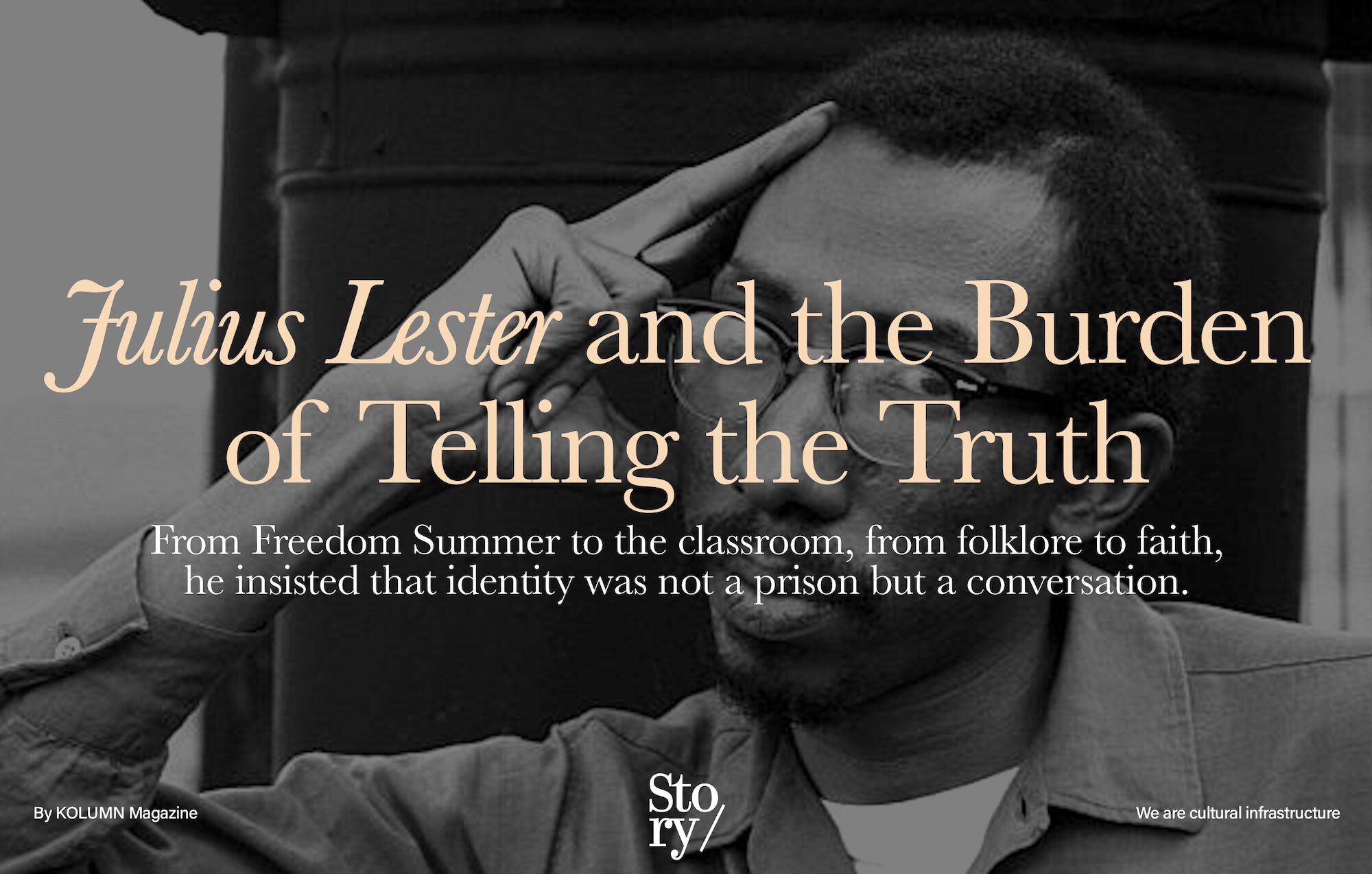
He was never interested in being merely representative. He was interested in being exact.
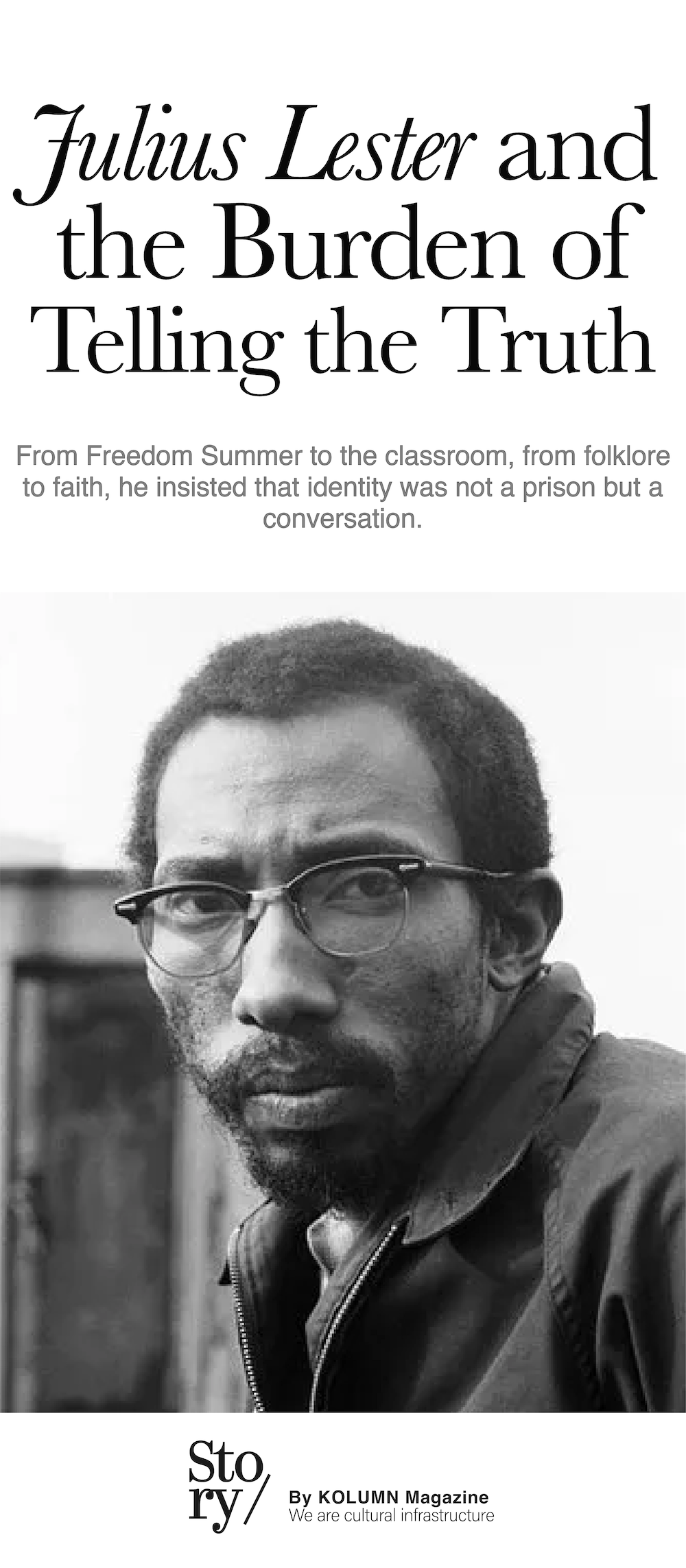
He was never interested in being merely representative. He was interested in being exact.
By KOLUMN Magazine
Julius Lester’s life resists summary for the same reason it still matters: he would not stay in the place other people assigned him. He was a civil rights worker and a folk singer, a Black Power-era polemicist and later a critic of movement dogma, a radio host and photographer, a professor of Afro-American studies and then Judaic studies, a public intellectual, memoirist and one of the most important writers of Black children’s literature in the late 20th century. By the time he died in January 2018 at 78, after a long career at the University of Massachusetts Amherst, he had written nearly 50 books and published more than 200 essays and reviews. The arc of that output alone would be enough to make him notable. What makes him consequential is the way he used each reinvention not to escape history but to press deeper into it.
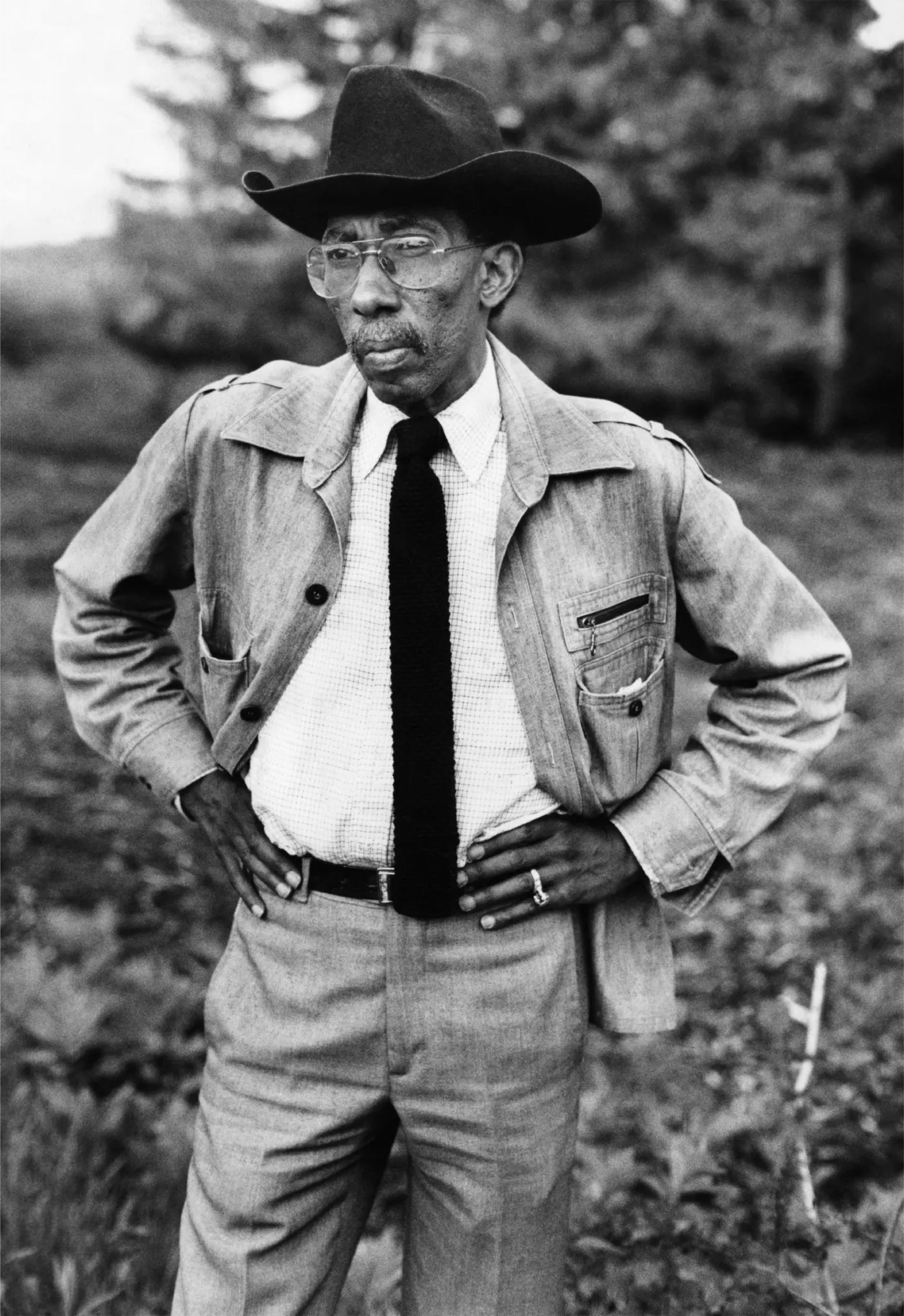
He chronicled Black American life in forms that did not always fit neatly together. In one decade he could write the confrontational Look Out, Whitey! Black Power’s Gon’ Get Your Mama and also produce To Be a Slave, a landmark work for young readers assembled from slave narratives and historical testimony. Later he could retell Br’er Rabbit stories, write novels, meditate on God, and publish a memoir about becoming a Jew. He was drawn to the moral and emotional ambiguities that simpler movement biographies tend to flatten. That is partly why his legacy can feel less immediately marketable than that of figures whose public identity stayed stable. Julius Lester changed, publicly and sometimes painfully. He let the record show the contradictions.
That instinct made Lester a difficult figure in the best and hardest sense. He could be exhilarating, generous, abrasive, wounding, funny, devout and impatient, sometimes all at once. Admirers saw a truth-teller willing to cross boundaries others treated as sacred. Critics saw a man who sometimes mistook provocation for courage. Both readings contain some truth. But neither is complete without the other, and neither makes sense without understanding where he came from: a segregated childhood shaped by Black church life, oral storytelling, music, and a family history that contained both slavery and Jewish ancestry.
Born into story, sermon and contradiction
Julius Bernard Lester was born on January 27, 1939, in St. Louis, Missouri, and grew up in Kansas City, Kansas, before his family moved to Nashville in the 1950s. His father was a Methodist minister, and Lester later described the importance of hearing sermons and stories in the home. That mattered. The cadence of Black preaching, the discipline of listening, the sense that language had weight beyond information: those qualities would stay with him whether he was singing, lecturing or writing for children. Publishers Weekly noted that Lester himself connected his father’s sermons and stories to the foundation they gave him in Black traditions.
His family history was also more layered than the racial shorthand available in midcentury America. The Encyclopedia of Arkansas notes that Lester’s grandmother was the daughter of a formerly enslaved woman and a German Jewish immigrant, a lineage that would become significant later in his life when he turned toward Judaism. That ancestry did not automatically determine his adult spiritual path, but it gave him an ancestral thread he would eventually follow. In Lester’s life, heritage was never inert background. It was an argument, a question, a source of unfinished business.
He graduated from Fisk University in 1960 with a degree in English. Fisk was not just a credentialing stop. It placed him inside a Black intellectual tradition that took art and politics seriously, often simultaneously. Yet Lester’s first ambition was not academia. He wanted music. After college he moved to New York City, where he pursued a career as a folk singer, taught guitar and banjo, worked in broadcasting, and built a public voice before many Americans knew him as an author. His first book, co-written with Pete Seeger, was a guide to the 12-string guitar as played by Lead Belly. The detail matters because it reminds us that Lester entered public life through performance and sound before he became a canonical writer.
The movement years and the uses of song
The civil rights movement often gets remembered through its most polished speeches and most photogenic marches. Lester’s place in it is slightly different. He belonged to the infrastructure of struggle: the singers, field workers, photographers, organizers and on-the-ground chroniclers who animated a movement that was never just its famous leaders. He went to Mississippi during Freedom Summer in 1964, part of the campaign to register Black voters and challenge the regime of white terror that governed daily life in the state. Accounts of Lester’s life repeatedly return to the danger of those years and to his role in helping sustain morale through music and presence. A PBS profile drawn from his interview material captures the existential clarity of that era in one Lester line: “If somebody can threaten your life they own you.”
SNCC records also place him in another important role: head of the organization’s photo department and a participant in internationalist work that extended beyond the U.S. South. The SNCC Digital Gateway notes that he traveled to North Vietnam and to Cuba in 1967, gathering photographs and materials intended to support organizing work at home. This was a period when parts of the movement were increasingly linking anti-racist struggle in the United States with anti-imperial politics abroad. Lester was inside that shift, not simply observing it.
But the movement years also exposed one of the abiding tensions in his life: he wanted solidarity, yet he was temperamentally suspicious of unquestioned orthodoxy. In a PBS interview, reflecting on the late 1960s, Lester said he felt alienated as the movement became “more anti white” and adopted the rhetoric of violence. He described feeling compelled to criticize people he had worked with and loved. That testimony is worth reading carefully. It does not make him an outsider to Black freedom politics; it shows him wrestling from within with what he believed the movement was becoming. The emotional undertow is unmistakable: leaving a political home can feel like losing language itself.
This is one reason Lester’s story remains relevant. Movements need internal critics, but they rarely reward them in real time. Lester understood the seductions of righteous certainty because he had helped produce it in public. He also knew what happens when a political identity becomes too rigid to accommodate moral complication. That knowledge made him useful and vulnerable at the same time.
Black Power, language and the danger of simplification
If Lester had died in the late 1960s, his legacy might rest mainly on his place in Black Power discourse. Look Out, Whitey! Black Power’s Gon’ Get Your Mama remains one of the most memorable titles of the era, part provocation, part challenge, part performance. It announced a voice unwilling to soothe white liberal anxieties. Yet even there, Lester was more complicated than the caricature of a one-note militant. The book emerged from a historical moment when Black communities were asking harder questions about power, self-determination, policing, education and the limits of interracial idealism. To write in that idiom was not merely to posture; it was to speak in a register that many Black readers recognized as overdue. SNCC’s own archival profile lists the book among the defining texts associated with his activism.
Still, the public often prefers a frozen image. Lester was repeatedly remembered either as the militant Black nationalist of the late ’60s or as the later Black Jewish intellectual who criticized Black anti-Semitism and wrote memoir about religious conversion. The truth is that each figure emerged from the other. He did not become serious about moral complexity after the movement; the complexity was already there. It was visible in his discomfort with dogma, his fascination with the uses and abuses of collective identity, and his insistence that history had to be felt as well as analyzed.
That is also why it is too easy to narrate him as someone who “left” Black politics for a more individual, spiritual path. What he actually did was continue asking a difficult question in different settings: What does it mean to belong without surrendering conscience? That question ran through his activism, his teaching, his faith writing and his children’s books.
The writer who changed children’s literature
For many readers, Julius Lester’s most durable contribution is not his movement celebrity or his controversies. It is the body of books he gave to children, especially Black children. This is where his public significance widens. Activism helped shape his urgency, but literature expanded his audience and lengthened his afterlife.
His 1968 book To Be a Slave was foundational. Published when children’s books rarely addressed slavery with seriousness or formal innovation, it drew directly on the narratives of formerly enslaved people and framed history as lived testimony rather than abstraction. Publishers Weekly reported that the book became a Newbery Honor title and sold just under half a million copies in hardcover and paperback. That success was not only commercial. It marked a breach in the assumptions of children’s publishing: that young readers could not handle the moral gravity of Black history, or that Black history should be softened into civics lesson uplift. Lester refused both premises.
He later said that writing To Be a Slave helped him realize he could write for children in ways he could not write for adults. That comment is revealing. Lester did not treat children’s literature as a lesser category. He understood it as a distinct art form—one capable of clarity without condescension, and of emotional directness without falsity. The result was a career that ranged widely across Black folklore, historical retellings and picture books, all while preserving a sense that children deserve formal ambition and historical truth.
The list of honors attached to his books is extensive: a Newbery Honor, Coretta Scott King recognitions, a National Book Award finalist nod, and more. Yet the awards only partially explain the impact. Lester advocated forcefully for books about Black life written by Black creators, and his own work broadened what that literature could sound like. He could be playful, solemn, mischievous, elegiac. The man who had written movement polemic also wrote with whimsy. That range mattered because it resisted one of the oldest traps in American letters: permitting Black art seriousness only when it performs suffering and permitting Black joy only when it is stripped of history. Lester insisted on the whole register.
His retellings of Br’er Rabbit and other folktales are part of that legacy. So is John Henry, his collaboration with illustrator Jerry Pinkney, which won major recognition. His later Day of Tears: A Novel in Dialogue, about a slave auction, won the Coretta Scott King Award. Across those books he treated folklore not as quaint residue but as a living technology of memory. Black storytelling traditions, in Lester’s hands, carried wit, grief, survival strategy and philosophical argument all at once.
“He wrote history for children without lowering the voltage.”
That may be the simplest way to understand why his children’s books endure. Lester did not merely “represent” Black history for young readers. He invited them into its soundscape and moral weather.
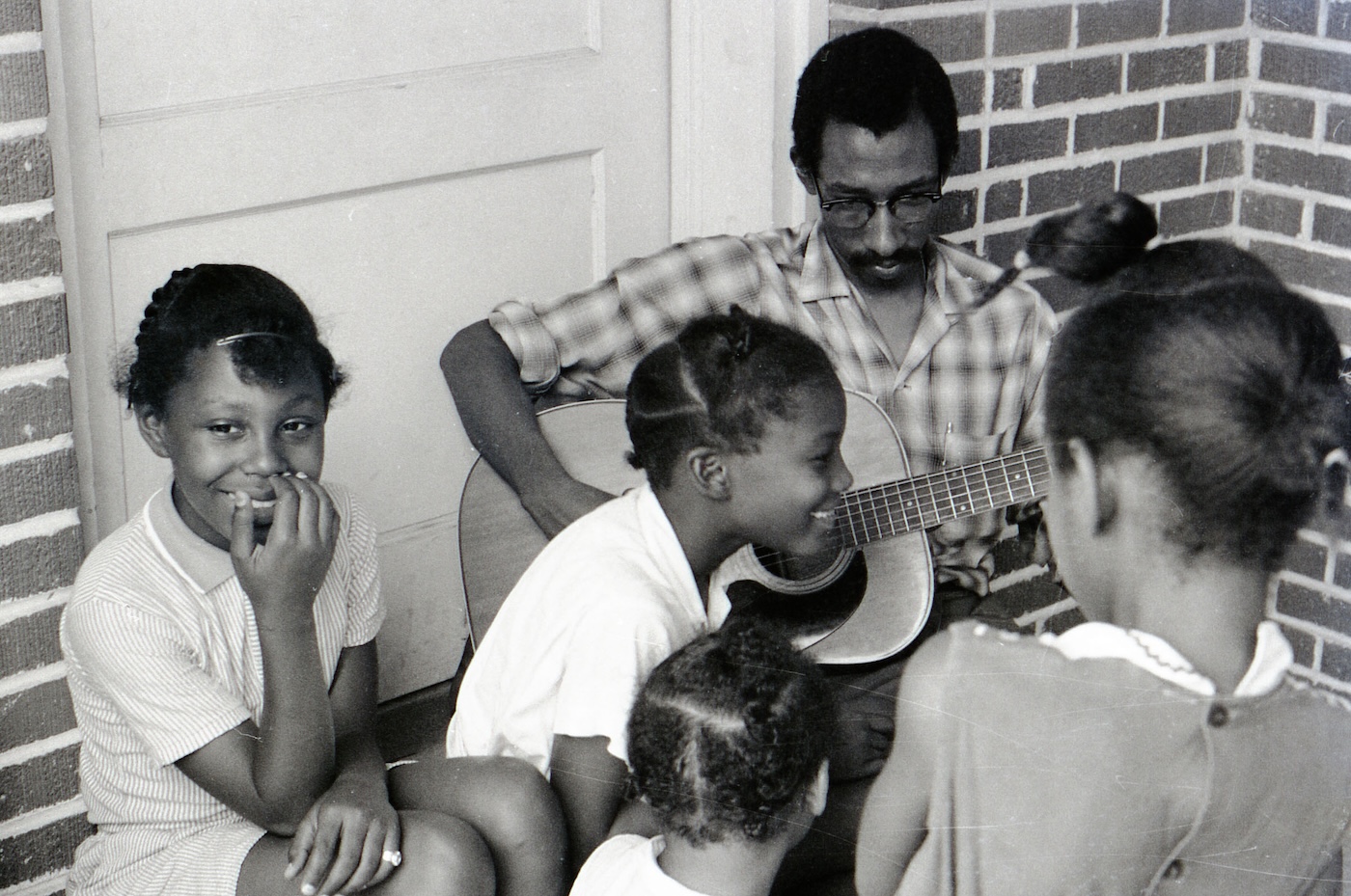
The classroom as a second stage
In 1971 Lester joined the University of Massachusetts Amherst as a visiting lecturer in what became the W.E.B. Du Bois Department of Afro-American Studies. He rose to associate professor, then professor, and from 1982 to 1988 held a joint appointment in Afro-American studies and Judaic studies before transferring fully to Judaic and Near Eastern studies. He retired in 2003 after more than three decades on the faculty.
It is tempting to see academia as his settled phase, the part of life after movement heat. But that would understate how central teaching was to his public role. Lester was not a retreating activist who took shelter in the university. He turned the classroom into another forum for argument about history, race, religion and language. UMass remembered him as nationally renowned not just for authorship but for teaching. His honors included distinguished teaching awards and professor-of-the-year recognition, suggesting that students experienced him not as a symbolic hire but as a serious and memorable educator.
The intellectual move from Afro-American studies into Judaic studies was not simply bureaucratic. It mirrored the questions that increasingly occupied him: the relation between Black and Jewish histories, the moral vocabulary of oppression, and the possibility of inhabiting multiple inherited identities at once. In an American public sphere that likes identity categories to remain discrete and legible, Lester’s academic path was itself an argument. He would not choose between Blackness and Jewishness because, for him, the choice was false.
Becoming a Jew, becoming more himself
Lester converted to Judaism in 1982. That fact often gets presented as a late-life surprise, particularly in obituaries that contrast it with his Black Power past. But the more interesting story is not the surprise; it is the continuity. His family history included Jewish ancestry. More importantly, his spiritual life had long been marked by searching. He had been raised in the Black church, passed through atheism, and then arrived at Judaism not as an aesthetic hobby but as a theological and ethical home. His memoir Lovesong: Becoming a Jew made that journey public.
Jewish Currents wrote that Lester embodied both the historic Black-Jewish bond and the tensions within it. That is accurate, and it captures why his conversion carried such symbolic force. Lester was not simply a Black public intellectual who adopted a private religion. He became, publicly, a Black Jew in America, speaking into a relationship between communities that had been marked by alliance, estrangement, projection and resentment. His life made neat communal scripts impossible.
He also challenged Jews. A 1996 interview in the Jewish Bulletin of Northern California described audience members directing “you people” questions to Lester as a Black man rather than as a Jewish convert. The episode underscores one of his enduring themes: crossing a boundary does not make the boundary disappear. Lester’s Jewishness did not dissolve anti-Blackness. His Blackness did not exempt him from criticism over anti-Semitism debates. He lived at the pressure point where both realities could be true at once.
This is another reason his story remains contemporary. Much of today’s public discourse around race and religion still depends on tidy binaries, tidy victimhood and tidy betrayal. Lester’s life offers none of that. It offers entanglement.
Controversy as vocation and cost
To write about Julius Lester honestly is to say that controversy was not incidental to his career. It was part of the texture of his public life. Some of that came from conviction; some from rhetorical style; some from the volatile historical terrain he occupied.
One of the most damaging early episodes involved the 1968 Ocean Hill-Brownsville school conflict in New York, where struggles over community control, union power, race and Jewish-Black relations became combustible. Lester hosted a WBAI radio program on which an anti-Semitic poem was read, an act that intensified public outrage and fixed his name in a particularly painful debate about Black anti-Semitism. The larger context of Ocean Hill-Brownsville was more complex than the shorthand that later prevailed, but the episode undeniably scarred his public image. Even later accounts of his death frequently returned to it.
Years later another controversy erupted when Lovesong alleged that James Baldwin had made anti-Semitic remarks during a campus lecture. UMass notes that the dispute placed Lester at the center of a national controversy in 1988 and contributed to his transfer from Afro-American studies to Judaic studies. A Los Angeles Times report from that period captured Lester insisting that Baldwin himself was not an anti-Semite, even as he argued that certain remarks were anti-Semitic. That distinction mattered to Lester, though it did little to calm the storm.
To some Black critics, Lester had become an “anti-Negro Negro,” a phrase repeated in later obituary coverage. To some Jewish readers, he was a needed voice on anti-Semitism. To others, he remained too marked by the earlier WBAI episode to become a clean moral authority. This instability of reputation followed him for years. It also reveals something important about American public culture: we often claim to admire complexity, then punish people who actually live it.
That does not mean Lester was always right. It means that his errors, provocations and arguments were inseparable from the same fierce independence that made his work vital. The challenge for any serious assessment is not to excuse the damage done in contentious episodes, nor to reduce him to them. It is to recognize that his career forces uncomfortable questions about accountability, speech, communal injury and the limits of ideological loyalty.
“He made people choose whether they wanted honesty or comfort. They often said honesty and chose comfort.”
Why the work still feels alive
Julius Lester’s significance is not only biographical. It lies in the themes his life keeps throwing back at the present.
First, he understood that Black history is not merely a ledger of injuries but a struggle over narration. His books repeatedly returned to the question of who gets to tell the story and in what form. In To Be a Slave, he centered the words of the enslaved themselves. In folklore, he preserved the tonal intelligence of oral tradition. In memoir, he treated personal identity as historically saturated rather than purely private. At a moment when fights over curriculum, censorship and historical memory again dominate public life, Lester’s methods feel strikingly current. He believed that history had to be emotionally credible, not just factually available.
Second, he stands as a model of artistic and political interdisciplinarity. Today that word gets used often and cheaply. Lester actually lived it. He moved among music, movement work, radio, photography, fiction, criticism, memoir and children’s literature without treating any of them as branding extensions. Each medium answered a different need. Music could rally and console. Photography could witness. Teaching could sharpen inquiry. Children’s books could build a moral archive. Few public intellectuals have worked across so many forms with comparable seriousness.
Third, he remains a difficult but necessary figure for conversations about Black-Jewish relations. Too many discussions in that area slip into nostalgia for an alliance that was never uncomplicated or into fatalism about an estrangement that need not be permanent. Lester’s life shows both the intimacy and the fracture. He neither fits the romance of perfect coalition nor the cynicism of total incompatibility. He lived the overlap, and therefore he lived the strain.
Fourth, he matters because he took children seriously. That should not be a footnote. A society reveals its ethics in what it is willing to tell the young. Lester helped enlarge the imaginative and historical possibilities available in children’s publishing, especially for Black readers who had long been underserved or distorted by the field. Many contemporary conversations about representation in children’s books rest on ground he helped clear.
Finally, his life is a reminder that evolution should not automatically be read as betrayal. In a time when ideological camps demand clean consistency and archive every deviation, Lester’s career offers a harsher, freer lesson: a person can change because experience changes them, because conscience interrupts them, because history demands new language. That does not absolve contradiction. It recognizes that a living mind will produce it.
The afterlife of an unruly witness
When Lester died in 2018, the obituary language around him often reached for breadth: activist, author, musician, scholar, photographer, professor. The abundance of nouns was accurate, but it still risked missing the through-line. Julius Lester was, above all, a witness with style. He witnessed Black life, Black struggle, Black memory, and later the fraught encounter between Blackness and Jewishness in America. He witnessed through song, argument, teaching and story. And he did it with a voice shaped by sermon, fieldwork, folklore and dissent.
There is a reason he continues to interest readers who care about activism but not only activism, literature but not only literature, religion but not only religion. He makes all those categories feel temporarily inadequate. Julius Lester’s life suggests that the fullest political biographies are also aesthetic ones, and the fullest literary biographies are also ethical and spiritual ones. That blend is not tidy. It is human.
He leaves behind a body of work that still invites argument, which is perhaps exactly right. Consensus was never his native climate. Yet even the disputes around him confirm his scale. Minor figures do not keep reappearing wherever Americans argue about race, memory, childhood, faith and the moral costs of public speech. Lester does.
The semi-casual temptation, especially in magazine writing, is to call someone “complicated” and let the adjective do the labor. Julius Lester deserves something more precise. He was not merely complicated. He was intellectually restless, morally demanding and historically saturated. He wanted language to carry consequence. He wanted identity to bear scrutiny. He wanted literature to do more than decorate virtue. And he wanted, perhaps more than anything, to remain answerable to what he knew, even when that answerability isolated him.
That kind of life rarely produces uncomplicated reverence. It produces something better: durable relevance.
So Julius Lester should be remembered not as a side character in civil rights history, not as a curiosity who moved from Black militancy to Judaism, and not only as a prize-winning children’s author, though he was all of those things. He should be remembered as one of the rare American figures who made a vocation out of refusing reduction. In an era that rewards slogans and punishments with equal speed, that refusal looks less like eccentricity than like discipline.
And maybe that is his sharpest legacy. Julius Lester insisted that a person could belong to history without becoming trapped inside somebody else’s summary of it. That insistence still feels radical.
More great stories
Afro Sheen, Wall Street, and the Architecture of Black Possibility
July 6, 2026
No Comments
The Fire Inside the Fourth
July 5, 2026
No Comments