


Harper asks, What kind of nation are we building if our reform movements still require some people to wait outside the room while others debate justice inside it?
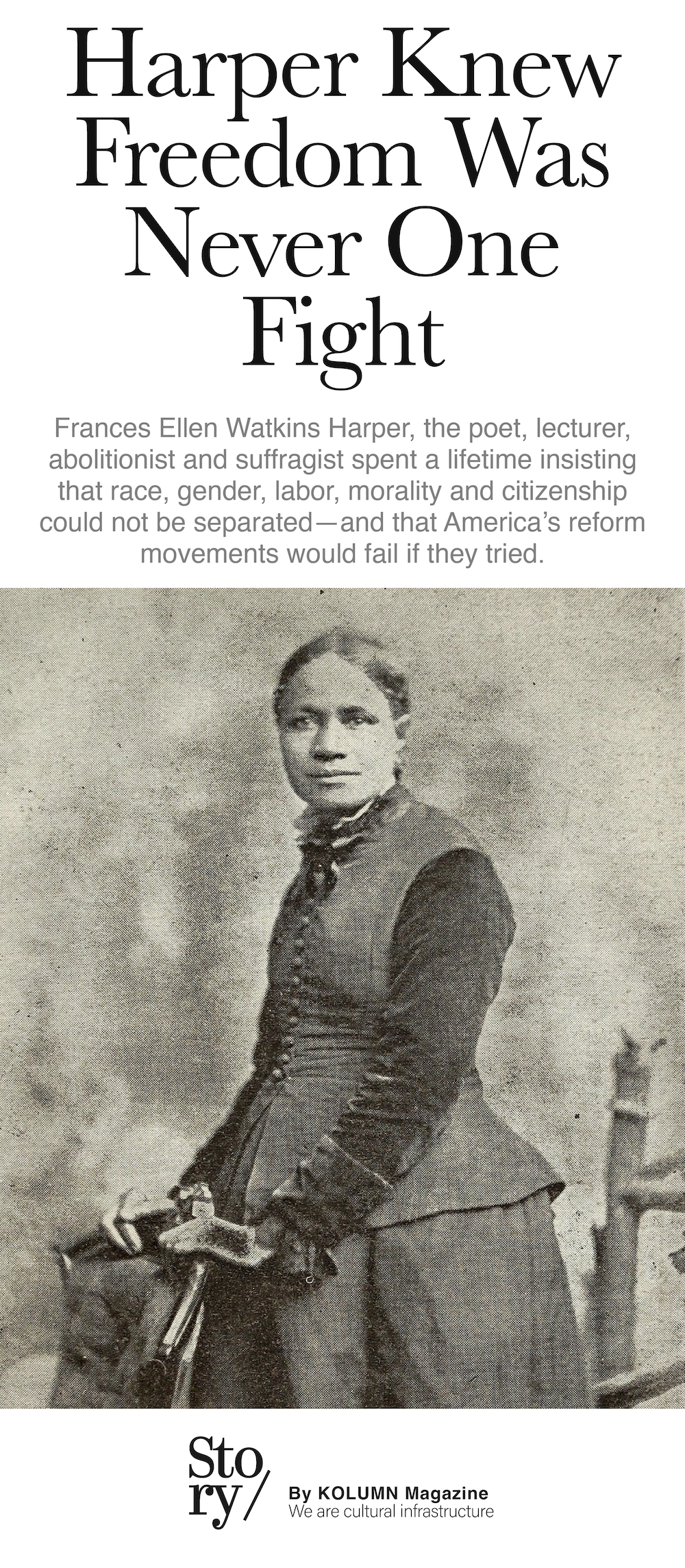
Harper asks, What kind of nation are we building if our reform movements still require some people to wait outside the room while others debate justice inside it?
By KOLUMN Magazine
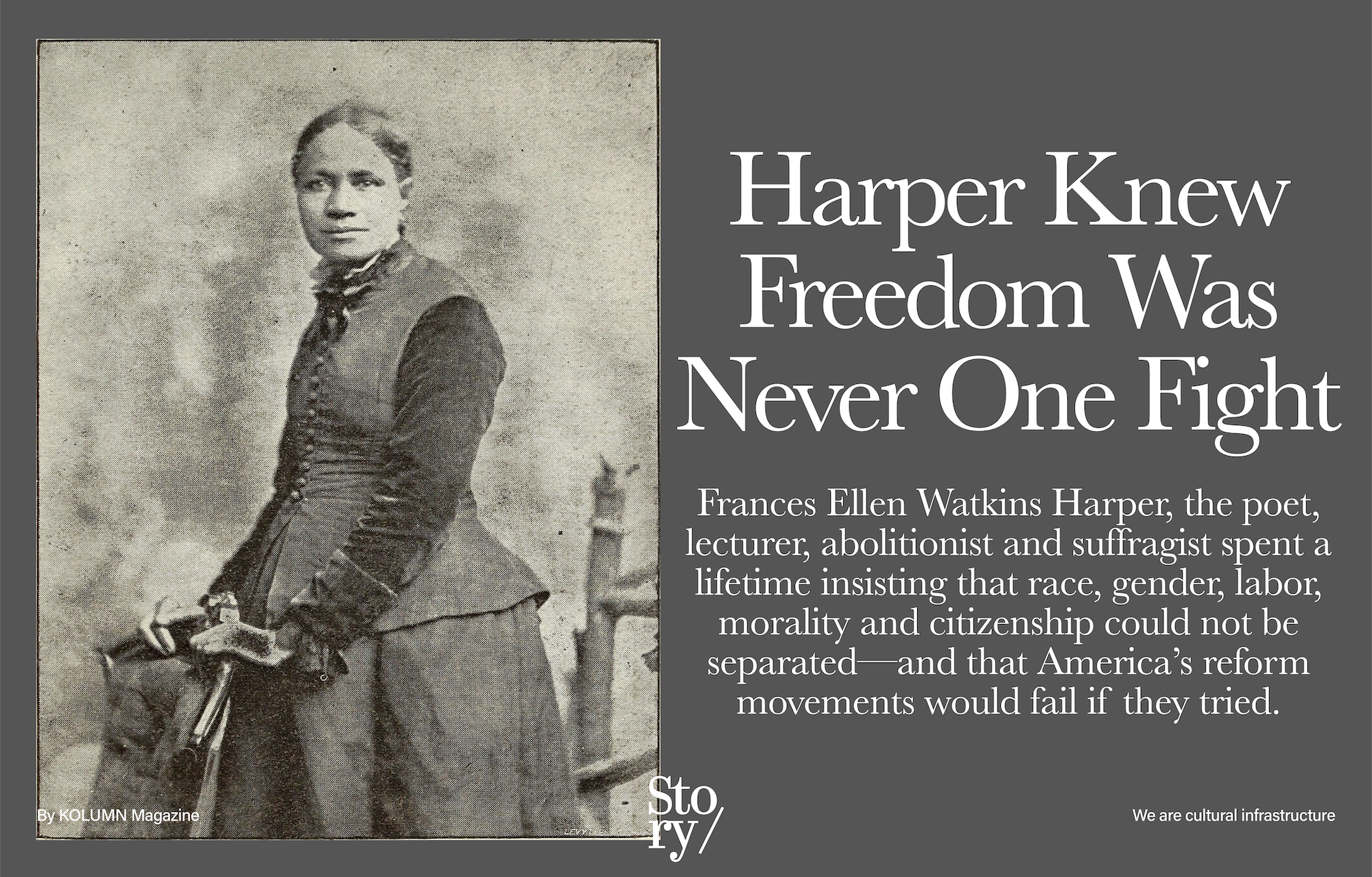
Frances Ellen Watkins Harper was published widely. She traveled relentlessly. She spoke before packed halls. She wrote poems that circulated through antislavery networks and prose that pushed readers to think about Black life, women’s rights, citizenship and morality not as separate subjects but as one entangled American crisis. Born free in Baltimore in 1825, laid to rest in Philadelphia in 1911, Harper lived across the great fault lines of the 19th century and refused, more consistently than many of her peers, to let reform movements lie to themselves about whom they were actually serving.
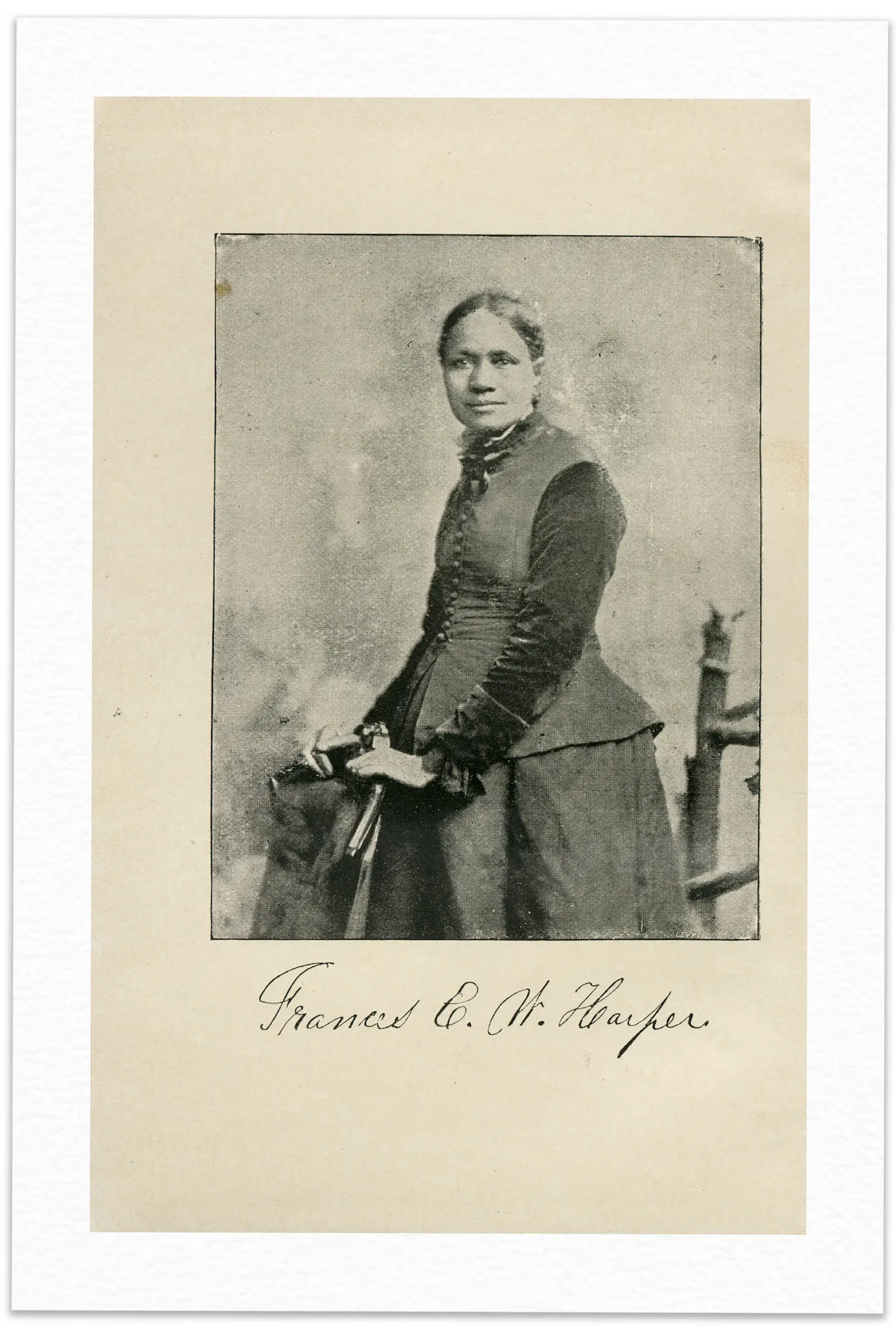
That is one reason Harper still feels startlingly current. She understood that progress rhetoric could be thin, self-congratulatory and selective. She knew that people who spoke passionately about rights could still ignore Black women, poor women and working people. She knew that emancipation without economic dignity was fragile, that suffrage without racial justice was incomplete, and that moral language without institutional courage was often just performance. In 1866, at a women’s rights convention, she delivered the line that still shadows every inadequate version of coalition politics: “You white women speak here of rights. I speak of wrongs.” The sentence remains famous because it is both diagnosis and rebuke. Harper was not objecting to rights; she was objecting to a political framework too narrow to account for lived harm.
What makes Harper so significant is not just that she participated in major 19th-century reform movements. It is that she changed the terms of argument inside them. She pressed abolitionists to think beyond sentiment, suffragists to reckon with race, temperance leaders to confront anti-Black violence, and readers to see literature as civic labor. Long before scholars built vocabularies for overlapping oppressions, Harper was practicing a politics that treated race, gender, class, education and public morality as structurally connected. The phrase “ahead of her time” gets overused, but in Harper’s case it is almost too small. She was not simply ahead of her time. She was often more honest than it.
A child of free Black Baltimore — and of its limits
Harper’s life began inside a contradiction. She was born to free Black parents in Baltimore on Sept. 24, 1825, but “free” in a slave society never meant unburdened. Her mother died when she was very young, and she was raised by her aunt and uncle, the Rev. William Watkins and his wife. Her uncle ran the Academy for Negro Youth, where Harper was educated before leaving school around age 13. That early education mattered. So did the moral atmosphere around it. Watkins was not simply a guardian; he was a teacher and activist whose intellectual seriousness helped shape Harper’s sense that literacy and public duty belonged together.
She then worked in a Quaker household as a domestic servant, a position that exposed the usual American split screen: racial restriction on one side, self-improvement through books on the other. Sources on Harper’s life note that she gained access there to a substantial library, and that reading widened both her literary range and her political imagination. This is a common American story in one sense — talent forcing its way through limited openings — but in Harper’s case the reading life did not become retreat. It became equipment. Her earliest surviving writing suggests a person already training language toward purpose.
Her first known pamphlet, Forest Leaves, appeared when she was still young, though copies were long thought lost. More widely recognized was Poems on Miscellaneous Subjects, first published in 1854. That book would make Harper a literary name, and not merely in a symbolic sense. It sold widely and went through many reprintings during her lifetime, giving Harper something more valuable than prestige: reach. She was not an obscure genius waiting for later scholars to rescue her. She was a working writer with an audience. Her poetry circulated because it addressed the emotional and political emergencies of her era in language ordinary readers could carry with them.
That line, from one of Harper’s best-known poems, is blunt enough to seem almost inevitable now. But it was sharpened in a context where freedom itself was unstable. Maryland passed a law in the early 1850s forbidding free Black people from re-entering the state without risking imprisonment and sale into slavery. For Harper, who had been born free there, the message was unmistakable: Black freedom in America could be revoked, reclassified or terrorized at will. That legal and psychic rupture helped push her more decisively into public abolitionist work.
When literature became activism by other means
Harper taught in Ohio and Pennsylvania in the early 1850s, including in settings closely tied to antislavery organizing. In Pennsylvania, she spent time in a household linked to Underground Railroad activity; in Philadelphia she later worked in the orbit of William Still, the famed abolitionist and chronicler of fugitives from slavery. These experiences deepened her identification with the antislavery movement not as abstraction but as daily emergency. She was not simply writing about bondage from afar. She was living near its fugitives, its paperwork, its moral debris and its constant threat.
From there Harper moved into public lecturing, and this is the phase of her life that can still be hard to fully imagine. A Black woman in mid-19th-century America traveling from place to place, speaking publicly on slavery and reform, was doing more than giving talks. She was turning her body into an argument against the social order. Antislavery societies hired her because she was powerful, and contemporary accounts repeatedly emphasize the force of her speaking voice and moral seriousness. Harper developed a public presence that was persuasive precisely because it combined sentiment, intellect, biblical cadence and political clarity.
This is where literature and activism become impossible to separate in her career. Harper’s poems did not exist beside her reform work; they were part of its infrastructure. Poems such as “Bury Me in a Free Land” and later “To the Union Savers of Cleveland,” written in response to the recapture of the fugitive Sara Lucy Bagby, were meant to stir conscience and mobilize feeling in a nation addicted to rationalizing cruelty. Harper understood that sentiment, in the 19th century, was not politically innocent. It could be weaponized for justice or manipulated for complacency. Her best work did the former.
The modern temptation is to classify Harper by genre — poet here, organizer there, novelist later — but she resisted that sorting in practice. She used whatever form could bear the argument. A poem could condense grief. A lecture could expose hypocrisy. A short story could dramatize women’s education and constrained choices. A novel could stage Black citizenship as a moral and political claim. Harper treated form as strategic. She was less interested in literary purity than in what language could make possible.
Marriage, loss and return to the platform
In 1860 Harper married Fenton Harper in Ohio. They had a daughter, Mary, and Harper stepped back from her previous pace of public lecturing during part of the marriage. The domestic interlude matters because it complicates any easy myth of nonstop public heroism. Harper knew firsthand the competing demands placed on women, especially women trying to sustain work, care and public duty at once. Fenton Harper died in 1864, leaving Frances Harper widowed with a child and under economic strain. The loss pushed her back into lecturing, but now with a more layered authority: she was speaking not only as reformer and writer, but as a woman who had experienced the precarity she so often described.
This period after the Civil War is where Harper’s public importance becomes even clearer. Many abolitionists had to decide what their politics meant once slavery as a legal institution was over. Harper did not retreat into victory language. She kept going, because she understood emancipation as a beginning, not a conclusion. Reconstruction presented questions that sentimental antislavery rhetoric alone could not solve: political rights, economic power, education, violence, citizenship, family reunification, sexual exploitation and the future of Black communities in a hostile republic. Harper addressed all of it.
Her writing from this period, especially Sketches of Southern Life, shows a deepening commitment to portraying Black life after slavery with specificity and dignity. The collection used recurring voices such as Aunt Chloe to speak about literacy, labor, religion, political awakening and the unfinished business of freedom. Critics and historians often regard the work as among Harper’s finest because it lets Black characters think, joke, mourn, remember and judge the nation from within their own experience. Harper was not just advocating for Black people in the abstract; she was crafting literary space in which Black life could interpret America back to itself.
“We are all bound up together”
If Harper has one speech that still resonates above all others, it is “We Are All Bound Up Together,” delivered in 1866. The National Constitution Center and Library of Congress both preserve the line of argument that made the speech endure: Harper insisted that a society that tramples its weakest members damages its own moral core, and she challenged white suffragists who framed gender oppression without reckoning seriously with race. Harper was asking a movement to tell the truth about hierarchy within womanhood itself.
The genius of that sentence is that it sounds generous while carrying a threat. Harper was saying, in effect, that domination is not a local injury. It disfigures the whole social body. But she was equally clear that appeals to shared humanity could become evasive if they blurred actual power. That is why the speech’s other famous line lands so hard. Harper refused the comfort of universalism that asks the injured to wait politely while movements center more respectable victims. She insisted on an order of attention shaped by actual suffering.
The Washington Post has noted that Harper’s remarks were effectively pushed aside in some white suffrage narratives, a telling reminder that erasure was built into the movement as well as imposed from outside it. Harper’s place in history is therefore not merely that she joined the women’s rights struggle, but that she exposed its exclusions in real time. She did not arrive later as a corrective voice supplied by historians. She was the corrective while the argument was happening.
This is part of why Harper reads now as foundational to Black feminist political thought. She was not using academic theory, of course. But she was naming a political reality scholars would later formalize: that Black women encounter forms of domination that cannot be reduced to either race-only or gender-only analysis. Harper saw that the insult of the streetcar, the vulnerability of labor, the indifference of white reformers and the brutality of racist law were interlocking facts. She built a public language to confront that structure.
The novelist of uplift — and argument
Harper’s literary reputation should not rest on poetry alone. In 1859 she published “The Two Offers” in the Anglo-African Magazine, widely recognized as the first short story published by an African American woman. The story’s focus on women’s education, independence and moral choice points to a through line in Harper’s work: she believed that social reform required transformed expectations about womanhood itself. Education was not decorative. It was part of freedom.
Her 1892 novel Iola Leroy, or Shadows Uplifted expanded those concerns. The book centers on race, passing, kinship, education, Reconstruction and citizenship, while also exploring the ethics of uplift politics and the possibilities of Black collective advancement. It is sometimes described as one of the earliest novels published by a Black woman in the United States, and it remains essential because Harper used fiction to dispute racist assumptions about intellect, virtue and belonging. She was writing against the idea that Blackness required white certification in order to appear human on the page.
What makes Iola Leroy especially interesting is that it is not simply a protest artifact. It is also a strategic novel about institution-building. Harper cared about family stability, education, sobriety, economic discipline and community leadership. At times modern readers may bristle at the uplift register, but to stop there is to miss the scale of her project. Harper was imagining how a people emerging from slavery could claim durable civic life in a nation eager to deny it. Her fiction is not assimilationist surrender. It is nation-building from below.
That sentence from the lecture platform also helps decode the fiction. Harper’s characters do not merely seek abstract rights. They navigate wrongs — legal, social, sexual, economic — and ask what kind of Black ethical life can survive them. Her literary world is full of instruction, yes, but also of realism about what violence does to families and futures. She wrote to improve society, but she was not naive about what society was.
Temperance, respectability and the hard edge of reform
Harper’s work in the temperance movement can make contemporary readers uneasy, especially when temperance history is remembered mainly as moral surveillance dressed up as benevolence. But Harper’s involvement cannot be understood apart from the conditions facing Black communities after slavery. Alcohol abuse, sexual exploitation, domestic instability, racial terror and labor vulnerability were not separate issues in her thinking. She saw temperance as part of a broader struggle for communal survival and self-determination, especially for Black women who bore the consequences of men’s addiction, poverty and violence.
Still, Harper’s experience in the Woman’s Christian Temperance Union also exposed the limits of white reform institutions. The Library of Congress notes that although she held leadership roles in Black and segregated temperance work, she grew disillusioned with the W.C.T.U.’s weak commitment to anti-lynching legislation. That disillusionment matters. Harper was again confronting a familiar American arrangement: white-led movements eager to claim moral authority while shrinking from racial justice when the stakes became structural.
Harper’s response was not withdrawal into purity. It was continued organizing. She helped build Black women’s institutional life in ways that would outlast individual disappointments. She was associated with the National Association of Colored Women and other organizations dedicated to education, youth, suffrage and communal advancement. These groups were not side projects. They were the architecture of Black civil society at a time when mainstream institutions either excluded Black women or treated them as expendable auxiliaries.
Why Harper matters to Black women’s political history
To write about Harper only as a poet or lecturer is to risk understating her role in the development of Black women’s public leadership. She belongs to a lineage that includes Maria Stewart, Sojourner Truth, Ida B. Wells, Mary Church Terrell, Anna Julia Cooper and others who refused the demand to choose between racial justice and woman-centered politics. Harper was one of the key bridge figures in that lineage: antebellum in formation, Reconstruction in urgency, club era in institution-building, and modern in the sharpness of her analysis.
She also helped change the public image of Black womanhood itself. In Harper’s work, Black women are not only victims of the republic’s failures. They are interpreters, reformers, teachers, mothers, strategists and moral critics. This might sound obvious now, but in the 19th century it was a direct challenge to dominant cultural scripts that either erased Black women altogether or rendered them as bodies without interiority. Harper filled that void with language, argument and example.
The phrase “intersectional” is modern; the thinking is not. Harper’s public record shows a mind constantly refusing false separations. The humiliation of Black women on public transportation, the need for suffrage, the failures of white reformers, the significance of schooling, the vulnerability of laboring families, the moral burden of lynching and the power of literature all belonged to one field of concern. She did not have the luxury of single-issue politics because Black women in her era did not have single-issue lives.
Why she is still less famous than she should be
Part of Harper’s under-recognition is a simple matter of canon formation. American literary history long centered white writers; Black literary history often privileged male figures; women’s history often centered white suffragists; and public memory likes heroes who fit one neat category. Harper breaks all those filing systems. She is too literary for some historians, too political for some literary gatekeepers, too religious for secular radicals, too radical for genteel reform narratives, too Black for traditional women’s history and too female for older abolitionist mythmaking.
There is also the problem of style. Harper wrote for broad audiences and often embraced clarity over obscurity, moral force over irony. Modern taste can be unfair to writers who mean what they say. But Harper’s plainness, when it comes, is usually a choice made under pressure. She wanted to be understood by people who needed language they could use, not just admire. Her work lives at the junction of art and usefulness, and American criticism has not always known what to do with that combination.
Yet the recovery is well underway. Research projects, museums, literary scholars, public historians and women’s history institutions have all helped reframe Harper as central rather than supplemental. Her Philadelphia house is recognized as a historic landmark. The Colored Conventions Project has highlighted her bicentennial significance. The National Women’s History Museum and Library of Congress continue to foreground her as a major voice in abolition, suffrage and Black women’s activism. The record is there; what remains is for the wider culture to catch up.
The afterlife of her moral imagination
Harper died in Philadelphia on Feb. 22, 1911, after decades of speaking, writing and organizing. She had lived at 1006 Bainbridge Street from 1870 until her death, and the house now stands as material evidence that one of the nation’s great democratic thinkers worked not from myth but from rooms, streets, deadlines, obligations and ceaseless labor. She did not inherit a stage built for her. She built one while standing on it.
Her afterlife has been long but uneven. Scholars have restored her bibliographies, republished her writings and clarified her role in American literary and political history. Readers coming to her now often discover something almost unnerving: the arguments feel current because the evasions she fought are current, too. The selective coalition. The polished rhetoric masking unequal care. The celebration of formal progress while material harm continues. The demand that Black women wait until a movement is ready for them. Harper knew the pattern. She named it before the nation had decent language for its habits.
What remains most moving about Harper is not only that she was right, though she often was. It is that she stayed in the work even while seeing clearly how compromised movements could be. She did not confuse clarity with cynicism. She kept making art. She kept building institutions. She kept speaking to crowds. She kept believing that language, sharpened by moral seriousness, could move people toward a better arrangement of public life. That belief was not sentimental. It was disciplined. It was earned.
And maybe that is the deepest lesson in Frances Harper’s significance. She was not just a witness to American contradiction; she was one of its most exacting interpreters. She understood that freedom is never one fight, because unfreedom is never one thing. It is law and custom, insult and deprivation, exclusion and violence, silence and story. Harper fought all of it with the tools she had: poems, speeches, essays, fiction, institutions, discipline and nerve. The result is a body of work and a public life that still ask more of America than America has usually wanted to give.
Her genius was not simply that she linked causes. It was that she understood the human cost when those causes are severed from one another. A women’s movement that ignores race will fail the women most burdened by power. A racial justice movement that sidelines women will reproduce the injuries it claims to oppose. A democracy that speaks of rights without addressing wrongs will become expert in self-deception. Harper saw each of those truths in the 19th century. They remain waiting for us in the 21st.
So yes, Frances Ellen Watkins Harper should be remembered as a major poet and pioneering Black woman writer. But stopping there would be too polite, and Harper was never finally a polite thinker. She was a theorist of democracy in public clothes. A literary worker of the abolitionist era. A Black feminist before the phrase. A builder of institutions for people shut out of the nation’s official ones. A moral critic of white reform. An advocate for women whose lives never fit movement talking points. A citizen of a country that did not fully recognize her, and one of the people who most clearly described what that country ought to become.
In the end, Harper’s enduring power is not just inspirational. It is corrective. She does not allow the reader to settle for commemorative admiration. She asks harder questions: Who gets named when we say “women”? Who gets protected when we say “freedom”? Who gets heard when we say “the public”? And what kind of nation are we building if our reform movements still require some people to wait outside the room while others debate justice inside it? Harper posed those questions with a 19th-century cadence. They remain, unfortunately, modern.
More great stories
Afro Sheen, Wall Street, and the Architecture of Black Possibility
July 6, 2026
No Comments
The Fire Inside the Fourth
July 5, 2026
No Comments