




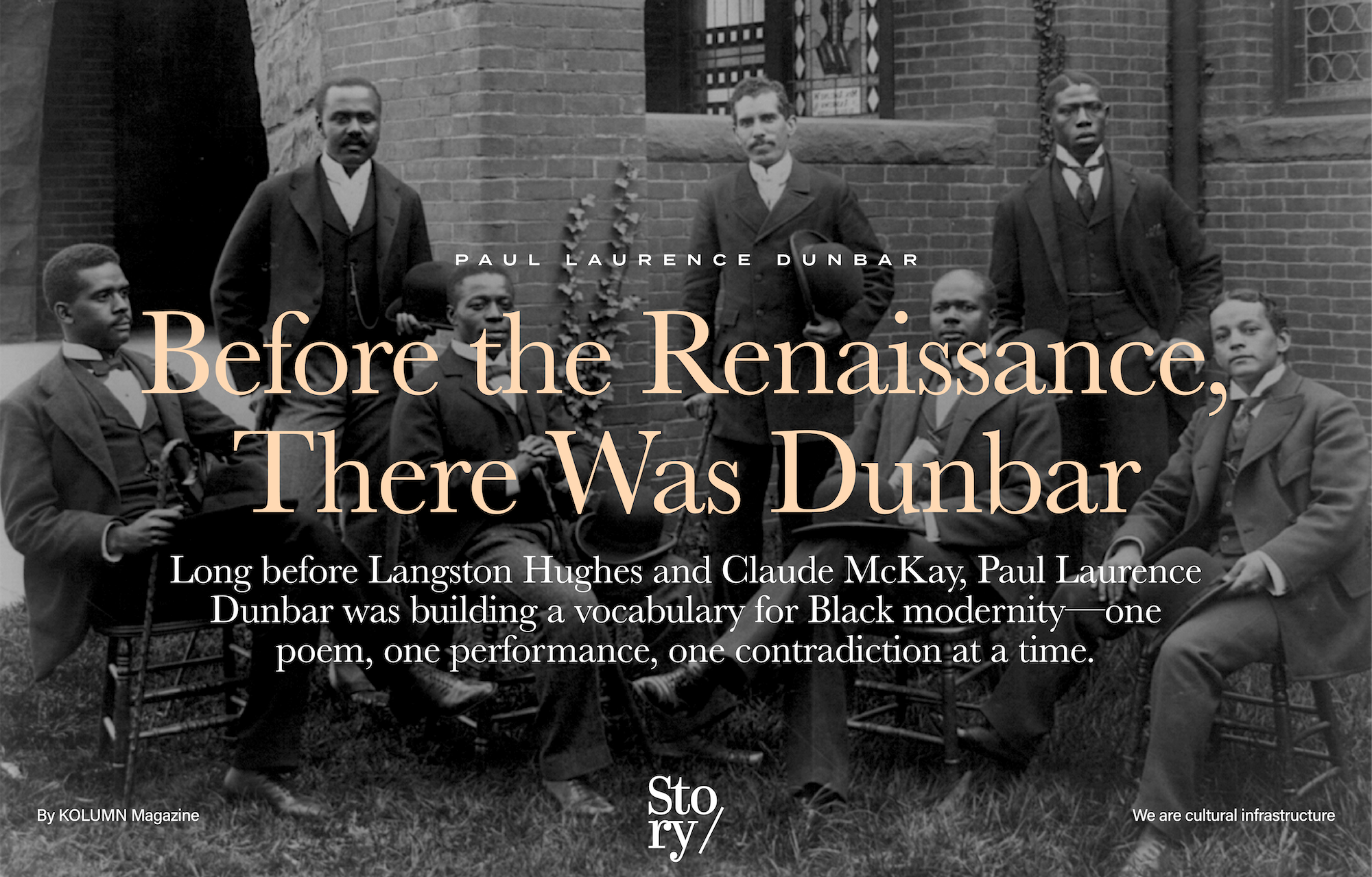
Dunbar did not inherit a literary marketplace. He entered one that barely imagined him and then made it answer.
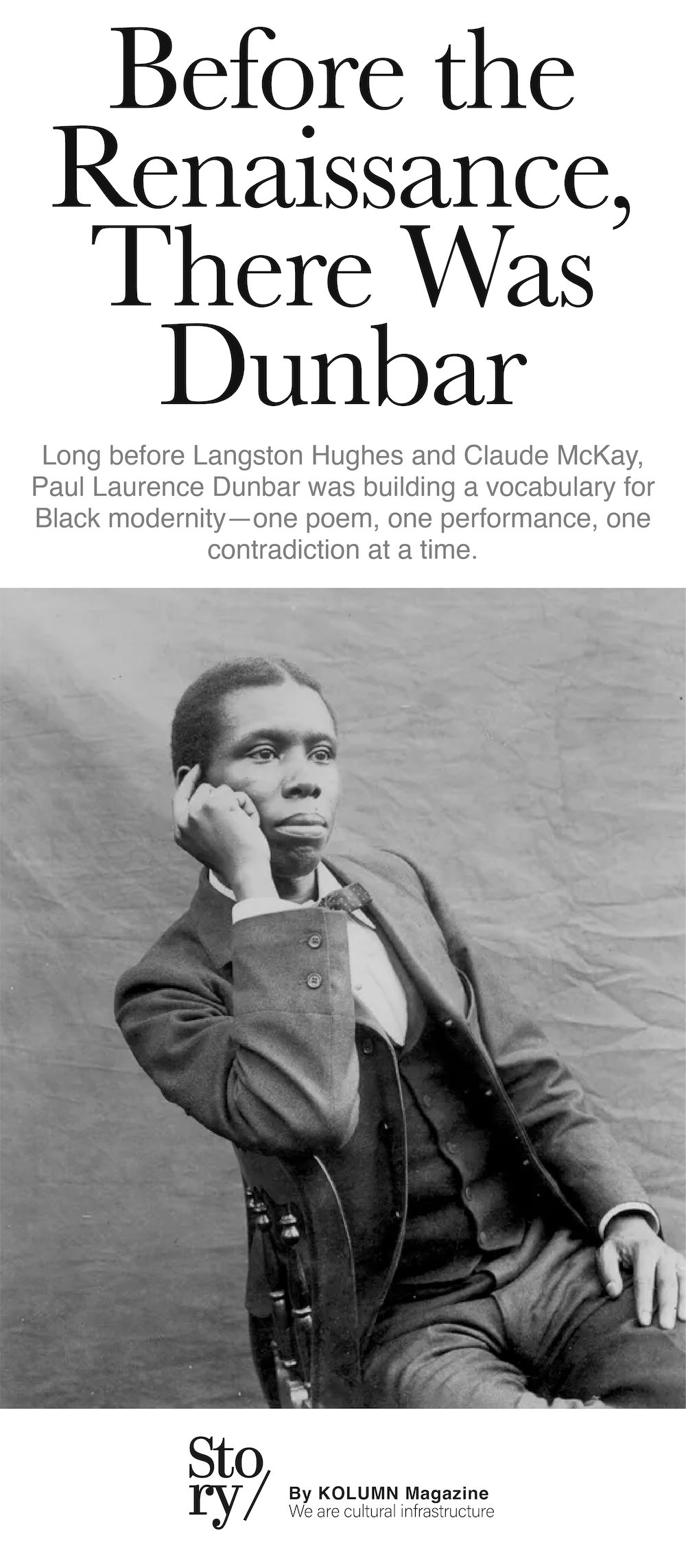
Dunbar did not inherit a literary marketplace. He entered one that barely imagined him and then made it answer.
By KOLUMN Magazine
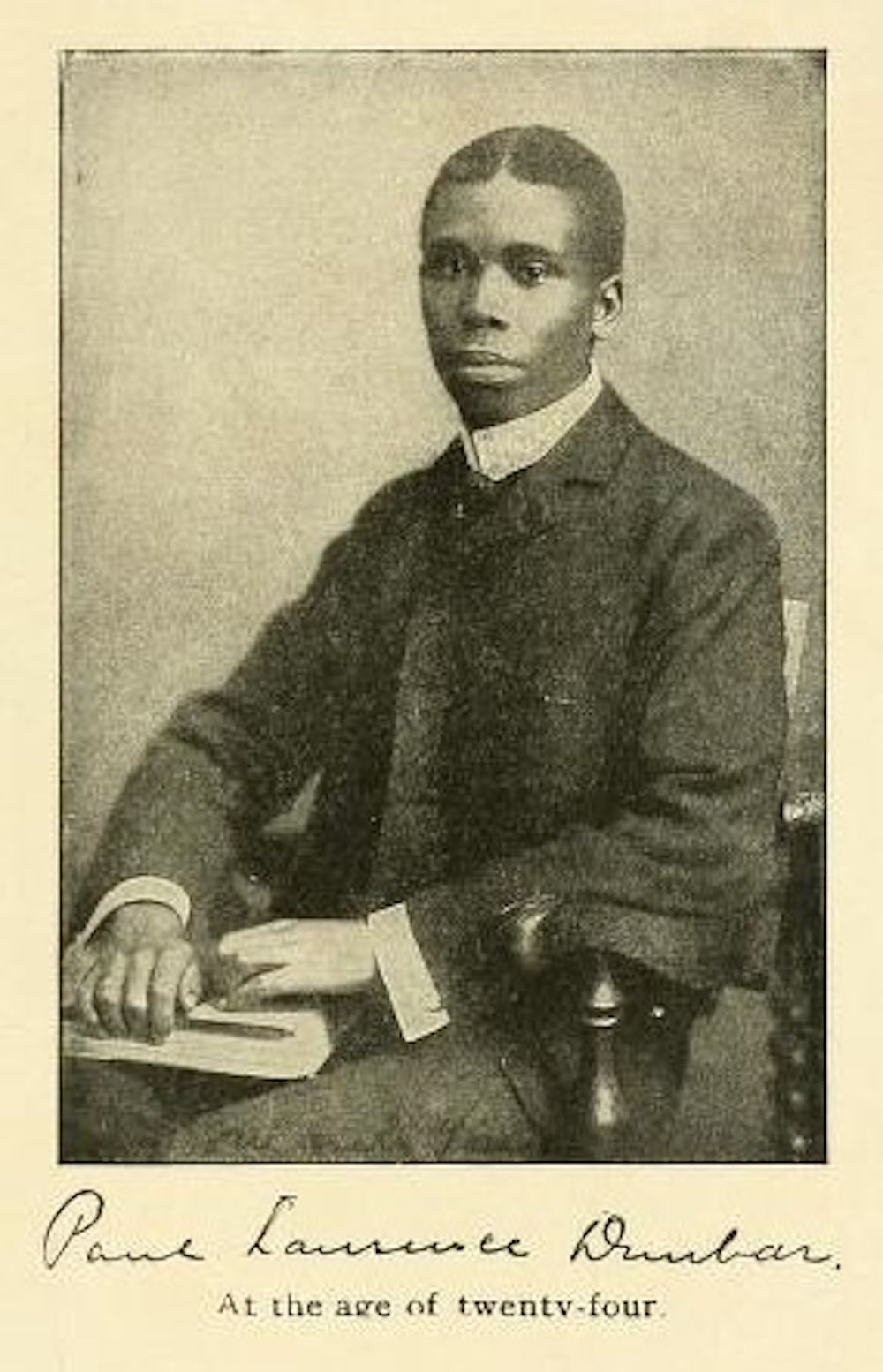
Paul Laurence Dunbar occupies a strange place in American literary history: he is too important to ignore, too often simplified when remembered, and too frequently taught in fragments. Many readers know him through a handful of lines—“We wear the mask,” or “I know why the caged bird sings”—without fully confronting what his life meant in the United States of the late 19th century. He was born in 1872 in Dayton, Ohio, to parents who had been enslaved in Kentucky. He became one of the first Black writers in the United States to win national literary recognition and one of the first to seriously try to live by writing alone. He published poetry, novels, short stories, essays, lyrics, journalism, and dramatic works, and his influence reached well into the Harlem Renaissance and beyond.
That should be enough to secure him a fixed place in the canon. But Dunbar’s importance is not just that he was “first,” though that matters. It is that he was first under conditions designed to make his full humanity illegible. He arrived in print at a moment when the United States had retreated from Reconstruction, when segregation was hardening, when Black aspiration was being monitored, mocked, and commercially managed. Dunbar had extraordinary talent, but talent was never the only issue. He was forced into a set of negotiations that would later confront generations of Black artists: What do you do when the door opens only for the part of your work that flatters the audience’s prejudices? What does success mean when your success depends on a misreading? And how do you keep writing when the public celebration of your voice comes bundled with pressure to perform a narrower version of yourself?
Dunbar’s story matters because it reveals how American literature works at its fault lines. It shows how race shaped not just subject matter but reception, genre, and market access. It shows how a Black writer could be praised and constrained in the same breath. It also shows, with uncommon clarity, that Black literary history did not begin with the Harlem Renaissance. Dunbar helped build the foundation on which it stood. National Park Service materials on his legacy explicitly identify his work as laying groundwork for the Harlem Renaissance, and the Park Service notes that writers such as James Weldon Johnson, Langston Hughes, and Claude McKay were among those influenced by him.
To read Dunbar seriously now is to read a writer who was both enabled and cornered by fame. It is to read someone who understood performance, audience, music, sorrow, and the mechanics of literary survival. And it is to realize that the contradictions often treated as flaws in his career are, in fact, the very reason he remains essential.
A child of freedom’s first generation
Dunbar was born on June 27, 1872, in Dayton, the child of Joshua Dunbar and Matilda Murphy, both formerly enslaved people from Kentucky. The biographical fact is basic, but its significance is easy to understate. Dunbar was not some distant inheritor of slavery’s memory; he was born in its immediate aftermath, inside a household shaped by emancipation’s promises and its betrayals. The Poetry Foundation, the National Park Service, and the University of Dayton all emphasize that his parents had been enslaved, and that his life unfolded just one generation removed from bondage.
That context mattered artistically and psychologically. Dunbar’s work is full of music, longing, wit, tenderness, and irony, but also of historical compression. In his writing, the intimate and the national keep colliding. The domestic scene is never just domestic. The lyric never stays merely personal. That quality did not emerge from abstraction. It came from living in the afterlife of slavery while the country insisted on calling itself free.
He grew up largely with his mother, and he showed literary promise early. In Dayton’s public schools he distinguished himself as a student and writer. He was the only African American in his Central High School class, became president of the literary society, edited the school paper, and served as class poet. By his teen years he was already publishing poems in the Dayton Herald. These details matter not simply as evidence of precocity, but because they show Dunbar mastering formal literary culture from the start. He was not an accidental poet “discovered” in folk speech. He was trained, ambitious, and visibly accomplished in institutions that remained overwhelmingly white.
One of the more famous details from his youth is that Orville Wright was his classmate. Wright did not graduate with Dunbar, but the two are linked through the Dayton Tattler, a short-lived newspaper for Dayton’s Black community that Dunbar edited and Wright printed. The paper lasted only three issues in late 1890, but its brief existence says a lot about Dunbar’s instincts. Before national fame, before the lecture circuits, before the endorsements of major critics, he was already working at the intersection of Black public life, local journalism, and literary ambition.
That’s a useful corrective to the flattened image of Dunbar as merely a gifted poet. He was also a builder. He understood circulation, community readership, and the need for Black platforms. Even in embryo, that anticipates the literary infrastructure later associated with the New Negro era: small publications, cultural networks, self-fashioning, and the constant effort to create venues where Black thought could appear on its own terms.
Talent in a closed marketplace
After high school, Dunbar hoped for college or journalism. But talent does not cancel labor-market racism. The National Park Service notes that money for further schooling was out of reach and that opportunities for a young Black man in Dayton were sharply limited. He worked as an elevator operator in the Callahan Building downtown and also performed other low-status jobs, including dishwashing and janitorial work, while continuing to write in spare moments.
That phase of his life has often been romanticized, as if genius simply glittered nobly in humble surroundings. But there is nothing sentimental about the structure here. Dunbar was confronting the central American contradiction: public rhetoric about merit on one side, racial exclusion on the other. He had credentials, discipline, and visible talent, yet he still had to build a literary career from spaces the culture considered menial.
There is, however, something revealing about the fact that he kept writing. Not casually. Relentlessly. In 1892, after encouragement from a former teacher and favorable attention following an appearance at a writers’ convention in Dayton, he moved toward publication. His first collection, Oak and Ivy, appeared in 1893. He also spent time at the World’s Columbian Exposition in Chicago, where, according to the National Park Service, he received praise from Frederick Douglass. That kind of encouragement mattered. Douglass represented an older tradition of Black public intellectual authority; Dunbar belonged to a younger generation trying to secure literary modernity in an increasingly segregated national culture.
This is the part of Dunbar’s career that deserves more admiration than it usually gets. He did not emerge from a benevolent system. He forced himself into notice through persistence, self-publication, networking, performance, and a disciplined belief that writing could become a profession. Verite News, reprinting a scholarly essay by University of Dayton professor Minnita Daniel-Cox, describes him as the first Black American to make a living as a writer. Even if one qualifies that claim in historical terms, the broader point holds: Dunbar was among the earliest Black writers to achieve national prominence and attempt literary self-sufficiency on a sustained basis.
The breakthrough, and the trap inside it
Dunbar’s major break came when William Dean Howells, one of the most influential literary critics in the country, praised his work. Sources differ slightly in how they summarize the sequence, but the broad outline is consistent: Majors and Minors brought him to wider notice, Howells’s 1896 review transformed his reputation, and Lyrics of Lowly Life helped establish him nationally. The Poetry Foundation identifies Majors and Minors and Lyrics of Lowly Life as landmark collections, while the National Park Service states directly that Howells’s review brought Dunbar national acclaim and strong sales.
This was the blessing. The trap was embedded inside the blessing.
Howells admired Dunbar, but he also helped fix the terms on which much of white literary America would read him. Dunbar’s dialect verse—musical, dramatic, often brilliant—became the mode most associated with his name. Yet the Poetry Foundation notes that dialect poems made up only a small portion of his overall output. He wrote extensively in standard English as well, and across genres. The narrowing of his public image was therefore not simply a reflection of what he wrote most. It was a reflection of what the market most wanted from a Black writer.
This point is crucial. Dunbar was not “just” a dialect poet. He was a formalist, a lyric poet, a satirist, a fiction writer, a dramatist, and a literary experimenter. National Park Service materials on his legacy stress exactly that breadth, noting that he wrote poems, novels, newspaper articles, lyrics, short stories, operettas, ballads, and orations.
But audiences, especially white ones, often preferred the Dunbar they thought confirmed a usable Black authenticity. Dialect could be heard as intimacy, rhythm, and cultural specificity. It could also be consumed as spectacle. That double condition followed Dunbar throughout his career. The work that helped make him famous also risked reducing him to a racial type in the eyes of the very public that celebrated him.
A 1978 Washington Post article about Dunbar criticism captures the persistence of that debate. It cites Black Arts scholar Addison Gayle arguing that Dunbar’s contradictions should not be apologized away but understood as part of a fuller human and artistic reality. The fact that such a debate remained alive decades later tells you how unresolved his place has remained: was he compromised by audience demand, strategically adaptive, internally divided, or all three at once? The honest answer is probably the last one.
That does not diminish him. It makes him modern.
Beyond dialect, beyond the classroom anthology
The persistence of Dunbar’s reputation often depends on two or three anthologized poems. “We Wear the Mask” survives because it is devastatingly concise. “Sympathy” survives because of the image of the caged bird. But reducing Dunbar to isolated classroom excerpts has obscured the larger architecture of his work.
The Poetry Foundation stresses that his literary body as a whole offers an impressive representation of Black life in the turn-of-the-century United States. The National Park Service goes further, arguing that he tried to place the African American experience, in its diversity, before a broad audience and that his writing consistently sought to show Black people as thoughtful, creative human beings rather than stereotypes.
That ambition is easy to miss if one encounters Dunbar only as a poet of quotable lines. He was trying to widen representation itself. His project was not merely to write “good poems”; it was to alter what counted as worthy subject matter, who counted as fully human in print, and how Black interiority could appear in American literature.
This is one reason “We Wear the Mask” continues to feel uncannily contemporary. The poem is frequently read as a meditation on performance under racial duress, and that reading has only become more resonant over time. The Atlantic, in a 2014 essay on Black life in America, invoked Dunbar’s line precisely because it still functions as a shorthand for the emotional labor of surviving a racist society. That does not mean the poem belongs only to one era. It means Dunbar named something structural.
Likewise, “Sympathy” became larger than its original publication life. The Library of Congress notes that the line “I know why the caged bird sings” from the poem was later borrowed by Maya Angelou for her memoir’s title. That afterlife is not incidental. It shows Dunbar transmitting a metaphor across generations, one capable of holding pain, aspiration, captivity, and song all at once.
And yet, even here, one has to resist simplification. Dunbar was not simply a poet of suffering. There is play in his work, and laughter, and courtliness, and sharp observation. He wrote love poems, children’s verse, regional pieces, narrative sketches, and social critiques. To keep returning only to the most emblematic lines is to risk turning Dunbar into a symbol when he spent his career insisting on multiplicity.
London, Washington, and the strain of literary celebrity
Fame expanded his world, but it did not stabilize it. After his rise, Dunbar toured the United States and Great Britain, giving public readings. The Library of Congress and National Park Service both indicate that the England trip, though prestigious, was financially disappointing. He returned in need of work, and through the help of the famous orator Robert Ingersoll, secured a position at the Library of Congress in 1897. There he worked as an attendant, retrieving and reshelving medical and scientific volumes in the building’s musty stacks.
This is one of the bitterer ironies in his biography: a nationally acclaimed writer, still needing institutional employment, shelved inside a system that could honor his talent symbolically while burdening him materially. The Library of Congress notes that he also became the first poet to give a reading in the new building, in the Reading Room for the Blind. So even within that period, there was recognition. But recognition and relief are not the same thing.
The Library’s dust and working conditions have often been linked to the deterioration of his health. National Park Service materials say that he left the job in 1898, and that in 1899 he was diagnosed with tuberculosis. The strain of illness would define the remaining years of his life.
It is hard not to see “Sympathy” differently in that context. The Library of Congress blog carefully notes that the “caged bird” is often assumed to come from his earlier elevator-operator days, but it also frames the metaphor in relation to the confinement and exhaustion of his Library employment. One should be careful not to overdetermine art biographically; poems are not case files. Still, the convergence is suggestive. Dunbar knew enclosure not as metaphor first, but as lived pressure.
Love, marriage, and fracture
In 1898 Dunbar married Alice Ruth Moore, a writer and teacher from New Orleans. Their courtship had unfolded largely through letters, and the marriage seemed, at least on paper, like a brilliant union of literary minds. National Park Service materials describe the engagement as stormy and note that the couple eloped in New York on March 6, 1898. They had no children. By 1902, the marriage had ended.
There is a temptation in literary biography to turn marital breakdown into easy narrative symbolism—the poet undone by fame, illness, and inner conflict. Reality is usually more stubborn than that. What can be said with confidence is that the years after marriage brought worsening health, professional strain, and personal instability. Dunbar resigned from the Library, wrote full time, but increasingly faced the combined pressures of sickness and disillusionment.
Alice Moore Dunbar would go on to become an important figure in her own right—writer, activist, teacher—and the marriage has drawn scholarly attention not simply because it failed, but because it joined two ambitious Black intellectuals trying to build lives under punishing historical conditions. That matters for how we understand Dunbar. He was not isolated genius floating above the world. He was part of a Black literary network, a relational world of correspondence, publication, aspiration, and argument.
Even his most solitary-seeming poems emerge from that world. Dunbar’s voice often feels singular because he compressed communal pressures into intimate forms. But the community was always there: readers, critics, friends, rivals, editors, family, and the racial state hovering over all of it.
Illness, return, and the final years
Tuberculosis altered the remainder of Dunbar’s life. The National Park Service states that he was diagnosed in 1899, separated from Alice in 1902, briefly lived in Chicago with his mother, then returned to Dayton, where he and Matilda purchased a house on Summit Street in 1904. He wrote there until his death on February 9, 1906, at just 33 years old. He was buried in Woodland Cemetery in Dayton.
There is a tendency, when writing about short-lived artists, to speak in register of the tragic: brief, brilliant, doomed. Dunbar’s life certainly permits that language. But it can also distort. He did not simply burn out. He worked. He continued producing. He kept trying to make a literary life under increasingly adverse conditions. The final years were not just a fade; they were a continuation, though under siege.
His last home later became a historic site of major significance. The National Park Service notes that it was the first home of a public memorial to an African American. After Matilda Dunbar’s death in 1934, Ohio purchased the property, furnishings, and belongings and turned the house into a memorial and museum. That preservation history is itself telling. Communities understood, even when mainstream literary culture sometimes lagged, that Dunbar’s life represented something foundational.
What did they understand? Not only that he had been famous. Plenty of famous writers fade. They understood that Dunbar had come to symbolize a larger Black struggle for authorship, memory, and public dignity. He had made a claim on the national imagination, and preserving his home meant preserving evidence that such a claim had been made at all.
“Dunbar’s life was short. His problem was not smallness. It was compression.”
The politics of reception
One of the most revealing things about Dunbar is not just what he wrote, but how people keep arguing about him. Writers who generate no friction usually do not matter very much. Dunbar matters because every serious reading of him must confront a tension: how should one understand his use of dialect in a racist market that rewarded certain forms of Blackness more than others?
The simplest answer—that he was merely catering to white taste—is too crude. The opposite answer—that dialect poems were only emancipatory folk expression—is also too neat. Dunbar was doing more difficult work than either account allows. He was writing within and against expectation. He was using the materials available to him, including Black speech traditions, performance, humor, and lyric craft, while also trying to resist being sealed inside the category those materials created for white audiences.
National Park Service materials on his legacy say he became known for dialect, but that his talent could not be confined there. That wording is useful because it avoids both dismissal and romanticization. Dunbar did not stumble into dialect accidentally, and he was not simply imprisoned by it. He used it artfully. But he also knew it could become a cage built from applause.
That is why his standard-English poems often feel like arguments for dimensionality. They are not departures from his “real” voice. They are part of it. To speak of Dunbar as if he had one authentic register is to misunderstand his historical situation and his craft. Code-switching, tonal variation, formal adaptation—these were not side issues. They were the conditions of authorship.
The afterlife of his reputation has repeated the same narrowing he struggled against in life. School curricula often made him the poet of two or three anthologized pieces. Popular memory often treated him as a precursor, admirable but surpassed, useful mainly for getting to Hughes or Angelou. That framing misses the point. Dunbar is not important because later figures improved upon him. He is important because later figures inherited a field he helped open.
Before Harlem had a vocabulary, Dunbar was already there
The historical claim that Dunbar helped set the stage for the Harlem Renaissance is not mere ceremonial praise. The National Park Service says so directly, and its biographical materials name James Weldon Johnson, Langston Hughes, and Claude McKay among the writers his poetry influenced. Britannica’s overview of African American literature also notes that Hughes admired Dunbar, even as Hughes would later move toward freer verse and a different poetics.
This influence matters on more than a genealogical level. Dunbar helped establish that Black literary production could be nationally visible, formally serious, commercially viable, and historically consequential. He also dramatized the costs of that visibility. Later Black writers inherited both halves of the lesson. They inherited possibility and warning.
Langston Hughes, for example, could write in the 1920s with a different sense of collective movement because earlier figures like Dunbar had already battled for legibility. Claude McKay could publish militant sonnets in a literary public already somewhat more prepared to recognize Black authorship as literature rather than curiosity. James Weldon Johnson could think expansively about Black song, speech, and art in a field Dunbar had already pressured into motion.
And the influence did not stop there. Through “Sympathy,” Dunbar entered Maya Angelou’s autobiographical lexicon. Through “We Wear the Mask,” he remains present in discussions of race, public performance, and psychic survival. Through the sheer breadth of his work, he remains a corrective to any literary history that acts as though Black innovation arrived suddenly in the 1920s, fully formed, in Harlem.
Why he still feels current
Dunbar feels current not because he wrote “timelessly,” a word critics often use when they want to avoid history. He feels current because the structures he confronted are not finished with us. The pressure to perform identity legibly for dominant audiences did not end with him. The market’s appetite for selective authenticity did not end with him. The gap between acclaim and control did not end with him. Neither did the emotional taxation of having to translate oneself inside unequal institutions.
Read that way, Dunbar looks less like a quaint forerunner and more like a writer of the American present.
He also remains current because he was not aesthetically narrow. The record shows a writer working across forms and publics. Poetry Foundation emphasizes the range of his output. The National Park Service calls him an experimenter and innovator. That language matters because it restores movement to a writer too often frozen into emblem.
There is also something unmistakably modern in his compression of public and private feeling. Dunbar could write from the position of a representative figure—“poet laureate of his people,” as he was sometimes called—while still making room for fatigue, bitterness, ambition, pleasure, and doubt. He was a public Black intellectual before that phrase was common, and he understood that public representation is both honor and burden.
If he sometimes seems difficult to pin down, that is because he refused, even when pushed, to remain one thing. The canon tends to like neat figures: rebel, traditionalist, folk poet, genteel poet, victim, pioneer. Dunbar frustrates those boxes. Good. So did life.
The significance of Paul Laurence Dunbar
So what, finally, is Dunbar’s significance?
He was one of the first major Black American literary celebrities, and one of the first to test whether writing could sustain a Black professional life in the national marketplace.
He broadened the possibilities of Black representation in literature, writing not only poetry but fiction, journalism, drama, lyrics, and essays, and insisting—through the work itself—that Black life contained as much tonal and formal variety as any other subject in American letters.
He exposed the racial politics of reception. The very terms of his success showed how white critical approval could elevate a Black artist while also narrowing him. His career remains one of the clearest case studies in the mixed economy of recognition and distortion.
He laid groundwork for what came next. His influence on the Harlem Renaissance is not honorary language attached after the fact; institutions and literary histories alike trace lines from Dunbar to Johnson, Hughes, and McKay.
And he left the culture with metaphors that endured because they were structurally true. The mask. The caged bird. These are not merely memorable images. They are frameworks for understanding the psychic and artistic costs of constraint.
Paul Laurence Dunbar died in 1906, young enough that American literary history is always tempted to speak of what he might have become. But that frame can accidentally minimize what he already was. He was already major. Already formative. Already doing the hard, often unrewarded work of making Black literary genius visible inside a nation determined to mistranslate it.
His life was brief. His significance was not.
And maybe that is the most useful way to end with Dunbar: not as a prelude, not as a footnote before bigger names, and not as a saint of premature loss. He should be read as a central figure in the making of American literature—one who understood, earlier than most, that art in this country is never just art. It is audience, race, commerce, pressure, misreading, ambition, and survival. Dunbar wrote from inside all of that. He made beauty there. He made argument there. He made room.
That room is one reason so many others could enter after him.
More great stories
Afro Sheen, Wall Street, and the Architecture of Black Possibility
July 6, 2026
No Comments
The Fire Inside the Fourth
July 5, 2026
No Comments