



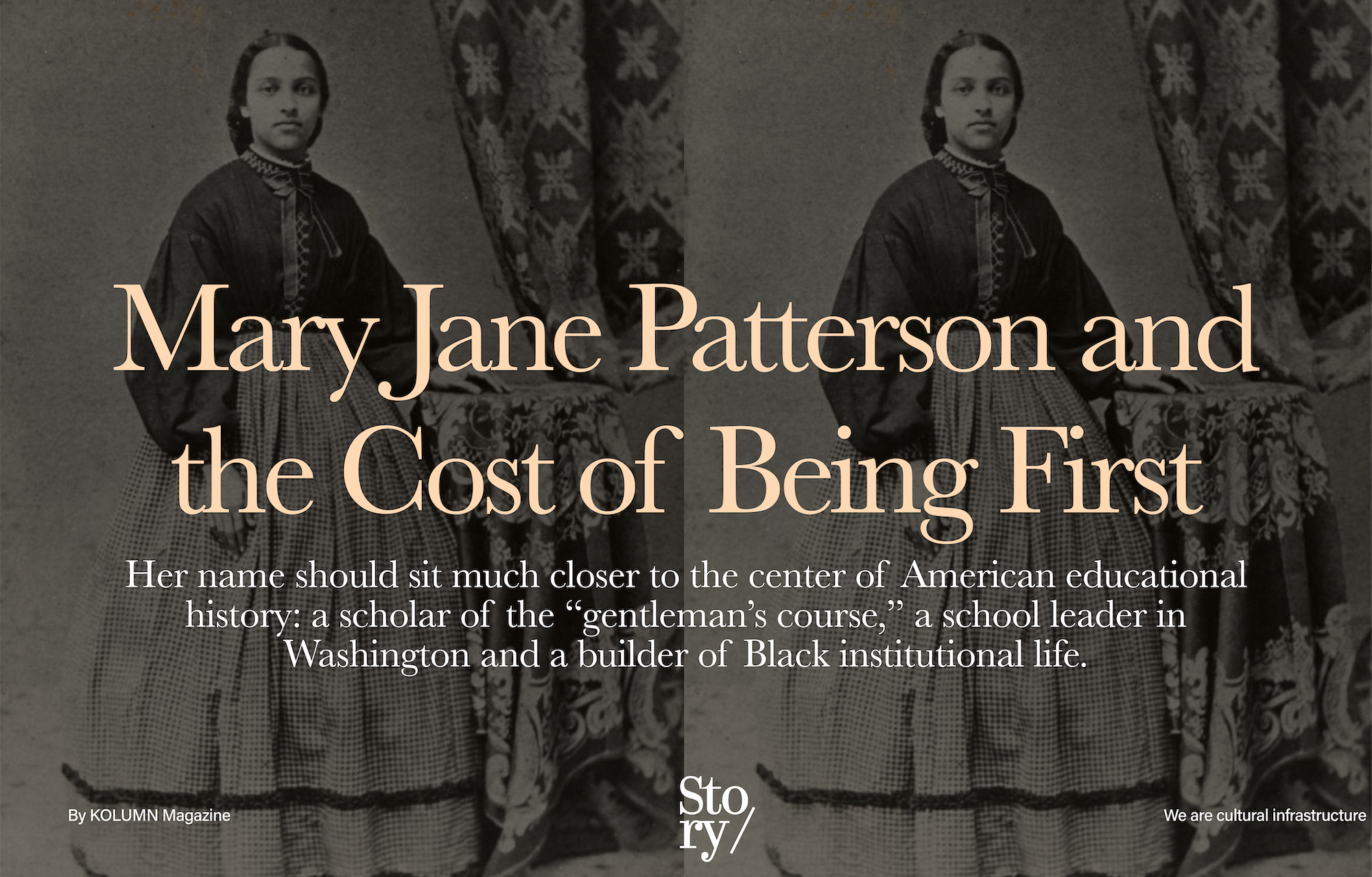
Mary Jane Patterson did not settle for admission. She insisted on the full weight of education.
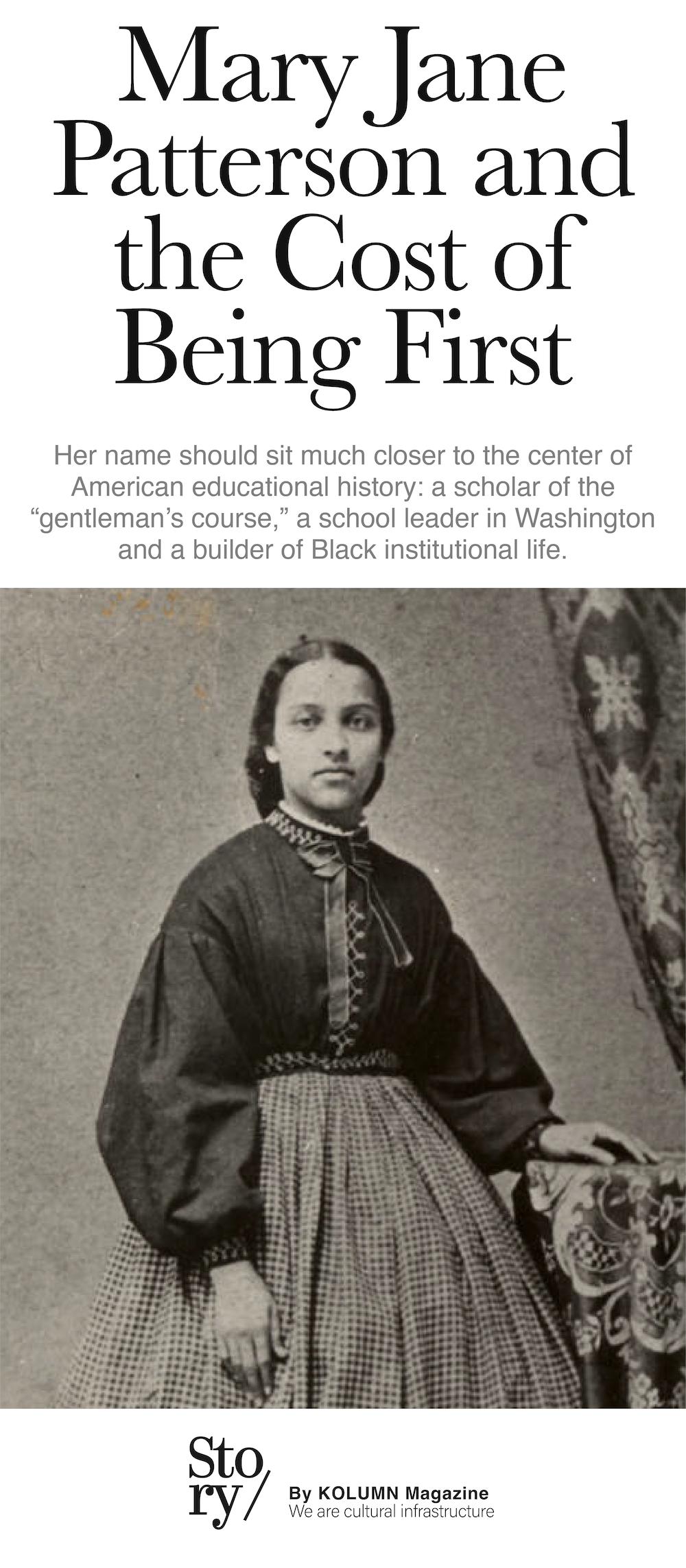
Mary Jane Patterson did not settle for admission. She insisted on the full weight of education.
By KOLUMN Magazine
There are some figures in American history whose importance is obvious the instant you say their names. There are others whose influence is so foundational that it gets mistaken for background architecture, as if what they did simply appeared by natural progression rather than by nerve, labor and insistence. Mary Jane Patterson belongs to the second group. She is most often introduced as the first Black woman in the United States known to receive a bachelor’s degree, which she earned from Oberlin College in 1862. That distinction is real, historic and worth holding onto. But if that is all we say about her, we miss the larger story. Patterson was not only a symbolic pioneer. She was a serious scholar, a disciplined educator, a school builder and a Black woman who converted personal attainment into institutional consequence.
Her life sits at the intersection of several American tensions that still feel current: who gets to be educated, what kind of education is considered proper for women, whether Black excellence is welcomed only as exception or supported as norm, and how quickly the labor of Black women can be minimized even when institutions depend on it. Patterson’s story reaches from antebellum North Carolina to abolitionist Ohio, from Civil War-era study to postwar teaching, from the classroom to the principal’s office in Washington, D.C. It also reaches into Black women’s club activism and the long campaign to make education not merely accessible to Black Americans, but rigorous enough to be liberating.
What makes Patterson especially compelling is that she did not simply ask to be included. She chose the most demanding available path. At Oberlin, where women could pursue a shorter ladies’ course, she instead entered the four-year classical program known as the “gentleman’s course,” studying subjects such as Latin, Greek and mathematics in a period when women were actively discouraged from precisely that kind of intellectual training. She graduated with high honors. That choice matters because it reveals something essential about Patterson’s character: she was not interested in symbolic permission where substantive equality was still being withheld.
If Patterson were more widely remembered, it might be because American culture tends to celebrate “firsts” only at the moment they happen, then file them away once the ceremony is over. But firsts are not self-executing. They do not automatically transform institutions. Someone has to remain in the room and force the future to become ordinary. Patterson did that through teaching, administration and civic work. Her career at the Preparatory High School for Colored Youth in Washington, later known as M Street High School and eventually Dunbar High School, helped shape one of the most important traditions in Black public education in the country. Under her administration, enrollment rose, the school’s profile expanded, commencements began, and a teacher-training department was added. That is not a side note to her college achievement. It is the fulfillment of it.
The world she entered was built to narrow her future
Mary Jane Patterson was born in North Carolina in 1840. Much about her early life remains difficult to pin down with total precision, which is itself a reminder of how uneven the historical record can be when it comes to Black women of the nineteenth century. Scholars and institutional histories agree on the broad outlines: she was born in Raleigh, her family eventually relocated to Oberlin, Ohio, and her life began under the long shadow of slavery, even as accounts differ over whether she herself was born enslaved or into a family already moving toward freedom. That uncertainty should not be treated as a flaw in the story. It is part of the story. Black life in that era was routinely documented in fragments, especially when the subject was a girl who had not yet done something the broader country considered remarkable.
What is clearer is the world the Patterson family entered in Ohio. Oberlin was unusual. The town and college had strong abolitionist commitments, the college admitted Black students beginning in 1835, and it became a rare place where race and gender barriers were challenged earlier than in most American institutions. Britannica notes that Oberlin admitted Black students on equal footing with white students beginning in 1835, and the Smithsonian points to the college as an early site of both coeducation and Black higher learning. None of this made Oberlin an egalitarian utopia; institutions can be progressive by nineteenth-century standards and still reproduce hierarchy. But it did create conditions in which a student like Patterson could imagine something most of the country would have dismissed outright.
That context matters because Patterson’s ascent was not a miracle detached from place. It was the product of talent meeting a narrow but real opening. Even then, the opening was partial. Oberlin’s willingness to admit women did not mean it viewed them as suited for the full range of intellectual life. Women had access to a two-year ladies’ course, while the four-year baccalaureate program remained coded as masculine. Patterson’s decision to take the “gentleman’s course” was therefore not simply ambitious. It was adversarial in the most disciplined sense. She was using the institution’s own structure to expose the arbitrariness of the limits it placed on women.
The line often recalled from later Oberlin graduate Fanny Jackson Coppin gets at the atmosphere Patterson was pushing against. The harder course, Coppin remembered, was not forbidden to women, but “they did not advise it.” That phrasing says a great deal about the mechanics of exclusion in higher education. Formal rules were only part of the barrier. Discouragement, redirected expectations and culturally enforced modesty did the rest. Patterson’s achievement was not just that she survived a demanding curriculum. It was that she refused to internalize the warning hidden inside institutional advice.
The degree was historic, but the choice behind it was even more radical
In 1862, Patterson graduated from Oberlin with a Bachelor of Arts and high honors, becoming the first Black woman in the United States known to earn that degree. That sentence is the reason her name survives in reference books and Black history observances. It deserves repetition. But its full significance only comes into focus when we remember what a bachelor’s degree meant at the time. This was not a loose credential or a ceremonial marker. It was entry into a realm of classical and formal learning that American institutions had long treated as a preserve of white men. To earn that degree as a Black woman in the middle of the Civil War was to perform a kind of public contradiction. Patterson’s very presence on that commencement stage challenged the racial, gendered and intellectual assumptions of the country around her.
TIME reports that Patterson delivered a graduation address on the revolutionary Giuseppe Garibaldi, which is an evocative detail because it hints at the breadth of her education and the global scope of her intellectual world. She was not being trained merely to become respectable. She was being formed inside a curriculum that assumed the student could think historically, politically and comparatively. For a Black woman in 1862, that was not just uncommon. It was insurgent.
There is, however, an important nuance in the language around Patterson as “the first.” Historians have pointed to earlier Black women whose educational achievements complicate any clean, singular narrative. Lucy Stanton Day Sessions, also of Oberlin, completed a course of study before Patterson but did not receive a bachelor’s degree because the women’s curriculum at the time led to a different credential. Scholars have also discussed Grace A. Mapps, who graduated from a four-year college in New York in 1852, though the exact nature of her degree is not entirely clear in the surviving record. That historical complexity does not diminish Patterson. It actually places her within a larger genealogy of Black women who pressed against the gates of higher learning before the nation was prepared to see them clearly.
And that genealogy matters because Patterson’s life is too often flattened into a neat plaque inscription: first Black woman, Oberlin, 1862. A more accurate reading is that she was one of a small number of Black women in the mid-nineteenth century forcing American education to reckon with its own contradictions. She was part of a vanguard, but she also became an especially legible symbol because the bachelor’s degree carried recognizable institutional weight. In other words, Patterson’s “firstness” was both individual and structural. She did something singular, and she did it in a form the nation could not easily explain away.
She turned scholarship into service, and service into leadership
After graduation, Patterson did what many of the most consequential Black educators of the nineteenth century did: she taught. That may sound straightforward now, but in the decades around the Civil War, Black teaching was nation-building work. Education was one of the central terrains on which freedom would either expand or be denied meaning. Patterson taught in Ohio, sought an appointment in Virginia, and then worked at Philadelphia’s Institute for Colored Youth, a major institution in Black education that later became Cheyney University. Her movement across these spaces suggests a life shaped by mission as much as employment. She was not collecting titles. She was going where Black education needed labor.
A surviving recommendation letter, quoted by TIME, described her as “a superior scholar” and praised her teaching ability. The language of that recommendation is revealing in ways both admirable and uncomfortable. It recognizes her excellence while also trapping her inside the paternal vocabulary of the period. Patterson had to be presented not only as capable but as respectable, refined and worthy of what could be paid “to ladies.” This was how institutions filtered merit through gendered and racialized expectations. Even praise carried a narrowing frame. Patterson’s career unfolded in spite of that frame, not because of it.
By 1869, she had moved to Washington, D.C., to teach at the Preparatory High School for Colored Youth, the first public high school for Black students in the United States. That school would become one of the crown jewels of Black public education, later known as M Street High School and then Paul Laurence Dunbar High School. Patterson served there as teacher, assistant principal and principal. According to institutional and reference accounts, she became the school’s first Black principal in 1871, served, was displaced for a period, then returned to lead again from 1873 to 1884. The pattern is familiar in American institutional life: Black women build, stabilize and elevate an organization, only to be told at moments of maturity that leadership now requires male authority. Patterson lived that pattern in real time.
Her displacement was not a verdict on her competence. It was a verdict on the gender politics of leadership. TIME notes that she was demoted in favor of Richard Theodore Greener, the first Black graduate of Harvard, and later stepped down again when the school’s administrators decided a growing institution should have a man in charge. That rationale is devastating in its plainness. Patterson had already proven that she could build a thriving school. What she could not overcome was the enduring belief, shared even within progressive Black educational circles, that authority looked more legitimate in male form.
Yet what stands out in Patterson’s story is not only that she endured those indignities. It is that she continued the work. She remained at the school as a teacher until her death in 1894. There is something morally clarifying about that. She was not at Dunbar for prestige alone. She was there because the school mattered, the students mattered and Black educational uplift required people willing to subordinate ego to institution without surrendering standards.
At Dunbar, she helped define what excellence could look like in Black public education
The record of Patterson’s administration is one of the strongest arguments for restoring her to the center of educational history. During her years leading the school, its enrollment reportedly rose from fewer than 50 students to 172. The school dropped the more tentative “Preparatory” framing, began holding high school commencements and added a normal, or teacher-training, department. Those are not cosmetic changes. They indicate a maturing institution moving from provisional existence to durable status. Patterson helped transform a school for Black youth into a school with ambition, identity and a pipeline into professional life.
This is where her significance moves beyond inspiration and into administration. American memory often handles Black women pioneers sentimentally, as if their main contribution were courage. Patterson was courageous, yes, but she was also managerial, pedagogical and exacting. Mary Church Terrell later described her as a woman of “strong, forceful personality” who helped establish “high intellectual standards in the public schools.” Another source preserves Terrell’s fuller appraisal: Patterson was thorough, quick, alert, vivacious and indefatigable. Those are the words of someone remembered not just as first, but as formidable.
The emphasis on standards is especially important. In the post-Emancipation era, Black schools were often judged by a white public ready to see any imperfection as proof that Black education itself was misguided. Black educators therefore faced a brutal double burden: they had to educate students under unequal conditions while also making the institution legible as excellent to hostile observers. Patterson appears to have understood this clearly. Her commitment to rigor was not elitism detached from the needs of her community. It was a protective strategy and a freedom strategy at once. To insist on intellectual seriousness for Black students was to reject the idea that they were fit only for partial citizenship.
There is also a longer institutional story here. Dunbar would become famous in the twentieth century for producing generations of Black intellectual, professional and civic leadership. Patterson did not singlehandedly create that tradition, but she helped lay its foundation. When later historians celebrate Dunbar as a model of Black educational excellence, they are describing a school culture shaped in part by the standards Patterson helped establish in its early years. The ladder of achievement associated with the school did not emerge spontaneously. It was built by educators who understood that curriculum, ceremony, teacher preparation and expectations all mattered.
She understood that Black women’s advancement required institutions beyond the schoolhouse
Patterson’s work did not stop at formal education. In Washington, she also became active in civic and reform efforts that widened the infrastructure of Black uplift. Ohio State’s Mary Jane Legacy Project notes that she was a founding member of the Colored Woman’s League in Washington in 1892. Reference accounts and later histories connect her to a circle that included Mary Church Terrell, Anna Julia Cooper and other major Black women intellectuals and activists. This places Patterson within the emerging Black women’s club movement, one of the most important sites of political and social organization in the late nineteenth century.
That involvement makes perfect sense when you consider the arc of her career. Patterson had spent decades in classrooms and school leadership. She knew, by experience, that education alone could not solve the conditions constraining Black life. Black women needed institutions, networks, advocacy and practical support. The Colored Woman’s League was part of that broader project of racial uplift, mutual aid and gendered public leadership. If Patterson’s college achievement announced that Black women could claim higher learning, her later organizing helped assert that Black women also had the right to shape public life.
Her obituary, as preserved in later reference works, noted that she supported the Home for the Aged and Infirm Colored People in Washington and devoted time and money to helping form and sustain an industrial school for Black girls. Those details are easy to glide past, but they reveal a pattern. Patterson’s understanding of education was expansive. It included formal schooling, vocational support, institutional care and intergenerational responsibility. She was not thinking only about exceptional students who could follow her to college. She was thinking about Black community survival in a larger sense.
This is one reason Patterson deserves to be remembered not only as an educational pioneer but as a Black feminist precursor, even if that was not the vocabulary of her moment. Her life tracked a set of linked commitments: Black intellectual seriousness, women’s advancement, institutional leadership and community care. She moved through each of those areas without grand self-branding. That is part of why her name has not traveled as widely as it should have. She was doing the kind of labor that often gets folded into the achievements of the institutions she served.
Why her name still feels less famous than it should
There is a revealing contradiction in how America remembers Mary Jane Patterson. On paper, she is the holder of an extraordinary distinction. In practice, she remains far less publicly known than many people whose achievements were narrower or less structurally important. Some of that has to do with the fate of educators in public memory. We tend to celebrate charismatic movement leaders, artists, inventors and elected officials more readily than school builders. Education is one of those fields whose deepest impact can be hard to dramatize, because it unfolds in habits, expectations and generations rather than in one spectacular event.
But part of the problem is more specific. Patterson was a Black woman whose most famous achievement took place inside an institution not built for people like her, and whose later career involved strengthening Black institutions rather than chasing individual celebrity. That combination makes for historically essential work and commercially inconvenient memory. She does not fit neatly into a single national myth. She was not merely a victim overcoming odds, nor merely a solitary genius, nor merely a reformer with a single cause. She was a systems person before that language existed. She studied inside one institution, built another and helped nourish still others.
There is also the persistent issue of Black women’s labor being archived thinly and narrated modestly. Much of what survives about Patterson comes through institutional histories, educational reference works and later commemorative projects rather than a thick public archive of her own speeches or personal papers. That scarcity can make her seem distant. But distance should not be confused with insignificance. In fact, one of the clearest lessons of Patterson’s life is that the American archive is often a poor measure of Black women’s importance.
What Mary Jane Patterson means now
To read Patterson’s life in the present is to see more than a historical milestone. It is to encounter a theory of education. She believed, through action more than slogan, that Black students deserved the most serious training available; that Black schools should not be judged as makeshift holding spaces but built as engines of excellence; that women should not accept a watered-down curriculum when the fuller one existed; and that educational advancement had to be connected to broader forms of institution building and civic care. Those ideas are not old. They are still contested.
Her life also sharpens the contemporary conversation about representation. Patterson’s story is a reminder that “being the first” is a beginning, not a conclusion. Access without authority is fragile. Authority without institutional support is precarious. Institutional support without memory can still leave a pioneer strangely invisible. Patterson experienced all three realities. She entered the space, led within it, strengthened it and was still left too close to the margins of popular history.
And yet her legacy persists. It persists every time Black educational history is told honestly enough to include the women who built its standards. It persists in the lineage connecting Oberlin, the Institute for Colored Youth, M Street and Dunbar. It persists in the tradition of Black women who understood that intellect and administration belong together. It persists in the fact that a degree earned in 1862 still has interpretive power now, not because it was rare, but because Patterson made clear what such a degree could be used for. She did not treat education as personal escape. She treated it as public obligation.
Mary Jane Patterson died in Washington, D.C., on September 24, 1894, at age 54. By then, she had spent decades giving Black students access to the kind of demanding, future-making education she herself had fought to receive. If her name still does not circulate as widely as it should, that is not because the legacy is small. It is because the country still has trouble measuring the women who build the future quietly, systematically and without waiting for permission. Patterson should be remembered as more than a first. She should be remembered as an architect of Black educational possibility.
More great stories
Afro Sheen, Wall Street, and the Architecture of Black Possibility
July 6, 2026
No Comments
The Fire Inside the Fourth
July 5, 2026
No Comments