




Native Son did not ask readers to admire America. It asked them to confront what America had made.
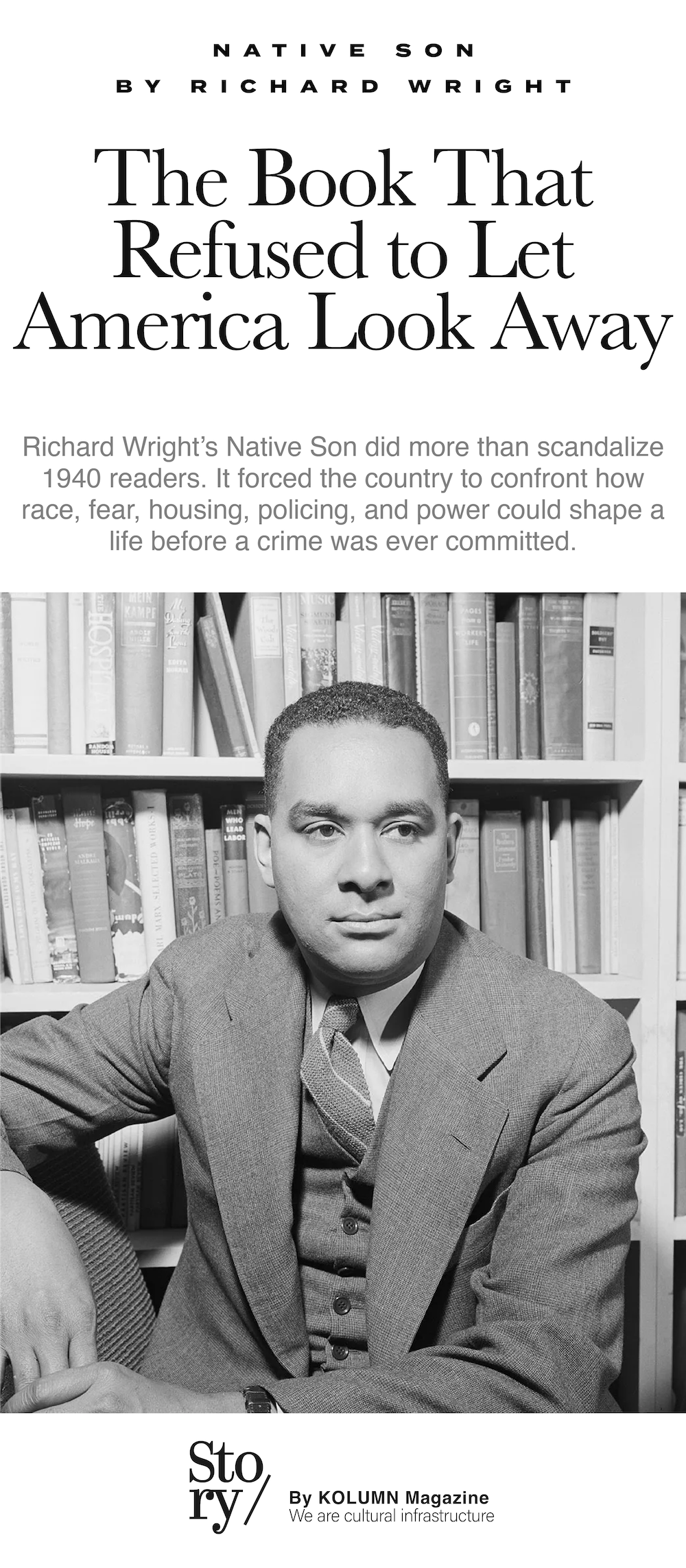
Native Son did not ask readers to admire America. It asked them to confront what America had made.
By KOLUMN Magazine
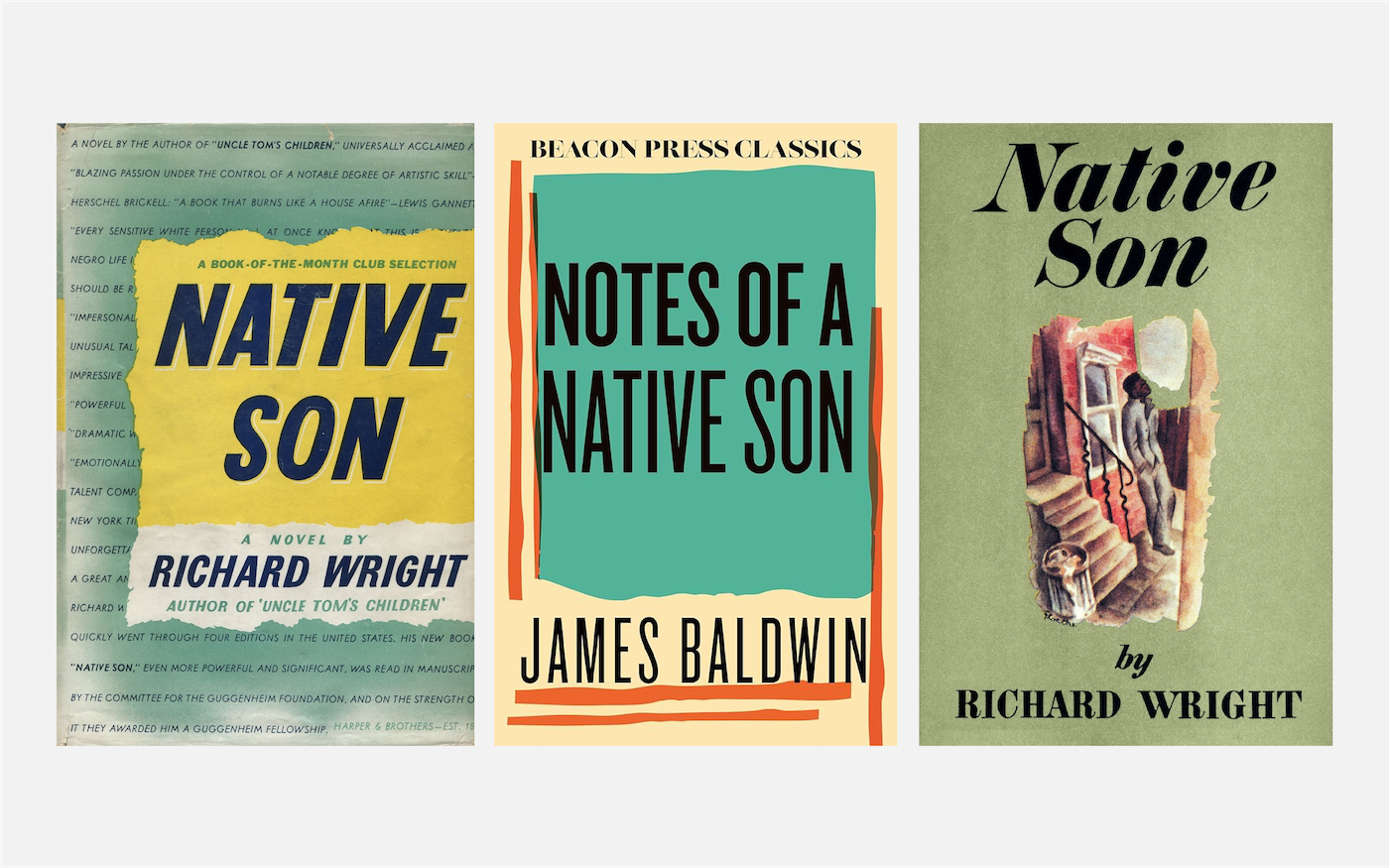
There are famous American novels, and then there are novels that behave more like historical events. Richard Wright’s Native Son belongs to the second category. When it appeared in 1940, it was not simply received as a work of fiction; it detonated inside American culture. It became an immediate commercial success, was selected by the Book-of-the-Month Club, and pushed Wright into national prominence with a speed that was almost unheard of for a Black novelist at the time. Just as important, it forced a broad reading public to sit with a portrait of Black urban life that was not sentimental, not reassuring, and not designed to make anyone feel innocent.
That remains the central significance of Native Son: it changed what American literature could say plainly about race, environment, fear, and power. Wright’s novel did not merely depict racism as prejudice in the abstract. It dramatized racism as a system—with effects on housing, labor, policing, intimacy, self-concept, and imagination. It insisted that Bigger Thomas, the novel’s central figure, could not be understood apart from the world that produced him. In that sense, Wright’s argument was literary, political, sociological, and moral all at once. It is one reason the book still turns up in discussions of the Great Migration, redlining, criminalization, and the psychology of containment.
And yet Native Son has lasted not because everybody agrees with it, but because everybody serious about American letters eventually has to argue with it. The novel has been praised as a landmark of social realism and protest fiction, condemned as heavy-handed, admired for its force, challenged for its limits, and kept alive by generations of writers who saw in Wright either a path forward or a problem to solve. James Baldwin’s critique of Wright helped define postwar Black literary debate; Irving Howe’s defense of the novel became one of the most quoted judgments in criticism; later restorations of Wright’s original text reopened questions about censorship, readership, and what the mainstream literary marketplace would tolerate from a Black writer.
If all of that sounds like a lot to place on one novel, that is precisely the point. Native Son is not “important” only because it is assigned in schools or sits comfortably in the canon. It is important because it never sat comfortably anywhere.
A story designed to unsettle
The plot is well known, though that familiarity can sometimes flatten just how shocking the novel was—and remains. Bigger Thomas, a 20-year-old Black man living on Chicago’s South Side, takes a job as a chauffeur for the wealthy Dalton family. A chain of events leads to the accidental suffocation of Mary Dalton, the family’s white daughter. Bigger then attempts to cover up the crime, later kills his girlfriend Bessie, and is eventually captured, tried, and sentenced to death. Britannica summarizes the novel as an account of white American society’s responsibility for the repression of Black people, and that is exactly where Wright wanted the reader’s attention to go: not toward simple exoneration, but toward causation.
What made the book so explosive was Wright’s refusal to provide the expected emotional shortcuts. Bigger is not written as an exemplary victim, nor as a tidy symbol of innocence. He is angry, frightened, impulsive, cruel, alienated, and often difficult to like. Wright understood perfectly well that this would provoke resistance. According to the Library of America’s account of the restored text and Wright’s accompanying essay “How ‘Bigger’ Was Born,” he believed that if he did not write Bigger as he truly saw him, he would be “acting out of fear.” That statement matters because it reveals Wright’s artistic wager: truth first, even at the risk of scandal, misreading, or backlash.
The American Library Association’s discussion guide on the novel captures what mainstream readers encountered in 1940: a “blunt, unapologetic portrait of black urban life” in a mainstream novel. That bluntness was the break. Wright had already published Uncle Tom’s Children in 1938, but he later judged that earlier work too soft, too available for pity. He reportedly vowed that if he wrote another book, readers would have to face it “without the consolation of tears.” Native Son was the fulfillment of that vow.
This is one of the novel’s deepest forms of significance. It rejected the idea that Black literature had to be morally pedagogical for white comfort. It did not exist to reassure liberal readers of their compassion. It did not package suffering into uplift. Instead, Wright built a narrative machine around dread. The book’s three sections—“Fear,” “Flight,” and “Fate”—announce that design with brutal clarity. Even before the plot turns fatal, the atmosphere is already coercive. Bigger is cornered by poverty, surveilled by white power, and stripped of the ordinary range of movement, work, and self-making that American mythology promises.
That atmosphere matters as much as the events themselves. Wright is showing that violence does not begin with the murder; it begins much earlier, in the arrangement of space, opportunity, and terror. Housing is segregated and overpriced. Work is limited. Public conduct is tightly policed. White philanthropy comes wrapped in ownership and control. Bigger’s life has already been narrowed long before he enters the Daltons’ house. The ALA guide notes that Wright rooted the novel in Depression-era Chicago, in which South Side housing was scarce, substandard, and exorbitant, and Black unemployment ran at devastating levels. The novel’s social pressure is therefore not ornamental background; it is structure.
Chicago, the Black Belt, and the architecture of confinement
To understand Native Son, you have to understand that it is also a Chicago novel. Not just in setting, but in method. Wright’s Chicago is a modern metropolis that promises freedom and manufactures containment. Like many Black southerners, Wright was shaped by the Great Migration, and the Chicago of the 1930s exposed the lie that northern racism was somehow gentler because it often wore a more bureaucratic face. By 1930, as the ALA guide notes, Chicago’s Black population had swelled to well over a quarter million, much of it compressed into the South Side’s “Black Belt.”
This is one reason Native Son still feels so contemporary. It reads now as an anatomy of structural inequality before that phrase became common currency in mainstream discourse. Wright understood that ghettoization was not accidental. He knew that “charity” could coexist with exploitation, which is why the Daltons are such devastating creations. Mr. Dalton gives money to Black causes while profiting from restrictive housing arrangements that trap Black tenants in poor conditions. The contradiction is not incidental; it is the point. The novel exposes the moral evasions of liberal paternalism, the way benevolence can sit comfortably beside extraction. The discussion guide highlights this tension directly, asking readers to consider whether the conditions of Dalton-owned rental properties are connected to Mary Dalton’s death. Wright’s answer is yes, even if the law’s answer is no.
The Guardian, in a broad piece on Chicago literature, described Wright’s contribution as emphasizing social inequality, economic deprivation, and a racialized version of the failed American Dream for migrants who came north seeking relief from racism. That frame is useful because Native Son is not simply a crime novel or a courtroom novel. It is a migration novel too, one that asks what happens when Black Americans move toward modernity and find that modern institutions have simply refined older forms of domination.
Wright’s own formation sharpened that perspective. Through the Federal Writers’ Project in Chicago and later New York, he gained both community and a wider historical frame for interpreting Black experience. David A. Taylor, writing in the ALA guide tied to Soul of a People, argues that Wright’s WPA work helped him interpret Black life not as marginal, but as central to modern America. That formulation is crucial. Native Son is not a side story off to the edge of national life. It is Wright’s claim that what happens to Bigger Thomas reveals the truth of the nation itself.
The setting also helps explain Wright’s stylistic choices. Chicago in Native Son feels hard, metallic, cold, mechanized. The city is not romantic urban energy; it is pressure. Wright absorbs elements of literary naturalism—the idea that people are powerfully shaped by environment, class, hunger, fear, and social force—and he uses them to build a world in which freedom is felt mostly as fantasy. The ALA guide explicitly places the novel in the naturalist tradition and notes Wright’s debt to Theodore Dreiser’s An American Tragedy. Yet Wright’s adaptation of naturalism is distinct: he racializes the genre with a degree of ferocity that changed its stakes.
Why Bigger Thomas mattered—and why he still does
One of the enduring debates around Native Son is whether Bigger Thomas is a fully realized human being or too schematic a figure, a product of thesis-driven fiction. That debate is real, but it sometimes obscures the immediate historical achievement Wright pulled off. Bigger was one of the first Black protagonists in a major American bestseller to be rendered not as a noble corrective to racist stereotypes, but as a terrifying, damaged, socially produced consciousness. That was a gamble of enormous consequence. It risked reinforcing the very fears Wright was trying to anatomize. But it also refused the sentimental politics of respectability.
Wright later explained that Bigger was an amalgam of boys and men he had known—figures “hovering unwanted between two worlds,” as the ALA guide recounts from Wright’s comments on the novel’s origins. He described them as alienated, unstable, driven by profound social distortion, and ultimately made to pay “a terrible price” by the white forces that restricted their lives. That description clarifies something important: Bigger is not meant to stand in for every Black man. He is meant to dramatize one lethal product of American racial conditions.
This distinction is central to the book’s significance. Wright was after a social type, but not a stereotype. He wanted to show how fear and humiliation warp the psyche. Bigger’s inner life is structured by anticipation—of insult, of punishment, of being caught in the wrong space under the wrong gaze. In that sense, Native Son is one of the foundational American novels about racialized fear as everyday environment rather than isolated incident. Its power lies not simply in the crimes, but in the sensation that Bigger has been coached by the world to expect disaster.
That sensation is why readers continue to find the novel hard to shake. Even critics who reject Wright’s aesthetics often admit the force of his diagnosis. The Humanities Moments project, reflecting on the book’s continued relevance, argues that Native Son, alongside Black Boy, helps readers see how racist ideologies shape both southern and northern communities. That point matters because the novel demolished the myth that Black suffering was purely a southern phenomenon. Wright moved the conversation northward, into the city, into labor, into housing, into policing, into mass readership.
The Poetry Foundation puts the matter broadly: when Wright published Native Son, he became the most famous and respected African American author in the United States and exerted major influence on younger Black writers. That influence was not merely about fame. It was about permission. Wright expanded the available emotional and thematic range of Black fiction in the national marketplace. He made it harder to pretend that Black writing had to be either folkloric, quaint, or uplifting to be legible.
The bestseller problem
Commercial success is not the most important measure of literary significance, but with Native Son, it is part of the story. The novel was an immediate bestseller, aided by Book-of-the-Month Club selection and widespread review coverage. WBEZ’s retrospective on the novel notes that it became an immediate bestseller in March 1940 and one of the earliest major examinations of race in America for a mass readership. The ALA guide likewise notes its immediate commercial success and selection by the club, while also recording that Wright had to delete certain sexual passages at the club’s request.
That last detail opens one of the book’s most revealing side stories. Native Son entered the mainstream, but only through negotiation with mainstream gatekeepers. Later Library of America editions restored cuts and changes, including material that book club editors feared would offend readers. The restored text is not just an archival curiosity. It is evidence of how the literary marketplace policed Black candor. Wright became a national sensation, yes, but he did so through a publishing culture that still demanded management, trimming, and sanitizing.
So the significance of Native Son lies partly in contradiction. It was both a breakthrough and a compromised breakthrough. It proved that a Black novel centered on systemic racism and psychological violence could reach a mass audience. It also proved that such access often came with editorial pressure. The story is familiar now because American culture repeats it so often: a Black artist breaks through, but only after powerful institutions decide what version of that artist’s truth can circulate safely. Wright’s later restoration reminds us that the “classic” many people encountered for decades was not exactly the book he first intended.
This matters, too, for how we think about canon formation. Canonical books are often treated as stable monuments. Native Son is better understood as a contested object—written in urgency, received in controversy, altered in publication, defended and attacked across generations. Its classic status is inseparable from that struggle.
Baldwin’s objection, and why the objection helped keep the novel alive
No conversation about the significance of Native Son is complete without James Baldwin. His 1948 essay “Everybody’s Protest Novel,” later collected in Notes of a Native Son, became one of the most famous critiques of Wright’s work. Baldwin argued that protest fiction could flatten human complexity into ideology, and he considered Native Son limited both artistically and morally by that tendency. Even summaries of Baldwin’s essay stress how forcefully he positioned Wright’s novel as something constrained by its own polemical design.
The Guardian has also summarized Baldwin’s view, noting his complaint that Native Son fostered a “climate of anarchy” and failed to articulate the fuller depth and ritual of Black life. For Baldwin, Wright’s vision could feel so dominated by rage and catastrophe that it left too little room for the subtler textures of feeling, relation, and culture.
Baldwin was not wrong to see a problem there. But he was also responding to a particular historical opening Wright had created. Baldwin’s own essays, and much of the Black literary criticism that followed, were made more legible because Wright had first dragged the argument into public view. In a strange way, Native Son is significant not only because of what it did, but because of the caliber of disagreement it provoked. It became the book later writers had to surpass, correct, revise, or defend. That is one of the surest signs of literary consequence.
The New Yorker, reconsidering Wright through the publication of The Man Who Lived Underground, notes that Baldwin later acknowledged Wright’s evolving powers, even as Native Son remained the emblem of the moralistic protest mode Baldwin distrusted. That later complexity is worth holding onto. Wright was not only the author of one polemical sensation; he was a larger, more searching writer whose career invites re-reading. But Native Son remains the flash point because it condensed so many questions at once: What should Black fiction do? How much should a novel argue? What happens when art tries to represent structural violence through a character who is himself violent?
A Black novel in the mainstream, and the redefinition of American literature
Irving Howe’s famous line—quoted in the ALA guide and repeated in later discussions—that “The day Native Son appeared, American culture was changed forever” may sound oversized, but it gets at something real. The change was not that racism suddenly became visible; Black Americans had been narrating it for generations. The change was that a mass literary culture had to encounter Black urban rage at a scale and intensity it could no longer treat as peripheral.
Before Wright, there had certainly been major Black writers—Charles Chesnutt, Zora Neale Hurston, Jean Toomer, Langston Hughes, among others. But Wright’s arrival with Native Son marked a different kind of public consolidation. The Poetry Foundation notes that the novel made Wright the most famous African American author in the country, and the ALA guide says he became, virtually overnight, the most popular Black writer in America and a spokesman on race. That rapid elevation had consequences beyond Wright himself. It changed publishing expectations, critical habits, and the scale at which Black fiction could intervene in the national conversation. (The Poetry Foundation)
It also influenced genre. Native Son is often discussed as protest fiction, but it also borrows from crime fiction, naturalism, psychological fiction, social realism, and courtroom drama. Wright fused these modes in a way that made literature feel urgent and public-facing without giving up novelistic tension. The result opened pathways for later writers who wanted fiction to do more than narrate private lives. You can feel its afterlife in midcentury urban fiction, in prison writing, in socially diagnostic novels about race and space, and in later Black arts debates over realism, politics, and representation.
The Library of America’s framing is especially useful here. It describes Native Son as having captured the hopes, pain, rage, and yearnings of Black Americans with “unprecedented intensity and vividness.” That phrase gets at the book’s formal achievement. Its significance is not only that it says the right political things. It is that Wright found a prose engine sharp enough to drive those things into the nerves of readers. The book moves with terrifying momentum. It is loud with dread. It is often ugly on purpose. It wants impact more than elegance, and that priority is part of its aesthetic.
Why the novel still feels live
There are old books that feel sealed in their moment, and then there are old books that continue to vibrate because the conditions they describe have not fully disappeared. Native Son is very much in the second category. That does not mean contemporary America is identical to Chicago in the late 1930s. It means Wright’s core insights remain legible: segregation works on the psyche as well as on geography; liberal innocence is often built atop structural arrangements it refuses to name; criminality is discussed more easily than causation; and Black fear is frequently treated as individual pathology instead of an adaptation to danger.
That ongoing relevance is one reason the novel keeps returning in classrooms, essays, and public debates. Readers still argue over whether Wright overstates, simplifies, or essentializes. But they also keep finding that the book illuminates conversations about housing segregation, over-policing, racialized media spectacle, and the social manufacture of “threat.” In other words, Native Son remains current because the republic keeps reproducing versions of the world it anatomized.
Even its discomfort remains useful. In an era that often wants easy representational politics—good victim, bad oppressor, tidy moral—Wright’s novel is still an irritant. It resists being turned into a clean civics lesson. Bigger Thomas is neither redeeming enough for sentimental humanism nor abstract enough to become mere sociological data. He keeps forcing the harder question: what kind of nation produces a person like this, then acts shocked by the result? That question is why the book persists.
The Atlantic’s Imani Perry, writing not directly about Native Son but about Wright’s larger legacy, describes the “bleak prescience” of his work. That phrase applies here. Wright often saw too much too early: the northern machinery of race, the brittleness of liberalism, the psychic cost of exclusion, the danger of pretending that structures do not generate behavior. Native Son is prescient because it understood that racism in the modern city is not just insult or taboo; it is administration, market logic, enclosure, and fear.
The final measure of its significance
So what is the significance of Richard Wright’s Native Son? It is the significance of a novel that changed scale. It made Black urban life central to the American literary imagination. It brought structural racism into mainstream narrative form with uncommon force. It created a protagonist designed to scandalize moral simplifications. It expanded the commercial and formal possibilities for Black fiction while exposing the constraints of the publishing establishment. It provoked one of the most important intergenerational debates in African American letters. And it continues to matter because the systems it described are not entirely past tense.
Its significance also lies in the fact that it does not flatter the reader. Some classics survive because they console. Native Son survives because it accuses. It accuses a nation of making Black life structurally claustrophobic and then calling the consequences mysterious. It accuses liberal decency of masking material exploitation. It accuses literature itself of preferring digestible suffering to terrifying truth. And it accuses readers, across generations, of wanting distance from the worlds they help sustain.
That is why the novel remains so hard to domesticate. You can admire Wright and still recoil from parts of the book. You can recognize its historic importance and still side with Baldwin on some aesthetic objections. You can teach it, criticize it, update it, restore it, adapt it, and argue over it endlessly. But you cannot easily make it harmless. That resistance to harmlessness is, finally, the clearest sign of its enduring power.
Richard Wright wrote Native Son at a moment when America wanted to tell itself stories about progress, democracy, and opportunity. He answered with a story about a young Black man who had inherited fear before he had inherited freedom. The result was not pleasant. It was not supposed to be. It was supposed to make repetition impossible—to make the old evasions sound false even when they were spoken confidently. More than eight decades later, that work is unfinished. Which is another way of saying that Native Son is still doing its job.
More great stories
Afro Sheen, Wall Street, and the Architecture of Black Possibility
July 6, 2026
No Comments
The Fire Inside the Fourth
July 5, 2026
No Comments