




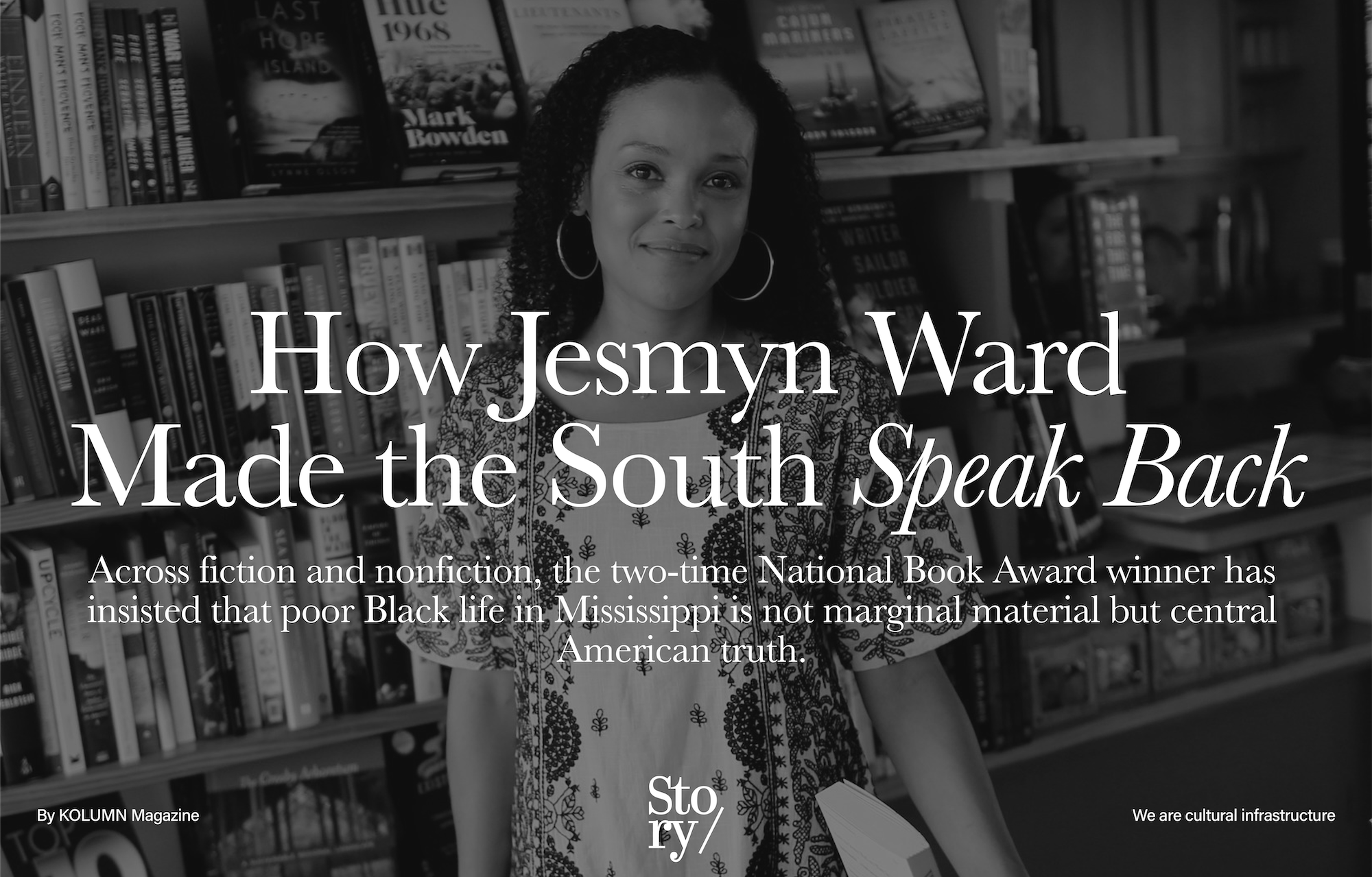
Jesmyn Ward writes like somebody who understands that memory is not passive.
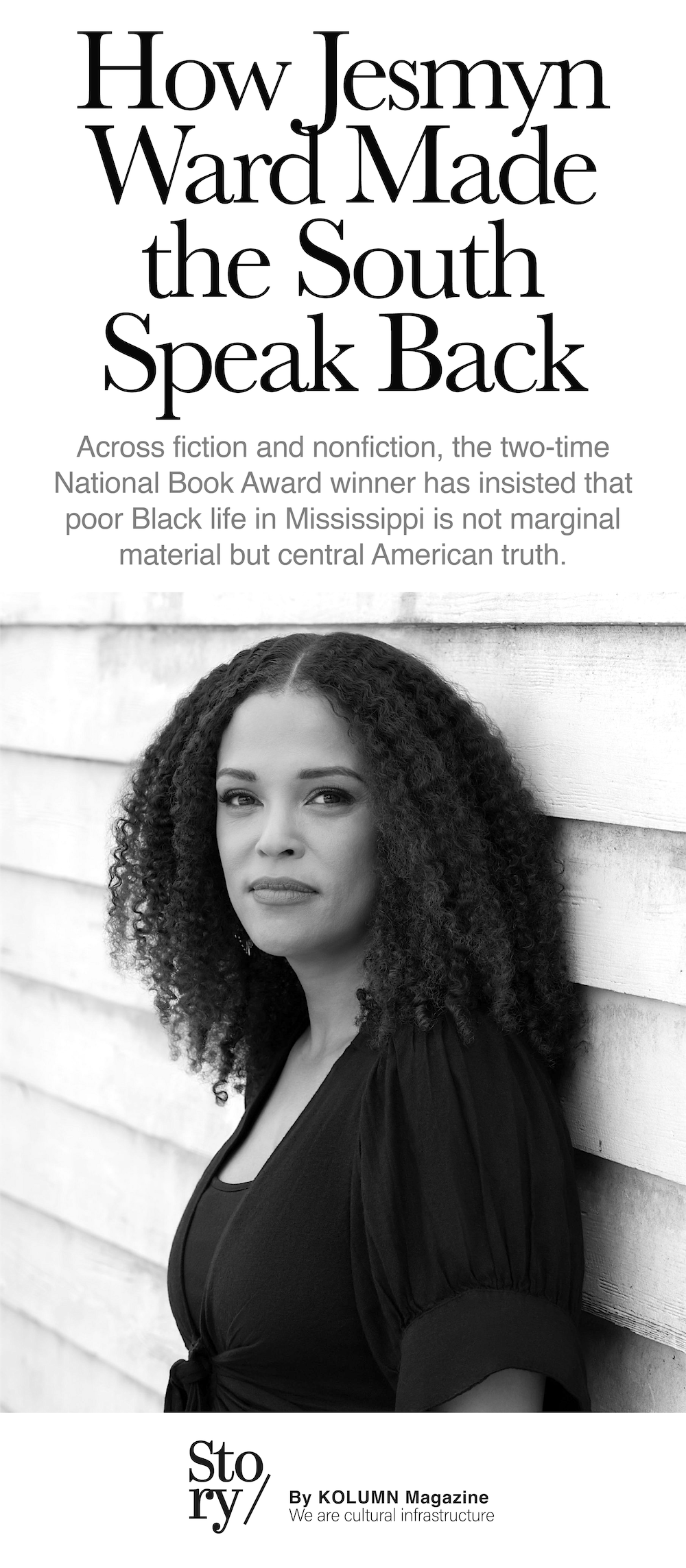
Jesmyn Ward writes like somebody who understands that memory is not passive.
By KOLUMN Magazine
It does not simply sit there, waiting to be retrieved. In her work, memory presses, accuses, mourns, testifies. It moves through swamp water and pine woods, through kitchens and prison farms, through the brutal logic of slavery and the afterlives that follow it. Over the last two decades, Ward has become one of the defining American writers of her generation not because she softened the story of the South, but because she refused to. She has written poor Black Mississippi with a seriousness, lyric power, and moral force that pushed her from admired novelist to major public intellectual. Official biographies from Tulane University, the National Book Foundation, and the Library of Congress place her among the rarest figures in American letters: a two-time National Book Award winner in fiction, a MacArthur Fellow, and, in 2022, the youngest recipient of the Library of Congress Prize for American Fiction.
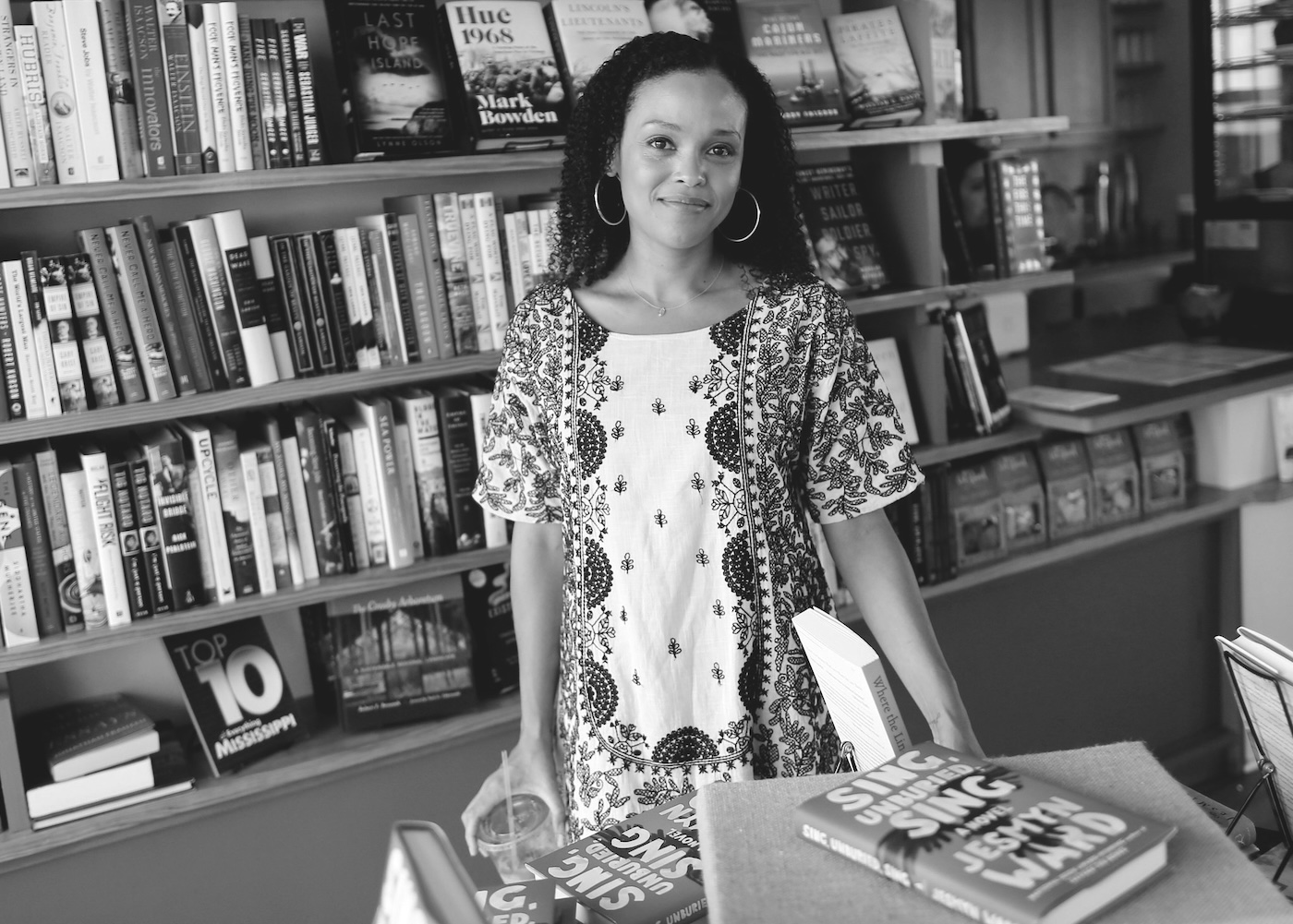
That résumé alone would make Ward significant. But résumés are the least interesting thing about her. What matters more is how she changed the imaginative center of contemporary American literature. Again and again, Ward has returned to the Mississippi Gulf Coast—especially the fictional town of Bois Sauvage—to render lives that mainstream publishing once treated as peripheral: poor Black children, mothers, addicts, prisoners, workers, survivors, and the dead who are never quite gone. The MacArthur Foundation described her project as an exploration of community and familial love among poor African Americans in the rural South; that is accurate, though almost too neat. Ward’s books are also about dispossession, vulnerability, racial capitalism, ecological peril, and the terrifying intimacy of loss.
If William Faulkner is the unavoidable literary ghost haunting Mississippi fiction, Ward’s achievement has been to build an equally mythic territory without inheriting his moral evasions. She writes the same region from the other side of history—from the side of the people who had to survive it. That is one reason critics so often describe her as a literary heir to Faulkner while also stressing how fully she has made something of her own. Time, The Atlantic, and the Library of Congress each frame her work as a major intervention in how the South is imagined: not as nostalgic atmosphere, but as an active system of race, class, weather, violence, kinship, and historical haunting.
A childhood shaped by geography, class, and exclusion
Ward was born in California in 1977 and raised largely in DeLisle, Mississippi, after her family returned South when she was very young. She has spoken and written about that return not as a simple homecoming, but as the beginning of a deep and sometimes painful intimacy with place. DeLisle and the wider Gulf Coast would become the emotional and imaginative ground of nearly everything she wrote. Official and university profiles note that Ward later studied at Stanford and earned an MFA from the University of Michigan, but the geographic and psychic fact of Mississippi remained primary. Even when she left, the landscape kept calling her back.
That attachment was complicated from the start. In interviews and essays, Ward has described being marked by the racism and class stratification of Mississippi, including the experience of moving between Black and white educational spaces where she was made to feel the terms of her difference. In a 2018 Atlantic essay, she wrote that racism was “built into the very bones” of Mississippi, a phrase that captures both the durability of the structure and the difficulty of loving a place that devalues you. The Guardian, in a profile the same year, similarly emphasized her unresolved tension with raising her own children in the state that wounded her.
That doubleness—love and estrangement, rootedness and critique—helps explain why her fiction feels so physically lived-in. Ward knows the seductions of the Gulf Coast: the humidity, the brackish water, the trees, the marsh, the intimate scale of kinship. She also knows what those landscapes conceal and enforce. In her books, beauty is never separate from danger. The natural world can cradle, but it can also drown. Poverty narrows every available choice. History is not background scenery; it is a force acting on the body.
Her rise through elite institutions did not sever that bond. Stanford awarded her well-earned degrees in English and media studies, and Michigan honed her as a fiction writer. Later, she returned to Stanford as a Stegner Fellow and taught at Tulane, where she is now a professor of creative writing. But unlike many writers whose careers require a certain estrangement from home, Ward’s authority has come from staying intellectually accountable to the world that formed her. University and literary profiles repeatedly underscore that continuity. She did not become important by abandoning Mississippi for a more legible literary center. She made Mississippi the center.
Grief as origin story, but not as brand
Any serious account of Ward’s work has to pass through the death of her younger brother, Joshua, who was killed by a drunk driver in 2000. Ward has returned to that loss in interviews, essays, and most devastatingly in Men We Reaped, her 2013 memoir about the deaths of five young Black men in her life over a four-year span. Profiles from the University of Michigan, The Atlantic, and Guernica all point to this period as central to Ward’s development—not only as an artist, but as a witness to how race, class, neglect, and fatalism converge in Black Southern life.
What distinguished Ward early was her refusal to sentimentalize this grief. She did not treat those deaths as isolated personal tragedies. She asked what made them possible, and why they seemed to arrive with such relentless regularity. Men We Reaped is often described as memoir, but it also operates as social diagnosis. It links private bereavement to broader structures: economic precarity, drugs, racism, diminished opportunity, and the casual disposability assigned to Black young men. That analytic rigor is part of what made the book so powerful. It grieves without becoming vague.
There is a temptation, in profiles of major writers, to reduce their seriousness to trauma. Ward’s work resists that simplification. Yes, grief is foundational in her writing. But grief alone does not explain the formal control, the mythic texture, the precision of voice, or the way her characters move with full interior complexity rather than symbolic burden. Loss is a source, not a shortcut. What Ward built from it was an ethic: to write the vulnerable as fully human, and to deny readers the comfort of looking away.
That ethic also explains why the dead remain active in her books. Ghosts in Ward are not decorative gothic touches. They are historical facts rendered spiritually. The dead return because the living have not been allowed to finish with them. In the moral architecture of her fiction, haunting is what happens when violence goes unredressed.
The first books and the making of Bois Sauvage
Ward’s debut novel, Where the Line Bleeds, introduced themes that would define her career: brothers bound by love and limited options, a Gulf Coast town saturated with constraint, and the sense that young Black life is always negotiating between tenderness and threat. The book did not make her a household name, but it established the territory. Critics and institutional biographies alike recognize it now as the foundation of the Bois Sauvage cycle, her fictional Mississippi world that allows her to work on the scale of both realism and myth.
Then came Salvage the Bones, the novel that changed everything. Published in 2011, the book follows a poor Black family in the days leading up to Hurricane Katrina. But to call it a “Katrina novel” only partly captures what Ward accomplished. The storm matters, of course, yet the book’s deeper revelation is that catastrophe did not begin with landfall. The family at its center is already living amid maternal loss, hunger, damaged masculinity, teenage pregnancy, and the exhausting improvisation poverty demands. Katrina intensifies those conditions; it does not invent them. That is one reason the book landed with such force. It repositioned the disaster, showing how national attention often begins only when Black suffering becomes spectacular enough to notice.
The National Book Award for Salvage the Bones announced Ward as a major figure, but the win also exposed something telling about the literary marketplace. Multiple accounts note that the novel had not been universally centered by mainstream reviewing before its nomination. Stanford Magazine, for example, observed that the book was initially “little noticed.” Ward herself understood the pattern. Stories about poor Black families in rural Mississippi, rendered without apology or uplift packaging, were not the kind the culture reliably rushes to canonize. The award did more than honor a novel. It corrected, however briefly, the attention economy around it.
Ward’s comments on Salvage the Bones also revealed a crucial part of her literary philosophy. In conversation with The Paris Review, she rejected the notion that Black Southern stories are somehow too “particular” to claim the status of the universal. Her use of Medea in the novel was deliberate: a way of asserting that Black female experience belongs inside, not outside, the grand traditions of literature. That argument remains central to her significance. She did not ask permission to enter the canon. She rewrote its terms.
Katrina, the Gulf Coast, and the politics of aftermath
Ward’s authority on Katrina comes partly from having lived through it. She has recalled staying on the Gulf Coast as the storm approached and then nearly being trapped as floodwaters rose. Later reflections make clear that the hurricane’s impact extended far beyond the event itself. In interviews and essays, she has described the long shadow Katrina cast across the region: the fear, the psychic residue, the altered relationship to weather, preparedness, and home.
That long view is essential to understanding Ward’s politics as a writer. She is not interested in disaster as a singular media event. She is interested in disaster as an ongoing condition, especially for communities already made vulnerable by policy, segregation, and economic abandonment. Salvage the Bones therefore works on two timelines at once: the immediate suspense of the storm and the deeper, structural storm of American inequality. Ward’s contribution was to bring those timelines together without flattening her characters into examples.
This is also where her prose style matters. Ward’s language is lush, rhythmic, sensuous, and alert to the body. That lyricism is not ornamental. It is one way she refuses the assumption that poor Black life must be narrated in stripped-down sociological terms to be legible. Beauty, in her work, is a form of insistence. Her sentences do not rescue her characters from harsh conditions, but they do refuse the insult of drab representation. In Ward, style itself becomes political.
Men We Reaped and the anatomy of disappearance
If Salvage the Bones made Ward famous, Men We Reaped may be the key to her entire project. The memoir, published two years later, braided the story of her brother’s death with the deaths of four other young men she knew. It is difficult to overstate how unsparing the book is. Ward does not allow the reader to treat these men as abstract symbols of social crisis. She gives them names, histories, edges, contradictions. Then she places their losses within an American order that had already made room for their disappearance.
The title invokes a line from Harriet Tubman, and that invocation matters. Ward is not just documenting grief; she is locating it within a Black historical tradition of naming what the nation prefers to obscure. Tubman’s language of reaping suggests harvest, reckoning, consequence. In Ward’s hands, it also suggests a social field in which death is cultivated—by neglect, by racism, by indifference, by the narrowing of possible futures.
Many writers can convert pain into confession. Fewer can convert it into inquiry. Ward asks why these men died and why their deaths felt, in some terrible sense, anticipated. Her answer is neither purely personal nor purely structural. It sits in the unstable space between agency and system, between individual decisions and inherited vulnerability. That is one reason the book remains so important. It refuses easy blame while refusing comforting innocence.

The Fire This Time and the public role of the writer
Ward’s significance is not limited to her own novels and memoir. In 2016 she edited The Fire This Time: A New Generation Speaks About Race, an anthology explicitly in conversation with James Baldwin’s The Fire Next Time. The project signaled her role not just as a singular artist, but as a literary organizer of moral argument. Official profiles from Britannica and the National Book Foundation highlight the anthology as part of her body of work, and its timing mattered: published during the renewed national reckoning around police violence, Black protest, and the illusion of post-racial America.
The book also demonstrated Ward’s instinct for chorus. Even in her fiction, she is interested in community rather than isolated genius. As an editor, she helped assemble a multi-voiced record of Black thought and feeling in a period of acute public strain. That matters because Ward’s public importance has always exceeded the usual boundaries of literary celebrity. She is read as a novelist, yes, but also as an interpreter of the nation—especially of the places where its myths fail hardest.
Sing, Unburied, Sing and the expansion of her vision
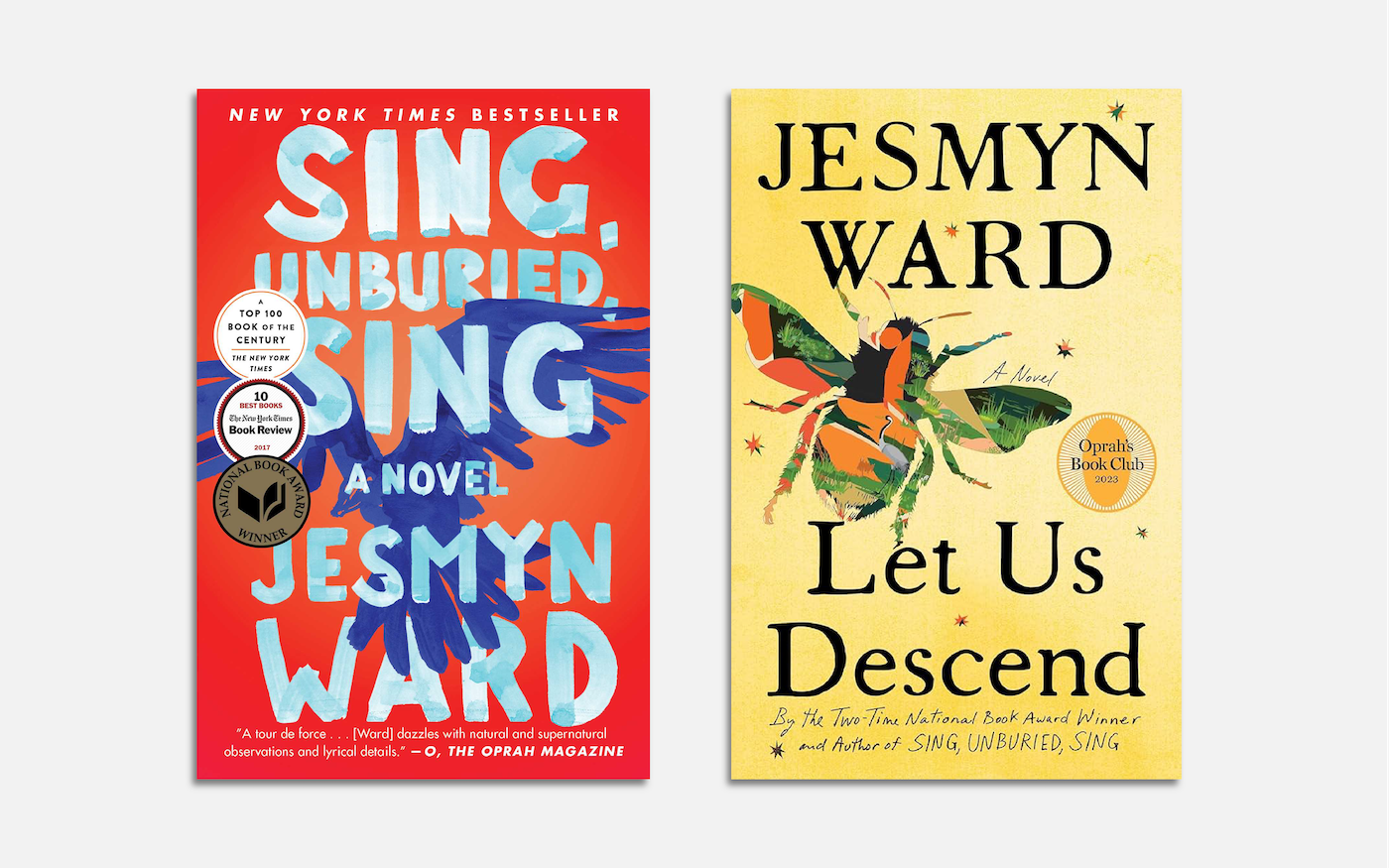
By the time Sing, Unburied, Sing appeared in 2017, Ward had already achieved what many writers spend a lifetime chasing. Instead of consolidating her status with a safer book, she widened the scale of her ambition. The novel follows a family road trip through Mississippi, but that description hardly suggests its reach. The book moves through incarceration, addiction, mixed-race family inheritance, child consciousness, maternal insufficiency, and the unquiet dead. Critics at The Atlantic noted how its ghosts transform the journey into a confrontation with the state’s buried history.
Winning a second National Book Award for fiction placed Ward in truly rare company. According to the Library of Congress and related literary profiles, she became the first woman and first Black American to win the fiction award twice. The achievement was not just symbolic. It confirmed that her earlier success was not an anomaly or a one-book coronation. She had built a body of work sturdy enough to demand institutional acknowledgment more than once.
What makes Sing, Unburied, Sing so consequential is the way it treats mass incarceration as both contemporary reality and historical extension. Mississippi’s prisons are not separate from the plantation past; they are one of its afterlives. The novel’s ghosts insist on that continuity. Ward’s gift is that she can make such arguments without reducing fiction to thesis. The book feels lived, strange, tender, and terrifying all at once.
Honors, canonization, and what institutions recognized
The MacArthur Fellowship in 2017 and the Library of Congress Prize for American Fiction in 2022 formalized what many readers already knew: Ward had become indispensable. The MacArthur citation praised her luminous and honest portrayals of poor Black communities in the rural South. The Library of Congress went further, emphasizing both her artistic achievement and the rarity of her distinction, noting that at 45 she was the youngest person ever to receive the prize. Time also named her among its 100 most influential people in 2018, another sign that Ward’s cultural reach extended beyond literary circles.
Still, the interesting question is not whether Ward deserves these honors. She does. The better question is what exactly institutions are recognizing when they honor her. In part, they are recognizing formal excellence. But they are also, perhaps belatedly, recognizing that the literature of poor Black Southern life belongs at the center of the national story. Ward’s career has forced that recognition. Her significance lies partly in the quality of her work and partly in the fact that the work made evasion harder.
Let Us Descend and the turn to historical fiction
Ward’s 2023 novel Let Us Descend marked a new phase. It was her first major work of fiction set directly in the antebellum past, following an enslaved girl named Annis from the Carolinas through New Orleans into the horror of a Louisiana sugar plantation. Simon & Schuster, AP, The Guardian, and Publishers Weekly all describe the novel as both harrowing and lyrical, with threads of spiritual guidance and Dantean descent shaping its architecture. Oprah selected it for her book club, amplifying its reach.
The move into slavery was not a departure from Ward’s previous concerns so much as an excavation of their roots. Her earlier books had already been haunted by the afterlives of enslavement—through land, prison, lineage, disposability, and inherited terror. Let Us Descend pushes beneath the afterlife to the originating wound. Interviews around the novel make clear that Ward was motivated in part by historical erasure, especially around the domestic slave trade and New Orleans’s role within it. She wanted to tell a story that confronted slavery without euphemism while still insisting on Black interior life, spirituality, and love.
That balance is difficult, and Ward’s seriousness about it is one reason the novel matters. American culture routinely asks Black writers either to aestheticize atrocity or to render it in a way that reassures the reader of their own moral clarity. Ward does neither. Reviews emphasize the brutality of Let Us Descend, but they also note its refusal to strip the enslaved of complexity or metaphysical depth. In Ward’s hands, history is unbearable because the people inside it are fully alive.
The novel also arrived in the aftermath of profound personal loss. In 2023 interviews with The Guardian and Vanity Fair, Ward discussed the death of her partner and the effect grief had on her writing life. That context does not explain the novel away, but it does illuminate its emotional register. Let Us Descend is a book of separation, endurance, maternal rupture, and the stubborn presence of love across impossible distance. Ward has long written grief; here she writes it at historical scale.
Why Jesmyn Ward matters now
Ward matters because she has given American literature a new moral geography. She has forced attention toward lives and landscapes that dominant culture alternately stereotypes, exploits, pities, and forgets. She has also modeled a literary practice in which Black Southern particularity is not provincial but expansive enough to hold the nation’s central contradictions. In her work, Mississippi is not merely one state among others. It is a pressure point where American history becomes undeniable.
She matters because she writes poor people without condescension. This sounds simple, but it is not. Much American writing either romanticizes poverty as authenticity or treats it as pathology. Ward does neither. Her characters are proud, compromised, erotic, selfish, loving, exhausted, funny, brutal, and vulnerable. They are never case studies. This fullness is one of her most radical contributions.
She matters because she understands that race in America is never detached from place, labor, weather, infrastructure, or inheritance. The violence in her books is not abstract prejudice. It is sedimented into roads, schools, prisons, coastlines, and family histories. That material understanding gives her work unusual force. Even when her novels incorporate ghosts and myth, they remain fiercely grounded in the built and broken realities of American life.
She matters because she changed the expectations around who gets to be called an “American writer” without qualifier. Ward is undeniably a Black writer, a Southern writer, a Mississippi writer. But her work has shown that these descriptors do not narrow her relevance; they are the very means by which she reaches the universal. That was her point all along. The lives most often marked as marginal were never marginal to the truth of the country. They were central, and literature had failed them by pretending otherwise.
And she matters because younger writers are now working in a world she helped make. A world in which serious Black Southern fiction is not an exception that must justify its existence each season. A world in which grief, folklore, climate disaster, historical haunting, and class critique can coexist in a novel without being treated as incompatible registers. Ward did not create that world alone, but she helped widen it decisively.
The steadiness beneath the acclaim
There is something striking about how often profiles of Ward emphasize her groundedness. Even after major prizes, even after national canonization, the reporting tends to return to DeLisle, to family, to Mississippi, to the ordinary obligations of care and teaching. Tulane identifies her as a professor of creative writing; recent interviews describe the practical and emotional realities of her life as a mother, teacher, and writer living with grief. That steadiness is not incidental. It is part of the discipline of her art. Ward keeps faith with the world from which her work comes.
In an age of noise, that fidelity may be one of her most unusual qualities. Ward does not seem interested in becoming a brand of importance. She is interested in making literature sturdy enough to bear witness. The distinction matters. It is the difference between prestige and necessity. A great many acclaimed writers are discussed as if their significance were settled by awards. With Ward, the awards mostly serve as late evidence for something the books already proved: she is one of the country’s essential witnesses.
Coda
Jesmyn Ward’s life and significance cannot be reduced to triumph over adversity, though the culture often tries to package Black excellence that way. Her story is more difficult and more interesting. It is the story of a writer who kept returning to the places where America hides its cruelties and insisted on looking closely. It is the story of someone who transformed private grief into public art without ever draining that grief of its specificity. It is the story of a novelist who took the poor Black Gulf Coast and made it undeniable as literature, as history, and as national testimony.
What she has given readers is not consolation exactly. Her books do not promise that history bends cleanly toward repair, or that love protects people from devastation. What they offer instead is harder and, finally, more durable: attention, dignity, memory, and the refusal to let the vulnerable disappear unrecorded. That is the kind of literary achievement prizes can acknowledge but never fully measure. Ward’s work endures because it knows that survival is not the same as justice, and that witness is not the same as rescue. But sometimes witness is what keeps a people, a place, and a truth from being erased.
More great stories

Afro Sheen, Wall Street, and the Architecture of Black Possibility
July 6, 2026
No Comments
The Fire Inside the Fourth
July 5, 2026
No Comments