

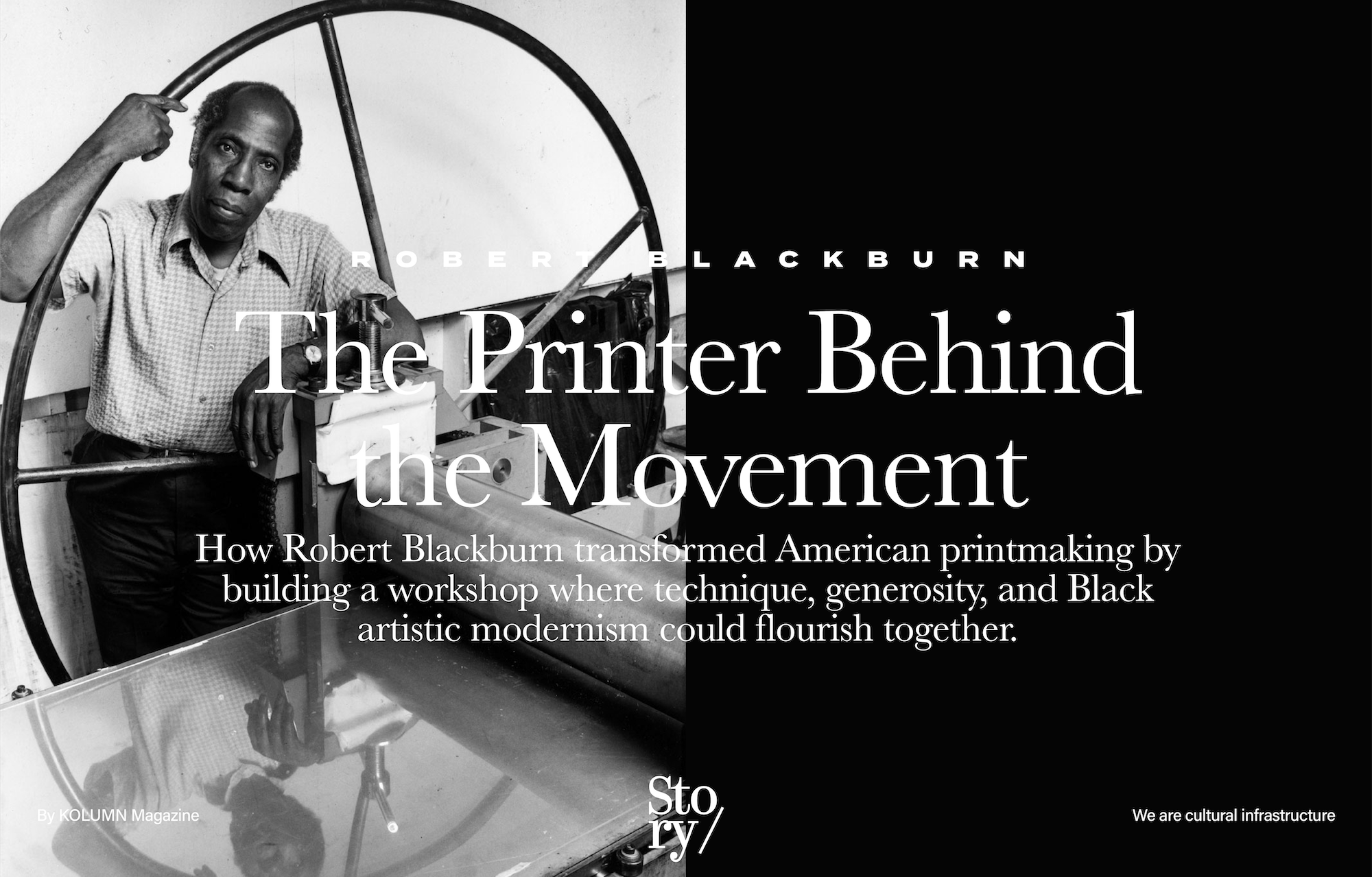
Blackburn believed artists should have the tools and room to test themselves.
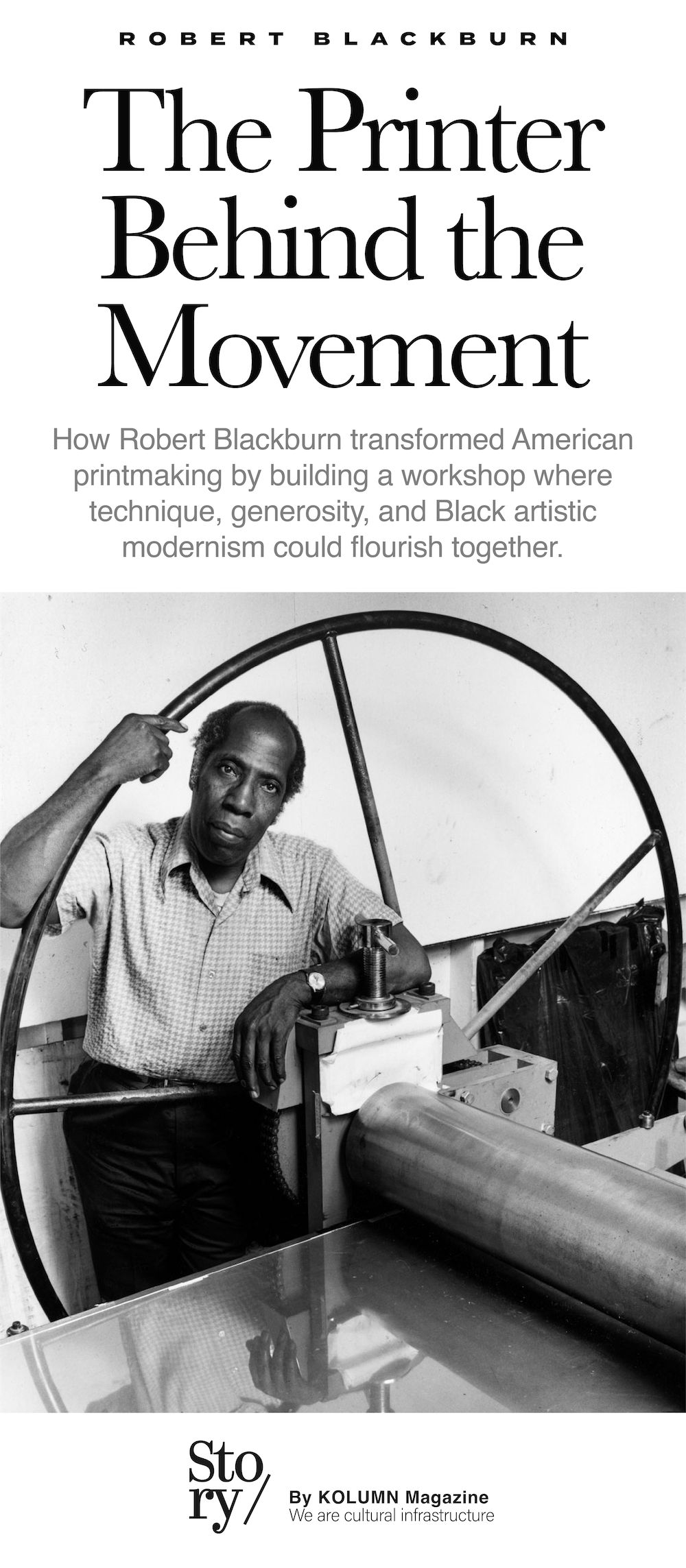
Blackburn believed artists should have the tools and room to test themselves.
By KOLUMN Magazine
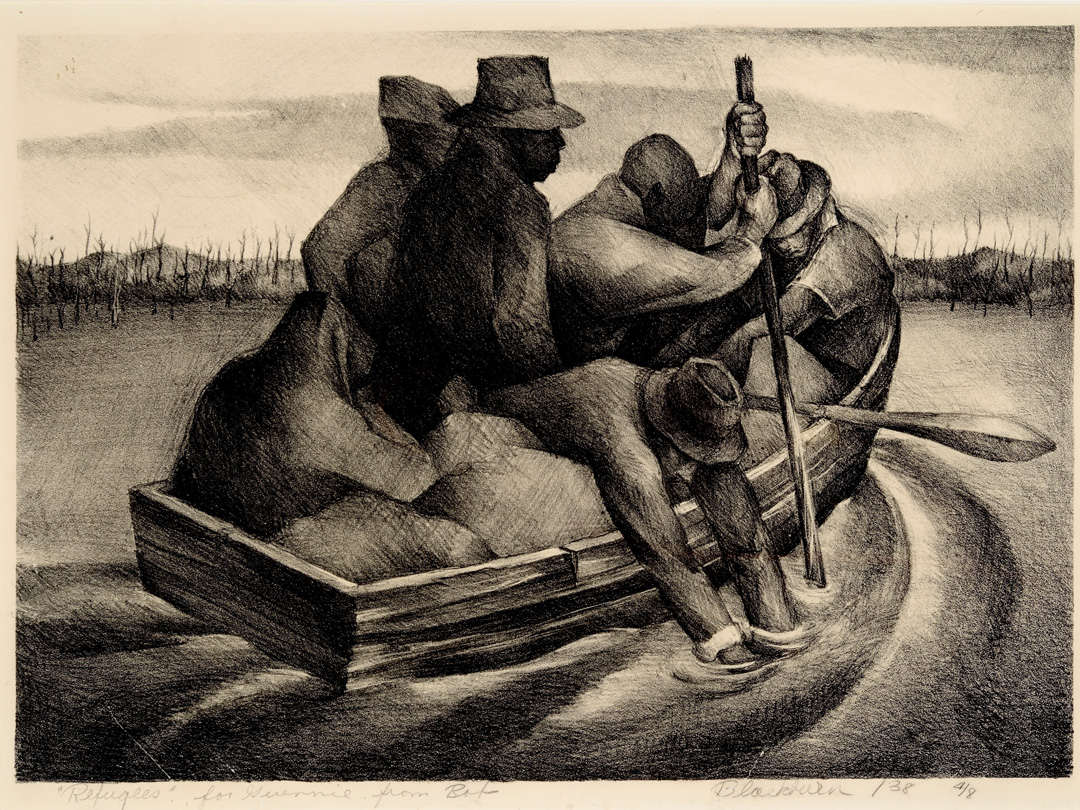
Robert Blackburn occupies a singular place in twentieth-century American art. He was a master printmaker, an inventive artist, an educator of unusual reach, and the founder of a workshop whose influence spread far beyond the walls of its Manhattan loft. To write about Blackburn is to write not only about an individual maker but about a method, an ethos, and an infrastructure. He changed what printmaking could be in the United States, and he changed who could participate in it. His achievement was aesthetic, technical, and social all at once. By the time of his death in 2003, Blackburn had become one of those rare cultural figures whose influence exceeded the visibility of his name. Many people knew the artists whose editions he printed, the schools and studios that borrowed from his model, and the generations of artists he encouraged. Fewer understood how central he had been to the formation of modern American print culture itself.
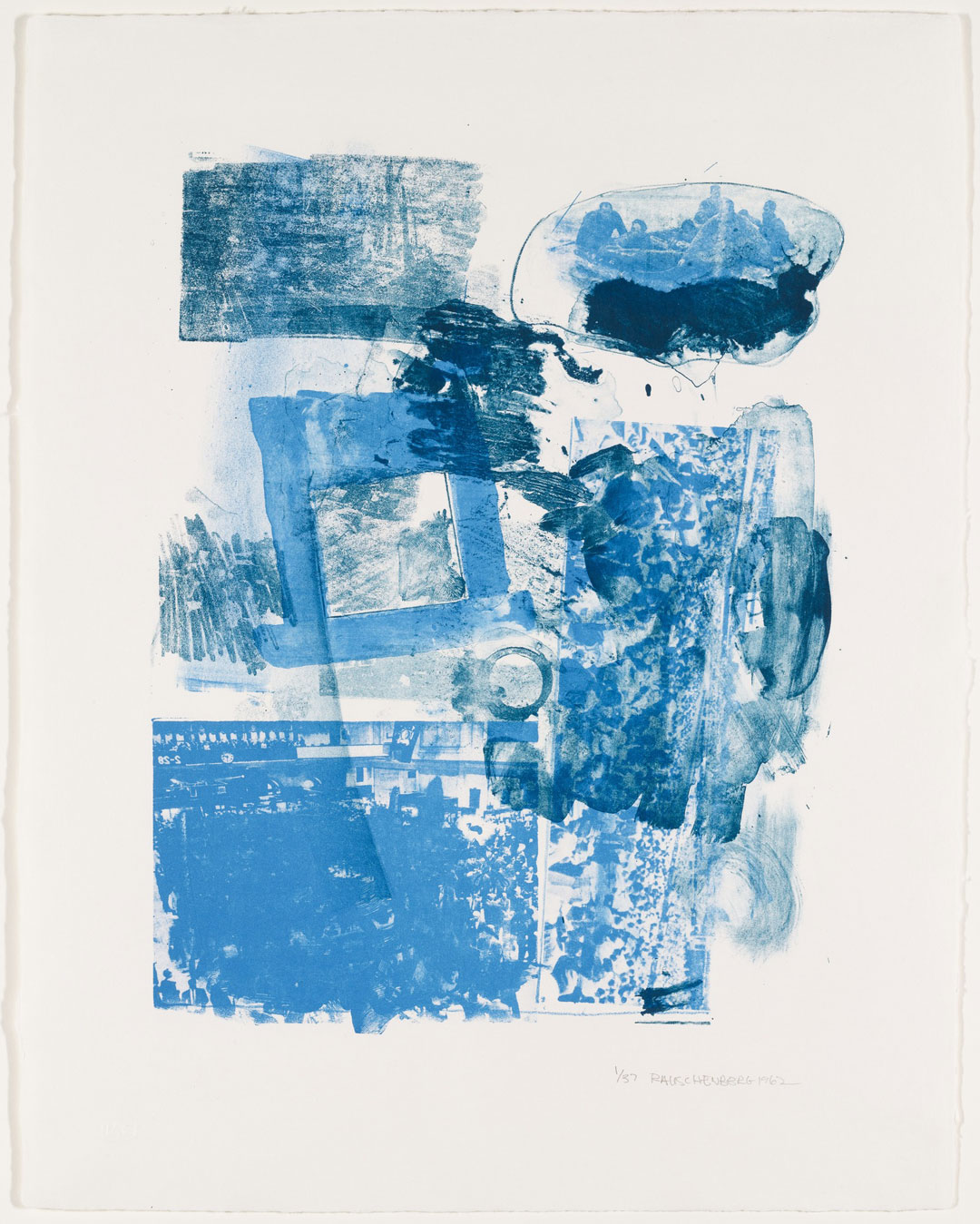
That relative invisibility is part of the story. Blackburn was widely described as a “printmaker’s printmaker,” a phrase that sounds admiring and faintly insufficient at the same time. It captures his technical authority and his devotion to the medium, but it can also reduce him to the role of facilitator, as though his greatest work existed only in service to others. The historical record suggests something larger. Blackburn was a serious artist in his own right, a pioneer of abstract color lithography, and a cultural organizer who understood earlier than many museums and markets that access to tools, shared knowledge, and sustained exchange could shape the future of art. His workshop, founded in New York in 1948, became the oldest and longest-running community print shop in the United States, a place where artists of different backgrounds, means, and reputations could work side by side.
He emerged from Harlem at a moment when Black artistic life was intensely social, intellectually charged, and structurally constrained. Born in Summit, New Jersey, in 1920 and raised in Harlem after his family moved there in 1927, Blackburn came of age amid the lingering force of the Harlem Renaissance and the practical opportunities created by New Deal arts programs. He studied in environments where art was less a private luxury than a communal undertaking. By adolescence he had encountered Charles Alston, Augusta Savage, Ronald Joseph, and other figures who linked art to discipline, exchange, and public possibility. At various points he studied with poet Countee Cullen, worked in Harlem art centers, and learned lithography through WPA-supported community programs. Those experiences formed not only his eye but also his conviction that art instruction and artistic opportunity should be shared rather than hoarded.
Blackburn’s life matters because he helped democratize a medium that had often been treated as either secondary to painting or too technically specialized for wide participation. His significance also lies in the fact that he built an interracial, collaborative, rigorously serious artistic space at midcentury, when American institutions were still deeply segregated and when Black artists faced persistent barriers to training, exhibition, and patronage. He made room for experiment without surrendering standards. He nurtured artists without flattening their differences. He helped define the visual language of postwar printmaking while refusing the narrow career script that would have centered his own fame above the community around him. That is why Robert Blackburn remains indispensable: he shows that artistic history is not made only by the most marketable object or the loudest signature, but also by the people who build the conditions under which art can happen.
Harlem as apprenticeship
To understand Blackburn’s artistic imagination, it is necessary to begin with Harlem not as a backdrop but as a formative system. The neighborhood into which he matured was a site of Black cultural density, argument, aspiration, and pedagogy. Its teachers and artists were not abstract influences; they were living presences. Blackburn attended classes at the Harlem Arts Workshop, studied with Charles Alston, and spent time around the famous “306” salon, where artists and intellectuals gathered to debate aesthetics and politics. He also studied with Augusta Savage and learned lithography at the Harlem Community Art Center, one of the largest WPA community art centers in New York. These settings exposed him to modernism, realism, Black cultural nationalism, and internationalist currents all at once. They also taught him that art develops through proximity: through watching others work, through conversation over coffee, through the repeated act of returning to the studio.
His formal study at the Art Students League from 1940 to 1943 sharpened those early lessons. There he worked with Will Barnet, who became an early teacher, collaborator, and eventually a fellow architect of the Printmaking Workshop’s ethos. Blackburn’s technical development in lithography accelerated during these years, but just as important was his growing sense that printmaking could be a field of invention rather than replication. Lithography, with its intimacy between drawing and stone, allowed him to think structurally and improvisationally at the same time. Later observers would note his extraordinary fluidity in moving around the stone, reorienting the image, layering forms, and treating the press bed like an active field of thought. His process suggested a mind that was never content with static composition.
Blackburn did not emerge from Harlem as a narrowly “community” artist in the reductive sense sometimes imposed on Black cultural figures. He absorbed the neighborhood’s social energy, but he also moved confidently through broader modernist vocabularies. Institutional biographies consistently note the mix of forces that shaped him: the Harlem Renaissance, European abstraction, American social realism, and Mexican modernism. That combination matters. Blackburn belonged to a generation of Black artists who were frequently expected to produce legible racial uplift imagery or documentary figuration. He understood those traditions and did important figurative work early on, but he was also drawn to abstraction, structure, mood, and formal play. His career therefore complicates any easy division between Black art as social witness and modernist abstraction as supposedly race-neutral experimentation. In Blackburn’s hands, abstraction was neither escape nor imitation. It was a language of freedom, inquiry, and compositional intelligence.
That tension between expectation and invention would follow him throughout his career. As the son of Jamaican immigrants and a Black artist working in a white-dominated art world, he knew the pressures of recognition and misrecognition. The Archives of American Art summary of his 1970 oral history notes that he spoke directly about the difficulties Black artists faced in gaining recognition, alongside his reflections on Harlem, school, religion, music, and the making of the workshop. Even in summary form, that record is telling. Blackburn’s career was never only a story of technical triumph; it was also a story of navigating an art system that often failed to credit the labor, intelligence, and innovation of Black cultural workers unless it could package them within familiar narratives.
The artist before the institution
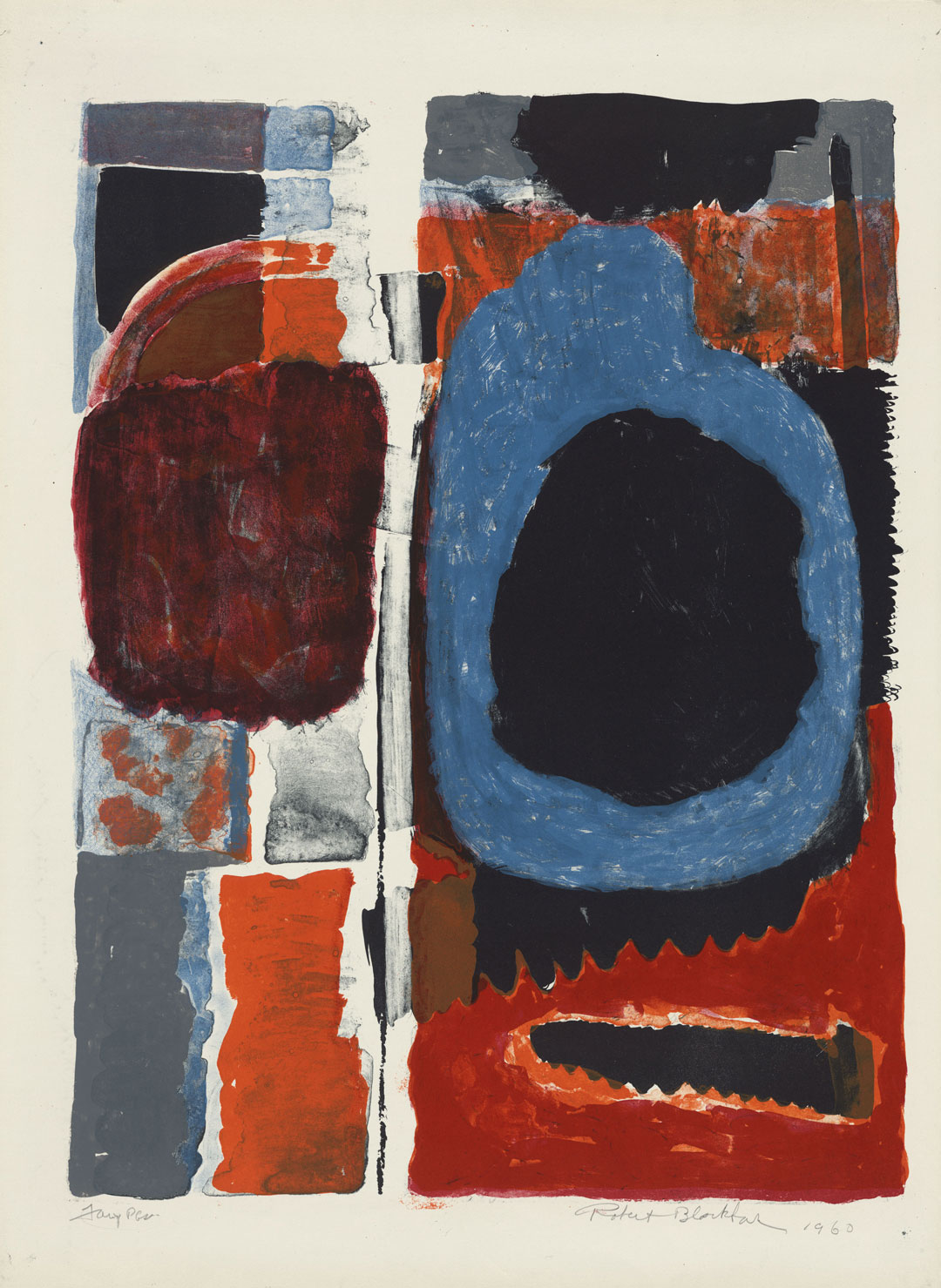
It would be a mistake to let the mythology of the workshop overshadow Blackburn’s art. Before he became a legend of collaborative printmaking, he was already making ambitious images. His early and midcareer works show a restless intelligence moving from figuration toward increasingly complex abstractions. “Girl in Red,” the 1950 lithograph now often cited as a pivotal work, captures that threshold. The Library of Congress describes it as a turning point, noting how Blackburn used a rich palette to combine still life, landscape, and portraiture while moving decisively toward abstraction. The young subject meets the viewer directly, but the image is not merely descriptive; it is already bending representational space into something denser, more layered, and more formally unstable.
In the following years Blackburn’s art developed through a deepening command of color lithography. His small tabletop compositions and Cubist-inflected arrangements from the 1950s and 1960s reveal a sustained concern with mark-making as both sign and structure. He was interested in the relation between object and surface, between image and the mechanics of its making. The Smithsonian American Art Museum notes that his key works shift between cubistic arrangements and color abstractions, and that his thought process often remained tied to the material orientation of the stone itself. Rather than concealing process, Blackburn let it inflect the image. The sheet remembers the stone; the final print remembers the labor of turning, layering, revising.
That sensibility would later reappear in his woodcuts of the 1970s and 1980s. The Library of Congress describes works such as “Red Inside,” “Woodscape,” and “Three Ovals” as the product of reworked large blocks, bold graphic thinking, and an ongoing exploration of line, woodgrain, and orientation. These are not minor late experiments. They are the work of an artist still asking fundamental questions about positive and negative space, the expressive potential of texture, and the relation between serial variation and singular image. Even after decades spent facilitating others’ work, Blackburn remained committed to extending his own formal language.
His art has sometimes been under-read because his service to other artists was so extraordinary. But the better scholarship and major retrospectives have increasingly insisted on the point: Blackburn was not simply the master printer who enabled the work of Jasper Johns or Robert Rauschenberg; he was himself an avant-garde thinker whose experiments helped shape the conditions under which the postwar “graphics boom” could occur. The Library of Congress credits his pioneering work in abstract color lithography with helping fuel the explosion of graphic art in the next decade. The Smithsonian goes further, arguing that his own experimental color lithography before the print boom was crucial, and that his talents helped shape the forms of printmaking adopted by better-known artists. That is not background labor. That is authorship in a broader, more historically accurate sense.
Building the Printmaking Workshop
Blackburn founded the Printmaking Workshop in 1948. That single fact appears in nearly every institutional biography, but the date alone does not convey the scale of the intervention. He was establishing a collaborative print environment in postwar New York at a time when access to presses, stones, technical knowledge, and affordable studio infrastructure was limited. He was also doing so as a Black artist whose own career opportunities would have justified a far more protective, individualistic approach. Instead, he built outward. The workshop began in modest form and evolved over time, but its founding premise was radical in practice: artists should be able to learn by doing, experiment without gatekeeping, and share a serious space regardless of their market status.
The workshop’s atmosphere became central to Blackburn’s legend. One former participant recalled that there was an “open arrangement” in which students and artists had unlimited access, and described Blackburn as “a dynamo of energy,” moving from stone to stone with painterly velocity. Blackburn himself, reflecting on the workshop’s early intellectual formation, said that much of the learning happened by “sitting down at the coffee table” with mentors and colleagues, drinking coffee and working together. Those details matter because they show how the workshop fused rigor with informality. It was not anti-professional; it was anti-exclusion. Blackburn’s genius lay partly in understanding that technical seriousness and social openness were not opposites.
By the mid-1950s, the workshop was already functioning as a node in a larger artistic network. Blackburn traveled in Europe on a John Hay Whitney fellowship during 1953 and 1954, and upon returning to New York he entered another major phase of his career. In 1957 he became the first master printer at Universal Limited Art Editions, the influential Long Island workshop founded by Tatyana and Maurice Grosman. There he printed the first seventy-nine editions, collaborating with artists including Larry Rivers, Grace Hartigan, Helen Frankenthaler, Jasper Johns, and Robert Rauschenberg. Institutional accounts from the Smithsonian, the Library of Congress, and the Studio Museum all emphasize the same point: Blackburn did not simply perform expert labor at ULAE; he helped set the standard for the workshop and influenced the visual direction of modern American printmaking at a critical moment.
When Blackburn returned to operating his own workshop full time in the 1960s, he expanded rather than narrowed its mission. The Library of Congress notes that by 1963 he was running an open graphics studio for artists of diverse social and economic backgrounds, ethnicities, styles, and levels of expertise, and that under his direction it became one of the most vital collaborative studios in the world. That description is not boosterism when measured against the workshop’s long roster of artists and its enduring institutional afterlife. Elizabeth Catlett, Romare Bearden, Charles White, Emma Amos, Faith Ringgold, Betye Saar, Melvin Edwards, Dindga McCannon, and many others either worked there, printed there, taught there, or were shaped by its example.
Collaboration as politics
Blackburn’s workshop was not a neutral zone floating above the racial realities of its time. Its openness was itself a political and cultural act. In an era of segregated institutions, unequal access to training, and recurring marginalization of Black artists, he built a place where collaboration across difference was not merely tolerated but normalized. The Nelson-Atkins Museum, in describing a major retrospective, noted that Blackburn “embraced democracy in terms of the creative process and access to art.” That phrase is useful because it points to the political structure embedded in his studio practice. He believed that printmaking could be democratic not only because prints can circulate more widely than unique paintings, but because the shop itself could model another social order.
That commitment became still more explicit when the Printmaking Workshop incorporated as a nonprofit in 1971. The Library of Congress states that the mission included maintaining artistic quality, encouraging innovation, creating opportunities for Third World and minority artists, and fostering public appreciation of the fine art print. This language places Blackburn within a broader Black institutional tradition: not simply making work inside hostile structures but building alternative structures with clear cultural mandates. Public funding from the National Endowment for the Arts, the New York State Council on the Arts, and the New York City Department of Cultural Affairs later helped him expand the workshop’s reach and invite a wider range of artists into the space.
His collaborations with Romare Bearden illuminate this politics especially well. Blackburn and Bearden met in Harlem in the 1930s through “306” and the Harlem Community Art Center, and their friendship endured for decades. Bearden became one of the original trustees when the workshop incorporated. The Library of Congress also credits Blackburn with major collaborative projects such as Impressions: Our World in 1974, a portfolio by notable African American artists introduced by Bearden and art historian Edmund Barry Gaither. The project demonstrates Blackburn’s understanding that printmaking could be both formally adventurous and institutionally strategic: a medium for building portfolios, amplifying Black artists, and creating lasting records of collective vision.
Oral-history material associated with the workshop reinforces the point. The recent Blackburn oral history project quotes artist Nanette Carter recalling that in New York’s Black art world of the 1970s, 1980s, and 1990s, Blackburn was “behind all of us,” and that “everyone knew him.” Kathy Caraccio, another longtime collaborator, remembered a workshop atmosphere where artists exchanged materials, advice, and even food, and where Blackburn actively fostered opportunities for artists inside and outside the studio. Such testimony should not be romanticized into a myth of perfect harmony. Workshops have frictions, financial pressures, and hierarchies. But these accounts do capture the scale of Blackburn’s relational labor. He was not only teaching print processes. He was sustaining an ecology.
The paradox of Blackburn’s legacy
Blackburn’s greatness is partly inseparable from a paradox. The very generosity that made him historically significant also contributed to the relative under-recognition of his own oeuvre. The Smithsonian notes plainly that his artistic production suffered because of his fifty-four-year commitment to the workshop. That is a devastating and clarifying sentence. It suggests the cost of institution-building for artists, especially Black artists, whose labor is so often redistributed into service, mentorship, and collective maintenance. Blackburn chose that path, but choice does not erase cost. He spent decades making space for others, raising funds, solving technical problems, providing advice, and preserving a workshop that repeatedly faced financial strain. In 1956, according to later accounts, the workshop nearly closed before it was saved through a cooperative structure devised with colleagues. Survival required improvisation as much as idealism.
And yet the paradox should not be cast as tragedy alone. Blackburn’s life argues for a broader definition of artistic accomplishment. He was not merely sacrificing studio time for charitable reasons. He was expanding the field in which his own art could live. The workshop’s conversations, experiments, and exchanges fed his work directly. The Library of Congress notes that the lively intellectual exchange of the nonprofit years stimulated Blackburn’s own graphic pursuits, including his investigations of abstract color woodcuts. His art and his pedagogy were not separate tracks. Each renewed the other.
Still, the art market’s bias toward singular genius has often left figures like Blackburn in a secondary position, celebrated by specialists and fellow artists more than by the public. That imbalance has begun to shift through retrospectives and institutional scholarship. The Library of Congress mounted Creative Space: Fifty Years of Robert Blackburn’s Printmaking Workshop. The Smithsonian organized Robert Blackburn & Modern American Printmaking. The Nelson-Atkins and the Studio Museum have also emphasized his dual role as maker and enabler. These efforts matter because they restore proportion. Blackburn was not peripheral to American modernism. He was one of its infrastructural authors.

Recognition, awards, and late-life honor
By the late twentieth century, Blackburn did receive significant recognition, though much of it arrived after decades of labor. He was elected to the National Academy of Design, received major arts honors in New York, and in 1992 was awarded a MacArthur Fellowship. The MacArthur Foundation described him as an educator and printmaker who provided generations of artists with the chance to develop their talents, and highlighted the workshop’s emphasis on human and artistic development over commercial success. That language captures the ethical core of Blackburn’s life. It also explains why the award resonated beyond personal prestige: it publicly affirmed a practice built on transmission and access.
There are telling stories about what Blackburn did with recognition. Later accounts note that the MacArthur support helped him continue the work of the workshop and aid younger artists. Whether framed as financial relief, institutional oxygen, or moral validation, the fellowship underscored a truth that had long been obvious to those around him: Blackburn had spent a lifetime generating value that could not be measured by sales or celebrity alone. His workshop was a living archive of relationships, techniques, and unrealized futures.
His final years also included a major public commission for the Metropolitan Transportation Authority: a set of permanent mosaics for the 116th Street subway station in New York, inspired by a lifetime of printmaking. The Nelson-Atkins retrospective points to the project as Blackburn’s last major undertaking. The symbolism is hard to miss. An artist who devoted himself to reproducible image-making and accessible cultural space ended by placing art into one of the city’s most democratic environments: public transit. The station commission extends the logic of his career. Blackburn believed art should circulate, encounter ordinary life, and belong to more people than the gallery system usually allows.
In 2002, as health issues mounted, Blackburn ensured the continuity of his legacy by relocating the workshop to the Elizabeth Foundation for the Arts. After his death in 2003, it reopened in 2005 as the Robert Blackburn Printmaking Workshop. Today it remains a cooperative printmaking space that supports artists across skill levels and maintains a diverse, technically ambitious culture. That continuity is not incidental. It is perhaps Blackburn’s strongest rebuttal to the idea that artistic life is fleeting unless attached to a market star. He built something durable.
Why Robert Blackburn matters now
Blackburn’s significance has only grown in the present moment, when museums, universities, and cultural organizations increasingly speak the language of access, diversity, and community while often struggling to embody it structurally. He did not theorize those commitments from a safe distance. He operationalized them in a workshop that maintained high standards and welcomed difference. He modeled a form of Black cultural leadership that was neither assimilationist nor separatist in any simplistic sense. Instead, he built a space where artists from multiple traditions could work seriously, exchange knowledge, and retain the integrity of their own visions.
His example also matters because it reframes what counts as innovation. In standard art-historical narratives, innovation often appears as a breakthrough object or a radical style. Blackburn certainly produced innovative prints, but his deeper innovation may have been institutional form. He recognized that a workshop could be a generator of modernism. It could function as a school, lab, archive, refuge, and meeting ground. It could produce not one signature style but many. That insight now feels prescient, especially as scholars reconsider the collaborative foundations of American art and the often-uncredited labor behind canonical works.
For Black art history, Blackburn is essential because he resists narrow categorization. He belongs to the lineage of Harlem cultural life, yet his art moved forcefully into abstraction. He worked with artists associated with Black modernism, social realism, abstract expressionism, and postwar experimentation, yet he was not reducible to any one school. He mentored Black artists in a discriminatory art world, yet his workshop was genuinely interracial and international. He was a teacher, but not merely a teacher; a technician, but not merely a technician; a host, but not merely a host. His life demonstrates that Black artistic leadership in the twentieth century often took infrastructural forms that conventional histories have undervalued.
There is also something instructive in Blackburn’s temperament. Accounts of him stress generosity, openness, and energy, but they also imply rigor. He did not romanticize mediocrity in the name of access. He believed artists should have the tools and room to test themselves. The workshop’s longevity depended on that balance. Too many institutions collapse into one of two failures: exclusivity without community, or community rhetoric without standards. Blackburn refused both. The result was a studio culture that artists remembered not just as welcoming, but as transformative.
In the end, Robert Blackburn’s life asks a difficult question of American culture: why are we so slow to celebrate the people who make other people’s art possible? Part of the answer lies in a celebrity economy that privileges the finished product over the social worlds that produce it. Blackburn disrupts that logic. He forces us to see the workshop, the press, the stone, the teaching table, the shared meal, the open door, and the patient explanation as part of art history itself. He reminds us that modernism was not only a sequence of masterpieces. It was also a set of communities, techniques, and acts of belief. Blackburn made those conditions visible by making them real. That is why his story endures, and why it deserves to be told with the fullness usually reserved for more famous names. He did not simply print the future of American art. He helped build it.
More great stories
Afro Sheen, Wall Street, and the Architecture of Black Possibility
July 6, 2026
No Comments
The Fire Inside the Fourth
July 5, 2026
No Comments