


Freeman believed freedom required administration.
Freeman believed freedom required administration.
By KOLUMN Magazine
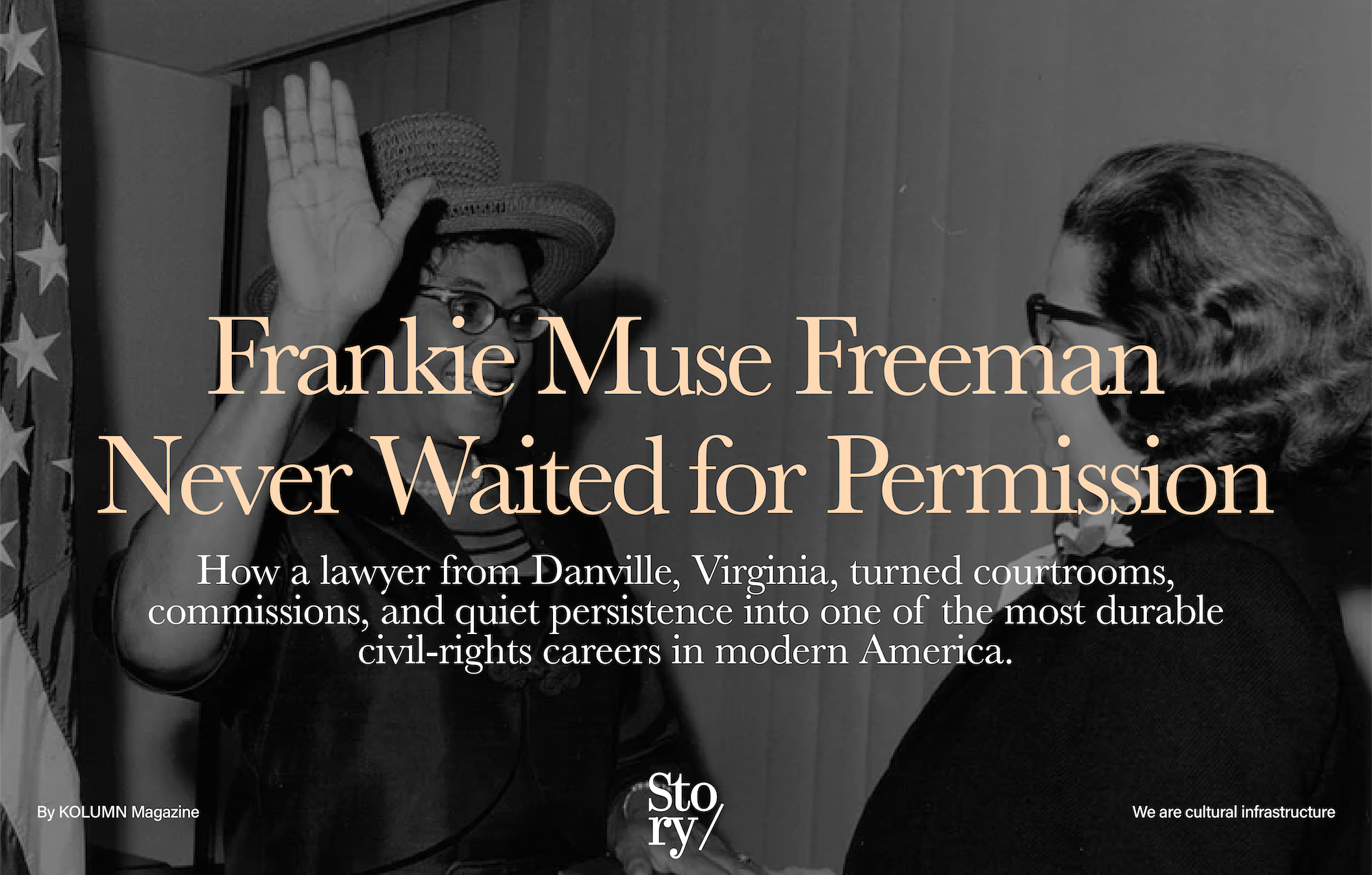
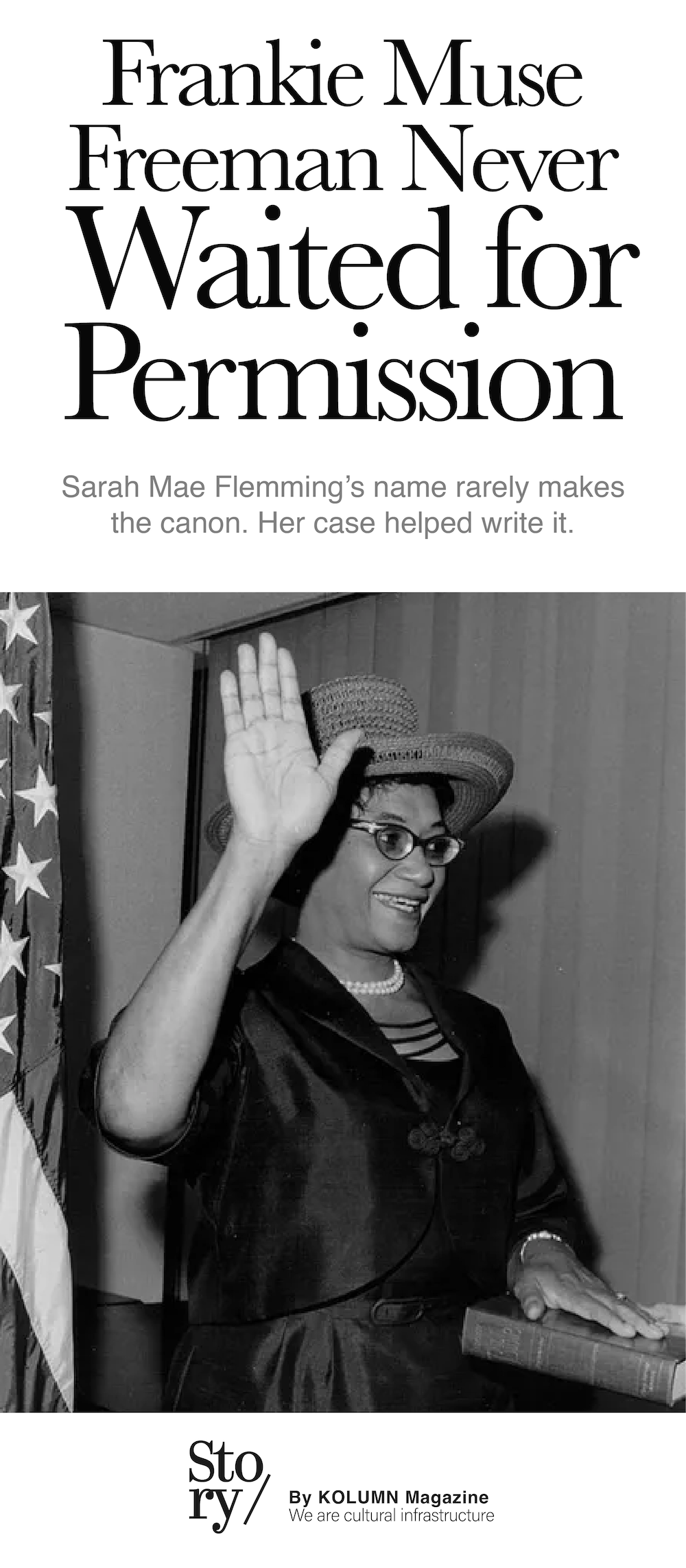
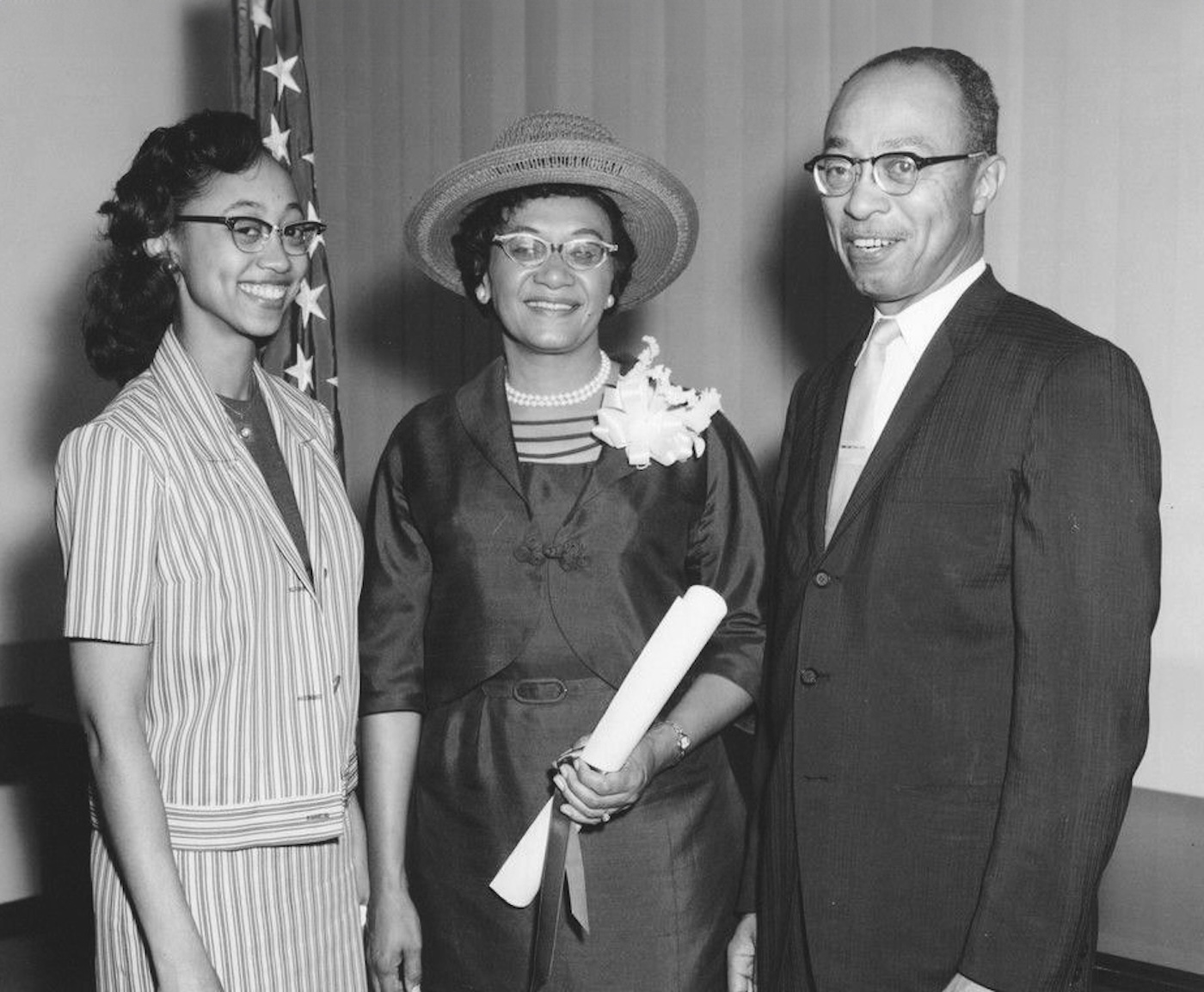
Frankie Muse Freeman belongs to that category of American figures who somehow remain both foundational and under-discussed. Her résumé is so stacked it almost reads like a compressed history of 20th-century Black public life: civil-rights lawyer, housing desegregation strategist, the first woman appointed to the U.S. Commission on Civil Rights, a longtime national civic leader, a Delta Sigma Theta national president, a presidential appointee across multiple administrations, and, well into her later years, still the kind of person who treated public service less like a chapter and more like a habit. Born in Danville, Virginia, on November 24, 1916, Freeman would go on to build a legal and civic career that stretched from Jim Crow’s deepest certainties into the unfinished arguments of the 21st century. The National Park Service later described her as a figure whose court victories became part of Americans’ “daily rights,” and that gets close to the heart of her significance: she did not merely symbolize progress; she helped write it into law and practice.
What makes Freeman especially compelling is that her life complicates the usual shorthand of civil-rights storytelling. Public memory often gravitates toward charismatic preachers, mass demonstrations, flashpoints, and martyrdom. Freeman’s arena was different. She believed in institutions enough to fight them, enter them, and then push them harder once inside. The line from her early NAACP litigation in St. Louis to her federal service in Washington is not a contradiction; it is the logic of her career. She understood that segregation was not just a moral failure or a regional custom. It was administrative. It was procedural. It was embedded in school assignments, housing policies, hiring practices, public accommodations, and supposedly neutral bureaucracies. That meant it required lawyers who could read the fine print, dismantle the machinery, and stay alert when the machinery tried to rebuild itself. The Library of Congress summary of her oral history puts it plainly: her work touched school segregation, public housing, the Civil Rights Commission, and later bipartisan watchdog efforts through the Citizens’ Commission on Civil Rights.
Freeman’s beginning matters because it helps explain her steadiness. According to the Missouri Historical Society’s biographical sketch, she was the oldest of eight children of William Brown Muse and Maude Beatrice Smith Muse, and she came of age in a Black family that prized education and discipline. She attended Hampton Institute, then moved to New York City, where she met Shelby T. Freeman Jr., a St. Louis native she married in 1938. The route to the law was not clean or welcoming. A St. Louis American account notes that she had hoped to attend St. John’s in New York, only to confront a system that discounted credits from Black colleges. Instead, after a period in Harlem and later Washington, she entered Howard University School of Law in 1944 while raising children, graduating in 1947 near the top of her class. That detail matters because it tells you something essential about her: she was not the beneficiary of an opening system. She kept moving through systems that were designed to slow her down.
By the time the Freemans reached St. Louis in 1948, she had the credentials, the ambition, and a problem familiar to Black women professionals of her generation: institutions admired excellence in theory and rejected it in practice. The ABA Women Trailblazers biography says that after writing several firms and getting nowhere, she opened her own practice in 1948, initially taking pro bono, divorce, and criminal matters. The St. Louis American fills in the texture. Even Black firms were reluctant to hire a woman trial lawyer. Judges had to be told directly that she was available for cases. One prospective client reportedly walked out after learning that “Frankie” Freeman was not a man. That kind of resistance could have made a different lawyer shrink her ambitions. Freeman instead treated exclusion as a clarifying force. She did not wait to be inducted into the profession’s comfort zone. She made herself unavoidable. In that sense, her private practice was more than a career move. It was an early act of structural defiance.
Her first major civil-rights work came quickly. The Missouri Historical Society and the ABA biography both identify Brewton v. Board of Education as one of her earliest important cases, involving the separate-and-unequal educational tracks offered at segregated technical schools in St. Louis. The St. Louis American recounts that the suit was brought on behalf of Black students seeking access to airplane mechanic training available only at the white school, and that Freeman and her NAACP colleagues prevailed, only to watch the school board eliminate the program rather than integrate it. That episode captures a recurring pattern in her career. A legal victory did not automatically produce justice; it often simply revealed the lengths to which institutions would go to preserve racial hierarchy. Freeman learned early that white resistance was not always dramatic. Sometimes it was petty, bureaucratic, and expertly disguised. Her genius was not just in winning cases. It was in understanding that each victory had to be defended against retreat, sabotage, and reinvention.
The case most closely associated with her name, and rightly so, was Davis v. St. Louis Housing Authority in 1954. The ABA Women Trailblazers biography calls Freeman the lead attorney in the landmark NAACP suit that ended legal racial discrimination in public housing in St. Louis. The Missouri Historical Society repeats that assessment in its biographical sketch, while the St. Louis American situates the case as a turning point not only for the city but for Freeman’s own stature in the movement. Housing segregation can sometimes seem less theatrical in public memory than bus boycotts or schoolhouse standoffs, but Freeman understood how central it was. Housing determined access to schools, wealth accumulation, safety, transportation, health, and the psychological map of belonging. To desegregate public housing was to challenge the city’s spatial logic. It was to say that race could not lawfully determine where dignity was permitted to reside. That is a huge thing to have done, and yet Freeman carried it with the matter-of-factness of someone who knew the work was bigger than the headline.
There is also something deeply revealing about what happened next. Rather than remaining forever outside the institutions she had defeated, Freeman went to work within housing administration. The ABA biography says she served as staff attorney for the St. Louis Land Clearance and Housing Authorities from 1956 to 1970, first as associate general counsel and later as general counsel. A lower-grade public imagination might read that as a softening or compromise. It was neither. Freeman seemed to grasp that changing the law was only the first half of the job; implementation mattered just as much. Winning a case against segregation did not automatically integrate a housing authority’s habits, personnel, or internal assumptions. Somebody had to be in the room when policy became procedure. Somebody had to insist that compliance mean more than decorative language. Her decision to move from adversary to counsel says a lot about how she thought. She was not addicted to outsider purity. She wanted results.
That same practical radicalism shaped her rise onto the national stage. In 1964, President Lyndon B. Johnson nominated her to the U.S. Commission on Civil Rights, making her the first woman to serve on the body. The Missouri Historical Society says she was later reappointed by Presidents Nixon, Ford, and Carter; the ABA biography notes that she held the position until 1979; and a U.S. Commission on Civil Rights letter marking her 100th birthday emphasized how fitting it was that Obama later appointed her to the Commission on Presidential Scholars. There are barriers, and then there are barriers so large that once broken they alter the expectation for everyone who follows. Freeman’s appointment was one of those. She was not the first Black woman on the Commission, as she sometimes reportedly corrected people to note. She was the first woman, period. That distinction mattered to her because precision mattered to her, and because she understood how often history minimizes Black women by folding their firsts into vaguer categories.
Her years on the Commission place her squarely inside some of the most contested terrain of post-1964 America. The Library of Congress summary of her oral history notes that she recalled Johnson asking her to join the Commission and discussed her work in Mississippi, a reminder that civil-rights enforcement was not an abstraction but a high-conflict national project. The St. Louis American adds another revealing chapter: when the Commission investigated employment and equal-opportunity issues involving McDonnell Douglas, Freeman defended the Commission’s work and soon found herself dismissed by the St. Louis Housing Authority. In her memoir, as quoted there, she wrote that she had been considered a “trouble-maker.” That word is doing a lot of work. In American public life, “trouble-maker” has often been what the powerful call a person who insists that law apply to them, too. Freeman’s career suggests that she had long ago made peace with being inconvenient to institutions that preferred applause without accountability.
What is especially striking is how broad her civil-rights understanding became. She was never just a housing lawyer, never just a school desegregation lawyer, never just a federal commissioner. The St. Louis American recounts that she also litigated gender discrimination, including a case involving a woman denied a high-school principal position because such posts were supposedly “reserved for men.” It also notes her 1978 suit against Southern Illinois University Edwardsville on behalf of a Black dental student who described his experience there as “psychological hell.” These episodes matter because they show Freeman thinking across categories before “intersectionality” became mainstream legal or academic vocabulary. Race, sex, education, housing, employment, public accommodations, political participation: for Freeman, these were not isolated silos but connected sites where power decided whose humanity counted and whose could be deferred.
She also knew this struggle in her own body. One of the strongest lines attributed to her comes from the St. Louis American: when asked whether she had been discriminated against more because of her race or her gender, she replied, “I don’t know, but I have scar tissue from both.” It is a devastatingly efficient sentence. It carries wit, realism, and the refusal to flatten lived experience into a contest of oppressions. It also tells you something about Freeman’s rhetorical style. She was not a grandstander. She could be elegant, but she could also be blunt in a way that cut through euphemism. The same article recounts her experiences being denied service in segregated facilities and then filing complaints that led to desegregation within weeks. That pattern repeated throughout her life: humiliation encountered, documentation assembled, action taken. She did not sentimentalize injustice. She moved against it.
If there is a throughline to Freeman’s life, it may be this: she believed freedom required administration. That sounds less romantic than it should, but it is one of the great neglected truths of democratic life. Protest can open a moral horizon. Litigation can create legal precedent. But commissions, boards, inspectors general, advisory bodies, and civic institutions determine whether rights become durable. Freeman served as assistant attorney general of Missouri in the mid-1950s, later became inspector general of the Community Services Administration under President Carter, and in 1982 joined the bipartisan Citizens’ Commission on Civil Rights, which the ABA and Library of Congress both describe as an effort to monitor government enforcement and devise remedies against discrimination. That pattern shows a figure who did not lose faith when the televised peak of the civil-rights era faded. She stayed in the less glamorous work of maintenance, review, and pressure. She understood that rollback is always waiting.
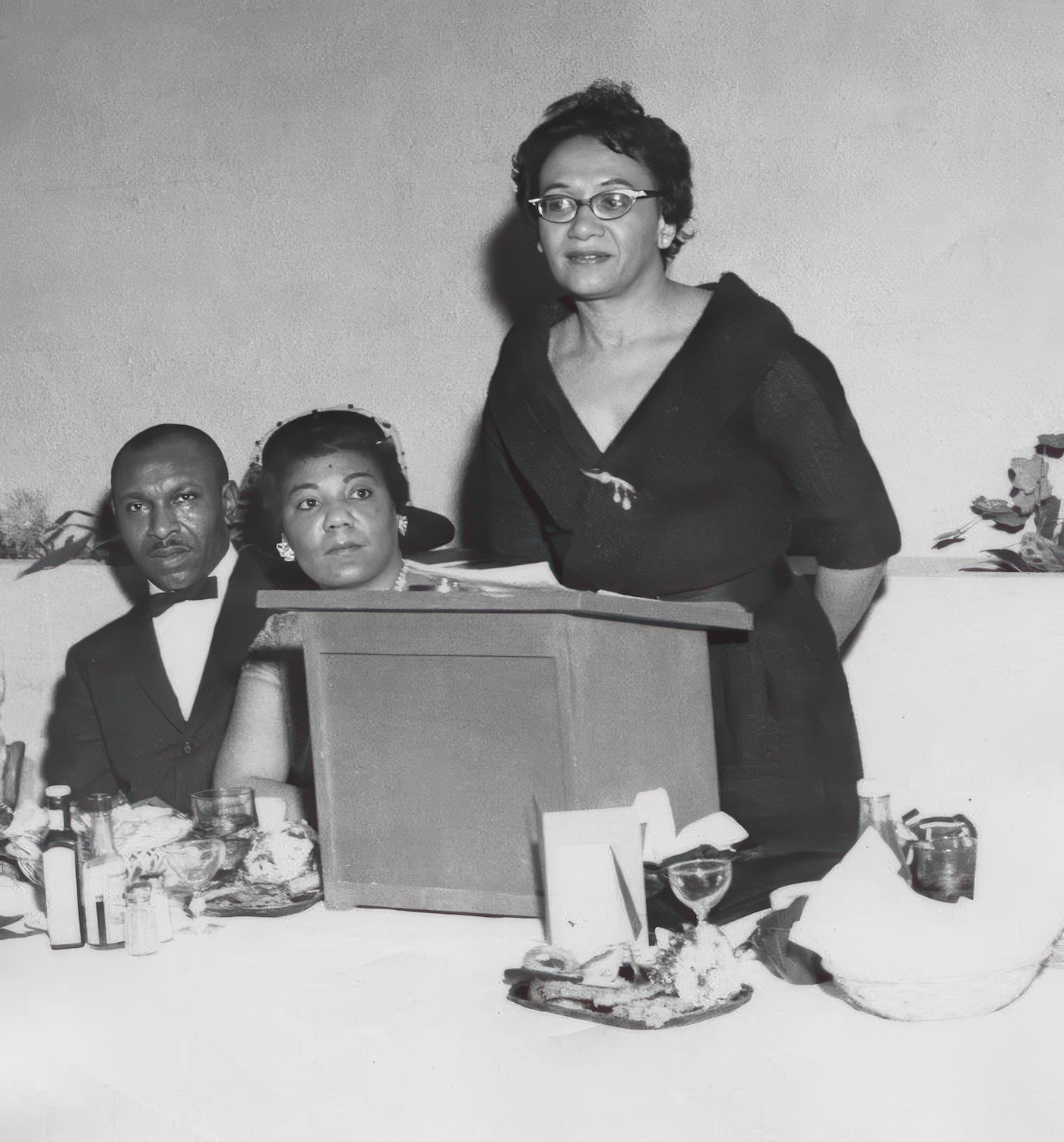
Her civic footprint extended beyond law in the narrow sense. The ABA biography lists her service with Howard University, the National Council on Aging, the Urban League of Metropolitan St. Louis, the Girl Scouts, the United Way, the YMCA, and other local and national boards. The Missouri Historical Society adds her service to the Metropolitan Zoological Park and Museum District Board and notes years of speeches, public appointments, and local recognition, including multiple proclamations of “Frankie Muse Freeman Day.” These details are not ornamental. They reveal a worldview in which civil rights were inseparable from civic architecture. Freeman did not seem interested in the pose of the solitary heroine. She joined boards, chaired committees, served churches, mentored institutions, and worked inside organizations that many activists dismiss as too ordinary to matter. But ordinary institutions are where public life actually happens. Freeman’s gift was seeing that.
She was honored widely, and significantly, while she was alive. The National Park Service inducted her into the International Civil Rights Walk of Fame in 2007. The ABA biography notes that the St. Louis Post-Dispatch named her Citizen of the Year in 2011, the same year she received the NAACP’s Spingarn Medal, the organization’s highest honor. The St. Louis American’s coverage of that award quoted NAACP leadership praising her barrier-breaking work and decades-long commitment to ending discrimination. In 2014 she received the American Bar Association’s Spirit of Excellence Award, and in 2015 President Obama appointed her to the Commission on Presidential Scholars. Then, in 2017, the St. Louis NAACP commissioned and installed a life-size bronze statue of her in Kiener Plaza. Public statuary can sometimes feel like a city’s attempt to apologize for having missed someone in real time. In Freeman’s case, the statue also felt like a hard-won acknowledgment that St. Louis had been shaped, materially and morally, by a Black woman lawyer who refused to leave justice to chance.
Yet even with all those honors, Freeman remains oddly less famous than she should be. Part of that has to do with the way American memory works. We like singular narratives, not people whose careers stretch across six decades and several institutional forms. We like dramatic confrontation more than sustained governance. We especially like civil-rights history when it can be reduced to a few photogenic moments and a handful of men. Freeman’s life resists all of that. She was a Black woman lawyer working in housing, education, federal oversight, and civic leadership. She helped children, monitored school integration, took in members of the Little Rock Nine during a dangerous summer in St. Louis, and kept practicing law deep into old age. The St. Louis American’s account of her providing a “safe house” for three of the Little Rock students is one of those details that quietly rearranges a reader’s sense of scale. It reminds us that behind the iconic images of movement history were practical networks of care, and Freeman was part of building those networks too.
The casual tone of Freeman’s public presence can make people underestimate just how radical she was. She could seem measured, church-rooted, impeccably professional, almost serene. But that surface should not be mistaken for moderation in the substantive sense. The lawyer who dismantled segregated public housing in a major American city was not a moderate in any meaningful relationship to power. The woman who defended federal civil-rights oversight when local elites turned on her was not a moderate in any meaningful relationship to racial convenience. Freeman’s method was disciplined rather than theatrical. She did not need to perform militancy because her record already did the talking. In a culture that often mistakes loudness for courage, her life offers a different model: rigor, endurance, institutional fluency, and a near-total lack of interest in being intimidated.
Her memoir’s title, A Song of Faith and Hope, feels almost too gentle until you think about what it took to sustain either faith or hope across the century she lived. Freeman was born before women had the constitutional right to vote for even four years. She came of age under Jim Crow, built a legal career when Black women were systematically excluded from elite law practice, fought housing segregation before fair housing became national consensus, served through administrations of both parties, and lived long enough to receive an appointment from the first Black president. The arc is extraordinary, but it was never automatic. Freeman’s life rebukes any easy idea of progress as self-executing. Rights expanded because people like her pressed institutions, embarrassed them, sued them, staffed them, monitored them, and returned when they backslid.
Frankie Muse Freeman died on January 12, 2018, at 101. By then, according to the Missouri Historical Society, her papers documented appointments from Johnson, Carter, and Obama, a law career that began in the 1940s, and a body of speeches and records spanning decades. The St. Louis American quoted former Congressman Bill Clay calling her one of the nation’s greatest crusaders for racial and sexual justice. That sounds right, but even that description may undersell the full shape of her contribution. Freeman was not merely a crusader. She was a builder. She built precedent. She built pathways into professions. She built federal legitimacy around civil-rights enforcement. She built networks of Black civic power in St. Louis. She built an example of how a person can remain both graceful and unyielding. In a juster culture, her name would be as instantly legible as many of the men whose work depended on women like her holding the line, filing the suit, drafting the policy, or opening the door.
And maybe that is the clearest way to understand her significance now. Frankie Muse Freeman represents a version of freedom work that America still badly needs: unspectacular to the inattentive eye, transformational to anyone paying attention. She reminds us that democracy is not saved only by eloquence or by emergency. It is also saved by competence, by memory, by legal imagination, by moral stamina, and by people who do not get bored with justice after the cameras leave. Her legacy is not just that she was first in so many rooms. It is that she changed what those rooms were for.
More great stories
Afro Sheen, Wall Street, and the Architecture of Black Possibility
July 6, 2026
No Comments
The Fire Inside the Fourth
July 5, 2026
No Comments