

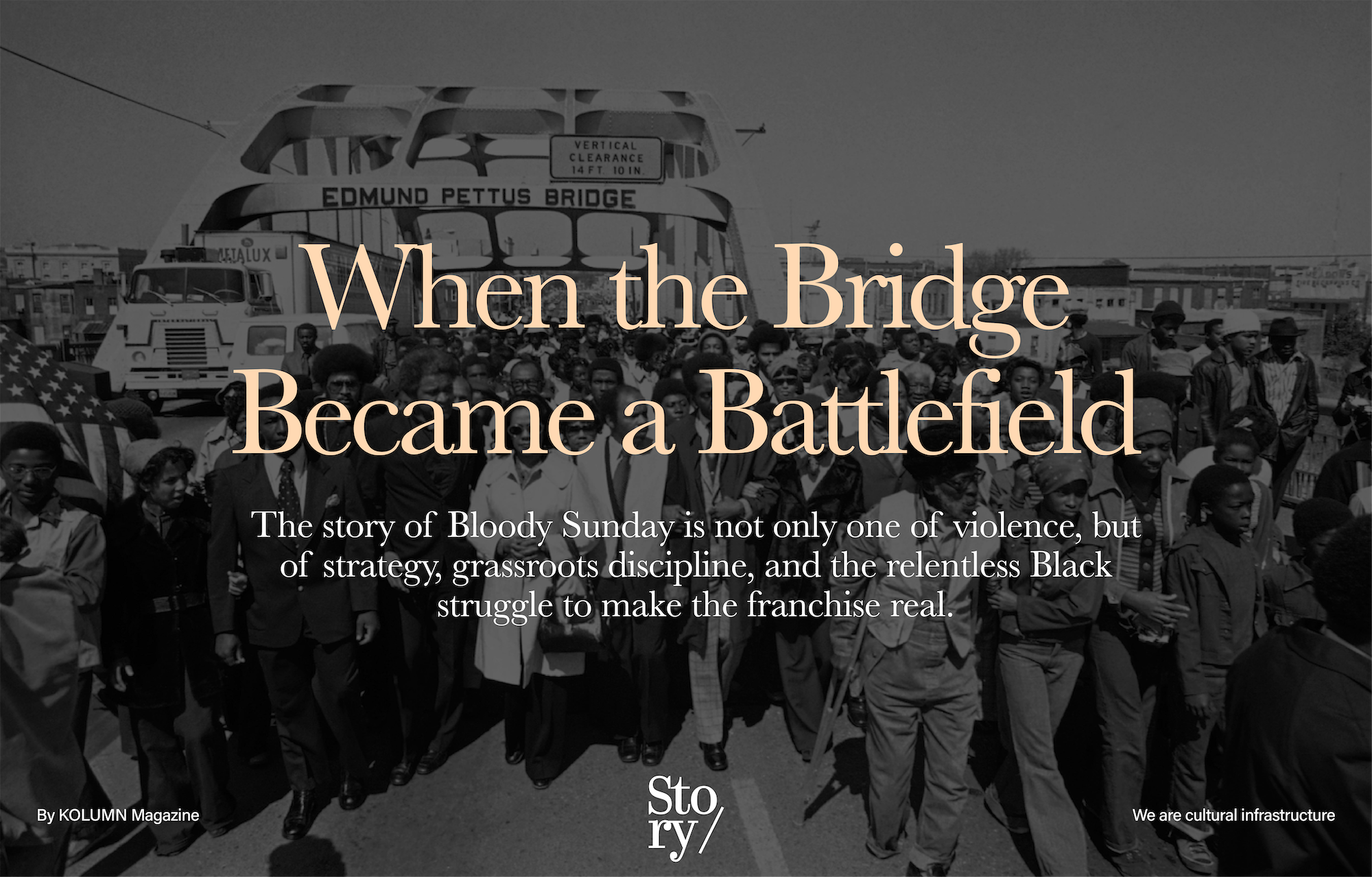
They understood that a bridge could become an argument and a wound could become evidence.
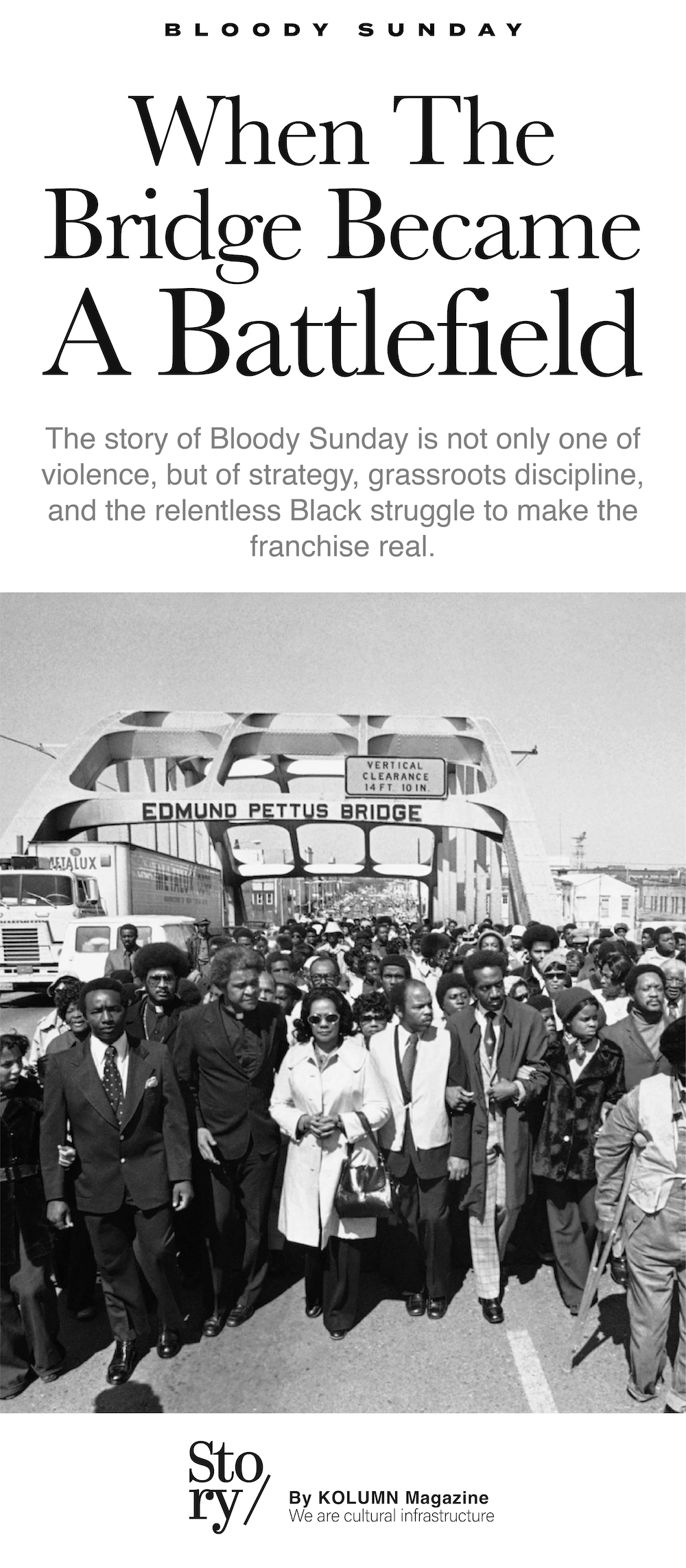
They understood that a bridge could become an argument and a wound could become evidence.
By KOLUMN Magazine
American history has a habit of flattening its turning points. It sands off the organizing, shortens the names, and turns a long campaign into one neat scene: a bridge, a line of marchers, a wall of troopers, the crack of clubs, the blur of tear gas. Bloody Sunday, the name given to the assault on civil rights marchers in Selma, Alabama, on March 7, 1965, is often remembered that way. The shorthand is understandable. Nearly 600 people set out from Brown Chapel A.M.E. Church to march the 54 miles from Selma to Montgomery in protest of racist disfranchisement and the recent killing of Jimmie Lee Jackson. At the Edmund Pettus Bridge, Alabama state troopers and mounted deputies attacked them. The violence left scores injured, helped shock the nation, and accelerated the path to the Voting Rights Act of 1965. But if that is all Bloody Sunday is allowed to mean, then the real story is lost.
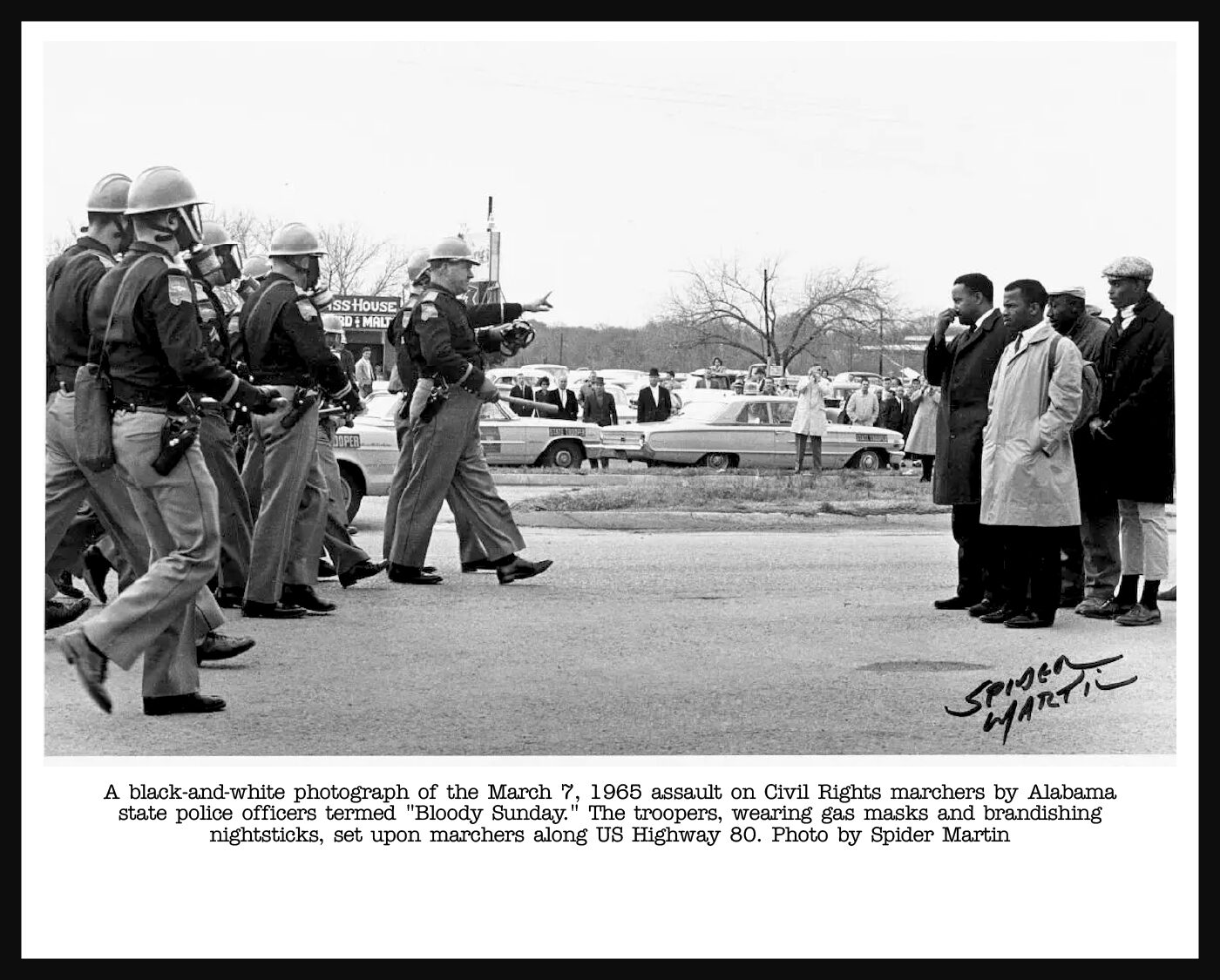
The real story begins long before television cameras caught John Lewis collapsing under blows to the head. It begins in Dallas County, Alabama, where Black residents had been pressing for the ballot for years under conditions designed to make democratic participation nearly impossible. It begins with the Dallas County Voters League, with local women and men such as Amelia Boynton, Marie Foster, Frederick Douglas Reese, and the group remembered as the “Courageous Eight.” It begins with SNCC organizers who had been in Selma since 1962, and with SCLC leaders who came later, at the invitation of local activists, to help turn a local fight into a national confrontation. Bloody Sunday mattered because it dramatized an injustice the movement had already spent years documenting, surviving, and resisting.
That broader view matters now because Bloody Sunday was not spontaneous chaos. It was organized history. The marchers were not simply victims of a shocking attack; they were disciplined political actors working within a strategy. Their aim was to expose the contradiction at the center of American democracy: a nation that claimed universal rights while allowing local officials to nullify them through terror, bureaucracy, and the ordinary routines of white supremacy. Martin Luther King Jr. later described Selma as a place where the “heart of the voting problem” was that enforcement remained in the hands of officials invested in Black disfranchisement. That was not rhetoric. It was a diagnosis.
Why Selma became the place
Selma was not chosen by accident. By early 1965, the movement’s leadership understood that the next major civil rights fight had to focus squarely on voting. The Civil Rights Act of 1964 had attacked segregation in public accommodations and employment, but it had not broken the political chokehold that white officials maintained over Black communities across the South. In Selma and surrounding Dallas County, that chokehold was glaring. The King Institute notes that although local Black residents repeatedly tried to register, only about 2 percent were on the voting rolls; King himself wrote that out of 15,000 eligible Black voters in Selma and the surrounding county, fewer than 350 were registered. The gap between the county’s Black population and its political power was not a side issue. It was the issue.
The mechanics of suppression were both blunt and elaborate. King described four major links in the “chain of slavery” that still bound Black citizens in Selma: the fear produced by sheriffs and deputies known for brutality; local ordinances that criminalized group action and subjected meetings to harassment; a registration system slowed to a crawl by limited office hours and deliberate delay; and literacy tests administered unfairly and strategically. In other words, Selma represented not one single barrier, but an entire governing structure designed to convert Black citizenship into a fiction.
That is why local organizing mattered so much. Before Selma drew national attention, Black residents had already been building the movement’s infrastructure. SNCC’s Bernard Lafayette and Colia Liddell Lafayette arrived in Selma in 1962 and found Amelia and S.W. Boynton ready for sustained work. The Boyntons had been urging Black people to register, acquire land, and build political power for years. They used their offices, their businesses, and their relationships in rural churches and homes to teach people how to complete the registration paperwork and navigate the county’s hostile system. By the mid-1930s, Amelia and S.W. Boynton were already involved in revitalizing the Dallas County Voters League. That long continuity is essential. Selma was not awakened by outsiders. Outsiders entered a struggle locals had already kept alive at considerable risk.
Amelia Boynton’s place in this history is especially important because mainstream retellings often narrow Bloody Sunday to a few famous men. Boynton was not a background figure. She was a strategist, a convener, and a bridge between generations of Black political organizing in Alabama. The National Park Service notes that after S.W. Boynton died, Amelia pressed forward, even running for Congress in 1964 as the first Black woman and the first woman to seek that office from Alabama. Her motto was plain: “A voteless people is a hopeless people.” When she asked King and SCLC to come to Selma, they accepted and used her home as a planning hub for the campaign and the march.
The coalition behind the march
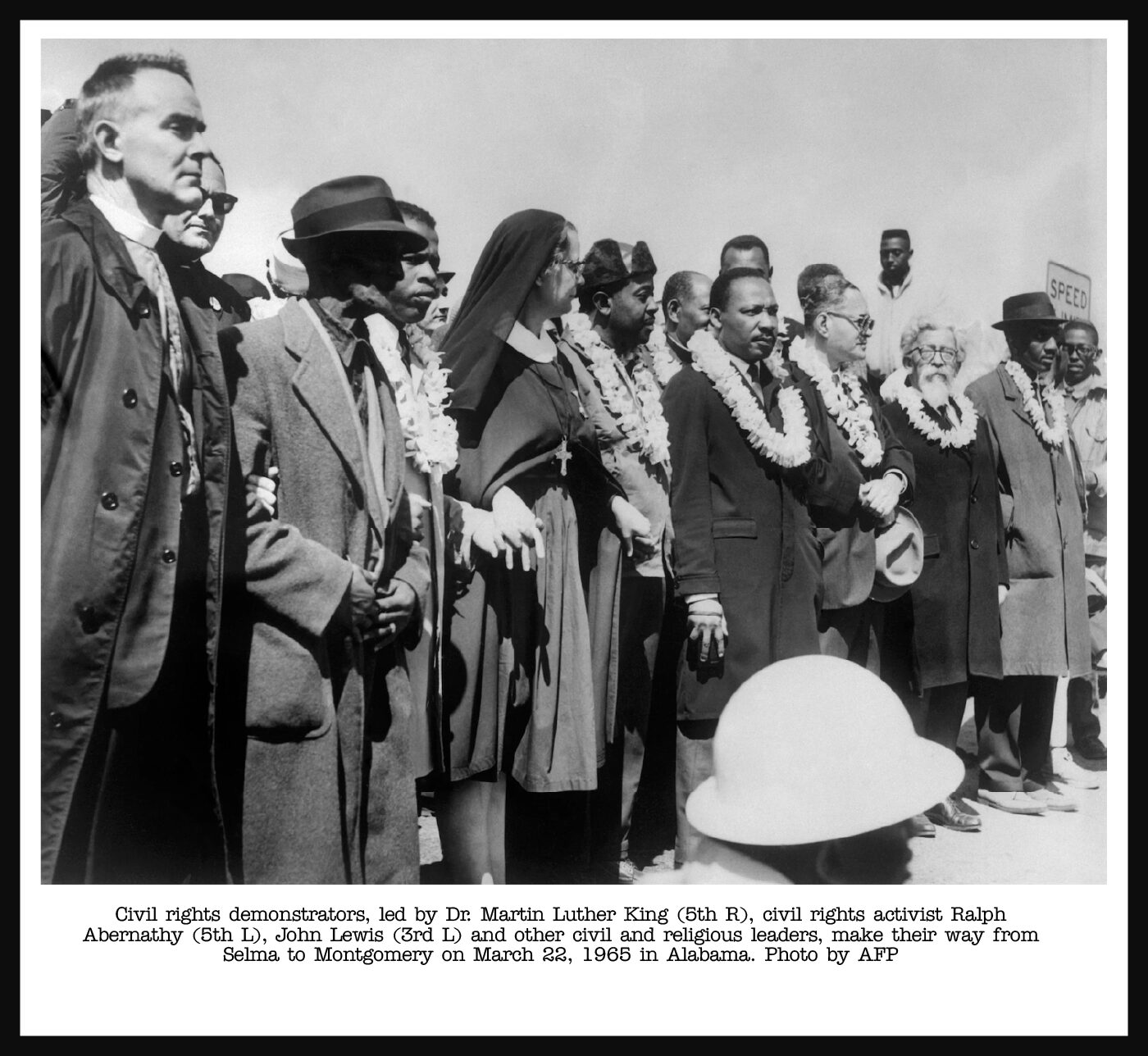
Bloody Sunday is sometimes told as if Selma were the site of perfect movement unity. The truth is more interesting and more human. The campaign in Selma involved local activists, SNCC, the Dallas County Voters League, and SCLC, but the coalition was not free of tension. SNCC had been in Selma for years and had deep roots there. SCLC brought national celebrity, fundraising strength, and the press magnetism of King. Those differences created disagreements over tactics, timing, and the role of charismatic leadership. The SNCC Digital Gateway notes that SNCC as an organization decided not to officially participate in the March 7 trek because many in the group believed such marches spilled too much blood for too little gain. Yet SNCC members who wished to join could do so personally, which is why John Lewis marched in the front ranks alongside SCLC’s Hosea Williams.
That tension should not be read as weakness. It is part of how serious movements function. Different organizations brought different theories of change. SNCC emphasized grassroots leadership and deep local relationships. SCLC often pursued high-visibility confrontations designed to force federal action. In Selma, both approaches mattered. Without local credibility, national attention would have been hollow. Without national attention, local suffering might have remained local news. Selma became historic because those streams met in one place.
James Bevel’s role is also central. After Alabama state troopers attacked demonstrators in Marion on February 18, 1965, and shot Jimmie Lee Jackson as he tried to protect his mother, Jackson died eight days later. That killing transformed the emotional and strategic stakes of the campaign. The National Archives identifies Jackson’s death as the immediate prompt for Bevel’s call for a march from Selma to Montgomery to confront Governor George Wallace about violence and disfranchisement. The march was therefore memorial and protest at once: a public grieving ritual and a political escalation.
The decision to march to Montgomery also carried symbolic power. Selma was where local suppression was lived. Montgomery was where state power sat. A walk from one to the other made an argument with bodies: that ordinary Black citizens had the right to travel from the site of their exclusion to the seat of authority and demand recognition. The route itself turned Alabama geography into political language.
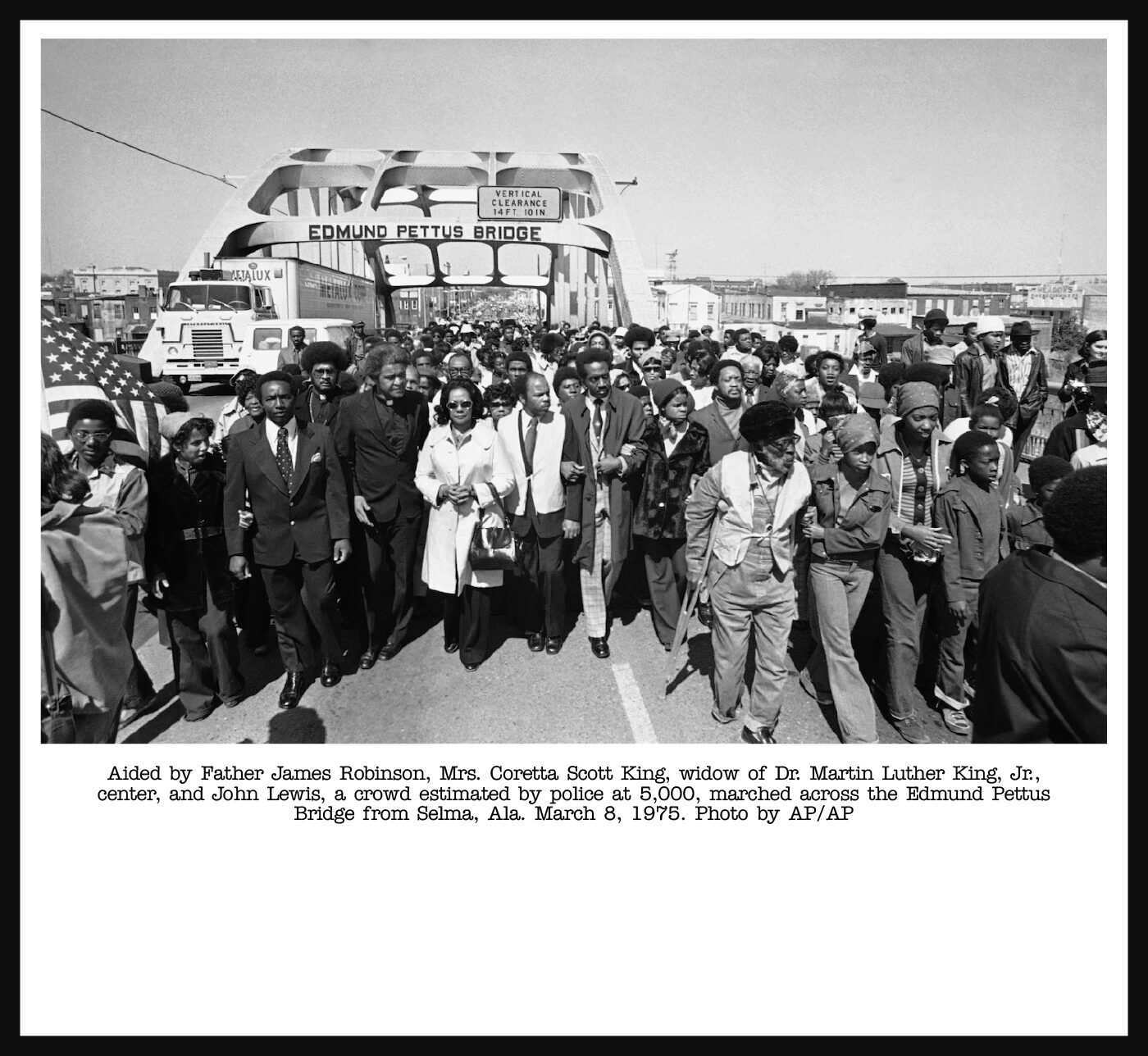
March 7, 1965
On the morning of March 7, the marchers gathered at Brown Chapel A.M.E. Church. Amelia Boynton later recalled seeing the road blocked just past the bridge. They marched in ordered rows, with John Lewis and Hosea Williams at the front. The intention was nonviolent and public. According to National Park Service and Library of Congress materials referenced through official historical resources, the front line included well-known figures, but it also included local people whose names are less often invoked: church members, teachers, laborers, domestic workers, and young activists who understood the risk but came anyway.
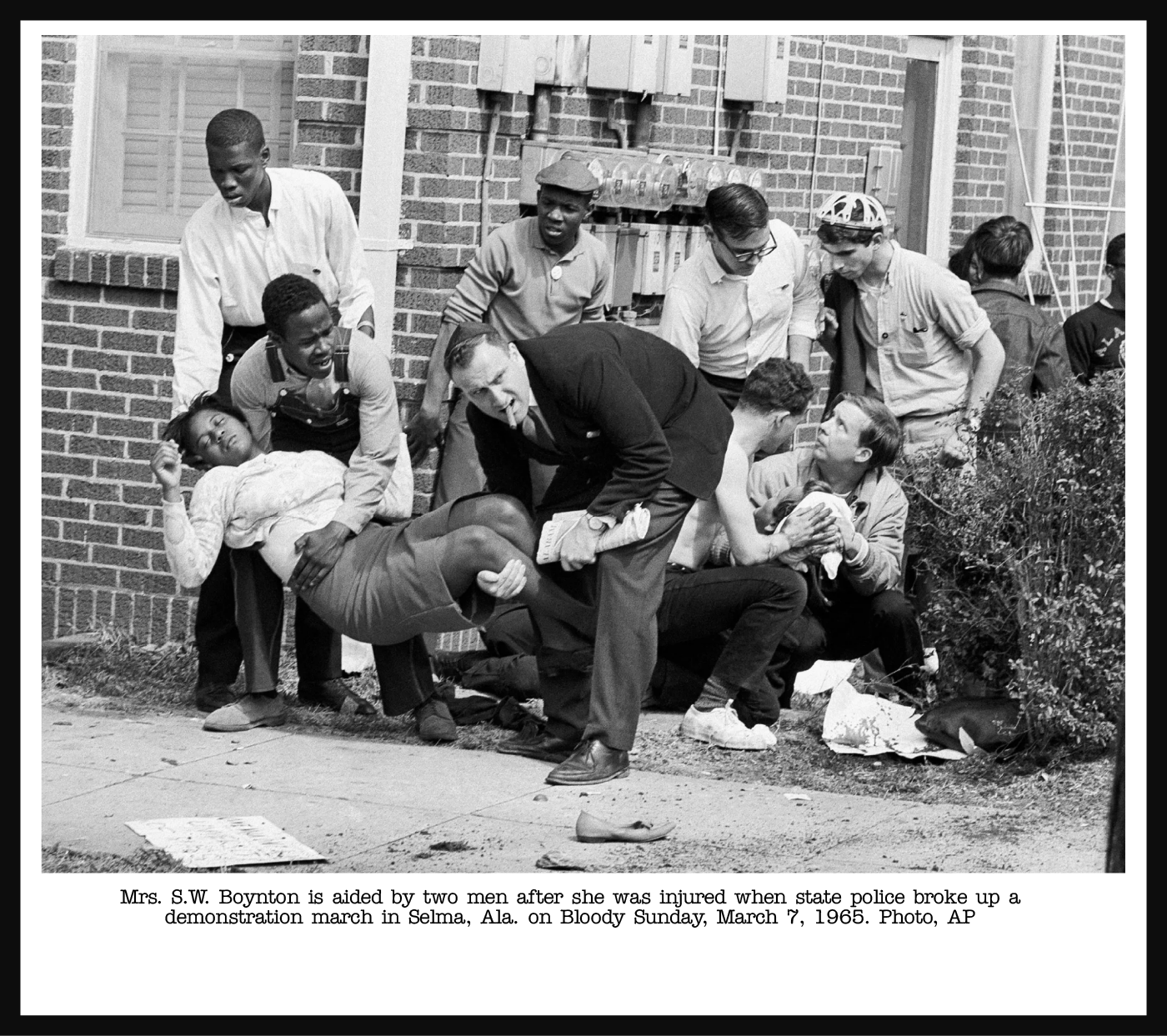
The state’s response was immediate and theatrical in its own way. The marchers met Alabama state troopers and Sheriff Jim Clark’s mounted posse, many equipped with gas masks, clubs, and tear gas. Boynton remembered a “solid wall” of troopers. After the order to disperse, officers charged. Lewis suffered a skull fracture. Boynton was beaten unconscious. National Archives and National Park Service sources report that more than 60 people were injured; the Park Service biography of Boynton says more than 70 were beaten and 17 hospitalized. The precise injury count varies by source, but the basic fact does not: the state used overwhelming force against unarmed citizens engaged in peaceful protest.
The iconic images from that day have become part of the nation’s visual archive for a reason. They condensed the moral argument of the movement into a form the country could not easily deny. Here were Black citizens in coats and dresses, on a highway in daylight, assaulted not by a mob operating in the shadows but by officers acting under color of law. This was one of Bloody Sunday’s deepest meanings. It stripped away the convenient fiction that Southern racial violence was merely the work of extremists. In Selma, the violence was governmental.
When television changed the scale of the struggle
Movements do not rely on media alone, but Selma demonstrates what can happen when disciplined organizing collides with modern broadcasting. The National Park Service notes that millions of Americans had their television programming interrupted that evening by the footage from Selma. History records that ABC broke into its broadcast of Judgment at Nuremberg to show the attack. The juxtaposition was devastating: a film about Nazi crimes interrupted by real-time images of American officers brutalizing peaceful Black demonstrators. The comparison was not exact, but it did not need to be. The moral charge was immediate.
This is one reason SCLC had seen Selma as strategically potent. The King Institute states plainly that SCLC believed the notorious brutality of Sheriff Jim Clark and local law enforcement would attract national attention and press President Lyndon B. Johnson and Congress toward voting-rights legislation. That assessment was grim, but correct. Selma was not chosen because suffering was desirable. It was chosen because Southern authorities were likely to reveal themselves on camera, and because the movement had learned, again and again, that in America visibility could force action when moral appeal alone did not.
The footage did more than inform the public. It altered the political weather. Clergy, students, labor leaders, and ordinary citizens traveled to Selma after Bloody Sunday. The campaign’s center of gravity shifted. It was no longer a local or even regional confrontation. It had become a national test of whether the federal government would protect a constitutional right when a state refused to do so.
From Bloody Sunday to the Voting Rights Act
Eight days after the attack, Johnson addressed Congress. In one of the most consequential speeches of his presidency, he told lawmakers that what happened in Selma was part of a much larger effort by Black Americans to secure “the full blessings of American life,” then concluded with the movement’s own refrain: “And we shall overcome.” That moment mattered not simply because a president used powerful language, but because the federal executive branch publicly aligned itself, however imperfectly and belatedly, with the movement’s core demand.
The movement still had to force the issue forward. The second march, on March 9, ended with marchers turning back at the bridge in what became known as “Turnaround Tuesday,” amid legal uncertainty and tactical dispute. The third march, beginning March 21, proceeded under federal protection. The King Institute and National Park Service both note that more than 1,000 marchers set out and that the final rally in Montgomery drew roughly 25,000 people. On March 25, King delivered “Our God Is Marching On,” linking the march not only to voting rights but to the unfinished transformation of American democracy.
On August 6, 1965, Johnson signed the Voting Rights Act. The Justice Department notes that the law imposed a nationwide prohibition on racial denial or abridgment of the vote and included targeted enforcement provisions for jurisdictions where discrimination was most entrenched. The National Archives adds that the law outlawed practices such as literacy tests that had long been used to block Black voting in the South. It is historically sound to say Selma was not the sole cause of the Act; generations of Black struggle made the law possible. But it is equally sound to say that Bloody Sunday was the immediate catalyst that broke the legislative logjam.
The significance of Bloody Sunday now
The significance of Bloody Sunday can be described on at least three levels. First, it was a triumph of grassroots organizing. The event is often remembered through famous photographs, but the deeper triumph was organizational: years of local voter education, church meetings, citizenship classes, coalition-building, and political risk-taking made the march possible. Without those foundations, there would have been no national spectacle to witness.
Second, Bloody Sunday exposed the structure of American racial rule in a way the nation could not comfortably evade. The issue was not prejudice in the abstract. It was power: who could register, who could assemble, who could petition the government, who could safely move through public space, and who could expect police protection instead of police violence. Selma forced Americans to see that the right to vote is only as real as the institutions willing to defend it.
Third, Bloody Sunday remains significant because its victory was never self-executing. The Guardian’s reporting on the 60th anniversary captures how veterans and contemporary leaders increasingly frame Selma not as a closed chapter, but as a warning and a mandate. Participants and observers linked the anniversary to present-day threats to civil rights enforcement and democratic participation, arguing that the meaning of Selma depends on whether later generations defend the franchise with comparable seriousness. That is an interpretation, but it is one rooted in the way Selma has always functioned in public life: less as a shrine to completed progress than as a measuring stick for the country’s democratic honesty.
This is why Bloody Sunday still matters far beyond Alabama. It reminds the country that reform did not arrive because power voluntarily corrected itself. It arrived because ordinary Black citizens, local movement builders, national organizers, clergy, students, and allies made injustice impossible to ignore. It reminds us that strategy and sacrifice were intertwined. It reminds us that when officials insist a problem is exaggerated, one of the movement’s oldest responses has been to stage the truth in public. And it reminds us that the ballot, so often discussed as a simple civic ritual, has historically been a contested terrain won through pain, planning, and collective nerve.
There is a temptation, in commemorating Bloody Sunday, to treat the marchers as mythic figures rather than political thinkers. But that would undersell them. They understood institutions. They understood optics. They understood law, even when the law did not protect them. They understood that federal action had to be compelled. They understood that a bridge could become an argument and a wound could become evidence. In that sense, Bloody Sunday was not simply a moment of martyrdom. It was a lesson in democratic leverage.
And that may be the event’s most enduring significance. Bloody Sunday showed that a democracy can be moved when those denied its promises force the nation to confront the distance between its ideals and its behavior. The people who marched out of Brown Chapel on March 7, 1965, did not know exactly what the country would do with the evidence they were about to provide. But they knew evidence was needed. They knew the lie had to be made visible. On that bridge in Selma, they made it visible, and the country has been answering for it ever since.
More great stories
Afro Sheen, Wall Street, and the Architecture of Black Possibility
July 6, 2026
No Comments
The Fire Inside the Fourth
July 5, 2026
No Comments