




A story about what segregation did when it was allowed to become infrastructure.
A story about what segregation did when it was allowed to become infrastructure.
By KOLUMN Magazine
If you grew up anywhere near the South, you probably know the sound of a screen door slapping shut on a humid evening. It’s not a dramatic sound. It’s domestic. Ordinary. It’s the noise of somebody coming home, or being sent out, or being told—maybe kindly, maybe not—to get in the house.
Now take that sound and strip it of everything that makes it normal. Replace the screen door with a heavy institutional door. Replace “get in the house” with “stay in the dorm.” Replace the comfort of family with the discipline of a segregated state facility. Then add the most unforgiving detail of all: the door is locked from the outside.
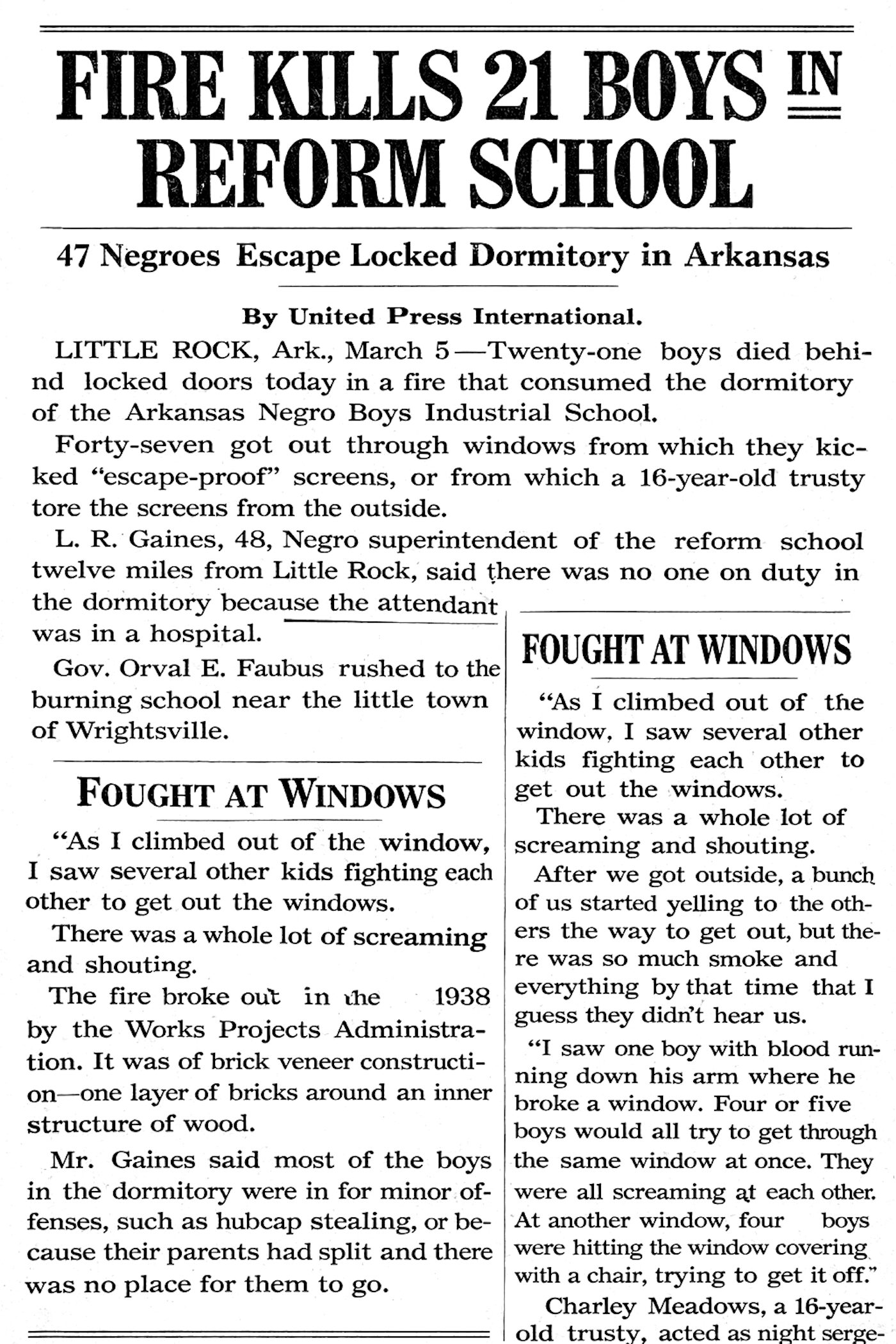
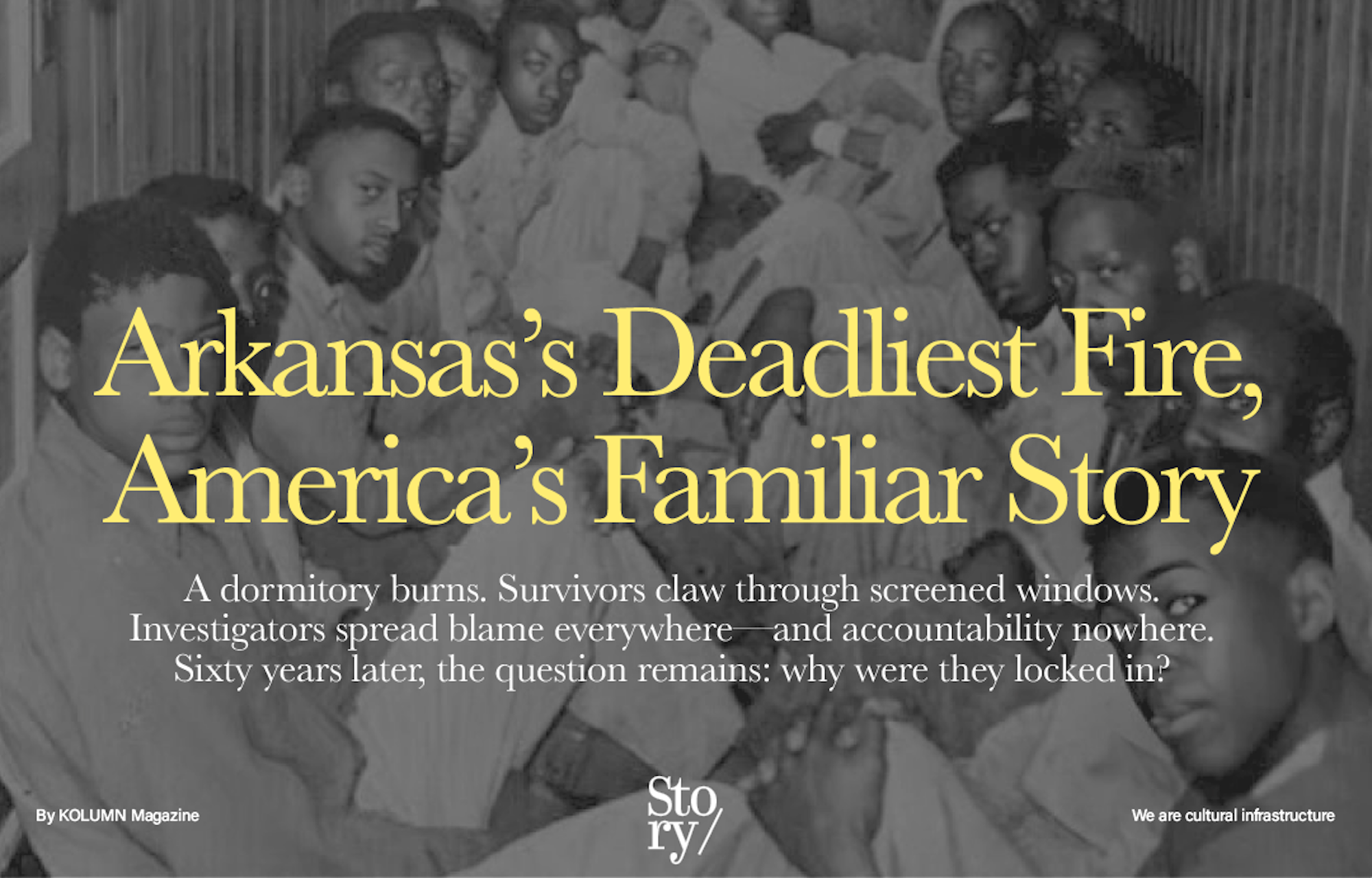
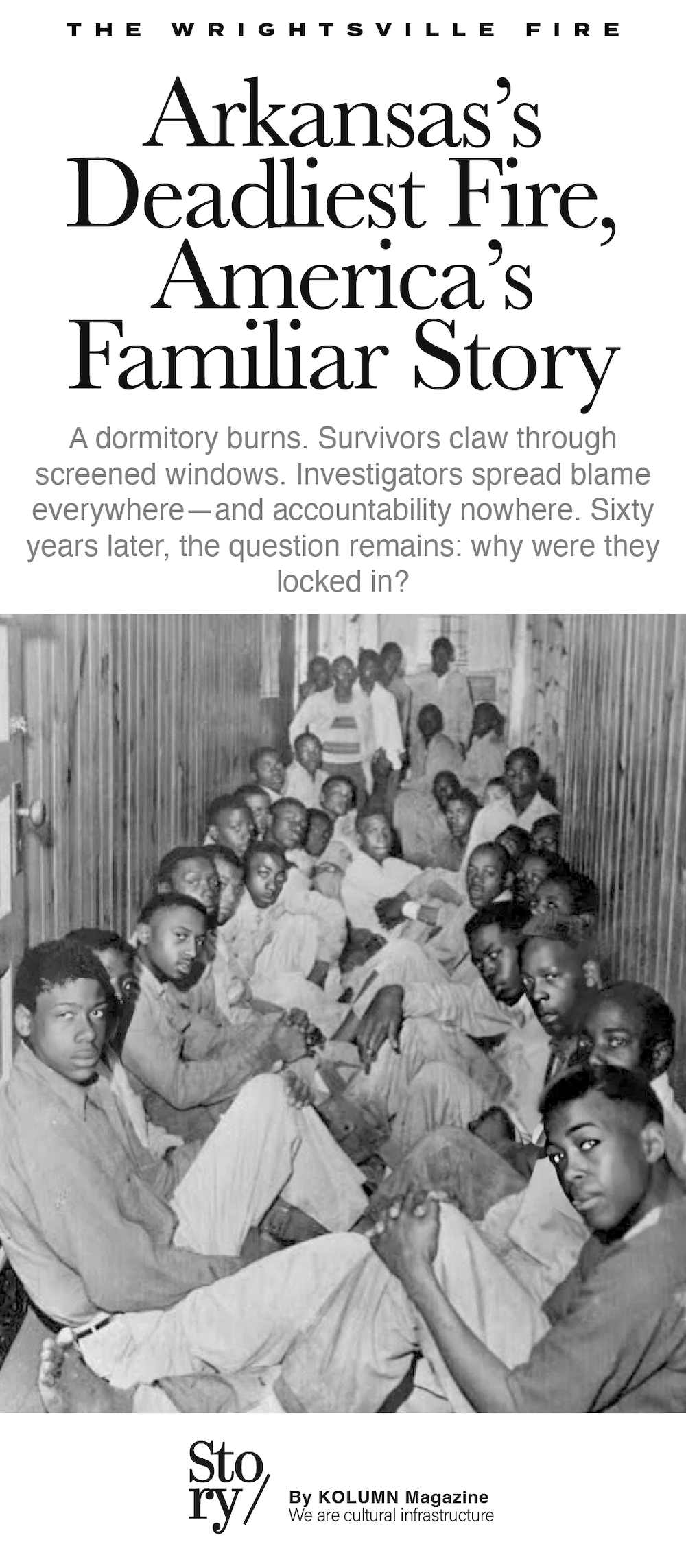
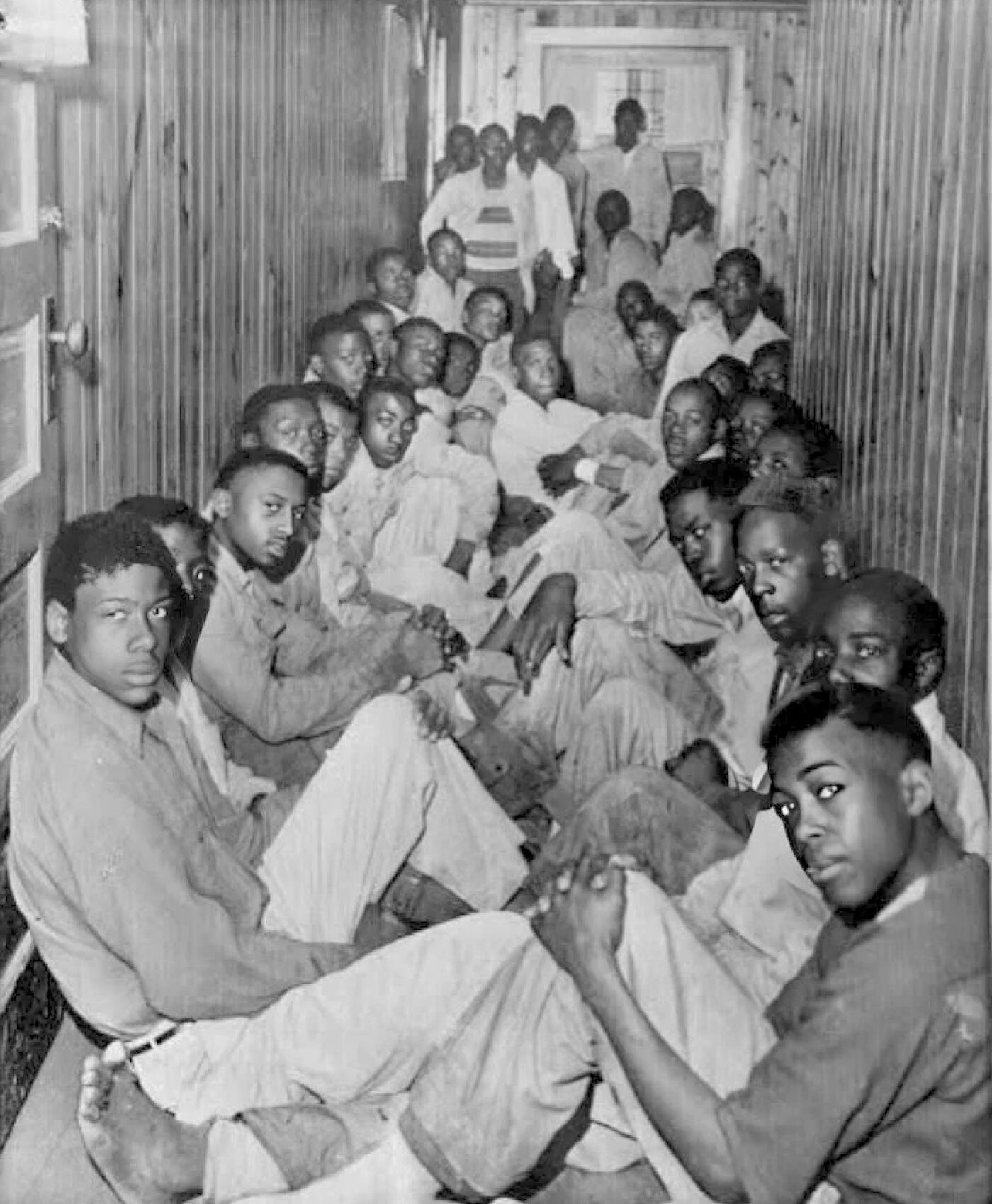
That’s the Wrightsville Fire, March 5, 1959—also widely referred to as the Negro Boys Industrial School Fire of 1959, or the tragedy of the “Wrightsville 21.” Twenty-one Black boys, most between 13 and 17, died in a pre-dawn fire in a dormitory at a segregated reform school outside Wrightsville, Arkansas. The dorm doors were locked. The windows were screened with heavy mesh. Survivors escaped by tearing at those barriers and forcing their way out through openings that only a few boys at a time could fit through. Others never made it out.
On paper, it’s a single event: a dormitory fire that turned fatal because of confinement. In practice, it’s a story about what segregation did when it was allowed to become infrastructure—built into budgets, policies, staffing, and the quiet assumptions of who deserved safety. It’s also a story about memory: why some tragedies become national shorthand and others become local grief, carried like a family Bible from one generation to the next.
The most honest way to understand the Wrightsville Fire is to stop treating it like an “accident” in isolation and start treating it like a scene in a longer movie: the postwar South, the backlash years after Brown v. Board, the Little Rock crisis still fresh in the air, and the routine humiliations of Jim Crow governance playing out not only in schools and buses, but inside the custody systems that took Black children and called it “correction.”
A place called a school, functioning like a lockup
The institution at the center of the story was the Arkansas Negro Boys Industrial School (often abbreviated NBIS), which the Encyclopedia of Arkansas describes as a juvenile work farm that operated during the Jim Crow era—first outside Pine Bluff, later near Wrightsville, down a dirt road from a mostly Black community south of Little Rock.
The name matters, because names are how systems sell themselves. “Industrial school” suggests training, structure, and a second chance. But contemporary and later accounts repeatedly describe something closer to a penal work farm—where education was minimal and labor was central, and where the children housed there were treated less like students and more like inmates. In reporting tied to later historical work and renewed public attention, scholars at UA Little Rock put it bluntly: calling it a “school” was a misnomer; the boys were “exploited for their labor” and kept in deplorable conditions.
Who were the boys? They weren’t a single type. Some had been labeled delinquent, some were effectively warehoused because they were poor, homeless, orphaned, or considered “incorrigible” by local authorities with wide discretion. Equal Justice Initiative’s entry on the event emphasizes how minor the “offenses” could be—so minor they read, today, like the criminalization of childhood itself: riding a white boy’s bicycle (even with permission), a Halloween prank like soaping windows.
None of that means every boy was innocent of every allegation, in the strict legal sense. That’s not the point. The point is that the institution existed within a racial order that treated Black youth as inherently suspect and easily punishable—an order that could turn small misbehavior into state custody, and custody into coerced labor, and labor into a daily routine that normalized confinement as “discipline.”
So when you ask how a dormitory could be locked from the outside, the answer isn’t just “bad policy.” It’s a worldview. It’s the assumption that these boys were the kind of children you locked in.
The night of March 5: routine confinement meets catastrophe
By the time the fire ignited—around 4 a.m., according to multiple summaries and historical accounts—it was already a cold, wet Arkansas morning, with storms having moved through earlier. The dormitory was occupied by dozens of boys. Staff were not inside the building with them. And as was apparently routine, the dormitory doors were secured from the outside.
From there, the story becomes brutally physical. Survivors described clawing their way to escape. The Encyclopedia of Arkansas recounts boys knocking out window screens—two windows becoming the difference between life and death—while smoke and heat made visibility and breathing nearly impossible. A handful of boys at a time could squeeze through narrow openings as the fire grew.
UA Little Rock’s account of the event—framed through the later CNN podcast attention—emphasizes the same grim mechanics: the boys were padlocked in, then fought their way out by prying off mesh metal screens to escape through windows.
Forty-eight boys survived. Twenty-one did not.
That ratio—48 living, 21 dead—can tempt you into a kind of moral arithmetic: look, some made it, so maybe the system wasn’t completely sealed, maybe it wasn’t completely hopeless.
But survivorship here is not proof of safety; it’s proof of desperation. Those boys didn’t survive because the building was designed to protect them. They survived because children, faced with fire, did what living bodies do: they fought.
And the detail that hangs over all of it is not a mystery about the spark—whether it was faulty wiring, negligence, or something more sinister. The detail is the lock. Whatever started the fire, the lock is what made it a mass death event.
The question that never got a satisfying answer
In tragedies, there is often an official rhythm: emergency response, investigation, a report, a promise, closure. Wrightsville never really got the last two.
Accounts of what happened next vary in emphasis, but they converge on a painful core: responsibility was diffuse, and accountability was absent.
According to UA Little Rock’s summary, a Pulaski County grand jury found that “many individuals and agencies were responsible” and spread blame broadly—from the school superintendent and staff to the state’s governor, legislature, and even “the people of Arkansas”—yet no criminal charges were filed.
EJI similarly notes that a committee investigated but no one was ever held responsible.
If you’ve followed enough American institutional tragedies, that pattern will feel familiar. It’s the accountability version of a fog machine: blame is everywhere, so it lands nowhere. The result is a story that becomes, over time, not only about the people who died, but about the way institutions protect themselves—through process, through distance, through time.
And time is its own shield. Officials change. Records go missing. Witnesses die. Narratives harden. The event becomes a paragraph in a state encyclopedia, a half-remembered family warning, a cemetery visit.
Burial, silence, and the long afterlife of indignity
Death is not the end of indignity when the dead are poor, Black, and under state custody. Sometimes it’s the beginning of a different kind.
One of the most haunting dimensions of the Wrightsville Fire is what happened after: the handling of bodies, the question of identification, and the decades-long absence of a proper public marker.
Reporting and institutional summaries describe how 14 of the boys were buried in a mass grave at Haven of Rest Cemetery in Little Rock, their bodies too badly burned to identify.
That number—14—doesn’t shrink the tragedy. It adds another layer. It means that, for many families, grief came with uncertainty and bureaucratic coldness. It means some parents and siblings lived with the ache of not knowing precisely where their child lay, or whether the state even tried hard enough to tell them. It means the fire didn’t just steal lives; it also distorted mourning.
KATV’s coverage of memorial efforts decades later makes that indignity plain, quoting a family member who came to honor boys who “did not have a proper burial,” describing the mass grave and the lack of identification.
And for years, the story itself was kept “fairly quiet,” as that same coverage puts it—little recognition given to the 21 lives lost.
Silence isn’t neutral. Silence is an outcome. It’s what happens when the dead are socially positioned as disposable—when a state can imagine the victims as “bad boys” rather than children, and when the rest of the public accepts that framing because it fits the era’s racial logic.
Why it was easy to forget—and why people refused to
To understand the forgetting, you have to remember the year.
1959 sits in an uncomfortable spot in the national memory of civil rights. It’s after Brown v. Board (1954) and after the Little Rock Central High crisis (1957), when images of federal troops escorting Black students became a kind of American iconography. The nation could locate racism in those dramatic flashpoints—schools, buses, lunch counters, televised mobs.
But Wrightsville was different. It wasn’t a public battlefield. It was a locked building down a dirt road.
UA Little Rock historian John Kirk has said the event has been “largely forgotten” in Arkansas’s turbulent racial history, often overlooked because the Central High crisis became the primary landscape through which that period is remembered.
That’s not a minor observation; it’s a map of public attention. If Central High represents the visible conflict over Black children entering white institutions, Wrightsville represents the hidden conflict over what happened to Black children when the state took custody of them—out of sight, outside the camera’s frame, away from the symbolic grandeur of desegregation battles.
And yet, the story kept resurfacing—because families kept carrying it.
In recent years, community commemorations, local journalism, and national storytelling projects have pushed Wrightsville back into the light. CNN’s audio series “Up From the Grave,” highlighted by UA Little Rock, aimed to reconstruct what happened and how the state handled the investigation, drawing on expert interviews, reporting, and the voices of relatives and at least one survivor.
The fact that it took six decades for a major national platform to tell the story in a sustained way is, itself, part of the story.
The fire as a lens on segregation’s “separate” bargain
Segregation wasn’t only about separation. It was about distribution—of safety, resources, patience, and benefit of the doubt.
EJI’s account draws a sharp comparison: white reform institutions were more geared toward education and vocational training, treating white boys like students; the Black boys at NBIS were treated like prisoners and subjected to manual labor.
That comparison is devastating because it removes the last refuge of “different times.” Even in 1959, Arkansas could imagine youth custody differently—just not for Black children.
The lock on the dorm door becomes, in that context, less like a random policy and more like a symbol of the racial bargain: security for some, containment for others.
It’s also why the cause of the fire, while important, is not the central moral issue. You can argue about wiring, lightning, arson, or negligence. But you cannot argue your way out of this: children were trapped because they were treated as people who needed to be trapped.
The carceral throughline: from “industrial school” to prison ground
There’s a grim continuity to the land itself.
EJI notes that today an adult prison—the Arkansas Department of Corrections’ Wrightsville Unit—operates on the land where NBIS was located.
Local reporting likewise describes how the Wrightsville Unit now stands where the boys’ school once did.
You don’t have to overstate the symbolism. The symbolism is already there.
A place that once confined Black children in the name of “correction” now confines adults in the formal apparatus of incarceration. That doesn’t mean the prison is a direct descendant of the industrial school in policy detail. It means Arkansas, like much of the country, has long used rural isolation and institutional custody to manage populations deemed problematic. The categories shift—“delinquent,” “vagrant,” “criminal”—but the architecture of distance and control holds.
And that architecture is not merely physical. It’s also narrative. It is easy for the public to ignore what happens in facilities that sit out of view, staffed by people with little scrutiny, housing those whom the broader society has already decided not to see.
What Wrightsville teaches about “accidents” and accountability
When journalists and historians revisit institutional tragedies, one of the first temptations is to look for the smoking gun: the person who lit the match, the official who signed the order, the single failing that explains everything.
Wrightsville resists that simplicity.
Even the best summaries of the case return, again and again, to a layered failure: unsafe conditions, neglect, racial hierarchy, locked doors, inadequate oversight, and a post-tragedy response that distributed blame without imposing consequences.
The grand jury’s broad assignment of responsibility, as described by UA Little Rock, is revealing because it implicitly acknowledges systemic failure. If everyone is responsible, then the system is responsible. But the absence of charges shows the limits of that recognition inside legal and political structures designed to protect the state.
This is where the story becomes less about 1959 and more about a recurring American dilemma: institutions can admit failure in a way that feels like confession but functions like insulation. “We all share responsibility” can be a bridge to reform—or it can be a way to ensure that no particular person pays a price, and no particular agency changes behavior.
The human scale: twenty-one lives, not a statistic
There is another trap in retelling Wrightsville: the pull toward abstraction. “The Wrightsville 21” is a powerful phrase, but it can flatten real children into a label.
Commemorations and more recent reporting have tried to resist that flattening by returning to names, relatives, and burial sites. KATV’s memorial coverage, for instance, centers family presence—people traveling to honor those who were not properly buried or publicly remembered.
The Encyclopedia of Arkansas includes a small but telling detail about trauma’s afterlife: survivors never forgot, and one survivor’s spouse recalled that he continued to dream about the fire years later.
That sentence matters because it pushes the story past death counts and into lived consequence. The fire didn’t just end twenty-one lives. It reshaped dozens more. It followed survivors into adulthood as insomnia and panic and the kind of memory that arrives uninvited at 3 a.m.
And it followed families into a grief that had to coexist with the suspicion—hard to shake, impossible to prove—that the state did not value their children enough to keep them safe, or to tell the truth, or to honor them properly afterward.
Why this story still matters
In a narrow sense, Wrightsville matters because it is one of the deadliest fires in Arkansas history, a catastrophe that should be known on the same terms that other public tragedies are known.
In a broader sense, it matters because it clarifies something Americans still struggle to say plainly: the harms of segregation were not only humiliation and exclusion; they were also lethal neglect inside systems that operated out of sight.
Wrightsville also matters because it sits at the intersection of three themes that remain painfully current:
First, the criminalization of Black youth. When minor childhood behavior can be treated as a custody-worthy offense, you create pipelines into institutions where danger is normalized.
Second, the invisibility of carceral spaces. Places labeled “schools,” “facilities,” “units,” and “centers” can function as warehouses of human beings, and the public often doesn’t look closely until something burns.
Third, the politics of memory. Some events become national morality plays; others become local secrets. Wrightsville shows how forgetting is not just an accident of time—it’s shaped by race, geography, and the social status of victims.
What we can say—and what we should be careful not to pretend we know
Responsible journalism has to live with uncertainty without romanticizing it.
What we can say, with confidence based on credible historical summaries, is that the boys were locked in, that the fire started around 4 a.m., that escape required prying through window barriers, that 21 died and 48 survived, that investigations did not lead to criminal accountability, and that many victims were buried in a mass grave that went long without proper public recognition.
What we should be careful not to do is assert a single definitive cause of ignition if the documentary record remains contested or incomplete in accessible public summaries. Even some modern accounts acknowledge uncertainty and the possibility that we may never know everything, especially as time erodes evidence and witnesses.
But uncertainty about the spark should not become uncertainty about the wrongdoing. The locked door is not ambiguous. The neglect described by historians and racial justice organizations is not a mere allegation floating in rumor; it is part of the documented context in which the event occurred and was later understood.
The meaning of a memorial, decades late
There’s a particular kind of pain in late recognition. It’s gratitude mixed with resentment, relief mixed with the knowledge that the people who needed to hear “we’re sorry” the most may already be gone.
Still, memorials matter. They are not only about the dead; they are about the living—about whether a community agrees to tell the truth out loud, in public, where future children can’t miss it.
When people gather at Haven of Rest Cemetery, or at ceremonies remembering the “Wrightsville 21,” they’re doing more than mourning. They’re correcting the record. They’re refusing the old storyline that these were disposable kids in a disposable place, and that what happened was just a sad footnote.
They are saying: these were children, and they should have been able to sleep through the night without being locked in a burning building.
That’s the simplest sentence in this whole story. It is also, somehow, the one that took decades to become a public consensus.
And if you want the cleanest explanation of why Wrightsville still matters, it’s this: the measure of a society is not how it treats its celebrated children—its honor students, its prodigies, its future presidents. The measure is how it treats the ones it’s tempted to label “trouble” and lock away.
On March 5, 1959, Arkansas failed that measure in the most final way possible. The work now—journalistic, civic, moral—is to make sure the failure is neither repeated nor forgotten.
More great stories
Afro Sheen, Wall Street, and the Architecture of Black Possibility
July 6, 2026
No Comments
The Fire Inside the Fourth
July 5, 2026
No Comments