





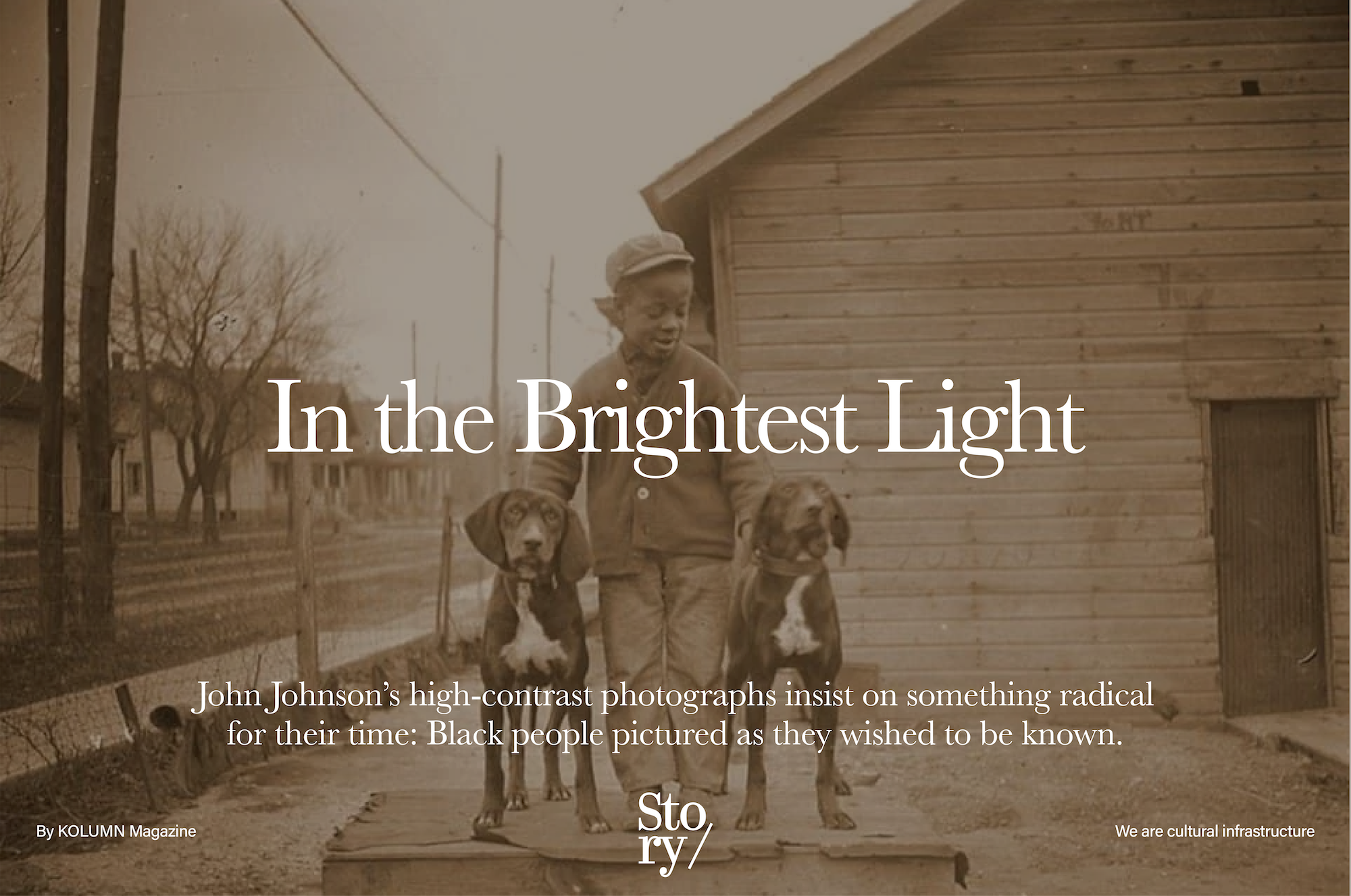
Johnson practiced a form of visual respect: portraying people as they wished to be seen, allowing complexity without spectacle.
Johnson practiced a form of visual respect: portraying people as they wished to be seen, allowing complexity without spectacle.
By KOLUMN Magazine
In the early decades of the twentieth century, photography was already a powerful civic language. A portrait could be proof of arrival—an announcement that a family had endured, prospered, belonged. But in much of America’s visual record, Black life was either erased or rendered as caricature: a tool for propaganda, a souvenir of dominance, a spectacle of poverty. Against that tide, in Lincoln, Nebraska, an African American photographer named John Johnson made a different kind of evidence—quiet, composed, insistently human. His subjects stand on porches and sidewalks, in yards and living rooms, in their best clothes and their everyday clothes, looking straight into the camera with the calm authority of people who understand that being seen is not the same thing as being known.
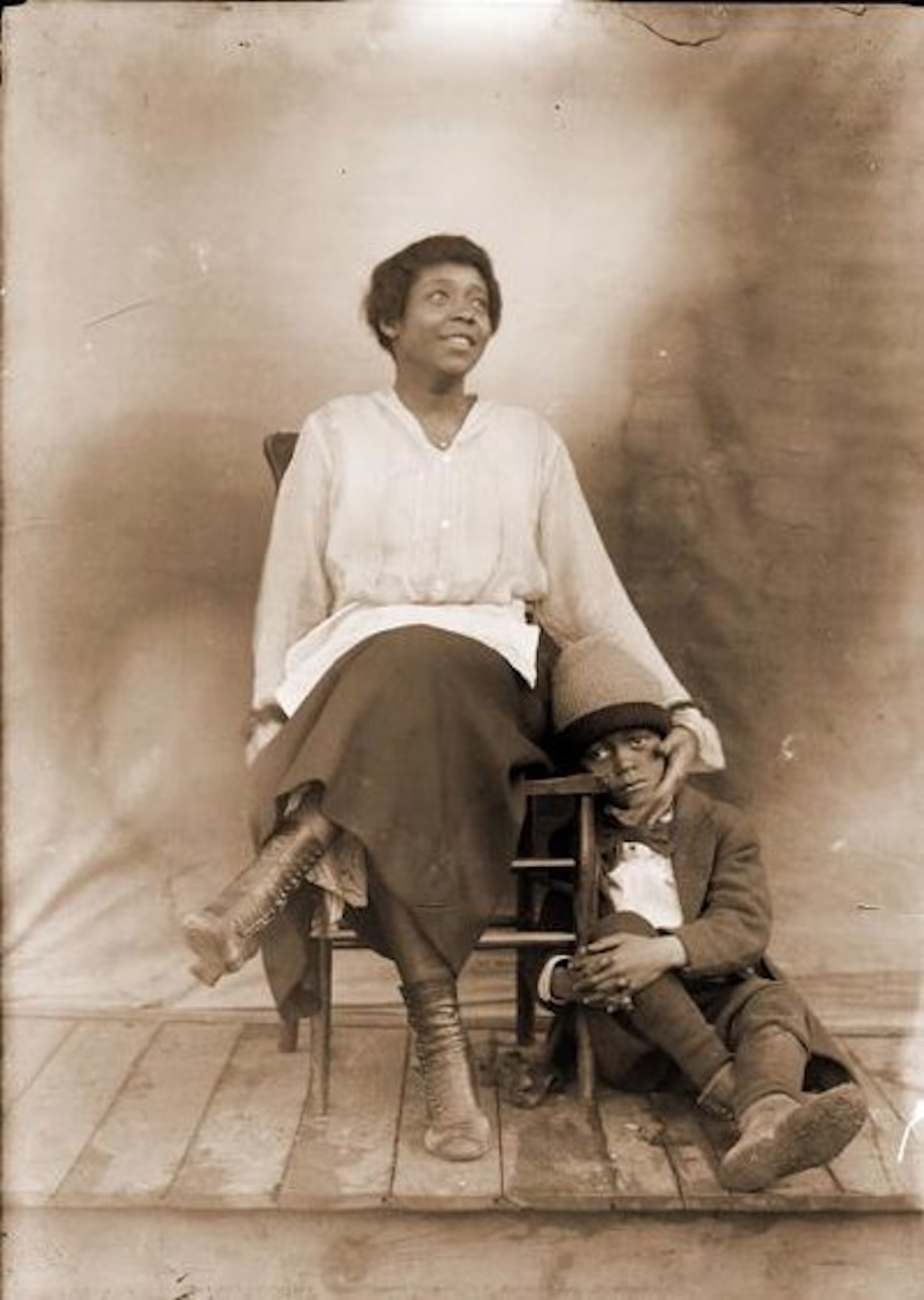
Johnson’s story is not the familiar arc of the celebrated artist in a coastal metropolis. His is a Great Plains story—of labor, migration, community-building, and an aesthetic emerging far from the publishing centers that typically decide what counts as “American” imagery. Born in Lincoln in 1879, Johnson lived through Reconstruction’s aftermath, the tightening grip of Jim Crow, the rise of Black institutions, and the churn of industrial modernity. He also lived through the era when photography moved from an elite craft to a widely used technology—yet access, training, and market opportunity remained profoundly unequal. That Johnson produced a substantial body of work under such conditions is significant. That his work survived—misfiled, nearly forgotten, then rediscovered through a chain of accidents and community memory—is a reminder of how fragile Black archives can be, and how often they depend on stewardship rather than certainty.
Today, Johnson is increasingly recognized as one of the most important visual chroniclers of early twentieth-century Black Midwestern life. His photographs are described as among the few documentary records of Lincoln’s African American community during that period. They matter not only because they show people we might not otherwise see, but because they show them in a manner that challenges the period’s dominant visual logic. Johnson’s camera does not hunt for degradation; it searches for self-possession. In doing so, it offers a counter-archive—an alternative answer to the question photography has always asked: who deserves to be pictured with dignity?
A Lincoln beginning: Family, education, and the long shadow of emancipation
John Johnson entered the world in a Nebraska still shaping its civic identity, a state whose booster narratives often underplayed the presence—and the labor—of Black Americans who helped build towns, rail lines, businesses, churches, and schools. Accounts of Johnson’s early life emphasize the trajectory of a family marked by the afterlife of enslavement. According to biographical summaries compiled by historians, his parents had self-emancipated; his father was a Civil War veteran. Those details matter because they locate Johnson’s later work in a generational project: the effort to translate freedom into something visible and durable—property, education, a place in the city’s story.
Johnson graduated from Lincoln High School in 1899 and attended the University of Nebraska, where he played football, though he did not complete a degree. In another life, this might be the beginning of a straightforward professional ascent. In Johnson’s America, schooling did not guarantee opportunity, and Black Nebraskans—especially those without wealth—often navigated a labor market that offered service work and heavy labor more readily than advancement. Johnson worked in jobs such as janitor and drayman, the kinds of roles that keep a city operating while conferring little prestige.
Yet those jobs also positioned him within the ordinary flow of urban life. A drayman moved goods; a janitor saw the back rooms, the institutional corridors, the working machinery of civic spaces. This is not romanticization—it is context. Johnson’s later photographs would demonstrate an acute understanding of how people inhabit environments: the arrangement of bodies on a porch, the angle of a doorway behind them, the placement of a chair or a hat or a child’s hand. He photographed not merely faces but the architecture of belonging.
He married Odessa Prince around the end of the 1910s—sources differ slightly on the exact year, with at least one exhibit account describing a wedding-day image from 1918, while other summaries cite 1919. This slippage is typical of lives that were not exhaustively documented by official institutions; it is also a reminder that community history often survives in fragments—photographs, local memory, newspaper clippings, a signature on a print.
The craft without a storefront: Making portraits in the open air
Johnson began taking photographs around 1910 and continued into the mid-1920s. The known corpus is substantial—often cited as roughly 500 photographs—many originally captured on glass plate negatives, a process that required technical precision and careful handling. Glass plates were heavy, fragile, and unforgiving; mistakes were expensive. Working with them outside a formal studio implies a level of competence and confidence that the “amateur” label does not fully capture.
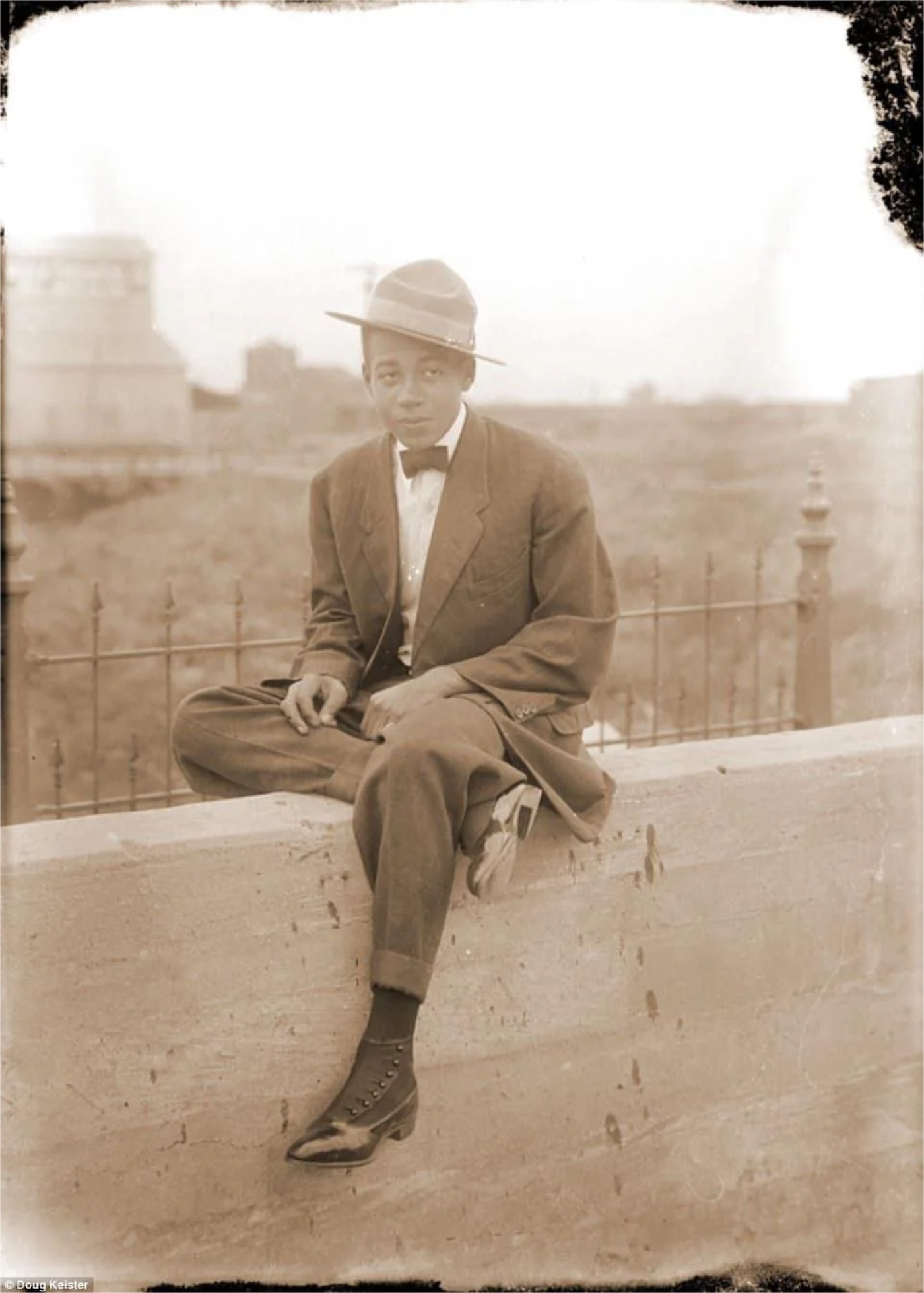
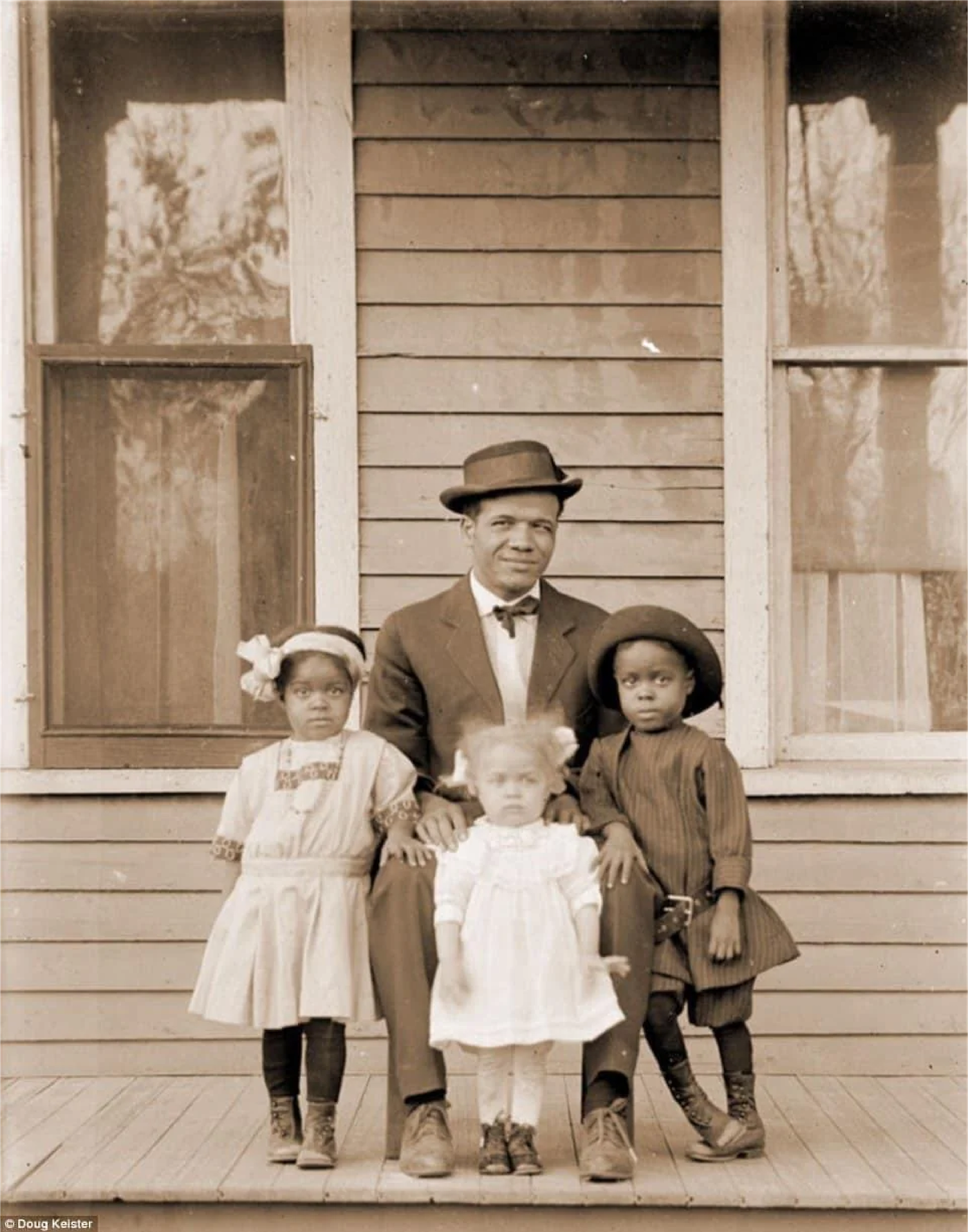
One of the defining features of Johnson’s practice is that he often worked without a studio, placing subjects outdoors—on porches, in yards, in front of homes, churches, or workplaces—where natural light could be shaped rather than invented. In an era when studio portraiture could be a status marker, Johnson’s outdoor portraits read as both practical and conceptually resonant. They situate people at the threshold between private life and public world. A porch is a domestic stage: a place to greet neighbors, to watch the street, to perform respectability and repose. Johnson turned that stage into an archive.
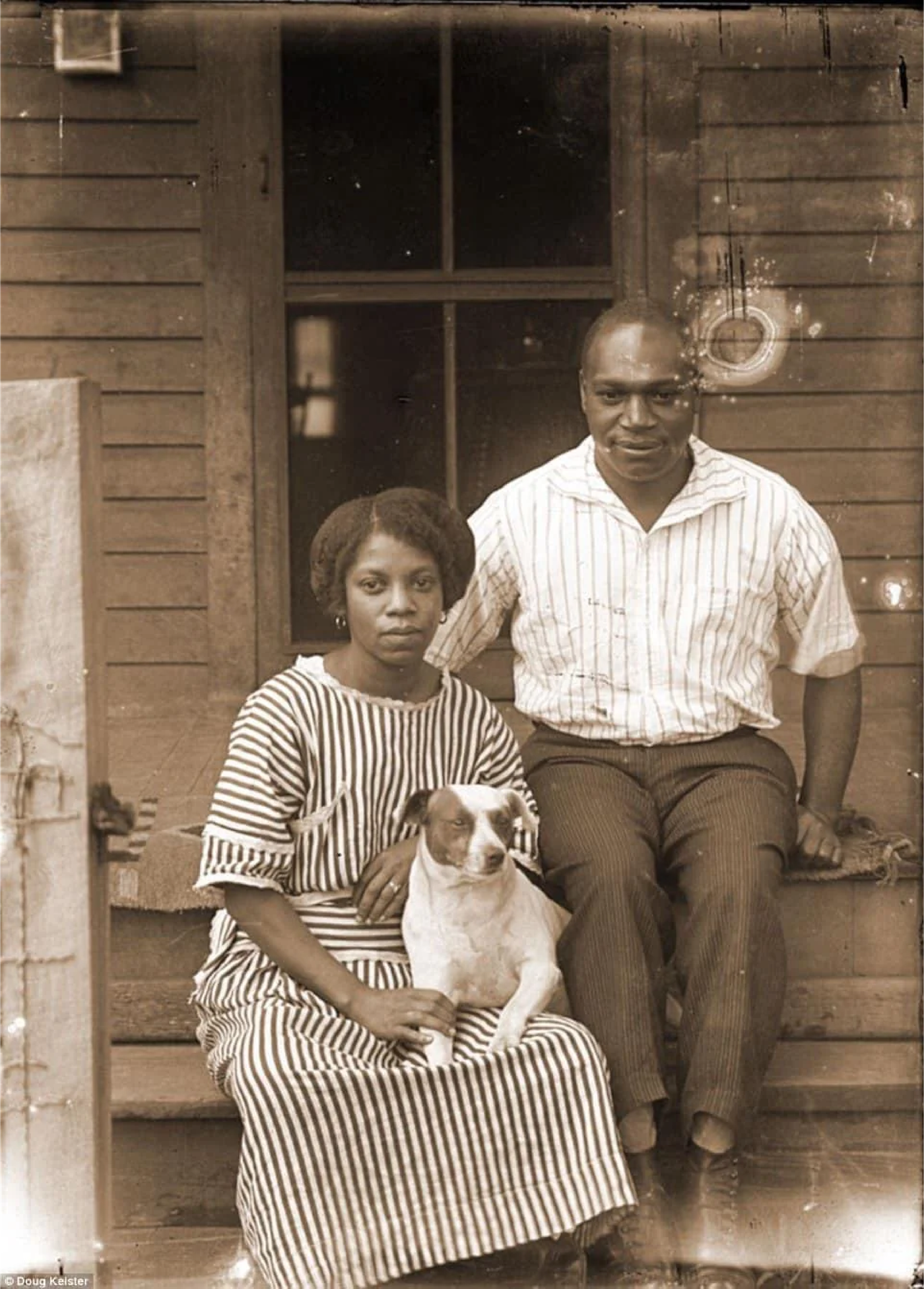
His images are often described as high-contrast black-and-white photographs with strong use of natural lighting. But to call them simply “beautiful” is to undersell their argument. Johnson’s portraits repeatedly insist on presentation: carefully chosen clothing, deliberate poses, direct gazes. In the context of early twentieth-century racial ideology—where Black people were routinely depicted as inferior, threatening, or pitiable—this insistence becomes political, even if Johnson never wrote a manifesto. His subjects appear well-dressed, composed, and self-assured.
This doesn’t mean he ignored hardship. It means he refused to let hardship be the only story an image could tell.
His work was not confined to Lincoln. Biographical and exhibition sources note that he photographed in other cities including Omaha and Kansas City. That geographical reach matters because it places him within a broader Black Midwestern network—church ties, fraternal organizations, migration patterns, and social events that linked communities across city lines. It also suggests that Johnson’s clientele, or at least his social world, extended beyond a single neighborhood. The Great Plains, in Johnson’s lens, was not a cultural blank. It was a place with aspirations, style, ceremony, and movement.
Photographing a community into history: Parades, buildings, and “spot news”
The public imagination often confines early Black photography to studio portraiture, but Johnson’s surviving work includes a wider range: parades, building sites, and local events. University of Nebraska–Lincoln reporting notes that his images include family portraits, parades, building sites, and even “spot news,” including a 1910 train wreck near 25th and E streets. This is another clue to his seriousness. To photograph a wreck, or a construction site, is to treat Black presence in the city as part of civic reality, not merely private life.
It also suggests a documentary impulse that anticipates later traditions of social photography: the belief that the everyday is historically meaningful. Johnson’s parades and street scenes show bodies gathered in public space, claiming visibility through celebration and assembly. His building images locate Black life within the physical transformation of Lincoln itself—brick, lumber, scaffolding, the city becoming what it would be.
There is a temptation to frame Johnson as an isolated genius. The more accurate framing is that he was a skilled image-maker embedded in a community that understood the value of representation. Portraits were commissioned not only for vanity but for legacy. They were sent to family, placed in albums, used to mark weddings, graduations, church milestones. Johnson’s gift was that he understood how to translate that desire into photographs that held up—technically, aesthetically, emotionally.
“New Negro” modernity on the Plains
Curators and exhibit organizers have often situated Johnson’s work within the cultural climate sometimes described as the “New Negro Movement,” an early twentieth-century ethos of Black self-definition that helped set the stage for the Harlem Renaissance. In New York, Chicago, and Washington, this movement found expression in literature, art, politics, and journalism. Johnson’s photographs propose that the same modernity existed in Nebraska—in clothing and posture, in domestic interiors, in the confidence of being photographed at all.
This matters because American cultural memory frequently treats Black artistic and intellectual flourishing as a story that happens elsewhere—Harlem, the South Side, the capital. Johnson complicates that map. His work indicates that even in places where Black populations were smaller and racial hostility could be acute, people still cultivated style, institutions, and a sense of future. In this way, Johnson’s photographs can be read as a Midwestern vernacular Renaissance: not a copy of Harlem, but a parallel expression of the same hunger to be seen accurately.
The disappearance: How an artist can be present in images and absent in records
Johnson died in 1953. By then, photography had shifted again—film was widespread, and the pace of image-making had accelerated. Yet Johnson’s name did not travel with his work into the mainstream historical record. The reasons are structural and familiar. Black artists and documentarians, especially those outside major institutions, were less likely to have their archives preserved by museums or libraries. Families moved. Estates were dispersed. Labels were lost. In many cases, Black historical materials were not considered “valuable” until much later—after they had already been damaged, sold, or thrown away.
In Johnson’s case, the disappearance was not total. His images persisted as objects, and, crucially, as community memory. But they became untethered from authorship.
The rediscovery: A box of negatives and a long path to the right name
The modern phase of Johnson’s legacy begins with a story that sounds like folklore because it is so contingent: in 1965, a Lincoln teenager and photography enthusiast named Doug Keister acquired a box containing hundreds of glass plate negatives at an estate sale. Keister made prints and even sold some, but the negatives were eventually stored away—heavy shoeboxes in a basement—while life moved on.
Decades later, in 1999, attention reignited when another small cache of glass negatives surfaced and local researchers began to investigate. Keister’s mother, having read about that discovery, prompted him to revisit his own collection, connecting what he had with what historians were starting to recognize. What followed was a rush of public interest: local coverage, national mentions, and institutional concern for preservation.
But the story included an error that would take time to correct. Early reporting attributed the images to Earl McWilliams, who had worked at a Lincoln photo studio. Attribution matters in any art history. In Black history, it matters doubly, because misattribution is one way erasure reproduces itself.
The correction emerged through persistent research and—most poignantly—through an elder’s recognition. Accounts in Smithsonian Magazine describe a moment when a researcher showed images to a woman in Lincoln, who matched them to her own family photos and simply stated that “Mr. Johnny Johnson” had taken them; a signed print later corroborated her memory. Local exhibit reporting similarly credits extensive research by Lincoln historic preservation planner Ed Zimmer and the recollection of a Lincoln elder, Ruth Talbert, as pivotal in restoring Johnson’s authorship.
This is how archives sometimes work: not as a clean chain of custody, but as a collaborative act between objects, institutions, and lived memory. A negative can survive without a name; a community can keep the name without the negative; history becomes accurate when the two meet.
From basement to museum wall: institutional recognition, and what it does—and doesn’t—solve
As Johnson’s authorship became clearer, his work entered a new ecosystem: museums, traveling exhibits, digitization projects, and scholarly essays. His photographs have been displayed at institutions including the Smithsonian’s National Museum of African American History and Culture and the Museum of Nebraska Art. Exhibitions have framed the work as “images of dignity, hope and diversity,” and positioned Johnson as an essential witness to Black life in the Great Plains.
This institutional embrace is overdue, but it also raises questions that responsible journalism should not dodge. When an archive moves from private storage into museum collections, what happens to ownership, access, and interpretation? Who gets to name the subjects? Who profits from reproductions? Who decides which images represent a community?
Some of the most ethically compelling work around Johnson’s archive has involved identification efforts—trying to recover not only the photographer’s name but the names of the people he photographed. Radio reporting connected to exhibit programming has emphasized that many subjects are still unidentified and that researchers continue to piece together the biographies embedded in the images. The photographs do not only ask us to remember John Johnson. They ask us to remember the community he photographed as individuals, not as anonymous evidence.
What the images say, formally and morally
To understand John Johnson’s significance, it helps to consider what his photographs do on multiple levels at once.
They are, first, artworks—carefully constructed images with attention to light, contrast, pose, and environment. A good portrait is never accidental. Johnson’s use of natural light outdoors, the way he positions bodies against architectural lines, the clarity of expression, suggests a photographer who knew how to make an image hold together.
They are, second, social documents. In a place and era where Black life was under-documented, Johnson created an archive of presence: evidence of families, fashion, built environments, celebrations, labor, and migration.
They are, third, arguments. Johnson’s portraits resist the visual grammar of white supremacy. He did not depict African Americans as poor or inferior; instead, he commonly portrayed them as proud, well-dressed, and confident. This is not simply flattering representation. It is a claim about reality: that Black dignity was not exceptional but ordinary, not aspirational but present.
This is why Johnson’s work resonates today, in an era when image-making has become constant and yet representational harm persists. His photographs anticipate contemporary debates about who controls the camera, how communities represent themselves, and what it means for an image to circulate without context.
A photographer shaped by labor, and a laborer shaped by photography
One of the more revealing tensions in Johnson’s biography is the gap between his artistic output and his economic status. Even as he produced hundreds of images, he also worked various service and labor jobs throughout his life. This duality—artist and laborer—is common in Black creative histories, where talent was not enough to guarantee stable patronage or institutional support.
But it may also explain part of his style. Johnson’s portraits often feel practical rather than ornate, precise rather than indulgent. They are made in the spaces people already occupy. They treat everyday life as worthy of formal attention. In that sense, his work aligns with a democratic aesthetic: the idea that grandeur is not required for significance.
The afterlife of a photograph: Why John Johnson matters now
John Johnson matters for reasons that extend beyond Nebraska and beyond photography.
He matters because he complicates the geography of Black cultural history. His Great Plains archive insists that Black modernity was not limited to places later mythologized as cultural capitals.
He matters because his work exposes how easily Black authorship can be lost, and how painstaking the work of repair can be. The correction of his attribution depended not only on institutional research but on community memory and material proof—a signed print, a matching family photograph, an elder’s certainty.
He matters because his images offer a usable model of representational ethics. Without announcing it, Johnson practiced a form of visual respect: portraying people as they wished to be seen, allowing complexity without spectacle.
And he matters because his archive is still unfinished in the most important way: not all the people he photographed have been fully named or contextualized. That ongoing work—identification, preservation, interpretation—turns his legacy into a living project rather than a closed chapter.
More great stories
Afro Sheen, Wall Street, and the Architecture of Black Possibility
July 6, 2026
No Comments
The Fire Inside the Fourth
July 5, 2026
No Comments