


Keys was within the same story—one that moved through buses and courtrooms, through federal agencies and local jails, through the slow conversion of a nation’s stated principles into enforceable commitments.
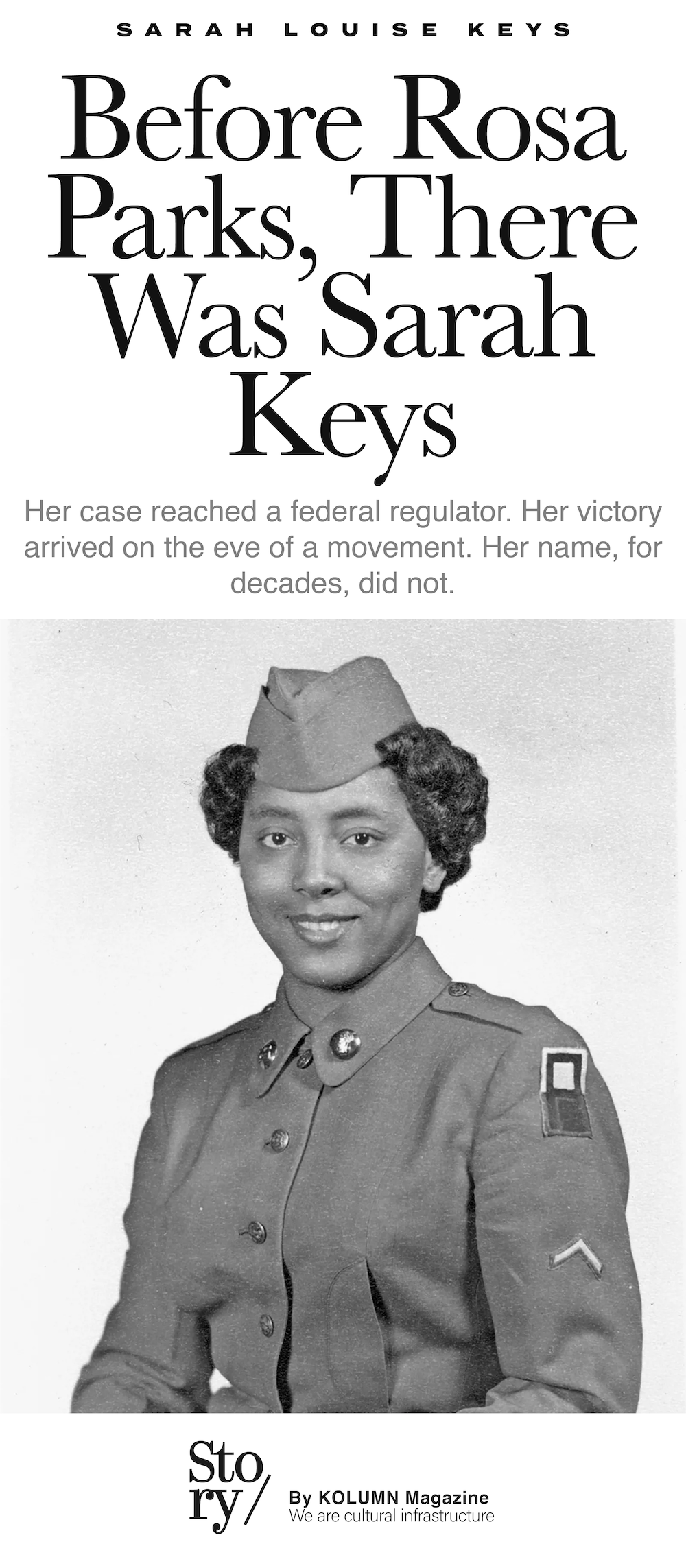
Keys was within the same story—one that moved through buses and courtrooms, through federal agencies and local jails, through the slow conversion of a nation’s stated principles into enforceable commitments.
By KOLUMN Magazine
In the public memory of the civil rights movement, the narrative often snaps into focus at its most cinematic moments: a seamstress in Montgomery, a student at a lunch counter, a march across a bridge. Those moments matter. They are bright, teachable, portable. But they also have a way of flattening the movement into a sequence of famous set pieces—while the legal, bureaucratic, and deeply personal fights that made those moments possible fade into the background.
Sarah Louise Keys belongs to that background, which is another way of saying she belongs to the foundation.
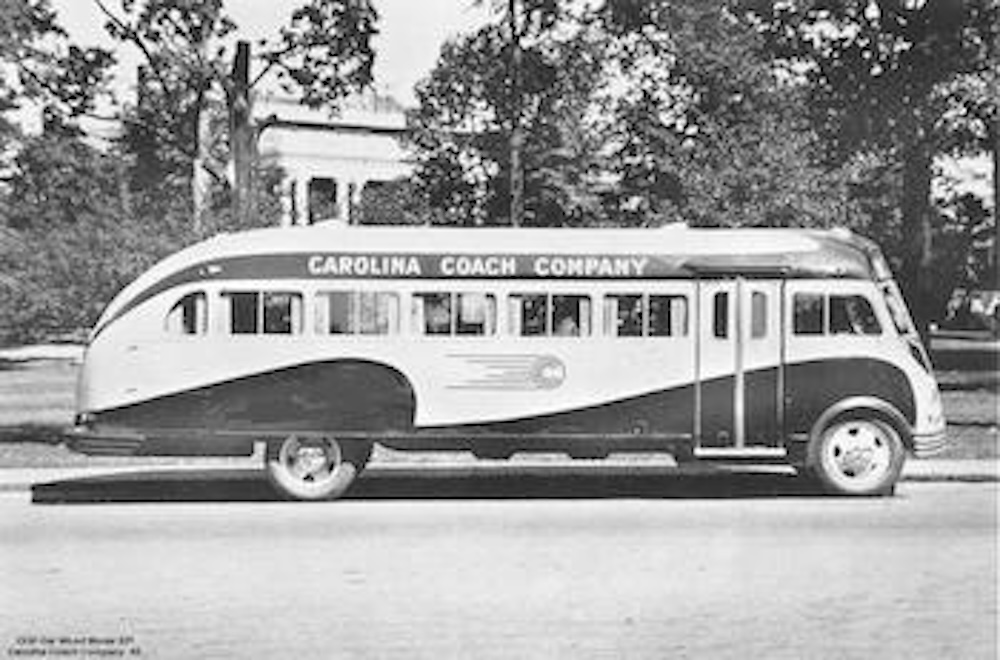
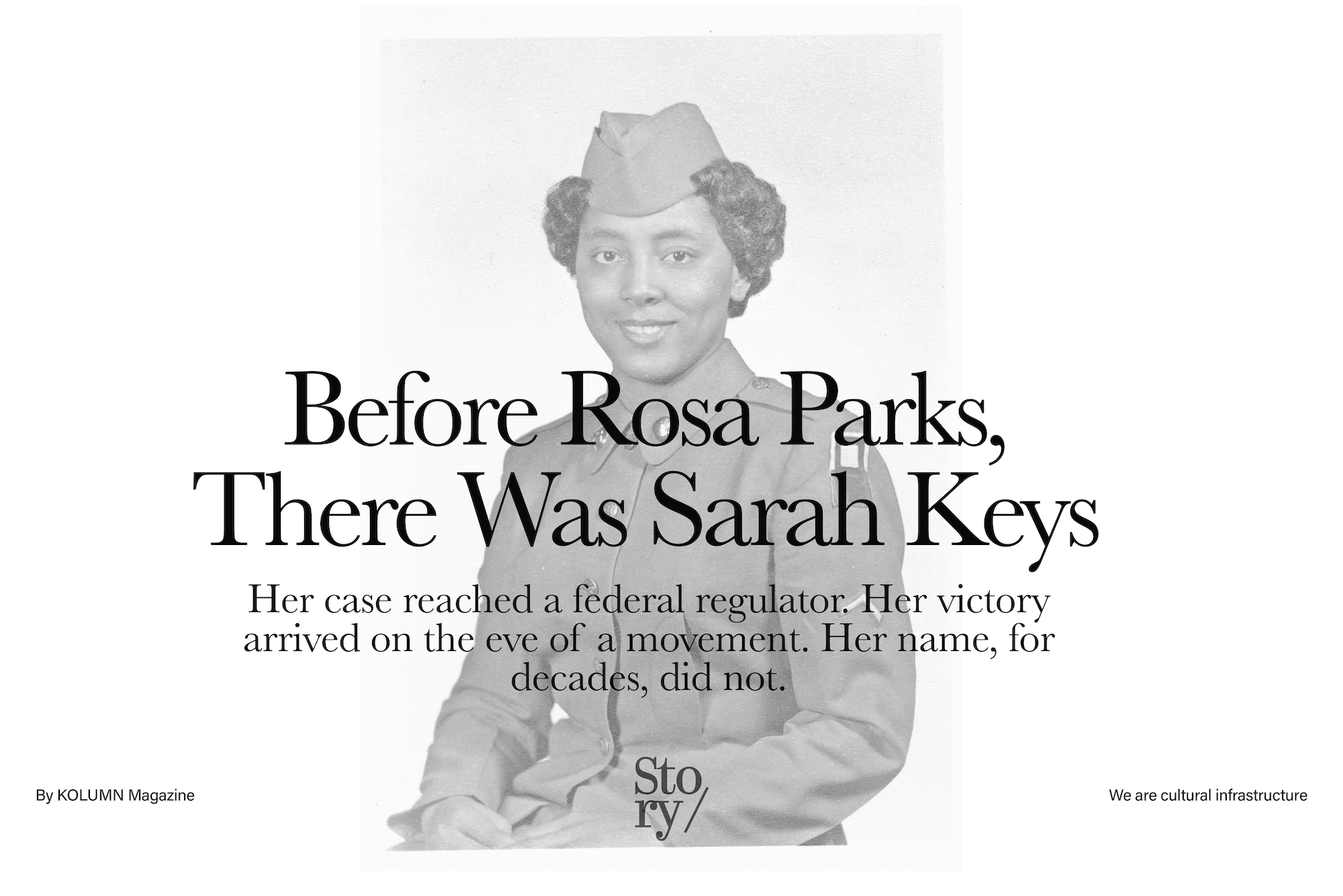
Keys was not a national leader with a microphone cadence or an organization behind her. She was a young Black servicewoman—Private First Class in the Women’s Army Corps—trying to get home. In the early hours of August 1, 1952, a bus stop in Roanoke Rapids, North Carolina, turned her ordinary trip into a confrontation with the machinery of Jim Crow transportation. She would spend roughly half a day in jail, face a conviction for disorderly conduct, and—at her father’s urging—pursue a complaint that would wind its way to a federal agency known for regulating routes and rates, not rewriting the moral order.
What happened next took time: years, not news cycles. It required lawyers willing to build an argument where the courts had left gaps, a congressman willing to push an unwilling commission, and a client willing to remain steady through procedural delays and institutional condescension. When the Interstate Commerce Commission finally ruled in November 1955 that segregating Black interstate bus passengers amounted to unlawful discrimination under the Interstate Commerce Act, it did something quietly radical: it condemned segregation itself, not merely unequal conditions.
The decision arrived on the eve of the era’s most famous bus story. The timing is one reason Keys’ case is so revealing. Her stand exposes how much of Jim Crow relied not only on state law and local custom, but on the strategic use of “private” rules—company regulations that could survive even when a Supreme Court ruling supposedly made segregation on interstate buses illegal. Keys’ case also exposes how resistance often depended on ordinary people who did not set out to be symbols, but became precedents.
Keys died in November 2023 at 95, after years of belated recognition that included public commemorations in the North Carolina town where she had been arrested and renewed interest in honoring her at the national level. Yet her broader significance is not primarily that she came “before” someone else. It is that she helped force the federal government to admit what segregation actually was: not a neutral “separation” but a system of stigma, humiliation, and coercion—an injury that traveled.
A journey north to south, and the moment the rules changed
To understand the power of Keys’ story, start with the setting: mid-century interstate bus travel, which acted like a moving map of American hierarchy. A Black traveler could ride one way in relative normalcy and then, miles later, be compelled into a ritual of surrender—stand up, move back, concede the front to whiteness. The indignity was not incidental; it was the point. And it was enforced not only by law but by labor: drivers, station managers, police.
Keys’ trip began from Fort Dix, New Jersey, where she was stationed. She was headed home to Washington, North Carolina, traveling on furlough. Accounts of the journey emphasize a detail that would matter later: for much of her travel, she experienced a version of what the law had promised. She boarded in the North, transferred in Washington, D.C., and took a seat toward the front of the bus.
Then the bus reached Roanoke Rapids. A driver change altered the social order. Keys was told to give up her seat to a white Marine and move to the back. She refused. Not with a speech—more with the plain logic of exhaustion and principle. She had a ticket. She had taken a seat. She had served her country in uniform. The demand was not about logistics; it was about submission.
The response was swift and theatrical. The driver emptied the bus, relocated other passengers, and barred Keys from boarding the replacement vehicle. What could have been a minor dispute became a performance of power, one designed to isolate her and signal to everyone else what resistance would cost. Keys was arrested, held overnight, and later fined.
Her story is often summarized as “three years before Rosa Parks.” But a better framing is that Keys’ stand happened during an awkward legal interregnum—after key court rulings had begun to undermine Jim Crow’s legitimacy, but before federal enforcement caught up, and before the movement’s mass tactics made defiance contagious.
In 1946, the Supreme Court decided Morgan v. Virginia, holding that state-imposed segregation on interstate buses could not stand because it imposed burdens on interstate commerce. But carriers and local officials found ways around it. If a state law was suspect, a company rule could do the same work—especially if the institutions tasked with regulation chose not to challenge it.
Keys’ case mattered precisely because it targeted that workaround. It did not merely ask whether a particular bus ride was unpleasant. It asked whether segregation, when imposed by private carriers traveling across state lines, was compatible with federal law.
The lawyers, the commission, and a fight that moved by inches
Legal history loves the myth of inevitability: one brave act, one perfect argument, one decisive ruling. The record of Keys’ case is messier, and therefore more instructive.
After her arrest, Keys’ father pressed her to pursue legal action. The family connected with civil rights advocates, and the case found its way to a young Washington, D.C. legal team: Julius Winfield Robertson and Dovey Johnson Roundtree. Roundtree, herself a former Women’s Army Corps officer, understood the particular cruelty of segregated travel for Black women in uniform—how the country could demand service and deny dignity in the same breath.
Their initial attempt in federal court failed on jurisdictional grounds, pushing them toward the Interstate Commerce Commission—the federal agency charged with regulating interstate carriers. This choice was strategic. The ICC had long tolerated “separate but equal” logic in transportation, interpreting the Interstate Commerce Act’s anti-discrimination language in ways that allowed segregation to survive.
This is one of the subtler points of Keys’ significance: her case shows that civil rights litigation was not only about courts. It was also about administrative bodies, rulemaking, and the slow grind of bureaucracy—places where the public rarely looked, and where precedent could be set with less fanfare but enormous effect.
Keys’ complaint reached the commission in 1953. An ICC hearing examiner initially rejected the argument, insisting that even the Supreme Court’s emerging desegregation logic did not apply to a private bus carrier’s practices. The decision reflected a larger pattern: institutions interpreting civil rights claims as “social questions” outside their remit, even when the statute in front of them addressed discrimination.
Roundtree and Robertson did what movement lawyers often had to do: they expanded the battlefield. Roundtree sought help from Congressman Adam Clayton Powell Jr., who pressed the commission to grant a full hearing. The intervention mattered. It turned what could have ended as a bureaucratic dead letter into a case the full commission had to confront.
The fight unfolded in the shadow of Brown v. Board of Education, decided in 1954, which declared segregated public education unconstitutional and shattered the legal respectability of “separate but equal.” But the ICC did not immediately treat Brown as controlling. That reluctance is part of the story: civil rights advances did not automatically cascade across every domain. They had to be carried—argument by argument—into each arena where segregation hid.
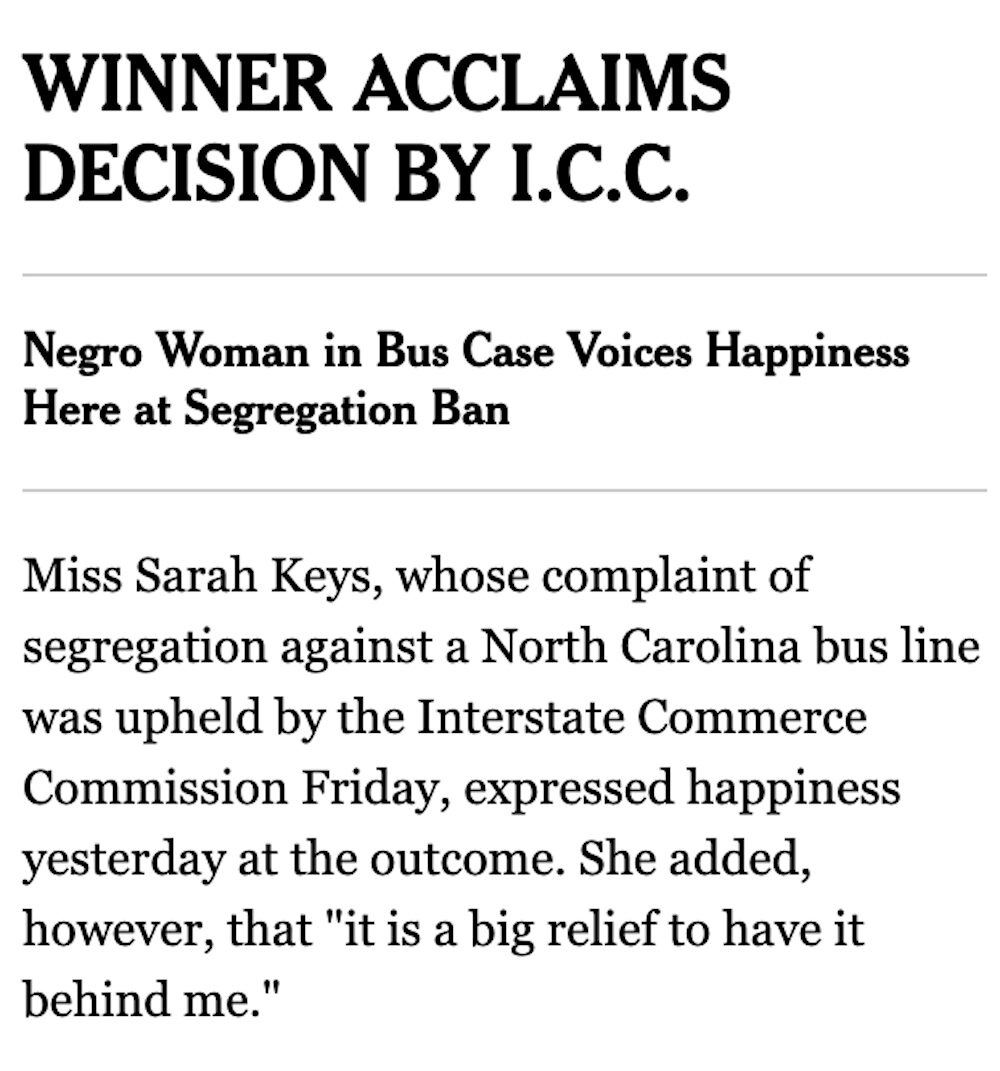
In November 1955, the commission ruled in Keys’ favor. The decision held that assigning seats in a way that implied the inferiority of Black travelers constituted unjust discrimination under the Interstate Commerce Act. That language was crucial, because it did not simply say, “provide equal accommodations.” It treated segregation’s message—its stigma—as the harm.
Keys was, by then, no longer in the Army. She was living and working in Brooklyn, building an ordinary life that had been interrupted by an extraordinary case. The picture of her receiving the news from afar—victory arriving years after the injury—is part of what makes her story both inspiring and unsettling. The country moves slowly when it is asked to value Black dignity as law rather than sentiment.
The timing: On the eve of Montgomery, and yet not the same story
The Keys ruling became public just days before Rosa Parks’ arrest in Montgomery, Alabama. The proximity invites comparison, but it also reveals a divide in how history chooses its emblems.
Parks’ act catalyzed a mass boycott and a visible movement architecture—churches, carpools, leaders, nightly meetings. Keys’ act traveled through law, procedure, and paperwork. It required a kind of endurance that doesn’t photograph well.
And yet, Keys’ case and Parks’ case were not simply parallel. They addressed different legal terrains: interstate travel versus intrastate city bus policy. Keys confronted a system that claimed federal law didn’t reach “private” segregation rules. Parks confronted a city’s enforcement of segregation as a matter of local ordinance and custom. The difference matters because it shows the movement’s multi-front character. Segregation was not one law waiting to be overturned. It was a web of rules—municipal, state, corporate, social—each requiring its own form of pressure.
Keys’ victory also illuminates a more sobering truth: legal victories are not self-executing. Even after the ICC ruled, enforcement lagged. The gap between a ruling and a lived reality would become familiar across civil rights history, from school desegregation to voting rights. In transportation, the pressure of direct action—especially the Freedom Riders—helped force federal authorities to enforce desegregation rules more aggressively in the early 1960s.
So, if Parks is often framed as the spark, Keys can be framed as part of the wiring: the legal and administrative groundwork that made later enforcement possible, even if delayed.
Why she was forgotten, and what that forgetting cost
It is tempting to blame Keys’ relative obscurity on the randomness of fame. But the pattern is legible. American memory tends to reward stories with clean arcs and singular protagonists. It often sidelines administrative victories because they feel technical. It also, too often, relegates Black women’s legal and political labor to footnotes—especially when that labor unfolds outside the charismatic leadership model.
Keys also did not cultivate celebrity. Reporting and retrospective accounts describe her as private, reluctant to position herself as a movement icon, and focused on building a life beyond the case. That choice deserves respect. It also complicates how institutions teach history: when a hero does not campaign to be remembered, the burden shifts to journalists, educators, archivists, and civic leaders to do the remembering honestly.
In the last decade of her life, that process accelerated. In Roanoke Rapids, commemorations and public art initiatives reframed the town’s relationship to the story, marking the place where she was arrested not as a point of pride in “order,” but as a site of injustice and courage.
After her death in November 2023, tributes noted both her role and the fact that she remained less known than figures whose actions came later. Even proposed national honors, including congressional recognition efforts, underscore how belated the institutional embrace has been.
But the deeper cost of forgetting Keys is not merely unfairness to one woman’s legacy. It is a distortion of how change happens. When history is reduced to a handful of famous moments, it encourages a theory of progress that is both romantic and misleading: the idea that one brave act flips a switch. Keys’ life argues for a different theory—one rooted in persistence, process, and the willingness to confront power in the places it prefers to hide.
The broader significance: Keys as a bridge between war, citizenship, and civil rights
Keys’ identity as a servicewoman is not incidental. In the mid-20th century, military service was often invoked as evidence of American belonging—especially for Black Americans demanding rights the country claimed to represent abroad. Yet the military itself was an institution struggling with segregation and discrimination. For a Black woman in uniform to be told she must move for a white man on a public conveyance carried a particular symbolic violence: service did not shield her from subordination; it merely sharpened its hypocrisy.
That hypocrisy became part of the moral argument around civil rights in the Cold War era. The United States positioned itself as a democracy worth emulating while tolerating caste-like practices at home. The movement’s legal strategies often leveraged federal power—courts, commissions, agencies—to force the country’s institutions to match its rhetoric. Keys’ case is a precise example of that strategy working, even when it took years and required political leverage.
It also highlights the importance of Black women’s legal networks. Dovey Johnson Roundtree’s role—alongside Robertson—matters because it reminds us that landmark legal change was often shaped by women who navigated double barriers of race and gender in the profession. The Washington Post’s account of Roundtree’s career situates the Keys case as a defining victory, achieved through persistence and strategic pressure on the ICC.
Meanwhile, local and regional accounts—including North Carolina public history efforts—frame Keys not only as a plaintiff but as an actor in a longer history of transportation activism, from earlier challenges to Jim Crow rail travel to later direct-action campaigns that forced enforcement.
The throughline is that Keys helped clarify a basic principle: discrimination is not only a matter of unequal facilities; it is the practice of imposing inferiority as policy. When a federal agency says so—even in the language of commerce regulation—it changes the legal landscape that activists and ordinary travelers move through.
A legacy that still feels unfinished
The most honest way to honor Sarah Louise Keys is not to turn her into a saintly silhouette, but to take her lesson seriously.
Her lesson is that systems can be legally wrong for a long time while remaining operationally intact. Her lesson is that rights on paper often require organized insistence to become rights in practice. Her lesson is that federal power—so often invoked as distant—can be moved, but typically only when pushed by people who refuse to accept the terms of their own humiliation.
Keys’ story also presses on a contemporary question: what do we choose to commemorate, and why? Communities that once enforced racial order now commission murals and hold ceremonies. That is not inherently cynical; it can reflect genuine civic growth. But it also demands a kind of accountability: commemoration should not substitute for understanding. Keys was arrested because a system required her to be put in her place. If her name is now spoken in public, it should be spoken alongside the truth about what that “place” was—and how deliberately it was enforced.
When she died in 2023, remembrances emphasized that she had been “before” the better-known stories. A stronger emphasis is that she was within the same story—one that moved through buses and courtrooms, through federal agencies and local jails, through the slow conversion of a nation’s stated principles into enforceable commitments.
The movement did not belong only to its most famous faces. It belonged to a young woman traveling home, who understood that the demand to move was not small. It was the whole structure, condensed into a single seat. And she refused to help hold it up.
More great stories
Afro Sheen, Wall Street, and the Architecture of Black Possibility
July 6, 2026
No Comments
The Fire Inside the Fourth
July 5, 2026
No Comments