




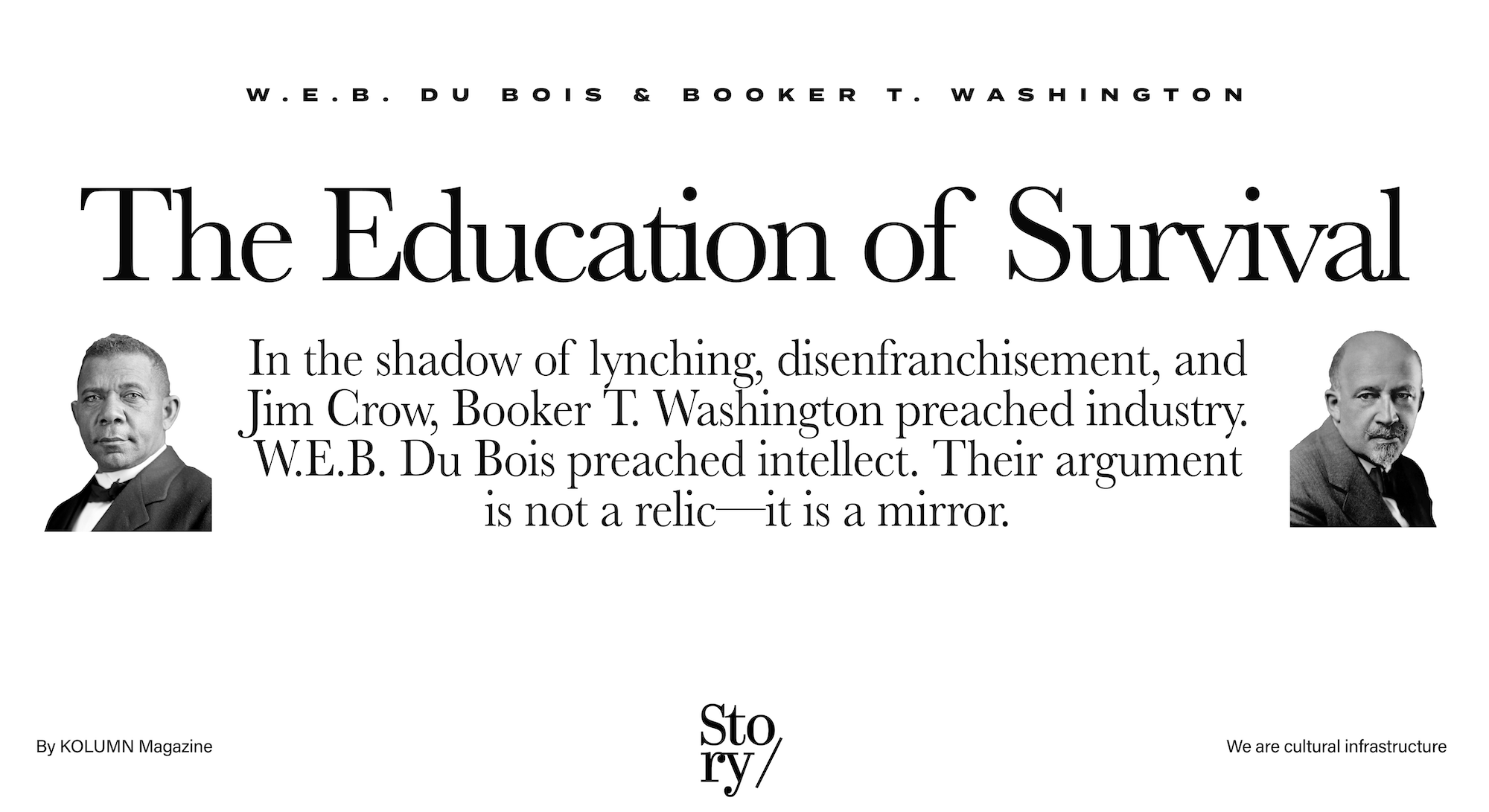
The aligned visions of Du Bois and Washington.
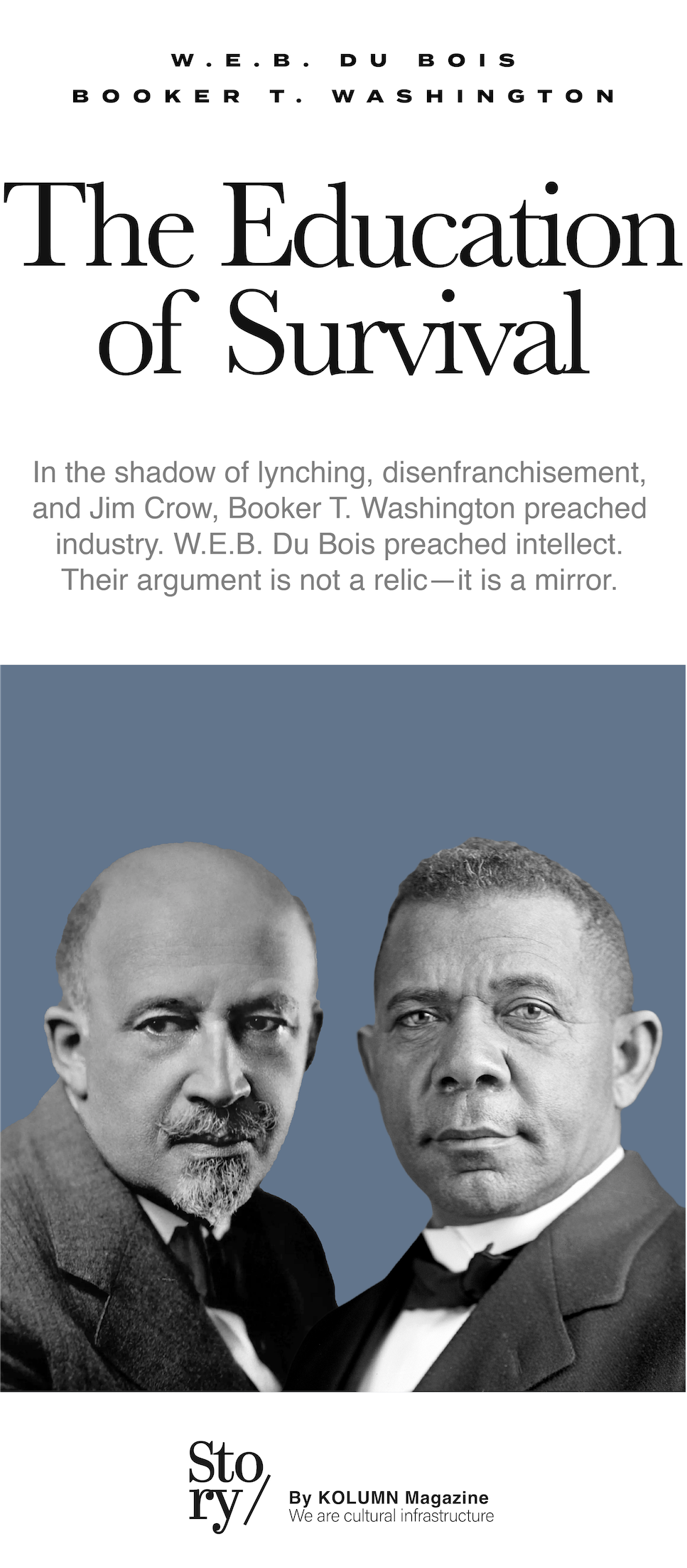
The aligned visions of Du Bois and Washington.
By KOLUMN Magazine
The disagreement between W.E.B. Du Bois and Booker T. Washington is frequently reduced to a tidy morality play: Du Bois as the uncompromising intellectual insisting on rights and higher learning; Washington as the pragmatic builder urging work, patience, and industrial training. That shorthand is not exactly wrong, but it is incomplete in ways that matter—because what these two men were really disputing was not whether Black people deserved education, or even whether they deserved the full range of American possibility. They were arguing about what education was for under siege, and what kind of schooling could convert a people’s vulnerability into durable power.
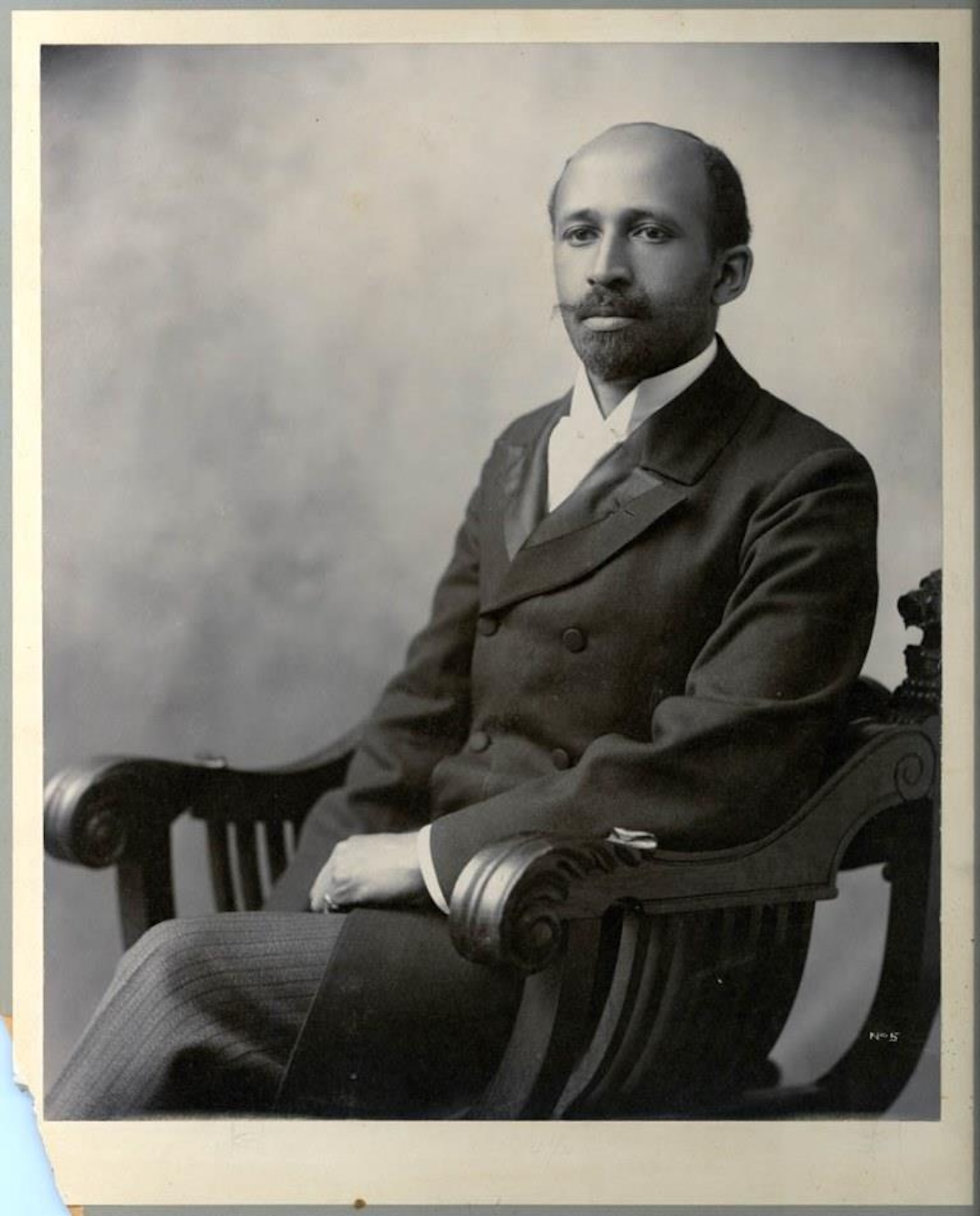
Their conflict unfolded in a country that had retreated from Reconstruction and invested heavily in the architecture of Jim Crow—through law, violence, labor exploitation, and cultural degradation. In that context, education was not merely the pathway to individual advancement; it was a battleground over the terms of Black citizenship. Washington’s public posture, crystallized in his 1895 Atlanta Exposition Address, asked Black Southerners to “cast down your bucket where you are,” prioritize industrial and agricultural work, and seek economic security even while social and political equality remained deferred. Du Bois, in The Souls of Black Folk and later essays like “The Talented Tenth,” argued that a people trained only for labor would be trained into subordination. He insisted on broad higher education—particularly for those who could become teachers, professionals, editors, lawyers, and organizers—because leadership and civic power were not luxuries; they were defensive necessities.
The temptation is to declare one man the winner and move on. But the more honest reading—especially for Black communities still negotiating unequal schools, unequal labor markets, and unequal political voice—is that both were diagnosing real constraints, and both were trying to solve for the same long-range variable: collective uplift and security. Their clash is best understood as a dispute about sequencing and emphasis, not as mutually exclusive visions. And that is precisely why the most compelling conclusion is also the most practical one: a combined model—liberal arts and vocational training, integrated rather than segregated into separate tracks—would have most effectively pursued the shared goals of both men, and would still best serve Black American communities now.
That conclusion is not an anachronistic compromise. It is a synthesis rooted in what each man correctly feared.
Washington’s wager: Economic footing first, rights later—because terror was now
Booker T. Washington rose to national prominence as the founding leader of Tuskegee Institute, a school built around normal (teacher) training and industrial education. By 1895, he had become the era’s most celebrated Black spokesman to many white audiences, and his Atlanta Exposition Address functioned as both sermon and strategy memo. The speech’s core argument was that Black people could win respect, stability, and eventual inclusion by proving indispensable as workers, farmers, builders, and tradesmen; that vocational education would produce immediate economic security; and that social equality and political office should not be the first demand in a region determined to deny them.
Even sympathetic readers can feel the chill in that logic. It asks a people who have been robbed to behave as if patient productivity will soften the hand that is still reaching into their pockets. Yet Washington’s wager was not simply ideological. It was calibrated to the immediate dangers of the post-Reconstruction South. In the late nineteenth century, Black political participation was being crushed through disfranchisement, intimidation, and terror. White mobs could burn down a Black town or lynch a Black man with near impunity. Washington believed that open confrontation, especially by a mass of newly emancipated people with little institutional protection, could invite catastrophe. His public rhetoric—in effect, a controlled burn—was designed to reduce white backlash long enough for Black communities to build schools, acquire property, learn trades, and cultivate internal economic systems.
Washington’s critics often describe this as “accommodation.” But accommodation is not always a synonym for surrender; sometimes it is a tactic in a landscape where the alternatives are too costly in the short term. The National Museum of African American History and Culture’s summary of the Atlanta Compromise emphasizes that Washington’s speech stressed accommodation rather than resistance to the segregated system under which Black Americans lived. The question is what he hoped to purchase with that accommodation. Washington’s answer was capacity: the kind you can touch, count, and defend—skills, wages, buildings, land, tools, businesses. In his view, vocational training was the most reliable way to produce those assets at scale.
He also knew his audience. The Atlanta speech was delivered to a biracial crowd at a major exposition; it was effectively a public negotiation. Washington asked white industrialists and politicians to invest in Black labor and Black schooling, framing that investment as beneficial to the region. In that sense, vocational education was not merely pedagogy; it was diplomacy. The argument was meant to be legible to people who equated Black advancement with Black threat. He offered them a version of progress that looked, from their side of the table, like stability.
To read Washington fairly is to admit that he was addressing a brutal reality: if your community is excluded from capital, policed by violence, and kept near starvation wages, then education that does not lead to work can look like a promise written on water. Vocational education, Washington believed, could be a bridge between bondage’s economic dispossession and freedom’s material requirements.
But Du Bois heard in Washington’s wager a different sound: the closing of a door.
Du Bois’s indictment: An education that trains you only to work can train you into caste
Du Bois did not disagree that Black people needed skills, jobs, and wealth. What he rejected was the political bargain embedded in Washington’s public posture—and the educational narrowing that followed. In the famous chapter “Of Mr. Booker T. Washington and Others” in The Souls of Black Folk, Du Bois summarizes Washington’s program as a blend of industrial education, conciliation of the South, and “submission and silence” on civil and political rights, and then argues that this approach—however understandable—risked conceding the very levers that could ever make economic security permanent.
Du Bois’s critique hinges on a simple but profound claim: economic progress without political power is precarious, because the rules of the economy are written and enforced politically. If Black workers become more productive but remain disfranchised, segregated, and legally exposed, then their productivity can be harvested without producing equality. If Black students are educated only for service and labor, they may become efficient—but also easier to confine to a subordinate class. Du Bois feared that Washington’s emphasis, especially when adopted by white philanthropists and Southern policymakers, would naturalize a two-tier system: vocational training for Black people, liberal education for white people, and leadership reserved accordingly.
This fear was not theoretical. Du Bois watched an America building separate systems—separate schools, separate railcars, separate civic lives—while simultaneously constructing an ideology that declared those separations “practical.” In that environment, an educational philosophy could become a justification for racial hierarchy. Du Bois wanted to break that logic by insisting that Black people had the same intellectual range and civic claim as any other group, and that the Black community needed thinkers and leaders not as ornaments but as infrastructure.
That is why “The Talented Tenth” remains central to the Du Bois side of the debate. In the essay, he argues that “the problem of education… must first of all deal with the ‘Talented Tenth’”—the development of those most likely to become leaders, professionals, and builders of institutions. The phrase is often caricatured as elitist, and Du Bois has been criticized—sometimes justly—for the hierarchies implied by his language. But the deeper point is strategic: no group secures full democratic standing without trained leadership—teachers to educate the mass, lawyers to contest unjust laws, editors to shape public opinion, physicians to care for communities, and scholars to produce knowledge that counters propaganda. Du Bois argued for higher education because he was arguing for sovereignty: the capacity of a people to interpret the world, advocate for themselves, and craft policy.
Even in texts that acknowledge vocational needs, Du Bois insists that training must not be reduced to mere utility. The Atlantic’s archival presentation of Du Bois’s argument in “Of the Training of Black Men” frames the piece as taking issue with Washington and arguing that Black Americans should attend college—because without broadly educated leaders, the community would be denied its full development.
Still, it would be a mistake to imagine Du Bois as indifferent to labor or craft. In many of his writings, he recognizes that the work of a people includes agriculture and mechanics as well as philosophy and art; the argument is about balance and power, not disdain for skill. But his most urgent warning is consistent: if Black education becomes defined by what white society finds “useful,” then Black aspiration will always be bounded by white comfort.
Washington wanted to keep his people alive and employed. Du Bois wanted to keep them free.
The argument underneath the argument: Who gets to define “practical”?
One reason this debate persists is that it contains a trap that still catches school systems today: the word “practical.” Practical for whom? Practical for what economy? Practical under what laws? Washington’s vocational emphasis sounds practical when a community needs immediate wages. Du Bois’s liberal-arts emphasis sounds practical when a community needs long-term political capacity. Both men were responding to a context in which Black people were denied the normal protections that make education feel like a straightforward ladder.
In the era after emancipation, many Black families faced a cruel arithmetic: children needed to work; schools were underfunded; white employers controlled wages; debt peonage and sharecropping made “employment” a new form of captivity. Under those conditions, vocational education could look like a lifeline. At the same time, the legal and political system was being redesigned to ensure that Black labor served white wealth. Under those conditions, vocational education could also be a funnel into exploitation unless paired with civic power and broad intellectual training. Du Bois’s fear is that a narrowly “practical” education becomes the education of those who are expected to serve rather than rule.
This is why the debate cannot be adjudicated by temperament—Du Bois as radical, Washington as conservative—alone. It must be judged by the systems each man was trying to build in response to white supremacy’s constraints. Washington’s system emphasizes economic capacity inside the limits the South would tolerate. Du Bois’s system emphasizes rights and leadership even when the South would punish such ambition.
Both approaches contain risk. Washington’s risk is obvious: he could be used as a mask for injustice, his call for vocational training transformed into a permanent ceiling. Du Bois’s risk is subtler but real: if higher education becomes the central investment while the economic base remains fragile, the community can produce credentialed leaders without sufficient jobs, capital, or trade-based wealth to sustain broad uplift. A people can be overeducated for an economy that still bars them, and under-protected in a polity that still hates them.
A comprehensive model is not a polite midpoint. It is the only approach that closes both vulnerabilities at once.
What each man got right about the other, if you read beyond the slogans
History is kinder to clean narratives than to complicated truths. Yet even within Du Bois’s famous critique, you can find acknowledgments that Washington was not simply the enemy of higher learning. A Yale-hosted excerpt of Du Bois’s “Talented Tenth” notes, pointedly, that Washington had college-trained helpers—teachers trained in Greek and the humanities, in Latin and mathematics, graduates of Harvard, Oberlin, Fisk, Smith—illustrating a tension in Washington’s own practice. Tuskegee’s leadership and staffing relied on people whose educations came from precisely the kind of liberal learning Du Bois defended. In other words: Washington’s institution-building quietly depended on the intellectual pipeline Du Bois argued for, even when Washington’s public rhetoric emphasized vocational training.
And if you read Washington with care, you can see that his vocational emphasis was not merely about wages; it was also about dignity and ownership. Industrial education, as he framed it, was meant to counter the racist lie that Black people were unfit for skilled work or disciplined enterprise. By training artisans, builders, and farmers, Washington aimed to demonstrate competence in a society that equated Blackness with incapacity. Vocational education was a form of rebuttal. It was also, in his mind, a platform from which political demands could eventually become safer and more credible.
Du Bois, for his part, was not arguing that everyone should be a classicist, nor that the trades were beneath Black people. He was arguing that a people cannot be free if they are systematically denied broad education—and that leadership, in particular, must be trained in ways that include history, philosophy, political economy, literature, and the arts, because those fields shape how societies justify themselves. A vocational education can teach you how to build a house; a liberal education can teach you why your neighborhood is zoned to be demolished, why your mortgage is denied, why your vote is diluted, and what language the law uses to dress theft as policy.
The deepest disagreement, then, is not about whether labor matters. It is about whether labor alone can purchase freedom.
The shared goal: Racial uplift, collective security, and a future built by Black hands
Strip away the rival camps and reputations, and a shared aspiration comes into view. Both men wanted Black Americans to have the capacity to shape their lives rather than merely endure them. Both believed education was the mechanism by which that capacity could be produced. Both saw schooling as a community project, not a private luxury. Both understood that leadership and labor were intertwined: you cannot build institutions without workers, and you cannot protect workers without institutions.
Even contemporary summaries of their dispute acknowledge the durability of these competing emphases. A PBS Frontline overview of their debate highlights Du Bois’s focus on developing the “Talented Tenth” and Washington’s focus on industrial education, mapping the fault line that still runs through American arguments over schooling and “practicality.”
But what the summaries sometimes miss is that both men were arguing against the same enemy: a society attempting to prescribe the boundaries of Black possibility. Washington tried to expand those boundaries by emphasizing usefulness and economic contribution. Du Bois tried to expand them by insisting on full citizenship and full intellectual stature. Their methods diverged because the constraints were vicious and because the costs of being wrong were not theoretical.
A better question than “Who was right?” is “What would have best protected Black life and advanced Black power under those constraints?” The answer requires refusing the false choice.
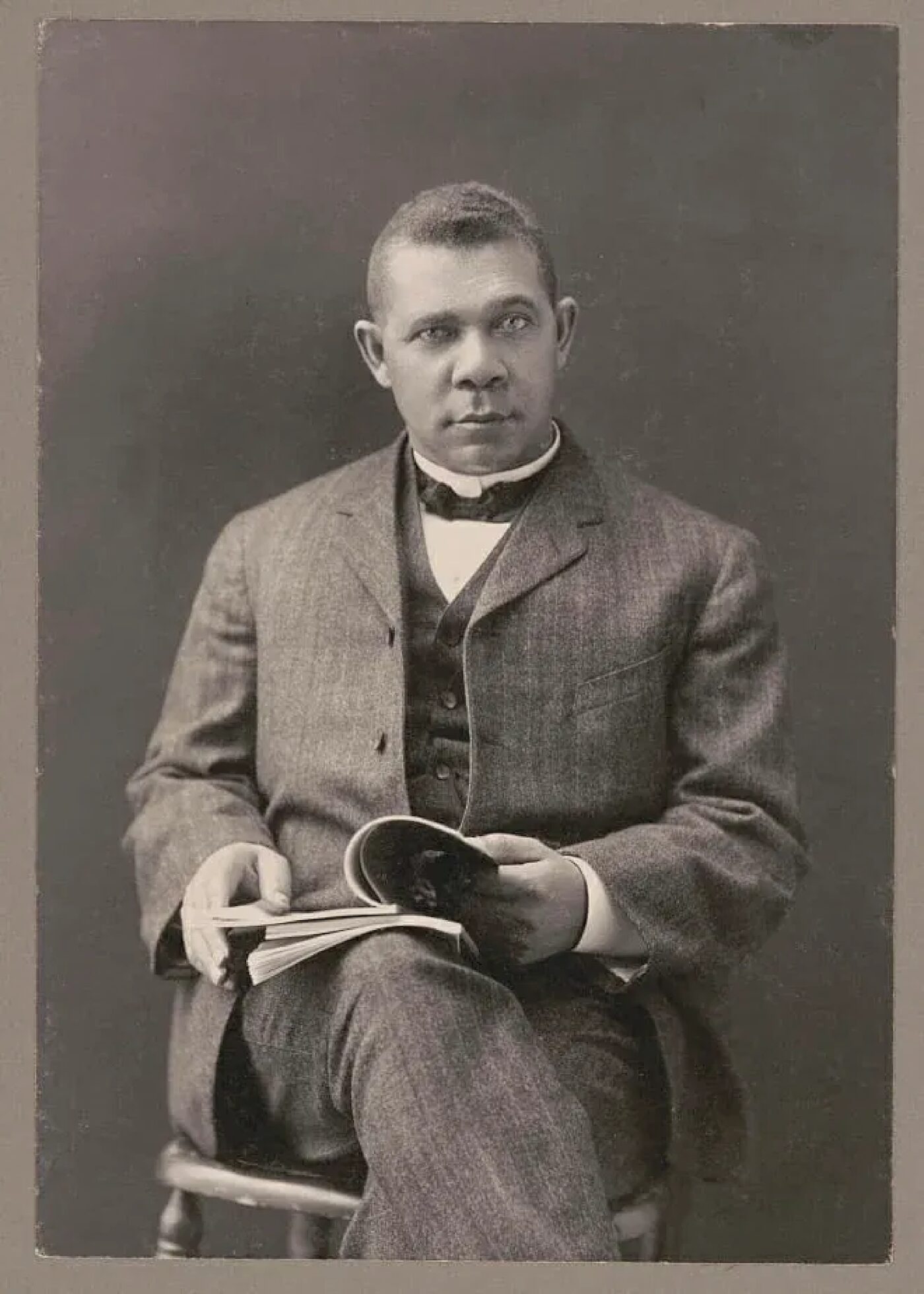
The synthesis: Why liberal arts and vocational education must be integrated, not opposed
A combined model—liberal arts and vocational education, comprehensive and braided together—does three things that neither approach can fully do alone.
First, it produces economic resilience without surrendering civic capacity. Washington’s vision, at its strongest, can generate skills, businesses, and material stability. Du Bois’s vision, at its strongest, can generate leaders, advocates, and institutional designers. A community needs both because material stability without civic power can be stolen, and civic power without material stability can be starved.
Second, it prevents the racialized tracking that Du Bois feared. Du Bois’s warning was not merely that vocational education exists; it was that vocational education could become the assigned destiny of Black children, while liberal education remained the birthright of others. An integrated system refuses that sorting. It treats welding and philosophy, coding and literature, nursing and political theory as part of one continuum of human capability. It makes it harder for policymakers to claim that some children need “skills” while others deserve “thought.”
Third, it answers Washington’s time-sensitive concern: the urgency of survival. Liberal education alone can be slow to translate into immediate wages, especially in an unequal labor market. Vocational training embedded in a broader education can provide a faster on-ramp to stability while the liberal arts deepen students’ ability to navigate, critique, and change the systems that govern their work.
The point is not to sprinkle a humanities elective into a trade program, or to add a shop class to a college-prep track as nostalgia. The point is to build an education that treats Black students as whole people—workers and citizens, builders and thinkers, inheritors of culture and creators of wealth.
This synthesis is not a modern invention. In practice, Washington’s own institution relied on liberally educated teachers and administrators, as Du Bois observed; and Du Bois himself acknowledged the importance of training in mechanical and agricultural arts alongside liberal learning in broader discussions of Black education. The divide hardened partly because white power brokers preferred a narrowed Black education—because it preserved hierarchy while appearing benevolent. The task, then, is to reclaim vocational education from hierarchy and reclaim liberal education from exclusivity.
What the debate looked like on the ground: Schools as battlegrounds, not abstractions
The Du Bois–Washington argument was never purely theoretical; it shaped institutions, budgets, and curricula. Historically Black colleges and universities, normal schools, industrial institutes, and land-grant programs were pulled into the gravity of this dispute. The Washington Post has repeatedly noted—across decades of coverage—that the old question keeps resurfacing: should Black institutions emphasize industrial education or liberal arts, and what is lost when one displaces the other?
This recurring public argument reveals something important: the debate is not merely about pedagogy; it is about power. Funding often follows what elites want Black education to produce. When white philanthropists or legislators preferred a Black workforce over Black leadership, vocational education was funded and praised. When Black communities demanded leadership, liberal education became a site of contention.
Du Bois’s critics sometimes treat his focus on leadership education as too narrow, but the historical record suggests he was responding to a pattern: whenever Black advancement threatened political arrangements, Black aspirations were redefined as “impractical.” The rhetoric of practicality often masked an insistence on Black containment.
At the same time, Washington’s critics sometimes treat vocational education as inherently compromised. But vocational training—done on a foundation of broad learning and paired with real access to capital and fair labor markets—can be a pathway to entrepreneurship and community wealth. The problem is not the trades; the problem is when the trades are used as a ceiling rather than a platform.
A clearer moral accounting: The cost of Washington’s public bargain, and the cost of ignoring his insight
Any ethical evaluation of Washington must grapple with how his public posture could be—and was—used by segregationists. The Atlanta Compromise’s premise that Black people should temporarily refrain from demanding equal rights gave cover to white leaders happy to make “temporary” permanent. Du Bois’s critique anticipated this danger: silence about civil and political rights could be interpreted not as strategy but as consent.
But an ethical evaluation of Du Bois must also grapple with the risk of romanticizing higher education while underestimating economic precarity. The United States has never distributed opportunity evenly; credentials do not automatically translate into security. For communities facing immediate hardship, an education that cannot be converted into work can deepen frustration and fuel narratives of futility.
The synthesis recognizes both ethical truths: it refuses Washington’s public bargain as a permanent posture, and it refuses the idea that broad learning must be divorced from tangible economic pathways.
How the argument maps onto the present: Credentials, debt, AI, and the new “practical”
If the Du Bois–Washington debate feels contemporary, it is because the same pressures have returned in new language. “College isn’t for everyone.” “Learn to code.” “Skilled trades are the future.” “The humanities don’t pay.” “Workforce development.” The vocabulary shifts, but the underlying question persists: are we educating Black students for citizenship and leadership, or for labor-market fitting?
Today’s political economy adds new wrinkles. College costs have soared; student debt can act like a tax on aspiration. Many trade careers offer stable wages without four-year debt, but access to apprenticeships, unions, and capital is uneven. Meanwhile, technology and automation threaten certain categories of routine labor while increasing the value of adaptive thinking, communication, and ethical reasoning—precisely the capacities the liberal arts are supposed to cultivate.
A comprehensive model fits this reality better than either pole. Vocational education—expanded to include modern technical skills, paid apprenticeships, healthcare pathways, green-energy trades, advanced manufacturing, and entrepreneurship—can provide immediate stability and local economic multipliers. Liberal arts education—history, writing, civics, philosophy, political economy, cultural studies—can provide the interpretive power to navigate a destabilized economy, resist predatory systems, and build institutions that protect the community.
This is also where Du Bois’s fear of caste returns in modern form. If the “practical” track becomes the default for Black students while elite institutions keep broad education for the already-advantaged, we recreate hierarchy with better branding. The remedy is not to reject vocational education; it is to universalize liberal learning and dignify skilled training within it, making both a shared entitlement.
What an integrated model actually looks like in practice
An integrated approach is not simply “offer both.” It is design. It means building schools and colleges where vocational pathways include rigorous writing, history, and civic education; where liberal-arts pathways include structured exposure to technical skill-building, internships, labs, maker spaces, entrepreneurship, and real-world problem solving; and where counseling and funding do not sort students into racialized destinies.
In a genuinely integrated system, the student who becomes an electrician also graduates fluent in local political structures, labor history, and contract literacy—prepared not only to work but to bid, own, employ, and advocate. The student who becomes a journalist, lawyer, or professor also graduates with experience in budgets, technology, and organizational operations—prepared not only to critique systems but to run institutions that can withstand economic pressure. The trades become a route to ownership, not merely employment. The humanities become a route to leadership grounded in material reality, not merely credentialed commentary.
This is what each man was missing when taken alone. Washington’s program needed a stronger civic spine. Du Bois’s program needed a broader, more explicit economic base. Together, they form something closer to a complete education—one that treats freedom as both an idea and a set of resources.
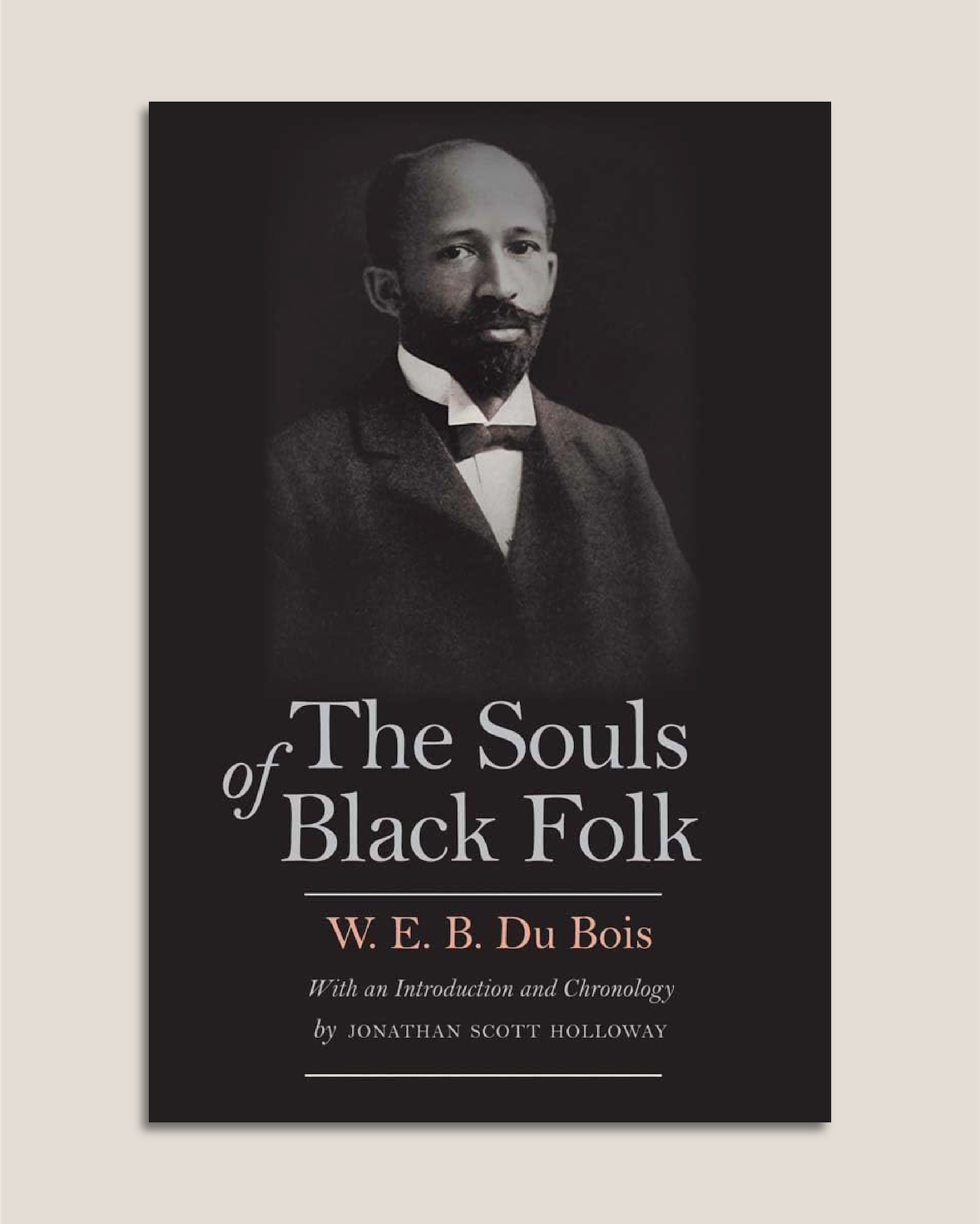
Re-reading the “debate” as a shared blueprint
There is a caution in how we memorialize Du Bois and Washington. Modern retellings can flatten them into archetypes—bootstraps versus protest, compromise versus agitation—until the real lesson disappears. The Root, in a critique of how Black history is packaged, notes that Du Bois and Washington are often reduced to a debate that amounts to “bootstraps” versus “the talented tenth,” with the nuance lost. That flattening is convenient for culture-war arguments, but it is dishonest to the stakes both men confronted.
Du Bois was not wrong to fear that vocational-only education could harden into caste. Washington was not wrong to fear that a strategy that ignores immediate economic survival can leave people exposed. The synthesis honors both fears and answers both.
And it suggests a more useful way to talk about their legacies: not as rival camps to choose from, but as complementary diagnostics that, when combined, form a durable prescription.
The conclusion: Education as double-entry bookkeeping—skills and soul, wages and voice
If the goal is the flourishing of Black American communities—materially, civically, culturally—then education has to keep two sets of books at once. One ledger tracks skills, wages, ownership, and the capacity to build. The other tracks interpretation, voice, leadership, and the capacity to govern. Washington wrote urgently in the first ledger because he saw how quickly hunger and exclusion could kill possibility. Du Bois wrote urgently in the second because he saw how quickly a people can be trained into permanent subordination when they are denied full intellectual and political formation.
The tragedy is that America has often tried to make Black education choose between these ledgers—offering skills without sovereignty, or rare sovereignty without broad material security. The opportunity, still, is to refuse that false choice.
A comprehensive and integrated inclusion of liberal arts and vocational education would have best advanced what both Du Bois and Washington ultimately wanted: a Black community capable of earning, owning, thinking, leading, voting, building institutions, contesting injustice, and defining “practical” on its own terms. That is not a compromise between two men. It is the completion of their shared project—freedom that is both livable and lasting.
More great stories
Afro Sheen, Wall Street, and the Architecture of Black Possibility
July 6, 2026
No Comments
The Fire Inside the Fourth
July 5, 2026
No Comments