



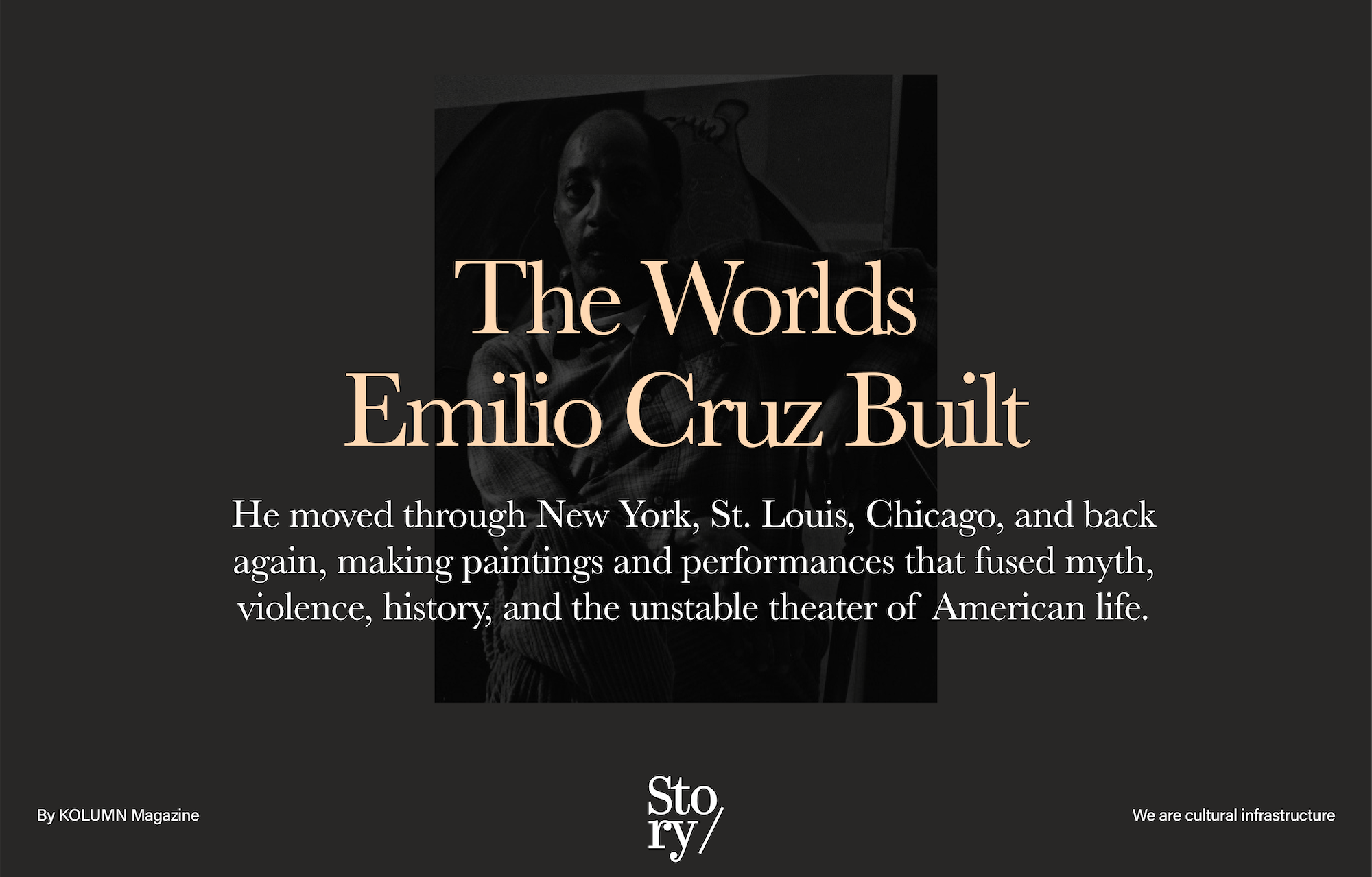
The difficulty of placing Emilio Cruz is part of why his significance is easy to underestimate. It is also exactly why he matters.
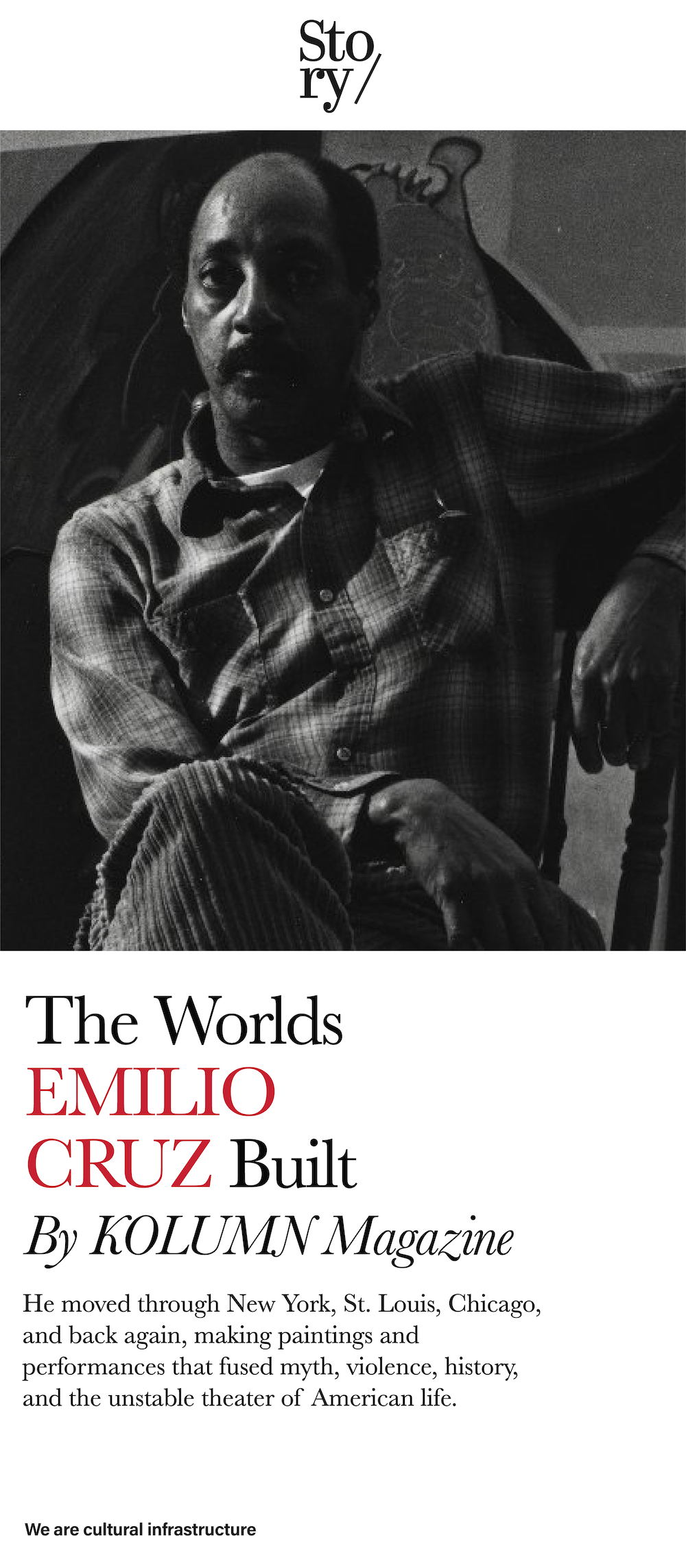
The difficulty of placing Emilio Cruz is part of why his significance is easy to underestimate. It is also exactly why he matters.
By KOLUMN Magazine
There are artists who fit neatly into the stories museums and textbooks like to tell, and then there are artists like Emilio Cruz, who make those stories look thin. Cruz, born in New York City in 1938 and dead there in 2004, was not just a painter. He was also a playwright, poet, performer, musician, teacher, and cultural traveler across scenes that are too often separated in hindsight: downtown New York figuration, Black avant-garde experimentation, Afro-diasporic inquiry, Chicago art pedagogy, and late-20th-century multicultural exhibition culture. The difficulty of placing him is part of why his significance is easy to underestimate. It is also exactly why he matters.
Cruz’s art carried a tension that never really went away. His paintings could look dreamlike, even fantastical, but they were seldom escapist. The Smithsonian American Art Museum describes his style as expressive and shaped by “imagined events and the history of Africa and the New World,” which gets at the scale of his ambition: Cruz was not merely illustrating scenes so much as building psychic worlds where myth, memory, violence, ritual, and survival collided. The Studio Museum in Harlem, which has long been one of the institutions most attentive to his work, frames his career as an investigation of “the human experience.” That phrase can sound generic when applied lazily. In Cruz’s case, it feels exact. He kept circling the same fundamental problem: how to picture humanity when history itself has been disfiguring.
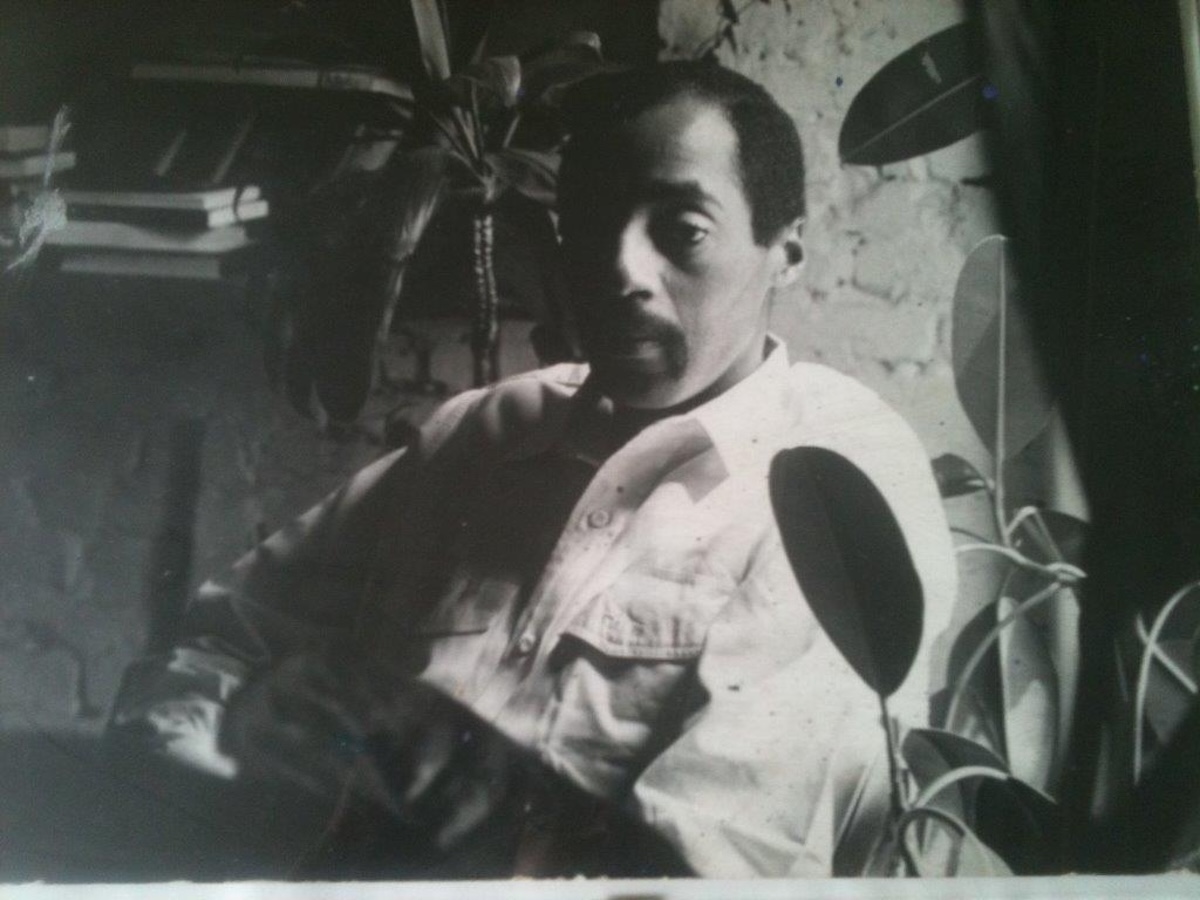
His career also tells a broader American story about who gets absorbed into the canon and who stays legible mainly to artists, curators, and committed viewers. Cruz exhibited early. He was not invisible in his own lifetime. He showed in New York in the 1960s, taught for years at the School of the Art Institute of Chicago, mounted major solo exhibitions, wrote and staged plays, and saw his work enter important public collections, including MoMA, the Brooklyn Museum, the Hirshhorn, the Smithsonian American Art Museum, and the Studio Museum in Harlem. Yet he never became a household shorthand for postwar American painting. That gap between accomplishment and recognition is not incidental. It is part of the subject.
To write about Cruz now is to write against older habits of omission. It is to notice how many histories of American art were built by narrowing the field until only a few movements, geographies, and names looked central. Cruz does not behave well inside those narrowed frames. He was Cuban American, Bronx-born, shaped by Harlem and downtown Manhattan, connected to Provincetown’s figurative circles, active in the Black Artists Group in St. Louis, professionally rooted for years in Chicago, and later reengaged with New York institutions and audiences. He belonged in several stories at once. That multivalence was a strength in the work, but for a long time it may have been a liability in the marketplace of easy art-historical branding. That is an inference, but it is a grounded one, especially given the fragmentary way his career has often been discussed relative to his peers.
A Bronx beginning, and an early education in looking
Cruz spent his early years in the Bronx and Harlem. According to the Studio Museum, his father was a trained artist and Cruz’s first art teacher, an origin point that matters because it places art not as some later professional discovery but as part of the structure of daily life. After high school, he worked as a commercial artist while studying at night at the Art Students League. That combination—wage work, formal study, and self-fashioning in New York—belongs to a familiar midcentury artistic pattern. But it also hints at Cruz’s lifelong refusal to treat art as sealed off from labor, improvisation, and survival.
His education was broad rather than singularly academic. Later biographical records list study at the Art Students League, the New School for Social Research, Provincetown under Seong Moy, and even the University of Louisville. The diversity of those sites helps explain some of the formal and intellectual elasticity in the work. Cruz was not a doctrinaire painter schooled into one neat ideology of form. He absorbed from workshops, from artists, from place, and from overlapping communities. That kind of education can produce uneven careers. It can also produce original ones. Cruz’s did both: there are shifts, detours, discontinuities, and restarts in his record, but there is also a powerful through-line of restless invention.
By the later 1950s, he was spending time in Provincetown, where he studied with Seong Moy and formed friendships with Bob Thompson, Franz Kline, and Charles Olson, according to the Studio Museum. That alone should complicate any attempt to isolate him from central postwar currents. Provincetown in that period was a crucial crossroads, and one recent Hyperallergic account of Bob Thompson’s early circle names Cruz among the artists Thompson met there in 1958, alongside Red Grooms, Mimi Gross, Bill Barrell, Jay Milder, and others. The article notes that this group’s commitment to figuration and older art-historical reference points marked out “a separate evolutionary trail” from the dominant New York movements that were then consolidating around Abstract Expressionism, Pop, and Minimalism. Cruz was in that room, in that argument, from early on.
This matters because Emilio Cruz is sometimes described only in relation to Black or Latino art histories, as though those categories are sufficient on their own. They are indispensable, but they are not sufficient. Cruz was also part of a larger postwar revolt against stylistic orthodoxy. He was among artists working through the aftermath of Abstract Expressionism without surrendering figuration, myth, narrative, or bodily presence. MoMA’s 1970 press material described him as initially influenced by Jan Müller and Bob Thompson, while noting his growing interest in African motifs and color. Read now, that description sounds like a museum trying to classify a painter whose vocabulary was already becoming more syncretic than its labels. Still, it confirms that institutions recognized Cruz, however partially, as an artist operating within the central formal debates of his time.
Early New York, and the problem of visibility
Cruz’s early exhibition history tells a revealing story. His CV places solo shows at Zabriskie Gallery in New York in 1963 and in Provincetown in 1965. Those are not minor data points. They suggest a young artist who was not waiting quietly on the sidelines. And yet the oral histories from peers convey how restricted visibility remained for Black painters of that generation. In a Smithsonian oral history, Jack Whitten recalled that in the mid-1960s, among young Black painters, Bob Thompson was showing with Martha Jackson and “Emilio Cruz was showing a little bit with Zabriskie,” while “nobody else was showing.” Joe Overstreet, in his own oral history, similarly recalled how brutally difficult it was for Black artists to sell work, adding that Cruz and Thompson were among the few who occasionally managed it. In other words, Cruz was visible, but visibility itself was scarce, precarious, and structurally uneven.
“He was not painting a stable identity. He was painting through instability itself.”
That tension is central to understanding his place in American art. Cruz was neither wholly neglected nor fully institutionalized. He occupied an in-between condition familiar to many serious artists of color in the postwar era: respected within certain circles, intermittently exhibited, collected by major institutions, but not stabilized into the kind of broad historical celebrity conferred on many white peers. The mainstream art world did not need to exclude an artist completely in order to diminish his historical footprint. Partial recognition could do that just as effectively. Cruz’s case is almost a textbook example.
He also came of age at a moment when the categories later used to recover him had not yet cohered in their current institutional form. “Latinx art,” “Afro-diasporic modernism,” “Black figurative expressionism”—these are useful contemporary frames, but Cruz lived through a period when artists were often forced to navigate such identities tactically, inconsistently, and across changing political terrain. The result is a body of work that resists retroactive simplification. He was not painting a stable identity. He was painting through instability itself.
Rome, downtown experimentation, and an expanding vocabulary
The mid-1960s opened the field further. The Studio Museum notes that Cruz received a John Hay Whitney Foundation fellowship in Rome. The Archives of American Art finding aid also records that he received a John Hay Whitney Fellowship, along with later honors including National Endowment for the Arts support. Fellowships matter in every artist’s life for practical reasons, but in Cruz’s case the significance also feels symbolic. He was building a language that could not be contained by provincial American categories, and the Rome fellowship widened his vantage point at a formative moment.
After Rome, he settled on Manhattan’s Lower East Side, where, according to the Studio Museum, he met jazz musicians and participated in experimental theater events. This downtown phase is not peripheral trivia. It helps explain why Cruz never behaved like a studio isolationist. His imagination was social, improvisational, and multidisciplinary. He moved in spaces where music, performance, poetry, and painting cross-pollinated. That sensibility would remain durable. Even when working in a static medium, Cruz’s imagery often seems staged, sequential, and rhythmically unstable, as though something between ritual and performance is always underway.
This is one of the reasons the usual distinction between “painting” and “content” feels especially inadequate with his work. Cruz was deeply invested in image-making, but he was also thinking dramaturgically. Figures in his paintings rarely read as passive occupants of pictorial space. They press, confront, mutate, enact. Even when the narrative remains elusive, the sensation of event is strong. The Smithsonian’s phrasing—“imagined events and the history of Africa and the New World”—again proves useful here. Cruz’s art is often historical without being documentary, allegorical without becoming didactic, and symbolic without giving up its visceral edge.
St. Louis and the Black Artists Group
One of the defining chapters of Cruz’s life came when musician Julius Hemphill invited him to St. Louis. The Studio Museum says that as a visiting artist with the Missouri Arts Council from 1968 to 1969, Cruz became involved with the Black Artists Group. The Saint Louis Art Museum’s educational materials are even more specific: Cruz, described there as a New York Afro-Cuban artist, arrived in 1969 as BAG’s visual artist in residence, participated in performances, taught at the group’s center and in the nearby Pruitt-Igoe housing project, and led workshops and neighborhood art projects. The museum quotes him embracing the chance to “work with Black people [on] our own way of saying things.”
That line is crucial. It clarifies that BAG was not merely a stop on a résumé. It was a political and aesthetic community, one in which Cruz’s commitments to experimentation and Black collective self-definition could converge. Washington University’s retrospective account of BAG identifies the collective as a seedbed for nationally recognized figures across music, theater, dance, poetry, and visual art, naming Cruz among them. What emerges is not a story of Cruz “joining” Black art after some earlier formal phase, but rather of his already broad practice finding a collective context equal to its ambitions.
BAG also helps correct the lazy notion that midcentury and late-modernist art unfolded primarily through New York galleries. Some of the most important experimental work of the period happened in collaborative regional formations, often with stronger political urgency and more porous boundaries between disciplines. Cruz’s St. Louis chapter proves he belonged to that American map too. He was not simply a New York artist who took a detour west. He was an artist whose formation depended on moving through several ecosystems of innovation.
Chicago: teaching, theater, and the long middle stretch
From 1970 to 1983, Cruz taught painting and drawing at the School of the Art Institute of Chicago, according to the Studio Museum. The Washington Post’s obituary also noted that during the 1970s he lived in Chicago and taught at the Art Institute of Chicago. This long tenure matters because it positioned him not only as a maker but as a transmitter. Artists who teach for more than a decade often exert an influence that is harder to measure than sales or museum acquisitions. Their impact disperses through students, local scenes, conversations, and critical habits. Cruz’s significance in Chicago, by that measure, is likely larger than the documentary record alone can easily prove.
Chicago was also a period of sustained exhibition activity. His CV lists solo shows there throughout the 1970s, including repeated appearances at Walter Kelly Gallery, as well as exhibitions at the Krannert Center and in institutional settings tied to the Art Institute and Museum of Contemporary Art Chicago. More recent scholarship and gallery work have returned to this period with special interest. Corbett vs. Dempsey’s 2022 exhibition Inter-Planetary Slavery: Paintings and Fiberglass Sculpture, 1970–1979 focused specifically on Cruz’s Chicago years, describing the show as centered on works made while he was teaching at SAIC. The exhibition highlighted his human-scale fiberglass “sarcophagi,” suggesting that the decade was not a lull but a laboratory.
That retrospective emphasis is revealing. Middle decades in an artist’s life are often flattened in hindsight, especially when they do not yield a single canonical masterpiece readily reproduced in textbooks. But Cruz’s 1970s now look less like an in-between chapter and more like a zone of formal expansion. He was not just painting canvases; he was moving into sculpture, theater, and hybrid environments. The Archives of American Art finding aid records that his papers include literary and performance materials, while the Studio Museum notes that in 1976 he and his wife Patricia founded Spectacle, Inc., a multimedia theater production company combining poetry, painting, movement, film, and music. The name alone—Spectacle—feels true to his sensibility. Cruz wanted art to happen across media, not within fences.
His plays confirm this impulse. The Archives of American Art records two works, Homeostasis: Once More the Scorpion and The Absence Held Fast to Its Presence, first performed in New York in 1981 and later staged in Europe as part of the World Theater Festival. The Washington Post also noted both plays in its obituary. That Cruz wrote plays at all is sometimes treated as an eccentric side note. It should be treated instead as evidence of how seriously he took the relation between image, language, event, and embodiment. The paintings and the plays belong to the same temperament: one that distrusted confinement in a single mode.
The paintings: beasts, bodies, cosmologies, contradiction
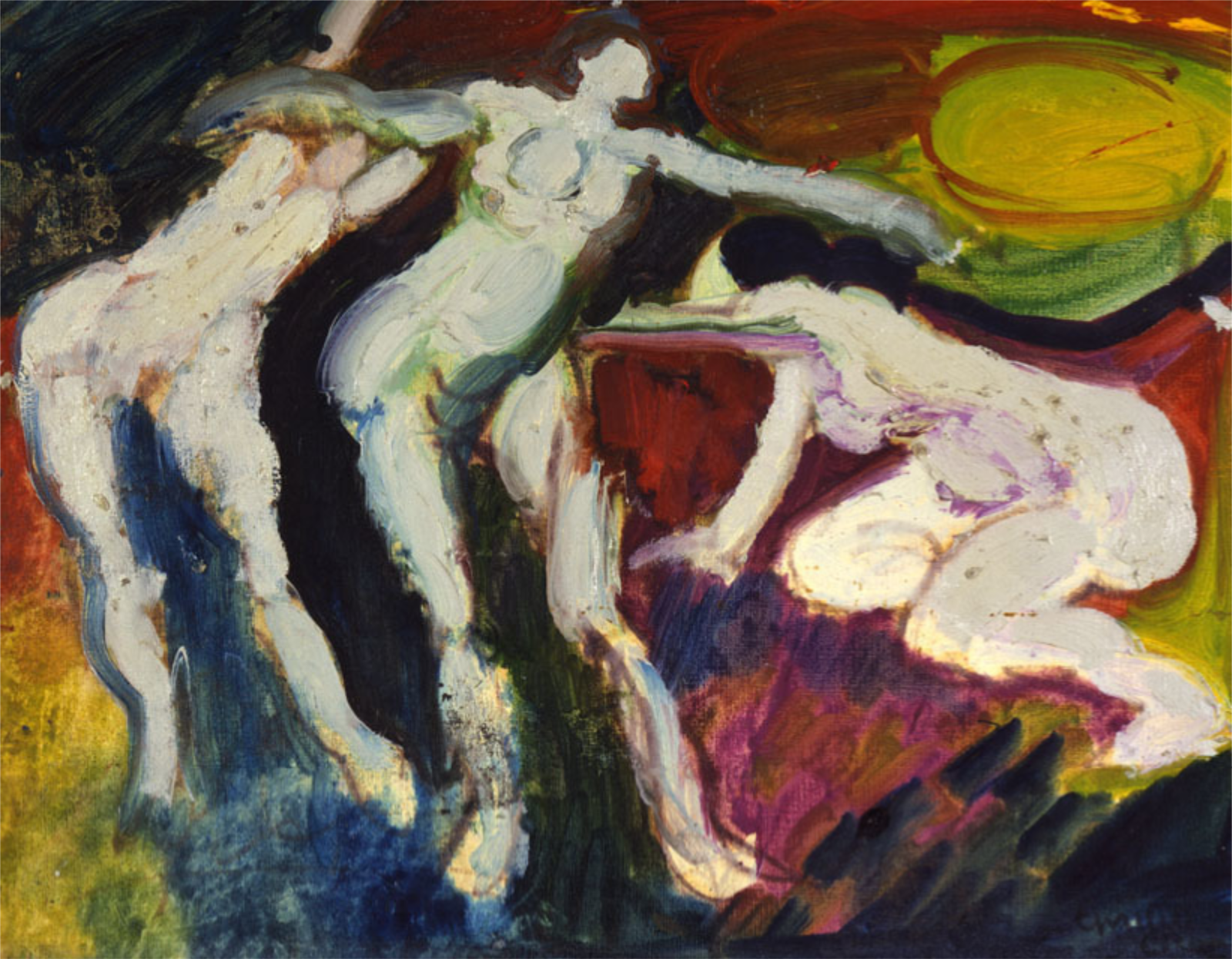
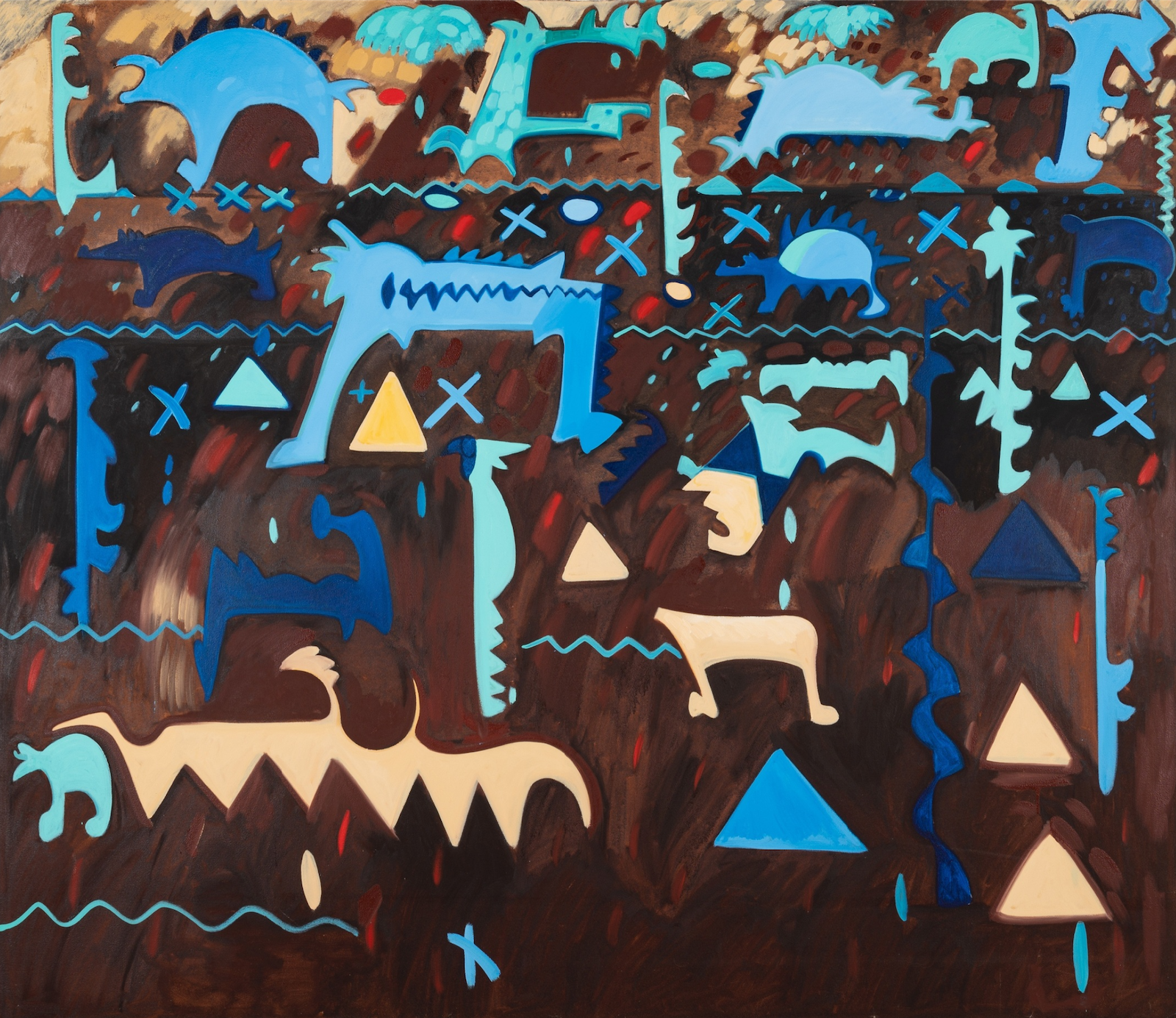
To look at Cruz’s painting is to encounter a visual world where bodies are unstable and meaning does not arrive in a straight line. Human and animal forms appear together. Mythic and natural-historical imagery collide. Color can feel lush, but the mood is often severe. The Washington Post remembered him as an artist known for mixing human figures with animal and natural-history imagery. The Studio Museum, discussing Thanksgiving and Other Holidays from 1986, describes a “contradictory image” in which festivities are set against a jarring scene, with layered visual elements and a tension between smooth paint and drawn motifs. That single work offers a useful key: contradiction is not incidental in Cruz. It is structural.
The Studio Museum goes further, noting that the painting’s amalgamation of elements grew from Cruz’s study of cosmologies, religions, and philosophies, and that in his vision, influenced by Hindu thought, life is a constant contradiction in which the opposite is always also true. That is an unusually illuminating institutional description because it helps explain why Cruz’s work can feel so difficult to paraphrase. He was not arranging symbols to produce one stable message. He was staging a metaphysical conflict. The paintings often ask viewers to inhabit simultaneity: attraction and dread, flesh and spirit, ritual and brutality, knowledge and bewilderment.
This is where Cruz’s relation to expressionism becomes especially interesting. Expressionism in American art is often discussed as a matter of brushwork, emotion, and distortion. Cruz certainly used those resources. But he also injected into figuration a density of cosmological and historical reference that makes the category feel too narrow on its own. The Studio Museum’s catalogue note for Thanksgiving and Other Holidays points to religion, ecology, and spirituality; the Smithsonian points to Africa and the New World; the Washington Post points to the darker side of human existence. Put together, those accounts suggest that Cruz’s expressionism was not merely psychological. It was civilizational.
That larger scope may be one reason his paintings still feel contemporary. We live in a moment fluent in fragmentation, hybridity, and overlapping catastrophe. Cruz got there early, though from a different angle. He was not making “contemporary” art in the market sense. He was making paintings adequate to entanglement. He seemed to understand that modern life, especially in the Americas, could not be pictured honestly through purity. Too much had been mixed under violent conditions. Too many histories occupied the same body. Too many inherited structures were both sacred and broken. This is interpretation, but it is supported by the repeated emphasis in institutional sources on contradiction, diaspora, Africa and the New World, mythology, and the human condition.
Return to New York, institutional recognition, and late work
When Cruz returned to New York in the 1980s, he reentered a city that was itself being reorganized by new markets, new identities, and new exhibition politics. The Studio Museum says he resumed teaching at various institutions after returning from Chicago; the Archives of American Art notes later teaching at Pratt Institute and New York University; and the Washington Post said that at the time of his death he was an assistant professor at both Pratt and NYU. Meanwhile, his exhibition profile in the 1980s and 1990s expanded in ways that now look especially significant.
The Studio Museum mounted his solo exhibition Spilled Nightmares, Revelations, and Reflections in 1987, and its store description of the accompanying catalogue says the show highlighted the evolution of his fantastical and allegorical scenes as modes of reflection on philosophy, religion, and the natural and social sciences. His CV shows that he also appeared in group exhibitions with lasting historical value, including The Decade Show in 1990, the landmark collaborative exhibition organized by The Studio Museum in Harlem, The New Museum, and The Museum of Contemporary Hispanic Art. That placement is telling. Cruz’s work was legible within the emerging frameworks of Black and Latinx institutional discourse, yet never reducible to them.
His later solo and group exhibitions also show sustained engagement rather than disappearance: California African American Museum in 1988, PAFA’s Homo sapiens Series in 1997, and the 1994 Cuenca Biennial’s American contingent, among many others. His CV records a 1994 Joan Mitchell Foundation Grant, earlier NEA support, and an Illinois Arts Council Fellowship. Those honors did not transform him into a market superstar, but they do undermine any narrative that treats him as a purely posthumous rediscovery. Cruz was working, showing, being awarded, and being collected. The more precise point is that his recognition was real but insufficiently consolidated into the broader public narrative of American art.
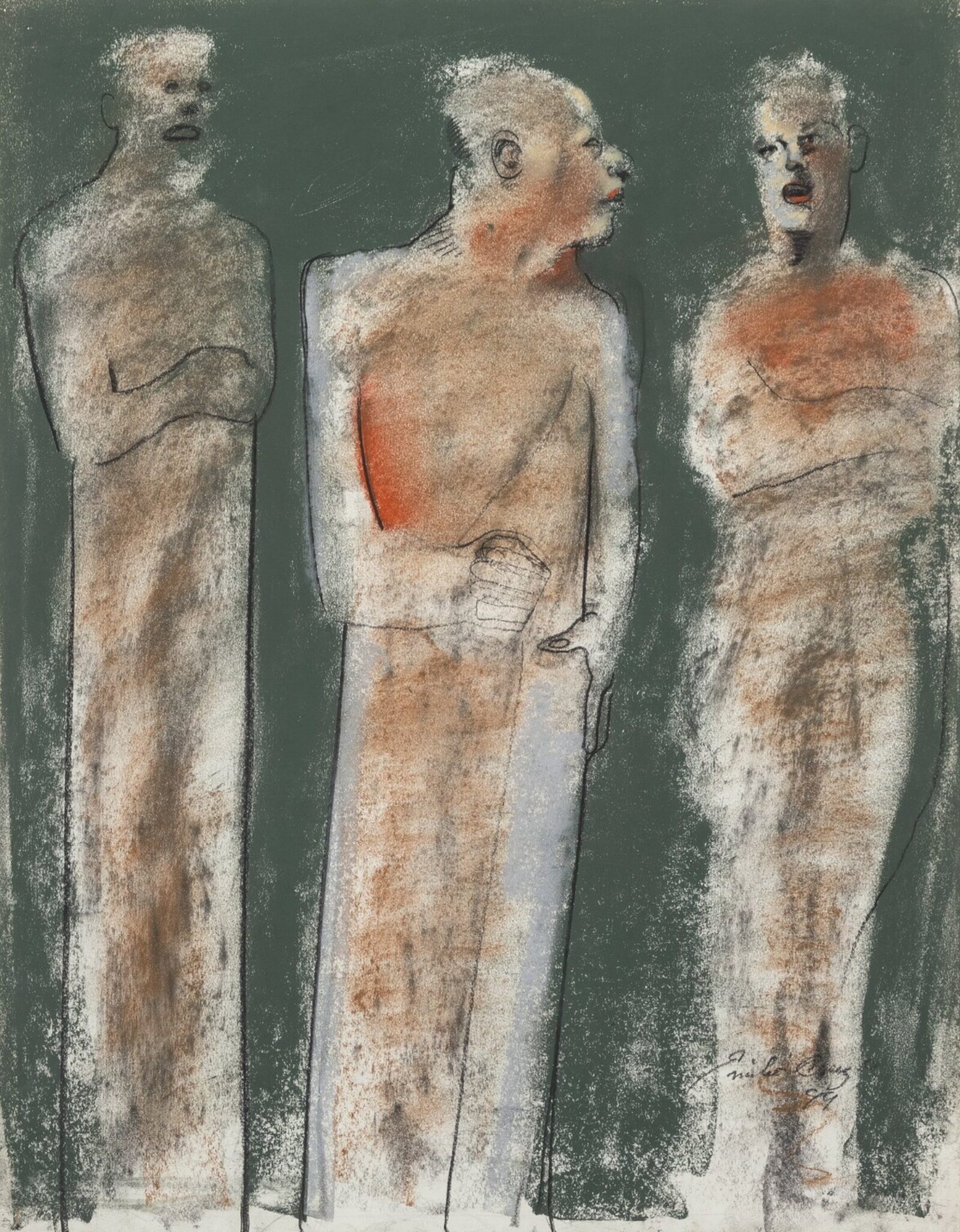
The late work underscores how relentless he remained. Corbett vs. Dempsey’s online exhibition The Big Dig: Emilio Cruz • I Am Food I Eat the Eater of Food notes that in 2004, just months before his death, Cruz completed a collective series of drawings under that title, with Part One shown in Los Angeles during the last months of his life and Part Two later brought together online. Even the title sounds like Cruz distilled: bodily, metaphysical, circular, violent, strangely comic, impossible to domesticate. He was still making work that bit back.
Death, legacy, and the slow work of recovery
Cruz died on December 10, 2004, at St. Vincent’s Hospital in New York, of pancreatic cancer, according to the Washington Post. He was 66. The obituary described him as an artist whose work often illustrated the darker side of human existence. Ken Johnson’s New York Times obituary is cited across secondary sources, and the Smithsonian, Studio Museum, and archives all confirm his death year and long institutional presence. What matters now is not merely the fact of his death but what happened after it: a familiar period of relative quiet, followed by the slower machinery of archival preservation, curatorial advocacy, and historical reevaluation.
The archive has been essential. The Archives of American Art received the Emilio Cruz papers from Patricia Cruz in 2016. Those papers include biographical materials, correspondence, writings, project files, printed matter, and photographs. They also include an interview related to the Black Artists’ Group and a recording of Cruz’s memorial service. Archives do not make reputations by themselves, but they make serious reconsideration possible. They create the conditions under which a career can be studied as more than rumor or anecdote. In Cruz’s case, that matters enormously because his work crossed so many fields that without archival consolidation, the record could easily remain scattered.
The exhibitions of the last several years suggest that the reconsideration is gaining real traction. Corbett vs. Dempsey’s 2021 and 2022 presentations recovered both his final drawings and his Chicago-period sculpture and painting. His CV records inclusion in institutional and historically minded shows such as Inventing Downtown: Artist-Run Galleries in New York, 1952–1965, The Freedom Principle: Experiments in Art and Music, 1965 to Now, and Modern Heroics: 75 Years of African-American Expressionism. These are not nostalgic afterthoughts. They indicate that curators increasingly see Cruz as central to multiple overdue revisions in postwar art history.
One reason this recovery has force is that Cruz speaks to several current scholarly interests at once: the entanglement of Black and Latinx modernisms, the role of artist-run and collective spaces, the porous relation between visual art and performance, the importance of regional scenes outside New York, and the limits of canonical narratives built around a small set of movements. But reducing him to a checklist of currently fashionable concerns would be another mistake. Cruz is not newly important because he fits today’s discourse. He is newly legible because today’s discourse is finally broad enough to register what was already there.
Why Emilio Cruz matters now
So what, finally, is Emilio Cruz’s significance? Part of the answer is formal. He helped build a strain of American figurative painting that refused the false choice between abstraction and representation. He drew energy from expressionism without surrendering narrative, symbol, or bodily presence. He fused mythic, historical, ecological, and spiritual material into pictures that feel unruly in the best sense: alive to contradiction, uninterested in flattening experience, unwilling to resolve the human into a slogan.
Part of the answer is cultural. Cruz’s life traced the networks through which postwar Black and Afro-diasporic art actually moved: family transmission, New York workshops, Provincetown circles, Lower East Side experimentation, St. Louis collectivity, Chicago teaching, Harlem institutions, and wider international exchange. His career exposes the inadequacy of the old center-margin model. He was never simply outside the story. He was in many of its vital rooms, even if the official narrative later tightened around other names.
And part of the answer is ethical. Cruz seems to have believed, as his estate site puts it, that art of significance required a commitment to humanity and moral imperatives. Estate language should always be read with care, but in this case it aligns convincingly with the work, the teaching, the BAG involvement, the theater projects, and the repeated institutional descriptions of his concern with the human condition. This was an artist for whom aesthetics and seriousness were not opposites. He did not treat beauty as innocence. He treated form as a way of holding difficult truths.
It is also worth saying plainly that Emilio Cruz matters because American art history is still being corrected, and correction is not just about adding overlooked names to a longer list. It is about changing the story those names tell. Insert Cruz back into postwar art and several things happen at once. New York looks less homogeneous. The line from Abstract Expressionism to later figuration gets more complex. Chicago becomes more central. BAG becomes harder to footnote away. The boundaries between Black art, Latinx art, and “American modernism” get productively unstable. And the very idea of a single-medium artist starts to look too narrow for the world some of the most interesting makers were actually inhabiting.
Cruz may never become a shorthand name in the way institutions like to market a canon. Maybe that would even misdescribe him. He was too shape-shifting for easy monumentality. But that does not make him minor. It may make him more useful now. We are living through a period of historical revision in which the most compelling figures are often those who unsettle categories rather than decorate them. Emilio Cruz belongs firmly in that company: a painter of beasts and bodies, ritual and rupture, ancestry and futurity; a playwright and teacher; a builder of forms equal to contradiction; an artist whose career reveals just how much American art was always larger, stranger, and more interconnected than the official story allowed.
More great stories
Afro Sheen, Wall Street, and the Architecture of Black Possibility
July 6, 2026
No Comments
The Fire Inside the Fourth
July 5, 2026
No Comments