





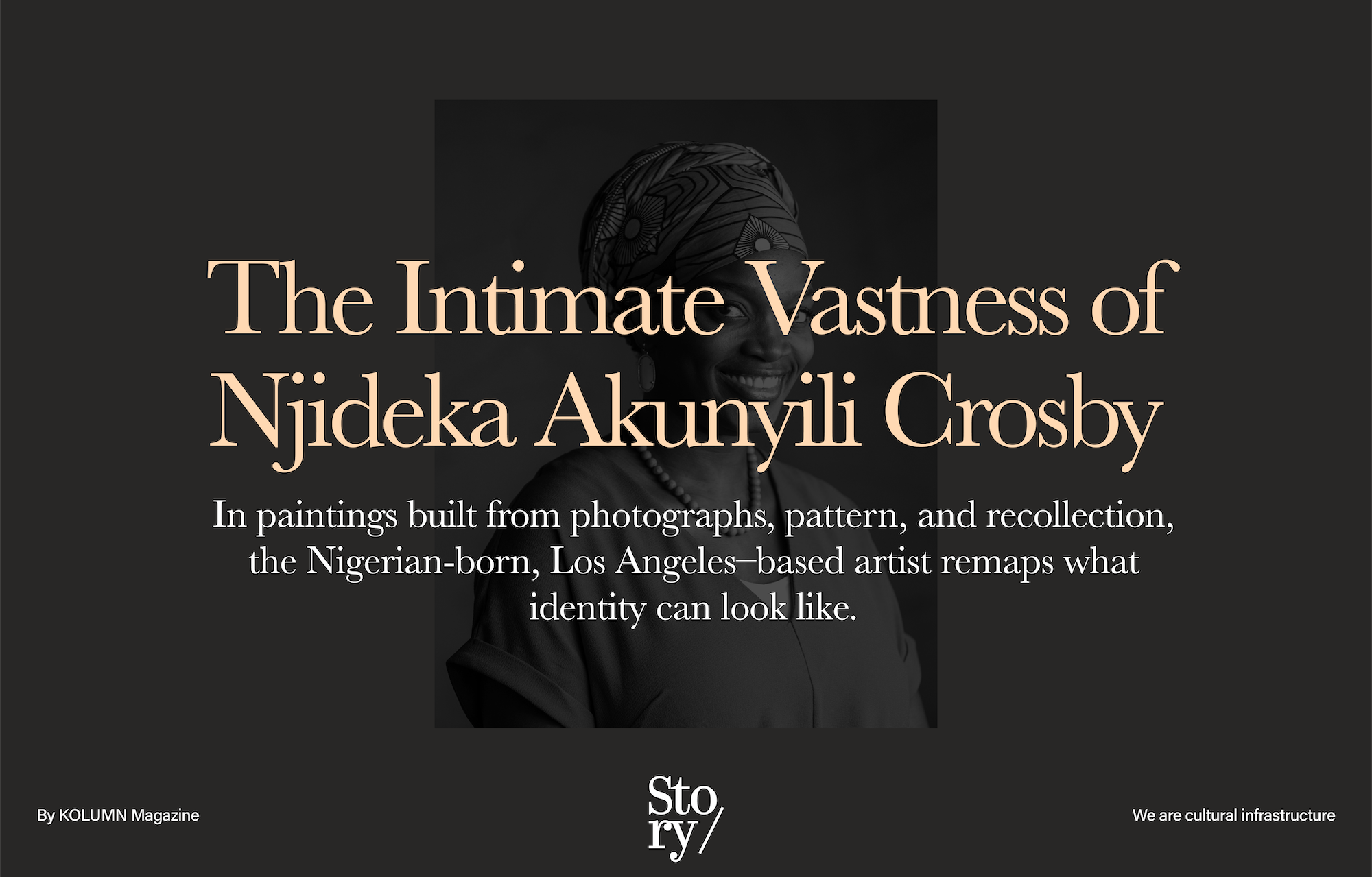
Njideka Akunyili Crosby paints domestic space as if it were a border crossing: tender, ordinary, and charged with history.
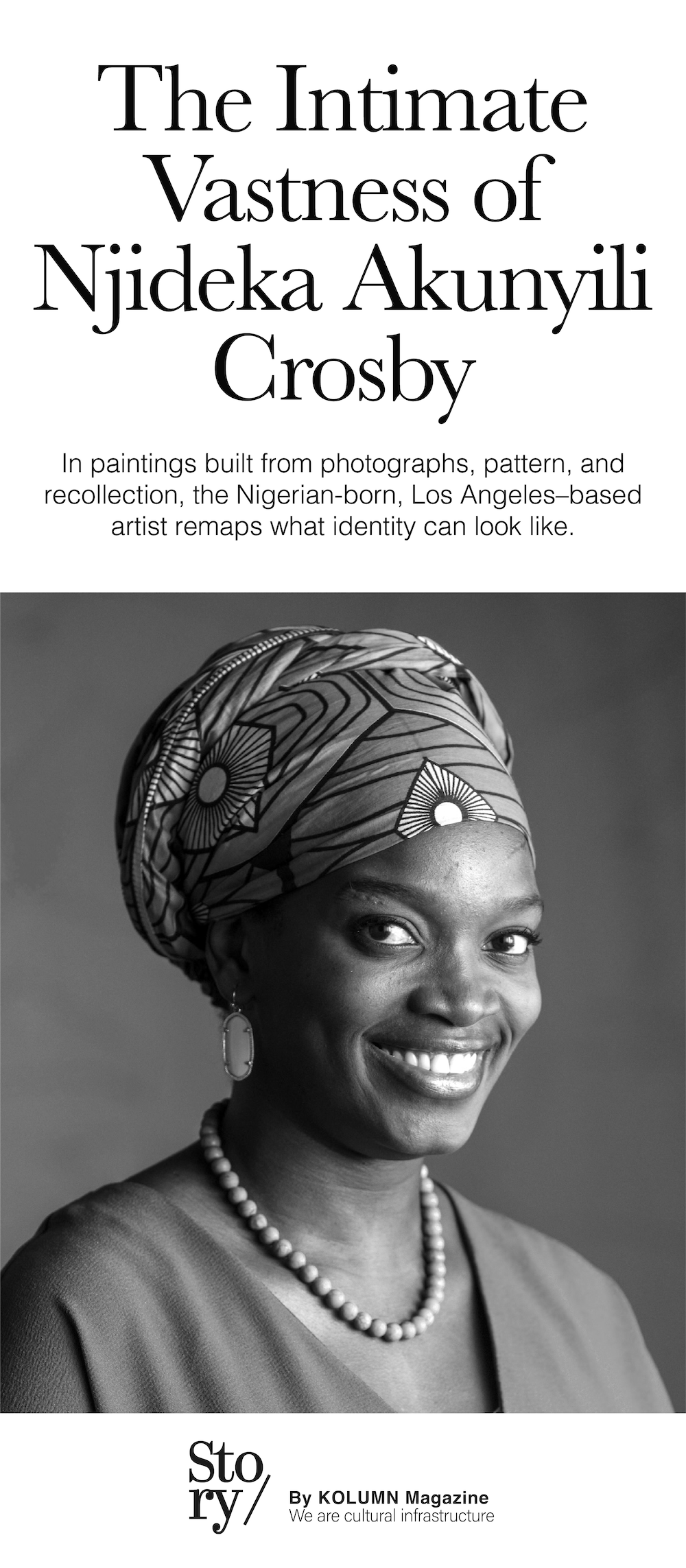
Njideka Akunyili Crosby paints domestic space as if it were a border crossing: tender, ordinary, and charged with history.
By KOLUMN Magazine
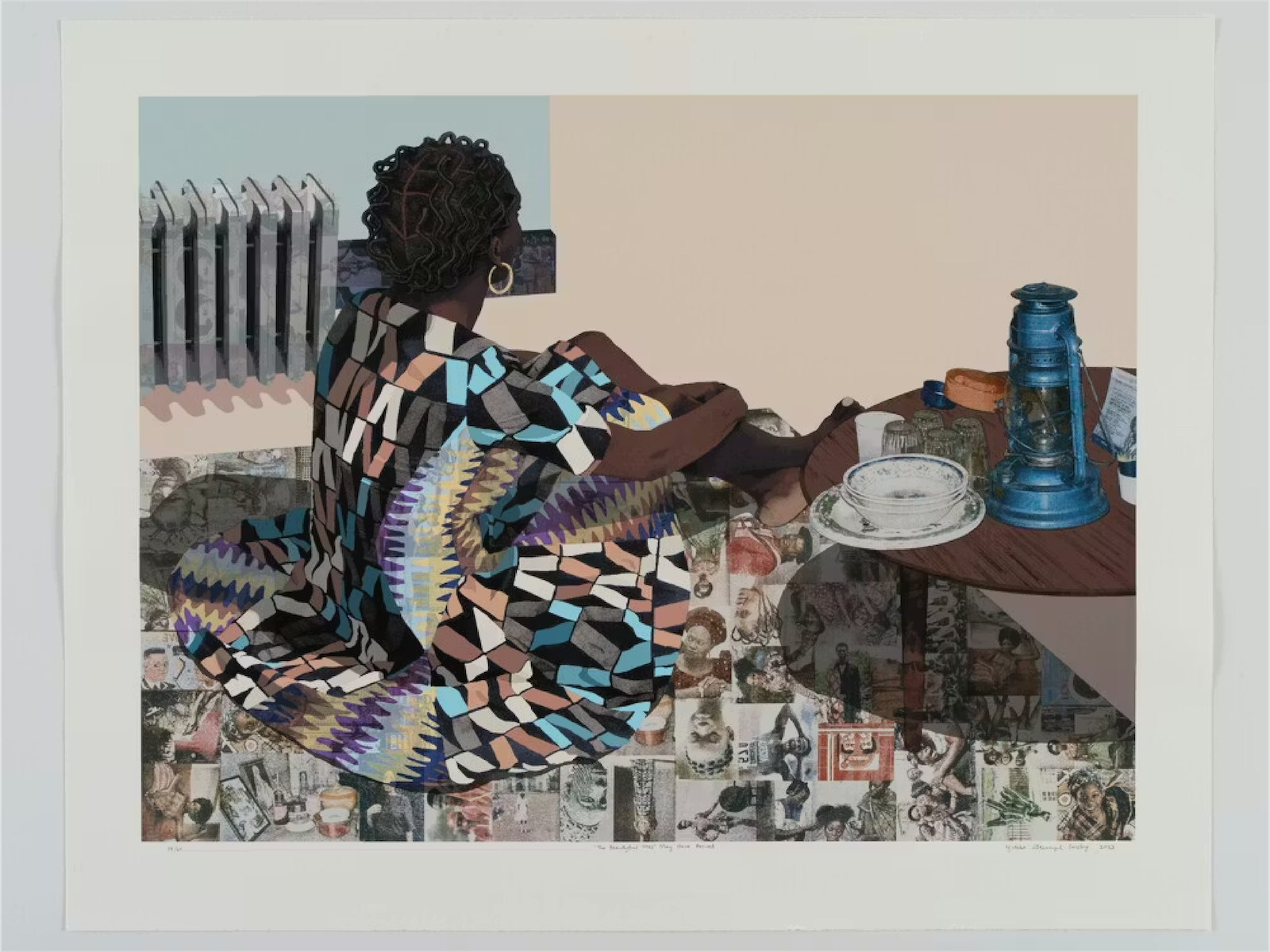
Njideka Akunyili Crosby changed the temperature of looking. Her pictures do not need to yell to command a room. They do something subtler and, in the long run, more disruptive. They pull the viewer close with intimacy, with domestic scenes, with softness, with beauty. Then they reveal that what first looked like a private interior is also a map of migration, a ledger of memory, and a compressed argument about race, class, nation, gender, and belonging. That slow unfolding is central to her significance. Akunyili Crosby has built one of the most distinctive visual languages in contemporary art by making the everyday newly legible.
Born in Enugu, Nigeria, in 1983, and now based in Los Angeles, Akunyili Crosby has, over the past decade and a half, emerged as one of the defining painters of her generation. Museums, critics, collectors, and fellow artists have all recognized the force of her work. She received the Smithsonian American Art Museum’s James Dicke Contemporary Artist Prize in 2014, the New Museum’s Next Generation Prize in 2015, the Prix Canson in 2016, and a MacArthur Fellowship in 2017. Her work is held by major institutions including the Whitney, MoMA, the Met, the Tate, and the Baltimore Museum of Art. That résumé is impressive on paper. But the real measure of her importance is more difficult to tabulate: she changed the terms of the conversation around figuration, diaspora, and Black subjectivity in contemporary painting.
Akunyili Crosby’s art is often described through the language of hybridity, and that is not wrong. Her works combine drawing, painting, photo-transfer, collage, pattern, textile references, and dense accumulations of imagery pulled from personal photographs, Nigerian magazines, family archives, and art history. Yet “hybridity” can be a flattening word when applied too casually, as if her work were simply about the mixing of two worlds. What makes her paintings so remarkable is that they do not merely blend Nigeria and America, or private and public, or past and present. They stage the frictions among them. They show that identity is not a neat synthesis. It is layered, negotiated, interrupted, and revised. Her surfaces do not smooth over contradiction; they preserve it.
That may be why her paintings feel so lived-in. The rooms she depicts are never just rooms. They are social and psychological architectures. A chair, a wall, a floor, a family photo, a wrapper, a textile pattern, a magazine clipping, a hairstyle, a pose at the table, a glance across the room: all of it carries pressure. Her art understands that interiors are not neutral. They are where families form and fracture, where class aspiration shows itself, where television and advertising leak into the self, where history becomes décor, and where the migrant experience is often felt most acutely. Home, in Akunyili Crosby’s hands, is not a retreat from politics. It is one of politics’ deepest habitats.
Growing up inside two Nigerian realities
To understand the power of Akunyili Crosby’s work, it helps to begin with her biography, though not in the simplistic art-market way that reduces artists to backstory. She grew up in Enugu and later lived in Lagos before moving to the United States as a teenager. Those early experiences matter because they gave her firsthand knowledge of movement within Nigeria as well as movement out of it. Enugu and Lagos are not interchangeable worlds. One is often associated with family rootedness and southeastern Igbo identity; the other with scale, speed, cosmopolitanism, and the social performance of class. Akunyili Crosby has spoken about those shifts, and her paintings retain an alertness to how location changes the texture of daily life.
Her family background mattered too. Her father was a surgeon, and her mother, Dora Akunyili, became one of Nigeria’s most revered public figures through her work as a pharmacologist and as the head of the National Agency for Food and Drug Administration and Control, where she led a high-profile crackdown on counterfeit pharmaceuticals. Dora Akunyili’s public stature gave her daughter unusual proximity to questions of state power, public service, visibility, and risk. Those themes are not illustrated literally in Njideka’s paintings, but they hover there, especially in works that fold family memory into national history. In the Met’s Mother and Child, for instance, commemorative fabric referencing Dora Akunyili becomes part of the painting’s emotional and political texture.
There is a temptation, especially in profile writing, to make Dora Akunyili the key to her daughter’s art. That would be too convenient. What is more accurate is to say that Njideka Akunyili Crosby grew up in a household where education, ambition, mobility, and public responsibility were not abstractions. She initially pursued pre-med studies and earned a BA from Swarthmore College before moving fully toward art, later studying at the Pennsylvania Academy of the Fine Arts and then earning an MFA at Yale. That route matters because it complicates the old cliché of the artist as someone who “always knew.” Akunyili Crosby’s formation was intellectual as much as intuitive. She did not drift into art. She chose it, after serious study elsewhere, which may help explain the deliberateness of her formal decisions.
Her move to the United States at sixteen also sits at the center of her work, though again, not as sentimental immigrant testimony. Migration in her paintings does not appear as an inspirational arc. It appears as a condition of split reference, altered perception, and doubled literacy. One of the most compelling things about her art is that it resists the demand to choose a singular cultural allegiance. Instead, it renders what it feels like to inhabit multiple image worlds at once. Nigerian pop culture, European painting, American domesticity, magazine reproduction, family photography, and modernist composition all coexist in her work without being forced into false harmony.
Building a language out of transfers, fragments, and touch
Akunyili Crosby’s signature technique is often described in technical shorthand: paint, transfers, colored pencil, charcoal, collage, marble dust, fabric. But the materials only become meaningful when one sees how they operate conceptually. Her photo-transfer process allows images to remain present while also becoming partially unstable. Faces, textiles, newsprint fragments, decorative motifs, and archival traces seep into the work like memory itself: visible, legible, but never entirely fixed. They do not sit on the surface as quotation marks. They become the atmosphere of the painting.
“In Akunyili Crosby’s work, surface is never superficial. It is where memory, class, beauty, and history leave their residue.”
This technique does a lot of intellectual work. It lets her avoid the dead end of straightforward realism while still preserving figural intimacy. It also lets her create a distributed kind of portraiture. The person in the foreground is never alone. Even when a single figure dominates the composition, that figure is surrounded by, clothed in, or embedded within other lives and images. Family snapshots can appear in wallpaper. Magazine images can populate the floor. Textile patterns become cultural memory banks. Background becomes biography. Ornament becomes archive.
That is part of why critics and curators have repeatedly emphasized the counter-narrative force of her work. The Hammer Museum, for example, framed her paintings as offering an important counterpoint to reductive representations of Africa’s political and social conditions. That description gets at something important. Akunyili Crosby does not deny difficulty, history, or violence. She simply refuses the impoverished visual script in which African life appears primarily through catastrophe. Her work insists on interiority, style, routine, desire, awkwardness, domestic calm, private grief, maternal lineage, and the aesthetics of ordinary life. It refuses both pity and spectacle.
This refusal has political stakes. For decades, Black representation in Western art institutions has often been mediated by a demand for legibility: explain the wound, narrate the trauma, signify the issue. Akunyili Crosby’s paintings do not opt out of politics, but they refuse to be exhausted by a sociological reading. Sebastian Smee, writing in The Washington Post, argued that her work transcends the traditional scope of identity politics. That is a useful phrasing, not because the work moves beyond identity, but because it makes identity too thick, too sensuous, too formally complex to be reduced to checklist discourse. The paintings ask to be read as paintings and as social documents, as structures of feeling and as structures of design.
The domestic as a serious stage
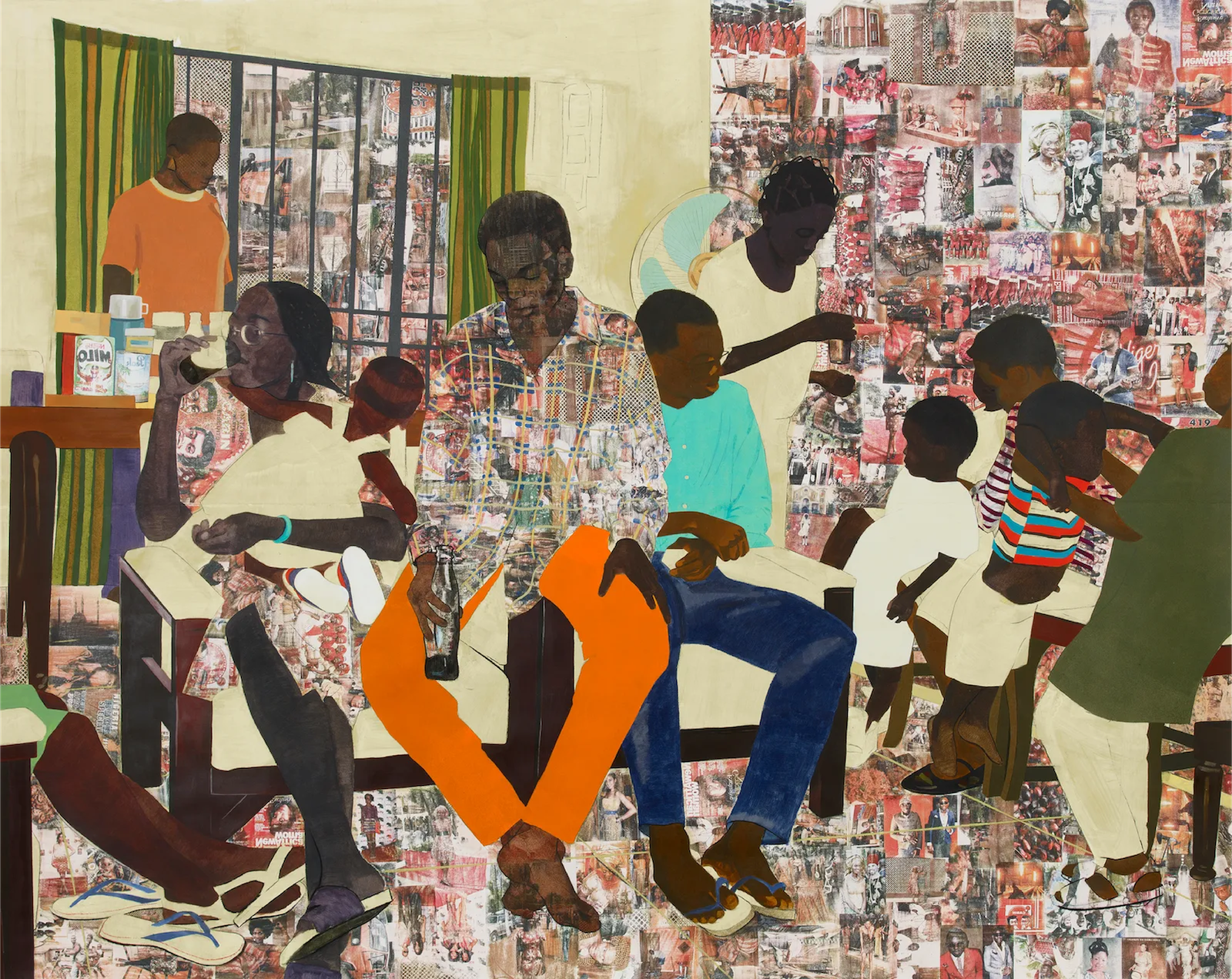
One of the most radical things about Akunyili Crosby’s art is how insistently it returns to domestic scenes. Friends sit at tables. Partners recline. Children pose. Couples inhabit rooms. Women appear in interiors shaped by fabric, ornament, and recollection. In a less disciplined artist’s hands, such scenes might drift into prettiness. Akunyili Crosby avoids that trap through structure. The compositions are architecturally intelligent; the surfaces are densely worked; and the iconography is rarely innocent. The result is a body of work that elevates domestic life without idealizing it.
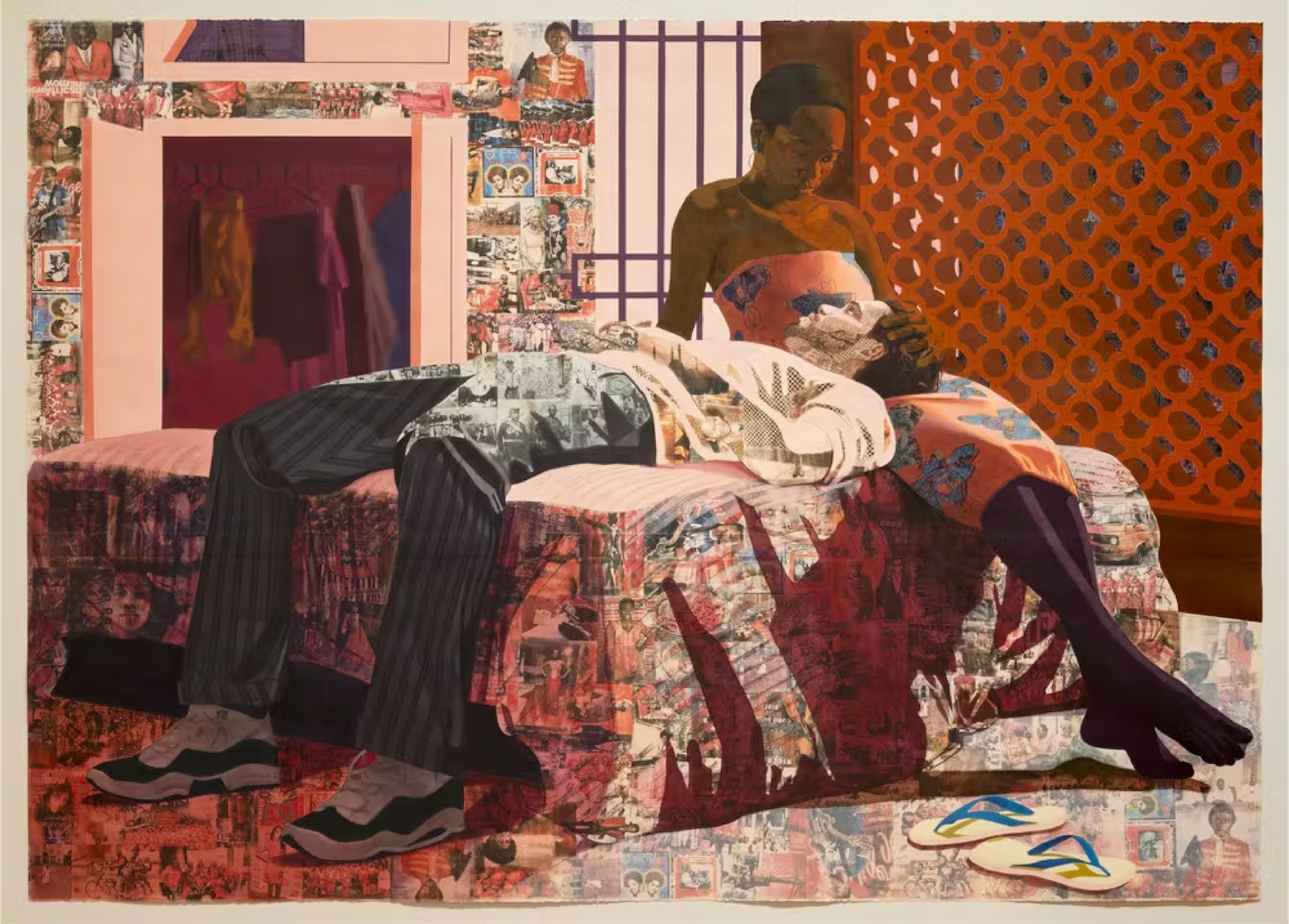
Take And We Begin to Let Go, now at MoMA. The museum notes that it depicts the artist with her husband leaning over her shoulder and that its making drew from Nigerian print media publications. That combination is characteristic. The image is intimate, but not sealed off from the wider media environment. Love appears inside circulation: circulation of images, of styles, of national reference, of racial meaning. Even tenderness, in her work, has a public dimension.
Or consider the Predecessors and Mother and Child works, where family lineage and maternal memory become explicit themes. The Met describes Mother and Child as shaped by two simultaneous facts of Akunyili Crosby’s life: she was expecting her first child and had recently lost her mother. That biographical intersection matters, but what makes the work powerful is how it transforms personal passage into visual complexity. Generations appear through image transfer, commemorative fabric, pose, and spatial layering. The painting does not narrate grief in a direct way. It materializes inheritance.
The domestic sphere, then, becomes a serious stage for historical thinking. In Akunyili Crosby’s hands, kitchens, parlors, living rooms, and bedrooms are places where colonial afterlives, gender roles, migration narratives, and middle-class aspirations all leave traces. Yet because she composes these scenes with so much visual pleasure, viewers are sometimes surprised by how much analytic density they carry. That surprise is part of the method. She understands that beauty can disarm, but she also knows it can dignify. Her paintings do not apologize for seducing the eye. They use seduction to make complexity unavoidable.
“The Beautyful Ones” and the future tense of portraiture
Among Akunyili Crosby’s most resonant bodies of work is The Beautyful Ones, an ongoing series of portraits of Nigerian children. The title references Ayi Kwei Armah’s 1968 novel The Beautyful Ones Are Not Yet Born, a classic of postcolonial African literature. That citation alone signals something important: Akunyili Crosby’s portraiture is never cut off from literary and political thought. The series has been described by the National Portrait Gallery in London and by Victoria Miro as comprising portraits of Nigerian children, including members of the artist’s family, derived from personal photographs and later from images made on visits to Nigeria.
These works are among her most moving because they combine formal control with a striking openness about futurity. Children in art are often made to bear symbolic burdens they did not choose. Akunyili Crosby handles that risk carefully. Her young subjects are not flattened into national allegory. They remain particular, stylish, self-possessed, and sometimes gloriously inscrutable. Yet the series undeniably asks what kind of future is being imagined for African children, and by whom. That question resonates even more strongly because the works refuse the familiar visual rhetoric of deprivation. These are portraits of presence, not rescue.
There is also a subtle temporal intelligence in the series. By using contemporary portraits while invoking a mid-century literary text, Akunyili Crosby folds generations together. The future is haunted by older hopes and disappointments. The child portrait becomes a site where private family memory and public postcolonial aspiration meet. That layered temporality runs through much of her work, but in The Beautyful Ones it becomes especially crisp. The series asks whether beauty can still carry political hope without becoming propaganda. Her answer seems to be yes, but only if beauty remains entangled with specificity.
Why critics and institutions responded so strongly
The rise of Akunyili Crosby’s reputation was not accidental, nor was it simply a market story, though the market certainly took notice. Museums and critics responded first to the uncommon rigor of the work. The Smithsonian jurors who awarded her the James Dicke prize described her paintings as reflecting the increasingly transnational nature of contemporary art and as sensitively negotiating the terrain between America and Nigeria. That language may sound institutional, but it points to a real achievement: Akunyili Crosby found a way to make transnational experience visible without cliché.
The MacArthur Foundation, in awarding her the fellowship in 2017, highlighted her visualization of globalization and transnational identity through works that layer paint, photographic imagery, prints, and collage. That recognition mattered not just because of the prestige, but because it positioned her as more than a rising star in the art market. It placed her in the category of a thinker making lasting contributions to cultural form. The MacArthur framing was especially important because it emphasized process and conceptual ambition rather than treating her work as merely fashionable figuration.
Writers outside the museum apparatus also grasped this. In The Guardian, Jason Farago named her among the best in American art in 2016, arguing that she had mapped a route to somewhere brave and important. In The Washington Post, Smee presented her as one of the most closely watched artists alive. These are not identical appraisals, but together they point to a shared recognition: Akunyili Crosby did not just arrive with technical talent. She arrived with a way of seeing that critics understood as newly consequential.
At the same time, Black media recognized the symbolic force of her ascent. Ebony covered her MacArthur award. The Root highlighted her ability to express the transnational experience through large-scale works built from layered materials. Those notices matter because they place her not only in the lineage of contemporary painting, but also in broader Black public culture, where questions of migration, identity, and representation have long carried special urgency.
The art market story, and its limits
It is impossible to write about Akunyili Crosby without mentioning the extraordinary speed with which the market embraced her work. By the late 2010s, her paintings were selling for millions at auction. Christie’s lists The Beautyful Ones at $4.74 million, and Sotheby’s reported a $3.375 million result for Bush Babies in 2018. She also became visible to a wider audience through the 2018 documentary The Price of Everything, which examines the contemporary art economy and its distortions.
“The millions matter less than the method. Njideka Akunyili Crosby slowed the eye down and made complexity look inevitable.”
This kind of market attention is double-edged. On one hand, it confirms institutional confidence and can materially support an artist’s practice. On the other, it creates pressures that are often especially intense for women artists and artists of color: pressure to produce, pressure to repeat what sells, pressure to become an emblem. Akunyili Crosby has been unusually clear, in interviews and through the pacing of her production, that she values slowness. That matters. Her work is labor-intensive, and its seriousness depends on resisting the logic of rapid extraction that the market often imposes.
There is also a broader structural issue here. When the art market rapidly elevates a Black artist, it often packages that ascent as proof of institutional progress. But commercial success is not the same thing as cultural justice. Akunyili Crosby’s importance does not come from high prices. It comes from what the work has made possible: richer conversations about diaspora, figuration, domesticity, and Black cosmopolitan life. The market can amplify that significance, but it can also distort it. To her credit, she has continued to make work that feels resistant to simplification even under intense demand.
A painter of diaspora, but not only that
Akunyili Crosby is frequently described as a diasporic artist, which is accurate, but incomplete. She is also an artist of composition, of chromatic restraint, of art-historical intelligence, of décor, of media archaeology, of portrait psychology. Her work speaks to migration, but it also speaks to the history of painting itself. Critics have noted echoes of European modernism and of artists such as Matisse, Bonnard, Manet, and even Vermeer, not as direct imitation but as compositional and atmospheric interlocutors. What she does with those histories is crucial. She enters the room of painting fully aware that Black women have often been excluded from its canonical center, and she responds not by asking permission, but by reorganizing the room.
That reorganization is formal as well as political. She takes conventions of interior painting, portraiture, and decorative surface and infuses them with transnational image culture. She treats photographic transfer not as a gimmick but as a way to think about how images travel and settle. She expands portraiture beyond the face into the domain of patterned environment. She uses paper at monumental scale, unsettling assumptions about medium hierarchy. Each of these decisions carries art-historical consequence.
This is why it would be a mistake to read her only through representation politics. Yes, she matters enormously as a Nigerian-born Black woman artist whose work entered major collections and reshaped visibility. But she also matters as a formal innovator. Her paintings are not important because they illustrate discourse. They are important because they generate it.
Motherhood, lineage, and the emotional architecture of later work
As her practice has matured, Akunyili Crosby’s work has deepened its engagement with family lineage and generational continuity. Mother and Child offers one clear example, with its fusion of mourning and expectancy. But more broadly, her later work seems increasingly interested in how identity is inherited through gesture, image, and domestic repetition. This does not mean her paintings have become less public. It means they have become even more precise about the ways public history enters the family.
There is a profound seriousness in the way she treats mothers, sisters, children, and spouses. She does not monumentalize them in the heroic sense. She lets them remain embedded in daily life. That choice can look quiet from a distance, but it is a major intervention in the history of portraiture, which has so often reserved grandeur for the powerful and the officially important. Akunyili Crosby redistributes grandeur. She locates it in kinship, in waiting, in sitting at the table, in being looked at without distortion.
What her work means now
It is tempting, when writing about living artists of Akunyili Crosby’s stature, to lean too heavily on coronation language: major, essential, definitive, canonical. Some of that language is earned here. Still, the better question is what her work means right now, in an era shaped by migration crises, resurgent nationalism, platform image overload, and increasingly commodified identity. Part of the answer is that she has offered an alternative model of how art can address these conditions without becoming didactic or disposable. Her paintings are deeply contemporary, but they do not feel trapped by the pace of the present. They slow time down. They ask viewers to inhabit layered attention.
They also make a broader claim about Black life and African modernity. Akunyili Crosby refuses the stale binary in which African subjects are represented either through ethnographic distance or through global-luxury abstraction. Her work understands cosmopolitanism from the inside. It shows that African modernity is not a derivative copy of Western forms, nor a sealed-off authenticity. It is lived, improvised, media-saturated, and self-aware. That insight places her in conversation with a larger field of artists, writers, and thinkers concerned with postcolonial subject formation, but she brings something especially potent to that conversation: she makes theory tactile.
Her significance, then, lies not only in being visible, decorated, and collected. It lies in having altered the visual grammar through which many viewers now understand diaspora and intimacy. Younger artists have already absorbed pieces of her achievement: the permission to make interiors politically charged without making them illustrative, the permission to braid photographic residue into figuration, the permission to claim decorative density as intellectual form. Akunyili Crosby’s paintings enlarged the field.
The lasting image
What lingers after spending time with Akunyili Crosby’s work is not one single motif, though doors, tables, textiles, and patterned walls recur. It is a feeling of density held in balance. Her pictures are full, but not crowded. They are intimate, but never small-minded. They are politically alert, but never reduced to messaging. They are exquisitely made, but not cold. That combination is rare. It helps explain why institutions trust the work, why critics keep returning to it, and why viewers often feel recognized by it even when the biographical details are not their own.
Njideka Akunyili Crosby’s art reminds us that identity is not a slogan and home is not a static location. Both are built, revised, and inhabited through images. In that sense, she is painting more than people or rooms. She is painting what it means to assemble a self from overlapping worlds without surrendering complexity. Few contemporary artists have done that with as much grace, intelligence, and formal authority. That is why her work matters. And that is why it will likely matter even more as time catches up with what she has already seen.
More great stories
Afro Sheen, Wall Street, and the Architecture of Black Possibility
July 6, 2026
No Comments
The Fire Inside the Fourth
July 5, 2026
No Comments