



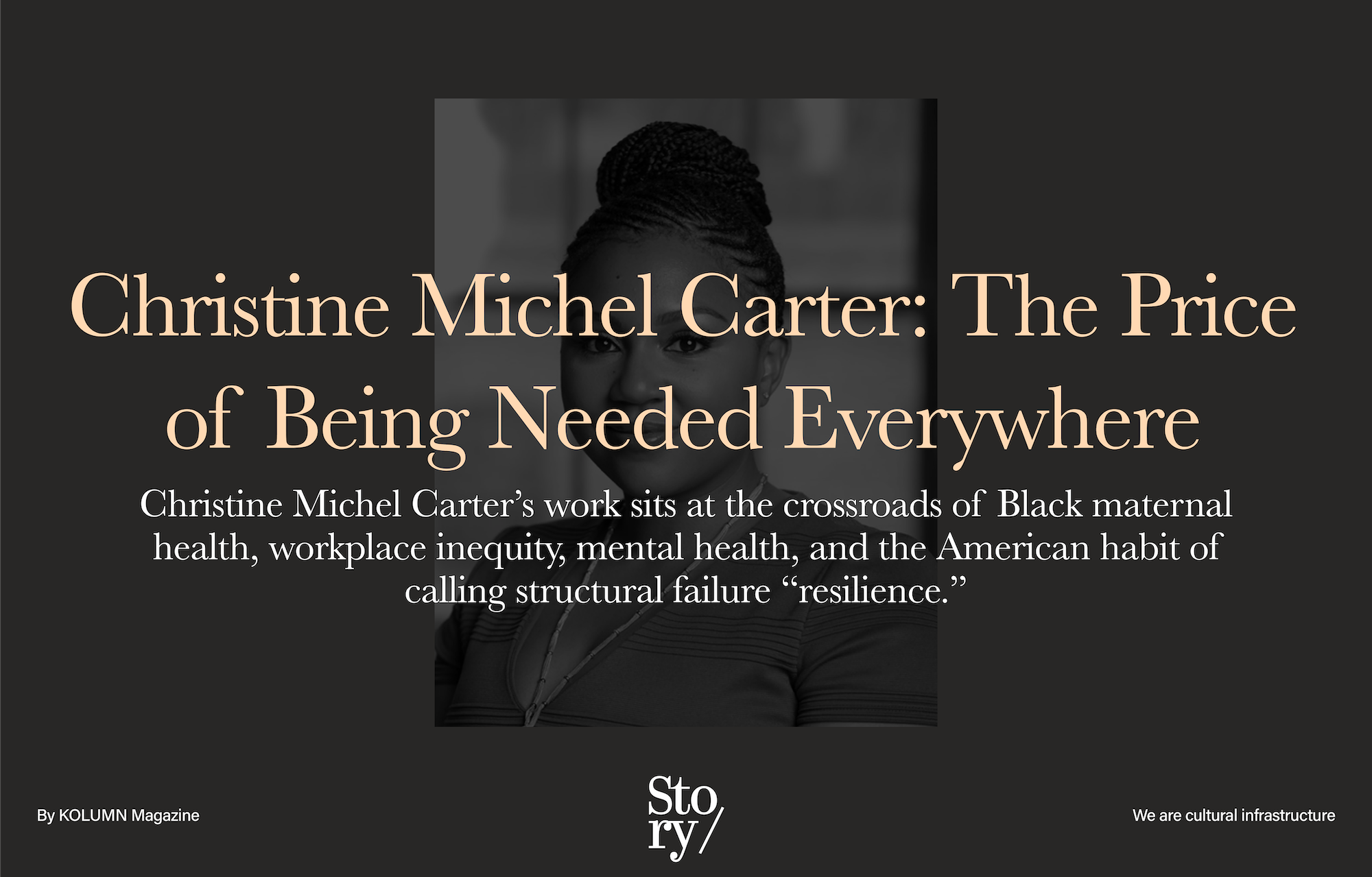
Christine Michel Carter’s work argues that motherhood is not a niche identity. It is one of the clearest ways to see how power operates.
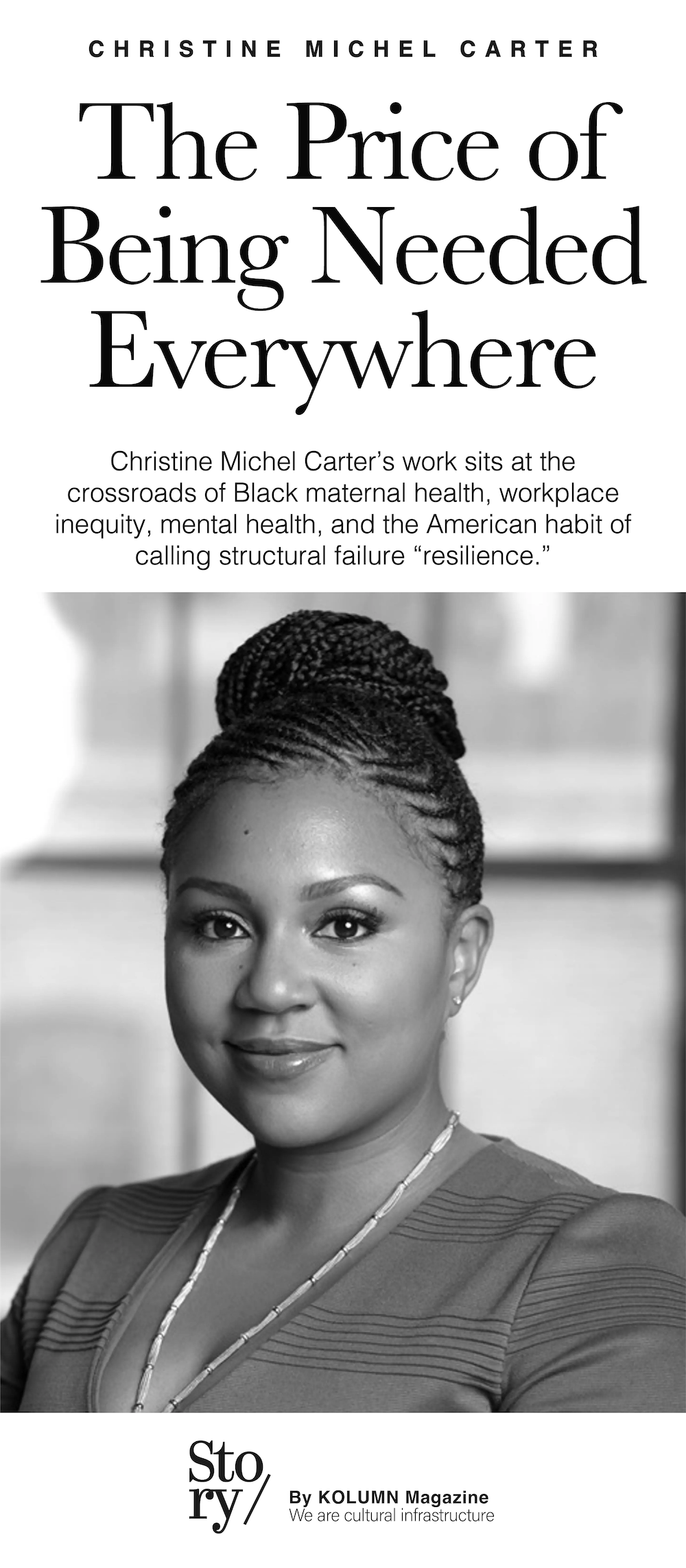
Christine Michel Carter’s work argues that motherhood is not a niche identity. It is one of the clearest ways to see how power operates.
By KOLUMN Magazine
Christine Michel Carter arrived through a sentence that refuses to behave itself. She is not best understood as a traditional movement leader with a single organization, a fixed ideological label, or a signature street action. She is better understood as a contemporary issue advocate who used the modern tools available to her — essays, interviews, social platforms, corporate speaking, journalism, and policy-adjacent storytelling — to force a cluster of subjects into public view: working motherhood, Black maternal health, pumping at work, postpartum strain, caregiver burnout, and the racialized costs of being expected to “do it all” with a smile.
That matters because Carter’s significance is not only in what she says, but in what she has helped normalize as sayable. For years, a huge amount of maternal labor in America has been discussed either sentimentally or administratively. The language tends to flatten women into symbols: “working moms,” “caregivers,” “women balancing it all.” Carter’s work has pushed in the other direction. In her writing for Forbes and Parents, in her books, and in the public profile she has built as an advocate for working mothers, she has insisted that motherhood is not a soft lifestyle category. It is an economic force, a workplace issue, a health issue, and for Black women in particular, often a site of systemic neglect.
Carter’s public résumé is unusually hybrid. She has been a Forbes contributor since 2016 and is described there as writing about health, work, and caregiving; her contributor page also notes that she ranks in the top 1 percent of authors on the platform by trending performance. Muck Rack describes her as a writer, speaker, and marketing strategist whose bylines have included ForbesWomen, TIME, Fast Company, Health, and Parents. General Assembly, where she has taught, presents her as a best-selling author and senior contributor whose writing has reached parents and working families in more than 150 countries.
Those descriptors can sound glossy, and glossy language is always worth approaching skeptically. But in Carter’s case, the breadth of the platform is part of the story. She is not merely a commentator floating around a topic. She has turned a professional life in marketing and media into a kind of bridge role: translating the experience of mothers, especially Black mothers and working mothers, to audiences that include parents, employers, policymakers, brands, and readers who may not have seen care work as structural until someone named it that way. That translation function is one reason she is worth taking seriously as an activist figure, even if “activist” here means a public advocate operating in the overlap of journalism, policy, and cultural critique rather than a picket line veteran.
From personal experience to public argument
One of the defining patterns in Carter’s career is that she does not separate autobiography from analysis as neatly as many institutional writers do. Instead, she often begins with something lived — postpartum alienation, pumping in an inadequate workplace setting, the psychic weight of parenting while employed, the social pressure placed on mothers to remain cheerful while overextended — and then widens the frame. That instinct is evident in the public descriptions of her work and in the recurring themes of her articles: burnout, unequal expectations, maternal mental health, workplace inequity, and the social architecture that turns those problems into private shame.
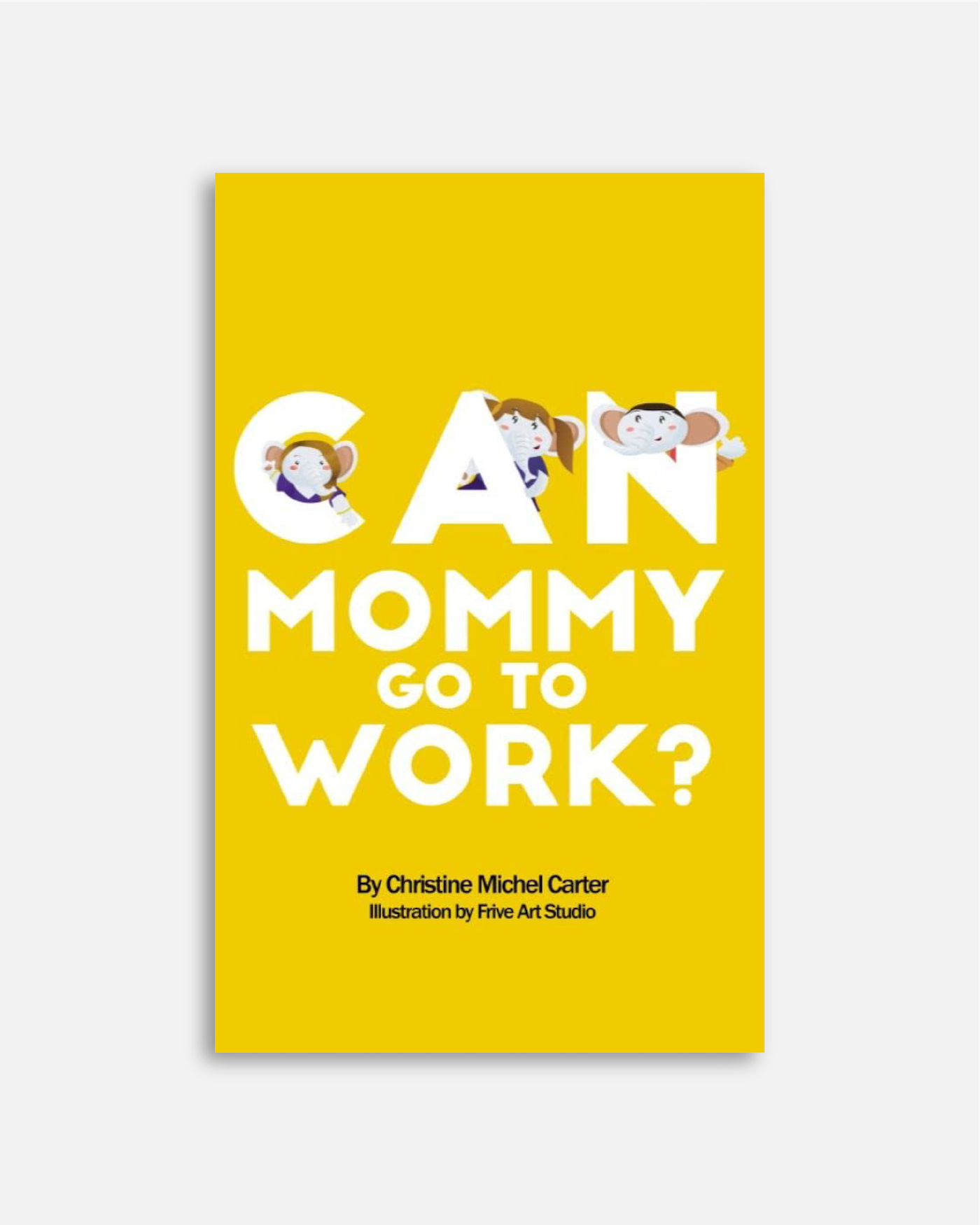
Her children’s book, Can Mommy Go To Work?, published in 2019, was born directly from that terrain. Google Books describes it as a book Carter wanted to write for mothers who struggled with work-life balance and felt guilty for wanting to further their careers. The book’s very premise is quietly political: it reframes maternal employment not as abandonment, but as a normal and loving part of family life. In a culture that still codes good motherhood as endless availability, that is not just an affirming bedtime message. It is an ideological intervention aimed at adults as much as children.
Her adult book, MOM AF, published the same year, was described by Bookshop as “a sister circle in a book,” inspired by both Carter’s life and her published articles. Even in that marketing language, you can hear the shape of the project: building a vocabulary for mothers who are tired of being managed as demographics and eager to be addressed as people. Carter’s appeal has always come partly from that tonal refusal. She is not interested in motherhood as pastel branding. She is interested in the unvarnished politics of it.
That willingness to speak plainly helped make her a recognizable voice in working-parent discourse. Parentaly describes her as a “true advocate for working parents,” noting that she has helped companies design mothers’ rooms, mentored others informally, and pursued transparency about the realities of being a working parent. In Parentaly’s framing, Carter’s day-to-day life and her advocacy are inseparable; she is presented as someone proving that a person can hold a job, parent children, and “fight social injustice simultaneously.” The phrase is slightly promotional, but it captures the central fact: her activism emerged not despite ordinary adult responsibilities, but through them.
That is also why her work lands with many readers who might never call themselves activists. Carter’s lane is not pure theory. It is materially specific. She talks about lactation rooms, return-to-work anxiety, career penalties, the emotional labor of explaining care needs, and the racial asymmetries that shape whose pain gets minimized. Those are not abstractions. They are daily frictions that, accumulated over years, form a political education.
The workplace as a site of struggle
Much of Carter’s public importance comes from how insistently she has treated the office — whether physical or remote — as a site where gender, race, and care collide. The standard American workplace still imagines an ideal worker who is endlessly available, minimally encumbered, and emotionally legible in ways that reward traditional masculinity. Mothers disrupt that fantasy simply by existing. Black mothers disrupt it further, because they are often navigating both maternal penalties and racialized expectations around competence, tone, and resilience. Carter has returned to that reality again and again.
Carter’s core argument is simple and destabilizing: care work is not outside the economy. It is what makes the economy possible.
The Harvard Business Review Working Parents series included a conversation with Carter titled “Returning to Work as a New Mother of Color.” That inclusion matters. HBR is not a marginal venue; it is management discourse. To appear there as a subject-matter expert is a sign that Carter’s concerns had moved from “mom content” into the bloodstream of business conversation. The topic itself is telling. Not just returning to work as a new mother, but as a new mother of color. The distinction acknowledges that maternal reentry is not evenly experienced and that race materially alters the terms of professional visibility.
Her Forbes work has hammered similar points from a journalistic angle. In 2020 she wrote about research showing that the coronavirus recession was disproportionately affecting Black working mothers. In 2024 she wrote that seven realities were redefining working motherhood, including high levels of burnout and inadequate mental health support. These are not random service pieces. They are part of a long-running attempt to make employers, media audiences, and policymakers confront the cost structure of modern family life.
One reason Carter’s arguments travel is that she speaks fluently to two audiences at once. She can talk like a parent to parents and like a strategist to institutions. That dual fluency is rare. Many writers can do one or the other. Carter’s work suggests that she understands the mechanics of messaging, audience segmentation, and corporate attention, and then uses those skills to make care legible in places that would otherwise treat it as personal background noise. Her teaching profile at General Assembly explicitly ties her public persona to expertise in both narrative and working-family issues.
There is activism in that choice. Not glamorous activism, not necessarily headline activism, but the kind that chips away at the cultural insulation protecting institutions from accountability. When Carter argues that employers must build real support structures for parents, or when she speaks about pumping, maternal mental health, or postpartum recovery as workplace concerns, she is contesting a longstanding American fiction: that paid work is the serious sphere and care is a private hobby women are supposed to manage invisibly.

Black maternal health, and the fight against polite silence
If workplace equity is one pillar of Carter’s advocacy, Black maternal health is another. It is here that her writing becomes especially forceful, because the stakes are not just advancement or burnout. They are survival, dignity, and the ability of Black women to move through pregnancy, birth, and postpartum life without being ignored by the systems supposed to care for them. Parents published her 2023 “An Open Letter to Black Birthing People During Black Maternal Health Week,” and the magazine’s description of the piece notes that Carter felt judged and alienated postpartum before becoming a maternal health advocate. In 2024, Parents also published her article arguing that the Black maternal health crisis is generations in the making.
That historical framing is important. Carter’s work on maternal health is not narrowly therapeutic. It is structural. The problem is not just that some women have bad experiences. The problem is that the country built a maternal care landscape in which Black women are more likely to be disbelieved, underserved, or harmed. Parents’ own coverage around the issue, including adjacent reporting, underscores the depth of those disparities. Carter’s contribution has been to explain them in public-facing language without diluting the severity of the crisis.
Secondary reporting has linked Carter’s advocacy to policy visibility. Her Agenda wrote in 2021 that her work on wellness legislation and maternal issues had drawn the attention of Vice President Kamala Harris and the U.S. Senate. SeekHer’s advisor page states that Carter has worked on Harris’s maternal initiatives and received a Congressional Citation recognizing her efforts to ensure Black moms and moms of color had access to important health information. While those descriptions come from supportive or affiliated contexts and should be read with that in mind, they still point to a real pattern: Carter’s voice has moved beyond lifestyle media and into policy-adjacent networks.
Her issue focus also aligns with organizations working at the intersection of policy and public education. Caring Across Generations named her to its Business Care Council when it launched that body in 2023, framing care work as what “makes all work possible” and arguing that workplaces are not built to support the care responsibilities many workers carry. SeekHer lists her among its council advisors, tying her advocacy to women’s mental health. These are not incidental affiliations. They place Carter inside an ecosystem of groups trying to move care from a private burden to a public priority.
That ecosystem matters because Carter’s activism has rarely been about claiming singular authorship over a cause. It is more coalition-oriented than that. She appears as a translator, amplifier, and public witness within broader campaigns around mental health, postpartum support, caregiver policy, and maternal equity. In a media culture that often prizes the solitary thought leader, there is something useful about that posture. It suggests an understanding that not every advocate must stand at the center of the frame to move the frame itself.
Care, race, and the refusal of the “supermom” myth
Another through line in Carter’s work is her hostility to the mythology that mothers, especially Black mothers, should absorb impossible strain without complaint. This is where her advocacy becomes as cultural as it is policy-driven. The burden is not only low support. It is also the story American culture tells about women who endure low support: that the admirable ones can somehow transmute exhaustion into elegance. Carter’s body of work has repeatedly attacked that script.
The “supermom” story flatters institutions by turning systemic neglect into personal virtue. Carter has spent years refusing that trade.
That attack is not stylistic. It is analytical. If mothers are rewarded for pretending everything is manageable, institutions have no incentive to change. If Black women are expected to be infinitely competent, then their requests for help can be interpreted as weakness rather than evidence of structural failure. Carter’s writing and speaking often pry open that contradiction. By describing the emotional and logistical realities of motherhood in direct, unsentimental terms, she makes it harder to romanticize what is, in many cases, a policy-made struggle.
There is a reason corporate audiences seek her out. According to SeekHer’s advisor page, employees have ranked her mental-health talk among the best corporate programming events of the year. Promotional language should always be discounted somewhat, but the claim points to something credible: employers increasingly understand that they need someone who can tell uncomfortable truths about parenthood in language that cuts through HR euphemism. Carter’s popularity in that lane reflects both institutional anxiety and institutional need. Companies know the old script is exhausted; many still do not know how to replace it.
Her popularity also reflects her ability to speak across registers. She can sound funny, outraged, strategic, and intimate in close succession. That tonal range is part of why audiences trust her. Muck Rack highlights not just her bylines but the subjects she returns to: working motherhood, the maternal wage gap, Black maternal health, and career planning for parents across life stages. Those are areas where sterile language often fails. Carter’s mode is to keep the analysis concrete enough that people can recognize themselves in it.
In that sense, she belongs to a lineage of Black women public thinkers who have had to do double labor: naming structural inequity while also translating it for audiences trained not to see it unless it arrives with narrative warmth. It is not that Carter invented this mode. It is that she has applied it effectively to 21st-century motherhood, where the battleground includes media brands, employer culture, digital influence, and public-health policy all at once.
A new kind of activist infrastructure
To understand Christine Michel Carter’s significance, it helps to see that her infrastructure is not built like old advocacy infrastructures. She does not rely on one institution, one title, or one publication. She is a writer, yes, but also a speaker, brand strategist, educator, and advisor. She has sat in spaces where culture, commerce, and policy brush against each other — and that has shaped the type of activism she practices.
That model has advantages and drawbacks. The advantage is reach. Carter can place a maternal-health argument in a parenting outlet, a caregiving argument in a business context, a workplace-equity point in a public talk, and a broader cultural critique in a media interview. She is not trapped in one silo. The drawback is that hybrid advocates are sometimes dismissed as insufficiently pure by every silo at once: too media-facing for movement spaces, too activist for traditional journalism, too blunt for corporate comfort, too institutionally legible for some grassroots sensibilities. Yet that same in-between quality may be exactly what makes her effective.
It also reflects how activism itself has changed. In the digital era, a lot of social influence is exercised through dispersed, cross-platform repetition rather than one definitive manifesto. Carter’s impact comes not from one canonical text but from accumulation: article after article, panel after panel, conversation after conversation, pushing the same broad claim that American systems exploit care while under-valuing caregivers. The message becomes difficult to ignore because it keeps appearing in places that were not always used to hearing it.
That is why the phrase “global voice for working moms,” which appears in several profiles, should be read not as a literal measurement but as evidence of how she has been positioned in the public sphere. It tells you that Carter has become, for many audiences, less a single writer than a recognizable node in a larger conversation. She is the person brought in when someone wants the unsoftened version of what motherhood costs.
The limits, and the real achievement
A fair profile should also note what Carter is not. She is not a household name on the scale of the biggest media celebrities. She has not built a mass-membership advocacy organization. And major legacy outlets have not profiled her as extensively as they have some other public voices in adjacent lanes. Part of the reporting challenge here is that Carter’s archive is spread across contributor pages, interviews, organizational bios, and issue-specific articles rather than a neat stack of establishment profiles. That diffuse visibility says something, too, about how women’s advocacy work is often covered: absorbed into issue coverage without always receiving biographical treatment of its own.
But that limitation does not reduce the achievement. If anything, it clarifies it. Carter built influence the hard way: not by waiting for institutions to anoint her, but by becoming too useful, too resonant, and too persistent to overlook. She made herself legible to parents who needed language, to employers who needed a wake-up call, and to public conversations that needed someone to connect motherhood to labor, race, and health without reducing any of those categories to cliché.
Her real significance lies there. Christine Michel Carter helped move working motherhood out of the realm of lifestyle chatter and into the realm of public consequence. She helped insist that the story of mothers in America is also a story about wages, workplace design, mental health, bodily autonomy, racial disparity, and the state’s selective indifference. She has treated those not as separate beats but as one braided reality. That is a meaningful form of activism, especially in an era when much of the fiercest public work happens through relentless explanation.
And perhaps that is the cleanest way to understand her career. Carter’s activism is not built on the fantasy that motherhood will someday be effortlessly respected. It is built on the harder premise that respect must be argued for, documented, repeated, and institutionalized. Over years of writing and advocacy, she has done exactly that. She has turned the supposedly private burdens of mothers into public evidence. She has asked employers and readers to see care not as a sentimental accessory to real life, but as one of the places where real life is most brutally organized. And in doing so, she has given modern motherhood something more durable than inspiration: she has given it political language.
More great stories

Afro Sheen, Wall Street, and the Architecture of Black Possibility
July 6, 2026
No Comments
The Fire Inside the Fourth
July 5, 2026
No Comments